 | Acta Crystallographica Section E Acta Crystallographica Section E CRYSTALLOGRAPHIC COMMUNICATIONS |


 journal menu


organic compounds
| CRYSTALLOGRAPHIC COMMUNICATIONS |
 access
N-(4-Bromophenyl)urea

aDepartment of Inorganic Chemistry, Faculty of Science, Charles University in Prague; Hlavova 2030, 12840 Prague 2, Czech Republic
*Correspondence e-mail: [email protected]
In the title compound, C7H7BrN2O, both the urea moiety [maximum deviation 0.003 (2) Å] and the benzene ring are essentially planar [maximum deviation 0.003 (2) Å] but are rotated with respect to each other by a dihedral angle of 47.8 (1)°. The crystal assembly is stabilized by N—H⋯O hydrogen bonds between all NH protons as conventional hydrogen bond donors and the C=O oxygen as a trifurcated hydrogen-bond acceptor. Both the overall molecular geometry and the crystal packing of the title compound are very similar to those of N-phenylurea, which is underscored by a practically isostructural relationship between these two urea derivatives.
Related literature
For the of N-phenylurea, see: Kashino & Haisa (1977![[Kashino, S. & Haisa, M. (1977). Acta Cryst. B33, 855-860.]](../../../../../../logos/arrows/e_arr.gif "Kashino, S. & Haisa, M. (1977). Acta Cryst. B33, 855-860.") ); Bott et al. (2000). For the crystal structure of N-(4-tolyl)urea, see: Ciajolo et al. (1982). For the structure of a molecular 1:1 adduct of N-(4-bromophenyl)urea with N-(4-bromophenyl)-2-{2-[2-(((4-bromophenyl)carbamoyl)amino)-2-oxoethyl]cyclohex-1-en-1-yl}-2-cyanoacetamide, see: Zhang et al. (2009).
); Bott et al. (2000). For the crystal structure of N-(4-tolyl)urea, see: Ciajolo et al. (1982). For the structure of a molecular 1:1 adduct of N-(4-bromophenyl)urea with N-(4-bromophenyl)-2-{2-[2-(((4-bromophenyl)carbamoyl)amino)-2-oxoethyl]cyclohex-1-en-1-yl}-2-cyanoacetamide, see: Zhang et al. (2009).
![[Scheme 1]](su2219scheme1.gif)
Experimental
Crystal data
|
| |||||||||||||||||||||||||||
 .
. Data collection: COLLECT (Nonius, 2000); cell refinement: HKL SCALEPACK (Otwinowski & Minor, 1997); data reduction: HKL DENZO (Otwinowski & Minor, 1997) and SCALEPACK; program(s) used to solve structure: SIR97 (Altomare et al., 1999); program(s) used to refine structure: SHELXL97 (Sheldrick, 2008); molecular graphics: PLATON (Spek, 2009); software used to prepare material for publication: PLATON.
Supporting information
contains datablocks I, global. DOI: https://doi.org/10.1107/S1600536810041735/su2219sup1.cif
Structure factors: contains datablock I. DOI: https://doi.org/10.1107/S1600536810041735/su2219Isup2.hkl
The title compound was obtained from the reaction of sodium cyanate with 4-bromoaniline as described in the literature (Pandeya et al., 2000), and was crystallized from hot 90% ethanol. 1H NMR (399.95 MHz, dmso-d6): δ 5.91 (s, 2H, NH2), 7.38 (s, 4H, C6H4), 8.66 (s, 1H, NH). 13C{1H} NMR (100.58 MHz, dmso-d6): δ 112.22 (Cipso of C6H4), 119.52 (2CH of C6H4), 131.18 (2CH of C6H4), 139.89 (Cipso of C6H4), 155.70 (C═O).
The C-bound H atoms were included in calculated positions and refined as riding atoms: C-H = 0.93 Å with Uiso(H) = 1.2Ueq(C). The NH and NH2 H-atoms were located in a difference and were refined as riding atoms with Uiso(H) = 1.2Ueq(N).
The title compound crystallized with the symmetry of the monoclinic P21. Its molecular structure (Fig. 1) compares well to those reported earlier for N-phenylurea (Kashino & Haisa 1977; Bott et al., 2000), N-(4-tolyl)urea (Ciajolo et al., 1982), and mainly to the structure of N-(4-bromophenyl)urea as recently established in the molecular adduct, N-(4-bromophenyl)-2-{2-[2-(((4-bromophenyl)carbamoyl)amino)-2-oxoethyl] cyclohex-1-en-1-yl}-2-cyanoacetamide–N-(4-bromophenyl)urea (1/1) (Zhang et al., 2009).
The four non-hydrogen atoms constituting the urea moiety in the title molecule are coplanar within 0.003 (2) Å, whilst the atoms forming the benzene ring (C1–C6) depart from their mean plane by only 0.002 (3) Å. The Br1 and N1 atoms are displaced from the latter plane by 0.016 (1) Å and 0.053 (2) Å, respectively. Whereas the bromine atoms binds symmetrically to the aromatic ring (the difference in the C(3/5)—C4—Br1 angles is less than 0.1 °), the C1—N1 bond connecting both functional parts is slightly twisted (cf. N1—C1—C2 = 121.5 (2) ° and N1—C1—C6 = 118.8 (3) °). More importantly, the benzene ring and the urea moiety are mutually rotated with a dihedral angle of their mean planes of 47.8 (1) °, which is considerably more than in the afore mentioned adduct (ca 16.5 °), but practically identical with the value reported for N-phenylurea [46.4 and 47.6 ° depending on the study (Kashino & Haisa, 1977; Bott et al., 2000)].
In the crystal, the individual molecules of N-(4-bromophenyl)urea associate predominantly by means of N—H···O hydrogen bonds (Table 1). However, because of the pronounced imbalance in the number of conventional hydrogen bond donors and acceptors, the carbonyl oxygen O1 behaves as a trifurcated hydrogen bond acceptor, interacting with two proximal molecules (Fig. 2a) related by elemental translation along the a-axis and a crystallographic twofold screw axis, respectively. This leads to the formation of layers oriented parallel to the ab plane (Fig. 2b). Notably, the same array is preserved also for N-phenylurea, resulting in similar metrical parameters and the same non-centrosymmetric For N-(4-tolyl)urea, on the other hand, similar hydrogen bonded layers related via a crystallographic inversion centre, leading to the P21/c and a doubling of the c axis length.
For the of N-phenylurea, see: Kashino & Haisa (1977); Bott et al. (2000). For the of N-(4-tolyl)urea, see: Ciajolo et al. (1982). For the structure of a molecular 1:1 adduct of N-(4-bromophenyl)urea with N-(4-bromophenyl)-2-{2-[2-(((4-bromophenyl)carbamoyl)amino)-2-oxoethyl]cyclohex-1-en-1-yl}-2-cyanoacetamide, see: Zhang et al. (2009).
Data collection: COLLECT (Nonius, 2000); cell HKL SCALEPACK (Otwinowski & Minor, 1997); data reduction: HKL DENZO and SCALEPACK (Otwinowski & Minor, 1997); program(s) used to solve structure: SIR97 (Altomare et al., 1999); program(s) used to refine structure: SHELXL97 (Sheldrick, 2008); molecular graphics: PLATON (Spek, 2009); software used to prepare material for publication: PLATON (Spek, 2009).
![[Figure 1]](./su2219fig1thm.gif) | Fig. 1. The molecular structure of the title molecule as viewed perpendicularly to the benzene ring. Displacement ellipsoids for the non-H atoms are shown at the 50% probability level. Hydrogen atoms are presented as spheres with an arbitrary radius. |
![[Figure 2]](./su2219fig2thm.gif) | Fig. 2. (a) Hydrogen bonds (dashed lines) generated by the molecules of the title compound (see Table 1 for details). (b) Section of the crystal array of the title compound as viewed along the b axis (hydrogen bonds are shown as dashed lines). |
| C7H7BrN2O | F(000) = 212 |
| Mr = 215.06 | Dx = 1.823 Mg m−3 |
| Monoclinic, P21 | Mo Kα radiation, λ = 0.71073 Å |
| Hall symbol: P 2yb | Cell parameters from 4819 reflections |
| a = 4.6033 (2) Å | θ = 1.0–27.5° |
| b = 5.3915 (2) Å | µ = 5.18 mm−1 |
| c = 15.9444 (8) Å | T = 150 K |
| β = 97.994 (3)° | Bar, colourless |
| V = 391.87 (3) Å3 | 0.40 × 0.20 × 0.20 mm |
| Z = 2 |
| Nonius KappaCCD diffractometer | 1771 independent reflections |
| Radiation source: fine-focus sealed tube | 1704 reflections with I > 2σ(I) |
| Horizontally mounted graphite crystal monochromator | Rint = 0.037 |
| Detector resolution: 9.091 pixels mm-1 | θmax = 27.5°, θmin = 2.6° |
| ω and φ scans to fill the Ewald sphere | h = −5→5 |
| Absorption correction: gaussian (Coppens, 1970) | k = −6→6 |
| Tmin = 0.247, Tmax = 0.475 | l = −20→20 |
| 5026 measured reflections |
| Refinement on F2 | Secondary atom site location: difference Fourier map |
| Least-squares matrix: full | Hydrogen site location: difference Fourier map |
| R[F2 > 2σ(F2)] = 0.023 | H-atom parameters constrained |
| wR(F2) = 0.056 | w = 1/[σ2(Fo2) + (0.0282P)2 + 0.0852P] where P = (Fo2 + 2Fc2)/3 |
| S = 1.05 | (Δ/σ)max = 0.001 |
| 1771 reflections | Δρmax = 0.30 e Å−3 |
| 103 parameters | Δρmin = −0.30 e Å−3 |
| 1 restraint | Absolute structure: Flack (1983), 792 Friedel pairs |
| Primary atom site location: structure-invariant direct methods | Absolute structure parameter: −0.010 (11) |
| C7H7BrN2O | V = 391.87 (3) Å3 |
| Mr = 215.06 | Z = 2 |
| Monoclinic, P21 | Mo Kα radiation |
| a = 4.6033 (2) Å | µ = 5.18 mm−1 |
| b = 5.3915 (2) Å | T = 150 K |
| c = 15.9444 (8) Å | 0.40 × 0.20 × 0.20 mm |
| β = 97.994 (3)° |
| Nonius KappaCCD diffractometer | 1771 independent reflections |
| Absorption correction: gaussian (Coppens, 1970) | 1704 reflections with I > 2σ(I) |
| Tmin = 0.247, Tmax = 0.475 | Rint = 0.037 |
| 5026 measured reflections |
| R[F2 > 2σ(F2)] = 0.023 | H-atom parameters constrained |
| wR(F2) = 0.056 | Δρmax = 0.30 e Å−3 |
| S = 1.05 | Δρmin = −0.30 e Å−3 |
| 1771 reflections | Absolute structure: Flack (1983), 792 Friedel pairs |
| 103 parameters | Absolute structure parameter: −0.010 (11) |
| 1 restraint |
Geometry. All e.s.d.'s (except the e.s.d. in the dihedral angle between two least-squares planes) are estimated using the full covariance matrix. The cell e.s.d.'s are taken into account individually in the estimation of e.s.d.'s in distances, angles and torsion angles; correlations between e.s.d.'s in cell parameters are only used when they are defined by crystal symmetry. An approximate (isotropic) treatment of cell e.s.d.'s is used for estimating e.s.d.'s involving least-squares planes. |
Refinement. Refinement of F2 against all diffractions. The weighted R-factor wR and goodness of fit S are based on F2, conventional R-factors R are based on F, with F set to zero for negative F2. The threshold expression of F2 > 2σ(F2) is used only for calculating R-factors(gt) etc. and is not relevant to the choice of reflections for refinement. R-factors based on F2 are statistically about twice as large as those based on F, and R- factors based on all data will be even larger. |
| x | y | z | Uiso*/Ueq | ||
| Br1 | 0.54956 (5) | 1.31775 (8) | 0.426555 (13) | 0.03508 (9) | |
| O1 | 0.4501 (4) | 0.5276 (3) | 0.08842 (11) | 0.0251 (4) | |
| N1 | 0.9049 (5) | 0.6438 (4) | 0.15212 (14) | 0.0268 (4) | |
| H1N | 1.1016 | 0.6285 | 0.1545 | 0.039 (9)* | |
| N2 | 0.8539 (5) | 0.3758 (4) | 0.03989 (15) | 0.0288 (6) | |
| H2N | 0.7282 | 0.3042 | −0.0015 | 0.042 (8)* | |
| H3N | 1.0526 | 0.3368 | 0.0491 | 0.046 (8)* | |
| C1 | 0.8105 (5) | 0.7986 (7) | 0.21549 (13) | 0.0240 (5) | |
| C2 | 0.5960 (6) | 0.9794 (5) | 0.19521 (16) | 0.0291 (6) | |
| H2 | 0.5049 | 0.9971 | 0.1397 | 0.035* | |
| C3 | 0.5192 (7) | 1.1329 (5) | 0.25844 (16) | 0.0313 (6) | |
| H3 | 0.3768 | 1.2546 | 0.2454 | 0.038* | |
| C4 | 0.6548 (6) | 1.1045 (5) | 0.34067 (16) | 0.0267 (5) | |
| C5 | 0.8670 (6) | 0.9267 (5) | 0.36161 (17) | 0.0316 (6) | |
| H5 | 0.9570 | 0.9095 | 0.4172 | 0.038* | |
| C6 | 0.9445 (6) | 0.7738 (5) | 0.29848 (16) | 0.0329 (7) | |
| H6 | 1.0880 | 0.6532 | 0.3119 | 0.039* | |
| C7 | 0.7229 (6) | 0.5154 (4) | 0.09379 (15) | 0.0219 (5) |
| U11 | U22 | U33 | U12 | U13 | U23 | |
| Br1 | 0.04673 (17) | 0.03249 (14) | 0.02688 (12) | 0.00234 (17) | 0.00808 (9) | −0.00465 (14) |
| O1 | 0.0148 (9) | 0.0297 (10) | 0.0307 (9) | 0.0013 (7) | 0.0031 (7) | −0.0010 (7) |
| N1 | 0.0152 (11) | 0.0337 (11) | 0.0315 (11) | 0.0002 (8) | 0.0035 (8) | −0.0076 (9) |
| N2 | 0.0182 (10) | 0.0353 (16) | 0.0335 (11) | −0.0008 (9) | 0.0057 (9) | −0.0104 (9) |
| C1 | 0.0215 (11) | 0.0243 (13) | 0.0269 (10) | −0.0023 (14) | 0.0063 (8) | −0.0016 (13) |
| C2 | 0.0344 (15) | 0.0267 (13) | 0.0253 (12) | 0.0053 (11) | 0.0013 (10) | 0.0022 (10) |
| C3 | 0.0391 (16) | 0.0250 (12) | 0.0299 (13) | 0.0075 (12) | 0.0051 (12) | 0.0010 (11) |
| C4 | 0.0304 (14) | 0.0250 (12) | 0.0263 (12) | −0.0044 (11) | 0.0092 (11) | −0.0033 (10) |
| C5 | 0.0319 (15) | 0.0357 (12) | 0.0256 (12) | 0.0017 (12) | −0.0018 (11) | 0.0001 (10) |
| C6 | 0.0268 (13) | 0.037 (2) | 0.0330 (12) | 0.0058 (12) | −0.0016 (10) | −0.0023 (11) |
| C7 | 0.0189 (12) | 0.0221 (11) | 0.0246 (11) | 0.0009 (9) | 0.0025 (9) | 0.0012 (9) |
| Br1—C4 | 1.901 (2) | C1—C2 | 1.393 (4) |
| O1—C7 | 1.249 (3) | C2—C3 | 1.388 (4) |
| N1—C7 | 1.353 (3) | C2—H2 | 0.9300 |
| N1—C1 | 1.424 (4) | C3—C4 | 1.380 (4) |
| N1—H1N | 0.9044 | C3—H3 | 0.9300 |
| N2—C7 | 1.346 (3) | C4—C5 | 1.376 (4) |
| N2—H2N | 0.9014 | C5—C6 | 1.386 (4) |
| N2—H3N | 0.9301 | C5—H5 | 0.9300 |
| C1—C6 | 1.386 (3) | C6—H6 | 0.9300 |
| C7—N1—C1 | 124.5 (2) | C2—C3—H3 | 120.1 |
| C7—N1—H1N | 120.2 | C5—C4—C3 | 121.3 (2) |
| C1—N1—H1N | 115.2 | C5—C4—Br1 | 119.3 (2) |
| C7—N2—H2N | 114.1 | C3—C4—Br1 | 119.37 (19) |
| C7—N2—H3N | 122.9 | C4—C5—C6 | 118.9 (2) |
| H2N—N2—H3N | 122.4 | C4—C5—H5 | 120.5 |
| C6—C1—C2 | 119.7 (3) | C6—C5—H5 | 120.5 |
| C6—C1—N1 | 118.8 (3) | C5—C6—C1 | 120.7 (3) |
| C2—C1—N1 | 121.4 (2) | C5—C6—H6 | 119.7 |
| C3—C2—C1 | 119.5 (2) | C1—C6—H6 | 119.7 |
| C3—C2—H2 | 120.2 | O1—C7—N2 | 121.4 (2) |
| C1—C2—H2 | 120.2 | O1—C7—N1 | 122.8 (2) |
| C4—C3—C2 | 119.8 (2) | N2—C7—N1 | 115.8 (2) |
| C4—C3—H3 | 120.1 | ||
| C7—N1—C1—C6 | 132.2 (3) | C3—C4—C5—C6 | −0.1 (4) |
| C7—N1—C1—C2 | −50.3 (4) | Br1—C4—C5—C6 | −179.3 (2) |
| C6—C1—C2—C3 | 0.1 (4) | C4—C5—C6—C1 | −0.1 (4) |
| N1—C1—C2—C3 | −177.4 (3) | C2—C1—C6—C5 | 0.1 (4) |
| C1—C2—C3—C4 | −0.3 (4) | N1—C1—C6—C5 | 177.6 (3) |
| C2—C3—C4—C5 | 0.3 (4) | C1—N1—C7—O1 | 2.4 (4) |
| C2—C3—C4—Br1 | 179.5 (2) | C1—N1—C7—N2 | −179.0 (3) |
| D—H···A | D—H | H···A | D···A | D—H···A |
| N1—H1N···O1i | 0.90 | 2.11 | 2.904 (3) | 146 |
| N2—H2N···O1ii | 0.90 | 2.12 | 2.979 (3) | 158 |
| N2—H3N···O1i | 0.93 | 2.12 | 2.865 (3) | 137 |
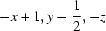
| Symmetry codes: (i) x+1, y, z; (ii) −x+1, y−1/2, −z. |
Experimental details
| Crystal data | |
| Chemical formula | C7H7BrN2O |
| Mr | 215.06 |
| Crystal system, space group | Monoclinic, P21 |
| Temperature (K) | 150 |
| a, b, c (Å) | 4.6033 (2), 5.3915 (2), 15.9444 (8) |
| β (°) | 97.994 (3) |
| V (Å3) | 391.87 (3) |
| Z | 2 |
| Radiation type | Mo Kα |
| µ (mm−1) | 5.18 |
| Crystal size (mm) | 0.40 × 0.20 × 0.20 |
| Data collection | |
| Diffractometer | Nonius KappaCCD |
| Absorption correction | Gaussian (Coppens, 1970) |
| Tmin, Tmax | 0.247, 0.475 |
| No. of measured, independent and observed [I > 2σ(I)] reflections | 5026, 1771, 1704 |
| Rint | 0.037 |
| (sin θ/λ)max (Å−1) | 0.649 |
| Refinement | |
| R[F2 > 2σ(F2)], wR(F2), S | 0.023, 0.056, 1.05 |
| No. of reflections | 1771 |
| No. of parameters | 103 |
| No. of restraints | 1 |
| H-atom treatment | H-atom parameters constrained |
| Δρmax, Δρmin (e Å−3) | 0.30, −0.30 |
| Absolute structure | Flack (1983), 792 Friedel pairs |
| Absolute structure parameter | −0.010 (11) |
Computer programs: COLLECT (Nonius, 2000), HKL SCALEPACK (Otwinowski & Minor, 1997), HKL DENZO and SCALEPACK (Otwinowski & Minor, 1997), SIR97 (Altomare et al., 1999), SHELXL97 (Sheldrick, 2008), PLATON (Spek, 2009).
| D—H···A | D—H | H···A | D···A | D—H···A |
| N1—H1N···O1i | 0.90 | 2.11 | 2.904 (3) | 146 |
| N2—H2N···O1ii | 0.90 | 2.12 | 2.979 (3) | 158 |
| N2—H3N···O1i | 0.93 | 2.12 | 2.865 (3) | 137 |
| Symmetry codes: (i) x+1, y, z; (ii) −x+1, y−1/2, −z. |
Acknowledgements
Financial support from the Ministry of Education of the Czech Republic (project No. MSM0021620857) is gratefully acknowledged.
References
 Altomare, A., Burla, M. C., Camalli, M., Cascarano, G. L., Giacovazzo, C., Guagliardi, A., Moliterni, A. G. G., Polidori, G. & Spagna, R. (1999). J. Appl. Cryst. 32, 115–119. Web of Science CrossRef CAS IUCr Journals Google Scholar
Bott, R. C., Smith, G., Wermuth, U. D. & Dwyer, N. C. (2000). Aust. J. Chem. 53, 767–777. Web of Science CSD CrossRef CAS Google Scholar
Ciajolo, M. R., Lelj, F., Tancredi, T., Temussi, P. A. & Tuzi, A. (1982). Acta Cryst. B38, 2928–2930. CSD CrossRef CAS Web of Science IUCr Journals Google Scholar
Coppens, P. (1970). Crystallographic Computing, edited by F. R. Ahmed, S. R. Hall & C. P. Huber, pp. 255–270. Copenhagen: Munksgaard. Google Scholar
Flack, H. D. (1983). Acta Cryst. A39, 876–881. CrossRef CAS Web of Science IUCr Journals Google Scholar
Kashino, S. & Haisa, M. (1977). Acta Cryst. B33, 855–860. CSD CrossRef CAS IUCr Journals Web of Science Google Scholar
Nonius (2000). Collect program suite. Nonius BV, Delft, The Netherlands. Google Scholar
Otwinowski, Z. & Minor, W. (1997). Methods in Enzymology, Vol. 276, Macromolecular Crystallography, Part A, edited by C. W. Carter Jr & R. M. Sweet, pp. 307–326. New York: Academic Press. Google Scholar
Sheldrick, G. M. (2008). Acta Cryst. A64, 112–122. Web of Science CrossRef CAS IUCr Journals Google Scholar
Spek, A. L. (2009). Acta Cryst. D65, 148–155. Web of Science CrossRef CAS IUCr Journals Google Scholar
Zhang, H.-J., Meng, T., Demerseman, B., Bruneau, C. & Xi, Z. (2009). Org. Lett. 11, 4458–4461. Web of Science CSD CrossRef PubMed CAS Google Scholar
This is an open-access article distributed under the terms of the Creative Commons Attribution (CC-BY) Licence, which permits unrestricted use, distribution, and reproduction in any medium, provided the original authors and source are cited.
| CRYSTALLOGRAPHIC COMMUNICATIONS |


The title compound crystallized with the symmetry of the monoclinic space group P21. Its molecular structure (Fig. 1) compares well to those reported earlier for N-phenylurea (Kashino & Haisa 1977; Bott et al., 2000), N-(4-tolyl)urea (Ciajolo et al., 1982), and mainly to the structure of N-(4-bromophenyl)urea as recently established in the molecular adduct, N-(4-bromophenyl)-2-{2-[2-(((4-bromophenyl)carbamoyl)amino)-2-oxoethyl] cyclohex-1-en-1-yl}-2-cyanoacetamide–N-(4-bromophenyl)urea (1/1) (Zhang et al., 2009).
The four non-hydrogen atoms constituting the urea moiety in the title molecule are coplanar within 0.003 (2) Å, whilst the atoms forming the benzene ring (C1–C6) depart from their mean plane by only 0.002 (3) Å. The Br1 and N1 atoms are displaced from the latter plane by 0.016 (1) Å and 0.053 (2) Å, respectively. Whereas the bromine atoms binds symmetrically to the aromatic ring (the difference in the C(3/5)—C4—Br1 angles is less than 0.1 °), the C1—N1 bond connecting both functional parts is slightly twisted (cf. N1—C1—C2 = 121.5 (2) ° and N1—C1—C6 = 118.8 (3) °). More importantly, the benzene ring and the urea moiety are mutually rotated with a dihedral angle of their mean planes of 47.8 (1) °, which is considerably more than in the afore mentioned adduct (ca 16.5 °), but practically identical with the value reported for N-phenylurea [46.4 and 47.6 ° depending on the study (Kashino & Haisa, 1977; Bott et al., 2000)].
In the crystal, the individual molecules of N-(4-bromophenyl)urea associate predominantly by means of N—H···O hydrogen bonds (Table 1). However, because of the pronounced imbalance in the number of conventional hydrogen bond donors and acceptors, the carbonyl oxygen O1 behaves as a trifurcated hydrogen bond acceptor, interacting with two proximal molecules (Fig. 2a) related by elemental translation along the a-axis and a crystallographic twofold screw axis, respectively. This leads to the formation of layers oriented parallel to the ab plane (Fig. 2b). Notably, the same array is preserved also for N-phenylurea, resulting in similar metrical parameters and the same non-centrosymmetric space group. For N-(4-tolyl)urea, on the other hand, similar hydrogen bonded layers related via a crystallographic inversion centre, leading to the space group P21/c and a doubling of the c axis length.