 | Acta Crystallographica Section E Acta Crystallographica Section E CRYSTALLOGRAPHIC COMMUNICATIONS |


 journal menu


metal-organic compounds
| CRYSTALLOGRAPHIC COMMUNICATIONS |
 access
Hexaaquanickel(II) 4,4′-(1,2-dihydroxyethane-1,2-diyl)dibenzoate monohydrate

aCollege of Food Science and Technology, Guangdong Ocean University, Zhanjiang 524088, People's Republic of China, bCollege of Science, Guangdong Ocean University, Zhanjiang 524088, People's Republic of China, and cCollege of Agriculture, Guang Dong Ocean University, Zhanjiang 524088, People's Republic of China
*Correspondence e-mail: [email protected]
In the title compound, [Ni(H2O)6](C16H12O6)·H2O, the NiII cation is located on a mirror plane and is coordinated by six water molecules, two of which are also located on the mirror plane, in a distorted octahedral geometry. The 4,4′-(1,2-dihydroxyethane-1,2-diyl)dibenzoate anion is centrosymmetric with the mid-point of the central ethane C—C bond located on an inversion center. The uncoordinated water molecule is located on a mirror plane. Extensive O—H⋯O hydrogen bonding is present in the crystal structure.
Related literature
For metal-organic networks constructed from benzene–multicarboxylate ligands, see: Wisser et al. (2008![[Wisser, B., Chamayou, A. C., Miller, R., Scherer, W. & Janiak, C. (2008). CrystEngComm, 10, 461-466.]](../../../../../../logos/arrows/e_arr.gif "Wisser, B., Chamayou, A. C., Miller, R., Scherer, W. & Janiak, C. (2008). CrystEngComm, 10, 461-466.") ); Sun et al. (2006); Janiak (2003). For structures incorporating benzene-1,4-dicarboxylate, see: Carton et al. (2007); Manna et al. (2007); Banerjee et al. (2005).
); Sun et al. (2006); Janiak (2003). For structures incorporating benzene-1,4-dicarboxylate, see: Carton et al. (2007); Manna et al. (2007); Banerjee et al. (2005).
![[Scheme 1]](xu5046scheme1.gif)
Experimental
Crystal data
|
Refinement
|
|
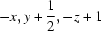 .
. Data collection: RAPID-AUTO (Rigaku, 1998); cell refinement: RAPID-AUTO; data reduction: CrystalStructure (Rigaku/MSC, 2002); program(s) used to solve structure: SHELXS97 (Sheldrick, 2008); program(s) used to refine structure: SHELXL97 (Sheldrick, 2008); molecular graphics: ORTEPII (Johnson, 1976); software used to prepare material for publication: SHELXL97.
Supporting information
contains datablocks I, global. DOI: https://doi.org/10.1107/S1600536810039917/xu5046sup1.cif
Structure factors: contains datablock I. DOI: https://doi.org/10.1107/S1600536810039917/xu5046Isup2.hkl
A solution of 4,4'-(1,2-dihydroxyethane-1,2-diyl)dibenzoic acid (0.5 mol, 0.15 g) and Ni(NO3)2 (0.5 mol, 0.14 g) and 20 ml water was stirred continuously, whose pH was adjusted to 7 by the addition of NaOH solution. The solution was then sealed in an autoclave equipped with a Teflon liner (20 ml) and heated at 373 K for 4 days. Crystals of the title compound were obtained by slow evaporation at room temperature.
H atoms bound to C atoms were placed at calculated positions and were treated as riding on the parent atoms with C—H = 0.93 Å (aromatic) and 0.98 Å (CH) and with Uiso(H) = 1.2 Ueq(C). H atoms of hydroxyl group and water molecules were located in a difference Fourier map and refined as riding with O—H = 0.85+_0.01 Å and Uiso(H) = 1.5Ueq(O) for water O atoms and O—H = 0.89±0.01 Å and 1.2 Ueq(O) for hydroxyl.
Metal-organic networks constructed by benzene-multicarboxylato ligands, have attracted a great deal of recent interest (Wisser et al., 2008; Sun et al., 2006; Janiak et al., 2003). Benzene-1,4-dicarboxylate with a 180° angle between the two carboxylic groups, can form short bridges via one carboxylato end and long bridges via the benzene ring, leading to a great variety of novel structures (Carton et al., 2007; Manna et al., 2007; Banerjee et al., 2005). Considering that in mind, our group select a derivative of the benzene-1,4-dicarboxylate named 4,4'-(1,2-dihydroxyethane-1,2-diyl)dibenzoate to react with Ni(NO3)2 to obtain novel metal-organic complex.
In figure 1, the title compound (C16H12O6)[Ni6H2O].H2O is obtained under hydrothermal condition, which comprises one 4,4'-(1,2-dihydroxyethane-1,2 -diyl)dibenzoate anion, one [Ni6H2O]2+ cation and a solvent water molecule, of which the [Ni6H2O]2+ cation and solvent water is lying on mirror planes, and the anion is locating on an inversion center. the two carboxyl groups of the ligand are total deprotonated, indicated by a difference of the bond lengths, which are also lying in the plane of the benzene rings. and the NiII center is coordinated by six water molecules instead of the 4,4'-(1,2-dihydroxyethane- 1,2-diyl)dibenzoate ligand. the O—H···O hydrogen bonding interactions between the carboxyl and hydroxyl of the ligands build an infinite chain along a axis. the chains, [Ni6H2O]2+ cations and solvent water molecules was further linked by additional O—H···O hydrogen bonds, forming a three-dimensional network.
For metal-organic networks constructed from benzene–multicarboxylate ligands, see: Wisser et al. (2008); Sun et al. (2006); Janiak (2003). For structures incorporating benzene-1,4-dicarboxylate, see: Carton et al. (2007); Manna et al. (2007); Banerjee et al. (2005).
Data collection: RAPID-AUTO (Rigaku, 1998); cell RAPID-AUTO (Rigaku, 1998); data reduction: CrystalStructure (Rigaku/MSC, 2002); program(s) used to solve structure: SHELXS97 (Sheldrick, 2008); program(s) used to refine structure: SHELXL97 (Sheldrick, 2008); molecular graphics: ORTEPII (Johnson, 1976); software used to prepare material for publication: SHELXL97 (Sheldrick, 2008).
![[Figure 1]](./xu5046fig1thm.gif) | Fig. 1. The title compound, with the atom-numbering scheme. Non-H atoms are shown with 30% probability displacement ellipsoids (H atoms are represented by arbitrary spheres). [Symmetry codes: (i) -x, -y, -z; (ii) x, 0.5 - y, z.] |
![[Figure 2]](./xu5046fig2thm.gif) | Fig. 2. The packing and hydrogen bonding of the title compound. |
| [Ni(H2O)6](C16H12O6)·H2O | F(000) = 508 |
| Mr = 485.08 | Dx = 1.567 Mg m−3 |
| Monoclinic, P21/m | Mo Kα radiation, λ = 0.71073 Å |
| Hall symbol: -P 2yb | Cell parameters from 3600 reflections |
| a = 6.0189 (12) Å | θ = 1.4–28° |
| b = 20.436 (4) Å | µ = 1.01 mm−1 |
| c = 8.6096 (17) Å | T = 293 K |
| β = 103.95 (3)° | Block, green |
| V = 1027.8 (4) Å3 | 0.30 × 0.25 × 0.21 mm |
| Z = 2 |
| Rigaku/MSC Mercury CCD diffractometer | 2120 independent reflections |
| Radiation source: fine-focus sealed tube | 2024 reflections with I > 2σ(I) |
| Graphite monochromator | Rint = 0.036 |
| ω scans | θmax = 26.2°, θmin = 3.2° |
| Absorption correction: multi-scan (REQAB; Jacobson, 1998) | h = −7→7 |
| Tmin = 0.751, Tmax = 0.816 | k = −25→25 |
| 9071 measured reflections | l = −10→9 |
| Refinement on F2 | Primary atom site location: structure-invariant direct methods |
| Least-squares matrix: full | Secondary atom site location: difference Fourier map |
| R[F2 > 2σ(F2)] = 0.071 | Hydrogen site location: inferred from neighbouring sites |
| wR(F2) = 0.184 | H-atom parameters constrained |
| S = 1.03 | w = 1/[σ2(Fo2) + (0.040P)2 + 10.P] where P = (Fo2 + 2Fc2)/3 |
| 2120 reflections | (Δ/σ)max < 0.001 |
| 142 parameters | Δρmax = 0.56 e Å−3 |
| 0 restraints | Δρmin = −0.54 e Å−3 |
| [Ni(H2O)6](C16H12O6)·H2O | V = 1027.8 (4) Å3 |
| Mr = 485.08 | Z = 2 |
| Monoclinic, P21/m | Mo Kα radiation |
| a = 6.0189 (12) Å | µ = 1.01 mm−1 |
| b = 20.436 (4) Å | T = 293 K |
| c = 8.6096 (17) Å | 0.30 × 0.25 × 0.21 mm |
| β = 103.95 (3)° |
| Rigaku/MSC Mercury CCD diffractometer | 2120 independent reflections |
| Absorption correction: multi-scan (REQAB; Jacobson, 1998) | 2024 reflections with I > 2σ(I) |
| Tmin = 0.751, Tmax = 0.816 | Rint = 0.036 |
| 9071 measured reflections |
| R[F2 > 2σ(F2)] = 0.071 | 0 restraints |
| wR(F2) = 0.184 | H-atom parameters constrained |
| S = 1.03 | Δρmax = 0.56 e Å−3 |
| 2120 reflections | Δρmin = −0.54 e Å−3 |
| 142 parameters |
Geometry. All e.s.d.'s (except the e.s.d. in the dihedral angle between two l.s. planes) are estimated using the full covariance matrix. The cell e.s.d.'s are taken into account individually in the estimation of e.s.d.'s in distances, angles and torsion angles; correlations between e.s.d.'s in cell parameters are only used when they are defined by crystal symmetry. An approximate (isotropic) treatment of cell e.s.d.'s is used for estimating e.s.d.'s involving l.s. planes. |
Refinement. Refinement of F2 against ALL reflections. The weighted R-factor wR and goodness of fit S are based on F2, conventional R-factors R are based on F, with F set to zero for negative F2. The threshold expression of F2 > σ(F2) is used only for calculating R-factors(gt) etc. and is not relevant to the choice of reflections for refinement. R-factors based on F2 are statistically about twice as large as those based on F, and R- factors based on ALL data will be even larger. |
| x | y | z | Uiso*/Ueq | ||
| Ni1 | 0.14235 (16) | 0.2500 | 0.95708 (11) | 0.0242 (3) | |
| O1W | −0.2105 (8) | 0.2500 | 0.8578 (6) | 0.0279 (11) | |
| H1W | −0.2488 | 0.2152 | 0.8065 | 0.042* | |
| O2W | 0.1795 (7) | 0.1762 (3) | 0.8058 (6) | 0.0555 (14) | |
| H3W | 0.2947 | 0.1584 | 0.7850 | 0.083* | |
| H4W | 0.0631 | 0.1713 | 0.7301 | 0.083* | |
| O3W | 0.4872 (10) | 0.2500 | 1.0567 (7) | 0.0504 (18) | |
| H5W | 0.5246 | 0.2500 | 1.1572 | 0.076* | |
| H6W | 0.6021 | 0.2500 | 1.0175 | 0.076* | |
| O4W | 0.0917 (8) | 0.3180 (2) | 1.1214 (5) | 0.0439 (11) | |
| H7W | 0.0201 | 0.3101 | 1.1918 | 0.066* | |
| H8W | 0.0439 | 0.3509 | 1.0647 | 0.066* | |
| O1 | 0.5811 (7) | 0.1431 (2) | 0.7095 (5) | 0.0438 (11) | |
| O2 | 0.8274 (7) | 0.1532 (3) | 0.5570 (6) | 0.0559 (14) | |
| O3 | 0.1710 (8) | −0.0731 (2) | 0.0238 (6) | 0.0478 (12) | |
| H10 | 0.2666 | −0.0921 | 0.1056 | 0.072* | |
| C1 | 0.6426 (10) | 0.1337 (3) | 0.5802 (8) | 0.0404 (15) | |
| C2 | 0.4864 (9) | 0.0953 (3) | 0.4462 (7) | 0.0352 (13) | |
| C3 | 0.2822 (10) | 0.0692 (3) | 0.4681 (8) | 0.0401 (14) | |
| H1 | 0.2394 | 0.0765 | 0.5635 | 0.048* | |
| C4 | 0.1421 (10) | 0.0323 (3) | 0.3473 (7) | 0.0397 (14) | |
| H2 | 0.0051 | 0.0155 | 0.3621 | 0.048* | |
| C5 | 0.2046 (10) | 0.0205 (3) | 0.2063 (7) | 0.0364 (14) | |
| C6 | 0.5483 (10) | 0.0834 (3) | 0.3050 (8) | 0.0416 (15) | |
| H4 | 0.6852 | 0.1004 | 0.2903 | 0.050* | |
| C7 | 0.4090 (11) | 0.0465 (3) | 0.1839 (8) | 0.0432 (15) | |
| H3 | 0.4520 | 0.0392 | 0.0886 | 0.052* | |
| C8 | 0.0514 (10) | −0.0204 (3) | 0.0746 (7) | 0.0389 (14) | |
| H9 | −0.0740 | −0.0384 | 0.1158 | 0.047* | |
| O5W | 0.8270 (14) | 0.2500 | 0.3307 (9) | 0.097 (4) | |
| H9W | 0.8455 | 0.2192 | 0.3971 | 0.145* |
| U11 | U22 | U33 | U12 | U13 | U23 | |
| Ni1 | 0.0219 (5) | 0.0290 (5) | 0.0213 (5) | 0.000 | 0.0045 (3) | 0.000 |
| O1W | 0.024 (2) | 0.026 (3) | 0.032 (3) | 0.000 | 0.003 (2) | 0.000 |
| O2W | 0.028 (2) | 0.076 (4) | 0.056 (3) | 0.008 (2) | −0.003 (2) | −0.036 (3) |
| O3W | 0.027 (3) | 0.099 (6) | 0.021 (3) | 0.000 | −0.003 (2) | 0.000 |
| O4W | 0.048 (2) | 0.045 (3) | 0.037 (2) | −0.002 (2) | 0.0068 (19) | −0.010 (2) |
| O1 | 0.036 (2) | 0.041 (2) | 0.045 (3) | −0.0026 (19) | −0.0069 (19) | −0.011 (2) |
| O2 | 0.032 (2) | 0.071 (3) | 0.058 (3) | −0.013 (2) | −0.002 (2) | −0.027 (3) |
| O3 | 0.050 (3) | 0.030 (2) | 0.052 (3) | 0.004 (2) | −0.010 (2) | −0.007 (2) |
| C1 | 0.033 (3) | 0.033 (3) | 0.045 (4) | 0.005 (3) | −0.012 (3) | −0.014 (3) |
| C2 | 0.029 (3) | 0.028 (3) | 0.039 (3) | 0.003 (2) | −0.010 (2) | −0.009 (2) |
| C3 | 0.038 (3) | 0.036 (3) | 0.040 (3) | −0.001 (3) | −0.003 (3) | −0.006 (3) |
| C4 | 0.036 (3) | 0.035 (3) | 0.041 (3) | −0.007 (3) | −0.006 (3) | −0.003 (3) |
| C5 | 0.035 (3) | 0.022 (3) | 0.041 (3) | 0.001 (2) | −0.013 (2) | −0.002 (2) |
| C6 | 0.031 (3) | 0.039 (3) | 0.047 (4) | −0.001 (3) | −0.005 (3) | −0.013 (3) |
| C7 | 0.039 (3) | 0.041 (3) | 0.041 (3) | 0.002 (3) | −0.007 (3) | −0.010 (3) |
| C8 | 0.036 (3) | 0.028 (3) | 0.044 (3) | 0.000 (2) | −0.009 (3) | −0.008 (3) |
| O5W | 0.062 (5) | 0.197 (12) | 0.033 (4) | 0.000 | 0.015 (4) | 0.000 |
| Ni1—O2Wi | 2.039 (5) | O3—H10 | 0.8851 |
| Ni1—O2W | 2.039 (4) | C1—C2 | 1.519 (7) |
| Ni1—O3W | 2.046 (6) | C2—C6 | 1.376 (9) |
| Ni1—O4W | 2.058 (4) | C2—C3 | 1.393 (9) |
| Ni1—O4Wi | 2.058 (4) | C3—C4 | 1.392 (8) |
| Ni1—O1W | 2.090 (5) | C3—H1 | 0.9300 |
| O1W—H1W | 0.8400 | C4—C5 | 1.377 (9) |
| O2W—H3W | 0.8400 | C4—H2 | 0.9300 |
| O2W—H4W | 0.8400 | C5—C7 | 1.395 (9) |
| O3W—H5W | 0.8400 | C5—C8 | 1.526 (7) |
| O3W—H6W | 0.8400 | C6—C7 | 1.393 (8) |
| O4W—H7W | 0.8400 | C6—H4 | 0.9300 |
| O4W—H8W | 0.8398 | C7—H3 | 0.9300 |
| O1—C1 | 1.269 (8) | C8—C8ii | 1.531 (12) |
| O2—C1 | 1.242 (8) | C8—H9 | 0.9800 |
| O3—C8 | 1.422 (7) | O5W—H9W | 0.8396 |
| O2Wi—Ni1—O2W | 95.4 (3) | O2—C1—C2 | 117.2 (6) |
| O2Wi—Ni1—O3W | 90.66 (17) | O1—C1—C2 | 119.1 (6) |
| O2W—Ni1—O3W | 90.66 (17) | C6—C2—C3 | 119.2 (5) |
| O2Wi—Ni1—O4W | 89.8 (2) | C6—C2—C1 | 120.8 (6) |
| O2W—Ni1—O4W | 174.6 (2) | C3—C2—C1 | 120.0 (6) |
| O3W—Ni1—O4W | 90.87 (18) | C4—C3—C2 | 120.1 (6) |
| O2Wi—Ni1—O4Wi | 174.6 (2) | C4—C3—H1 | 119.9 |
| O2W—Ni1—O4Wi | 89.8 (2) | C2—C3—H1 | 119.9 |
| O3W—Ni1—O4Wi | 90.87 (18) | C5—C4—C3 | 120.5 (6) |
| O4W—Ni1—O4Wi | 85.0 (3) | C5—C4—H2 | 119.7 |
| O2Wi—Ni1—O1W | 89.75 (16) | C3—C4—H2 | 119.7 |
| O2W—Ni1—O1W | 89.75 (16) | C4—C5—C7 | 119.5 (5) |
| O3W—Ni1—O1W | 179.4 (2) | C4—C5—C8 | 120.4 (6) |
| O4W—Ni1—O1W | 88.68 (17) | C7—C5—C8 | 120.1 (6) |
| O4Wi—Ni1—O1W | 88.68 (17) | C2—C6—C7 | 121.0 (6) |
| Ni1—O1W—H1W | 109.7 | C2—C6—H4 | 119.5 |
| Ni1—O2W—H3W | 132.8 | C7—C6—H4 | 119.5 |
| Ni1—O2W—H4W | 112.6 | C6—C7—C5 | 119.7 (6) |
| H3W—O2W—H4W | 111.1 | C6—C7—H3 | 120.2 |
| Ni1—O3W—H5W | 115.1 | C5—C7—H3 | 120.2 |
| Ni1—O3W—H6W | 133.0 | O3—C8—C5 | 112.6 (5) |
| H5W—O3W—H6W | 111.9 | O3—C8—C8ii | 106.6 (7) |
| Ni1—O4W—H7W | 123.6 | C5—C8—C8ii | 112.0 (6) |
| Ni1—O4W—H8W | 103.2 | O3—C8—H9 | 108.5 |
| H7W—O4W—H8W | 114.1 | C5—C8—H9 | 108.5 |
| C8—O3—H10 | 111.6 | C8ii—C8—H9 | 108.5 |
| O2—C1—O1 | 123.7 (5) | ||
| O2—C1—C2—C6 | −0.5 (9) | C3—C2—C6—C7 | 0.7 (9) |
| O1—C1—C2—C6 | −179.2 (6) | C1—C2—C6—C7 | 177.9 (6) |
| O2—C1—C2—C3 | 176.7 (6) | C2—C6—C7—C5 | −0.6 (10) |
| O1—C1—C2—C3 | −2.0 (9) | C4—C5—C7—C6 | 0.6 (9) |
| C6—C2—C3—C4 | −0.7 (9) | C8—C5—C7—C6 | −179.6 (5) |
| C1—C2—C3—C4 | −178.0 (6) | C4—C5—C8—O3 | −126.7 (6) |
| C2—C3—C4—C5 | 0.8 (9) | C7—C5—C8—O3 | 53.5 (8) |
| C3—C4—C5—C7 | −0.7 (9) | C4—C5—C8—C8ii | 113.2 (8) |
| C3—C4—C5—C8 | 179.6 (5) | C7—C5—C8—C8ii | −66.6 (9) |
| Symmetry codes: (i) x, −y+1/2, z; (ii) −x, −y, −z. |
| D—H···A | D—H | H···A | D···A | D—H···A |
| O3—H10···O1iii | 0.89 | 1.94 | 2.810 (6) | 168 |
| O1W—H1W···O1iv | 0.84 | 1.87 | 2.684 (5) | 162 |
| O2W—H3W···O1 | 0.84 | 2.01 | 2.821 (6) | 163 |
| O2W—H4W···O2iv | 0.84 | 1.83 | 2.667 (6) | 174 |
| O3W—H5W···O5Wv | 0.84 | 2.06 | 2.724 (10) | 136 |
| O3W—H6W···O1Wvi | 0.84 | 1.98 | 2.783 (8) | 161 |
| O4W—H7W···O5Wvii | 0.84 | 2.23 | 3.017 (8) | 157 |
| O4W—H8W···O3viii | 0.84 | 2.05 | 2.840 (6) | 157 |
| O5W—H9W···O2 | 0.84 | 1.95 | 2.776 (8) | 168 |
| Symmetry codes: (iii) −x+1, −y, −z+1; (iv) x−1, y, z; (v) x, y, z+1; (vi) x+1, y, z; (vii) x−1, y, z+1; (viii) −x, y+1/2, −z+1. |
Experimental details
| Crystal data | |
| Chemical formula | [Ni(H2O)6](C16H12O6)·H2O |
| Mr | 485.08 |
| Crystal system, space group | Monoclinic, P21/m |
| Temperature (K) | 293 |
| a, b, c (Å) | 6.0189 (12), 20.436 (4), 8.6096 (17) |
| β (°) | 103.95 (3) |
| V (Å3) | 1027.8 (4) |
| Z | 2 |
| Radiation type | Mo Kα |
| µ (mm−1) | 1.01 |
| Crystal size (mm) | 0.30 × 0.25 × 0.21 |
| Data collection | |
| Diffractometer | Rigaku/MSC Mercury CCD |
| Absorption correction | Multi-scan (REQAB; Jacobson, 1998) |
| Tmin, Tmax | 0.751, 0.816 |
| No. of measured, independent and observed [I > 2σ(I)] reflections | 9071, 2120, 2024 |
| Rint | 0.036 |
| (sin θ/λ)max (Å−1) | 0.621 |
| Refinement | |
| R[F2 > 2σ(F2)], wR(F2), S | 0.071, 0.184, 1.03 |
| No. of reflections | 2120 |
| No. of parameters | 142 |
| H-atom treatment | H-atom parameters constrained |
| Δρmax, Δρmin (e Å−3) | 0.56, −0.54 |
Computer programs: RAPID-AUTO (Rigaku, 1998), CrystalStructure (Rigaku/MSC, 2002), SHELXS97 (Sheldrick, 2008), SHELXL97 (Sheldrick, 2008), ORTEPII (Johnson, 1976).
| D—H···A | D—H | H···A | D···A | D—H···A |
| O3—H10···O1i | 0.89 | 1.94 | 2.810 (6) | 168.0 |
| O1W—H1W···O1ii | 0.84 | 1.87 | 2.684 (5) | 162.3 |
| O2W—H3W···O1 | 0.84 | 2.01 | 2.821 (6) | 162.6 |
| O2W—H4W···O2ii | 0.84 | 1.83 | 2.667 (6) | 173.5 |
| O3W—H5W···O5Wiii | 0.84 | 2.06 | 2.724 (10) | 135.9 |
| O3W—H6W···O1Wiv | 0.84 | 1.98 | 2.783 (8) | 160.5 |
| O4W—H7W···O5Wv | 0.84 | 2.23 | 3.017 (8) | 156.7 |
| O4W—H8W···O3vi | 0.84 | 2.05 | 2.840 (6) | 157.1 |
| O5W—H9W···O2 | 0.84 | 1.95 | 2.776 (8) | 168.2 |
| Symmetry codes: (i) −x+1, −y, −z+1; (ii) x−1, y, z; (iii) x, y, z+1; (iv) x+1, y, z; (v) x−1, y, z+1; (vi) −x, y+1/2, −z+1. |
Acknowledgements
The authors acknowledge Guangdong Ocean University for supporting this work.
References
 Banerjee, S., Lassahn, P. G., Janiak, C. & Ghosh, A. (2005). Polyhedron, 24, 2963–2971. Web of Science CSD CrossRef CAS Google Scholar
Carton, A., Mesbah, A., Perrin, L. & François, M. (2007). Acta Cryst. E63, m948–m949. Web of Science CSD CrossRef IUCr Journals Google Scholar
Jacobson, R. (1998). REQAB. Private communication to Rigaku Corporation, Tokyo, Japan. Google Scholar
Janiak, C. (2003). Dalton Trans. pp. 2781–2804. Web of Science CrossRef Google Scholar
Johnson, C. K. (1976). ORTEPII. Report ORNL-5138. Oak Ridge National Laboratory, Tennessee, USA. Google Scholar
Manna, S. C., Zangrando, E., Ribas, J. & Chaudjuri, N. R. (2007). Dalton Trans. pp. 1383–1391. Web of Science CSD CrossRef Google Scholar
Rigaku (1998). RAPID-AUTO. Rigaku Corporation, Tokyo, Japan. Google Scholar
Rigaku/MSC (2002). CrystalStructure. Rigaku/MSC, The Woodlands, Texas, USA. Google Scholar
Sheldrick, G. M. (2008). Acta Cryst. A64, 112–122. Web of Science CrossRef CAS IUCr Journals Google Scholar
Sun, C. Y., Gao, S. & Jin, L. P. (2006). Eur. J. Inorg. Chem. pp. 2411–2421. Web of Science CSD CrossRef Google Scholar
Wisser, B., Chamayou, A. C., Miller, R., Scherer, W. & Janiak, C. (2008). CrystEngComm, 10, 461–466. Web of Science CSD CrossRef CAS Google Scholar
This is an open-access article distributed under the terms of the Creative Commons Attribution (CC-BY) Licence, which permits unrestricted use, distribution, and reproduction in any medium, provided the original authors and source are cited.
| CRYSTALLOGRAPHIC COMMUNICATIONS |


Metal-organic networks constructed by benzene-multicarboxylato ligands, have attracted a great deal of recent interest (Wisser et al., 2008; Sun et al., 2006; Janiak et al., 2003). Benzene-1,4-dicarboxylate with a 180° angle between the two carboxylic groups, can form short bridges via one carboxylato end and long bridges via the benzene ring, leading to a great variety of novel structures (Carton et al., 2007; Manna et al., 2007; Banerjee et al., 2005). Considering that in mind, our group select a derivative of the benzene-1,4-dicarboxylate named 4,4'-(1,2-dihydroxyethane-1,2-diyl)dibenzoate to react with Ni(NO3)2 to obtain novel metal-organic complex.
In figure 1, the title compound (C16H12O6)[Ni6H2O].H2O is obtained under hydrothermal condition, which comprises one 4,4'-(1,2-dihydroxyethane-1,2 -diyl)dibenzoate anion, one [Ni6H2O]2+ cation and a solvent water molecule, of which the [Ni6H2O]2+ cation and solvent water is lying on mirror planes, and the anion is locating on an inversion center. the two carboxyl groups of the ligand are total deprotonated, indicated by a difference of the bond lengths, which are also lying in the plane of the benzene rings. and the NiII center is coordinated by six water molecules instead of the 4,4'-(1,2-dihydroxyethane- 1,2-diyl)dibenzoate ligand. the O—H···O hydrogen bonding interactions between the carboxyl and hydroxyl of the ligands build an infinite chain along a axis. the chains, [Ni6H2O]2+ cations and solvent water molecules was further linked by additional O—H···O hydrogen bonds, forming a three-dimensional network.