 | Acta Crystallographica Section E Acta Crystallographica Section E CRYSTALLOGRAPHIC COMMUNICATIONS |


 journal menu


metal-organic compounds
| CRYSTALLOGRAPHIC COMMUNICATIONS |
 access
Poly[diaqua-μ3-4-nitrophthalato-copper(II)]

aSchool of Environment and Chemical Engineering and Key Laboratory of Hollow Fiber Membrane Materials and Membrane Processes, Tianjin Polytechnic University, Tianjin 300160, People's Republic of China
*Correspondence e-mail: [email protected]
In the title complex, [Cu(C8H3NO6)(H2O)2]n, the two carboxylate groups of the 4-nitrophthalate dianion ligands have monodentate and 1,3-bridging bonding modes, respectively. The Cu atom shows an approximate square-pyramidal coordination as it is bonded to O atoms from the carboxylate groups of three 4-nitrophthalate ligands and two O atoms of the non-equivalent coordinated water molecules. Other Cu atoms in the coordination polymer are connected into a two-dimensional layer in the ab plane. The layers are aggregated to a three-dimensional structure through interlayer hydrogen bonding involving an O atom of a nitro group. The whole three-dimensional structure is further maintained and stabilized by intralayer hydrogen bonds between the O atoms of the carboxylate groups and the coordinated water molecules.
Related literature
For τ value calculations in a square-pyramidal environment, see: Addison et al. (1984![[Addison, A. W., Rao, T. N., Reedijk, J., van Rijn, J. & Verschoor, G. C. (1984). J. Chem. Soc. Dalton Trans. pp. 1349-1356.]](../../../../../../logos/arrows/e_arr.gif "Addison, A. W., Rao, T. N., Reedijk, J., van Rijn, J. & Verschoor, G. C. (1984). J. Chem. Soc. Dalton Trans. pp. 1349-1356.") ). For related structures, see: Baca et al. (2003, 2004); Biagini Cingi et al. (1978); Fu et al. (2006); Guo & Guo (2007); Ma et al. (2004); Wang et al. (2009); Yang et al. (2003). For hydrogen bonds, see Bernstein et al. (1995); Brown (1976). For a comparison of Cu—O distances, see: Pasan et al. (2007).
). For related structures, see: Baca et al. (2003, 2004); Biagini Cingi et al. (1978); Fu et al. (2006); Guo & Guo (2007); Ma et al. (2004); Wang et al. (2009); Yang et al. (2003). For hydrogen bonds, see Bernstein et al. (1995); Brown (1976). For a comparison of Cu—O distances, see: Pasan et al. (2007).
![[Scheme 1]](sj5060scheme1.gif)
Experimental
Crystal data
|
Refinement
|
| ||||||||||||||
 ; (ii)
  .
.
|
 ; (iv)
  .
. Data collection: CrystalClear (Rigaku/MSC, 2005); cell refinement: CrystalClear; data reduction: CrystalClear; program(s) used to solve structure: SHELXS97 (Sheldrick, 2008); program(s) used to refine structure: SHELXL97 (Sheldrick, 2008); molecular graphics: SHELXTL (Sheldrick, 2008); software used to prepare material for publication: SHELXTL .
Supporting information
contains datablocks I, global. DOI: https://doi.org/10.1107/S1600536810049792/sj5060sup1.cif
Structure factors: contains datablock I. DOI: https://doi.org/10.1107/S1600536810049792/sj5060Isup2.hkl
Copper(II) oxide (0.32 g 4 mmol) was added to a stirred solution of 4-nitrophthalic acid (0.53 g, 2.5 mmol) in boiling water (20.0 ml) over a period of 40 min. After filtration, slow evaporation over a period of a week at room temperature provided green needle-like crystals of (I).
All water H atoms were found in difference Fourier maps. However, during they were fixed at O–H distances of 0.85 Å, with Uiso(H)=1.2 Ueq(O). The H atoms of C–H groups were treated as riding, with C–H = 0.93 Å and Uiso (H) = 1.2 Ueq(C).
Aromatic dicarboxylate ligands such as phthalate (phth) and substituted phthalatehave been used in the construction of polymeric metal complexes because they can act as a bis-monodentate, bis-bidentate and combined modes of coordination to form short bridges via one carboxylato end or long bridges via the benzene ring and lead to a great variety of structures (Biagini Cingi et al., 1978; Guo and Guo, 2007; Wang et al., 2009; Ma et al., 2004; Baca et al., 2003, 2004; Yang et al., 2003; Fu et al., 2006). We have used the 4-nitrophthalate dianion as a ligand, and have obtained the title novel five-coordinate 4-nitrophthalate-copper complex, (I), which forms a three-dimensional supramolecular network through O—H···O hydrogen bonding.
The in the structure of (I) comprises one Cu atom, one complete 4-nitrophthate dianion and two non-equivalent water molecules, and is shown in Fig. 1 in a symmetry-expanded view, which displays the full coordination of the Cu atom. Selected geometric parameters are given in Table 1.
The Cu atom exhibits an approximate square pyramidal environment (the τ value being 0.171, Addison et al., 1984), with atoms O1, O4i (see Fig. 1 for symmetry codes) of two non-equivalent 4-nitrophthalate dianions and O7 and O8 atoms of coordinated water molecules in a planar arrangement, with the mean Cu–O(eq) bond distance being 1.961 (3) Å, which is comparable to that reported for poly[(µ3-methylmalonato-O,O',O'',O''')-aqua-copper(II)] (Pasan, et al., 2007). The apical position is occupied by O3ii atom [Cu1–O3ii = 2.263 (3) Å]. The Cu atom is shifted by 0.0889 (5) A° toward the apical position. There is an additional weak Cu–O2 contact in (I), with a Cu···O distance of 2.821 (3) Å.
In the present structure, monodentate, bidentate 1,3-bridging bonding and 1,6-bridging bonding modes via the benzene ring are present (Fig. 2). The O1 atom binds in a monodentate fashion, while the O3 and O4 atoms display both monodentate and bidentate 1,3-bridge bonding to link two Cu atoms. The O1 and O3 (or O4) atoms adopt a 1,6-bridging bonding mode via the benzene ring to connect with two other Cu atoms.
The Cu atoms are further interconnected by three O atoms from three 4-nitrophthalate dianions into a two-dimensional layer in the ab plane. The mean planes of the carboxylate groups of O1/C1/O2 and the benzene ring make a dihedral angle of 72.4 (5)°, and the value of a dihedral angle for the carboxylate groups of O3/C8/O4 is 14.5 (5)°; the two C—O bond distances (O1—C1 and O2—C1) of the monodentate carboxylate group are 1.278 (5) and 1.241 (5) Å, respectively, and the two C—O bond distances (O3—C4 and O4—C4) of the 1,3-bridging bonding carboxylate group are 1.253 (5) and 1.266 (6) Å, respectively. These indicate that the for the 1,3-bridging bonding carboxylate group is somewhat greater than that of the monodentate carboxylate group.
The two water molecules within the coordination sphere of the Cu atom, and the nitro group (O5/N1/O6) in the present structure engage in distinct hydrogen bonding interactions (see Table 2). Within each layer, the non-coordinated O2 atom is involved in forming strong O8—H8B···O2ii (Brown, 1976) and weak O7—H7A···O2v hydrogen bonds. These play an important role in the propagation of the two-dimensional layer structure, due to the formation of different hydrogen bonded ring graph set motifs (Bernstein et al., 1995), such as an S(8), and two 10-membered R22(10) motifs (Fig.3). The neighbouring layers are linked together via weak O7—H7B···O6vi hydrogen bonding interactions. These also result in the aryl rings of the 4-nitrophthalato ligands stacking weakly in an offset fashion along the c direction with centroid to centroid distances in the range 4.55 (4)Å - 4.97 (2)%A. Thus, the three-dimensional connectivity of the structure is achieved.
For τ value calculations in a square-pyramidal environment, see: Addison et al. (1984). For related structures, see: Baca et al. (2003, 2004); Biagini Cingi et al. (1978); Fu et al. (2006); Guo & Guo (2007); Ma et al. (2004); Wang et al. (2009); Yang et al. (2003). For hydrogen bonds, see Bernstein et al. (1995); Brown (1976). For a comparison of Cu—O distances, see: Pasan et al. (2007).
Data collection: CrystalClear (Rigaku/MSC, 2005); cell CrystalClear (Rigaku/MSC, 2005); data reduction: CrystalClear (Rigaku/MSC, 2005); program(s) used to solve structure: SHELXS97 (Sheldrick, 2008); program(s) used to refine structure: SHELXL97 (Sheldrick, 2008); molecular graphics: SHELXTL (Sheldrick, 2008); software used to prepare material for publication: SHELXTL (Sheldrick, 2008).
![[Figure 1]](./sj5060fig1thm.gif) | Fig. 1. A view of the structure of (I), showing the atom-numbering scheme and coordination polyhedra for the Cu atoms; displacement ellipsoids were drawn at the 30% probability level [Symmetry codes: (i) x - 1/2, y, -z + 1/2; (ii) -x + 1, y - 1/2, -z + 1/2]. |
![[Figure 2]](./sj5060fig2thm.gif) | Fig. 2. A view of the packing of (I), viewed down the c axis, showing the two-dimensional layer in the ab plane. |
![[Figure 3]](./sj5060fig3thm.gif) | Fig. 3. Packing diagram for (I), viewed down the b axis, showing the hydrogen bonding interactions as dashed lines. |
| [Cu(C8H3NO6)(H2O)2] | F(000) = 1240 |
| Mr = 308.69 | Dx = 2.039 Mg m−3 |
| Orthorhombic, Pbca | Mo Kα radiation, λ = 0.71073 Å |
| Hall symbol: -P 2ac 2ab | Cell parameters from 3445 reflections |
| a = 14.208 (3) Å | θ = 2.4–26.0° |
| b = 6.5159 (13) Å | µ = 2.21 mm−1 |
| c = 21.722 (4) Å | T = 133 K |
| V = 2011.0 (7) Å3 | Needle, green |
| Z = 8 | 0.14 × 0.06 × 0.04 mm |
| Rigaku Saturn diffractometer | 1974 independent reflections |
| Radiation source: rotating anode | 1609 reflections with I > 2σ(I) |
| Confocal monochromator | Rint = 0.079 |
| Detector resolution: 26.033 pixels mm-1 | θmax = 26.1°, θmin = 2.4° |
| ω scans | h = −17→15 |
| Absorption correction: multi-scan (CrystalClear; Rigaku/MSC, 2005) | k = −6→8 |
| Tmin = 0.850, Tmax = 0.917 | l = −26→26 |
| 11779 measured reflections |
| Refinement on F2 | Primary atom site location: structure-invariant direct methods |
| Least-squares matrix: full | Secondary atom site location: difference Fourier map |
| R[F2 > 2σ(F2)] = 0.048 | Hydrogen site location: inferred from neighbouring sites |
| wR(F2) = 0.144 | H-atom parameters constrained |
| S = 1.07 | w = 1/[σ2(Fo2) + (0.0713P)2 + 4.9336P] where P = (Fo2 + 2Fc2)/3 |
| 1974 reflections | (Δ/σ)max < 0.001 |
| 163 parameters | Δρmax = 0.79 e Å−3 |
| 0 restraints | Δρmin = −0.66 e Å−3 |
| [Cu(C8H3NO6)(H2O)2] | V = 2011.0 (7) Å3 |
| Mr = 308.69 | Z = 8 |
| Orthorhombic, Pbca | Mo Kα radiation |
| a = 14.208 (3) Å | µ = 2.21 mm−1 |
| b = 6.5159 (13) Å | T = 133 K |
| c = 21.722 (4) Å | 0.14 × 0.06 × 0.04 mm |
| Rigaku Saturn diffractometer | 1974 independent reflections |
| Absorption correction: multi-scan (CrystalClear; Rigaku/MSC, 2005) | 1609 reflections with I > 2σ(I) |
| Tmin = 0.850, Tmax = 0.917 | Rint = 0.079 |
| 11779 measured reflections |
| R[F2 > 2σ(F2)] = 0.048 | 0 restraints |
| wR(F2) = 0.144 | H-atom parameters constrained |
| S = 1.07 | Δρmax = 0.79 e Å−3 |
| 1974 reflections | Δρmin = −0.66 e Å−3 |
| 163 parameters |
Geometry. All e.s.d.'s (except the e.s.d. in the dihedral angle between two l.s. planes) are estimated using the full covariance matrix. The cell e.s.d.'s are taken into account individually in the estimation of e.s.d.'s in distances, angles and torsion angles; correlations between e.s.d.'s in cell parameters are only used when they are defined by crystal symmetry. An approximate (isotropic) treatment of cell e.s.d.'s is used for estimating e.s.d.'s involving l.s. planes. |
Refinement. Refinement of F2 against ALL reflections. The weighted R-factor wR and goodness of fit S are based on F2, conventional R-factors R are based on F, with F set to zero for negative F2. The threshold expression of F2 > σ(F2) is used only for calculating R-factors(gt) etc. and is not relevant to the choice of reflections for refinement. R-factors based on F2 are statistically about twice as large as those based on F, and R- factors based on ALL data will be even larger. |
| x | y | z | Uiso*/Ueq | ||
| Cu1 | 0.35209 (4) | 0.13735 (8) | 0.24112 (3) | 0.0228 (2) | |
| O1 | 0.4485 (2) | 0.1048 (4) | 0.30394 (14) | 0.0225 (7) | |
| O2 | 0.4281 (2) | 0.4401 (5) | 0.31949 (14) | 0.0268 (7) | |
| O3 | 0.6351 (2) | 0.2964 (5) | 0.27688 (14) | 0.0230 (7) | |
| O4 | 0.7598 (2) | 0.1491 (5) | 0.32317 (15) | 0.0274 (7) | |
| N1 | 0.6821 (4) | 0.1444 (7) | 0.5486 (2) | 0.0398 (11) | |
| O5 | 0.7673 (3) | 0.0995 (8) | 0.5446 (2) | 0.0547 (12) | |
| O6 | 0.6397 (3) | 0.1487 (6) | 0.59882 (18) | 0.0476 (11) | |
| C1 | 0.4654 (3) | 0.2731 (7) | 0.33201 (19) | 0.0226 (9) | |
| C2 | 0.5298 (3) | 0.2557 (6) | 0.3875 (2) | 0.0227 (9) | |
| C3 | 0.4867 (4) | 0.2677 (6) | 0.4447 (2) | 0.0266 (10) | |
| H3 | 0.4226 | 0.2964 | 0.4470 | 0.032* | |
| C4 | 0.5373 (4) | 0.2375 (7) | 0.4982 (2) | 0.0295 (11) | |
| H4 | 0.5086 | 0.2475 | 0.5366 | 0.035* | |
| C5 | 0.6314 (4) | 0.1923 (7) | 0.4930 (2) | 0.0306 (11) | |
| C6 | 0.6779 (4) | 0.1873 (7) | 0.4368 (2) | 0.0279 (10) | |
| H6A | 0.7423 | 0.1634 | 0.4350 | 0.034* | |
| C7 | 0.6262 (3) | 0.2185 (6) | 0.3836 (2) | 0.0222 (9) | |
| C8 | 0.6772 (3) | 0.2218 (6) | 0.3224 (2) | 0.0221 (9) | |
| O7 | 0.2588 (3) | 0.1002 (5) | 0.30857 (16) | 0.0318 (8) | |
| H7A | 0.2064 | 0.0748 | 0.2912 | 0.038* | |
| H7B | 0.2764 | 0.0051 | 0.3328 | 0.038* | |
| O8 | 0.4457 (2) | 0.2481 (5) | 0.18154 (15) | 0.0295 (8) | |
| H8A | 0.4672 | 0.3642 | 0.1921 | 0.035* | |
| H8B | 0.4877 | 0.1567 | 0.1770 | 0.035* |
| U11 | U22 | U33 | U12 | U13 | U23 | |
| Cu1 | 0.0185 (4) | 0.0227 (3) | 0.0271 (4) | 0.0010 (2) | −0.0029 (2) | −0.00199 (19) |
| O1 | 0.0210 (17) | 0.0233 (14) | 0.0230 (14) | −0.0003 (13) | −0.0020 (13) | −0.0017 (11) |
| O2 | 0.0226 (18) | 0.0240 (16) | 0.0338 (17) | 0.0017 (14) | −0.0012 (14) | 0.0013 (13) |
| O3 | 0.0189 (17) | 0.0227 (15) | 0.0274 (16) | 0.0001 (13) | −0.0008 (13) | 0.0015 (12) |
| O4 | 0.0188 (18) | 0.0333 (17) | 0.0301 (17) | 0.0047 (14) | 0.0015 (14) | 0.0047 (13) |
| N1 | 0.037 (3) | 0.043 (3) | 0.039 (3) | −0.006 (2) | 0.000 (2) | −0.0008 (18) |
| O5 | 0.035 (3) | 0.079 (3) | 0.050 (3) | 0.007 (2) | −0.007 (2) | 0.002 (2) |
| O6 | 0.052 (3) | 0.060 (3) | 0.031 (2) | −0.009 (2) | 0.0032 (19) | 0.0028 (17) |
| C1 | 0.018 (2) | 0.026 (2) | 0.024 (2) | 0.0005 (19) | 0.0035 (18) | −0.0016 (16) |
| C2 | 0.020 (2) | 0.0198 (19) | 0.028 (2) | −0.0007 (18) | 0.0003 (18) | −0.0004 (16) |
| C3 | 0.026 (3) | 0.024 (2) | 0.030 (2) | 0.000 (2) | 0.001 (2) | −0.0061 (17) |
| C4 | 0.034 (3) | 0.028 (2) | 0.027 (2) | −0.002 (2) | 0.001 (2) | −0.0028 (17) |
| C5 | 0.041 (3) | 0.025 (2) | 0.026 (2) | 0.000 (2) | −0.007 (2) | −0.0001 (17) |
| C6 | 0.023 (3) | 0.029 (2) | 0.032 (2) | 0.002 (2) | −0.001 (2) | −0.0018 (18) |
| C7 | 0.022 (2) | 0.019 (2) | 0.026 (2) | 0.0009 (18) | −0.0013 (18) | 0.0004 (16) |
| C8 | 0.021 (2) | 0.018 (2) | 0.027 (2) | −0.0036 (18) | −0.0006 (19) | −0.0007 (16) |
| O7 | 0.0226 (19) | 0.0408 (19) | 0.0320 (17) | 0.0000 (16) | −0.0039 (15) | −0.0032 (14) |
| O8 | 0.0263 (19) | 0.0260 (16) | 0.0361 (18) | −0.0035 (15) | −0.0035 (15) | 0.0024 (13) |
| Cu1—O4i | 1.917 (3) | C2—C7 | 1.393 (7) |
| Cu1—O1 | 1.945 (3) | C3—C4 | 1.382 (7) |
| Cu1—O8 | 1.991 (3) | C3—H3 | 0.9300 |
| Cu1—O7 | 1.991 (4) | C4—C5 | 1.373 (7) |
| Cu1—O3ii | 2.263 (3) | C4—H4 | 0.9300 |
| O1—C1 | 1.278 (5) | C5—C6 | 1.388 (7) |
| O2—C1 | 1.241 (5) | C6—C7 | 1.385 (7) |
| O3—C8 | 1.253 (5) | C6—H6A | 0.9300 |
| O4—C8 | 1.266 (6) | C7—C8 | 1.514 (6) |
| N1—O6 | 1.246 (6) | O7—H7A | 0.8505 |
| N1—O5 | 1.249 (7) | O7—H7B | 0.8505 |
| N1—C5 | 1.441 (7) | O8—H8A | 0.8477 |
| C1—C2 | 1.517 (6) | O8—H8B | 0.8487 |
| C2—C3 | 1.387 (6) | ||
| O4i—Cu1—O1 | 175.60 (13) | C4—C3—H3 | 119.5 |
| O4i—Cu1—O8 | 88.20 (14) | C2—C3—H3 | 119.5 |
| O1—Cu1—O8 | 91.45 (14) | C5—C4—C3 | 117.9 (4) |
| O4i—Cu1—O7 | 94.90 (15) | C5—C4—H4 | 121.1 |
| O1—Cu1—O7 | 86.53 (14) | C3—C4—H4 | 121.1 |
| O8—Cu1—O7 | 165.32 (14) | C4—C5—C6 | 122.8 (5) |
| O4i—Cu1—O3ii | 88.18 (12) | C4—C5—N1 | 117.6 (5) |
| O1—Cu1—O3ii | 87.58 (12) | C6—C5—N1 | 119.6 (5) |
| O8—Cu1—O3ii | 100.93 (12) | C7—C6—C5 | 118.6 (5) |
| O7—Cu1—O3ii | 93.51 (13) | C7—C6—H6A | 120.7 |
| C1—O1—Cu1 | 112.0 (3) | C5—C6—H6A | 120.7 |
| C8—O3—Cu1iii | 118.6 (3) | C6—C7—C2 | 119.7 (4) |
| C8—O4—Cu1iv | 129.7 (3) | C6—C7—C8 | 118.8 (4) |
| O6—N1—O5 | 122.4 (5) | C2—C7—C8 | 121.4 (4) |
| O6—N1—C5 | 119.2 (5) | O3—C8—O4 | 126.7 (4) |
| O5—N1—C5 | 118.4 (5) | O3—C8—C7 | 118.0 (4) |
| O2—C1—O1 | 124.6 (4) | O4—C8—C7 | 115.2 (4) |
| O2—C1—C2 | 119.8 (4) | Cu1—O7—H7A | 106.3 |
| O1—C1—C2 | 115.4 (4) | Cu1—O7—H7B | 110.4 |
| C3—C2—C7 | 119.9 (4) | H7A—O7—H7B | 113.0 |
| C3—C2—C1 | 116.1 (4) | Cu1—O8—H8A | 112.9 |
| C7—C2—C1 | 123.9 (4) | Cu1—O8—H8B | 106.9 |
| C4—C3—C2 | 121.0 (5) | H8A—O8—H8B | 113.8 |
| O8—Cu1—O1—C1 | 81.6 (3) | O5—N1—C5—C6 | 0.1 (7) |
| O7—Cu1—O1—C1 | −83.9 (3) | C4—C5—C6—C7 | −3.5 (7) |
| O3ii—Cu1—O1—C1 | −177.6 (3) | N1—C5—C6—C7 | 175.2 (4) |
| Cu1—O1—C1—O2 | −2.7 (6) | C5—C6—C7—C2 | 0.5 (7) |
| Cu1—O1—C1—C2 | 172.0 (3) | C5—C6—C7—C8 | 177.5 (4) |
| O2—C1—C2—C3 | 70.4 (5) | C3—C2—C7—C6 | 2.0 (6) |
| O1—C1—C2—C3 | −104.5 (5) | C1—C2—C7—C6 | −174.3 (4) |
| O2—C1—C2—C7 | −113.1 (5) | C3—C2—C7—C8 | −174.9 (4) |
| O1—C1—C2—C7 | 72.0 (6) | C1—C2—C7—C8 | 8.7 (6) |
| C7—C2—C3—C4 | −1.8 (6) | Cu1iii—O3—C8—O4 | −90.7 (5) |
| C1—C2—C3—C4 | 174.8 (4) | Cu1iii—O3—C8—C7 | 88.5 (4) |
| C2—C3—C4—C5 | −1.0 (7) | Cu1iv—O4—C8—O3 | 3.5 (7) |
| C3—C4—C5—C6 | 3.7 (7) | Cu1iv—O4—C8—C7 | −175.7 (3) |
| C3—C4—C5—N1 | −175.0 (4) | C6—C7—C8—O3 | −163.6 (4) |
| O6—N1—C5—C4 | −1.1 (7) | C2—C7—C8—O3 | 13.3 (6) |
| O5—N1—C5—C4 | 178.8 (5) | C6—C7—C8—O4 | 15.7 (6) |
| O6—N1—C5—C6 | −179.8 (5) | C2—C7—C8—O4 | −167.4 (4) |
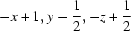
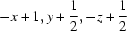
| Symmetry codes: (i) x−1/2, y, −z+1/2; (ii) −x+1, y−1/2, −z+1/2; (iii) −x+1, y+1/2, −z+1/2; (iv) x+1/2, y, −z+1/2. |
| D—H···A | D—H | H···A | D···A | D—H···A |
| O7—H7A···O2v | 0.85 | 2.19 | 2.862 (5) | 136 |
| O7—H7A···O3i | 0.85 | 2.30 | 2.858 (5) | 123 |
| O7—H7B···O6vi | 0.85 | 2.15 | 2.959 (6) | 158 |
| O8—H8A···O1iii | 0.85 | 1.98 | 2.787 (4) | 160 |
| O8—H8B···O2ii | 0.85 | 1.85 | 2.692 (5) | 170 |
| Symmetry codes: (i) x−1/2, y, −z+1/2; (ii) −x+1, y−1/2, −z+1/2; (iii) −x+1, y+1/2, −z+1/2; (v) −x+1/2, y−1/2, z; (vi) −x+1, −y, −z+1. |
Experimental details
| Crystal data | |
| Chemical formula | [Cu(C8H3NO6)(H2O)2] |
| Mr | 308.69 |
| Crystal system, space group | Orthorhombic, Pbca |
| Temperature (K) | 133 |
| a, b, c (Å) | 14.208 (3), 6.5159 (13), 21.722 (4) |
| V (Å3) | 2011.0 (7) |
| Z | 8 |
| Radiation type | Mo Kα |
| µ (mm−1) | 2.21 |
| Crystal size (mm) | 0.14 × 0.06 × 0.04 |
| Data collection | |
| Diffractometer | Rigaku Saturn |
| Absorption correction | Multi-scan (CrystalClear; Rigaku/MSC, 2005) |
| Tmin, Tmax | 0.850, 0.917 |
| No. of measured, independent and observed [I > 2σ(I)] reflections | 11779, 1974, 1609 |
| Rint | 0.079 |
| (sin θ/λ)max (Å−1) | 0.618 |
| Refinement | |
| R[F2 > 2σ(F2)], wR(F2), S | 0.048, 0.144, 1.07 |
| No. of reflections | 1974 |
| No. of parameters | 163 |
| H-atom treatment | H-atom parameters constrained |
| Δρmax, Δρmin (e Å−3) | 0.79, −0.66 |
Computer programs: CrystalClear (Rigaku/MSC, 2005), SHELXS97 (Sheldrick, 2008), SHELXL97 (Sheldrick, 2008), SHELXTL (Sheldrick, 2008).
| Cu1—O4i | 1.917 (3) | O1—C1 | 1.278 (5) |
| Cu1—O1 | 1.945 (3) | O2—C1 | 1.241 (5) |
| Cu1—O8 | 1.991 (3) | O3—C8 | 1.253 (5) |
| Cu1—O7 | 1.991 (4) | O4—C8 | 1.266 (6) |
| Cu1—O3ii | 2.263 (3) |
| Symmetry codes: (i) x−1/2, y, −z+1/2; (ii) −x+1, y−1/2, −z+1/2. |
| D—H···A | D—H | H···A | D···A | D—H···A |
| O7—H7A···O2iii | 0.85 | 2.19 | 2.862 (5) | 136 |
| O7—H7A···O3i | 0.85 | 2.30 | 2.858 (5) | 123 |
| O7—H7B···O6iv | 0.85 | 2.15 | 2.959 (6) | 158 |
| O8—H8A···O1v | 0.85 | 1.98 | 2.787 (4) | 160 |
| O8—H8B···O2ii | 0.85 | 1.85 | 2.692 (5) | 170 |
| Symmetry codes: (i) x−1/2, y, −z+1/2; (ii) −x+1, y−1/2, −z+1/2; (iii) −x+1/2, y−1/2, z; (iv) −x+1, −y, −z+1; (v) −x+1, y+1/2, −z+1/2. |
Acknowledgements
The author thanks Tianjin Polytechnic University for financial support.
References
 Addison, A. W., Rao, T. N., Reedijk, J., van Rijn, J. & Verschoor, G. C. (1984). J. Chem. Soc. Dalton Trans. pp. 1349–1356. CSD CrossRef Web of Science Google Scholar
Baca, S. G., Filippova, I. G., Gherco, O. A., Gdaniec, M., Simonov, Y. A., Gerbeleu, N. V., Franz, P., Basler, R. & Decurtins, S. (2004). Inorg. Chim. Acta, 357, 3419–3429. Web of Science CrossRef CAS Google Scholar
Baca, S. G., Simonov, Y. A., Gdaniec, M., Gerbeleu, N., Filippova, I. G. & Timco, G. A. (2003). Inorg. Chem. Commun. 6, 685–689. Web of Science CSD CrossRef CAS Google Scholar
Bernstein, J., Davis, R. E., Shimoni, L. & Chang, N.-L. (1995). Angew. Chem. Int. Ed. Engl. 34, 1555–1573. CrossRef CAS Web of Science Google Scholar
Biagini Cingi, M., Manotti Lanfredi, A. M., Tiripicchio, A. & Tiripicchio Camellini, M. (1978). Acta Cryst. B34, 134–137. CSD CrossRef CAS IUCr Journals Google Scholar
Brown, I. D. (1976). Acta Cryst. A32, 24–31. CrossRef IUCr Journals Web of Science Google Scholar
Fu, X.-C., Wang, X.-Y., Li, M.-T., Wang, C.-G. & Deng, X.-T. (2006). Acta Cryst. C62, m343–m345. Web of Science CSD CrossRef CAS IUCr Journals Google Scholar
Guo, M.-L. & Guo, C.-H. (2007). Acta Cryst. C63, m595–m597. Web of Science CSD CrossRef IUCr Journals Google Scholar
Ma, C.-B., Wang, W.-G., Zhang, X.-F., Chen, C.-N., Liu, Q.-T., Zhu, H.-P., Liao, D.-Z. & Li, L.-C. (2004). Eur. J. Inorg. Chem. pp. 3522–3532. Web of Science CSD CrossRef Google Scholar
Pasan, J., Sanchiz, J., Lloret, F., Julvec, M. & Ruiz-Perez, C. (2007). CrystEngComm, 9, 478–487. CAS Google Scholar
Rigaku/MSC (2005). CrystalClear. Rigaku/MSC, The Woodlands, Texas, USA. Google Scholar
Sheldrick, G. M. (2008). Acta Cryst. A64, 112–122. Web of Science CrossRef CAS IUCr Journals Google Scholar
Wang, F.-Q., Lu, F.-L., Wei, B. & Zhao, Y.-N. (2009). Acta Cryst. C65, m42–m44. Web of Science CSD CrossRef IUCr Journals Google Scholar
Yang, S.-Y., Long, L.-S., Huang, R.-B., Zheng, L.-S. & Ng, S. W. (2003). Acta Cryst. E59, m507–m509. Web of Science CSD CrossRef CAS IUCr Journals Google Scholar
This is an open-access article distributed under the terms of the Creative Commons Attribution (CC-BY) Licence, which permits unrestricted use, distribution, and reproduction in any medium, provided the original authors and source are cited.
| CRYSTALLOGRAPHIC COMMUNICATIONS |
access


Aromatic dicarboxylate ligands such as phthalate (phth) and substituted phthalatehave been used in the construction of polymeric metal complexes because they can act as a bis-monodentate, bis-bidentate and combined modes of coordination to form short bridges via one carboxylato end or long bridges via the benzene ring and lead to a great variety of structures (Biagini Cingi et al., 1978; Guo and Guo, 2007; Wang et al., 2009; Ma et al., 2004; Baca et al., 2003, 2004; Yang et al., 2003; Fu et al., 2006). We have used the 4-nitrophthalate dianion as a ligand, and have obtained the title novel five-coordinate 4-nitrophthalate-copper complex, (I), which forms a three-dimensional supramolecular network through O—H···O hydrogen bonding.
The asymmetric unit in the structure of (I) comprises one Cu atom, one complete 4-nitrophthate dianion and two non-equivalent water molecules, and is shown in Fig. 1 in a symmetry-expanded view, which displays the full coordination of the Cu atom. Selected geometric parameters are given in Table 1.
The Cu atom exhibits an approximate square pyramidal environment (the τ value being 0.171, Addison et al., 1984), with atoms O1, O4i (see Fig. 1 for symmetry codes) of two non-equivalent 4-nitrophthalate dianions and O7 and O8 atoms of coordinated water molecules in a planar arrangement, with the mean Cu–O(eq) bond distance being 1.961 (3) Å, which is comparable to that reported for poly[(µ3-methylmalonato-O,O',O'',O''')-aqua-copper(II)] (Pasan, et al., 2007). The apical position is occupied by O3ii atom [Cu1–O3ii = 2.263 (3) Å]. The Cu atom is shifted by 0.0889 (5) A° toward the apical position. There is an additional weak Cu–O2 contact in (I), with a Cu···O distance of 2.821 (3) Å.
In the present structure, monodentate, bidentate 1,3-bridging bonding and 1,6-bridging bonding modes via the benzene ring are present (Fig. 2). The O1 atom binds in a monodentate fashion, while the O3 and O4 atoms display both monodentate and bidentate 1,3-bridge bonding to link two Cu atoms. The O1 and O3 (or O4) atoms adopt a 1,6-bridging bonding mode via the benzene ring to connect with two other Cu atoms.
The Cu atoms are further interconnected by three O atoms from three 4-nitrophthalate dianions into a two-dimensional layer in the ab plane. The mean planes of the carboxylate groups of O1/C1/O2 and the benzene ring make a dihedral angle of 72.4 (5)°, and the value of a dihedral angle for the carboxylate groups of O3/C8/O4 is 14.5 (5)°; the two C—O bond distances (O1—C1 and O2—C1) of the monodentate carboxylate group are 1.278 (5) and 1.241 (5) Å, respectively, and the two C—O bond distances (O3—C4 and O4—C4) of the 1,3-bridging bonding carboxylate group are 1.253 (5) and 1.266 (6) Å, respectively. These indicate that the mesomeric effect for the 1,3-bridging bonding carboxylate group is somewhat greater than that of the monodentate carboxylate group.
The two water molecules within the coordination sphere of the Cu atom, and the nitro group (O5/N1/O6) in the present structure engage in distinct hydrogen bonding interactions (see Table 2). Within each layer, the non-coordinated O2 atom is involved in forming strong O8—H8B···O2ii (Brown, 1976) and weak O7—H7A···O2v hydrogen bonds. These play an important role in the propagation of the two-dimensional layer structure, due to the formation of different hydrogen bonded ring graph set motifs (Bernstein et al., 1995), such as an S(8), and two 10-membered R22(10) motifs (Fig.3). The neighbouring layers are linked together via weak O7—H7B···O6vi hydrogen bonding interactions. These also result in the aryl rings of the 4-nitrophthalato ligands stacking weakly in an offset fashion along the c direction with centroid to centroid distances in the range 4.55 (4)Å - 4.97 (2)%A. Thus, the three-dimensional connectivity of the structure is achieved.