 | Acta Crystallographica Section E Acta Crystallographica Section E CRYSTALLOGRAPHIC COMMUNICATIONS |


 journal menu


organic compounds
| CRYSTALLOGRAPHIC COMMUNICATIONS |
 access
(E)-2-(2-Nitroprop-1-enyl)thiophene

aHangzhou Minsheng Pharmaceutical Group Co. Ltd, Hangzhou 310000, People's Republic of China, bZhejiang University of Technology, Hangzhou 310000, People's Republic of China, and cHangzhou Radio & TV University, Hangzhou 310000, People's Republic of China
*Correspondence e-mail: [email protected]
The title compound, C7H7NO2S, adopts an E conformation about the C=C bond. The torsion angle C=C—C—C is −177.7 (3)°. The features weak intermolecular by C—H⋯O interactions.
Related literature
For the use of nitroalkenes as organic intermediates, see: Ballini & Petrini (2004![[Ballini, R. & Petrini, M. (2004). Tetrahedron, 60, 1017-1047.]](../../../../../../logos/arrows/e_arr.gif "Ballini, R. & Petrini, M. (2004). Tetrahedron, 60, 1017-1047.") ); Berner et al. (2002); Ono (2001).
); Berner et al. (2002); Ono (2001).
![[Scheme 1]](jh2274scheme1.gif)
Experimental
Crystal data
|
Refinement
|
| |||||||||||||||||
 .
. Data collection: PROCESS-AUTO (Rigaku, 2006); cell refinement: PROCESS-AUTO; data reduction: CrystalStructure (Rigaku Americas and Rigaku, 2007); program(s) used to solve structure: SHELXS97 (Sheldrick, 2008); program(s) used to refine structure: SHELXL97 (Sheldrick, 2008); molecular graphics: ORTEP-3 for Windows (Farrugia, 1997); software used to prepare material for publication: WinGX (Farrugia, 1999).
Supporting information
contains datablocks I, global. DOI: 10.1107/S1600536811010622/jh2274sup1.cif
Structure factors: contains datablock I. DOI: 10.1107/S1600536811010622/jh2274Isup2.hkl
To a solution of thiophene-2-carbaldehyde (50 mmol) in AcOH (25 mL), nitroethane (75 mmol) was added, followed by butylamine (100 mmol, 7.4 mL). The mixture was sonicated at 60 °C, until GC showed full conversion of the aldehyde. The mixture was poured into ice water, the precipitate was filtered off, washed with water and recrystallized from EtOH/EtOAc to give the product. Single crystals were obtained by slow evaporation of an cyclohexane-EtOAc solution (10:1, v/v).
All H atoms were placed in calculated positions and refined using a riding model, with C—H = 0.93–0.96 Å, and with Uiso(H) = 1.2 Ueq(C) or 1.5 Ueq(C) for methyl H atoms.
Data collection: PROCESS-AUTO (Rigaku, 2006); cell PROCESS-AUTO (Rigaku, 2006); data reduction: CrystalStructure (Rigaku Americas and Rigaku, 2007); program(s) used to solve structure: SHELXS97 (Sheldrick, 2008); program(s) used to refine structure: SHELXL97 (Sheldrick, 2008); molecular graphics: ORTEP-3 for Windows (Farrugia, 1997); software used to prepare material for publication: WinGX (Farrugia, 1999).
![[Figure 1]](./jh2274fig1thm.gif) | Fig. 1. The asymmetric unit of the title compound with the atomic labeling scheme; displacement ellipsoids are drawn at the 50% probability level. |
![[Figure 2]](./jh2274fig2thm.gif) | Fig. 2. The view of intermolecular interaction illustrated as dash lines. |
| C7H7NO2S | F(000) = 352 |
| Mr = 169.20 | Dx = 1.429 Mg m−3 |
| Monoclinic, P21/n | Mo Kα radiation, λ = 0.71073 Å |
| Hall symbol: -P 2yn | Cell parameters from 3534 reflections |
| a = 6.7545 (6) Å | θ = 3.2–27.4° |
| b = 16.6940 (13) Å | µ = 0.36 mm−1 |
| c = 7.4527 (4) Å | T = 296 K |
| β = 110.640 (7)° | Prism, yellow |
| V = 786.42 (10) Å3 | 0.31 × 0.18 × 0.17 mm |
| Z = 4 |
| Rigaku R-AXIS RAPID diffractometer | 1362 independent reflections |
| Radiation source: rolling anode | 971 reflections with I > 2σ(I) |
| Graphite monochromator | Rint = 0.035 |
| Detector resolution: 10.00 pixels mm-1 | θmax = 25.0°, θmin = 3.2° |
| ω scans | h = −7→8 |
| Absorption correction: multi-scan (ABSCOR; Higashi, 1995) | k = −19→19 |
| Tmin = 0.879, Tmax = 0.942 | l = −8→8 |
| 5936 measured reflections |
| Refinement on F2 | Secondary atom site location: difference Fourier map |
| Least-squares matrix: full | Hydrogen site location: inferred from neighbouring sites |
| R[F2 > 2σ(F2)] = 0.049 | H-atom parameters constrained |
| wR(F2) = 0.170 | w = 1/[σ2(Fo2) + (0.0837P)2 + 0.8184P] where P = (Fo2 + 2Fc2)/3 |
| S = 1.00 | (Δ/σ)max = 0.001 |
| 1362 reflections | Δρmax = 0.39 e Å−3 |
| 102 parameters | Δρmin = −0.33 e Å−3 |
| 0 restraints | Extinction correction: SHELXL97 (Sheldrick, 2008), Fc*=kFc[1+0.001xFc2λ3/sin(2θ)]-1/4 |
| Primary atom site location: structure-invariant direct methods | Extinction coefficient: 0.0067 (6) |
| C7H7NO2S | V = 786.42 (10) Å3 |
| Mr = 169.20 | Z = 4 |
| Monoclinic, P21/n | Mo Kα radiation |
| a = 6.7545 (6) Å | µ = 0.36 mm−1 |
| b = 16.6940 (13) Å | T = 296 K |
| c = 7.4527 (4) Å | 0.31 × 0.18 × 0.17 mm |
| β = 110.640 (7)° |
| Rigaku R-AXIS RAPID diffractometer | 1362 independent reflections |
| Absorption correction: multi-scan (ABSCOR; Higashi, 1995) | 971 reflections with I > 2σ(I) |
| Tmin = 0.879, Tmax = 0.942 | Rint = 0.035 |
| 5936 measured reflections |
| R[F2 > 2σ(F2)] = 0.049 | 0 restraints |
| wR(F2) = 0.170 | H-atom parameters constrained |
| S = 1.00 | Δρmax = 0.39 e Å−3 |
| 1362 reflections | Δρmin = −0.33 e Å−3 |
| 102 parameters |
Geometry. All e.s.d.'s (except the e.s.d. in the dihedral angle between two l.s. planes) are estimated using the full covariance matrix. The cell e.s.d.'s are taken into account individually in the estimation of e.s.d.'s in distances, angles and torsion angles; correlations between e.s.d.'s in cell parameters are only used when they are defined by crystal symmetry. An approximate (isotropic) treatment of cell e.s.d.'s is used for estimating e.s.d.'s involving l.s. planes. |
Refinement. Refinement of F2 against ALL reflections. The weighted R-factor wR and goodness of fit S are based on F2, conventional R-factors R are based on F, with F set to zero for negative F2. The threshold expression of F2 > σ(F2) is used only for calculating R-factors(gt) etc. and is not relevant to the choice of reflections for refinement. R-factors based on F2 are statistically about twice as large as those based on F, and R- factors based on ALL data will be even larger. |
| x | y | z | Uiso*/Ueq | ||
| S1 | 0.21787 (15) | 0.56891 (6) | 0.61453 (16) | 0.0684 (5) | |
| C4 | 0.4914 (5) | 0.5654 (2) | 0.7041 (5) | 0.0496 (8) | |
| C3 | 0.6192 (5) | 0.4976 (2) | 0.7933 (4) | 0.0500 (8) | |
| H3 | 0.7644 | 0.5067 | 0.8373 | 0.060* | |
| N1 | 0.7349 (5) | 0.36806 (18) | 0.9203 (4) | 0.0584 (8) | |
| O2 | 0.9190 (4) | 0.39008 (17) | 0.9632 (5) | 0.0775 (9) | |
| C2 | 0.5624 (5) | 0.4238 (2) | 0.8227 (5) | 0.0493 (8) | |
| O1 | 0.6885 (5) | 0.30107 (17) | 0.9578 (5) | 0.0832 (9) | |
| C5 | 0.5793 (6) | 0.64019 (19) | 0.6781 (5) | 0.0512 (8) | |
| H5 | 0.7230 | 0.6515 | 0.7150 | 0.061* | |
| C1 | 0.3450 (6) | 0.3888 (2) | 0.7708 (6) | 0.0652 (10) | |
| H1A | 0.2975 | 0.3941 | 0.8775 | 0.098* | |
| H1B | 0.3487 | 0.3332 | 0.7398 | 0.098* | |
| H1C | 0.2496 | 0.4168 | 0.6621 | 0.098* | |
| C7 | 0.2176 (6) | 0.6653 (2) | 0.5463 (6) | 0.0698 (11) | |
| H7 | 0.0948 | 0.6947 | 0.4869 | 0.084* | |
| C6 | 0.4120 (6) | 0.6951 (2) | 0.5863 (6) | 0.0675 (11) | |
| H6 | 0.4365 | 0.7475 | 0.5568 | 0.081* |
| U11 | U22 | U33 | U12 | U13 | U23 | |
| S1 | 0.0499 (6) | 0.0587 (7) | 0.0895 (8) | −0.0017 (4) | 0.0158 (5) | 0.0006 (5) |
| C4 | 0.0447 (19) | 0.051 (2) | 0.0507 (19) | −0.0015 (14) | 0.0131 (15) | −0.0040 (14) |
| C3 | 0.0419 (17) | 0.052 (2) | 0.052 (2) | −0.0039 (14) | 0.0124 (15) | −0.0078 (15) |
| N1 | 0.0557 (19) | 0.0507 (19) | 0.0660 (19) | 0.0060 (14) | 0.0180 (15) | 0.0000 (14) |
| O2 | 0.0474 (15) | 0.0661 (18) | 0.107 (2) | 0.0055 (12) | 0.0125 (15) | 0.0016 (16) |
| C2 | 0.0468 (18) | 0.0464 (19) | 0.0532 (19) | 0.0018 (14) | 0.0157 (15) | −0.0040 (14) |
| O1 | 0.079 (2) | 0.0533 (17) | 0.118 (3) | 0.0078 (14) | 0.0349 (18) | 0.0175 (16) |
| C5 | 0.056 (2) | 0.0418 (18) | 0.0499 (19) | 0.0022 (14) | 0.0116 (15) | 0.0006 (14) |
| C1 | 0.054 (2) | 0.056 (2) | 0.082 (3) | −0.0085 (17) | 0.0198 (19) | 0.0007 (19) |
| C7 | 0.058 (2) | 0.058 (2) | 0.083 (3) | 0.0100 (18) | 0.012 (2) | 0.002 (2) |
| C6 | 0.074 (3) | 0.047 (2) | 0.076 (3) | −0.0032 (18) | 0.019 (2) | 0.0038 (18) |
| S1—C7 | 1.688 (4) | C2—C1 | 1.499 (5) |
| S1—C4 | 1.730 (3) | C5—C6 | 1.429 (5) |
| C4—C5 | 1.425 (5) | C5—H5 | 0.9300 |
| C4—C3 | 1.436 (5) | C1—H1A | 0.9600 |
| C3—C2 | 1.331 (5) | C1—H1B | 0.9600 |
| C3—H3 | 0.9300 | C1—H1C | 0.9600 |
| N1—O1 | 1.220 (4) | C7—C6 | 1.336 (5) |
| N1—O2 | 1.226 (4) | C7—H7 | 0.9300 |
| N1—C2 | 1.469 (4) | C6—H6 | 0.9300 |
| C7—S1—C4 | 92.09 (18) | C4—C5—H5 | 125.4 |
| C5—C4—C3 | 122.8 (3) | C6—C5—H5 | 125.4 |
| C5—C4—S1 | 110.9 (2) | C2—C1—H1A | 109.5 |
| C3—C4—S1 | 126.3 (3) | C2—C1—H1B | 109.5 |
| C2—C3—C4 | 130.0 (3) | H1A—C1—H1B | 109.5 |
| C2—C3—H3 | 115.0 | C2—C1—H1C | 109.5 |
| C4—C3—H3 | 115.0 | H1A—C1—H1C | 109.5 |
| O1—N1—O2 | 122.3 (3) | H1B—C1—H1C | 109.5 |
| O1—N1—C2 | 118.1 (3) | C6—C7—S1 | 113.0 (3) |
| O2—N1—C2 | 119.6 (3) | C6—C7—H7 | 123.5 |
| C3—C2—N1 | 116.3 (3) | S1—C7—H7 | 123.5 |
| C3—C2—C1 | 129.2 (3) | C7—C6—C5 | 114.7 (4) |
| N1—C2—C1 | 114.5 (3) | C7—C6—H6 | 122.7 |
| C4—C5—C6 | 109.3 (3) | C5—C6—H6 | 122.7 |
| C7—S1—C4—C5 | −0.3 (3) | O1—N1—C2—C1 | −3.2 (5) |
| C7—S1—C4—C3 | 179.8 (3) | O2—N1—C2—C1 | 177.6 (3) |
| C5—C4—C3—C2 | −177.7 (3) | C3—C4—C5—C6 | −179.8 (3) |
| S1—C4—C3—C2 | 2.1 (6) | S1—C4—C5—C6 | 0.3 (4) |
| C4—C3—C2—N1 | −179.7 (3) | C4—S1—C7—C6 | 0.2 (4) |
| C4—C3—C2—C1 | 0.0 (6) | S1—C7—C6—C5 | −0.1 (5) |
| O1—N1—C2—C3 | 176.6 (3) | C4—C5—C6—C7 | −0.2 (5) |
| O2—N1—C2—C3 | −2.6 (5) |
| D—H···A | D—H | H···A | D···A | D—H···A |
| C6—H6···O2i | 0.93 | 2.60 | 3.511 (5) | 168 |
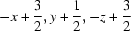
| Symmetry code: (i) −x+3/2, y+1/2, −z+3/2. |
Experimental details
| Crystal data | |
| Chemical formula | C7H7NO2S |
| Mr | 169.20 |
| Crystal system, space group | Monoclinic, P21/n |
| Temperature (K) | 296 |
| a, b, c (Å) | 6.7545 (6), 16.6940 (13), 7.4527 (4) |
| β (°) | 110.640 (7) |
| V (Å3) | 786.42 (10) |
| Z | 4 |
| Radiation type | Mo Kα |
| µ (mm−1) | 0.36 |
| Crystal size (mm) | 0.31 × 0.18 × 0.17 |
| Data collection | |
| Diffractometer | Rigaku R-AXIS RAPID diffractometer |
| Absorption correction | Multi-scan (ABSCOR; Higashi, 1995) |
| Tmin, Tmax | 0.879, 0.942 |
| No. of measured, independent and observed [I > 2σ(I)] reflections | 5936, 1362, 971 |
| Rint | 0.035 |
| (sin θ/λ)max (Å−1) | 0.595 |
| Refinement | |
| R[F2 > 2σ(F2)], wR(F2), S | 0.049, 0.170, 1.00 |
| No. of reflections | 1362 |
| No. of parameters | 102 |
| H-atom treatment | H-atom parameters constrained |
| Δρmax, Δρmin (e Å−3) | 0.39, −0.33 |
Computer programs: PROCESS-AUTO (Rigaku, 2006), CrystalStructure (Rigaku Americas and Rigaku, 2007), SHELXS97 (Sheldrick, 2008), SHELXL97 (Sheldrick, 2008), ORTEP-3 for Windows (Farrugia, 1997), WinGX (Farrugia, 1999).
| D—H···A | D—H | H···A | D···A | D—H···A |
| C6—H6···O2i | 0.930 | 2.597 | 3.511 (5) | 168 |
| Symmetry code: (i) −x+3/2, y+1/2, −z+3/2. |
Acknowledgements
The authors are grateful to Mr Jianming Gu for the X-ray single crystal analysis.
References
 Ballini, R. & Petrini, M. (2004). Tetrahedron, 60, 1017–1047. Web of Science CrossRef CAS Google Scholar
Berner, O. M., Tedeschi, L. & Enders, D. (2002). Eur. J. Org. Chem. 12, 1877–1894. CrossRef Google Scholar
Farrugia, L. J. (1997). J. Appl. Cryst. 30, 565. CrossRef IUCr Journals Google Scholar
Farrugia, L. J. (1999). J. Appl. Cryst. 32, 837–838. CrossRef CAS IUCr Journals Google Scholar
Higashi, T. (1995). ABSCOR. Rigaku Corporation, Tokyo, Japan. Google Scholar
Ono, N. (2001). The Nitro Group in Organic Synthesis. New York: Wiley-VCH. Google Scholar
Rigaku (2006). PROCESS-AUTO. Rigaku Corporation, Tokyo, Japan. Google Scholar
Rigaku Americas and Rigaku (2007). CrystalStructure. Rigaku Americas, The Woodlands, Texas, USA, and Rigaku Corporation, Tokyo, Japan. Google Scholar
Sheldrick, G. M. (2008). Acta Cryst. A64, 112–122. Web of Science CrossRef CAS IUCr Journals Google Scholar
This is an open-access article distributed under the terms of the Creative Commons Attribution (CC-BY) Licence, which permits unrestricted use, distribution, and reproduction in any medium, provided the original authors and source are cited.
| CRYSTALLOGRAPHIC COMMUNICATIONS |


Nitroalkenes are important organic intermediates, since they can be converted to synthetically useful N– and O-containing organic molecules, such as amines, aldehydes, carboxylic acids, or denitrated compounds (Ono, 2001; Berner et al., 2002; Ballini & Petrini, 2004). As a contribution in this field, we have synthesized a series of nitroalkenes by employing benzaldehydes and nitroethane. We report here one of this nitroalkenes, i.e. the crystal structure of the title compound. The C2═C3 bond involves the E configuration with the C2—C3—C4—C5 torsion angle of 177.71 (3)° (Fig. 1). The atoms of the thiophene ring are coplanar. The conformation of (I) is stabilized by weak intermolecular by C6—H6···O2' interaction (Fig. 2 and Table 1).