Experimental
Crystal data
[HgCl2(C11H10N2O)] Mr = 457.70 Monoclinic, P 21 /n a = 7.7275 (11) Å b = 9.4705 (13) Å c = 16.729 (2) Å β = 101.416 (2)° V = 1200.1 (3) Å3 Z = 4 Mo Kα radiation μ = 13.25 mm−1 T = 130 K 0.21 × 0.09 × 0.08 mm
|
Data collection
Bruker SMART APEX diffractometer Absorption correction: multi-scan (SADABS; Sheldrick, 1996![[Sheldrick, G. M. (1996). SADABS. University of Göttingen.]](../../../../../../logos/arrows/e_arr.gif "Sheldrick, G. M. (1996). SADABS. University of Göttingen.") ) Tmin = 0.167, Tmax = 0.417 ) Tmin = 0.167, Tmax = 0.417 13274 measured reflections 3014 independent reflections 2620 reflections with I > 2σ(I) Rint = 0.041
|
| Hg1—Cl1 | 2.3258 (16) | | Hg1—Cl2 | 2.3302 (16) | | Hg1—Cl1i | 3.1301 (16) | | Hg1—Cl2ii | 3.0416 (16) | | Hg1—O1iii | 2.775 (6) | | Hg1—N1 | 2.649 (6) | Symmetry codes: (i) -x+2, -y, -z; (ii) -x+1, -y, -z; (iii) x, y-1, z.
| |
| D—H⋯A | D—H | H⋯A | D⋯A | D—H⋯A | | C5—H5A⋯Cl1iv | 0.93 | 2.81 | 3.630 (8) | 147 | | C10—H10B⋯Cl2v | 0.97 | 2.76 | 3.724 (9) | 171 | Symmetry codes: (iv) -x+2, -y+1, -z; (v) 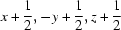 . .
| |
Data collection: SMART APEX (Bruker, 2000); cell refinement: SAINT-Plus (Bruker, 1999); data reduction: SAINT-Plus; program(s) used to solve structure: SHELXS97 (Sheldrick, 2008); program(s) used to refine structure: SHELXL97 (Sheldrick, 2008); molecular graphics: XP (Bruker, 1998); software used to prepare material for publication: publCIF (Westrip, 2010).
Supporting information
A solution of 27.15 mg (0.1 mmol) of mercury (II) chloride in 2 ml water was added to a solution of 18.62 mg (0.1 mmol) of 1,2,3,9-tetrahydropyrrolo(2,1 - b)quinazolin-9-one in 2 ml acetone. The solution was allowed for slow evaporation at the room temperature. Colourless needle shaped crystals were obtained after several days.
Carbon-bound H atoms were positioned geometrically and treated as riding on their C atoms, with C—H distances of 0.93 Å (aromatic) and 0.97 Å (CH2) and were refined with Uiso(H)=1.2Ueq(C). After completion of the structure model, a difference Fourier synthesis resulted in a local maximum closer than 0.8 Å to Hg1.
Data collection: SMART APEX (Bruker, 2000); cell refinement: SAINT-Plus (Bruker, 1999); data reduction: SAINT-Plus (Bruker, 1999); program(s) used to solve structure: SHELXS97 (Sheldrick, 2008); program(s) used to refine structure: SHELXL97 (Sheldrick, 2008); molecular graphics: XP (Bruker, 1998); software used to prepare material for publication: publCIF (Westrip, 2010).
Poly[di-µ-chlorido-µ-(1,2,3,9-tetrahydropyrrolo[2,1-
b]quinazolin- 9-one-
κ2N:
O)-mercury(II)]
top Crystal data top | [HgCl2(C11H10N2O)] | F(000) = 848 |
| Mr = 457.70 | Dx = 2.533 Mg m−3 |
| Monoclinic, P21/n | Mo Kα radiation, λ = 0.71073 Å |
| Hall symbol: -P 2yn | Cell parameters from 3815 reflections |
| a = 7.7275 (11) Å | θ = 2.2–28.3° |
| b = 9.4705 (13) Å | µ = 13.25 mm−1 |
| c = 16.729 (2) Å | T = 130 K |
| β = 101.416 (2)° | Rod, colourless |
| V = 1200.1 (3) Å3 | 0.21 × 0.09 × 0.08 mm |
| Z = 4 | |
Data collection top Bruker SMART APEX
diffractometer | 3014 independent reflections |
| Radiation source: fine-focus sealed tube | 2620 reflections with I > 2σ(I) |
| Graphite monochromator | Rint = 0.041 |
| ω scans | θmax = 28.5°, θmin = 2.5° |
Absorption correction: multi-scan
(SADABS; Sheldrick, 1996) | h = −10→10 |
| Tmin = 0.167, Tmax = 0.417 | k = −12→12 |
| 13274 measured reflections | l = −22→22 |
Refinement top | Refinement on F2 | Primary atom site location: structure-invariant direct methods |
| Least-squares matrix: full | Secondary atom site location: difference Fourier map |
| R[F2 > 2σ(F2)] = 0.042 | Hydrogen site location: inferred from neighbouring sites |
| wR(F2) = 0.099 | H-atom parameters constrained |
| S = 1.20 | w = 1/[σ2(Fo2) + (0.0432P)2 + 2.8193P]
where P = (Fo2 + 2Fc2)/3 |
| 3014 reflections | (Δ/σ)max = 0.001 |
| 154 parameters | Δρmax = 6.57 e Å−3 |
| 0 restraints | Δρmin = −1.26 e Å−3 |
Crystal data top | [HgCl2(C11H10N2O)] | V = 1200.1 (3) Å3 |
| Mr = 457.70 | Z = 4 |
| Monoclinic, P21/n | Mo Kα radiation |
| a = 7.7275 (11) Å | µ = 13.25 mm−1 |
| b = 9.4705 (13) Å | T = 130 K |
| c = 16.729 (2) Å | 0.21 × 0.09 × 0.08 mm |
| β = 101.416 (2)° | |
Data collection top Bruker SMART APEX
diffractometer | 3014 independent reflections |
Absorption correction: multi-scan
(SADABS; Sheldrick, 1996) | 2620 reflections with I > 2σ(I) |
| Tmin = 0.167, Tmax = 0.417 | Rint = 0.041 |
| 13274 measured reflections | |
Refinement top | R[F2 > 2σ(F2)] = 0.042 | 0 restraints |
| wR(F2) = 0.099 | H-atom parameters constrained |
| S = 1.20 | Δρmax = 6.57 e Å−3 |
| 3014 reflections | Δρmin = −1.26 e Å−3 |
| 154 parameters | |
Special details top Geometry. All e.s.d.'s (except the e.s.d. in the dihedral angle between two l.s. planes) are estimated using the full covariance matrix. The cell e.s.d.'s are taken into account individually in the estimation of e.s.d.'s in distances, angles and torsion angles; correlations between e.s.d.'s in cell parameters are only used when they are defined by crystal symmetry. An approximate (isotropic) treatment of cell e.s.d.'s is used for estimating e.s.d.'s involving l.s. planes. |
Refinement. Refinement of F2 against ALL reflections. The weighted R-factor wR and goodness of fit S are based on F2, conventional R-factors R are based on F, with F set to zero for negative F2. The threshold expression of F2 > σ(F2) is used only for calculating R-factors(gt) etc. and is not relevant to the choice of reflections for refinement. R-factors based on F2 are statistically about twice as large as those based on F, and R- factors based on ALL data will be even larger. |
Fractional atomic coordinates and isotropic or equivalent isotropic displacement parameters (Å2) top| | x | y | z | Uiso*/Ueq | |
| Hg1 | 0.75260 (3) | 0.03946 (3) | 0.005310 (12) | 0.02475 (11) | |
| Cl1 | 0.9924 (2) | 0.02655 (19) | 0.11378 (9) | 0.0277 (3) | |
| Cl2 | 0.5237 (2) | 0.01819 (19) | −0.10788 (9) | 0.0288 (4) | |
| O1 | 0.7419 (7) | 0.7485 (6) | 0.0235 (3) | 0.0439 (14) | |
| N1 | 0.7546 (6) | 0.3191 (7) | 0.0057 (3) | 0.0248 (12) | |
| C2 | 0.7279 (8) | 0.3824 (8) | 0.0697 (4) | 0.0264 (14) | |
| N3 | 0.7223 (7) | 0.5265 (6) | 0.0757 (3) | 0.0245 (12) | |
| C4 | 0.7484 (8) | 0.6201 (8) | 0.0148 (4) | 0.0286 (14) | |
| C4A | 0.7784 (9) | 0.5509 (7) | −0.0581 (4) | 0.0238 (14) | |
| C5 | 0.8068 (9) | 0.6256 (8) | −0.1257 (4) | 0.0320 (15) | |
| H5A | 0.8074 | 0.7237 | −0.1240 | 0.038* | |
| C6 | 0.8339 (9) | 0.5600 (8) | −0.1943 (4) | 0.0321 (16) | |
| H6A | 0.8510 | 0.6123 | −0.2391 | 0.038* | |
| C7 | 0.8355 (9) | 0.4115 (7) | −0.1964 (4) | 0.0249 (13) | |
| H7A | 0.8534 | 0.3659 | −0.2434 | 0.030* | |
| C8 | 0.8111 (8) | 0.3315 (7) | −0.1301 (4) | 0.0249 (13) | |
| H8A | 0.8143 | 0.2334 | −0.1320 | 0.030* | |
| C8A | 0.7813 (8) | 0.4016 (7) | −0.0596 (3) | 0.0193 (12) | |
| C9 | 0.6954 (10) | 0.3200 (9) | 0.1470 (4) | 0.0374 (18) | |
| H9A | 0.7924 | 0.2592 | 0.1716 | 0.045* | |
| H9B | 0.5870 | 0.2654 | 0.1373 | 0.045* | |
| C10 | 0.6806 (13) | 0.4488 (10) | 0.2024 (5) | 0.049 (2) | |
| H10A | 0.5692 | 0.4460 | 0.2208 | 0.059* | |
| H10B | 0.7757 | 0.4470 | 0.2499 | 0.059* | |
| C11 | 0.6914 (10) | 0.5786 (8) | 0.1545 (4) | 0.0337 (17) | |
| H11A | 0.5822 | 0.6319 | 0.1475 | 0.040* | |
| H11B | 0.7880 | 0.6382 | 0.1810 | 0.040* | |
Atomic displacement parameters (Å2) top| | U11 | U22 | U33 | U12 | U13 | U23 |
| Hg1 | 0.02197 (15) | 0.03650 (19) | 0.01675 (14) | 0.00429 (11) | 0.00622 (9) | 0.00185 (9) |
| Cl1 | 0.0231 (7) | 0.0420 (10) | 0.0188 (7) | 0.0049 (7) | 0.0060 (5) | 0.0053 (6) |
| Cl2 | 0.0229 (8) | 0.0452 (10) | 0.0189 (7) | −0.0008 (7) | 0.0055 (6) | 0.0021 (6) |
| O1 | 0.059 (4) | 0.035 (3) | 0.043 (3) | 0.009 (3) | 0.021 (3) | −0.011 (3) |
| N1 | 0.028 (3) | 0.031 (3) | 0.016 (2) | 0.005 (2) | 0.005 (2) | −0.0025 (19) |
| C2 | 0.024 (3) | 0.036 (4) | 0.019 (3) | 0.009 (3) | 0.005 (2) | 0.003 (3) |
| N3 | 0.021 (3) | 0.033 (3) | 0.020 (2) | 0.011 (2) | 0.004 (2) | −0.002 (2) |
| C4 | 0.023 (3) | 0.035 (4) | 0.029 (3) | 0.004 (3) | 0.007 (2) | −0.004 (3) |
| C4A | 0.021 (3) | 0.026 (4) | 0.023 (3) | 0.008 (3) | 0.000 (2) | −0.002 (2) |
| C5 | 0.035 (4) | 0.031 (4) | 0.029 (3) | −0.001 (3) | 0.005 (3) | 0.005 (3) |
| C6 | 0.033 (4) | 0.041 (5) | 0.024 (3) | 0.001 (3) | 0.008 (3) | 0.009 (3) |
| C7 | 0.026 (3) | 0.031 (4) | 0.018 (3) | 0.001 (3) | 0.006 (2) | −0.001 (2) |
| C8 | 0.027 (3) | 0.025 (3) | 0.022 (3) | 0.005 (3) | 0.005 (2) | 0.000 (2) |
| C8A | 0.017 (3) | 0.023 (3) | 0.017 (2) | 0.004 (2) | 0.000 (2) | 0.002 (2) |
| C9 | 0.044 (4) | 0.052 (5) | 0.021 (3) | 0.014 (4) | 0.019 (3) | 0.004 (3) |
| C10 | 0.057 (5) | 0.069 (7) | 0.023 (3) | −0.021 (5) | 0.014 (3) | −0.016 (4) |
| C11 | 0.030 (4) | 0.047 (5) | 0.027 (3) | 0.010 (3) | 0.011 (3) | −0.014 (3) |
Geometric parameters (Å, º) top | Hg1—Cl1 | 2.3258 (16) | C5—C6 | 1.357 (10) |
| Hg1—Cl2 | 2.3302 (16) | C5—H5A | 0.93 |
| Hg1—Cl1i | 3.1301 (16) | C6—C7 | 1.407 (10) |
| Hg1—Cl2ii | 3.0416 (16) | C6—H6A | 0.93 |
| Hg1—O1iii | 2.775 (6) | C7—C8 | 1.387 (9) |
| Hg1—N1 | 2.649 (6) | C7—H7A | 0.93 |
| O1—C4 | 1.227 (9) | C8—C8A | 1.411 (8) |
| N1—C2 | 1.279 (8) | C8—H8A | 0.93 |
| N1—C8A | 1.392 (8) | C9—C10 | 1.550 (11) |
| C2—N3 | 1.370 (9) | C9—H9A | 0.97 |
| C2—C9 | 1.488 (9) | C9—H9B | 0.97 |
| N3—C4 | 1.395 (9) | C10—C11 | 1.479 (12) |
| N3—C11 | 1.471 (8) | C10—H10A | 0.97 |
| C4—C4A | 1.442 (9) | C10—H10B | 0.97 |
| C4A—C5 | 1.388 (9) | C11—H11A | 0.97 |
| C4A—C8A | 1.415 (10) | C11—H11B | 0.97 |
| | | |
| Cl1—Hg1—Cl2 | 171.44 (7) | C6—C7—H7A | 119.3 |
| Cl1—Hg1—N1 | 92.70 (11) | C7—C8—C8A | 118.8 (6) |
| Cl2—Hg1—N1 | 95.27 (11) | C7—C8—H8A | 120.6 |
| C2—N1—C8A | 117.9 (6) | C8A—C8—H8A | 120.6 |
| C2—N1—Hg1 | 118.0 (5) | N1—C8A—C8 | 117.8 (6) |
| C8A—N1—Hg1 | 124.1 (4) | N1—C8A—C4A | 122.8 (5) |
| N1—C2—N3 | 122.7 (6) | C8—C8A—C4A | 119.4 (5) |
| N1—C2—C9 | 128.6 (7) | C2—C9—C10 | 104.6 (7) |
| N3—C2—C9 | 108.6 (5) | C2—C9—H9A | 110.8 |
| C2—N3—C4 | 124.6 (5) | C10—C9—H9A | 110.8 |
| C2—N3—C11 | 114.4 (5) | C2—C9—H9B | 110.8 |
| C4—N3—C11 | 121.0 (6) | C10—C9—H9B | 110.8 |
| O1—C4—N3 | 121.9 (6) | H9A—C9—H9B | 108.9 |
| O1—C4—C4A | 124.6 (7) | C11—C10—C9 | 108.1 (6) |
| N3—C4—C4A | 113.6 (6) | C11—C10—H10A | 110.1 |
| C5—C4A—C8A | 119.2 (6) | C9—C10—H10A | 110.1 |
| C5—C4A—C4 | 122.4 (7) | C11—C10—H10B | 110.1 |
| C8A—C4A—C4 | 118.3 (6) | C9—C10—H10B | 110.1 |
| C6—C5—C4A | 122.1 (7) | H10A—C10—H10B | 108.4 |
| C6—C5—H5A | 118.9 | N3—C11—C10 | 104.1 (6) |
| C4A—C5—H5A | 118.9 | N3—C11—H11A | 110.9 |
| C5—C6—C7 | 118.9 (6) | C10—C11—H11A | 110.9 |
| C5—C6—H6A | 120.6 | N3—C11—H11B | 110.9 |
| C7—C6—H6A | 120.6 | C10—C11—H11B | 110.9 |
| C8—C7—C6 | 121.4 (6) | H11A—C11—H11B | 109.0 |
| C8—C7—H7A | 119.3 | | |
| Symmetry codes: (i) −x+2, −y, −z; (ii) −x+1, −y, −z; (iii) x, y−1, z. |
Hydrogen-bond geometry (Å, º) top | D—H···A | D—H | H···A | D···A | D—H···A |
| C5—H5A···Cl1iv | 0.93 | 2.81 | 3.630 (8) | 147 |
| C10—H10B···Cl2v | 0.97 | 2.76 | 3.724 (9) | 171 |
| Symmetry codes: (iv) −x+2, −y+1, −z; (v) x+1/2, −y+1/2, z+1/2. |
Experimental details
| Crystal data |
| Chemical formula | [HgCl2(C11H10N2O)] |
| Mr | 457.70 |
| Crystal system, space group | Monoclinic, P21/n |
| Temperature (K) | 130 |
| a, b, c (Å) | 7.7275 (11), 9.4705 (13), 16.729 (2) |
| β (°) | 101.416 (2) |
| V (Å3) | 1200.1 (3) |
| Z | 4 |
| Radiation type | Mo Kα |
| µ (mm−1) | 13.25 |
| Crystal size (mm) | 0.21 × 0.09 × 0.08 |
| |
| Data collection |
| Diffractometer | Bruker SMART APEX
diffractometer |
| Absorption correction | Multi-scan
(SADABS; Sheldrick, 1996) |
| Tmin, Tmax | 0.167, 0.417 |
No. of measured, independent and
observed [I > 2σ(I)] reflections | 13274, 3014, 2620 |
| Rint | 0.041 |
| (sin θ/λ)max (Å−1) | 0.671 |
| |
| Refinement |
| R[F2 > 2σ(F2)], wR(F2), S | 0.042, 0.099, 1.20 |
| No. of reflections | 3014 |
| No. of parameters | 154 |
| H-atom treatment | H-atom parameters constrained |
| Δρmax, Δρmin (e Å−3) | 6.57, −1.26 |
Selected bond lengths (Å) top| Hg1—Cl1 | 2.3258 (16) | Hg1—Cl2ii | 3.0416 (16) |
| Hg1—Cl2 | 2.3302 (16) | Hg1—O1iii | 2.775 (6) |
| Hg1—Cl1i | 3.1301 (16) | Hg1—N1 | 2.649 (6) |
| Symmetry codes: (i) −x+2, −y, −z; (ii) −x+1, −y, −z; (iii) x, y−1, z. |
Hydrogen-bond geometry (Å, º) top | D—H···A | D—H | H···A | D···A | D—H···A |
| C5—H5A···Cl1iv | 0.93 | 2.81 | 3.630 (8) | 147.0 |
| C10—H10B···Cl2v | 0.97 | 2.76 | 3.724 (9) | 171.0 |
| Symmetry codes: (iv) −x+2, −y+1, −z; (v) x+1/2, −y+1/2, z+1/2. |
Acknowledgements
The authors gratefully acknowledge the DAAD for supporting this study.
References
 Batten, S. R., Harris, A. R., Murray, K. S. & Smith, J. P. (2002). Cryst. Growth Des. 2, 87–89. Web of Science CSD CrossRef CAS Google Scholar
Bruker (1998). XP. Bruker AXS Inc., Madison, Wisconsin, USA. Google Scholar
Bruker (1999). SAINT-Plus. Bruker AXS Inc., Madison, Wisconsin, USA. Google Scholar
Bruker (2000). SMART APEX. Bruker AXS Inc., Madison, Wisconsin, USA. Google Scholar
Chatterjee, A. & Ganguly, M. G. (1968). Phytochemistry, 7, 307–311. CrossRef CAS Web of Science Google Scholar
Englert, U. (2010). Coord. Chem. Rev. 254, 537–554. Web of Science CrossRef CAS Google Scholar
Hu, C., Kalf, I. & Englert, U. (2007). CrystEngComm, 9, 603–610. Web of Science CSD CrossRef CAS Google Scholar
Merkens, C., Kalf, I. & Englert, U. (2010). Z. Anorg. Allg. Chem. 636, 681–684. Web of Science CSD CrossRef CAS Google Scholar
Sheldrick, G. M. (1996). SADABS. University of Göttingen. Google Scholar
Sheldrick, G. M. (2008). Acta Cryst. A64, 112–122. Web of Science CrossRef CAS IUCr Journals Google Scholar
Turgunov, K. K., Tashkhodzhaev, B., Molchanov, L. V. & Aripov, Kh. N. (1995). Chem. Nat. Compd, 31, 714–718. CrossRef Google Scholar
Westrip, S. P. (2010). J. Appl. Cryst. 43, 920–925. Web of Science CrossRef CAS IUCr Journals Google Scholar
This is an open-access article distributed under the terms of the Creative Commons Attribution (CC-BY) Licence, which permits unrestricted use, distribution, and reproduction in any medium, provided the original authors and source are cited.
 | CRYSTALLOGRAPHIC
COMMUNICATIONS |
ISSN: 2056-9890
Open

access


 journal menu



![[Scheme 1]](si2358scheme1.gif)
![[Figure 1]](./si2358fig1thm.gif)
![[Figure 2]](./si2358fig2thm.gif)


The title compound represents the first crystal structure of a complex with the heterocyclic ligand 1,2,3,9-tetrahydropyrrolo(2,1 - b)quinazolin-9-one; the uncoordinated organic molecule has been reported by Turgunov et al. (1995).
The asymmetric unit contains a slightly bent HgCl2 moiety (Cl1—Hg1—Cl2 = 171.44 (6)°) and one ligand molecule (Fig.1) In the crystal each HgII cation is coordinated by four bridging chlorido ligands in the equatorial plane; one N- and one O-connected organic ligand occupy the axial positions of a distorted octahedron. The Hg—Cl bonds are asymmetric with two short and two longer distances (Table 1).
The bridging chlorido ligands form zigzag Hg—Cl—Hg—Cl ring chains in the direction of the shortest lattice parameter. Strongly asymmetric halide bridges are well established structural features in the coordination chemistry of divalent mercury (Batten et al., 2002; Hu et al., 2007; Merkens et al., 2010; Englert, 2010).
The chlorido-bridged Hg···Hg distances amount to 3.9342 (7) and 3.9442 (7) Å. As the result of halide bridging in the [100] and bridging of the ditopic organic ligand in the [010] direction, an overall two-dimensional sheet is formed which is depicted in Fig. 2.
The observed structure is stabilized by weak C—H···Cl hydrogen bonds (Table 2). Cooperative π–π stacking interactions between neighbouring quinazolone ring systems also contribute to the stability of this layer structure (Cg1···Cg1i=3.942 (4) Cg1···Cg2i=3.621 (4) Å, where Cg1 represents the centroid of the pyrimidinone and Cg2 that of the benzo ring centroid, (i): 2 - x,1 - y,-z).
The ligand molecule is essentially planar with a maximum deviation of 0.044 (7) Å for atom C10 and an r.m.s. deviation of 0.015 Å.