 | Acta Crystallographica Section E Acta Crystallographica Section E CRYSTALLOGRAPHIC COMMUNICATIONS |


 journal menu


organic compounds
| CRYSTALLOGRAPHIC COMMUNICATIONS |
 access
4,4,5,5-Tetramethyl-1,3,2λ5-dioxaphospholan-2-one

aFaculty of Chemistry, University of Wrocław, 14 F. Joliot-Curie, 50-383 Wrocław, Poland
*Correspondence e-mail: [email protected]
The five-membered ring in the title compound, C6H13O3P, exists in an envelope conformation with one of the ring C atoms at the flap position. The coordination geometry around the P atom is a distorted tetrahedron. The crystal structure is stabilized by several weak C—H⋯O and P—H⋯O hydrogen bonds, forming a three-dimensional network.
Related literature
For a discussion of 1,3,2-dioxaphospholane chemistry, see: Maffei & Buono (2003![[Maffei, M. & Buono, G. (2003). Tetrahedron, 59, 8821-8825.]](../../../../../../logos/arrows/e_arr.gif "Maffei, M. & Buono, G. (2003). Tetrahedron, 59, 8821-8825.") ); Zwierzak (1967) and for the Heck reaction, see: Beletskaya & Cheprakov (2000); Skarżyńska et al. (2011). For hydrogen-bond interactions, see: Desiraju & Steiner (1999). For bond lengths in organic compounds, see: Allen et al. (1987). For details of the temperature control applied during data collection, see: Cosier & Glazer (1986) and for specifications of the analytical numeric absorption correction, see: Clark & Reid (1995).
); Zwierzak (1967) and for the Heck reaction, see: Beletskaya & Cheprakov (2000); Skarżyńska et al. (2011). For hydrogen-bond interactions, see: Desiraju & Steiner (1999). For bond lengths in organic compounds, see: Allen et al. (1987). For details of the temperature control applied during data collection, see: Cosier & Glazer (1986) and for specifications of the analytical numeric absorption correction, see: Clark & Reid (1995).
![[Scheme 1]](bt5583scheme1.gif)
Experimental
Crystal data
|
Refinement
|
|
 ; (ii)
  ; (iii)
  .
. Data collection: CrysAlis CCD (Oxford Diffraction, 2010); cell refinement: CrysAlis RED (Oxford Diffraction, 2010); data reduction: CrysAlis RED; program(s) used to solve structure: SHELXS97 (Sheldrick, 2008); program(s) used to refine structure: SHELXL97 (Sheldrick, 2008); molecular graphics: ORTEP-3 (Farrugia, 1997); software used to prepare material for publication: SHELXL97.
Supporting information
contains datablocks global, I. DOI: 10.1107/S160053681102959X/bt5583sup1.cif
Structure factors: contains datablock I. DOI: 10.1107/S160053681102959X/bt5583Isup2.hkl
Supporting information file. DOI: 10.1107/S160053681102959X/bt5583Isup3.cml
The title compound may be prepared according to the known procedures: utilizing pinacol and phosphorus trichloride, followed by hydrolysis (Zwierzak, 1967) or involving a transestrification process between pinacol and diethyl phosphite (Maffei & Buono, 2003). Here we report an alternative route. Crystallization of 2,2,3,3,7,7,8,8-octamethyl-1,4,6,9–5λ5-phosphaspiro[4.4]nonane in non-dried diethyl ether leads to hydrolysis of the tetraoxaspirophosphorane. As a result, 4,4,5,5-teramethyl-1,3,2-dioxaphospholane 2-oxide is formed as single crystals.
All H atoms were found in a difference Fourier map and refined isotropically. The measured C—H distances in methyl groups are in range 0.92 (2)–1.00 (2)Å and P—H bond length is 1.28 (2) Å. The highest residual peak and the deepest hole in the final difference map are located 0.77 and 0.76Å from the C1 and P atom, respectively.
Data collection: CrysAlis CCD (Oxford Diffraction, 2010); cell CrysAlis RED (Oxford Diffraction, 2010); data reduction: CrysAlis RED (Oxford Diffraction, 2010); program(s) used to solve structure: SHELXS97 (Sheldrick, 2008); program(s) used to refine structure: SHELXL97 (Sheldrick, 2008); molecular graphics: ORTEP-3 (Farrugia, 1997); software used to prepare material for publication: SHELXL97 (Sheldrick, 2008).
![[Figure 1]](./bt5583fig1thm.gif) | Fig. 1. The molecular structure and atom numbering scheme of the title compound. Displacement ellipsoids are drawn at the 30% probability level and H atoms are shown as small spheres of arbitrary radii. |
| C6H13O3P | F(000) = 352 |
| Mr = 164.13 | Dx = 1.338 Mg m−3 |
| Monoclinic, P21/c | Mo Kα radiation, λ = 0.71073 Å |
| Hall symbol: -P 2ybc | Cell parameters from 4820 reflections |
| a = 7.144 (2) Å | θ = 3.0–27.5° |
| b = 7.570 (2) Å | µ = 0.29 mm−1 |
| c = 15.064 (4) Å | T = 100 K |
| β = 90.98 (2)° | Block, colorless |
| V = 814.5 (4) Å3 | 0.33 × 0.27 × 0.26 mm |
| Z = 4 |
| Kuma KM-4 diffractometer with CCD detector | 1869 independent reflections |
| Radiation source: fine-focus sealed tube | 1673 reflections with I > 2σ(I) |
| Graphite monochromator | Rint = 0.021 |
| ω scans | θmax = 27.5°, θmin = 3.0° |
| Absorption correction: analytical (CrysAlis RED; Oxford Diffraction, 2010) | h = −9→9 |
| Tmin = 0.910, Tmax = 0.952 | k = −9→9 |
| 7254 measured reflections | l = −19→13 |
| Refinement on F2 | Primary atom site location: structure-invariant direct methods |
| Least-squares matrix: full | Secondary atom site location: difference Fourier map |
| R[F2 > 2σ(F2)] = 0.035 | Hydrogen site location: difference Fourier map |
| wR(F2) = 0.096 | All H-atom parameters refined |
| S = 1.10 | w = 1/[σ2(Fo2) + (0.0645P)2 + 0.1298P] where P = (Fo2 + 2Fc2)/3 |
| 1869 reflections | (Δ/σ)max < 0.001 |
| 143 parameters | Δρmax = 0.49 e Å−3 |
| 0 restraints | Δρmin = −0.30 e Å−3 |
| C6H13O3P | V = 814.5 (4) Å3 |
| Mr = 164.13 | Z = 4 |
| Monoclinic, P21/c | Mo Kα radiation |
| a = 7.144 (2) Å | µ = 0.29 mm−1 |
| b = 7.570 (2) Å | T = 100 K |
| c = 15.064 (4) Å | 0.33 × 0.27 × 0.26 mm |
| β = 90.98 (2)° |
| Kuma KM-4 diffractometer with CCD detector | 1869 independent reflections |
| Absorption correction: analytical (CrysAlis RED; Oxford Diffraction, 2010) | 1673 reflections with I > 2σ(I) |
| Tmin = 0.910, Tmax = 0.952 | Rint = 0.021 |
| 7254 measured reflections |
| R[F2 > 2σ(F2)] = 0.035 | 0 restraints |
| wR(F2) = 0.096 | All H-atom parameters refined |
| S = 1.10 | Δρmax = 0.49 e Å−3 |
| 1869 reflections | Δρmin = −0.30 e Å−3 |
| 143 parameters |
Experimental. The crystal was placed in the cold stream of an open-flow nitrogen cryostat (Cosier & Glazer, 1986) operating at 100 K. Analytical numeric absorption correction was carried out with CrysAlis RED (Oxford Diffraction, 2010) using a multifaceted crystal model (Clark & Reid, 1995). |
Geometry. All e.s.d.'s (except the e.s.d. in the dihedral angle between two l.s. planes) are estimated using the full covariance matrix. The cell e.s.d.'s are taken into account individually in the estimation of e.s.d.'s in distances, angles and torsion angles; correlations between e.s.d.'s in cell parameters are only used when they are defined by crystal symmetry. An approximate (isotropic) treatment of cell e.s.d.'s is used for estimating e.s.d.'s involving l.s. planes. |
Refinement. Refinement of F2 against ALL reflections. The weighted R-factor wR and goodness of fit S are based on F2, conventional R-factors R are based on F, with F set to zero for negative F2. The threshold expression of F2 > 2σ(F2) is used only for calculating R-factors(gt) etc. and is not relevant to the choice of reflections for refinement. R-factors based on F2 are statistically about twice as large as those based on F and R- factors based on ALL data will be even larger. |
| x | y | z | Uiso*/Ueq | ||
| P | 0.35196 (5) | 0.22996 (4) | 0.21158 (2) | 0.02085 (14) | |
| H | 0.528 (2) | 0.199 (2) | 0.2076 (11) | 0.028 (4)* | |
| O | 0.26815 (19) | 0.25962 (13) | 0.12379 (7) | 0.0376 (3) | |
| O1 | 0.32677 (12) | 0.38610 (11) | 0.28007 (5) | 0.0172 (2) | |
| C1 | 0.29786 (16) | 0.31569 (15) | 0.37050 (8) | 0.0152 (2) | |
| C11 | 0.48914 (18) | 0.28153 (19) | 0.41307 (10) | 0.0236 (3) | |
| H111 | 0.553 (2) | 0.190 (2) | 0.3832 (12) | 0.030 (4)* | |
| H112 | 0.563 (3) | 0.389 (3) | 0.4098 (12) | 0.044 (5)* | |
| H113 | 0.476 (3) | 0.251 (2) | 0.4759 (14) | 0.037 (5)* | |
| C12 | 0.19155 (18) | 0.45553 (17) | 0.42081 (8) | 0.0213 (3) | |
| H121 | 0.076 (2) | 0.494 (2) | 0.3871 (11) | 0.031 (4)* | |
| H122 | 0.265 (2) | 0.555 (2) | 0.4267 (10) | 0.026 (4)* | |
| H123 | 0.163 (2) | 0.408 (2) | 0.4813 (11) | 0.033 (4)* | |
| O2 | 0.27159 (13) | 0.07451 (11) | 0.26996 (6) | 0.0224 (2) | |
| C2 | 0.18549 (16) | 0.14270 (16) | 0.35218 (8) | 0.0168 (3) | |
| C21 | 0.21170 (19) | 0.00213 (17) | 0.42256 (9) | 0.0235 (3) | |
| H211 | 0.339 (2) | −0.037 (2) | 0.4228 (10) | 0.028 (4)* | |
| H212 | 0.131 (3) | −0.095 (3) | 0.4074 (12) | 0.037 (5)* | |
| H213 | 0.179 (2) | 0.044 (3) | 0.4806 (12) | 0.040 (5)* | |
| C22 | −0.02050 (19) | 0.1768 (2) | 0.33204 (11) | 0.0278 (3) | |
| H221 | −0.039 (3) | 0.273 (2) | 0.2898 (13) | 0.034 (5)* | |
| H222 | −0.069 (2) | 0.063 (3) | 0.3105 (11) | 0.040 (5)* | |
| H223 | −0.082 (3) | 0.215 (2) | 0.3860 (13) | 0.029 (4)* |
| U11 | U22 | U33 | U12 | U13 | U23 | |
| P | 0.0308 (2) | 0.0184 (2) | 0.0136 (2) | 0.00484 (12) | 0.00665 (14) | 0.00041 (11) |
| O | 0.0656 (8) | 0.0339 (6) | 0.0132 (5) | 0.0071 (5) | 0.0000 (5) | −0.0014 (4) |
| O1 | 0.0224 (4) | 0.0161 (4) | 0.0131 (4) | 0.0004 (3) | 0.0037 (3) | 0.0011 (3) |
| C1 | 0.0160 (5) | 0.0173 (5) | 0.0123 (5) | −0.0012 (4) | 0.0002 (4) | 0.0012 (4) |
| C11 | 0.0167 (6) | 0.0305 (7) | 0.0235 (7) | −0.0014 (5) | −0.0050 (5) | 0.0027 (5) |
| C12 | 0.0271 (6) | 0.0195 (6) | 0.0175 (6) | 0.0021 (5) | 0.0032 (5) | −0.0034 (5) |
| O2 | 0.0343 (5) | 0.0159 (4) | 0.0171 (4) | 0.0007 (4) | 0.0071 (4) | −0.0023 (3) |
| C2 | 0.0175 (5) | 0.0169 (5) | 0.0162 (5) | −0.0005 (4) | 0.0027 (4) | −0.0012 (4) |
| C21 | 0.0282 (6) | 0.0194 (6) | 0.0232 (7) | −0.0016 (5) | 0.0061 (5) | 0.0051 (5) |
| C22 | 0.0173 (6) | 0.0290 (7) | 0.0368 (8) | −0.0047 (5) | −0.0031 (5) | −0.0009 (6) |
| P—O | 1.4596 (12) | C12—H123 | 1.00 (2) |
| P—H | 1.28 (2) | C1—C2 | 1.5582 (16) |
| P—O1 | 1.5812 (10) | O2—C2 | 1.4850 (14) |
| P—O2 | 1.5827 (10) | C2—C21 | 1.5115 (16) |
| O1—C1 | 1.4806 (14) | C2—C22 | 1.5196 (16) |
| C1—C12 | 1.5137 (16) | C21—H211 | 0.96 (2) |
| C1—C11 | 1.5216 (16) | C21—H212 | 0.96 (2) |
| C11—H111 | 0.95 (2) | C21—H213 | 0.96 (2) |
| C11—H112 | 0.98 (2) | C22—H221 | 0.98 (2) |
| C11—H113 | 0.98 (2) | C22—H222 | 0.98 (2) |
| C12—H121 | 1.00 (2) | C22—H223 | 0.97 (2) |
| C12—H122 | 0.92 (2) | ||
| O—P—O1 | 115.26 (6) | H121—C12—H122 | 106 (2) |
| O—P—O2 | 118.08 (6) | H121—C12—H123 | 113 (2) |
| O—P—H | 112.0 (8) | H122—C12—H123 | 109 (2) |
| O1—P—O2 | 98.44 (6) | C2—O2—P | 111.37 (7) |
| O1—P—H | 106.9 (8) | O2—C2—C21 | 106.99 (10) |
| O2—P—H | 104.7 (8) | O2—C2—C22 | 107.82 (10) |
| C1—O1—P | 110.52 (7) | C21—C2—C22 | 111.57 (10) |
| O1—C1—C11 | 108.09 (10) | O2—C2—C1 | 102.73 (9) |
| O1—C1—C12 | 106.74 (10) | C21—C2—C1 | 114.22 (10) |
| C12—C1—C11 | 111.25 (10) | C22—C2—C1 | 112.75 (10) |
| O1—C1—C2 | 102.66 (9) | C2—C21—H211 | 109.1 (12) |
| C11—C1—C2 | 112.83 (10) | C2—C21—H212 | 107.7 (12) |
| C12—C1—C2 | 114.52 (10) | C2—C21—H213 | 112.1 (12) |
| C1—C11—H111 | 111.0 (12) | H211—C21—H212 | 109 (2) |
| C1—C11—H112 | 108.7 (12) | H211—C21—H213 | 110 (2) |
| C1—C11—H113 | 110.5 (12) | H212—C21—H213 | 109 (2) |
| H111—C11—H112 | 109 (2) | C2—C22—H221 | 112.1 (12) |
| H111—C11—H113 | 110 (2) | C2—C22—H222 | 104.5 (12) |
| H112—C11—H113 | 108 (2) | C2—C22—H223 | 109.4 (12) |
| C1—C12—H121 | 111.4 (12) | H221—C22—H222 | 113 (2) |
| C1—C12—H122 | 109.0 (12) | H221—C22—H223 | 105 (2) |
| C1—C12—H123 | 108.5 (12) | H222—C22—H223 | 112 (2) |
| O—P—O1—C1 | 143.16 (9) | O1—C1—C2—O2 | 37.31 (10) |
| O2—P—O1—C1 | 16.56 (8) | C11—C1—C2—O2 | −78.79 (12) |
| P—O1—C1—C11 | 85.34 (8) | C12—C1—C2—O2 | 152.58 (12) |
| P—O1—C1—C12 | −154.89 (10) | O1—C1—C2—C21 | 152.79 (10) |
| P—O1—C1—C2 | −34.11 (10) | C11—C1—C2—C21 | 36.69 (12) |
| O—P—O2—C2 | −116.09 (9) | C12—C1—C2—C21 | −91.94 (12) |
| O1—P—O2—C2 | 8.52 (8) | O1—C1—C2—C22 | −78.47 (10) |
| P—O2—C2—C21 | −149.19 (8) | C11—C1—C2—C22 | 165.44 (12) |
| P—O2—C2—C22 | 90.67 (10) | C12—C1—C2—C22 | 36.80 (12) |
| P—O2—C2—C1 | −28.61 (10) |
| D—H···A | D—H | H···A | D···A | D—H···A |
| C11—H113···Oi | 0.98 (2) | 2.70 (2) | 3.583 (2) | 150 (2) |
| C12—H123···Oi | 1.00 (2) | 2.60 (2) | 3.499 (2) | 150 (2) |
| C21—H213···Oi | 0.96 (2) | 2.68 (2) | 3.544 (2) | 148 (2) |
| C22—H222···O1ii | 0.98 (2) | 2.64 (2) | 3.515 (2) | 148 (2) |
| P—H···O1iii | 1.28 (2) | 2.58 (2) | 3.4713 (12) | 124 (1) |
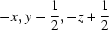
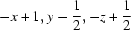
| Symmetry codes: (i) x, −y+1/2, z+1/2; (ii) −x, y−1/2, −z+1/2; (iii) −x+1, y−1/2, −z+1/2. |
Experimental details
| Crystal data | |
| Chemical formula | C6H13O3P |
| Mr | 164.13 |
| Crystal system, space group | Monoclinic, P21/c |
| Temperature (K) | 100 |
| a, b, c (Å) | 7.144 (2), 7.570 (2), 15.064 (4) |
| β (°) | 90.98 (2) |
| V (Å3) | 814.5 (4) |
| Z | 4 |
| Radiation type | Mo Kα |
| µ (mm−1) | 0.29 |
| Crystal size (mm) | 0.33 × 0.27 × 0.26 |
| Data collection | |
| Diffractometer | Kuma KM-4 diffractometer with CCD detector |
| Absorption correction | Analytical (CrysAlis RED; Oxford Diffraction, 2010) |
| Tmin, Tmax | 0.910, 0.952 |
| No. of measured, independent and observed [I > 2σ(I)] reflections | 7254, 1869, 1673 |
| Rint | 0.021 |
| (sin θ/λ)max (Å−1) | 0.650 |
| Refinement | |
| R[F2 > 2σ(F2)], wR(F2), S | 0.035, 0.096, 1.10 |
| No. of reflections | 1869 |
| No. of parameters | 143 |
| H-atom treatment | All H-atom parameters refined |
| Δρmax, Δρmin (e Å−3) | 0.49, −0.30 |
Computer programs: CrysAlis CCD (Oxford Diffraction, 2010), CrysAlis RED (Oxford Diffraction, 2010), SHELXS97 (Sheldrick, 2008), SHELXL97 (Sheldrick, 2008), ORTEP-3 (Farrugia, 1997).
| D—H···A | D—H | H···A | D···A | D—H···A |
| C11—H113···Oi | 0.98 (2) | 2.70 (2) | 3.583 (2) | 150 (2) |
| C12—H123···Oi | 1.00 (2) | 2.60 (2) | 3.499 (2) | 150 (2) |
| C21—H213···Oi | 0.96 (2) | 2.68 (2) | 3.544 (2) | 148 (2) |
| C22—H222···O1ii | 0.98 (2) | 2.64 (2) | 3.515 (2) | 148 (2) |
| P—H···O1iii | 1.28 (2) | 2.58 (2) | 3.4713 (12) | 124 (1) |
| Symmetry codes: (i) x, −y+1/2, z+1/2; (ii) −x, y−1/2, −z+1/2; (iii) −x+1, y−1/2, −z+1/2. |
Acknowledgements
This work was partially supported by the Polish Ministry of Science and Higher Education through grant No. N204 028538. The financial support is gratefully acknowledged.
References
 Allen, F. H., Kennard, O., Watson, D. G., Brammer, L., Orpen, A. G. & Taylor, R. (1987). J. Chem. Soc. Perkin Trans. 2, pp. S1–19. CrossRef Web of Science Google Scholar
Beletskaya, I. P. & Cheprakov, A. V. (2000). Chem. Rev. 100, 3009–3066. Web of Science CrossRef PubMed CAS Google Scholar
Clark, R. C. & Reid, J. S. (1995). Acta Cryst. A51, 887–897. CrossRef CAS Web of Science IUCr Journals Google Scholar
Cosier, J. & Glazer, A. M. (1986). J. Appl. Cryst. 19, 105–107. CrossRef CAS Web of Science IUCr Journals Google Scholar
Desiraju, G. R. & Steiner, T. (1999). The Weak Hydrogen Bond in Structural Chemistry and Biology. New York: Oxford University Press. Google Scholar
Farrugia, L. J. (1997). J. Appl. Cryst. 30, 565. CrossRef IUCr Journals Google Scholar
Maffei, M. & Buono, G. (2003). Tetrahedron, 59, 8821–8825. Web of Science CrossRef CAS Google Scholar
Oxford Diffraction (2010). CrysAlis CCD and CrysAlis RED. Oxford Diffraction Ltd, Wrocław, Poland. Google Scholar
Sheldrick, G. M. (2008). Acta Cryst. A64, 112–122. Web of Science CrossRef CAS IUCr Journals Google Scholar
Skarżyńska, A., Trzeciak, A. M. & Siczek, M. (2011). Inorg. Chim. Acta, 365, 204–210. Google Scholar
Zwierzak, A. (1967). Can. J. Chem. 45, 2501–2512. CrossRef CAS Web of Science Google Scholar
This is an open-access article distributed under the terms of the Creative Commons Attribution (CC-BY) Licence, which permits unrestricted use, distribution, and reproduction in any medium, provided the original authors and source are cited.
| CRYSTALLOGRAPHIC COMMUNICATIONS |


Carbon-carbon bond-forming catalytic reactions are very important fundamental processes in synthetic chemistry. Among them, one of the commonly recognized is the Heck reaction employing as the catalyst precursors palladium compounds with phosphorus ligands (Beletskaya & Cheprakov, 2000). Complexes incorporating in their structure 1,3,2-dioxaphospholane heterocyclic rings have been recently found to be efficient catalysts of the Heck reaction carried out under mild conditions (Skarżyńska et al., 2011). In this paper we report the synthesis and crystallization of tetramethyl dioxaphospholane, the title compound.
The geometric parameters around the four-coordinate phosphorus atom (Fig. 1) indicate a deformation of the ideal tetrahedron towards a trigonal pyramid. The O—P—O1 and O—P—O2 angles differ considerably from the ideal value of 109.5° and approach 120°, while O1—P—O2 is close to 90°. Such deformations might be explained by the effect of different substituents and bond types. Bond lengths P—O1, P—O2, P—O, and P—H are typical (Allen et al., 1987). The heterocyclic five-membered ring P/O1/C1/C2/O2 adopts an envelope conformation with the C1 atom deviating from the four-atom plane by about 0.55 Å.
The crystal structure is stabilized by a few hydrogen bonds of the C—H···O and P—H···O types (Desiraju & Steiner, 1999). Consequently, a three-dimensional network of such interactions is formed in the crystal. The C11, C12 and C21 atoms act as hydrogen-bond donors, via H113, H123 and H213, respectively, to the Oi atom [symmetry code: (i) x, –y + 1/2, z + 1/2] as an acceptor (Table 1). As a result, chains running parallel to the [001] direction are formed. The adjacent chains of the molecules are further linked by C22—H222···O1ii and P—H···O1iii hydrogen interactions [symmetry codes: (ii) –x, y – 1/2, –z + 1/2; (iii) –x + 1, y – 1/2, –z + 1/2].