 | Acta Crystallographica Section E Acta Crystallographica Section E CRYSTALLOGRAPHIC COMMUNICATIONS |


 journal menu


organic compounds
| CRYSTALLOGRAPHIC COMMUNICATIONS |
 access
Acridine 0.75-hydrate

aBen Gurion University of the Negev, Beer Sheva, Israel 84105
*Correspondence e-mail: [email protected]
The title compound, C13H9N·0.75H2O was obtained during a study of the polymorphic system of acridine, by slow evaporation from an ethanol–water solution. There are two acridine molecules (indicated by I and II, respectively) and one and a half water molecules in the asymmetric unit. The half-molecule of water is located on a crystallographic twofold axis. The crystal structure is built up from two threads of molecule II sewn together with water molecules through O—H⋯O and O—H⋯N hydrogen bonds from one side and with π–π interactions [centroid–centroid distance = 3.640 (3) and 3.7431 (3) Å] between overlapping molecules II on the other side. Molecule I is attached to this thread from both sides by C—H⋯O hydrogen bonds. The threads are connected to each other by π–π interactions [centroid–centroid distances = 3.582 (3) and 3.582 (3) Å] between the inner side of molecule I and stabilized by a C—H⋯π interaction on the other side of molecule I. This thread with rows of molecule I hanging on its sides is generated by translation perpendicular to the a axis.
Related literature
For the five anhydrous polymorphs of acridine, see: Phillips (1954![[Phillips, D. C. (1954). Acta Cryst. 7, C649, abstract No. 25.]](../../../../../../logos/arrows/e_arr.gif "Phillips, D. C. (1954). Acta Cryst. 7, C649, abstract No. 25.") , 1956), Phillips et al. (1960) and Mei & Wolf (2004) for monoclinic forms VI and VII, and Braga et al. (2010) for orthorhombic form IV and monoclinic forms II and III. For further crystallographic studies of acridine hydrate, see: Groth (1919); Lowde et al. (1953).
, 1956), Phillips et al. (1960) and Mei & Wolf (2004) for monoclinic forms VI and VII, and Braga et al. (2010) for orthorhombic form IV and monoclinic forms II and III. For further crystallographic studies of acridine hydrate, see: Groth (1919); Lowde et al. (1953).
![[Scheme 1]](ez2255scheme1.gif)
Experimental
Crystal data
|
Data collection
|
Refinement
|
|
 ; (iii)
 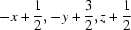 .
. Data collection: SMART (Bruker, 2005); cell refinement: SAINT (Bruker, 2003); data reduction: SAINT; program(s) used to solve structure: SHELXTL (Sheldrick, 2008); program(s) used to refine structure: SHELXTL; molecular graphics: OLEX2 (Dolomanov et al., 2009); software used to prepare material for publication: OLEX2.
Supporting information
contains datablocks I, global. DOI: https://doi.org/10.1107/S1600536811038220/ez2255sup1.cif
Structure factors: contains datablock I. DOI: https://doi.org/10.1107/S1600536811038220/ez2255Isup2.hkl
Supporting information file. DOI: https://doi.org/10.1107/S1600536811038220/ez2255Isup3.cml
The title compound was obtained by slow evaporation from an ethanol-water solution in 3:1 and 2:1 ratio at 4°C. The crystals are unstable at room temperature and transform to the anhydrous form III. The common habit of acridine hydrate is thick yellow needles but other habits may be obtained as well.
The water H atoms were located in a difference map and refined with distance restraints of O—H = 0.94 (2) Å. Other H atoms were positioned geometrically and refined using a riding model with C—H = 0.930 (1) Å.
Acridine hydrate is the hydrated form of the very rich polymorphic system of acridine. There are five anhydrous polymorphs of acridine with fully analyzed structures: an orthorhombic form and four monoclinic forms. For the orthorhombic form (form IV) cell parameters were first published by Phillips (1954), and the full solution was recently published by Braga et al. (2010). The monoclinic forms are designated II, III, VI and VII. The of forms III and II respectively were determined by Phillips (1956) and Phillips et al. (1960) and redetermined by Mei and Wolf (2004) and by Braga et al. (2010). Forms VI and VII were reported by Mei and Wolf (2004). The form described in this paper was initially thought to be one of the first polymorphs of acridine and known historically as the orthorhombic form of Groth (1919) and subsequently labeled as acridine I. Lowde et al. (1953) established the parameters, the and the density. From analysis using the Karl Fischer reagent, it was concluded that acridine I is in fact the monohydrate and not a polymorph of acridine.
There are two acridine molecules and one and a half water molecules in the (see Fig. 1). In the packing diagram (see Fig. 2), molecule I is colored in green, molecule II is colored in blue, the water molecule that is sitting on a two fold axis is red and the other one is in yellow. The molecules are linked by O—H···O and C—H···O hydrogen bonds (see Table 1).
For the five anhydrous polymorphs of acridine, see: Phillips (1954, 1956), Phillips et al. (1960) and Mei & Wolf (2004) for monoclinic forms VI and VII, and Braga et al. (2010) for orthorhombic form IV and monoclinic forms II and III. For further crystallographic studies of acridine hydrate, see: Groth (1919); Lowde et al. (1953).
Data collection: SMART (Bruker, 2005); cell SAINT (Bruker, 2003); data reduction: SAINT (Bruker, 2003); program(s) used to solve structure: SHELXTL (Sheldrick, 2008); program(s) used to refine structure: SHELXTL (Sheldrick, 2008); molecular graphics: OLEX2 (Dolomanov et al.,2009); software used to prepare material for publication: OLEX2 (Dolomanov et al.,2009).
![[Figure 1]](./ez2255fig1thm.gif) | Fig. 1. The asymmetric unit with atom labels and 50% probability displacement ellipsoids for non-H atoms. Atom H1i is generated by a two-fold axis (-x, y, -z-1/2). |
![[Figure 2]](./ez2255fig2thm.gif) | Fig. 2. The packing of acridine hydrate viewed down the b axis. Hydrogen bonds are marked in dashed lines. |
| C13H9N·0.75H2O | F(000) = 1632 |
| Mr = 192.71 | Dx = 1.247 Mg m−3 Dm = 1.247 Mg m−3 Dm measured by not measured |
| Orthorhombic, Pbcn | Mo Kα radiation, λ = 0.71073 Å |
| Hall symbol: -P 2n 2ab | Cell parameters from 1764 reflections |
| a = 26.400 (5) Å | θ = 2.3–21.8° |
| b = 8.893 (5) Å | µ = 0.08 mm−1 |
| c = 17.492 (5) Å | T = 197 K |
| V = 4107 (3) Å3 | Cube, yellow |
| Z = 16 | 0.3 × 0.3 × 0.3 mm |
| Bruker SMART 6000 diffractometer | 1733 reflections with I > 2σ(I) |
| Radiation source: fine-focus sealed tube | Rint = 0.068 |
| Graphite monochromator | θmax = 25.0°, θmin = 3.3° |
| phi and ω scans | h = −31→22 |
| 14504 measured reflections | k = −10→9 |
| 3606 independent reflections | l = −20→20 |
| Refinement on F2 | Primary atom site location: structure-invariant direct methods |
| Least-squares matrix: full | Secondary atom site location: difference Fourier map |
| R[F2 > 2σ(F2)] = 0.058 | Hydrogen site location: inferred from neighbouring sites |
| wR(F2) = 0.197 | H atoms treated by a mixture of independent and constrained refinement |
| S = 1.00 | w = 1/[σ2(Fo2) + (0.0837P)2 + 1.779P] where P = (Fo2 + 2Fc2)/3 |
| 3606 reflections | (Δ/σ)max = 0.035 |
| 272 parameters | Δρmax = 0.35 e Å−3 |
| 2 restraints | Δρmin = −0.29 e Å−3 |
| C13H9N·0.75H2O | V = 4107 (3) Å3 |
| Mr = 192.71 | Z = 16 |
| Orthorhombic, Pbcn | Mo Kα radiation |
| a = 26.400 (5) Å | µ = 0.08 mm−1 |
| b = 8.893 (5) Å | T = 197 K |
| c = 17.492 (5) Å | 0.3 × 0.3 × 0.3 mm |
| Bruker SMART 6000 diffractometer | 1733 reflections with I > 2σ(I) |
| 14504 measured reflections | Rint = 0.068 |
| 3606 independent reflections |
| R[F2 > 2σ(F2)] = 0.058 | 2 restraints |
| wR(F2) = 0.197 | H atoms treated by a mixture of independent and constrained refinement |
| S = 1.00 | Δρmax = 0.35 e Å−3 |
| 3606 reflections | Δρmin = −0.29 e Å−3 |
| 272 parameters |
Geometry. All e.s.d.'s (except the e.s.d. in the dihedral angle between two l.s. planes) are estimated using the full covariance matrix. The cell e.s.d.'s are taken into account individually in the estimation of e.s.d.'s in distances, angles and torsion angles; correlations between e.s.d.'s in cell parameters are only used when they are defined by crystal symmetry. An approximate (isotropic) treatment of cell e.s.d.'s is used for estimating e.s.d.'s involving l.s. planes. |
Refinement. Refinement of F2 against ALL reflections. The weighted R-factor wR and goodness of fit S are based on F2, conventional R-factors R are based on F, with F set to zero for negative F2. The threshold expression of F2 > σ(F2) is used only for calculating R-factors(gt) etc. and is not relevant to the choice of reflections for refinement. R-factors based on F2 are statistically about twice as large as those based on F, and R- factors based on ALL data will be even larger. |
| x | y | z | Uiso*/Ueq | ||
| C1 | 0.08797 (12) | 0.6902 (4) | −0.0316 (2) | 0.0579 (9) | |
| C2 | 0.10417 (14) | 0.8419 (5) | −0.0350 (2) | 0.0746 (11) | |
| H2 | 0.1166 | 0.8883 | 0.0088 | 0.090* | |
| C3 | 0.10180 (15) | 0.9206 (5) | −0.1017 (3) | 0.0846 (13) | |
| H3 | 0.1125 | 1.0202 | −0.1031 | 0.102* | |
| C4 | 0.08311 (15) | 0.8515 (6) | −0.1688 (3) | 0.0839 (13) | |
| H4 | 0.0813 | 0.9066 | −0.2140 | 0.101* | |
| C5 | 0.06791 (14) | 0.7066 (5) | −0.1681 (2) | 0.0741 (11) | |
| H5 | 0.0563 | 0.6625 | −0.2130 | 0.089* | |
| C6 | 0.06934 (11) | 0.6201 (5) | −0.0995 (2) | 0.0581 (9) | |
| C7 | 0.05310 (11) | 0.4738 (4) | −0.09624 (19) | 0.0551 (9) | |
| H7 | 0.0409 | 0.4271 | −0.1401 | 0.066* | |
| C8 | 0.05470 (11) | 0.3952 (4) | −0.0281 (2) | 0.0571 (9) | |
| C9 | 0.03850 (13) | 0.2431 (5) | −0.0214 (2) | 0.0703 (11) | |
| H9 | 0.0268 | 0.1922 | −0.0644 | 0.084* | |
| C10 | 0.03996 (14) | 0.1718 (5) | 0.0472 (3) | 0.0789 (12) | |
| H10 | 0.0293 | 0.0724 | 0.0507 | 0.095* | |
| C11 | 0.05760 (14) | 0.2473 (6) | 0.1135 (2) | 0.0798 (12) | |
| H11 | 0.0583 | 0.1969 | 0.1601 | 0.096* | |
| C12 | 0.07325 (13) | 0.3910 (5) | 0.1097 (2) | 0.0689 (11) | |
| H12 | 0.0843 | 0.4392 | 0.1538 | 0.083* | |
| C13 | 0.07305 (11) | 0.4701 (4) | 0.0390 (2) | 0.0578 (9) | |
| C14 | 0.19756 (12) | 0.7990 (4) | 0.28030 (18) | 0.0503 (8) | |
| C15 | 0.16763 (13) | 0.7107 (4) | 0.3315 (2) | 0.0628 (10) | |
| H15 | 0.1325 | 0.7115 | 0.3271 | 0.075* | |
| C16 | 0.18986 (15) | 0.6257 (4) | 0.3863 (2) | 0.0716 (11) | |
| H16 | 0.1697 | 0.5686 | 0.4189 | 0.086* | |
| C17 | 0.24310 (16) | 0.6224 (4) | 0.3950 (2) | 0.0708 (11) | |
| H17 | 0.2577 | 0.5645 | 0.4334 | 0.085* | |
| C18 | 0.27294 (14) | 0.7039 (4) | 0.3470 (2) | 0.0638 (10) | |
| H18 | 0.3079 | 0.7009 | 0.3530 | 0.077* | |
| C19 | 0.25146 (12) | 0.7941 (4) | 0.28769 (18) | 0.0514 (8) | |
| C20 | 0.28036 (11) | 0.8773 (4) | 0.23658 (18) | 0.0524 (8) | |
| H20 | 0.3155 | 0.8749 | 0.2398 | 0.063* | |
| C21 | 0.25709 (12) | 0.9640 (4) | 0.18072 (18) | 0.0504 (8) | |
| C22 | 0.28402 (14) | 1.0520 (4) | 0.1261 (2) | 0.0639 (10) | |
| H22 | 0.3192 | 1.0524 | 0.1271 | 0.077* | |
| C23 | 0.25950 (17) | 1.1351 (4) | 0.0727 (2) | 0.0737 (11) | |
| H23 | 0.2779 | 1.1914 | 0.0376 | 0.088* | |
| C24 | 0.20596 (17) | 1.1363 (4) | 0.0705 (2) | 0.0734 (11) | |
| H24 | 0.1893 | 1.1932 | 0.0336 | 0.088* | |
| C25 | 0.17860 (13) | 1.0551 (4) | 0.1217 (2) | 0.0632 (10) | |
| H25 | 0.1434 | 1.0584 | 0.1199 | 0.076* | |
| C26 | 0.20288 (12) | 0.9648 (4) | 0.17826 (18) | 0.0514 (8) | |
| N1 | 0.08930 (10) | 0.6160 (4) | 0.03670 (17) | 0.0675 (9) | |
| N2 | 0.17409 (9) | 0.8829 (3) | 0.22676 (15) | 0.0528 (7) | |
| O1 | 0.0000 | 0.3361 (6) | −0.2500 | 0.1183 (16) | |
| O2 | 0.07381 (11) | 0.8227 (5) | 0.17081 (17) | 0.1234 (14) | |
| H2A | 0.0499 | 0.9004 | 0.2031 | 0.137 (18)* | |
| H2B | 0.1071 | 0.8385 | 0.1869 | 0.137 (18)* | |
| H1 | −0.0308 (14) | 0.280 (6) | −0.248 (4) | 0.205* |
| U11 | U22 | U33 | U12 | U13 | U23 | |
| C1 | 0.0437 (18) | 0.066 (2) | 0.064 (2) | 0.0044 (17) | 0.0016 (16) | −0.010 (2) |
| C2 | 0.065 (2) | 0.075 (3) | 0.084 (3) | −0.003 (2) | 0.015 (2) | −0.021 (3) |
| C3 | 0.074 (3) | 0.071 (3) | 0.110 (3) | −0.002 (2) | 0.029 (3) | −0.009 (3) |
| C4 | 0.077 (3) | 0.095 (4) | 0.080 (3) | 0.006 (3) | 0.017 (2) | 0.008 (3) |
| C5 | 0.066 (2) | 0.093 (3) | 0.064 (2) | −0.002 (2) | 0.0025 (18) | −0.005 (2) |
| C6 | 0.0389 (17) | 0.073 (3) | 0.063 (2) | 0.0082 (17) | 0.0009 (15) | −0.012 (2) |
| C7 | 0.0434 (18) | 0.068 (2) | 0.054 (2) | 0.0046 (18) | −0.0042 (15) | −0.0172 (19) |
| C8 | 0.0383 (17) | 0.062 (2) | 0.071 (2) | 0.0124 (17) | −0.0010 (16) | −0.016 (2) |
| C9 | 0.056 (2) | 0.069 (3) | 0.086 (3) | 0.005 (2) | 0.0002 (19) | −0.016 (2) |
| C10 | 0.058 (2) | 0.067 (3) | 0.112 (3) | 0.011 (2) | 0.010 (2) | 0.003 (3) |
| C11 | 0.060 (2) | 0.097 (4) | 0.082 (3) | 0.017 (2) | −0.002 (2) | 0.010 (3) |
| C12 | 0.053 (2) | 0.086 (3) | 0.068 (3) | 0.010 (2) | −0.0068 (18) | −0.003 (2) |
| C13 | 0.0365 (17) | 0.071 (3) | 0.066 (2) | 0.0093 (17) | −0.0025 (15) | −0.011 (2) |
| C14 | 0.0470 (18) | 0.047 (2) | 0.0574 (19) | 0.0011 (16) | 0.0037 (16) | −0.0130 (17) |
| C15 | 0.054 (2) | 0.063 (2) | 0.072 (2) | −0.0028 (19) | 0.0115 (18) | −0.010 (2) |
| C16 | 0.087 (3) | 0.059 (3) | 0.069 (2) | −0.006 (2) | 0.013 (2) | −0.003 (2) |
| C17 | 0.087 (3) | 0.063 (3) | 0.063 (2) | 0.002 (2) | −0.008 (2) | −0.003 (2) |
| C18 | 0.063 (2) | 0.063 (2) | 0.066 (2) | 0.008 (2) | −0.0122 (19) | −0.009 (2) |
| C19 | 0.0486 (18) | 0.049 (2) | 0.0570 (19) | 0.0012 (16) | −0.0049 (16) | −0.0135 (18) |
| C20 | 0.0380 (17) | 0.054 (2) | 0.065 (2) | −0.0018 (16) | −0.0014 (15) | −0.0157 (19) |
| C21 | 0.0512 (18) | 0.0441 (19) | 0.0560 (19) | −0.0004 (16) | 0.0004 (16) | −0.0157 (17) |
| C22 | 0.064 (2) | 0.061 (2) | 0.066 (2) | −0.0080 (19) | 0.0095 (19) | −0.014 (2) |
| C23 | 0.099 (3) | 0.058 (3) | 0.065 (2) | −0.011 (2) | 0.011 (2) | −0.005 (2) |
| C24 | 0.095 (3) | 0.059 (2) | 0.066 (2) | −0.001 (2) | −0.015 (2) | −0.005 (2) |
| C25 | 0.060 (2) | 0.057 (2) | 0.073 (2) | 0.0022 (19) | −0.0128 (19) | −0.011 (2) |
| C26 | 0.0475 (18) | 0.047 (2) | 0.060 (2) | 0.0032 (16) | −0.0039 (16) | −0.0153 (18) |
| N1 | 0.0478 (16) | 0.082 (2) | 0.073 (2) | 0.0054 (16) | −0.0043 (14) | −0.0156 (19) |
| N2 | 0.0406 (15) | 0.0505 (17) | 0.0672 (17) | 0.0005 (13) | −0.0006 (13) | −0.0101 (15) |
| O1 | 0.077 (3) | 0.118 (4) | 0.160 (4) | 0.000 | 0.014 (3) | 0.000 |
| O2 | 0.0619 (18) | 0.204 (4) | 0.104 (2) | −0.034 (2) | −0.0056 (17) | −0.013 (3) |
| C1—C2 | 1.416 (5) | C14—N2 | 1.348 (4) |
| C1—C6 | 1.430 (5) | C15—H15 | 0.9300 |
| C1—N1 | 1.365 (4) | C15—C16 | 1.354 (5) |
| C2—H2 | 0.9300 | C16—H16 | 0.9300 |
| C2—C3 | 1.362 (5) | C16—C17 | 1.414 (5) |
| C3—H3 | 0.9300 | C17—H17 | 0.9300 |
| C3—C4 | 1.414 (6) | C17—C18 | 1.359 (5) |
| C4—H4 | 0.9300 | C18—H18 | 0.9300 |
| C4—C5 | 1.350 (6) | C18—C19 | 1.429 (4) |
| C5—H5 | 0.9300 | C19—C20 | 1.389 (4) |
| C5—C6 | 1.425 (5) | C20—H20 | 0.9300 |
| C6—C7 | 1.371 (5) | C20—C21 | 1.388 (4) |
| C7—H7 | 0.9300 | C21—C22 | 1.425 (5) |
| C7—C8 | 1.382 (5) | C21—C26 | 1.432 (4) |
| C8—C9 | 1.423 (5) | C22—H22 | 0.9300 |
| C8—C13 | 1.434 (5) | C22—C23 | 1.356 (5) |
| C9—H9 | 0.9300 | C23—H23 | 0.9300 |
| C9—C10 | 1.358 (5) | C23—C24 | 1.414 (5) |
| C10—H10 | 0.9300 | C24—H24 | 0.9300 |
| C10—C11 | 1.420 (5) | C24—C25 | 1.359 (5) |
| C11—H11 | 0.9300 | C25—H25 | 0.9300 |
| C11—C12 | 1.345 (6) | C25—C26 | 1.426 (4) |
| C12—H12 | 0.9300 | C26—N2 | 1.352 (4) |
| C12—C13 | 1.423 (5) | O1—H1 | 0.954 (11) |
| C13—N1 | 1.367 (5) | O2—H2A | 1.093 (4) |
| C14—C15 | 1.430 (5) | O2—H2B | 0.933 (3) |
| C14—C19 | 1.430 (4) | ||
| C2—C1—C6 | 118.9 (4) | N2—C14—C19 | 122.5 (3) |
| N1—C1—C2 | 119.3 (3) | C14—C15—H15 | 119.7 |
| N1—C1—C6 | 121.7 (3) | C16—C15—C14 | 120.7 (3) |
| C1—C2—H2 | 119.6 | C16—C15—H15 | 119.7 |
| C3—C2—C1 | 120.8 (4) | C15—C16—H16 | 119.4 |
| C3—C2—H2 | 119.6 | C15—C16—C17 | 121.2 (4) |
| C2—C3—H3 | 119.9 | C17—C16—H16 | 119.4 |
| C2—C3—C4 | 120.3 (4) | C16—C17—H17 | 120.0 |
| C4—C3—H3 | 119.9 | C18—C17—C16 | 119.9 (4) |
| C3—C4—H4 | 119.6 | C18—C17—H17 | 120.0 |
| C5—C4—C3 | 120.7 (4) | C17—C18—H18 | 119.4 |
| C5—C4—H4 | 119.6 | C17—C18—C19 | 121.2 (3) |
| C4—C5—H5 | 119.5 | C19—C18—H18 | 119.4 |
| C4—C5—C6 | 121.0 (4) | C18—C19—C14 | 118.5 (3) |
| C6—C5—H5 | 119.5 | C20—C19—C14 | 118.2 (3) |
| C5—C6—C1 | 118.3 (4) | C20—C19—C18 | 123.3 (3) |
| C7—C6—C1 | 119.1 (3) | C19—C20—H20 | 119.8 |
| C7—C6—C5 | 122.6 (3) | C21—C20—C19 | 120.4 (3) |
| C6—C7—H7 | 119.8 | C21—C20—H20 | 119.8 |
| C6—C7—C8 | 120.4 (3) | C20—C21—C22 | 123.8 (3) |
| C8—C7—H7 | 119.8 | C20—C21—C26 | 117.8 (3) |
| C7—C8—C9 | 122.8 (3) | C22—C21—C26 | 118.4 (3) |
| C7—C8—C13 | 118.8 (3) | C21—C22—H22 | 119.2 |
| C9—C8—C13 | 118.4 (4) | C23—C22—C21 | 121.5 (3) |
| C8—C9—H9 | 119.7 | C23—C22—H22 | 119.2 |
| C10—C9—C8 | 120.5 (4) | C22—C23—H23 | 120.0 |
| C10—C9—H9 | 119.7 | C22—C23—C24 | 120.0 (4) |
| C9—C10—H10 | 119.6 | C24—C23—H23 | 120.0 |
| C9—C10—C11 | 120.7 (4) | C23—C24—H24 | 119.7 |
| C11—C10—H10 | 119.6 | C25—C24—C23 | 120.6 (4) |
| C10—C11—H11 | 119.7 | C25—C24—H24 | 119.7 |
| C12—C11—C10 | 120.6 (4) | C24—C25—H25 | 119.4 |
| C12—C11—H11 | 119.7 | C24—C25—C26 | 121.2 (3) |
| C11—C12—H12 | 119.6 | C26—C25—H25 | 119.4 |
| C11—C12—C13 | 120.8 (4) | C25—C26—C21 | 118.2 (3) |
| C13—C12—H12 | 119.6 | N2—C26—C21 | 122.7 (3) |
| C12—C13—C8 | 118.9 (4) | N2—C26—C25 | 119.1 (3) |
| N1—C13—C8 | 121.5 (3) | C13—N1—C1 | 118.5 (3) |
| N1—C13—C12 | 119.6 (3) | C14—N2—C26 | 118.4 (3) |
| C19—C14—C15 | 118.5 (3) | H2A—O2—H2B | 107.1 (3) |
| N2—C14—C15 | 119.0 (3) |
| Cg1 and Cg2 are the centroids of the C1/C6–C8/C13/N1 and C1–C6 rings, respectively. |
| D—H···A | D—H | H···A | D···A | D—H···A |
| O2—H2B···N2 | 0.933 (3) | 1.942 (2) | 2.873 (4) | 175.2 (2) |
| C7—H7···O1 | 0.93 | 2.35 | 3.271 (4) | 171 |
| O1—H1···O2i | 0.95 (1) | 1.98 (5) | 2.777 (4) | 139 (6) |
| C16—H16···Cg1ii | 0.93 | 2.93 | 3.773 (5) | 152 |
| C18—H18···Cg2iii | 0.93 | 2.93 | 3.848 (5) | 168 |
| Symmetry codes: (i) −x, −y+1, −z; (ii) x, −y+1, z+1/2; (iii) −x+1/2, −y+3/2, z+1/2. |
Experimental details
| Crystal data | |
| Chemical formula | C13H9N·0.75H2O |
| Mr | 192.71 |
| Crystal system, space group | Orthorhombic, Pbcn |
| Temperature (K) | 197 |
| a, b, c (Å) | 26.400 (5), 8.893 (5), 17.492 (5) |
| V (Å3) | 4107 (3) |
| Z | 16 |
| Radiation type | Mo Kα |
| µ (mm−1) | 0.08 |
| Crystal size (mm) | 0.3 × 0.3 × 0.3 |
| Data collection | |
| Diffractometer | Bruker SMART 6000 |
| Absorption correction | – |
| No. of measured, independent and observed [I > 2σ(I)] reflections | 14504, 3606, 1733 |
| Rint | 0.068 |
| (sin θ/λ)max (Å−1) | 0.596 |
| Refinement | |
| R[F2 > 2σ(F2)], wR(F2), S | 0.058, 0.197, 1.00 |
| No. of reflections | 3606 |
| No. of parameters | 272 |
| No. of restraints | 2 |
| H-atom treatment | H atoms treated by a mixture of independent and constrained refinement |
| Δρmax, Δρmin (e Å−3) | 0.35, −0.29 |
Computer programs: SMART (Bruker, 2005), SAINT (Bruker, 2003), SHELXTL (Sheldrick, 2008), OLEX2 (Dolomanov et al.,2009).
| Cg1 and Cg2 are the centroids of the C1/C6–C8/C13/N1 and C1–C6 rings, respectively. |
| D—H···A | D—H | H···A | D···A | D—H···A |
| O2—H2B···N2 | 0.933 (3) | 1.942 (2) | 2.873 (4) | 175.2 (2) |
| C7—H7···O1 | 0.93 | 2.35 | 3.271 (4) | 171.2 |
| O1—H1···O2i | 0.954 (11) | 1.98 (5) | 2.777 (4) | 139 (6) |
| C16—H16···Cg1ii | 0.93 | 2.93 | 3.773 (5) | 152 |
| C18—H18···Cg2iii | 0.93 | 2.93 | 3.848 (5) | 168 |
| Symmetry codes: (i) −x, −y+1, −z; (ii) x, −y+1, z+1/2; (iii) −x+1/2, −y+3/2, z+1/2. |
References
 Braga, D., Grepioni, F., Maini, L., Mazzeo, P. P. & Rubini, K. (2010). Thermochimica Acta, 507–508, 1–8. Web of Science CSD CrossRef CAS Google Scholar
Bruker (2003). SAINT. Bruker AXS Inc., Madison, Wisconsin, USA. Google Scholar
Bruker (2005). SMART. Bruker AXS Inc., Madison, Wisconsin, USA. Google Scholar
Dolomanov, O. V., Bourhis, L. J., Gildea, R. J., Howard, J. A. K. & Puschmann, H. (2009). J. Appl. Cryst. 42, 339–341. Web of Science CrossRef CAS IUCr Journals Google Scholar
Groth, P. (1919). Chem. Kristallogr. 5, 816–817. Google Scholar
Lowde, R. D., Phillips, D. C. & Wood, R. G. (1953). Acta Cryst. 6, 553–556. CSD CrossRef CAS IUCr Journals Web of Science Google Scholar
Mei, X. & Wolf, C. (2004). Cryst. Growth Des. 4, 1099–1103. Web of Science CSD CrossRef CAS Google Scholar
Phillips, D. C. (1954). Acta Cryst. 7, C649, abstract No. 25. Google Scholar
Phillips, D. C. (1956). Acta Cryst. 9, 237–250. CSD CrossRef CAS IUCr Journals Web of Science Google Scholar
Phillips, D. C., Ahmed, F. R. & Barnes, W. H. (1960). Acta Cryst. 13, 365–377. CSD CrossRef CAS IUCr Journals Web of Science Google Scholar
Sheldrick, G. M. (2008). Acta Cryst. A64, 112–122. Web of Science CrossRef CAS IUCr Journals Google Scholar
This is an open-access article distributed under the terms of the Creative Commons Attribution (CC-BY) Licence, which permits unrestricted use, distribution, and reproduction in any medium, provided the original authors and source are cited.
| CRYSTALLOGRAPHIC COMMUNICATIONS |


Acridine hydrate is the hydrated form of the very rich polymorphic system of acridine. There are five anhydrous polymorphs of acridine with fully analyzed structures: an orthorhombic form and four monoclinic forms. For the orthorhombic form (form IV) cell parameters were first published by Phillips (1954), and the full solution was recently published by Braga et al. (2010). The monoclinic forms are designated II, III, VI and VII. The crystal structure of forms III and II respectively were determined by Phillips (1956) and Phillips et al. (1960) and redetermined by Mei and Wolf (2004) and by Braga et al. (2010). Forms VI and VII were reported by Mei and Wolf (2004). The form described in this paper was initially thought to be one of the first polymorphs of acridine and known historically as the orthorhombic form of Groth (1919) and subsequently labeled as acridine I. Lowde et al. (1953) established the unit cell parameters, the space group and the density. From analysis using the Karl Fischer reagent, it was concluded that acridine I is in fact the monohydrate and not a polymorph of acridine.
There are two acridine molecules and one and a half water molecules in the asymmetric unit (see Fig. 1). In the packing diagram (see Fig. 2), molecule I is colored in green, molecule II is colored in blue, the water molecule that is sitting on a two fold axis is red and the other one is in yellow. The molecules are linked by O—H···O and C—H···O hydrogen bonds (see Table 1).