Experimental
Crystal data
[Zn(C6H3N2O4)(H2O)2]NO3 Mr = 330.52 Monoclinic, P 21 /n a = 8.7431 (17) Å b = 10.867 (2) Å c = 11.412 (2) Å β = 100.48 (3)° V = 1066.2 (4) Å3 Z = 4 Mo Kα radiation μ = 2.36 mm−1 T = 293 K 0.20 × 0.19 × 0.15 mm
|
Data collection
Kuma KM-4 four-circle diffractometer Absorption correction: analytical (CrysAlis RED; Oxford Diffraction, 2008![[Oxford Diffraction (2008). CrysAlis RED. Oxford Diffraction Ltd, Yarnton, England.]](../../../../../../logos/arrows/e_arr.gif "Oxford Diffraction (2008). CrysAlis RED. Oxford Diffraction Ltd, Yarnton, England.") ) Tmin = 0.636, Tmax = 0.747 ) Tmin = 0.636, Tmax = 0.747 3232 measured reflections 3101 independent reflections 2397 reflections with I > 2σ(I) Rint = 0.012 3 standard reflections every 200 reflections intensity decay: 1.6%
|
| Zn1—O6 | 2.052 (2) | | Zn1—O5 | 2.069 (2) | | Zn1—O4i | 2.0769 (18) | | Zn1—O1 | 2.0816 (17) | | Zn1—N1 | 2.1663 (18) | | Zn1—N2i | 2.1946 (19) | Symmetry code: (i) 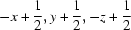 . .
| |
| D—H⋯A | D—H | H⋯A | D⋯A | D—H⋯A | | O6—H61⋯O13ii | 0.84 (4) | 1.90 (4) | 2.732 (3) | 176 (3) | | O5—H52⋯O12iii | 0.83 (4) | 1.88 (4) | 2.696 (3) | 169 (4) | | O6—H62⋯O11iii | 0.72 (5) | 2.04 (5) | 2.758 (3) | 175 (5) | | O5—H51⋯O3ii | 0.73 (6) | 2.37 (5) | 2.983 (3) | 142 (5) | | O5—H51⋯O11i | 0.73 (6) | 2.63 (6) | 3.094 (4) | 123 (5) | | O2—H3⋯O3 | 1.20 (5) | 1.22 (5) | 2.404 (2) | 170 (4) | Symmetry codes: (i) ; (ii) 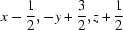 ; (iii) x-1, y, z. ; (iii) x-1, y, z.
| |
Data collection: KM-4 Software (Kuma, 1996); cell refinement: KM-4 Software; data reduction: DATAPROC (Kuma, 2001); program(s) used to solve structure: SHELXS97 (Sheldrick, 2008); program(s) used to refine structure: SHELXL97 (Sheldrick, 2008); molecular graphics: SHELXTL (Sheldrick, 2008); software used to prepare material for publication: SHELXTL.
Supporting information
Single crystals of the title compound were found incidently in the course of an attempt to obtain dinuclear magnesium-zinc complex with the pyrazine-2,3-dicarboxylate ligand. A solution containing 2 mmols of pyrazine-2,3-dicarboxylic acid dihydrate, 1 mmol of magnesium nitrate dihydrate and a small excess over 1 mmol of zinc nitrate hexahydrate in 100 mL of doubly distilled water was boiled under reflux with stirring for 10 h. After cooling to room temperature, two drops of 95% hydrazine were added to the solution which was left to crystallise. Colourless single-crystal blocks of the title compound and crystals of Zn(H2O)6(NO3)2 were found in an unidentified polycrystalline material after evaporation to dryness. The crystals of the title complex were extracted, washed with ethanol and dried in air.
Water hydrogen atoms were located in a difference map and refined isotropically while H atoms attached to pyrazine-ring C atoms were located at calculated positions and treated as riding on the parent atoms with C—H=0.93 Å and Uiso(H)=1.2Ueq(C).
Data collection: KM-4 Software (Kuma, 1996); cell refinement: KM-4 Software (Kuma, 1996); data reduction: DATAPROC (Kuma, 2001); program(s) used to solve structure: SHELXS97 (Sheldrick, 2008); program(s) used to refine structure: SHELXL97 (Sheldrick, 2008); molecular graphics: SHELXTL (Sheldrick, 2008); software used to prepare material for publication: SHELXTL (Sheldrick, 2008).
catena-Poly[[(diaquazinc)-µ-3-carboxypyrazine-2-carboxylato-
κ4N1,
O2;
N4,
O3] nitrate]
top Crystal data top | [Zn(C6H3N2O4)(H2O)2]NO3 | F(000) = 664 |
| Mr = 330.52 | Dx = 2.059 Mg m−3 |
| Monoclinic, P21/n | Mo Kα radiation, λ = 0.71073 Å |
| Hall symbol: -P 2yn | Cell parameters from 25 reflections |
| a = 8.7431 (17) Å | θ = 6–15° |
| b = 10.867 (2) Å | µ = 2.36 mm−1 |
| c = 11.412 (2) Å | T = 293 K |
| β = 100.48 (3)° | Blocks, colourless |
| V = 1066.2 (4) Å3 | 0.20 × 0.19 × 0.15 mm |
| Z = 4 | |
Data collection top Kuma KM-4 four-circle
diffractometer | 2397 reflections with I > 2σ(I) |
| Radiation source: fine-focus sealed tube | Rint = 0.012 |
| Graphite monochromator | θmax = 30.1°, θmin = 2.6° |
| profile data from ω/2θ scans | h = −10→12 |
Absorption correction: analytical
(CrysAlis RED; Oxford Diffraction, 2008) | k = −15→0 |
| Tmin = 0.636, Tmax = 0.747 | l = −16→0 |
| 3232 measured reflections | 3 standard reflections every 200 reflections |
| 3101 independent reflections | intensity decay: 1.6% |
Refinement top | Refinement on F2 | Primary atom site location: structure-invariant direct methods |
| Least-squares matrix: full | Secondary atom site location: difference Fourier map |
| R[F2 > 2σ(F2)] = 0.032 | Hydrogen site location: inferred from neighbouring sites |
| wR(F2) = 0.097 | H atoms treated by a mixture of independent and constrained refinement |
| S = 1.03 | w = 1/[σ2(Fo2) + (0.0564P)2 + 0.8069P]
where P = (Fo2 + 2Fc2)/3 |
| 3101 reflections | (Δ/σ)max = 0.001 |
| 192 parameters | Δρmax = 0.81 e Å−3 |
| 0 restraints | Δρmin = −0.48 e Å−3 |
Crystal data top | [Zn(C6H3N2O4)(H2O)2]NO3 | V = 1066.2 (4) Å3 |
| Mr = 330.52 | Z = 4 |
| Monoclinic, P21/n | Mo Kα radiation |
| a = 8.7431 (17) Å | µ = 2.36 mm−1 |
| b = 10.867 (2) Å | T = 293 K |
| c = 11.412 (2) Å | 0.20 × 0.19 × 0.15 mm |
| β = 100.48 (3)° | |
Data collection top Kuma KM-4 four-circle
diffractometer | 2397 reflections with I > 2σ(I) |
Absorption correction: analytical
(CrysAlis RED; Oxford Diffraction, 2008) | Rint = 0.012 |
| Tmin = 0.636, Tmax = 0.747 | 3 standard reflections every 200 reflections |
| 3232 measured reflections | intensity decay: 1.6% |
| 3101 independent reflections | |
Refinement top | R[F2 > 2σ(F2)] = 0.032 | 0 restraints |
| wR(F2) = 0.097 | H atoms treated by a mixture of independent and constrained refinement |
| S = 1.03 | Δρmax = 0.81 e Å−3 |
| 3101 reflections | Δρmin = −0.48 e Å−3 |
| 192 parameters | |
Special details top Geometry. All e.s.d.'s (except the e.s.d. in the dihedral angle between two l.s. planes) are estimated using the full covariance matrix. The cell e.s.d.'s are taken into account individually in the estimation of e.s.d.'s in distances, angles and torsion angles; correlations between e.s.d.'s in cell parameters are only used when they are defined by crystal symmetry. An approximate (isotropic) treatment of cell e.s.d.'s is used for estimating e.s.d.'s involving l.s. planes. |
Refinement. Refinement of F2 against ALL reflections. The weighted R-factor wR and goodness of fit S are based on F2, conventional R-factors R are based on F, with F set to zero for negative F2. The threshold expression of F2 > σ(F2) is used only for calculating R-factors(gt) etc. and is not relevant to the choice of reflections for refinement. R-factors based on F2 are statistically about twice as large as those based on F, and R- factors based on ALL data will be even larger. |
Fractional atomic coordinates and isotropic or equivalent isotropic displacement parameters (Å2) top| | x | y | z | Uiso*/Ueq | |
| Zn1 | −0.00406 (3) | 0.82559 (2) | 0.26307 (2) | 0.02503 (9) | |
| C7 | 0.0503 (2) | 0.68275 (19) | 0.06020 (18) | 0.0235 (4) | |
| C2 | 0.1549 (2) | 0.61605 (18) | 0.16261 (17) | 0.0212 (4) | |
| N1 | 0.1442 (2) | 0.66517 (17) | 0.26888 (16) | 0.0255 (4) | |
| C3 | 0.2546 (2) | 0.51569 (19) | 0.15702 (18) | 0.0214 (4) | |
| C8 | 0.3008 (3) | 0.45650 (19) | 0.04721 (19) | 0.0247 (4) | |
| C6 | 0.2221 (3) | 0.6151 (2) | 0.36834 (19) | 0.0303 (5) | |
| H6 | 0.2153 | 0.6495 | 0.4418 | 0.036* | |
| O5 | −0.1653 (2) | 0.96368 (18) | 0.2120 (2) | 0.0403 (4) | |
| N2 | 0.3300 (2) | 0.46525 (17) | 0.25858 (16) | 0.0246 (3) | |
| O3 | 0.2334 (2) | 0.48857 (16) | −0.05626 (14) | 0.0314 (3) | |
| O4 | 0.4046 (2) | 0.37756 (16) | 0.06479 (15) | 0.0313 (3) | |
| O2 | 0.0421 (2) | 0.64513 (17) | −0.04597 (14) | 0.0323 (4) | |
| O1 | −0.02615 (19) | 0.77131 (15) | 0.08585 (14) | 0.0295 (3) | |
| O6 | −0.1700 (2) | 0.71769 (19) | 0.3183 (2) | 0.0373 (4) | |
| C5 | 0.3133 (3) | 0.5120 (2) | 0.36293 (19) | 0.0294 (4) | |
| H5 | 0.3634 | 0.4752 | 0.4330 | 0.035* | |
| O11 | 0.5234 (3) | 0.7166 (3) | 0.2043 (2) | 0.0568 (6) | |
| O12 | 0.5562 (3) | 0.8786 (3) | 0.1012 (3) | 0.0758 (9) | |
| O13 | 0.3449 (2) | 0.7771 (2) | 0.05949 (19) | 0.0463 (5) | |
| N3 | 0.4762 (2) | 0.7915 (2) | 0.1237 (2) | 0.0366 (5) | |
| H61 | −0.166 (4) | 0.723 (3) | 0.392 (3) | 0.035 (8)* | |
| H52 | −0.256 (5) | 0.946 (4) | 0.181 (4) | 0.056 (11)* | |
| H62 | −0.251 (6) | 0.722 (4) | 0.289 (4) | 0.081 (16)* | |
| H51 | −0.165 (6) | 1.002 (5) | 0.265 (5) | 0.095 (19)* | |
| H3 | 0.143 (5) | 0.574 (4) | −0.056 (4) | 0.088 (15)* | |
Atomic displacement parameters (Å2) top| | U11 | U22 | U33 | U12 | U13 | U23 |
| Zn1 | 0.02357 (14) | 0.02086 (13) | 0.02998 (14) | −0.00042 (9) | 0.00303 (9) | −0.00081 (9) |
| C7 | 0.0212 (9) | 0.0232 (9) | 0.0241 (9) | −0.0025 (7) | −0.0014 (7) | 0.0015 (7) |
| C2 | 0.0199 (8) | 0.0202 (8) | 0.0224 (9) | −0.0013 (7) | 0.0010 (7) | 0.0010 (7) |
| N1 | 0.0253 (8) | 0.0249 (9) | 0.0249 (8) | 0.0031 (7) | 0.0006 (7) | −0.0020 (6) |
| C3 | 0.0205 (9) | 0.0197 (8) | 0.0234 (8) | −0.0014 (7) | 0.0022 (7) | −0.0003 (7) |
| C8 | 0.0260 (10) | 0.0236 (9) | 0.0246 (9) | −0.0015 (7) | 0.0047 (7) | −0.0003 (7) |
| C6 | 0.0353 (11) | 0.0328 (11) | 0.0214 (9) | 0.0080 (9) | 0.0016 (8) | −0.0015 (8) |
| O5 | 0.0317 (10) | 0.0276 (9) | 0.0589 (13) | 0.0062 (7) | 0.0010 (9) | −0.0050 (8) |
| N2 | 0.0231 (8) | 0.0236 (8) | 0.0260 (8) | 0.0020 (6) | 0.0013 (6) | 0.0012 (6) |
| O3 | 0.0360 (9) | 0.0348 (9) | 0.0231 (7) | 0.0068 (7) | 0.0041 (6) | 0.0002 (6) |
| O4 | 0.0353 (9) | 0.0296 (8) | 0.0297 (8) | 0.0079 (7) | 0.0075 (7) | 0.0003 (6) |
| O2 | 0.0345 (9) | 0.0363 (9) | 0.0233 (7) | 0.0070 (7) | −0.0022 (6) | −0.0015 (6) |
| O1 | 0.0291 (8) | 0.0264 (8) | 0.0295 (8) | 0.0060 (6) | −0.0035 (6) | −0.0009 (6) |
| O6 | 0.0315 (10) | 0.0400 (10) | 0.0393 (11) | −0.0078 (8) | 0.0041 (8) | 0.0034 (8) |
| C5 | 0.0318 (11) | 0.0309 (11) | 0.0236 (9) | 0.0057 (9) | −0.0004 (8) | 0.0014 (8) |
| O11 | 0.0473 (12) | 0.0708 (16) | 0.0467 (12) | −0.0080 (11) | −0.0060 (9) | 0.0132 (11) |
| O12 | 0.0526 (15) | 0.0659 (17) | 0.100 (2) | −0.0293 (13) | −0.0098 (14) | 0.0186 (16) |
| O13 | 0.0259 (9) | 0.0682 (14) | 0.0428 (10) | −0.0089 (9) | 0.0006 (8) | 0.0042 (10) |
| N3 | 0.0265 (10) | 0.0452 (12) | 0.0379 (11) | −0.0069 (9) | 0.0052 (8) | −0.0012 (9) |
Geometric parameters (Å, º) top | Zn1—O6 | 2.052 (2) | C6—C5 | 1.382 (3) |
| Zn1—O5 | 2.069 (2) | C6—H6 | 0.9300 |
| Zn1—O4i | 2.0769 (18) | O5—H52 | 0.83 (4) |
| Zn1—O1 | 2.0816 (17) | O5—H51 | 0.73 (6) |
| Zn1—N1 | 2.1663 (18) | N2—C5 | 1.327 (3) |
| Zn1—N2i | 2.1946 (19) | N2—Zn1ii | 2.1947 (19) |
| C7—O1 | 1.237 (3) | O3—H3 | 1.22 (5) |
| C7—O2 | 1.268 (3) | O4—Zn1ii | 2.0769 (18) |
| C7—C2 | 1.529 (3) | O2—H3 | 1.20 (5) |
| C2—N1 | 1.344 (3) | O6—H61 | 0.84 (4) |
| C2—C3 | 1.405 (3) | O6—H62 | 0.72 (5) |
| N1—C6 | 1.330 (3) | C5—H5 | 0.9300 |
| C3—N2 | 1.342 (3) | O11—N3 | 1.241 (3) |
| C3—C8 | 1.527 (3) | O12—N3 | 1.230 (3) |
| C8—O4 | 1.238 (3) | O13—N3 | 1.254 (3) |
| C8—O3 | 1.269 (3) | | |
| | | |
| O6—Zn1—O5 | 90.99 (9) | C2—C3—C8 | 128.54 (18) |
| O6—Zn1—O4i | 93.59 (8) | O4—C8—O3 | 122.9 (2) |
| O5—Zn1—O4i | 102.46 (9) | O4—C8—C3 | 117.00 (19) |
| O6—Zn1—O1 | 101.00 (8) | O3—C8—C3 | 120.06 (19) |
| O5—Zn1—O1 | 89.65 (9) | N1—C6—C5 | 120.2 (2) |
| O4i—Zn1—O1 | 160.90 (7) | N1—C6—H6 | 119.9 |
| O6—Zn1—N1 | 89.06 (8) | C5—C6—H6 | 119.9 |
| O5—Zn1—N1 | 164.96 (9) | Zn1—O5—H52 | 120 (3) |
| O4i—Zn1—N1 | 92.55 (7) | Zn1—O5—H51 | 107 (4) |
| O1—Zn1—N1 | 75.58 (7) | H52—O5—H51 | 110 (5) |
| O6—Zn1—N2i | 166.71 (8) | C5—N2—C3 | 120.11 (19) |
| O5—Zn1—N2i | 85.27 (8) | C5—N2—Zn1ii | 123.90 (15) |
| O4i—Zn1—N2i | 74.86 (7) | C3—N2—Zn1ii | 115.27 (14) |
| O1—Zn1—N2i | 91.74 (7) | C8—O3—H3 | 114 (2) |
| N1—Zn1—N2i | 97.85 (7) | C8—O4—Zn1ii | 120.67 (15) |
| O1—C7—O2 | 122.53 (19) | C7—O2—H3 | 113 (2) |
| O1—C7—C2 | 117.50 (19) | C7—O1—Zn1 | 119.46 (14) |
| O2—C7—C2 | 119.96 (19) | Zn1—O6—H61 | 112 (2) |
| N1—C2—C3 | 119.66 (18) | Zn1—O6—H62 | 121 (4) |
| N1—C2—C7 | 111.79 (18) | H61—O6—H62 | 108 (4) |
| C3—C2—C7 | 128.54 (18) | N2—C5—C6 | 120.6 (2) |
| C6—N1—C2 | 119.93 (19) | N2—C5—H5 | 119.7 |
| C6—N1—Zn1 | 124.51 (15) | C6—C5—H5 | 119.7 |
| C2—N1—Zn1 | 115.56 (14) | O12—N3—O11 | 122.2 (2) |
| N2—C3—C2 | 119.29 (18) | O12—N3—O13 | 118.0 (3) |
| N2—C3—C8 | 112.05 (18) | O11—N3—O13 | 119.8 (2) |
| Symmetry codes: (i) −x+1/2, y+1/2, −z+1/2; (ii) −x+1/2, y−1/2, −z+1/2. |
Hydrogen-bond geometry (Å, º) top | D—H···A | D—H | H···A | D···A | D—H···A |
| O6—H61···O13iii | 0.84 (4) | 1.90 (4) | 2.732 (3) | 176 (3) |
| O5—H52···O12iv | 0.83 (4) | 1.88 (4) | 2.696 (3) | 169 (4) |
| O6—H62···O11iv | 0.72 (5) | 2.04 (5) | 2.758 (3) | 175 (5) |
| O5—H51···O3iii | 0.73 (6) | 2.37 (5) | 2.983 (3) | 142 (5) |
| O5—H51···O11i | 0.73 (6) | 2.63 (6) | 3.094 (4) | 123 (5) |
| O2—H3···O3 | 1.20 (5) | 1.22 (5) | 2.404 (2) | 170 (4) |
| Symmetry codes: (i) −x+1/2, y+1/2, −z+1/2; (iii) x−1/2, −y+3/2, z+1/2; (iv) x−1, y, z. |
Experimental details
| Crystal data |
| Chemical formula | [Zn(C6H3N2O4)(H2O)2]NO3 |
| Mr | 330.52 |
| Crystal system, space group | Monoclinic, P21/n |
| Temperature (K) | 293 |
| a, b, c (Å) | 8.7431 (17), 10.867 (2), 11.412 (2) |
| β (°) | 100.48 (3) |
| V (Å3) | 1066.2 (4) |
| Z | 4 |
| Radiation type | Mo Kα |
| µ (mm−1) | 2.36 |
| Crystal size (mm) | 0.20 × 0.19 × 0.15 |
| |
| Data collection |
| Diffractometer | Kuma KM-4 four-circle
diffractometer |
| Absorption correction | Analytical
(CrysAlis RED; Oxford Diffraction, 2008) |
| Tmin, Tmax | 0.636, 0.747 |
No. of measured, independent and
observed [I > 2σ(I)] reflections | 3232, 3101, 2397 |
| Rint | 0.012 |
| (sin θ/λ)max (Å−1) | 0.705 |
| |
| Refinement |
| R[F2 > 2σ(F2)], wR(F2), S | 0.032, 0.097, 1.03 |
| No. of reflections | 3101 |
| No. of parameters | 192 |
| H-atom treatment | H atoms treated by a mixture of independent and constrained refinement |
| Δρmax, Δρmin (e Å−3) | 0.81, −0.48 |
Selected bond lengths (Å) top| Zn1—O6 | 2.052 (2) | Zn1—O1 | 2.0816 (17) |
| Zn1—O5 | 2.069 (2) | Zn1—N1 | 2.1663 (18) |
| Zn1—O4i | 2.0769 (18) | Zn1—N2i | 2.1946 (19) |
| Symmetry code: (i) −x+1/2, y+1/2, −z+1/2. |
Hydrogen-bond geometry (Å, º) top | D—H···A | D—H | H···A | D···A | D—H···A |
| O6—H61···O13ii | 0.84 (4) | 1.90 (4) | 2.732 (3) | 176 (3) |
| O5—H52···O12iii | 0.83 (4) | 1.88 (4) | 2.696 (3) | 169 (4) |
| O6—H62···O11iii | 0.72 (5) | 2.04 (5) | 2.758 (3) | 175 (5) |
| O5—H51···O3ii | 0.73 (6) | 2.37 (5) | 2.983 (3) | 142 (5) |
| O5—H51···O11i | 0.73 (6) | 2.63 (6) | 3.094 (4) | 123 (5) |
| O2—H3···O3 | 1.20 (5) | 1.22 (5) | 2.404 (2) | 170 (4) |
| Symmetry codes: (i) −x+1/2, y+1/2, −z+1/2; (ii) x−1/2, −y+3/2, z+1/2; (iii) x−1, y, z. |
References
 Gryz, M., Starosta, W. & Leciejewicz, J. (2005). J. Coord. Chem. 58, 931–935. Web of Science CSD CrossRef CAS Google Scholar
Kuma (1996). KM-4 Software. Kuma Diffraction Ltd, Wrocław, Poland. Google Scholar
Kuma (2001). DATAPROC. Kuma Diffraction Ltd, Wrocław, Poland. Google Scholar
Oxford Diffraction (2008). CrysAlis RED. Oxford Diffraction Ltd, Yarnton, England. Google Scholar
Ptasiewicz-Bąk, H. & Leciejewicz, J. (1999). Pol. J. Chem. 73, 1887–1893. Google Scholar
Richard, P., Tranqui, D. & Bertaut, E. F. (1974). Acta Cryst. B30, 628–633. CSD CrossRef CAS IUCr Journals Web of Science Google Scholar
Sheldrick, G. M. (2008). Acta Cryst. A64, 112–122. Web of Science CrossRef CAS IUCr Journals Google Scholar
This is an open-access article distributed under the terms of the Creative Commons Attribution (CC-BY) Licence, which permits unrestricted use, distribution, and reproduction in any medium, provided the original authors and source are cited.
 | CRYSTALLOGRAPHIC
COMMUNICATIONS |
ISSN: 2056-9890
Open

access


 journal menu



![[Scheme 1]](kp2377scheme1.gif)
![[Figure 1]](./kp2377fig1thm.gif)
![[Figure 2]](./kp2377fig2thm.gif)


The structures of three ZnII coordination compounds with pyrazine-2,3-dicarboxylate ligand (2,3-PZDC), each with a different molecular pattern were reported. In the triclinic structure of Zn(2,3-PZDC)(H2O)2.H2O (Richard et al., 1974) molecular ribbons are observed while the monoclinic Zn(2,3-PZDC)(H2O)3.H2O (Ptasiewicz-Bąk & Leciejewicz, 1999) shows a zigzag catenated molecular pattern. The monoclinic structure of (H3O)+2 [Zn(2,3-PZDC)2- is built of catenated doubly layered polyanions with hydronium cations in the interstitials (Gryz et al. 2005). The structure of the title compound is composed of zigzag molecular chains propagating along the crystal b axis in which ZnII ions are coordinated by N,O chelating groups of two singly deprotonated ligand molecules; their planes make a dihedral angle of 82.1 (1)° each to the other (Fig. 1). Two water O atoms complete the coordination of the ZnII ion to six, located at the apices of a distorted octahedron. O1, N1, O4i and O5 atoms form its basal plane with r.m.s. of 0.1408 (2) Å. Zn—O and Zn—N bond lengths are close to those observed in the structures of other Zn complexes with the title ligand (Richard, et al., 1974; Ptasiewicz-Bąk & Leciejewicz, 1999; Gryz, et al., 2005). A pyrazine ring is planar [r.m.s. 0.0146 (2) Å, the carboxylate groups C7/O1/O2 and C8/O3/O4 make with it dihedral angles of 4.8 (1)° and 171.9 (1)°, respectively. One of the carboxylate groups remains protonated and participates in a short, intra-molecular hydrogen bond of 2.404 (2) Å. Consequently, each building unit of the chain shows a singly positive charge which is compensated by a nitrate anion located in the space between chains (Fig. 2). Hydrogen bonds are observed between coordinated water molecules which act as donors and nitrate O atoms as acceptors (Table 2).