 | Acta Crystallographica Section E Acta Crystallographica Section E CRYSTALLOGRAPHIC COMMUNICATIONS |


 journal menu


metal-organic compounds
| CRYSTALLOGRAPHIC COMMUNICATIONS |
 access
Diaquabis(5-methyl-1,2-oxazole-3-carboxylato-κ2N,O3)cobalt(II) dihydrate

aOrdered Matter Science Research Center, College of Chemistry and Chemical Engineering, Southeast University, Nanjing 210096, People's Republic of China
*Correspondence e-mail: [email protected]
In the title compound, [Co(C5H4NO3)2(H2O)2]·2H2O, the coordination polyhedron around the six-coordinate CoII ion is formed by two equatorial 5-methylisoxazole-3-carboxylate ligands in an N,O3-bidentate fashion through the isoxazole N atom and a carboxylate O atom, and by two axial water ligands. The asymmetric unit consists of half of the complex and one water molecule (the full comlex being completed by application of inversion). In the crystal, the water molecules participate in the formation of an intricate three-dimensional network of hydrogen bonds involving the coordinated water molecule and the carboxylate groups.
![[Scheme 1]](vm2142scheme1.gif)
Experimental
Crystal data
|
Refinement
|
|
 ; (ii)
 Data collection: CrystalClear (Rigaku, 2005![[Rigaku. (2005). CrystalClear. Rigaku Corporation, Tokyo, Japan.]](../../../../../../logos/arrows/e_arr.gif "Rigaku. (2005). CrystalClear. Rigaku Corporation, Tokyo, Japan.") ); cell refinement: CrystalClear; data reduction: CrystalClear; program(s) used to solve structure: SHELXS97 (Sheldrick, 2008); program(s) used to refine structure: SHELXL97 (Sheldrick, 2008); molecular graphics: DIAMOND (Brandenburg & Putz, 2005); software used to prepare material for publication: SHELXL97.
); cell refinement: CrystalClear; data reduction: CrystalClear; program(s) used to solve structure: SHELXS97 (Sheldrick, 2008); program(s) used to refine structure: SHELXL97 (Sheldrick, 2008); molecular graphics: DIAMOND (Brandenburg & Putz, 2005); software used to prepare material for publication: SHELXL97.
Supporting information
contains datablocks I, global. DOI: 10.1107/S1600536811053414/vm2142sup1.cif
Structure factors: contains datablock I. DOI: 10.1107/S1600536811053414/vm2142Isup2.hkl
0.06 g CoCl2.6H2O (mg) was added to a methanol solution of 0.06 g 5-methyl-3-isoxazolecarboxylic acid and stirred for three h at room temperature. The resulting solution was filtered off and allowed to evaporate at room temperature. Pillar pink crystals of the title compound were obtained within 3 days.
All H atoms attached to C atoms were fixed geometrically and treated as riding with C—H = 0.93 Å (CH), C—H = 0.96 Å (CH3) with Uiso(H) = 1.2Ueq(CH) and Uiso(H) = 1.5Ueq(CH3). H atoms of water molecules were located in difference Fourier maps and included in the subsequent using restraints (O—H= 0.79 (1) Å with Uiso(H) = 1.5Ueq(O) or Uiso(H) = 2.0 Ueq(O). In the last cycles of they were treated as riding on their parent O atoms.
Data collection: CrystalClear (Rigaku, 2005); cell CrystalClear (Rigaku, 2005); data reduction: CrystalClear (Rigaku, 2005); program(s) used to solve structure: SHELXS97 (Sheldrick, 2008); program(s) used to refine structure: SHELXL97 (Sheldrick, 2008); molecular graphics: DIAMOND (Brandenburg & Putz, 2005); software used to prepare material for publication: SHELXL97 (Sheldrick, 2008).
![[Figure 1]](./vm2142fig1thm.gif) | Fig. 1. The molecular structure of the title compound with the atom-labelling scheme. Displacement ellipsoids are drawn at the 30% probability level. H atoms are represented as small spheres of arbitrary radii. Symmetry code: (A) -x+1, -y, -z+1. |
![[Figure 2]](./vm2142fig2thm.gif) | Fig. 2. A packing view down the a axis showing the three dimensional network. Intermolecular hydrogen bonds are shown as dashed lines. |
| [Co(C5H4NO3)2(H2O)2]·2H2O | F(000) = 394 |
| Mr = 383.18 | Dx = 1.664 Mg m−3 |
| Monoclinic, P21/n | Mo Kα radiation, λ = 0.71073 Å |
| Hall symbol: -P 2yn | Cell parameters from 1344 reflections |
| a = 5.260 (3) Å | θ = 2.2–25.0° |
| b = 18.528 (10) Å | µ = 1.18 mm−1 |
| c = 8.077 (4) Å | T = 296 K |
| β = 103.707 (6)° | Pillar, pink |
| V = 764.9 (7) Å3 | 0.20 × 0.20 × 0.20 mm |
| Z = 2 |
| Rigaku SCXmini diffractometer | 1344 independent reflections |
| Radiation source: fine-focus sealed tube | 1202 reflections with I > 2σ(I) |
| Graphite monochromator | Rint = 0.034 |
| Detector resolution: 13.6612 pixels mm-1 | θmax = 25.0°, θmin = 2.2° |
| CCD_Profile_fitting scans | h = −6→6 |
| Absorption correction: multi-scan (CrystalClear; Rigaku, 2005) | k = −22→22 |
| Tmin = 0.983, Tmax = 0.983 | l = −9→9 |
| 5217 measured reflections |
| Refinement on F2 | Primary atom site location: structure-invariant direct methods |
| Least-squares matrix: full | Secondary atom site location: difference Fourier map |
| R[F2 > 2σ(F2)] = 0.028 | Hydrogen site location: inferred from neighbouring sites |
| wR(F2) = 0.078 | H atoms treated by a mixture of independent and constrained refinement |
| S = 1.06 | w = 1/[σ2(Fo2) + (0.0428P)2 + 0.2614P] where P = (Fo2 + 2Fc2)/3 |
| 1344 reflections | (Δ/σ)max < 0.001 |
| 123 parameters | Δρmax = 0.28 e Å−3 |
| 0 restraints | Δρmin = −0.38 e Å−3 |
| [Co(C5H4NO3)2(H2O)2]·2H2O | V = 764.9 (7) Å3 |
| Mr = 383.18 | Z = 2 |
| Monoclinic, P21/n | Mo Kα radiation |
| a = 5.260 (3) Å | µ = 1.18 mm−1 |
| b = 18.528 (10) Å | T = 296 K |
| c = 8.077 (4) Å | 0.20 × 0.20 × 0.20 mm |
| β = 103.707 (6)° |
| Rigaku SCXmini diffractometer | 1344 independent reflections |
| Absorption correction: multi-scan (CrystalClear; Rigaku, 2005) | 1202 reflections with I > 2σ(I) |
| Tmin = 0.983, Tmax = 0.983 | Rint = 0.034 |
| 5217 measured reflections |
| R[F2 > 2σ(F2)] = 0.028 | 0 restraints |
| wR(F2) = 0.078 | H atoms treated by a mixture of independent and constrained refinement |
| S = 1.06 | Δρmax = 0.28 e Å−3 |
| 1344 reflections | Δρmin = −0.38 e Å−3 |
| 123 parameters |
Geometry. All e.s.d.'s (except the e.s.d. in the dihedral angle between two l.s. planes) are estimated using the full covariance matrix. The cell e.s.d.'s are taken into account individually in the estimation of e.s.d.'s in distances, angles and torsion angles; correlations between e.s.d.'s in cell parameters are only used when they are defined by crystal symmetry. An approximate (isotropic) treatment of cell e.s.d.'s is used for estimating e.s.d.'s involving l.s. planes. |
Refinement. Refinement of F2 against ALL reflections. The weighted R-factor wR and goodness of fit S are based on F2, conventional R-factors R are based on F, with F set to zero for negative F2. The threshold expression of F2 > σ(F2) is used only for calculating R-factors(gt) etc. and is not relevant to the choice of reflections for refinement. R-factors based on F2 are statistically about twice as large as those based on F, and R- factors based on ALL data will be even larger. |
| x | y | z | Uiso*/Ueq | ||
| Co1 | 0.5000 | 0.0000 | 0.5000 | 0.02592 (16) | |
| O1 | 0.8288 (3) | 0.18878 (7) | 0.38174 (19) | 0.0361 (4) | |
| O5 | 0.0881 (3) | 0.06221 (8) | 0.16193 (19) | 0.0345 (4) | |
| O2 | 0.7638 (3) | 0.08451 (7) | 0.50526 (17) | 0.0293 (3) | |
| N1 | 0.3171 (3) | 0.06356 (9) | 0.2896 (2) | 0.0312 (4) | |
| O3 | 0.3032 (4) | 0.05798 (10) | 0.6557 (2) | 0.0369 (4) | |
| C5 | 0.6992 (4) | 0.13440 (10) | 0.3955 (3) | 0.0266 (4) | |
| C4 | 0.4387 (4) | 0.12311 (10) | 0.2705 (3) | 0.0270 (4) | |
| C3 | 0.2957 (4) | 0.16322 (12) | 0.1325 (3) | 0.0330 (5) | |
| H3 | 0.3393 | 0.2077 | 0.0937 | 0.040* | |
| C1 | −0.1485 (5) | 0.13125 (15) | −0.0775 (3) | 0.0462 (6) | |
| H1A | −0.1458 | 0.1782 | −0.1275 | 0.069* | |
| H1B | −0.3060 | 0.1259 | −0.0382 | 0.069* | |
| H1C | −0.1427 | 0.0949 | −0.1612 | 0.069* | |
| C2 | 0.0819 (4) | 0.12328 (12) | 0.0685 (3) | 0.0313 (5) | |
| O4 | 0.3191 (4) | 0.20264 (10) | 0.6234 (3) | 0.0511 (5) | |
| H3A | 0.332 (6) | 0.0981 (18) | 0.655 (4) | 0.051 (9)* | |
| H3B | 0.144 (8) | 0.0564 (18) | 0.623 (5) | 0.081 (12)* | |
| H4B | 0.175 (8) | 0.2028 (19) | 0.555 (5) | 0.080 (12)* | |
| H4A | 0.309 (7) | 0.232 (2) | 0.698 (5) | 0.093 (13)* |
| U11 | U22 | U33 | U12 | U13 | U23 | |
| Co1 | 0.0265 (2) | 0.0213 (2) | 0.0275 (3) | −0.00130 (14) | 0.00157 (17) | 0.00343 (14) |
| O1 | 0.0380 (8) | 0.0292 (8) | 0.0374 (9) | −0.0093 (6) | 0.0014 (7) | 0.0050 (7) |
| O5 | 0.0321 (8) | 0.0325 (8) | 0.0324 (8) | −0.0032 (6) | −0.0051 (6) | 0.0006 (6) |
| O2 | 0.0287 (7) | 0.0267 (7) | 0.0290 (8) | −0.0024 (6) | −0.0002 (6) | 0.0046 (6) |
| N1 | 0.0300 (9) | 0.0284 (9) | 0.0301 (10) | −0.0019 (7) | −0.0030 (7) | 0.0033 (7) |
| O3 | 0.0360 (10) | 0.0318 (10) | 0.0424 (10) | 0.0002 (7) | 0.0082 (7) | −0.0041 (7) |
| C5 | 0.0281 (10) | 0.0244 (10) | 0.0269 (11) | −0.0005 (8) | 0.0059 (8) | −0.0007 (8) |
| C4 | 0.0297 (10) | 0.0254 (10) | 0.0252 (11) | −0.0006 (8) | 0.0052 (8) | 0.0007 (8) |
| C3 | 0.0374 (11) | 0.0294 (11) | 0.0305 (11) | 0.0014 (9) | 0.0048 (9) | 0.0085 (9) |
| C1 | 0.0409 (13) | 0.0579 (16) | 0.0329 (13) | 0.0074 (11) | −0.0051 (10) | 0.0006 (11) |
| C2 | 0.0344 (11) | 0.0343 (11) | 0.0234 (11) | 0.0064 (9) | 0.0031 (9) | 0.0012 (9) |
| O4 | 0.0483 (11) | 0.0376 (10) | 0.0598 (12) | 0.0073 (8) | −0.0024 (9) | −0.0118 (9) |
| Co1—O2i | 2.0860 (16) | O3—H3B | 0.82 (4) |
| Co1—O2 | 2.0860 (16) | C5—C4 | 1.512 (3) |
| Co1—N1i | 2.1035 (18) | C4—C3 | 1.401 (3) |
| Co1—N1 | 2.1035 (18) | C3—C2 | 1.343 (3) |
| Co1—O3i | 2.1038 (18) | C3—H3 | 0.9300 |
| Co1—O3 | 2.1038 (18) | C1—C2 | 1.485 (3) |
| O1—C5 | 1.236 (2) | C1—H1A | 0.9600 |
| O5—C2 | 1.356 (3) | C1—H1B | 0.9600 |
| O5—N1 | 1.388 (2) | C1—H1C | 0.9600 |
| O2—C5 | 1.270 (2) | O4—H4B | 0.83 (4) |
| N1—C4 | 1.303 (3) | O4—H4A | 0.83 (5) |
| O3—H3A | 0.76 (3) | ||
| O2i—Co1—O2 | 180.00 (5) | Co1—O3—H3B | 113 (3) |
| O2i—Co1—N1i | 76.76 (6) | H3A—O3—H3B | 103 (3) |
| O2—Co1—N1i | 103.24 (6) | O1—C5—O2 | 126.42 (19) |
| O2i—Co1—N1 | 103.24 (6) | O1—C5—C4 | 119.00 (17) |
| O2—Co1—N1 | 76.76 (6) | O2—C5—C4 | 114.57 (16) |
| N1i—Co1—N1 | 180.0 | N1—C4—C3 | 110.96 (18) |
| O2i—Co1—O3i | 91.37 (8) | N1—C4—C5 | 115.51 (17) |
| O2—Co1—O3i | 88.63 (8) | C3—C4—C5 | 133.53 (18) |
| N1i—Co1—O3i | 90.08 (8) | C2—C3—C4 | 104.87 (19) |
| N1—Co1—O3i | 89.92 (8) | C2—C3—H3 | 127.6 |
| O2i—Co1—O3 | 88.63 (8) | C4—C3—H3 | 127.6 |
| O2—Co1—O3 | 91.37 (8) | C2—C1—H1A | 109.5 |
| N1i—Co1—O3 | 89.92 (8) | C2—C1—H1B | 109.5 |
| N1—Co1—O3 | 90.08 (8) | H1A—C1—H1B | 109.5 |
| O3i—Co1—O3 | 180.00 (7) | C2—C1—H1C | 109.5 |
| C2—O5—N1 | 107.48 (15) | H1A—C1—H1C | 109.5 |
| C5—O2—Co1 | 117.73 (12) | H1B—C1—H1C | 109.5 |
| C4—N1—O5 | 106.92 (16) | C3—C2—O5 | 109.77 (18) |
| C4—N1—Co1 | 115.26 (13) | C3—C2—C1 | 134.6 (2) |
| O5—N1—Co1 | 137.76 (13) | O5—C2—C1 | 115.60 (19) |
| Co1—O3—H3A | 112 (2) | H4B—O4—H4A | 106 (3) |
| Symmetry code: (i) −x+1, −y, −z+1. |
| D—H···A | D—H | H···A | D···A | D—H···A |
| O4—H4A···O1ii | 0.83 (5) | 2.07 (5) | 2.890 (3) | 172 (4) |
| O4—H4B···O1iii | 0.83 (4) | 2.03 (4) | 2.853 (3) | 172 (3) |
| O3—H3B···O2iii | 0.82 (4) | 2.07 (4) | 2.852 (3) | 161 (3) |
| O3—H3A···O4 | 0.76 (3) | 1.95 (3) | 2.696 (3) | 167 (3) |
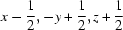
| Symmetry codes: (ii) x−1/2, −y+1/2, z+1/2; (iii) x−1, y, z. |
Experimental details
| Crystal data | |
| Chemical formula | [Co(C5H4NO3)2(H2O)2]·2H2O |
| Mr | 383.18 |
| Crystal system, space group | Monoclinic, P21/n |
| Temperature (K) | 296 |
| a, b, c (Å) | 5.260 (3), 18.528 (10), 8.077 (4) |
| β (°) | 103.707 (6) |
| V (Å3) | 764.9 (7) |
| Z | 2 |
| Radiation type | Mo Kα |
| µ (mm−1) | 1.18 |
| Crystal size (mm) | 0.20 × 0.20 × 0.20 |
| Data collection | |
| Diffractometer | Rigaku SCXmini diffractometer |
| Absorption correction | Multi-scan (CrystalClear; Rigaku, 2005) |
| Tmin, Tmax | 0.983, 0.983 |
| No. of measured, independent and observed [I > 2σ(I)] reflections | 5217, 1344, 1202 |
| Rint | 0.034 |
| (sin θ/λ)max (Å−1) | 0.595 |
| Refinement | |
| R[F2 > 2σ(F2)], wR(F2), S | 0.028, 0.078, 1.06 |
| No. of reflections | 1344 |
| No. of parameters | 123 |
| H-atom treatment | H atoms treated by a mixture of independent and constrained refinement |
| Δρmax, Δρmin (e Å−3) | 0.28, −0.38 |
Computer programs: CrystalClear (Rigaku, 2005), SHELXS97 (Sheldrick, 2008), SHELXL97 (Sheldrick, 2008), DIAMOND (Brandenburg & Putz, 2005).
| D—H···A | D—H | H···A | D···A | D—H···A |
| O4—H4A···O1i | 0.83 (5) | 2.07 (5) | 2.890 (3) | 172 (4) |
| O4—H4B···O1ii | 0.83 (4) | 2.03 (4) | 2.853 (3) | 172 (3) |
| O3—H3B···O2ii | 0.82 (4) | 2.07 (4) | 2.852 (3) | 161 (3) |
| O3—H3A···O4 | 0.76 (3) | 1.95 (3) | 2.696 (3) | 167 (3) |
| Symmetry codes: (i) x−1/2, −y+1/2, z+1/2; (ii) x−1, y, z. |
References
 Brandenburg, K. & Putz, H. (2005). DIAMOND. Crystal Impact GbR, Bonn, Germany. Google Scholar
Luo, Y.-H., Qian, X.-M., Gao, G., Li, J.-F. & Mao, S.-L. (2011). Acta Cryst. E67, m172. Web of Science CSD CrossRef IUCr Journals Google Scholar
Rigaku. (2005). CrystalClear. Rigaku Corporation, Tokyo, Japan. Google Scholar
Sheldrick, G. M. (2008). Acta Cryst. A64, 112–122. Web of Science CrossRef CAS IUCr Journals Google Scholar
This is an open-access article distributed under the terms of the Creative Commons Attribution (CC-BY) Licence, which permits unrestricted use, distribution, and reproduction in any medium, provided the original authors and source are cited.
| CRYSTALLOGRAPHIC COMMUNICATIONS |


Isoxazole derivatives are versatile ligands towards transition metal ions both in man-made and natural systems. They are not only used as (bio)catalysts but also for dioxygen transport and electron storage (Luo et al., 2011). As part of our interest in isoxazole derivatives, we report here the crystal structure of a new cobalt complex.
The molecular structure of the title compound is shown in Fig. 1. All non-H atoms, except O3 and O4, are located in the same plane with an r.m.s. deviation of 0.0247 Å.
The coordination polyhedron around the six coordinated central CoII ion is described as a octahedron, formed by two equatorial 5-methylisoxazole-3-carboxylates in an O, N bidentate fashion through the isoxazole nitrogen and the carboxylate oxygen atoms and by two axial water ligands.
The title compound forms a three-dimensional structure via intermolecular O—H···O hydrogen bonds interactions (Table 1, Fig. 2).