 | Acta Crystallographica Section E Acta Crystallographica Section E CRYSTALLOGRAPHIC COMMUNICATIONS |


 journal menu


organic compounds
| CRYSTALLOGRAPHIC COMMUNICATIONS |
 access
6H,13H-5,12:7,14-Dimethanodinaphtho[2,3-d:2,3-i][1,3,6,8]tetraazecine

aUniversidad Nacional de Colombia, Sede Bogotá, Facultad de Ciencias, Departamento de Química, Grupo de Investigación Síntesis de Heterociclos, Cra 30 No.45-03, Bogotá, Código Postal 111321, Colombia, and bInstitute of Physics ASCR, v.v.i., Na Slovance 2, 182 21 Praha 8, Czech Republic
*Correspondence e-mail: [email protected]
In the title compound, C24H20N4, obtained through the condensation of naphthalene-2,3-diamine with formaldehyde in methanol, the molecule is located on a special position of site symmetry -4. Due to symmetry considerations, the aromatic rings are strictly perpendicular to each other. In the crystal, molecules are linked by pairs of C—H⋯π interactions into columns along [110].
Related literature
For chemical background to the synthesis of the title compound, see: Volpp (1962![[Volpp, G. (1962). Chem. Ber. 95, 1493-1494.]](../../../../../../logos/arrows/e_arr.gif "Volpp, G. (1962). Chem. Ber. 95, 1493-1494.") ). For related structures, see: Murray-Rust & Smith (1975); Rivera et al. (2009, 2011). For bond-length data, see: Allen et al. (1987).
). For related structures, see: Murray-Rust & Smith (1975); Rivera et al. (2009, 2011). For bond-length data, see: Allen et al. (1987).
![[Scheme 1]](bg2445scheme1.gif)
Experimental
Crystal data
|

Refinement
|
| ||||||||||||||||||||||
 .
. Data collection: CrysAlis PRO (Agilent, 2010); cell refinement: CrysAlis PRO; data reduction: CrysAlis PRO; program(s) used to solve structure: SIR2002 (Burla et al., 2003); program(s) used to refine structure: JANA2006 (Petříček et al., 2006); molecular graphics: DIAMOND (Brandenburg & Putz, 2005); software used to prepare material for publication: JANA2006.
Supporting information
contains datablocks global, I. DOI: 10.1107/S1600536812010185/bg2445sup1.cif
Structure factors: contains datablock I. DOI: 10.1107/S1600536812010185/bg2445Isup2.hkl
Supporting information file. DOI: 10.1107/S1600536812010185/bg2445Isup3.cml
A solution of naphthalene-2,3-diamine (158 mg, 1 mmol) in methanol (10 ml) was added dropwise at 273 K to 5 ml of 37% aqueous formaldehyde. The reaction mixture was stirring at this temperature for 1 h and its completion was monitored by TLC. After completion, the contents were poured over cold water (10 ml). The resultant solid was isolated by filtration, washed with cold water, dried in vacuum and recrystallized from ethyl acetate to give the title compound with 28% yield. The melting point of the title structure is 484 K.
1H NMR (δ, 400 MHz, CDCl3): 4.55, 7.52, 7.74, 7.86. 13C NMR (δ, 100 MHz, CDCl3): 70.2, 125.6, 126.2, 127.7, 133.0, 151.9.
The H atoms atoms were found in difference Fourier maps and their coordinates were refined freely. The isotropic atomic displacement parameters of hydrogen atoms were evaluated as 1.2×Ueq of the parent atom. As the structure contains only light atoms, the Friedel-pair reflections were merged and the has not been determined.
We have as a general goal the design and synthesis of new macrocyclic saturated ring-fused of considerable interest as useful intermediates for the synthesis of N-containing These comprise a family of preformed electrophilic reagents which have been utilized in condensation reactions with electron-rich aromatic compounds in a variant of the Mannich reaction. These ring-fused are frequently prepared by reaction of 1,2-diamines with formaldehyde (Volpp, 1962). By an analogous route we prepared for the first time 6H,13H-5,12:7,14-dimethanodinaphtho[2,3-d:2,3-i][1,3,6,8]tetraazecine (I).
The molecular structure and atom-numbering scheme for (I) are shown in Fig. 1. Unlike the related structures, which crystallized in orthorhombic space groups Aba2 (Rivera et al., 2009, 2011) and Pbcn (Murray-Rust & Smith, 1975), the title compound (I) crystallizes in the tetragonal I42m with one quarter-molecule in the (located on a special position of 4). The X-ray structure of I shows similar features to other ring-fused So, the bond lengths and angles are normal (Allen et al., 1987) and similar to those observed for related structures (Murray-Rust & Smith, 1975; Rivera et al., 2009; Rivera et al., 2011).
Due to symmetry considerations the aromatic rings are strictly perpendicular to each other. In the crystal packing (Fig. 2), the molecules are linked by a pair of C—H···π interactions (Table 1) into columns along [110].
For chemical background to the synthesis of the title compound, see: Volpp (1962). For related structures, see: Murray-Rust & Smith (1975); Rivera et al. (2009, 2011). For bond-length data, see: Allen et al. (1987).
Data collection: CrysAlis PRO (Agilent, 2010); cell CrysAlis PRO (Agilent, 2010); data reduction: CrysAlis PRO (Agilent, 2010); program(s) used to solve structure: SIR2002 (Burla et al., 2003); program(s) used to refine structure: JANA2006 (Petříček et al., 2006); molecular graphics: DIAMOND (Brandenburg & Putz, 2005); software used to prepare material for publication: JANA2006 (Petříček et al., 2006).
![[Figure 1]](./bg2445fig1thm.gif) | Fig. 1. A view of (I) with the numbering scheme, displacement ellipsoids are drawn at the 50% probability level. Symmetry codes: (i) 1 + y,1 - x,-z; (ii) 2 - x,-y,z; (iii) 1 - y,-1 + x,-z. |
![[Figure 2]](./bg2445fig2thm.gif) | Fig. 2. Packing of the molecules of the title compound view along b axis. |
| C24H20N4 | Dx = 1.338 Mg m−3 |
| Mr = 364.5 | Cu Kα radiation, λ = 1.5418 Å |
| Tetragonal, I42m | Cell parameters from 3581 reflections |
| Hall symbol: I -4 2 | θ = 5.1–67.0° |
| a = 7.1996 (2) Å | µ = 0.63 mm−1 |
| c = 17.4511 (5) Å | T = 120 K |
| V = 904.56 (6) Å3 | Irregular shape, yellow |
| Z = 2 | 0.45 × 0.22 × 0.15 mm |
| F(000) = 384 |
| Agilent Xcalibur diffractometer with an Atlas (Gemini ultra Cu) detector | 273 independent reflections |
| Radiation source: Enhance Ultra (Cu) X-ray Source | 268 reflections with I > 3σ(I) |
| Mirror monochromator | Rint = 0.025 |
| Detector resolution: 10.3784 pixels mm-1 | θmax = 67.1°, θmin = 5.1° |
| Rotation method, ω scans | h = −8→8 |
| Absorption correction: multi-scan (CrysAlis PRO; Agilent, 2010) | k = −8→8 |
| Tmin = 0.50, Tmax = 0.90 | l = −20→20 |
| 4873 measured reflections |
| Refinement on F2 | 4 constraints |
| R[F > 3σ(F)] = 0.027 | Only H-atom coordinates refined |
| wR(F) = 0.077 | Weighting scheme based on measured s.u.'s w = 1/(σ2(I) + 0.0016I2) |
| S = 1.85 | (Δ/σ)max = 0.003 |
| 273 reflections | Δρmax = 0.08 e Å−3 |
| 51 parameters | Δρmin = −0.15 e Å−3 |
| 0 restraints |
| C24H20N4 | Z = 2 |
| Mr = 364.5 | Cu Kα radiation |
| Tetragonal, I42m | µ = 0.63 mm−1 |
| a = 7.1996 (2) Å | T = 120 K |
| c = 17.4511 (5) Å | 0.45 × 0.22 × 0.15 mm |
| V = 904.56 (6) Å3 |
| Agilent Xcalibur diffractometer with an Atlas (Gemini ultra Cu) detector | 273 independent reflections |
| Absorption correction: multi-scan (CrysAlis PRO; Agilent, 2010) | 268 reflections with I > 3σ(I) |
| Tmin = 0.50, Tmax = 0.90 | Rint = 0.025 |
| 4873 measured reflections |
| R[F > 3σ(F)] = 0.027 | 0 restraints |
| wR(F) = 0.077 | Only H-atom coordinates refined |
| S = 1.85 | Δρmax = 0.08 e Å−3 |
| 273 reflections | Δρmin = −0.15 e Å−3 |
| 51 parameters |
Refinement. The refinement was carried out against all reflections. The conventional R-factor is always based on F. The goodness of fit as well as the weighted R-factor are based on F and F2 for carried out on F and F2, respectively. The threshold expression is used only for calculating R-factors etc. and it is not relevant to the choice of reflections for refinement. The program used for Jana2006, uses the weighting scheme based on the experimental expectations, see _refine_ls_weighting_details, that does not force S to be one. Therefore the values of S are usually larger than the ones from the SHELX program. |
| x | y | z | Uiso*/Ueq | ||
| N1 | 0.86029 (13) | 0.13971 (13) | 0.04360 (8) | 0.0180 (4) | |
| C1 | 0.7560 (2) | 0 | 0 | 0.0187 (4) | |
| C2 | 0.92982 (16) | 0.07018 (16) | 0.11529 (9) | 0.0175 (4) | |
| C3 | 0.86239 (18) | 0.13761 (18) | 0.18326 (11) | 0.0194 (4) | |
| C4 | 0.9299 (2) | 0.0701 (2) | 0.25428 (9) | 0.0181 (4) | |
| C5 | 0.86279 (18) | 0.13721 (18) | 0.32562 (11) | 0.0221 (4) | |
| C6 | 0.93073 (18) | 0.06927 (18) | 0.39302 (9) | 0.0222 (4) | |
| H1 | 0.677 (2) | 0.0686 (18) | −0.0400 (7) | 0.0225* | |
| H3 | 0.760 (2) | 0.240 (2) | 0.1798 (11) | 0.0233* | |
| H5 | 0.760 (2) | 0.240 (2) | 0.3243 (12) | 0.0265* | |
| H6 | 0.886 (2) | 0.114 (2) | 0.4421 (13) | 0.0266* |
| U11 | U22 | U33 | U12 | U13 | U23 | |
| N1 | 0.0174 (5) | 0.0174 (5) | 0.0191 (8) | 0.0016 (7) | 0.0002 (4) | −0.0002 (4) |
| C1 | 0.0152 (8) | 0.0201 (8) | 0.0210 (7) | 0 | 0 | 0.0003 (7) |
| C2 | 0.0158 (5) | 0.0158 (5) | 0.0208 (9) | 0.0001 (7) | −0.0016 (5) | 0.0016 (5) |
| C3 | 0.0174 (6) | 0.0174 (6) | 0.0235 (10) | 0.0026 (7) | 0.0007 (5) | −0.0007 (5) |
| C4 | 0.0168 (6) | 0.0168 (6) | 0.0208 (8) | −0.0015 (7) | −0.0008 (5) | 0.0008 (5) |
| C5 | 0.0211 (6) | 0.0211 (6) | 0.0240 (10) | 0.0031 (8) | 0.0002 (4) | −0.0002 (4) |
| C6 | 0.0234 (6) | 0.0234 (6) | 0.0196 (7) | 0.0012 (8) | 0.0007 (5) | −0.0007 (5) |
| N1—C1 | 1.4680 (13) | C3—H3 | 1.042 (18) |
| N1—C1i | 1.4680 (13) | C4—C4iii | 1.428 (2) |
| N1—C2 | 1.437 (2) | C4—C5 | 1.420 (2) |
| C1—H1 | 1.027 (13) | C5—C6 | 1.365 (2) |
| C1—H1ii | 1.027 (13) | C5—H5 | 1.047 (18) |
| C2—C2iii | 1.4292 (17) | C6—C6iii | 1.4106 (18) |
| C2—C3 | 1.370 (2) | C6—H6 | 0.97 (2) |
| C3—C4 | 1.417 (2) | ||
| C1—N1—C1i | 115.64 (9) | C2—C3—C4 | 120.94 (12) |
| C1—N1—C2 | 113.00 (8) | C2—C3—H3 | 116.7 (11) |
| C1i—N1—C2 | 113.00 (8) | C4—C3—H3 | 122.3 (11) |
| N1—C1—N1iv | 118.44 (11) | C3—C4—C4iii | 118.99 (14) |
| N1—C1—H1 | 107.8 (7) | C3—C4—C5 | 122.26 (13) |
| N1—C1—H1ii | 105.1 (7) | C4iii—C4—C5 | 118.74 (14) |
| N1iv—C1—H1 | 105.1 (7) | C4—C5—C6 | 120.80 (13) |
| N1iv—C1—H1ii | 107.8 (7) | C4—C5—H5 | 117.5 (11) |
| H1—C1—H1ii | 112.7 (11) | C6—C5—H5 | 121.7 (11) |
| N1—C2—C2iii | 119.50 (13) | C5—C6—C6iii | 120.46 (14) |
| N1—C2—C3 | 120.43 (11) | C5—C6—H6 | 121.7 (10) |
| C2iii—C2—C3 | 120.06 (14) | C6iii—C6—H6 | 117.8 (10) |
| Symmetry codes: (i) y+1, −x+1, −z; (ii) x, −y, −z; (iii) −x+2, −y, z; (iv) −y+1, x−1, −z. |
| Cg1 and Cg2 are the centroids of the C2–C4/C2'–C4' and C4–C6/C4'–C6' rings, respectively. |
| D—H···A | D—H | H···A | D···A | D—H···A |
| C3—H3···Cg2v | 1.042 (18) | 2.648 (14) | 3.6921 (14) | 178.2 (15) |
| C5—H5···Cg1v | 1.047 (18) | 2.652 (14) | 3.6979 (14) | 178.0 (16) |
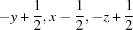
| Symmetry code: (v) −y+1/2, x−1/2, −z+1/2. |
Experimental details
| Crystal data | |
| Chemical formula | C24H20N4 |
| Mr | 364.5 |
| Crystal system, space group | Tetragonal, I42m |
| Temperature (K) | 120 |
| a, c (Å) | 7.1996 (2), 17.4511 (5) |
| V (Å3) | 904.56 (6) |
| Z | 2 |
| Radiation type | Cu Kα |
| µ (mm−1) | 0.63 |
| Crystal size (mm) | 0.45 × 0.22 × 0.15 |
| Data collection | |
| Diffractometer | Agilent Xcalibur diffractometer with an Atlas (Gemini ultra Cu) detector |
| Absorption correction | Multi-scan (CrysAlis PRO; Agilent, 2010) |
| Tmin, Tmax | 0.50, 0.90 |
| No. of measured, independent and observed [I > 3σ(I)] reflections | 4873, 273, 268 |
| Rint | 0.025 |
| (sin θ/λ)max (Å−1) | 0.597 |
| Refinement | |
| R[F > 3σ(F)], wR(F), S | 0.027, 0.077, 1.85 |
| No. of reflections | 273 |
| No. of parameters | 51 |
| H-atom treatment | Only H-atom coordinates refined |
| Δρmax, Δρmin (e Å−3) | 0.08, −0.15 |
Computer programs: CrysAlis PRO (Agilent, 2010), SIR2002 (Burla et al., 2003), JANA2006 (Petříček et al., 2006), DIAMOND (Brandenburg & Putz, 2005).
| Cg1 and Cg2 are the centroids of the C2–C4/C2'–C4' and C4–C6/C4'–C6' rings, respectively. |
| D—H···A | D—H | H···A | D···A | D—H···A |
| C3—H3···Cg2i | 1.042 (18) | 2.648 (14) | 3.6921 (14) | 178.2 (15) |
| C5—H5···Cg1i | 1.047 (18) | 2.652 (14) | 3.6979 (14) | 178.0 (16) |
| Symmetry code: (i) −y+1/2, x−1/2, −z+1/2. |
Acknowledgements
We acknowledge the Dirección de Investigaciones, Sede Bogotá (DIB) de la Universidad Nacional de Colombia, for financial support of this work, as well as the Institutional research plan No. AVOZ10100521 of the Institute of Physics and the Praemium Academiae project of the Academy of Sciences of the Czech Republic.
References
 Agilent (2010). CrysAlis PRO. Agilent Technologies, Yarnton, England. Google Scholar
Allen, F. H., Kennard, O., Watson, D. G., Brammer, L., Orpen, A. G. & Taylor, R. (1987). J. Chem. Soc. Perkin Trans. 2, pp. S1–19. CSD CrossRef Web of Science Google Scholar
Brandenburg, K. & Putz, H. (2005). DIAMOND Crystal Impact, Bonn, Germany. Google Scholar
Burla, M. C., Camalli, M., Carrozzini, B., Cascarano, G. L., Giacovazzo, C., Polidori, G. & Spagna, R. (2003). J. Appl. Cryst. 36, 1103. CrossRef IUCr Journals Google Scholar
Murray-Rust, P. & Smith, I. (1975). Acta Cryst. B31, 587–589. CSD CrossRef CAS IUCr Journals Web of Science Google Scholar
Petříček, V., Dušek, M. & Palatinus, L. (2006). JANA2006. Institute of Physics, Prague, Czech Republic. Google Scholar
Rivera, A., Maldonado, M., Ríos-Motta, J., Fejfarová, K. & Dušek, M. (2011). Acta Cryst. E67, o2395. Web of Science CSD CrossRef IUCr Journals Google Scholar
Rivera, A., Maldonado, M., Ríos-Motta, J., González-Salas, D. & Dacunha-Marinho, B. (2009). Acta Cryst. E65, o2553. Web of Science CSD CrossRef IUCr Journals Google Scholar
Volpp, G. (1962). Chem. Ber. 95, 1493–1494. CrossRef CAS Web of Science Google Scholar
This is an open-access article distributed under the terms of the Creative Commons Attribution (CC-BY) Licence, which permits unrestricted use, distribution, and reproduction in any medium, provided the original authors and source are cited.
| CRYSTALLOGRAPHIC COMMUNICATIONS |


We have as a general goal the design and synthesis of new macrocyclic saturated ring-fused aminals, of considerable interest as useful intermediates for the synthesis of N-containing heterocyclic compounds. These aminals comprise a family of preformed electrophilic reagents which have been utilized in condensation reactions with electron-rich aromatic compounds in a variant of the Mannich reaction. These ring-fused aminals are frequently prepared by reaction of 1,2-diamines with formaldehyde (Volpp, 1962). By an analogous route we prepared for the first time 6H,13H-5,12:7,14-dimethanodinaphtho[2,3-d:2,3-i][1,3,6,8]tetraazecine (I).
The molecular structure and atom-numbering scheme for (I) are shown in Fig. 1. Unlike the related structures, which crystallized in orthorhombic space groups Aba2 (Rivera et al., 2009, 2011) and Pbcn (Murray-Rust & Smith, 1975), the title compound (I) crystallizes in the tetragonal I42m space group with one quarter-molecule in the asymmetric unit (located on a special position of site symmetry 4). The X-ray structure of I shows similar features to other ring-fused aminals. So, the bond lengths and angles are normal (Allen et al., 1987) and similar to those observed for related structures (Murray-Rust & Smith, 1975; Rivera et al., 2009; Rivera et al., 2011).
Due to symmetry considerations the aromatic rings are strictly perpendicular to each other. In the crystal packing (Fig. 2), the molecules are linked by a pair of C—H···π interactions (Table 1) into columns along [110].