 | Acta Crystallographica Section E Acta Crystallographica Section E CRYSTALLOGRAPHIC COMMUNICATIONS |


 journal menu


metal-organic compounds
| CRYSTALLOGRAPHIC COMMUNICATIONS |
 access
catena-Poly[[triaquacopper(II)]-μ2-furan-2,5-dicarboxylato-κ4O1,O2:O2,O2′]

aSchool of Chemical Engineering, Changchun University of Technology, Changchun 130012, People's Republic of China
*Correspondence e-mail: [email protected]
In the title compound, [Cu(C6H2O5)(H2O)3]n, an infinite chain is formed along [001] by linking of the Cu(OH2)3O4 cluster with one carboxylate group of the furan-2,5-dicarboxylate ligand. Adjacent chains are linked by Owater—H⋯O hydrogen-bonding interactions. The Cu(OH2)3O4 cluster displays a pentagonal bipyrimadal geometry with two weak coordinations [Cu—Ofuran = 2.790 (2) Å) and Cu—Ocarboxylate = 2.684 (2) Å] and two water molecules located in axial positions.
Related literature
For background to metalorganic framework materials, see: Chui et al. (1999![[Chui, S. S. Y., Lo, S. M. F., Charmant, J. P. H., Orpen, A. G. & Williams, I. D. (1999). Science, 283, 1148-1150.]](../../../../../../logos/arrows/e_arr.gif "Chui, S. S. Y., Lo, S. M. F., Charmant, J. P. H., Orpen, A. G. & Williams, I. D. (1999). Science, 283, 1148-1150.") ); Corma et al. (2010); Ferey (2008); Li et al. (1999); Murray et al. (2009); Tranchemontagne et al. (2009).
); Corma et al. (2010); Ferey (2008); Li et al. (1999); Murray et al. (2009); Tranchemontagne et al. (2009).
![[Scheme 1]](zj2064scheme1.gif)
Experimental
Crystal data
|
Refinement
|
|
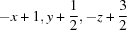 ; (ii)
 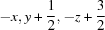 ; (iv)
 Data collection: PROCESS-AUTO (Rigaku, 1998); cell refinement: PROCESS-AUTO; data reduction: CrystalStructure (Rigaku/MSC, 2002); program(s) used to solve structure: SHELXS97 (Sheldrick, 2008); program(s) used to refine structure: SHELXL97 (Sheldrick, 2008); molecular graphics: DIAMOND (Brandenburg, 2000); software used to prepare material for publication: SHELXL97.
Supporting information
contains datablocks I, global. DOI: 10.1107/S1600536812010161/zj2064sup1.cif
Structure factors: contains datablock I. DOI: 10.1107/S1600536812010161/zj2064Isup2.hkl
(I) was synthesized under solvothermal condition. In a typically route, furan-2,5-dicarboxyl acid (0.312 g, 2.0 mmol) and Cu(NO3)2.3H2O (0.48 g, 2.0 mmol) were dissolved in the mixture of EtOH (2.9 ml, 50 mmol) and DMF (3.9 ml, 50 mmol) under stirring. Then, the clear solution with molar ratio of 1 (furan-2,5-dicarboxyl acid): 1 (Cu(NO3)2.3H2O): 25 (EtOH): 25 (DMF) was tranferred into 23 ml autoclave and heated at 393 K for 24hrs. After naturally cooling to room temperature, blue block product was collected by filtration as a single phase.
Water H atoms were located in a difference Fourier map and were refined with O—H = 0.82 (2) Å, H···H = 1.37 (2) Å and Uiso(H) = 1.2Ueq(O). The carbon H-atoms were placed in calculated positions (C—H = 0.93 Å) and were included in the in the riding-model approximation, with Uiso(H) = 1.2Ueq(C).
During past decades, the MOF materials have being attracted huge attentions due to the applications including gas absorption and catalyst reactions(Murray, et al., 2009; Corma, et al., 2010). The more efforts have been focused on the MOF based on the phenyl ring with carboxyl groups (Chui, et al., 1999; Li, et al., 1999; Ferey, 2008; Tranchemontagne, et al., 2009). Compared with phenyl ring with carboxyl groups, the 5-membered rings with carboxyl groups as the ligand are rarely studied. Recently, we utilize furan-2,5-dicarboxyl acid as the ligand to constructed the MOFs. In this work, chainlike compound, [Cu.(C6O5H2).3H2O]n (I), is synthesized.
The of (I) comprises of one Cu(II) cation, one furan-2,5-dicarboxylate anion and three H2O (Fig.1). Cu cation is coordinated by three carboxyl O atoms, one oxygen of furan ring, and three water molecules of which two locate at the poles, exhibiting pentagonal bipyrimad geometry. It is necessarily noted that oxygen of furan ring (dO—Cu=2.790 (2) Å) and η2-oxygen of carboxyl (dO—Cu=2.684 (2) Å) are very weakly ligated to Cu cation. If excluding this two O atoms, Cu displays triganol bipyramid geometry and the chain property may not be changed. Only one carboxyl of furan-2,5-dicarboxylate involves in the formation of Cu polyhedron. The carboxyl shows µ2:η1,η2 mode.
Cu cations are linked by one carboxyl of furan-2,5-dicarboxylate to give rise to the infinite chain (Fig.2). The H-bond of OW—H···O holds together adjacent chains (Fig.3).
For background to metalorganic framework materials, see: Chui et al. (1999); Corma et al. (2010); Ferey (2008); Li et al. (1999); Murray et al. (2009); Tranchemontagne et al. (2009).
Data collection: PROCESS-AUTO (Rigaku, 1998); cell PROCESS-AUTO (Rigaku, 1998); data reduction: CrystalStructure (Rigaku/MSC, 2002); program(s) used to solve structure: SHELXS97 (Sheldrick, 2008); program(s) used to refine structure: SHELXL97 (Sheldrick, 2008); molecular graphics: DIAMOND (Brandenburg, 2000); software used to prepare material for publication: SHELXL97 (Sheldrick, 2008).
![[Figure 1]](./zj2064fig1thm.gif) | Fig. 1. The unit cell of (I), showing the atomic labelling scheme and displacement ellipsoids at the 50% probability level. [Symmetry codes: (i) x, 1.5 - y, -0.5 + z.] |
![[Figure 2]](./zj2064fig2thm.gif) | Fig. 2. The stick plot of (I), displaying the infinite chain along (001) direction formed by linking the Cu with carboxyl of furan-2,5-dicarboxylate. |
![[Figure 3]](./zj2064fig3thm.gif) | Fig. 3. The ball-stick packing diagram of (I). The H-bond of OW—H···O holds together adjacent chains. |
| [Cu(C6H2O5)(H2O)3] | F(000) = 548 |
| Mr = 271.66 | Dx = 2.089 Mg m−3 |
| Monoclinic, P21/c | Mo Kα radiation, λ = 0.71073 Å |
| Hall symbol: -P 2ybc | Cell parameters from 2000 reflections |
| a = 7.0559 (14) Å | θ = 3.2–27.5° |
| b = 15.040 (3) Å | µ = 2.55 mm−1 |
| c = 8.1578 (16) Å | T = 296 K |
| β = 93.92 (3)° | Block, light blue |
| V = 863.7 (3) Å3 | 0.15 × 0.14 × 0.12 mm |
| Z = 4 |
| Rigaku R-AXIS RAPID diffractometer | 1985 independent reflections |
| Radiation source: fine-focus sealed tube | 1656 reflections with I > 2σ(I) |
| Graphite monochromator | Rint = 0.039 |
| Detector resolution: 10.00 pixels mm-1 | θmax = 27.5°, θmin = 3.2° |
| ω scans | h = −9→9 |
| Absorption correction: multi-scan (ABSCOR; Higashi, 1995) | k = −18→19 |
| Tmin = 0.701, Tmax = 0.749 | l = −10→10 |
| 8400 measured reflections |
| Refinement on F2 | Primary atom site location: structure-invariant direct methods |
| Least-squares matrix: full | Secondary atom site location: difference Fourier map |
| R[F2 > 2σ(F2)] = 0.031 | Hydrogen site location: inferred from neighbouring sites |
| wR(F2) = 0.070 | H atoms treated by a mixture of independent and constrained refinement |
| S = 1.09 | w = 1/[σ2(Fo2) + (0.0277P)2 + 0.660P] where P = (Fo2 + 2Fc2)/3 |
| 1985 reflections | (Δ/σ)max = 0.001 |
| 154 parameters | Δρmax = 0.43 e Å−3 |
| 10 restraints | Δρmin = −0.44 e Å−3 |
| [Cu(C6H2O5)(H2O)3] | V = 863.7 (3) Å3 |
| Mr = 271.66 | Z = 4 |
| Monoclinic, P21/c | Mo Kα radiation |
| a = 7.0559 (14) Å | µ = 2.55 mm−1 |
| b = 15.040 (3) Å | T = 296 K |
| c = 8.1578 (16) Å | 0.15 × 0.14 × 0.12 mm |
| β = 93.92 (3)° |
| Rigaku R-AXIS RAPID diffractometer | 1985 independent reflections |
| Absorption correction: multi-scan (ABSCOR; Higashi, 1995) | 1656 reflections with I > 2σ(I) |
| Tmin = 0.701, Tmax = 0.749 | Rint = 0.039 |
| 8400 measured reflections |
| R[F2 > 2σ(F2)] = 0.031 | 10 restraints |
| wR(F2) = 0.070 | H atoms treated by a mixture of independent and constrained refinement |
| S = 1.09 | Δρmax = 0.43 e Å−3 |
| 1985 reflections | Δρmin = −0.44 e Å−3 |
| 154 parameters |
Geometry. All e.s.d.'s (except the e.s.d. in the dihedral angle between two l.s. planes) are estimated using the full covariance matrix. The cell e.s.d.'s are taken into account individually in the estimation of e.s.d.'s in distances, angles and torsion angles; correlations between e.s.d.'s in cell parameters are only used when they are defined by crystal symmetry. An approximate (isotropic) treatment of cell e.s.d.'s is used for estimating e.s.d.'s involving l.s. planes. |
Refinement. Refinement of F2 against ALL reflections. The weighted R-factor wR and goodness of fit S are based on F2, conventional R-factors R are based on F, with F set to zero for negative F2. The threshold expression of F2 > σ(F2) is used only for calculating R-factors(gt) etc. and is not relevant to the choice of reflections for refinement. R-factors based on F2 are statistically about twice as large as those based on F, and R- factors based on ALL data will be even larger. |
| x | y | z | Uiso*/Ueq | ||
| Cu1 | 0.25359 (5) | 0.68635 (2) | 0.66688 (4) | 0.02149 (11) | |
| O1 | 0.2757 (3) | 0.66588 (12) | 1.1767 (2) | 0.0271 (5) | |
| O2 | 0.2608 (3) | 0.69971 (11) | 0.9141 (2) | 0.0260 (4) | |
| O3 | 0.2629 (3) | 0.52292 (11) | 0.82901 (19) | 0.0198 (4) | |
| O4 | 0.3038 (3) | 0.42902 (12) | 0.5442 (2) | 0.0370 (5) | |
| O5 | 0.2282 (3) | 0.30371 (11) | 0.6657 (2) | 0.0263 (4) | |
| C1 | 0.2663 (4) | 0.64357 (16) | 1.0277 (3) | 0.0183 (5) | |
| C2 | 0.2593 (4) | 0.54734 (15) | 0.9908 (3) | 0.0188 (5) | |
| C3 | 0.2454 (5) | 0.47559 (17) | 1.0867 (3) | 0.0288 (6) | |
| H3 | 0.2409 | 0.4750 | 1.2003 | 0.035* | |
| C4 | 0.2389 (5) | 0.40085 (17) | 0.9808 (3) | 0.0285 (6) | |
| H4 | 0.2283 | 0.3416 | 1.0116 | 0.034* | |
| C5 | 0.2511 (4) | 0.43186 (15) | 0.8272 (3) | 0.0192 (5) | |
| C6 | 0.2608 (4) | 0.38628 (16) | 0.6674 (3) | 0.0198 (5) | |
| O1W | 0.5258 (3) | 0.67555 (14) | 0.6763 (2) | 0.0320 (5) | |
| H1A | 0.588 (4) | 0.7150 (17) | 0.721 (4) | 0.038* | |
| H1B | 0.573 (4) | 0.6500 (19) | 0.605 (3) | 0.038* | |
| O2W | −0.0197 (3) | 0.69352 (15) | 0.6594 (3) | 0.0356 (5) | |
| H2A | −0.060 (5) | 0.7333 (18) | 0.716 (3) | 0.043* | |
| H2B | −0.074 (5) | 0.690 (2) | 0.570 (2) | 0.043* | |
| O3W | 0.2223 (3) | 0.60185 (12) | 0.4812 (2) | 0.0261 (4) | |
| H3A | 0.258 (4) | 0.5519 (10) | 0.503 (3) | 0.031* | |
| H3B | 0.245 (4) | 0.6171 (18) | 0.391 (2) | 0.031* |
| U11 | U22 | U33 | U12 | U13 | U23 | |
| Cu1 | 0.02457 (18) | 0.02215 (17) | 0.01807 (16) | 0.00066 (14) | 0.00374 (11) | −0.00597 (13) |
| O1 | 0.0528 (14) | 0.0170 (9) | 0.0118 (8) | −0.0027 (8) | 0.0048 (8) | −0.0024 (7) |
| O2 | 0.0502 (13) | 0.0154 (8) | 0.0128 (8) | 0.0014 (8) | 0.0053 (8) | 0.0000 (7) |
| O3 | 0.0368 (11) | 0.0108 (8) | 0.0120 (7) | −0.0012 (7) | 0.0037 (7) | −0.0012 (7) |
| O4 | 0.0747 (17) | 0.0181 (9) | 0.0202 (9) | 0.0038 (10) | 0.0169 (10) | 0.0004 (8) |
| O5 | 0.0432 (13) | 0.0127 (9) | 0.0237 (9) | −0.0066 (8) | 0.0073 (8) | −0.0050 (7) |
| C1 | 0.0236 (14) | 0.0162 (11) | 0.0156 (11) | 0.0012 (10) | 0.0041 (9) | −0.0006 (10) |
| C2 | 0.0276 (14) | 0.0152 (11) | 0.0138 (10) | 0.0013 (10) | 0.0019 (9) | −0.0023 (10) |
| C3 | 0.053 (2) | 0.0201 (12) | 0.0129 (12) | −0.0026 (13) | 0.0030 (11) | −0.0011 (11) |
| C4 | 0.0534 (19) | 0.0132 (11) | 0.0187 (12) | −0.0006 (12) | 0.0014 (12) | 0.0001 (11) |
| C5 | 0.0272 (13) | 0.0109 (10) | 0.0196 (11) | −0.0008 (10) | 0.0018 (9) | −0.0026 (10) |
| C6 | 0.0236 (13) | 0.0173 (12) | 0.0184 (11) | 0.0023 (10) | 0.0014 (9) | −0.0021 (10) |
| O1W | 0.0244 (11) | 0.0360 (12) | 0.0357 (11) | 0.0011 (9) | 0.0028 (9) | −0.0173 (9) |
| O2W | 0.0238 (11) | 0.0479 (13) | 0.0353 (11) | 0.0004 (10) | 0.0025 (8) | −0.0235 (11) |
| O3W | 0.0484 (13) | 0.0161 (8) | 0.0144 (8) | 0.0038 (9) | 0.0057 (8) | 0.0012 (7) |
| Cu1—O1W | 1.924 (2) | C2—C3 | 1.340 (4) |
| Cu1—O2W | 1.928 (2) | C3—C4 | 1.416 (4) |
| Cu1—O3W | 1.9782 (18) | C3—H3 | 0.9300 |
| Cu1—O2 | 2.0243 (17) | C4—C5 | 1.345 (3) |
| Cu1—O1i | 2.2289 (18) | C4—H4 | 0.9300 |
| O1—C1 | 1.258 (3) | C5—C6 | 1.479 (3) |
| O1—Cu1ii | 2.2289 (18) | C6—O4 | 1.248 (3) |
| O2—C1 | 1.252 (3) | O1W—H1A | 0.809 (17) |
| O3—C2 | 1.372 (3) | O1W—H1B | 0.791 (17) |
| O3—C5 | 1.372 (3) | O2W—H2A | 0.816 (17) |
| O4—C6 | 1.248 (3) | O2W—H2B | 0.802 (17) |
| O5—C6 | 1.263 (3) | O3W—H3A | 0.807 (15) |
| C1—C2 | 1.478 (3) | O3W—H3B | 0.799 (16) |
| O1W—Cu1—O2W | 178.29 (10) | C4—C3—H3 | 126.8 |
| O1W—Cu1—O3W | 92.01 (9) | C5—C4—C3 | 106.9 (2) |
| O2W—Cu1—O3W | 87.28 (9) | C5—C4—H4 | 126.5 |
| O1W—Cu1—O2 | 90.67 (9) | C3—C4—H4 | 126.5 |
| O2W—Cu1—O2 | 89.03 (9) | C4—C5—O3 | 110.1 (2) |
| O3W—Cu1—O2 | 145.16 (7) | C4—C5—C6 | 132.1 (2) |
| O1W—Cu1—O1i | 90.89 (8) | O3—C5—C6 | 117.8 (2) |
| O2W—Cu1—O1i | 90.73 (9) | O4—C6—O5 | 123.5 (2) |
| O3W—Cu1—O1i | 132.21 (7) | O4—C6—O5 | 123.5 (2) |
| O2—Cu1—O1i | 82.44 (6) | O4—C6—C5 | 120.0 (2) |
| C1—O1—Cu1ii | 103.45 (15) | O4—C6—C5 | 120.0 (2) |
| C1—O2—Cu1 | 131.89 (15) | O5—C6—C5 | 116.5 (2) |
| C2—O3—C5 | 105.81 (17) | Cu1—O1W—H1A | 118 (2) |
| O2—C1—O1 | 122.1 (2) | Cu1—O1W—H1B | 119 (2) |
| O2—C1—C2 | 120.7 (2) | H1A—O1W—H1B | 116 (3) |
| O1—C1—C2 | 117.2 (2) | Cu1—O2W—H2A | 114 (2) |
| C3—C2—O3 | 110.7 (2) | Cu1—O2W—H2B | 116 (3) |
| C3—C2—C1 | 132.2 (2) | H2A—O2W—H2B | 113 (3) |
| O3—C2—C1 | 117.1 (2) | Cu1—O3W—H3A | 114.5 (15) |
| C2—C3—C4 | 106.5 (2) | Cu1—O3W—H3B | 120 (2) |
| C2—C3—H3 | 126.8 | H3A—O3W—H3B | 113 (2) |
| O1W—Cu1—O2—C1 | −84.2 (2) | C1—C2—C3—C4 | 178.1 (3) |
| O2W—Cu1—O2—C1 | 94.1 (2) | C2—C3—C4—C5 | 0.6 (4) |
| O3W—Cu1—O2—C1 | 10.3 (3) | C3—C4—C5—O3 | −0.7 (3) |
| O1i—Cu1—O2—C1 | −175.0 (3) | C3—C4—C5—C6 | 176.7 (3) |
| Cu1—O2—C1—O1 | 177.90 (19) | C2—O3—C5—C4 | 0.5 (3) |
| Cu1—O2—C1—C2 | −3.0 (4) | C2—O3—C5—C6 | −177.2 (2) |
| Cu1ii—O1—C1—O2 | 4.6 (3) | O4—O4—C6—O5 | 0.0 (3) |
| Cu1ii—O1—C1—C2 | −174.55 (19) | O4—O4—C6—C5 | 0.0 (3) |
| C5—O3—C2—C3 | −0.2 (3) | C4—C5—C6—O4 | −167.8 (3) |
| C5—O3—C2—C1 | −178.8 (2) | O3—C5—C6—O4 | 9.3 (4) |
| O2—C1—C2—C3 | −172.9 (3) | C4—C5—C6—O4 | −167.8 (3) |
| O1—C1—C2—C3 | 6.3 (5) | O3—C5—C6—O4 | 9.3 (4) |
| O2—C1—C2—O3 | 5.4 (4) | C4—C5—C6—O5 | 10.6 (5) |
| O1—C1—C2—O3 | −175.4 (2) | O3—C5—C6—O5 | −172.3 (2) |
| O3—C2—C3—C4 | −0.2 (3) |
| Symmetry codes: (i) x, −y+3/2, z−1/2; (ii) x, −y+3/2, z+1/2. |
| D—H···A | D—H | H···A | D···A | D—H···A |
| O1W—H1A···O5iii | 0.81 (2) | 2.04 (2) | 2.843 (3) | 173 (3) |
| O1W—H1B···O4iv | 0.79 (2) | 1.95 (2) | 2.729 (3) | 170 (3) |
| O2W—H2A···O5v | 0.82 (2) | 1.91 (2) | 2.690 (3) | 161 (3) |
| O2W—H2B···O4vi | 0.80 (2) | 2.55 (3) | 3.118 (3) | 129 (3) |
| O3W—H3A···O4 | 0.81 (2) | 1.90 (2) | 2.704 (3) | 171 (3) |
| O3W—H3B···O1vii | 0.80 (2) | 1.92 (2) | 2.715 (2) | 172 (3) |
| Symmetry codes: (iii) −x+1, y+1/2, −z+3/2; (iv) −x+1, −y+1, −z+1; (v) −x, y+1/2, −z+3/2; (vi) −x, −y+1, −z+1; (vii) x, y, z−1. |
Experimental details
| Crystal data | |
| Chemical formula | [Cu(C6H2O5)(H2O)3] |
| Mr | 271.66 |
| Crystal system, space group | Monoclinic, P21/c |
| Temperature (K) | 296 |
| a, b, c (Å) | 7.0559 (14), 15.040 (3), 8.1578 (16) |
| β (°) | 93.92 (3) |
| V (Å3) | 863.7 (3) |
| Z | 4 |
| Radiation type | Mo Kα |
| µ (mm−1) | 2.55 |
| Crystal size (mm) | 0.15 × 0.14 × 0.12 |
| Data collection | |
| Diffractometer | Rigaku R-AXIS RAPID |
| Absorption correction | Multi-scan (ABSCOR; Higashi, 1995) |
| Tmin, Tmax | 0.701, 0.749 |
| No. of measured, independent and observed [I > 2σ(I)] reflections | 8400, 1985, 1656 |
| Rint | 0.039 |
| (sin θ/λ)max (Å−1) | 0.649 |
| Refinement | |
| R[F2 > 2σ(F2)], wR(F2), S | 0.031, 0.070, 1.09 |
| No. of reflections | 1985 |
| No. of parameters | 154 |
| No. of restraints | 10 |
| H-atom treatment | H atoms treated by a mixture of independent and constrained refinement |
| Δρmax, Δρmin (e Å−3) | 0.43, −0.44 |
Computer programs: PROCESS-AUTO (Rigaku, 1998), CrystalStructure (Rigaku/MSC, 2002), SHELXS97 (Sheldrick, 2008), SHELXL97 (Sheldrick, 2008), DIAMOND (Brandenburg, 2000).
| D—H···A | D—H | H···A | D···A | D—H···A |
| O1W—H1A···O5i | 0.809 (17) | 2.039 (18) | 2.843 (3) | 173 (3) |
| O1W—H1B···O4ii | 0.791 (17) | 1.947 (17) | 2.729 (3) | 170 (3) |
| O2W—H2A···O5iii | 0.816 (17) | 1.91 (2) | 2.690 (3) | 161 (3) |
| O2W—H2B···O4iv | 0.802 (17) | 2.55 (3) | 3.118 (3) | 129 (3) |
| O3W—H3A···O4 | 0.807 (15) | 1.903 (15) | 2.704 (3) | 171 (3) |
| O3W—H3B···O1v | 0.799 (16) | 1.921 (16) | 2.715 (2) | 172 (3) |
| Symmetry codes: (i) −x+1, y+1/2, −z+3/2; (ii) −x+1, −y+1, −z+1; (iii) −x, y+1/2, −z+3/2; (iv) −x, −y+1, −z+1; (v) x, y, z−1. |
Acknowledgements
This project was sponsored by the Scientific Research Foundation for the Returned Overseas Team, Chinese Education Ministry.
References
 Brandenburg, K. (2000). DIAMOND. Crystal Impact GbR, Bonn, Germany. Google Scholar
Chui, S. S. Y., Lo, S. M. F., Charmant, J. P. H., Orpen, A. G. & Williams, I. D. (1999). Science, 283, 1148–1150. Web of Science CSD CrossRef PubMed CAS Google Scholar
Corma, A., Garcia, H., Xamena, F. X. L. I. (2010). Chem. Rev. 110, 4606–4655. Web of Science CrossRef CAS PubMed Google Scholar
Ferey, G. (2008). Chem. Soc. Rev. 37, 191–214. Web of Science PubMed CAS Google Scholar
Higashi, T. (1995). ABSCOR. Rigaku Corporation, Tokyo, Japan. Google Scholar
Li, H., Eddaoudi, M., O'Keeffe, M. & Yaghi, O. M. (1999). Nature (London), 402, 276–279. CAS Google Scholar
Murray, L. J., Dinca, M. & Long, J. R. (2009). Chem. Soc. Rev. 38, 1294–1314. Web of Science CrossRef PubMed CAS Google Scholar
Rigaku (1998). PROCESS-AUTO. Rigaku Corporation, Tokyo, Japan. Google Scholar
Rigaku/MSC (2002). CrystalStructure. Rigaku/MSC, The Woodlands, Texas, USA. Google Scholar
Sheldrick, G. M. (2008). Acta Cryst. A64, 112–122. Web of Science CrossRef CAS IUCr Journals Google Scholar
Tranchemontagne, D. J., Mendoza-Cortes, J. L., O'Keeffe, M. & Yaghi, O. M. (2009). Chem. Soc. Rev. 38, 1257–1283. Web of Science CrossRef PubMed CAS Google Scholar
This is an open-access article distributed under the terms of the Creative Commons Attribution (CC-BY) Licence, which permits unrestricted use, distribution, and reproduction in any medium, provided the original authors and source are cited.
| CRYSTALLOGRAPHIC COMMUNICATIONS |


During past decades, the MOF materials have being attracted huge attentions due to the applications including gas absorption and catalyst reactions(Murray, et al., 2009; Corma, et al., 2010). The more efforts have been focused on the MOF based on the phenyl ring with carboxyl groups (Chui, et al., 1999; Li, et al., 1999; Ferey, 2008; Tranchemontagne, et al., 2009). Compared with phenyl ring with carboxyl groups, the 5-membered rings with carboxyl groups as the ligand are rarely studied. Recently, we utilize furan-2,5-dicarboxyl acid as the ligand to constructed the MOFs. In this work, chainlike compound, [Cu.(C6O5H2).3H2O]n (I), is synthesized.
The asymmetric unit of (I) comprises of one Cu(II) cation, one furan-2,5-dicarboxylate anion and three H2O (Fig.1). Cu cation is coordinated by three carboxyl O atoms, one oxygen of furan ring, and three water molecules of which two locate at the poles, exhibiting pentagonal bipyrimad geometry. It is necessarily noted that oxygen of furan ring (dO—Cu=2.790 (2) Å) and η2-oxygen of carboxyl (dO—Cu=2.684 (2) Å) are very weakly ligated to Cu cation. If excluding this two O atoms, Cu displays triganol bipyramid geometry and the chain property may not be changed. Only one carboxyl of furan-2,5-dicarboxylate involves in the formation of Cu polyhedron. The carboxyl shows µ2:η1,η2 mode.
Cu cations are linked by one carboxyl of furan-2,5-dicarboxylate to give rise to the infinite chain (Fig.2). The H-bond of OW—H···O holds together adjacent chains (Fig.3).