 | Acta Crystallographica Section E Acta Crystallographica Section E CRYSTALLOGRAPHIC COMMUNICATIONS |


 journal menu


metal-organic compounds
| CRYSTALLOGRAPHIC COMMUNICATIONS |
 access
Poly[tetraaqua(μ6-9,10-dioxo-9,10-dihydroanthracene-1,4,5,8-tetracarboxylato)dimanganese(II)]

aDepartment of Applied Chemistry, College of Science, Nanjing University of Technology, Nanjing 210009, People's Republic of China
*Correspondence e-mail: [email protected]
The title complex, [Mn2(C18H4O10)(H2O)4]n, was synthesized from manganese(II) chloride tetrahydrate and 9,10-dioxo-9,10-dihydroanthracene-1,4,5,8-tetracarboxylic acid (H4AQTC) in water. The anthraquinone unit is located about a crystallographic center of inversion. Each asymmetric unit therefore contains one MnII atom, two water ligands and one half AQTC4− anion. The MnII atom is coordinated in a distorted octahedral geometry by four O atoms from three AQTC4− ligands and two water O atoms. Two of the carboxylate groups coordinate one MnII atom in a chelating mode, whereas the others each coordinate two MnII atoms. Each AQTC4− tetra-anion therefore coordinates six different MnII ions and, as a result, a three-dimensional coordination polymer is formed. O—H⋯O hydrogen bonds, some of them bifurcated, between water ligands and neighboring water or anthraquinone ligands are observed in the crystal structure.
Related literature
For general background to metal-organic frameworks, see: Li et al. (1999![[Li, H., Eddaoudi, M., O'Keeffe, M. & Yaghi, O. M. (1999). Nature (London), 402, 276-279.]](../../../../../../logos/arrows/e_arr.gif "Li, H., Eddaoudi, M., O'Keeffe, M. & Yaghi, O. M. (1999). Nature (London), 402, 276-279.") , 2012); Cheng et al. (2010); Hong et al. (2009); Miller & Gatteschi (2011); Liu et al. (2010).
, 2012); Cheng et al. (2010); Hong et al. (2009); Miller & Gatteschi (2011); Liu et al. (2010).
![[Scheme 1]](im2383scheme1.gif)
Experimental
Crystal data
|
Refinement
|
|
 ; (ii)
  ; (iii)
  .
. Data collection: SMART (Bruker, 2000); cell refinement: SAINT (Bruker, 2000); data reduction: SAINT; program(s) used to solve structure: SHELXS97 (Sheldrick, 2008); program(s) used to refine structure: SHELXL97 (Sheldrick, 2008); molecular graphics: SHELXTL (Sheldrick, 2008); software used to prepare material for publication: SHELXTL.
Supporting information
contains datablocks I, global. DOI: https://doi.org/10.1107/S1600536812027158/im2383sup1.cif
Structure factors: contains datablock I. DOI: https://doi.org/10.1107/S1600536812027158/im2383Isup2.hkl
A mixture of 9,10-dioxo-9,10-dihydroanthracene-1,4,5,8-tetracarboxylic acid (H4AQTC; 0.025 mmol, 9.8 mg) was added to distilled water (4 ml) and ultra-sounded for 10 min. The pH value of the mixture was then adjusted to 7.0 with sodium hydroxide (0.5 mol L-1), prior to the addition of manganese(II) chloride tetrahydrate (0.05 mmol, 9.9 mg). The reactants were placed in a Teflon-lined stainless steel vessel, heated for 3 days, and then cooled to ambient temperature over 12 h. The solution was exposed to air for three days leading to the precipitation of brown crystals (yield 10%).
All non-hydrogen atoms were refined anisotropically. H atoms of the H2O ligands were determined in difference Fourier maps and refined isotropically with distance restraints for O9—H5 and O9—H6 of 0.82 Å. H atoms of AQTC4- ligands calculated in idealized positions with C—H = 0.93 Å and refined as riding atoms, with Uiso(H) = 1.2Ueq(C).
Porous solid materials, such as MOFs (metal-organic frameworks) have been widely studied for their potential applications in gas absorption, separation, catalysis and magnetic materials. Explorations of advanced porous materials for these applications are an intense subject of scientific research (Li et al.,1999; Li et al., 2012; Cheng et al., 2010; Hong et al., 2009; Miller & Gatteschi, 2011; Liu et al., 2010.) Herein we report the of the title compound.
The molecular structure of (I) is illustrated in Fig. 1., a summary of the observed hydrogen bonds and the corresponding angles are given in Table 1.
Each therefore contains one manganese(II) atom, two water ligands and one half AQTC4- ligand. The coordination sphere around manganese is distorted octahedral due to the coordination of four O atoms from three AQTC4- ligands and two O atoms from two water molecules. Two of the carboxylate groups coordinate one manganese in a chelating mode whereas the others each coordinate two manganese center. Each AQTC4- therefore coordinates six different manganese ions and as a result a three-dimensional coordination polymer is formed.
For general background to metal-organic frameworks, see: Li et al. (1999, 2012); Cheng et al. (2010); Hong et al. (2009); Miller & Gatteschi (2011); Liu et al. (2010).
Data collection: SMART (Bruker, 2000); cell SAINT (Bruker, 2000); data reduction: SAINT (Bruker, 2000); program(s) used to solve structure: SHELXS97 (Sheldrick, 2008); program(s) used to refine structure: SHELXL97 (Sheldrick, 2008); molecular graphics: SHELXTL (Sheldrick, 2008); software used to prepare material for publication: SHELXTL (Sheldrick, 2008).
![[Figure 1]](./im2383fig1thm.gif) | Fig. 1. One repeating unit of the coordination polymer, showing displacement ellipsoids at the 30% probability level. [Symmetry codes: (#1) x + 1,-y,-z + 1; (#2) x + 1,y + 1/2,-z + 1/2; (#3) x + 1,-y + 1,-z + 1; (#4) x + 1,y - 1/2,-z + 1/2.] |
![[Figure 2]](./im2383fig2thm.gif) | Fig. 2. A view of the crystal structure of the title compound. |
| [Mn2(C18H4O10)(H2O)4] | F(000) = 564 |
| Mr = 562.16 | Dx = 2.034 Mg m−3 |
| Monoclinic, P21/c | Mo Kα radiation, λ = 0.71073 Å |
| Hall symbol: -P 2ybc | Cell parameters from 5133 reflections |
| a = 11.2255 (16) Å | θ = 2.2–27.6° |
| b = 8.4153 (13) Å | µ = 1.46 mm−1 |
| c = 9.7252 (14) Å | T = 273 K |
| β = 92.355 (2)° | Block, brown |
| V = 917.9 (2) Å3 | 0.46 × 0.32 × 0.26 mm |
| Z = 2 |
| Bruker SMART APEX CCD area-detector diffractometer | 1609 independent reflections |
| Radiation source: fine-focus sealed tube | 1499 reflections with I > 2σ(I) |
| Graphite monochromator | Rint = 0.065 |
| phi and ω scans | θmax = 25.0°, θmin = 3.0° |
| Absorption correction: multi-scan (SADABS; Bruker, 2000) | h = −12→13 |
| Tmin = 0.553, Tmax = 0.702 | k = −10→7 |
| 4340 measured reflections | l = −11→11 |
| Refinement on F2 | Primary atom site location: structure-invariant direct methods |
| Least-squares matrix: full | Secondary atom site location: difference Fourier map |
| R[F2 > 2σ(F2)] = 0.028 | Hydrogen site location: inferred from neighbouring sites |
| wR(F2) = 0.076 | H atoms treated by a mixture of independent and constrained refinement |
| S = 1.08 | w = 1/[σ2(Fo2) + (0.0357P)2 + 0.3487P] where P = (Fo2 + 2Fc2)/3 |
| 1609 reflections | (Δ/σ)max < 0.001 |
| 170 parameters | Δρmax = 0.35 e Å−3 |
| 2 restraints | Δρmin = −0.41 e Å−3 |
| [Mn2(C18H4O10)(H2O)4] | V = 917.9 (2) Å3 |
| Mr = 562.16 | Z = 2 |
| Monoclinic, P21/c | Mo Kα radiation |
| a = 11.2255 (16) Å | µ = 1.46 mm−1 |
| b = 8.4153 (13) Å | T = 273 K |
| c = 9.7252 (14) Å | 0.46 × 0.32 × 0.26 mm |
| β = 92.355 (2)° |
| Bruker SMART APEX CCD area-detector diffractometer | 1609 independent reflections |
| Absorption correction: multi-scan (SADABS; Bruker, 2000) | 1499 reflections with I > 2σ(I) |
| Tmin = 0.553, Tmax = 0.702 | Rint = 0.065 |
| 4340 measured reflections |
| R[F2 > 2σ(F2)] = 0.028 | 2 restraints |
| wR(F2) = 0.076 | H atoms treated by a mixture of independent and constrained refinement |
| S = 1.08 | Δρmax = 0.35 e Å−3 |
| 1609 reflections | Δρmin = −0.41 e Å−3 |
| 170 parameters |
Geometry. All e.s.d.'s (except the e.s.d. in the dihedral angle between two l.s. planes) are estimated using the full covariance matrix. The cell e.s.d.'s are taken into account individually in the estimation of e.s.d.'s in distances, angles and torsion angles; correlations between e.s.d.'s in cell parameters are only used when they are defined by crystal symmetry. An approximate (isotropic) treatment of cell e.s.d.'s is used for estimating e.s.d.'s involving l.s. planes. |
Refinement. Refinement of F2 against ALL reflections. The weighted R-factor wR and goodness of fit S are based on F2, conventional R-factors R are based on F, with F set to zero for negative F2. The threshold expression of F2 > σ(F2) is used only for calculating R-factors(gt) etc. and is not relevant to the choice of reflections for refinement. R-factors based on F2 are statistically about twice as large as those based on F, and R- factors based on ALL data will be even larger. |
| x | y | z | Uiso*/Ueq | ||
| C1 | 0.32095 (18) | 0.3515 (2) | 0.3203 (2) | 0.0199 (4) | |
| C2 | 0.44180 (17) | 0.2999 (2) | 0.37593 (19) | 0.0182 (4) | |
| C3 | 0.47029 (17) | 0.1544 (2) | 0.43842 (19) | 0.0174 (4) | |
| C4 | 0.58569 (16) | 0.1290 (2) | 0.49497 (19) | 0.0168 (4) | |
| C5 | 0.67291 (17) | 0.2464 (2) | 0.4857 (2) | 0.0176 (4) | |
| C6 | 0.64515 (18) | 0.3863 (2) | 0.4181 (2) | 0.0214 (4) | |
| H1 | 0.7036 | 0.4632 | 0.4081 | 0.026* | |
| C7 | 0.53093 (18) | 0.4128 (2) | 0.3654 (2) | 0.0214 (4) | |
| H2 | 0.5133 | 0.5087 | 0.3217 | 0.026* | |
| C8 | 0.79987 (17) | 0.2271 (2) | 0.5408 (2) | 0.0187 (4) | |
| C9 | 0.38273 (18) | 0.0223 (2) | 0.4344 (2) | 0.0173 (4) | |
| Mn1 | 0.14215 (3) | 0.50978 (3) | 0.21336 (3) | 0.02054 (15) | |
| O1 | 0.31881 (13) | 0.4118 (2) | 0.20209 (15) | 0.0305 (4) | |
| O2 | 0.23044 (12) | 0.35278 (18) | 0.39148 (15) | 0.0261 (4) | |
| O3 | 0.87242 (12) | 0.15778 (18) | 0.46563 (15) | 0.0245 (3) | |
| O6 | 0.82943 (13) | 0.28802 (18) | 0.65405 (15) | 0.0274 (4) | |
| O7 | 0.28972 (13) | 0.03344 (17) | 0.36714 (16) | 0.0244 (4) | |
| O8 | 0.09489 (15) | 0.2961 (2) | 0.08600 (17) | 0.0267 (4) | |
| O9 | −0.04028 (17) | 0.5190 (3) | 0.2639 (2) | 0.0489 (6) | |
| H3 | 0.143 (3) | 0.273 (4) | 0.034 (3) | 0.053 (10)* | |
| H4 | 0.024 (3) | 0.306 (4) | 0.042 (4) | 0.068 (10)* | |
| H5 | −0.064 (3) | 0.590 (3) | 0.312 (3) | 0.079 (13)* | |
| H6 | −0.091 (3) | 0.457 (5) | 0.239 (5) | 0.114 (17)* |
| U11 | U22 | U33 | U12 | U13 | U23 | |
| C1 | 0.0197 (10) | 0.0151 (10) | 0.0247 (11) | −0.0006 (8) | −0.0031 (8) | 0.0011 (8) |
| C2 | 0.0176 (10) | 0.0206 (10) | 0.0166 (10) | 0.0002 (8) | 0.0007 (7) | 0.0003 (8) |
| C3 | 0.0157 (9) | 0.0201 (10) | 0.0163 (10) | 0.0020 (8) | 0.0004 (7) | −0.0001 (8) |
| C4 | 0.0171 (9) | 0.0186 (10) | 0.0147 (10) | 0.0016 (8) | −0.0007 (7) | −0.0010 (7) |
| C5 | 0.0172 (10) | 0.0191 (10) | 0.0163 (10) | 0.0015 (8) | −0.0002 (7) | −0.0031 (8) |
| C6 | 0.0183 (10) | 0.0225 (11) | 0.0233 (11) | −0.0042 (8) | 0.0000 (8) | 0.0011 (8) |
| C7 | 0.0223 (10) | 0.0191 (10) | 0.0225 (10) | 0.0012 (8) | −0.0008 (8) | 0.0042 (8) |
| C8 | 0.0177 (10) | 0.0154 (10) | 0.0228 (11) | −0.0029 (8) | −0.0027 (8) | 0.0029 (8) |
| C9 | 0.0158 (10) | 0.0183 (10) | 0.0178 (10) | 0.0016 (8) | 0.0002 (8) | −0.0015 (8) |
| Mn1 | 0.0173 (2) | 0.0225 (2) | 0.0215 (2) | 0.00180 (12) | −0.00320 (14) | −0.00052 (12) |
| O1 | 0.0221 (8) | 0.0426 (10) | 0.0265 (8) | 0.0031 (7) | −0.0023 (6) | 0.0113 (7) |
| O2 | 0.0205 (8) | 0.0280 (8) | 0.0299 (8) | 0.0030 (6) | 0.0035 (6) | 0.0038 (6) |
| O3 | 0.0166 (7) | 0.0319 (8) | 0.0247 (8) | 0.0000 (6) | −0.0016 (6) | −0.0063 (6) |
| O6 | 0.0260 (8) | 0.0289 (8) | 0.0266 (8) | −0.0003 (7) | −0.0069 (6) | −0.0097 (7) |
| O7 | 0.0183 (8) | 0.0225 (7) | 0.0315 (9) | 0.0000 (6) | −0.0105 (6) | 0.0041 (6) |
| O8 | 0.0185 (8) | 0.0339 (9) | 0.0276 (9) | 0.0005 (7) | −0.0007 (7) | −0.0065 (7) |
| O9 | 0.0217 (9) | 0.0638 (14) | 0.0617 (14) | −0.0095 (9) | 0.0059 (9) | −0.0353 (11) |
| C1—O2 | 1.253 (3) | C8—O3 | 1.260 (2) |
| C1—O1 | 1.256 (2) | C9—O7 | 1.212 (2) |
| C1—C2 | 1.504 (3) | C9—C4i | 1.483 (3) |
| C2—C7 | 1.386 (3) | Mn1—O9 | 2.1270 (19) |
| C2—C3 | 1.398 (3) | Mn1—O3ii | 2.1412 (15) |
| C3—C4 | 1.403 (3) | Mn1—O6iii | 2.1508 (15) |
| C3—C9 | 1.483 (3) | Mn1—O1 | 2.1547 (15) |
| C4—C5 | 1.396 (3) | Mn1—O8 | 2.2350 (16) |
| C4—C9i | 1.483 (3) | Mn1—O2 | 2.3637 (15) |
| C5—C6 | 1.378 (3) | O3—Mn1iv | 2.1412 (15) |
| C5—C8 | 1.511 (3) | O6—Mn1iii | 2.1508 (15) |
| C6—C7 | 1.379 (3) | O8—H3 | 0.78 (3) |
| C6—H1 | 0.9300 | O8—H4 | 0.89 (4) |
| C7—H2 | 0.9300 | O9—H5 | 0.812 (10) |
| C8—O6 | 1.247 (2) | O9—H6 | 0.809 (10) |
| O2—C1—O1 | 121.11 (18) | C4i—C9—C3 | 119.05 (17) |
| O2—C1—C2 | 122.96 (18) | O9—Mn1—O3ii | 97.16 (8) |
| O1—C1—C2 | 115.40 (17) | O9—Mn1—O6iii | 87.31 (7) |
| C7—C2—C3 | 118.63 (18) | O3ii—Mn1—O6iii | 91.81 (6) |
| C7—C2—C1 | 114.76 (17) | O9—Mn1—O1 | 157.30 (8) |
| C3—C2—C1 | 126.59 (18) | O3ii—Mn1—O1 | 102.77 (5) |
| C2—C3—C4 | 119.69 (18) | O6iii—Mn1—O1 | 102.67 (6) |
| C2—C3—C9 | 120.34 (17) | O9—Mn1—O8 | 87.05 (7) |
| C4—C3—C9 | 119.75 (18) | O3ii—Mn1—O8 | 90.52 (6) |
| C5—C4—C3 | 120.36 (18) | O6iii—Mn1—O8 | 174.13 (6) |
| C5—C4—C9i | 118.84 (17) | O1—Mn1—O8 | 82.05 (6) |
| C3—C4—C9i | 120.80 (17) | O9—Mn1—O2 | 103.28 (8) |
| C6—C5—C4 | 119.34 (17) | O3ii—Mn1—O2 | 159.49 (5) |
| C6—C5—C8 | 116.90 (17) | O6iii—Mn1—O2 | 87.45 (6) |
| C4—C5—C8 | 123.71 (17) | O1—Mn1—O2 | 57.61 (5) |
| C5—C6—C7 | 120.24 (19) | O8—Mn1—O2 | 92.25 (6) |
| C5—C6—H1 | 119.9 | C1—O1—Mn1 | 95.23 (12) |
| C7—C6—H1 | 119.9 | C1—O2—Mn1 | 85.71 (12) |
| C6—C7—C2 | 121.64 (19) | C8—O3—Mn1iv | 135.36 (13) |
| C6—C7—H2 | 119.2 | C8—O6—Mn1iii | 151.88 (14) |
| C2—C7—H2 | 119.2 | Mn1—O8—H3 | 114 (2) |
| O6—C8—O3 | 123.22 (18) | Mn1—O8—H4 | 112 (2) |
| O6—C8—C5 | 118.82 (17) | H3—O8—H4 | 110 (3) |
| O3—C8—C5 | 117.82 (17) | Mn1—O9—H5 | 120 (3) |
| O7—C9—C4i | 120.01 (18) | Mn1—O9—H6 | 126 (4) |
| O7—C9—C3 | 120.77 (18) | H5—O9—H6 | 114 (5) |
| O2—C1—C2—C7 | −122.6 (2) | C4—C5—C8—O3 | 84.0 (2) |
| O1—C1—C2—C7 | 49.1 (3) | C2—C3—C9—O7 | 6.4 (3) |
| O2—C1—C2—C3 | 55.6 (3) | C4—C3—C9—O7 | −168.17 (19) |
| O1—C1—C2—C3 | −132.7 (2) | C2—C3—C9—C4i | −178.27 (17) |
| C7—C2—C3—C4 | 3.3 (3) | C4—C3—C9—C4i | 7.1 (3) |
| C1—C2—C3—C4 | −174.94 (18) | O2—C1—O1—Mn1 | 6.2 (2) |
| C7—C2—C3—C9 | −171.33 (17) | C2—C1—O1—Mn1 | −165.70 (15) |
| C1—C2—C3—C9 | 10.5 (3) | O9—Mn1—O1—C1 | −39.0 (2) |
| C2—C3—C4—C5 | −1.8 (3) | O3ii—Mn1—O1—C1 | 170.17 (12) |
| C9—C3—C4—C5 | 172.81 (17) | O6iii—Mn1—O1—C1 | 75.34 (13) |
| C2—C3—C4—C9i | 178.11 (17) | O8—Mn1—O1—C1 | −101.11 (13) |
| C9—C3—C4—C9i | −7.3 (3) | O2—Mn1—O1—C1 | −3.32 (11) |
| C3—C4—C5—C6 | −1.2 (3) | O1—C1—O2—Mn1 | −5.63 (19) |
| C9i—C4—C5—C6 | 178.86 (18) | C2—C1—O2—Mn1 | 165.63 (18) |
| C3—C4—C5—C8 | −178.52 (18) | O9—Mn1—O2—C1 | 169.94 (12) |
| C9i—C4—C5—C8 | 1.6 (3) | O3ii—Mn1—O2—C1 | −15.1 (2) |
| C4—C5—C6—C7 | 2.8 (3) | O6iii—Mn1—O2—C1 | −103.43 (12) |
| C8—C5—C6—C7 | −179.76 (18) | O1—Mn1—O2—C1 | 3.32 (11) |
| C5—C6—C7—C2 | −1.3 (3) | O8—Mn1—O2—C1 | 82.44 (12) |
| C3—C2—C7—C6 | −1.8 (3) | O6—C8—O3—Mn1iv | 168.36 (14) |
| C1—C2—C7—C6 | 176.64 (19) | C5—C8—O3—Mn1iv | −15.9 (3) |
| C6—C5—C8—O6 | 82.5 (2) | O3—C8—O6—Mn1iii | 112.0 (3) |
| C4—C5—C8—O6 | −100.1 (2) | C5—C8—O6—Mn1iii | −63.7 (4) |
| C6—C5—C8—O3 | −93.4 (2) |
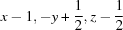
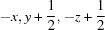
| Symmetry codes: (i) −x+1, −y, −z+1; (ii) −x+1, y+1/2, −z+1/2; (iii) −x+1, −y+1, −z+1; (iv) −x+1, y−1/2, −z+1/2. |
| D—H···A | D—H | H···A | D···A | D—H···A |
| O8—H3···O2v | 0.78 (3) | 2.03 (3) | 2.775 (2) | 160 (3) |
| O8—H4···O3vi | 0.89 (4) | 1.86 (4) | 2.742 (2) | 174 (3) |
| O8—H4···O6vi | 0.89 (4) | 2.60 (3) | 3.159 (2) | 121 (3) |
| O9—H5···O8vii | 0.81 (1) | 2.03 (1) | 2.832 (3) | 168 (4) |
| O9—H6···O6vi | 0.81 (1) | 2.38 (2) | 3.135 (3) | 157 (5) |
| O9—H6···O7vii | 0.81 (1) | 2.50 (4) | 3.031 (3) | 124 (4) |
| Symmetry codes: (v) x, −y+1/2, z−1/2; (vi) x−1, −y+1/2, z−1/2; (vii) −x, y+1/2, −z+1/2. |
Experimental details
| Crystal data | |
| Chemical formula | [Mn2(C18H4O10)(H2O)4] |
| Mr | 562.16 |
| Crystal system, space group | Monoclinic, P21/c |
| Temperature (K) | 273 |
| a, b, c (Å) | 11.2255 (16), 8.4153 (13), 9.7252 (14) |
| β (°) | 92.355 (2) |
| V (Å3) | 917.9 (2) |
| Z | 2 |
| Radiation type | Mo Kα |
| µ (mm−1) | 1.46 |
| Crystal size (mm) | 0.46 × 0.32 × 0.26 |
| Data collection | |
| Diffractometer | Bruker SMART APEX CCD area-detector |
| Absorption correction | Multi-scan (SADABS; Bruker, 2000) |
| Tmin, Tmax | 0.553, 0.702 |
| No. of measured, independent and observed [I > 2σ(I)] reflections | 4340, 1609, 1499 |
| Rint | 0.065 |
| (sin θ/λ)max (Å−1) | 0.594 |
| Refinement | |
| R[F2 > 2σ(F2)], wR(F2), S | 0.028, 0.076, 1.08 |
| No. of reflections | 1609 |
| No. of parameters | 170 |
| No. of restraints | 2 |
| H-atom treatment | H atoms treated by a mixture of independent and constrained refinement |
| Δρmax, Δρmin (e Å−3) | 0.35, −0.41 |
Computer programs: SMART (Bruker, 2000), SAINT (Bruker, 2000), SHELXS97 (Sheldrick, 2008), SHELXL97 (Sheldrick, 2008), SHELXTL (Sheldrick, 2008).
| D—H···A | D—H | H···A | D···A | D—H···A |
| O8—H3···O2i | 0.78 (3) | 2.03 (3) | 2.775 (2) | 160 (3) |
| O8—H4···O3ii | 0.89 (4) | 1.86 (4) | 2.742 (2) | 174 (3) |
| O8—H4···O6ii | 0.89 (4) | 2.60 (3) | 3.159 (2) | 121 (3) |
| O9—H5···O8iii | 0.812 (10) | 2.033 (13) | 2.832 (3) | 168 (4) |
| O9—H6···O6ii | 0.809 (10) | 2.38 (2) | 3.135 (3) | 157 (5) |
| O9—H6···O7iii | 0.809 (10) | 2.50 (4) | 3.031 (3) | 124 (4) |
| Symmetry codes: (i) x, −y+1/2, z−1/2; (ii) x−1, −y+1/2, z−1/2; (iii) −x, y+1/2, −z+1/2. |
Acknowledgements
The authors thank the Center of Testing and Analysis, Nanjing University, for support.
References
 Bruker (2000). SMART, SAINT and SADABS. Bruker AXS Inc., Madison, Wisconsin, USA. Google Scholar
Cheng, X. N., Xue, W. & Chen, X. M. (2010). Eur. J. Inorg. Chem. 24, 3850–3855. Web of Science CSD CrossRef Google Scholar
Hong, D. Y., Hwang, Y. K., Serre, C., Ferey, G. & Chang, J. S. (2009). Adv. Funct. Mater. 19, 1537–1552. Web of Science CrossRef CAS Google Scholar
Li, H., Eddaoudi, M., O'Keeffe, M. & Yaghi, O. M. (1999). Nature (London), 402, 276–279. CAS Google Scholar
Li, J. R., Sculley, J. & Zhou, H. C. (2012). Chem. Rev. 112, 869–932. Web of Science CrossRef CAS PubMed Google Scholar
Liu, Y. M., He, R., Wang, F. M., Lu, C. S. & Meng, Q. J. (2010). Inorg. Chem. Commun. 13, 1375–1379. Web of Science CSD CrossRef CAS Google Scholar
Miller, J. S. & Gatteschi, D. (2011). Chem. Soc. Rev. 40, 3065–3066. Web of Science CrossRef PubMed Google Scholar
Sheldrick, G. M. (2008). Acta Cryst. A64, 112–122. Web of Science CrossRef CAS IUCr Journals Google Scholar
This is an open-access article distributed under the terms of the Creative Commons Attribution (CC-BY) Licence, which permits unrestricted use, distribution, and reproduction in any medium, provided the original authors and source are cited.
| CRYSTALLOGRAPHIC COMMUNICATIONS |


Porous solid materials, such as MOFs (metal-organic frameworks) have been widely studied for their potential applications in gas absorption, separation, catalysis and magnetic materials. Explorations of advanced porous materials for these applications are an intense subject of scientific research (Li et al.,1999; Li et al., 2012; Cheng et al., 2010; Hong et al., 2009; Miller & Gatteschi, 2011; Liu et al., 2010.) Herein we report the crystal structure of the title compound.
The molecular structure of (I) is illustrated in Fig. 1., a summary of the observed hydrogen bonds and the corresponding angles are given in Table 1.
Each asymmetric unit therefore contains one manganese(II) atom, two water ligands and one half AQTC4- ligand. The coordination sphere around manganese is distorted octahedral due to the coordination of four O atoms from three AQTC4- ligands and two O atoms from two water molecules. Two of the carboxylate groups coordinate one manganese in a chelating mode whereas the others each coordinate two manganese center. Each AQTC4- therefore coordinates six different manganese ions and as a result a three-dimensional coordination polymer is formed.