 | Acta Crystallographica Section E Acta Crystallographica Section E CRYSTALLOGRAPHIC COMMUNICATIONS |


 journal menu


inorganic compounds
| CRYSTALLOGRAPHIC COMMUNICATIONS |
 access
Diaquatetrabromidotin(IV) trihydrate

aInstitut für Chemie, Anorganische Chemie II, Universität Osnabrück, Barbarastrasse 7, 49069 Osnabrück, Germany
*Correspondence e-mail: [email protected]
The title compound, [SnBr4(H2O)2]·3H2O, forms large colourless crystals in originally sealed samples of tin tetrabromide. It constitutes the first structurally characterized hydrate of SnBr4 and is isostructural with the corresponding hydrate of SnCl4. It is composed of SnIV atoms octahedrally coordinated by four Br atoms and two cis-related water molecules. The octahedra exhibit site symmetry 2. They are arranged into columns along [001] via medium–strong O—H⋯O hydrogen bonds involving the two lattice water molecules (one situated on a twofold rotation axis) while the chains are interconnected via longer O—H⋯Br hydrogen bonds, forming a three-dimensional network.
Related literature
For background information on hydrates of SnBr4, see: Pfeiffer (1914![[Pfeiffer, P. (1914). Z. Anorg. Chem. 87, 235-247.]](../../../../../../logos/arrows/e_arr.gif "Pfeiffer, P. (1914). Z. Anorg. Chem. 87, 235-247.") ); Pickering (1895); Rayman & Preis (1884). For the isostructural compound [SnCl4(H2O)2]·3H2O, see: Shihada et al. (2004). For structural information on other hydrates of SnCl4, see: Semenov et al. (2005); Genge et al. (2004).
); Pickering (1895); Rayman & Preis (1884). For the isostructural compound [SnCl4(H2O)2]·3H2O, see: Shihada et al. (2004). For structural information on other hydrates of SnCl4, see: Semenov et al. (2005); Genge et al. (2004).
Experimental
Crystal data
|
Refinement
|
| ||||||||||
|
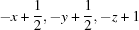 ; (iii)
  .
. Data collection: APEX2 (Bruker, 2009); cell refinement: SAINT (Bruker, 2009); data reduction: SAINT; program(s) used to solve structure: SHELXS97 (Sheldrick, 2008); program(s) used to refine structure: SHELXL97 (Sheldrick, 2008); molecular graphics: DIAMOND (Brandenburg, 2006) and Mercury (Macrae et al., 2008); software used to prepare material for publication: SHELXTL (Sheldrick, 2008).
Supporting information
contains datablocks I, global. DOI: 10.1107/S1600536812036434/fj2592sup1.cif
Structure factors: contains datablock I. DOI: 10.1107/S1600536812036434/fj2592Isup2.hkl
A suitable single-crystal was selected under a polarization microscope and mounted on a 50 µm MicroMesh MiTeGen Micromount TM using FROMBLIN Y perfluoropolyether (LVAC 16/6, Aldrich).
All H atoms of the water molecules were found in a difference Fourier synthesis. Their positions were first refined with respect to a O—H distance of 0.96 Å and an H—O—H angle of 104.95°. Thereafter their positions were constrained to ride on their parent oxygen atoms, with three common isotropic displacement parameter for the three different water molecules.
Data collection: APEX2 (Bruker, 2009); cell SAINT (Bruker, 2009); data reduction: SAINT (Bruker, 2009); program(s) used to solve structure: SHELXS97 (Sheldrick, 2008); program(s) used to refine structure: SHELXL97 (Sheldrick, 2008); molecular graphics: DIAMOND (Brandenburg, 2006) and Mercury (Macrae et al., 2008); software used to prepare material for publication: SHELXTL (Sheldrick, 2008).
![[Figure 1]](./fj2592fig1thm.gif) | Fig. 1. Ball-and-stick model of the {SnBr4(H2O)2} octahedron showing the atom labeling scheme used and the orientation of the twofold (C2) rotation axes. Displacement ellipsoids are drawn at the 50% probability level. Symmetry code: 1) -x, y, 1/2 - z. |
![[Figure 2]](./fj2592fig2thm.gif) | Fig. 2. Schematic representation of the O—H···O hydrogen bonds (red broken lines) beetween the {SnBr4(H2O)2} octahedrons and the uncoordinated water molecules. (a) View perpendicular to, (b) into their tubelike arrangement. Symmetry codes: 1) -1 + x, y, z; 2) 1 - x, y, 3/2 - z. |
![[Figure 3]](./fj2592fig3thm.gif) | Fig. 3. Tube packing as capped sticks model with the shortest O—H···Br hydrogen bridges (green broken lines) interconnecting neighboring tubes in the third dimension. |
| [SnBr4(H2O)2]·3H2O | F(000) = 960 |
| Mr = 528.41 | Dx = 3.179 Mg m−3 |
| Monoclinic, C2/c | Mo Kα radiation, λ = 0.71073 Å |
| Hall symbol: -C 2yc | Cell parameters from 8700 reflections |
| a = 12.6484 (5) Å | θ = 2.6–30.0° |
| b = 10.1647 (4) Å | µ = 16.77 mm−1 |
| c = 8.8683 (4) Å | T = 100 K |
| β = 104.462 (1)° | Block, colourless |
| V = 1104.04 (8) Å3 | 0.18 × 0.15 × 0.12 mm |
| Z = 4 |
| Bruker APEXII CCD diffractometer | 1618 independent reflections |
| Radiation source: fine-focus sealed tube | 1523 reflections with I > 2σ(I) |
| Graphite monochromator | Rint = 0.033 |
| ϕ and ω scans | θmax = 30.0°, θmin = 3.2° |
| Absorption correction: multi-scan (SADABS; Bruker, 2009) | h = −17→16 |
| Tmin = 0.148, Tmax = 0.234 | k = −12→14 |
| 16999 measured reflections | l = −12→12 |
| Refinement on F2 | Secondary atom site location: difference Fourier map |
| Least-squares matrix: full | Hydrogen site location: inferred from neighbouring sites |
| R[F2 > 2σ(F2)] = 0.013 | H-atom parameters constrained |
| wR(F2) = 0.028 | w = 1/[σ2(Fo2) + (0.0089P)2 + 1.3814P] where P = (Fo2 + 2Fc2)/3 |
| S = 1.10 | (Δ/σ)max = 0.001 |
| 1618 reflections | Δρmax = 0.46 e Å−3 |
| 51 parameters | Δρmin = −0.41 e Å−3 |
| 0 restraints | Extinction correction: SHELXL97 (Sheldrick, 2008), Fc*=kFc[1+0.001xFc2λ3/sin(2θ)]-1/4 |
| Primary atom site location: structure-invariant direct methods | Extinction coefficient: 0.00035 (4) |
| [SnBr4(H2O)2]·3H2O | V = 1104.04 (8) Å3 |
| Mr = 528.41 | Z = 4 |
| Monoclinic, C2/c | Mo Kα radiation |
| a = 12.6484 (5) Å | µ = 16.77 mm−1 |
| b = 10.1647 (4) Å | T = 100 K |
| c = 8.8683 (4) Å | 0.18 × 0.15 × 0.12 mm |
| β = 104.462 (1)° |
| Bruker APEXII CCD diffractometer | 1618 independent reflections |
| Absorption correction: multi-scan (SADABS; Bruker, 2009) | 1523 reflections with I > 2σ(I) |
| Tmin = 0.148, Tmax = 0.234 | Rint = 0.033 |
| 16999 measured reflections |
| R[F2 > 2σ(F2)] = 0.013 | 0 restraints |
| wR(F2) = 0.028 | H-atom parameters constrained |
| S = 1.10 | Δρmax = 0.46 e Å−3 |
| 1618 reflections | Δρmin = −0.41 e Å−3 |
| 51 parameters |
Geometry. All e.s.d.'s (except the e.s.d. in the dihedral angle between two l.s. planes) are estimated using the full covariance matrix. The cell e.s.d.'s are taken into account individually in the estimation of e.s.d.'s in distances, angles and torsion angles; correlations between e.s.d.'s in cell parameters are only used when they are defined by crystal symmetry. An approximate (isotropic) treatment of cell e.s.d.'s is used for estimating e.s.d.'s involving l.s. planes. |
Refinement. Refinement of F2 against ALL reflections. The weighted R-factor wR and goodness of fit S are based on F2, conventional R-factors R are based on F, with F set to zero for negative F2. The threshold expression of F2 > σ(F2) is used only for calculating R-factors(gt) etc. and is not relevant to the choice of reflections for refinement. R-factors based on F2 are statistically about twice as large as those based on F, and R- factors based on ALL data will be even larger. |
| x | y | z | Uiso*/Ueq | ||
| Sn1 | 0.0000 | 0.259481 (16) | 0.2500 | 0.00769 (5) | |
| Br1 | 0.143871 (16) | 0.280603 (17) | 0.09578 (2) | 0.01115 (5) | |
| Br2 | 0.117864 (16) | 0.098459 (17) | 0.43896 (2) | 0.01257 (5) | |
| O1 | 0.07836 (11) | 0.42263 (12) | 0.38481 (14) | 0.0123 (3) | |
| H11 | 0.1025 | 0.4275 | 0.4963 | 0.048 (6)* | |
| H12 | 0.1063 | 0.5008 | 0.3480 | 0.048 (6)* | |
| O2 | 0.13528 (11) | 0.39033 (13) | 0.70061 (15) | 0.0134 (3) | |
| H21 | 0.0954 | 0.3121 | 0.7118 | 0.038 (5)* | |
| H22 | 0.2103 | 0.3632 | 0.7231 | 0.038 (5)* | |
| O3 | 1.0000 | 0.19063 (19) | 0.7500 | 0.0170 (4) | |
| H3 | 0.9756 | 0.1311 | 0.6643 | 0.056 (10)* |
| U11 | U22 | U33 | U12 | U13 | U23 | |
| Sn1 | 0.00819 (9) | 0.00818 (8) | 0.00695 (8) | 0.000 | 0.00236 (6) | 0.000 |
| Br1 | 0.01097 (10) | 0.01404 (9) | 0.00975 (8) | 0.00156 (7) | 0.00504 (7) | 0.00131 (6) |
| Br2 | 0.01312 (10) | 0.01227 (9) | 0.01191 (9) | 0.00208 (6) | 0.00235 (7) | 0.00356 (6) |
| O1 | 0.0151 (7) | 0.0124 (6) | 0.0087 (6) | −0.0042 (5) | 0.0017 (5) | −0.0013 (5) |
| O2 | 0.0131 (7) | 0.0143 (6) | 0.0126 (6) | 0.0033 (5) | 0.0027 (5) | 0.0009 (5) |
| O3 | 0.0250 (12) | 0.0150 (9) | 0.0102 (9) | 0.000 | 0.0026 (8) | 0.000 |
| Sn1—O1i | 2.1378 (12) | O1—H11 | 0.9600 |
| Sn1—O1 | 2.1378 (12) | O1—H12 | 0.9600 |
| Sn1—Br2i | 2.5420 (2) | O2—H21 | 0.9600 |
| Sn1—Br2 | 2.5420 (2) | O2—H22 | 0.9600 |
| Sn1—Br1 | 2.5439 (2) | O3—H3 | 0.9602 |
| Sn1—Br1i | 2.5439 (2) | ||
| O1i—Sn1—O1 | 78.26 (7) | O1i—Sn1—Br1i | 86.63 (4) |
| O1i—Sn1—Br2i | 90.98 (4) | O1—Sn1—Br1i | 85.86 (4) |
| O1—Sn1—Br2i | 169.06 (4) | Br2i—Sn1—Br1i | 91.620 (7) |
| O1i—Sn1—Br2 | 169.06 (4) | Br2—Sn1—Br1i | 94.613 (7) |
| O1—Sn1—Br2 | 90.98 (4) | Br1—Sn1—Br1i | 170.317 (10) |
| Br2i—Sn1—Br2 | 99.837 (10) | Sn1—O1—H11 | 126.8 |
| O1i—Sn1—Br1 | 85.86 (4) | Sn1—O1—H12 | 127.6 |
| O1—Sn1—Br1 | 86.63 (4) | H11—O1—H12 | 105.0 |
| Br2i—Sn1—Br1 | 94.612 (7) | H21—O2—H22 | 105.0 |
| Br2—Sn1—Br1 | 91.621 (7) |
| Symmetry code: (i) −x, y, −z+1/2. |
| D—H···A | D—H | H···A | D···A | D—H···A |
| O3—H3···Br2ii | 0.96 | 2.67 | 3.5239 (16) | 148 |
| O2—H22···Br2iii | 0.96 | 2.92 | 3.6365 (14) | 133 |
| O2—H22···Br1iii | 0.96 | 2.58 | 3.4004 (13) | 144 |
| O2—H21···O3iv | 0.96 | 1.82 | 2.7595 (19) | 167 |
| O1—H12···O2v | 0.96 | 1.82 | 2.7182 (18) | 155 |
| O1—H11···O2 | 0.96 | 1.80 | 2.7318 (18) | 164 |
| Symmetry codes: (ii) −x+1, −y, −z+1; (iii) −x+1/2, −y+1/2, −z+1; (iv) x−1, y, z; (v) x, −y+1, z−1/2. |
Experimental details
| Crystal data | |
| Chemical formula | [SnBr4(H2O)2]·3H2O |
| Mr | 528.41 |
| Crystal system, space group | Monoclinic, C2/c |
| Temperature (K) | 100 |
| a, b, c (Å) | 12.6484 (5), 10.1647 (4), 8.8683 (4) |
| β (°) | 104.462 (1) |
| V (Å3) | 1104.04 (8) |
| Z | 4 |
| Radiation type | Mo Kα |
| µ (mm−1) | 16.77 |
| Crystal size (mm) | 0.18 × 0.15 × 0.12 |
| Data collection | |
| Diffractometer | Bruker APEXII CCD diffractometer |
| Absorption correction | Multi-scan (SADABS; Bruker, 2009) |
| Tmin, Tmax | 0.148, 0.234 |
| No. of measured, independent and observed [I > 2σ(I)] reflections | 16999, 1618, 1523 |
| Rint | 0.033 |
| (sin θ/λ)max (Å−1) | 0.703 |
| Refinement | |
| R[F2 > 2σ(F2)], wR(F2), S | 0.013, 0.028, 1.10 |
| No. of reflections | 1618 |
| No. of parameters | 51 |
| H-atom treatment | H-atom parameters constrained |
| Δρmax, Δρmin (e Å−3) | 0.46, −0.41 |
Computer programs: APEX2 (Bruker, 2009), SAINT (Bruker, 2009), SHELXS97 (Sheldrick, 2008), SHELXL97 (Sheldrick, 2008), DIAMOND (Brandenburg, 2006) and Mercury (Macrae et al., 2008), SHELXTL (Sheldrick, 2008).
| D—H···A | D—H | H···A | D···A | D—H···A |
| O3—H3···Br2i | 0.96 | 2.67 | 3.5239 (16) | 148 |
| O2—H22···Br2ii | 0.96 | 2.92 | 3.6365 (14) | 133 |
| O2—H22···Br1ii | 0.96 | 2.58 | 3.4004 (13) | 144 |
| O2—H21···O3iii | 0.96 | 1.82 | 2.7595 (19) | 167 |
| O1—H12···O2iv | 0.96 | 1.82 | 2.7182 (18) | 155 |
| O1—H11···O2 | 0.96 | 1.80 | 2.7318 (18) | 164 |
| Symmetry codes: (i) −x+1, −y, −z+1; (ii) −x+1/2, −y+1/2, −z+1; (iii) x−1, y, z; (iv) x, −y+1, z−1/2. |
References
 Brandenburg, K. (2006). DIAMOND. Crystal Impact GbR, Bonn, Germany. Google Scholar
Bruker (2009). APEX2, SAINT and SADABS. Bruker AXS Inc., Madison, Wisconsin, USA. Google Scholar
Genge, A. R. J., Levason, W., Patel, R., Reid, G. & Webster, M. (2004). Acta Cryst. C60, i47–i49. Web of Science CrossRef CAS IUCr Journals Google Scholar
Macrae, C. F., Bruno, I. J., Chisholm, J. A., Edgington, P. R., McCabe, P., Pidcock, E., Rodriguez-Monge, L., Taylor, R., van de Streek, J. & Wood, P. A. (2008). J. Appl. Cryst. 41, 466–470. Web of Science CrossRef CAS IUCr Journals Google Scholar
Pfeiffer, P. (1914). Z. Anorg. Chem. 87, 235–247. CrossRef CAS Google Scholar
Pickering, S. U. (1895). Phil. Mag. 39, 510–528. CrossRef Google Scholar
Rayman, B. & Preis, K. (1884). Liebigs Ann. Chem. 223, 323–334. Google Scholar
Semenov, S. N., Maltsev, E. Y., Timokhin, I. G., Drozdov, A. A. & Troyanov, S. I. (2005). Mendeleev Commun. pp. 205–207. Web of Science CrossRef Google Scholar
Sheldrick, G. M. (2008). Acta Cryst. A64, 112–122. Web of Science CrossRef CAS IUCr Journals Google Scholar
Shihada, A.-F., Abushamleh, A. S. & Weller, F. (2004). Z. Anorg. Allg. Chem. 630, 841–847. Web of Science CSD CrossRef CAS Google Scholar
This is an open-access article distributed under the terms of the Creative Commons Attribution (CC-BY) Licence, which permits unrestricted use, distribution, and reproduction in any medium, provided the original authors and source are cited.
| CRYSTALLOGRAPHIC COMMUNICATIONS |


In contrast to tin(IV) chloride, SnCl4, from which the crystal structures of hydrates, SnCl4.nH2O, with n = 2 (Semenov et al., 2005), n = 3 (Genge et al., 2004; Semenov et al., 2005), n = 4 (Genge et al., 2004; Shihada et al., 2004), and n = 5 (Shihada et al., 2004) are known in detail, no structural data are available concerning the hydrates of tin(IV) bromide, SnBr4.nH2O, although there are some hints in the older literature that a tetrahydrate, n = 4, (Rayman & Preis, 1884; Pfeiffer, 1914) and octahydrate, n = 8, (Pickering, 1895) exist. By chance, we found near the neck of some several years old, originally sealed bottles of tin(IV) bromide some large, colorless, transparent single-crystal in shape totally different from those of SnBr4 at the bottom of the flask. From single-crystal X-ray diffraction experiments we were able to confirm their composition to correspond to a so far unknown pentahydrate of tin tetrabromide, SnBr4.5H2O, 1.
The asymmetric unit of the title compound consists of half a {SnBr4(H2O)2} octahedron with tin at a twofold rotation axes, and one and a half water molecule in general position, respectively, on a twofold rotation axes, too. The {SnBr4(H2O)2} octahedron (Fig. 1) belongs to point group C2 with the two coordinated water molecules in a cis position, a structural feature that is common to all the hydrates of SnCl4, mentioned above. Since the title compound is isostructural to the corresponding pentahydrate of SnCl4, 2, the influence of the larger bromine atom on bond angles and bond lengths can be studied in more detail. Both different tin-bromine distances are very similar and differ by only 0.0002 (2) Å, the mean value being 2.5435 (2) Å. The corresponding tin-chlorine distances were found to be 2.3824 (6) and 2.3826 (7) Å. The tin-oxygen distance of 2.135 (1) Å in 1 is somewhat longer than in 2 [2.115 (2) Å] but in the range [2.106 (5), tetrahydrate, T = 130 K, - 2.168 (2), dihydrate, T = 150 K] found in the other hydrates of SnCl4. Influence of the larger bromine atom on the structural parameters of the coordination polyhedron becomes more evident with respect to bond angles. Thus, the angle between the two water molecules [78.26 (7)°, Hal = Br] is slightly reduced [79.9 (1)°, Hal = Cl]. This is also valid for the angle between the bromine atoms being trans to each other [170.32 (1)°, 1, 171.47 (3)°, 2]. In contrast, the angle [99.84 (1)°] between the bromine atoms trans to the water molecules is significantly enlarged in comparison to the corresponding angle between the chlorine atoms [93.54 (2)°] of 2.
Between the {SnBr4(H2O)2} octahedrons and the uncoordinated water molecules an extended array of hydrogen bonds of different strengths (Tab. 2) exist. The strongest ones are those of type O—H···O between the three different water molecules giving rise to a tube-like arrangement (Fig. 2) of these components. Within these tubes, the coordinated water molecule 1 acts as acceptor for one and donor for two hydrogen bonds. From the two other uncoordinated water molecules, molecule 2 serves as donor for one and acceptor for two hydrogen bonds, whereas molecule 3 is only acceptor for two hydrogen bonds. In addition, the hydrogen atoms of these two molecules not involved into O—H···O hydrogen bridges form weaker (longer) hydrogen bonds to bromine atoms. The shortest one of these O—H···Br hydrogen bridges interconnects neighboring tubes (Fig. 3) in the third dimension.