 | Acta Crystallographica Section E Acta Crystallographica Section E CRYSTALLOGRAPHIC COMMUNICATIONS |


 journal menu


metal-organic compounds
| CRYSTALLOGRAPHIC COMMUNICATIONS |
 access
Poly[[diaquabis[μ-2-(4-fluorophenoxy)acetato-κ2O1:O1′]magnesium] 0.4-hydrate]

aScience and Engineering Faculty, Queensland University of Technology, GPO Box 2434, Brisbane, Queensland 4001, Australia
*Correspondence e-mail: [email protected]
In the title compound, {[Mg(C8H6FO3)2(H2O)2]·0.4H2O}n, slightly distorted octahedral MgO6 complex units have crystallographic inversion symmetry, the comprising two trans-related water molecules and four carboxyl O-atom donors, two of which are bridging. Within the two-dimensional complex polymer which is parallel to (100), coordinating water molecules form intermolecular O—H⋯O hydrogen bonds with carboxylate and phenoxy O-atom acceptors, as well as with the partial-occupancy solvent water molecules.
Related literature
For the structures of some magnesium complexes, derived from phenoxyacetic acids, see: Smith et al. (1980![[Smith, G., O'Reilly, E. J. & Kennard, C. H. L. (1980). J. Chem. Soc. Dalton Trans. pp. 2462-2466.]](../../../../../../logos/arrows/e_arr.gif "Smith, G., O'Reilly, E. J. & Kennard, C. H. L. (1980). J. Chem. Soc. Dalton Trans. pp. 2462-2466.") , 1981, 1982); Kennard et al. (1986). For the structures of other metal complexes with 4-fluorophenoxyacetate, see: O'Reilly et al. (1984); Smith et al. (1993).
, 1981, 1982); Kennard et al. (1986). For the structures of other metal complexes with 4-fluorophenoxyacetate, see: O'Reilly et al. (1984); Smith et al. (1993).
![[Scheme 1]](lh5512scheme1.gif)
Experimental
Crystal data
|
Refinement
|
| ||||||||||
 .
.
|
 ; (iv)
 Data collection: CrysAlis PRO (Agilent, 2012); cell refinement: CrysAlis PRO; data reduction: CrysAlis PRO; program(s) used to solve structure: SIR92 (Altomare et al., 1993); program(s) used to refine structure: SHELXL97 (Sheldrick, 2008) within WinGX (Farrugia, 1999); molecular graphics: PLATON (Spek, 2009); software used to prepare material for publication: PLATON.
Supporting information
contains datablocks global, I. DOI: 10.1107/S1600536812035246/lh5512sup1.cif
Structure factors: contains datablock I. DOI: 10.1107/S1600536812035246/lh5512Isup2.hkl
Supporting information file. DOI: 10.1107/S1600536812035246/lh5512Isup3.cml
The title compound was synthesized by the addition of excess MgCO3 to 15 ml of a hot aqueous ethanolic solution (10:1) of 4-fluorophenoxyacetic acid (0.1 g). After completion of the reaction, the excess MgCO3 was removed by filtration and the solution was allowed evaporate to incipient dryness at room temperature, giving thin colourless plates of the title compound from which a specimen was cleaved for the X-ray analysis.
Hydrogen atoms on the coordinated water molecule were located by difference methods and both positional and isotropic displacement parameters were initially refined but these were then allowed to ride, with Uiso(H) = 1.5Ueq(C). Other H-atoms were included in the at calculated positions [C—H(aromatic) = 0.93 Å, 0.98 Å (methylene)] or O—H = 0.84–0.94 Å, with Uiso(H) = 1.2Ueq(C) or 1.5Ueq(O), also using a riding-model approximation. The site occupancy factor for the partial water molecule of solvation was determined as 0.196 (4) and was subsequently fixed as 0.20.
Data collection: CrysAlis PRO (Agilent, 2012); cell CrysAlis PRO (Agilent, 2012); data reduction: CrysAlis PRO (Agilent, 2012); program(s) used to solve structure: SIR92 (Altomare et al., 1993); program(s) used to refine structure: SHELXL97 (Sheldrick, 2008) within WinGX (Farrugia, 1999); molecular graphics: PLATON (Spek, 2009); software used to prepare material for publication: PLATON (Spek, 2009).
![[Figure 1]](./lh5512fig1thm.gif) | Fig. 1. The molecular structure of the title compound, including the partial water molecules of solvation (O2W), with displacement ellipsoids drawn at the 50% probability level. For symmetry codes, see Table 1. |
![[Figure 2]](./lh5512fig2thm.gif) | Fig. 2. The hydrogen-bonding interactions, shown as dashed lines, in the title compound viewed along c. The partial water molecule of solvation and non-associative H-atoms have been omitted. For symmetry codes, see Tables 1 and 2. |
| [Mg(C8H6FO3)2(H2O)2]·0.4H2O | F(000) = 420 |
| Mr = 405.80 | Dx = 1.508 Mg m−3 |
| Monoclinic, P21/c | Mo Kα radiation, λ = 0.71073 Å |
| Hall symbol: -P 2ybc | Cell parameters from 1476 reflections |
| a = 17.2526 (9) Å | θ = 3.2–28.9° |
| b = 6.8899 (3) Å | µ = 0.17 mm−1 |
| c = 7.5474 (3) Å | T = 200 K |
| β = 95.118 (4)° | Plate, colourless |
| V = 893.57 (7) Å3 | 0.30 × 0.20 × 0.05 mm |
| Z = 2 |
| Oxford Diffraction Gemini-S CCD-detector diffractometer | 1762 independent reflections |
| Radiation source: Enhance (Mo) X-ray source | 1400 reflections with I > 2σ(I) |
| Graphite monochromator | Rint = 0.040 |
| Detector resolution: 16.077 pixels mm-1 | θmax = 26.0°, θmin = 3.2° |
| ω scans | h = −21→21 |
| Absorption correction: multi-scan (CrysAlis PRO; Agilent, 2012) | k = −8→8 |
| Tmin = 0.964, Tmax = 0.980 | l = −9→9 |
| 5825 measured reflections |
| Refinement on F2 | Primary atom site location: structure-invariant direct methods |
| Least-squares matrix: full | Secondary atom site location: difference Fourier map |
| R[F2 > 2σ(F2)] = 0.047 | Hydrogen site location: inferred from neighbouring sites |
| wR(F2) = 0.109 | H-atom parameters constrained |
| S = 1.06 | w = 1/[σ2(Fo2) + (0.0424P)2 + 0.393P] where P = (Fo2 + 2Fc2)/3 |
| 1762 reflections | (Δ/σ)max < 0.001 |
| 133 parameters | Δρmax = 0.25 e Å−3 |
| 0 restraints | Δρmin = −0.29 e Å−3 |
| [Mg(C8H6FO3)2(H2O)2]·0.4H2O | V = 893.57 (7) Å3 |
| Mr = 405.80 | Z = 2 |
| Monoclinic, P21/c | Mo Kα radiation |
| a = 17.2526 (9) Å | µ = 0.17 mm−1 |
| b = 6.8899 (3) Å | T = 200 K |
| c = 7.5474 (3) Å | 0.30 × 0.20 × 0.05 mm |
| β = 95.118 (4)° |
| Oxford Diffraction Gemini-S CCD-detector diffractometer | 1762 independent reflections |
| Absorption correction: multi-scan (CrysAlis PRO; Agilent, 2012) | 1400 reflections with I > 2σ(I) |
| Tmin = 0.964, Tmax = 0.980 | Rint = 0.040 |
| 5825 measured reflections |
| R[F2 > 2σ(F2)] = 0.047 | 0 restraints |
| wR(F2) = 0.109 | H-atom parameters constrained |
| S = 1.06 | Δρmax = 0.25 e Å−3 |
| 1762 reflections | Δρmin = −0.29 e Å−3 |
| 133 parameters |
Geometry. Bond distances, angles etc. have been calculated using the rounded fractional coordinates. All su's are estimated from the variances of the (full) variance-covariance matrix. The cell e.s.d.'s are taken into account in the estimation of distances, angles and torsion angles |
Refinement. Refinement of F2 against ALL reflections. The weighted R-factor wR and goodness of fit S are based on F2, conventional R-factors R are based on F, with F set to zero for negative F2. The threshold expression of F2 > σ(F2) is used only for calculating R-factors(gt) etc. and is not relevant to the choice of reflections for refinement. R-factors based on F2 are statistically about twice as large as those based on F, and R- factors based on ALL data will be even larger. |
| x | y | z | Uiso*/Ueq | Occ. (<1) | |
| Mg1 | 0.00000 | 0.50000 | 0.50000 | 0.0187 (3) | |
| F4 | 0.49577 (8) | −0.0237 (3) | 0.7819 (2) | 0.0567 (6) | |
| O1 | 0.20100 (10) | −0.0103 (3) | 0.4489 (2) | 0.0481 (6) | |
| O1W | 0.09125 (8) | 0.6177 (2) | 0.36712 (19) | 0.0255 (5) | |
| O21 | 0.01967 (8) | 0.2303 (2) | 0.39916 (19) | 0.0255 (4) | |
| O22 | 0.07774 (8) | 0.02846 (19) | 0.22234 (18) | 0.0220 (4) | |
| C1 | 0.27377 (13) | −0.0045 (4) | 0.5408 (3) | 0.0358 (8) | |
| C2 | 0.32768 (15) | −0.1323 (4) | 0.4814 (4) | 0.0519 (10) | |
| C3 | 0.40282 (15) | −0.1370 (4) | 0.5616 (4) | 0.0487 (9) | |
| C4 | 0.42218 (13) | −0.0158 (4) | 0.7001 (3) | 0.0393 (8) | |
| C5 | 0.37063 (15) | 0.1118 (4) | 0.7620 (3) | 0.0408 (9) | |
| C6 | 0.29510 (14) | 0.1183 (4) | 0.6810 (3) | 0.0378 (8) | |
| C11 | 0.14596 (12) | 0.1286 (3) | 0.4960 (3) | 0.0264 (7) | |
| C21 | 0.07588 (12) | 0.1271 (3) | 0.3609 (3) | 0.0194 (6) | |
| O2W | 0.2262 (5) | 0.5768 (14) | 0.5816 (12) | 0.048 (3) | 0.200 |
| H2 | 0.31330 | −0.21540 | 0.38700 | 0.0620* | |
| H3 | 0.43940 | −0.22160 | 0.52140 | 0.0580* | |
| H5 | 0.38580 | 0.19330 | 0.85700 | 0.0490* | |
| H6 | 0.25920 | 0.20490 | 0.72100 | 0.0450* | |
| H11A | 0.16940 | 0.25660 | 0.50070 | 0.0320* | |
| H11B | 0.12990 | 0.09860 | 0.61290 | 0.0320* | |
| H11W | 0.13290 | 0.67830 | 0.42470 | 0.0380* | |
| H12W | 0.06600 | 0.68980 | 0.27780 | 0.0380* | |
| H21W | 0.22790 | 0.70540 | 0.62850 | 0.0710* | 0.200 |
| H22W | 0.18990 | 0.52540 | 0.63450 | 0.0710* | 0.200 |
| U11 | U22 | U33 | U12 | U13 | U23 | |
| Mg1 | 0.0232 (5) | 0.0158 (5) | 0.0167 (5) | 0.0015 (4) | 0.0003 (4) | −0.0012 (4) |
| F4 | 0.0271 (7) | 0.0734 (12) | 0.0671 (11) | 0.0020 (8) | −0.0101 (7) | 0.0008 (9) |
| O1 | 0.0388 (10) | 0.0607 (12) | 0.0412 (11) | 0.0274 (9) | −0.0169 (8) | −0.0299 (9) |
| O1W | 0.0261 (8) | 0.0252 (8) | 0.0249 (8) | 0.0015 (7) | 0.0008 (6) | 0.0034 (6) |
| O21 | 0.0299 (8) | 0.0197 (7) | 0.0261 (8) | 0.0051 (7) | −0.0011 (6) | −0.0065 (6) |
| O22 | 0.0274 (8) | 0.0198 (7) | 0.0186 (7) | 0.0013 (6) | 0.0003 (6) | −0.0028 (6) |
| C1 | 0.0310 (12) | 0.0464 (15) | 0.0286 (13) | 0.0124 (12) | −0.0048 (10) | −0.0082 (11) |
| C2 | 0.0461 (16) | 0.0655 (19) | 0.0416 (16) | 0.0250 (15) | −0.0107 (13) | −0.0223 (14) |
| C3 | 0.0373 (15) | 0.0621 (18) | 0.0457 (16) | 0.0206 (14) | −0.0021 (12) | −0.0062 (14) |
| C4 | 0.0249 (12) | 0.0519 (16) | 0.0401 (15) | −0.0001 (12) | −0.0021 (11) | 0.0062 (13) |
| C5 | 0.0354 (14) | 0.0475 (16) | 0.0383 (15) | −0.0048 (12) | −0.0037 (11) | −0.0096 (12) |
| C6 | 0.0334 (13) | 0.0466 (15) | 0.0327 (13) | 0.0060 (12) | −0.0012 (11) | −0.0109 (12) |
| C11 | 0.0293 (12) | 0.0258 (11) | 0.0237 (11) | 0.0069 (10) | −0.0005 (9) | −0.0071 (9) |
| C21 | 0.0254 (11) | 0.0130 (9) | 0.0198 (10) | −0.0022 (9) | 0.0022 (8) | 0.0013 (8) |
| O2W | 0.045 (5) | 0.054 (6) | 0.043 (5) | −0.017 (5) | 0.001 (4) | 0.009 (4) |
| Mg1—O1W | 2.1032 (14) | O2W—H21W | 0.9500 |
| Mg1—O21 | 2.0478 (14) | C1—C2 | 1.384 (4) |
| Mg1—O22i | 2.0620 (14) | C1—C6 | 1.379 (3) |
| Mg1—O1Wii | 2.1032 (14) | C2—C3 | 1.381 (4) |
| Mg1—O21ii | 2.0478 (14) | C3—C4 | 1.356 (4) |
| Mg1—O22iii | 2.0620 (14) | C4—C5 | 1.363 (4) |
| F4—C4 | 1.362 (3) | C5—C6 | 1.390 (3) |
| O1—C1 | 1.380 (3) | C11—C21 | 1.511 (3) |
| O1—C11 | 1.416 (3) | C2—H2 | 0.9300 |
| O21—C21 | 1.257 (3) | C3—H3 | 0.9300 |
| O22—C21 | 1.250 (3) | C5—H5 | 0.9300 |
| O1W—H11W | 0.9100 | C6—H6 | 0.9300 |
| O1W—H12W | 0.9200 | C11—H11B | 0.9700 |
| O2W—H22W | 0.8500 | C11—H11A | 0.9700 |
| O1W—Mg1—O21 | 90.96 (5) | C1—C2—C3 | 120.3 (3) |
| O1W—Mg1—O22i | 92.03 (5) | C2—C3—C4 | 118.7 (2) |
| O1W—Mg1—O1Wii | 180.00 | F4—C4—C3 | 118.7 (2) |
| O1W—Mg1—O21ii | 89.04 (5) | F4—C4—C5 | 118.7 (2) |
| O1W—Mg1—O22iii | 87.97 (5) | C3—C4—C5 | 122.6 (2) |
| O21—Mg1—O22i | 84.33 (5) | C4—C5—C6 | 119.0 (2) |
| O1Wii—Mg1—O21 | 89.04 (5) | C1—C6—C5 | 119.6 (2) |
| O21—Mg1—O21ii | 180.00 | O1—C11—C21 | 109.90 (17) |
| O21—Mg1—O22iii | 95.67 (5) | O21—C21—C11 | 115.38 (19) |
| O1Wii—Mg1—O22i | 87.97 (5) | O22—C21—C11 | 119.32 (18) |
| O21ii—Mg1—O22i | 95.67 (5) | O21—C21—O22 | 125.3 (2) |
| O22i—Mg1—O22iii | 180.00 | C3—C2—H2 | 120.00 |
| O1Wii—Mg1—O21ii | 90.96 (5) | C1—C2—H2 | 120.00 |
| O1Wii—Mg1—O22iii | 92.03 (5) | C2—C3—H3 | 121.00 |
| O21ii—Mg1—O22iii | 84.33 (5) | C4—C3—H3 | 121.00 |
| C1—O1—C11 | 117.06 (19) | C4—C5—H5 | 120.00 |
| Mg1—O21—C21 | 139.08 (14) | C6—C5—H5 | 121.00 |
| Mg1iv—O22—C21 | 132.00 (13) | C5—C6—H6 | 120.00 |
| Mg1—O1W—H12W | 103.00 | C1—C6—H6 | 120.00 |
| H11W—O1W—H12W | 114.00 | O1—C11—H11A | 110.00 |
| Mg1—O1W—H11W | 123.00 | O1—C11—H11B | 110.00 |
| H21W—O2W—H22W | 102.00 | C21—C11—H11B | 110.00 |
| O1—C1—C6 | 124.9 (2) | H11A—C11—H11B | 108.00 |
| C2—C1—C6 | 119.9 (2) | C21—C11—H11A | 110.00 |
| O1—C1—C2 | 115.2 (2) | ||
| O1W—Mg1—O21—C21 | 36.0 (2) | C6—C1—C2—C3 | −0.2 (4) |
| O22i—Mg1—O21—C21 | 127.9 (2) | O1—C1—C6—C5 | −179.4 (2) |
| O1Wii—Mg1—O21—C21 | −144.0 (2) | C2—C1—C6—C5 | −0.3 (4) |
| O22iii—Mg1—O21—C21 | −52.1 (2) | C1—C2—C3—C4 | 0.7 (4) |
| C11—O1—C1—C2 | −175.1 (2) | C2—C3—C4—F4 | 178.5 (2) |
| C11—O1—C1—C6 | 4.0 (3) | C2—C3—C4—C5 | −0.7 (4) |
| C1—O1—C11—C21 | 169.15 (19) | F4—C4—C5—C6 | −179.0 (2) |
| Mg1—O21—C21—O22 | −136.10 (18) | C3—C4—C5—C6 | 0.2 (4) |
| Mg1—O21—C21—C11 | 43.1 (3) | C4—C5—C6—C1 | 0.3 (4) |
| Mg1iv—O22—C21—O21 | 4.0 (3) | O1—C11—C21—O21 | 172.84 (18) |
| Mg1iv—O22—C21—C11 | −175.24 (13) | O1—C11—C21—O22 | −7.9 (3) |
| O1—C1—C2—C3 | 179.0 (2) |
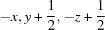
| Symmetry codes: (i) −x, y+1/2, −z+1/2; (ii) −x, −y+1, −z+1; (iii) x, −y+1/2, z+1/2; (iv) −x, y−1/2, −z+1/2. |
| D—H···A | D—H | H···A | D···A | D—H···A |
| O1W—H11W···O1v | 0.91 | 2.45 | 3.214 (2) | 143 |
| O1W—H12W···O22v | 0.92 | 2.38 | 3.0352 (19) | 128 |
| O1W—H12W···O21i | 0.92 | 1.92 | 2.760 (2) | 151 |
| O2W—H21W···O1v | 0.95 | 2.41 | 3.034 (10) | 123 |
| O2W—H22W···O22iii | 0.85 | 2.13 | 2.950 (9) | 160 |
| Symmetry codes: (i) −x, y+1/2, −z+1/2; (iii) x, −y+1/2, z+1/2; (v) x, y+1, z. |
Experimental details
| Crystal data | |
| Chemical formula | [Mg(C8H6FO3)2(H2O)2]·0.4H2O |
| Mr | 405.80 |
| Crystal system, space group | Monoclinic, P21/c |
| Temperature (K) | 200 |
| a, b, c (Å) | 17.2526 (9), 6.8899 (3), 7.5474 (3) |
| β (°) | 95.118 (4) |
| V (Å3) | 893.57 (7) |
| Z | 2 |
| Radiation type | Mo Kα |
| µ (mm−1) | 0.17 |
| Crystal size (mm) | 0.30 × 0.20 × 0.05 |
| Data collection | |
| Diffractometer | Oxford Diffraction Gemini-S CCD-detector diffractometer |
| Absorption correction | Multi-scan (CrysAlis PRO; Agilent, 2012) |
| Tmin, Tmax | 0.964, 0.980 |
| No. of measured, independent and observed [I > 2σ(I)] reflections | 5825, 1762, 1400 |
| Rint | 0.040 |
| (sin θ/λ)max (Å−1) | 0.617 |
| Refinement | |
| R[F2 > 2σ(F2)], wR(F2), S | 0.047, 0.109, 1.06 |
| No. of reflections | 1762 |
| No. of parameters | 133 |
| H-atom treatment | H-atom parameters constrained |
| Δρmax, Δρmin (e Å−3) | 0.25, −0.29 |
Computer programs: CrysAlis PRO (Agilent, 2012), SIR92 (Altomare et al., 1993), SHELXL97 (Sheldrick, 2008) within WinGX (Farrugia, 1999), PLATON (Spek, 2009).
| Mg1—O1W | 2.1032 (14) | Mg1—O1Wii | 2.1032 (14) |
| Mg1—O21 | 2.0478 (14) | Mg1—O21ii | 2.0478 (14) |
| Mg1—O22i | 2.0620 (14) | Mg1—O22iii | 2.0620 (14) |
| Symmetry codes: (i) −x, y+1/2, −z+1/2; (ii) −x, −y+1, −z+1; (iii) x, −y+1/2, z+1/2. |
| D—H···A | D—H | H···A | D···A | D—H···A |
| O1W—H11W···O1iv | 0.91 | 2.45 | 3.214 (2) | 143 |
| O1W—H12W···O22iv | 0.92 | 2.38 | 3.0352 (19) | 128 |
| O1W—H12W···O21i | 0.92 | 1.92 | 2.760 (2) | 151 |
| O2W—H21W···O1iv | 0.95 | 2.41 | 3.034 (10) | 123 |
| O2W—H22W···O22iii | 0.85 | 2.13 | 2.950 (9) | 160 |
| Symmetry codes: (i) −x, y+1/2, −z+1/2; (iii) x, −y+1/2, z+1/2; (iv) x, y+1, z. |
Acknowledgements
The author acknowledges financial support from the Australian Research Council, the Science and Engineering Faculty and the University Library, Queensland University of Technology.
References
 Agilent (2012). CrysAlis PRO. Agilent Technologies Ltd, Yarnton, England. Google Scholar
Altomare, A., Cascarano, G., Giacovazzo, C. & Guagliardi, A. (1993). J. Appl. Cryst. 26, 343–350. CrossRef Web of Science IUCr Journals Google Scholar
Farrugia, L. J. (1999). J. Appl. Cryst. 32, 837–838. CrossRef CAS IUCr Journals Google Scholar
Kennard, C. H. L., O'Reilly, E. J., Schiller, S., Smith, G. & White, A. H. (1986). Aust. J. Chem. 39, 1823–1832. CSD CrossRef CAS Google Scholar
O'Reilly, E. J., Smith, G. & Kennard, C. H. L. (1984). Inorg. Chim. Acta, 90, 63–71. CSD CrossRef CAS Web of Science Google Scholar
Sheldrick, G. M. (2008). Acta Cryst. A64, 112–122. Web of Science CrossRef CAS IUCr Journals Google Scholar
Smith, G., Lynch, D. E., Mak, T. C. W., Yip, W.-H. & Kennard, C. H. L. (1993). Polyhedron, 12, 203–208. CSD CrossRef CAS Web of Science Google Scholar
Smith, G., O'Reilly, E. J. & Kennard, C. H. L. (1980). J. Chem. Soc. Dalton Trans. pp. 2462–2466. CSD CrossRef Web of Science Google Scholar
Smith, G., O'Reilly, E. J. & Kennard, C. H. L. (1981). Cryst. Struct. Commun. 10, 1397–1402. CAS Google Scholar
Smith, G., O'Reilly, E. J. & Kennard, C. H. L. (1982). Inorg. Chim. Acta, 62, 241–246. CSD CrossRef CAS Web of Science Google Scholar
Spek, A. L. (2009). Acta Cryst. D65, 148–155. Web of Science CrossRef CAS IUCr Journals Google Scholar
This is an open-access article distributed under the terms of the Creative Commons Attribution (CC-BY) Licence, which permits unrestricted use, distribution, and reproduction in any medium, provided the original authors and source are cited.
| CRYSTALLOGRAPHIC COMMUNICATIONS |


Magnesium complexes involving monoanionic phenoxyacetate ligands (L) show a variety of coordination modes, all based on an octahedral MgO6 metal stereochemistry, e.g. discrete monomeric [[MgL2(H2O)4] (L = 2-fluorophenoxyacetate) (Kennard et al., 1986); (L = 4-chloro-2-methylphenoxyacetate) (Smith et al., 1981); [MgL(H2O)5] (L = 2,4,5-trichlorophenoxyacetate) (Smith et al., 1982)], or polymeric [[MgL2(H2O)2]n (L = phenoxyacetate or 4-chlorophenoxyacetate) (Smith et al., 1980)].
The title complex, [Mg(H2O)2(C8H6FO3)2]n (0.4H2O)n was obtained from the reaction of 4-fluorophenoxyacetic acid with MgCO3 in aqueous ethanol and the structure is reported herein. In this structure (Fig. 1), the slightly distorted octahedral MgO6 complex units [bond range Mg—O, 2.0478 (14)–2.1032 (14) Å (Table 1)] have crystallographic inversion symmetry, the coordination polyhedron comprising two trans-related water molecules and four carboxyl O-atom donors, two of which are bridging. Within the two-dimensional complex polymer layers which extend across (100), the coordinated water molecules from intermolecular O—H···O hydrogen-bonding interactions (Table 2), with carboxyl and phenoxy O-atom acceptors as well as with the partial water molecules of solvation (S.O.F. = 0.2) (Fig. 2). Except for the presence of the partial water molecules, the structure is similar to the those of the isomorphous Mg complexes with phenoxyacetate and 4-chlorophenoxyacetate (Smith et al., 1980). In the present complex, the 4-fluorophenoxyacetate ligand is essentially planar, with the carboxyl group rotated slightly out of the plane [benzene ring to acetate dihedral angle = 12.26 (12)°].