 | Acta Crystallographica Section E Acta Crystallographica Section E CRYSTALLOGRAPHIC COMMUNICATIONS |


 journal menu


organic compounds
| CRYSTALLOGRAPHIC COMMUNICATIONS |
 access
N-[2-(4-Methylbenzoyl)ethyl]propan-2-aminium chloride

aDepartment of Science Education, Faculty of Education, Kastamonu University, 37200 Kastamonu, Turkey, bDepartment of Physics, Faculty of Sciences, Erciyes University, 38039 Kayseri, Turkey, cDepartment of Pharmaceutical Chemistry, Faculty of Pharmacy, Atatürk University, 25240 Erzurum, Turkey, and dDepartment of Chemistry, Faculty of Sciences, Atatürk University, 25240 Erzurum, Turkey
*Correspondence e-mail: [email protected]
In the title compound, C13H20NO+·Cl−, the protonated amino N atom is hydrogen bonded to the chloride anion. N—H⋯Cl hydrogen bonds link the anions and cations into dimers, which are connected by C—H⋯O hydrogen bonds, forming supramolecular chains extending along [100].
Related literature
For the details of the pharmacological effects of Mannich bases and for their synthesis, see: Dimmock & Kumar (1997![[Dimmock, J. R. & Kumar, P. (1997). Curr. Med. Chem. 4, 1-22.]](../../../../../../logos/arrows/e_arr.gif "Dimmock, J. R. & Kumar, P. (1997). Curr. Med. Chem. 4, 1-22.") ); Gul et al. (2004; 2005a,b; 2009); Gul (2005); Mete et al. (2011a,b); Kucukoglu et al. (2011); Canturk et al. (2008); Chen et al. (1991); Suleyman et al. (2007); Plastino et al. (1962, 1964). For bond-length data, see: Allen et al. (1987). For hydrogen-bond motifs, see: Bernstein et al. (1995); Etter (1990). For some related structures, see: Abonia et al. (2011); Tuzina et al. (2006).
); Gul et al. (2004; 2005a,b; 2009); Gul (2005); Mete et al. (2011a,b); Kucukoglu et al. (2011); Canturk et al. (2008); Chen et al. (1991); Suleyman et al. (2007); Plastino et al. (1962, 1964). For bond-length data, see: Allen et al. (1987). For hydrogen-bond motifs, see: Bernstein et al. (1995); Etter (1990). For some related structures, see: Abonia et al. (2011); Tuzina et al. (2006).
![[Scheme 1]](qm2078scheme1.gif)
Experimental
Crystal data
|
Refinement
|
| |||||||||||||||||||||||||||
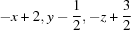 ; (ii)
 Data collection: CrystalClear (Rigaku/MSC, 2005); cell refinement: CrystalClear; data reduction: CrystalClear (Rigaku/MSC, 2005); program(s) used to solve structure: SHELXS97 (Sheldrick, 2008); program(s) used to refine structure: SHELXL97 (Sheldrick, 2008); molecular graphics: ORTEP-3 for Windows (Farrugia, 1997) and PLATON (Spek, 2009); software used to prepare material for publication: WinGX (Farrugia, 1999).
Supporting information
contains datablocks global, I. DOI: 10.1107/S1600536812035271/qm2078sup1.cif
Structure factors: contains datablock I. DOI: 10.1107/S1600536812035271/qm2078Isup2.hkl
Supporting information file. DOI: 10.1107/S1600536812035271/qm2078Isup3.cml
A mixture of the appropriate ketone (50 mmol), paraformaldehyde (50 mmol), and isopropylamine hydrochloride (27 mmol) was heated in an oil bath at 403 K. The reaction vessel was then removed from the oil bath and when the temperature of the mixture dropped to 338 K, ethyl acetate (40–80 ml) was added. The mixture was stirred at room temperature for 24 h and the resultant precipitate was then collected and were recrystallized from ether/methanol. The melting point and yield of this compound was: 443–444 K (lit. Plastino et al., 1962, 1964; m.p. 444–445 K), 58% (Mete et al., 2011b).
1H-NMR δ 1.50 (d, J = 6.6 Hz, 6H, CH(CH3)2), 2.34 (s, 3H, ArCH3), 3.36–3.46 (m, 3H, CH(CH3)2 and 2 x H-2), 3.74 (t, J = 7.3 Hz, 2H, 2 x H-3), 7.14 (d, J = 8.1 Hz, 2H, H-3'/5'), 7.79 (d, J = 8.1 Hz, 2H, H-2'/6'), 9.54 (brs, 2H, NH2+); 13C-NMR δ 19.4 (CH(CH3)2), 21.9, 35.1, 40.5, 51.2, 128.5, 129.6, 133.6, 144.9, 196.6; MS (EI) m/z (%): 190.1 (M–CH3)+, 205.3 (M+). IR (KBr, cm-1): 2461 (NH2+), 1679 (CO). Calcd. for C13H20ClNO (241.76): C, 64.59: H, 8.34; N, 5.79. Found: C, 64.39; H, 8.45; N, 5.53.
H atoms were positioned geometrically, with N—H = 0.90 Å, C—H = 0.93(aromatic), 0.97(methylene) and 0.98 Å (methine), and refined as riding with Uiso(H) = 1.5Ueq(O) for methyl H and 1.2Ueq(C) for the others.
Data collection: CrystalClear (Rigaku/MSC, 2005); cell CrystalClear (Rigaku/MSC, 2005); data reduction: CrystalClear (Rigaku/MSC, 2005); program(s) used to solve structure: SHELXS97 (Sheldrick, 2008); program(s) used to refine structure: SHELXL97 (Sheldrick, 2008); molecular graphics: ORTEP-3 for Windows (Farrugia, 1997) and PLATON (Spek, 2009); software used to prepare material for publication: WinGX (Farrugia, 1999).
| Fig.1. The title molecule with the atom numbering scheme. Displacement ellipsoids fornon-H atoms are drawn at the 30% probability level. Fig.2. The packing and hydrogen bonding of the title compound viewed down the baxis. H atoms not involved in hydrogen bondings are omitted for clarity. |
| C13H20NO+·Cl− | F(000) = 520 |
| Mr = 241.75 | Dx = 1.180 Mg m−3 |
| Monoclinic, P21/c | Mo Kα radiation, λ = 0.71073 Å |
| Hall symbol: -P 2ybc | Cell parameters from 4594 reflections |
| a = 7.786 (5) Å | θ = 2.6–26.5° |
| b = 7.511 (5) Å | µ = 0.26 mm−1 |
| c = 23.365 (5) Å | T = 294 K |
| β = 95.362 (5)° | Block, white |
| V = 1360.4 (13) Å3 | 0.17 × 0.11 × 0.10 mm |
| Z = 4 |
| Rigaku R-AXIS RAPID-S diffractometer | 2800 independent reflections |
| Radiation source: Sealed Tube | 2007 reflections with I > 2σ(I) |
| Graphite Monochromator monochromator | Rint = 0.066 |
| Detector resolution: 10.0000 pixels mm-1 | θmax = 26.4°, θmin = 2.6° |
| dtprofit.ref scans | h = −9→9 |
| Absorption correction: multi-scan (Blessing, 1995) | k = −8→9 |
| Tmin = 0.966, Tmax = 0.974 | l = −29→29 |
| 26900 measured reflections |
| Refinement on F2 | Secondary atom site location: difference Fourier map |
| Least-squares matrix: full | Hydrogen site location: inferred from neighbouring sites |
| R[F2 > 2σ(F2)] = 0.049 | H-atom parameters constrained |
| wR(F2) = 0.151 | w = 1/[σ2(Fo2) + (0.0681P)2 + 0.2172P] where P = (Fo2 + 2Fc2)/3 |
| S = 1.06 | (Δ/σ)max < 0.001 |
| 2800 reflections | Δρmax = 0.21 e Å−3 |
| 149 parameters | Δρmin = −0.18 e Å−3 |
| 0 restraints | Extinction correction: SHELXL97 (Sheldrick, 2008), FC*=KFC[1+0.001XFC2Λ3/SIN(2Θ)]-1/4 |
| Primary atom site location: structure-invariant direct methods | Extinction coefficient: 0.010 (3) |
| C13H20NO+·Cl− | V = 1360.4 (13) Å3 |
| Mr = 241.75 | Z = 4 |
| Monoclinic, P21/c | Mo Kα radiation |
| a = 7.786 (5) Å | µ = 0.26 mm−1 |
| b = 7.511 (5) Å | T = 294 K |
| c = 23.365 (5) Å | 0.17 × 0.11 × 0.10 mm |
| β = 95.362 (5)° |
| Rigaku R-AXIS RAPID-S diffractometer | 2800 independent reflections |
| Absorption correction: multi-scan (Blessing, 1995) | 2007 reflections with I > 2σ(I) |
| Tmin = 0.966, Tmax = 0.974 | Rint = 0.066 |
| 26900 measured reflections |
| R[F2 > 2σ(F2)] = 0.049 | 0 restraints |
| wR(F2) = 0.151 | H-atom parameters constrained |
| S = 1.06 | Δρmax = 0.21 e Å−3 |
| 2800 reflections | Δρmin = −0.18 e Å−3 |
| 149 parameters |
Geometry. Bond distances, angles etc. have been calculated using the rounded fractional coordinates. All su's are estimated from the variances of the (full) variance-covariance matrix. The cell e.s.d.'s are taken into account in the estimation of distances, angles and torsion angles |
Refinement. Refinement on F2 for ALL reflections except those flagged by the user for potential systematic errors. Weighted R-factors wR and all goodnesses of fit S are based on F2, conventional R-factors R are based on F, with F set to zero for negative F2. The observed criterion of F2 > σ(F2) is used only for calculating -R-factor-obs etc. and is not relevant to the choice of reflections for refinement. R-factors based on F2 are statistically about twice as large as those based on F, and R-factors based on ALL data will be even larger. |
| x | y | z | Uiso*/Ueq | ||
| O1 | 0.7123 (2) | 0.2422 (3) | 0.57107 (8) | 0.0903 (8) | |
| N1 | 0.7916 (2) | 0.0622 (2) | 0.74056 (7) | 0.0555 (6) | |
| C1 | 1.2949 (3) | 0.1740 (3) | 0.53020 (10) | 0.0722 (9) | |
| C2 | 1.2627 (3) | 0.2488 (3) | 0.47633 (10) | 0.0653 (8) | |
| C3 | 1.0947 (3) | 0.2961 (3) | 0.45820 (9) | 0.0680 (9) | |
| C4 | 0.9644 (3) | 0.2737 (3) | 0.49337 (9) | 0.0659 (8) | |
| C5 | 0.9974 (3) | 0.2024 (3) | 0.54815 (9) | 0.0563 (7) | |
| C6 | 1.1652 (3) | 0.1501 (3) | 0.56544 (10) | 0.0658 (8) | |
| C7 | 0.8564 (3) | 0.1895 (3) | 0.58624 (9) | 0.0616 (8) | |
| C8 | 0.8956 (3) | 0.1133 (3) | 0.64590 (9) | 0.0623 (8) | |
| C9 | 0.7524 (3) | 0.1489 (3) | 0.68361 (9) | 0.0606 (8) | |
| C10 | 0.6625 (3) | 0.0981 (3) | 0.78362 (9) | 0.0611 (8) | |
| C11 | 0.6888 (4) | 0.2830 (4) | 0.80850 (12) | 0.0807 (10) | |
| C12 | 0.6811 (4) | −0.0436 (4) | 0.82927 (12) | 0.0864 (10) | |
| C13 | 1.4074 (4) | 0.2830 (5) | 0.43891 (12) | 0.0913 (11) | |
| Cl1 | 1.17234 (7) | 0.15576 (7) | 0.78840 (2) | 0.0665 (2) | |
| H1 | 1.40660 | 0.13910 | 0.54290 | 0.0870* | |
| H3 | 1.06950 | 0.34370 | 0.42160 | 0.0820* | |
| H4 | 0.85250 | 0.30690 | 0.48030 | 0.0790* | |
| H6 | 1.19010 | 0.09810 | 0.60140 | 0.0790* | |
| H8A | 0.91290 | −0.01420 | 0.64310 | 0.0750* | |
| H8B | 1.00180 | 0.16520 | 0.66350 | 0.0750* | |
| H9A | 0.73980 | 0.27620 | 0.68870 | 0.0730* | |
| H9B | 0.64450 | 0.10290 | 0.66530 | 0.0730* | |
| H10 | 0.54610 | 0.09070 | 0.76380 | 0.0730* | |
| H11A | 0.59650 | 0.31080 | 0.83150 | 0.1210* | |
| H11B | 0.68980 | 0.36790 | 0.77780 | 0.1210* | |
| H11C | 0.79670 | 0.28780 | 0.83190 | 0.1210* | |
| H12A | 0.66880 | −0.15880 | 0.81160 | 0.1290* | |
| H12B | 0.59360 | −0.02790 | 0.85520 | 0.1290* | |
| H12C | 0.79290 | −0.03440 | 0.85020 | 0.1290* | |
| H13A | 1.43820 | 0.40670 | 0.44090 | 0.1370* | |
| H13B | 1.37010 | 0.25180 | 0.39990 | 0.1370* | |
| H13C | 1.50570 | 0.21210 | 0.45220 | 0.1370* | |
| H14A | 0.89610 | 0.09920 | 0.75560 | 0.0670* | |
| H14B | 0.79790 | −0.05620 | 0.73520 | 0.0670* |
| U11 | U22 | U33 | U12 | U13 | U23 | |
| O1 | 0.0562 (10) | 0.1386 (17) | 0.0763 (11) | 0.0110 (11) | 0.0077 (8) | 0.0214 (11) |
| N1 | 0.0530 (10) | 0.0541 (10) | 0.0609 (10) | −0.0019 (8) | 0.0135 (8) | 0.0028 (8) |
| C1 | 0.0545 (13) | 0.0940 (19) | 0.0683 (15) | 0.0016 (12) | 0.0076 (11) | 0.0037 (13) |
| C2 | 0.0651 (14) | 0.0730 (15) | 0.0596 (13) | −0.0076 (12) | 0.0152 (10) | −0.0054 (11) |
| C3 | 0.0723 (16) | 0.0783 (16) | 0.0541 (13) | −0.0016 (12) | 0.0094 (10) | 0.0048 (11) |
| C4 | 0.0618 (14) | 0.0764 (15) | 0.0596 (13) | −0.0001 (12) | 0.0057 (10) | 0.0003 (11) |
| C5 | 0.0553 (12) | 0.0579 (12) | 0.0555 (12) | −0.0054 (10) | 0.0048 (9) | −0.0023 (9) |
| C6 | 0.0625 (14) | 0.0774 (16) | 0.0577 (12) | 0.0004 (11) | 0.0066 (10) | 0.0071 (11) |
| C7 | 0.0557 (13) | 0.0684 (14) | 0.0609 (13) | −0.0038 (11) | 0.0059 (10) | −0.0008 (10) |
| C8 | 0.0574 (13) | 0.0718 (14) | 0.0588 (13) | −0.0014 (11) | 0.0111 (10) | 0.0039 (11) |
| C9 | 0.0584 (13) | 0.0630 (14) | 0.0614 (13) | 0.0002 (10) | 0.0103 (10) | 0.0041 (10) |
| C10 | 0.0535 (12) | 0.0672 (14) | 0.0653 (13) | 0.0004 (10) | 0.0195 (10) | 0.0012 (10) |
| C11 | 0.0901 (19) | 0.0698 (16) | 0.0871 (18) | 0.0072 (13) | 0.0350 (14) | −0.0041 (13) |
| C12 | 0.108 (2) | 0.0767 (17) | 0.0808 (17) | 0.0039 (15) | 0.0418 (15) | 0.0138 (13) |
| C13 | 0.0797 (18) | 0.120 (2) | 0.0775 (18) | −0.0034 (17) | 0.0253 (14) | 0.0074 (16) |
| Cl1 | 0.0631 (4) | 0.0604 (4) | 0.0756 (4) | 0.0010 (3) | 0.0046 (3) | −0.0014 (3) |
| O1—C7 | 1.211 (3) | C3—H3 | 0.9300 |
| N1—C9 | 1.487 (3) | C4—H4 | 0.9300 |
| N1—C10 | 1.511 (3) | C6—H6 | 0.9300 |
| N1—H14B | 0.9000 | C8—H8A | 0.9700 |
| N1—H14A | 0.9000 | C8—H8B | 0.9700 |
| C1—C6 | 1.373 (3) | C9—H9A | 0.9700 |
| C1—C2 | 1.380 (3) | C9—H9B | 0.9700 |
| C2—C3 | 1.383 (3) | C10—H10 | 0.9800 |
| C2—C13 | 1.511 (4) | C11—H11A | 0.9600 |
| C3—C4 | 1.374 (3) | C11—H11B | 0.9600 |
| C4—C5 | 1.389 (3) | C11—H11C | 0.9600 |
| C5—C7 | 1.480 (3) | C12—H12A | 0.9600 |
| C5—C6 | 1.388 (3) | C12—H12B | 0.9600 |
| C7—C8 | 1.511 (3) | C12—H12C | 0.9600 |
| C8—C9 | 1.508 (3) | C13—H13A | 0.9600 |
| C10—C12 | 1.504 (4) | C13—H13B | 0.9600 |
| C10—C11 | 1.512 (4) | C13—H13C | 0.9600 |
| C1—H1 | 0.9300 | ||
| C9—N1—C10 | 115.08 (16) | C7—C8—H8A | 109.00 |
| H14A—N1—H14B | 107.00 | C7—C8—H8B | 109.00 |
| C9—N1—H14B | 109.00 | C9—C8—H8A | 109.00 |
| C10—N1—H14A | 109.00 | C9—C8—H8B | 109.00 |
| C9—N1—H14A | 108.00 | H8A—C8—H8B | 108.00 |
| C10—N1—H14B | 108.00 | N1—C9—H9A | 110.00 |
| C2—C1—C6 | 121.3 (2) | N1—C9—H9B | 110.00 |
| C1—C2—C13 | 121.0 (2) | C8—C9—H9A | 110.00 |
| C1—C2—C3 | 118.0 (2) | C8—C9—H9B | 110.00 |
| C3—C2—C13 | 120.9 (2) | H9A—C9—H9B | 108.00 |
| C2—C3—C4 | 121.0 (2) | N1—C10—H10 | 109.00 |
| C3—C4—C5 | 121.0 (2) | C11—C10—H10 | 109.00 |
| C6—C5—C7 | 122.5 (2) | C12—C10—H10 | 109.00 |
| C4—C5—C7 | 119.7 (2) | C10—C11—H11A | 109.00 |
| C4—C5—C6 | 117.7 (2) | C10—C11—H11B | 109.00 |
| C1—C6—C5 | 120.9 (2) | C10—C11—H11C | 109.00 |
| O1—C7—C5 | 121.5 (2) | H11A—C11—H11B | 109.00 |
| C5—C7—C8 | 118.8 (2) | H11A—C11—H11C | 110.00 |
| O1—C7—C8 | 119.7 (2) | H11B—C11—H11C | 109.00 |
| C7—C8—C9 | 112.03 (19) | C10—C12—H12A | 109.00 |
| N1—C9—C8 | 110.12 (18) | C10—C12—H12B | 109.00 |
| N1—C10—C12 | 108.65 (19) | C10—C12—H12C | 109.00 |
| C11—C10—C12 | 112.1 (2) | H12A—C12—H12B | 110.00 |
| N1—C10—C11 | 110.19 (19) | H12A—C12—H12C | 109.00 |
| C2—C1—H1 | 119.00 | H12B—C12—H12C | 109.00 |
| C6—C1—H1 | 119.00 | C2—C13—H13A | 109.00 |
| C2—C3—H3 | 119.00 | C2—C13—H13B | 109.00 |
| C4—C3—H3 | 119.00 | C2—C13—H13C | 109.00 |
| C3—C4—H4 | 119.00 | H13A—C13—H13B | 110.00 |
| C5—C4—H4 | 120.00 | H13A—C13—H13C | 109.00 |
| C1—C6—H6 | 120.00 | H13B—C13—H13C | 109.00 |
| C5—C6—H6 | 120.00 | ||
| C9—N1—C10—C11 | −76.7 (2) | C3—C4—C5—C7 | 176.5 (2) |
| C9—N1—C10—C12 | 160.08 (19) | C4—C5—C6—C1 | 2.2 (3) |
| C10—N1—C9—C8 | 176.31 (17) | C7—C5—C6—C1 | −176.0 (2) |
| C6—C1—C2—C3 | −1.3 (3) | C6—C5—C7—C8 | −1.2 (3) |
| C6—C1—C2—C13 | 177.0 (2) | C4—C5—C7—O1 | −1.1 (3) |
| C2—C1—C6—C5 | −0.7 (4) | C4—C5—C7—C8 | −179.4 (2) |
| C13—C2—C3—C4 | −176.6 (2) | C6—C5—C7—O1 | 177.1 (2) |
| C1—C2—C3—C4 | 1.7 (3) | O1—C7—C8—C9 | −11.9 (3) |
| C2—C3—C4—C5 | −0.2 (3) | C5—C7—C8—C9 | 166.46 (19) |
| C3—C4—C5—C6 | −1.8 (3) | C7—C8—C9—N1 | 176.54 (17) |
| D—H···A | D—H | H···A | D···A | D—H···A |
| N1—H14A···Cl1 | 0.90 | 2.26 | 3.148 (3) | 172 |
| N1—H14B···Cl1i | 0.90 | 2.25 | 3.145 (3) | 173 |
| C1—H1···O1ii | 0.93 | 2.53 | 3.340 (4) | 146 |
| Symmetry codes: (i) −x+2, y−1/2, −z+3/2; (ii) x+1, y, z. |
Experimental details
| Crystal data | |
| Chemical formula | C13H20NO+·Cl− |
| Mr | 241.75 |
| Crystal system, space group | Monoclinic, P21/c |
| Temperature (K) | 294 |
| a, b, c (Å) | 7.786 (5), 7.511 (5), 23.365 (5) |
| β (°) | 95.362 (5) |
| V (Å3) | 1360.4 (13) |
| Z | 4 |
| Radiation type | Mo Kα |
| µ (mm−1) | 0.26 |
| Crystal size (mm) | 0.17 × 0.11 × 0.10 |
| Data collection | |
| Diffractometer | Rigaku R-AXIS RAPID-S diffractometer |
| Absorption correction | Multi-scan (Blessing, 1995) |
| Tmin, Tmax | 0.966, 0.974 |
| No. of measured, independent and observed [I > 2σ(I)] reflections | 26900, 2800, 2007 |
| Rint | 0.066 |
| (sin θ/λ)max (Å−1) | 0.626 |
| Refinement | |
| R[F2 > 2σ(F2)], wR(F2), S | 0.049, 0.151, 1.06 |
| No. of reflections | 2800 |
| No. of parameters | 149 |
| H-atom treatment | H-atom parameters constrained |
| Δρmax, Δρmin (e Å−3) | 0.21, −0.18 |
Computer programs: CrystalClear (Rigaku/MSC, 2005), SHELXS97 (Sheldrick, 2008), SHELXL97 (Sheldrick, 2008), ORTEP-3 for Windows (Farrugia, 1997) and PLATON (Spek, 2009), WinGX (Farrugia, 1999).
| D—H···A | D—H | H···A | D···A | D—H···A |
| N1—H14A···Cl1 | 0.90 | 2.26 | 3.148 (3) | 172 |
| N1—H14B···Cl1i | 0.90 | 2.25 | 3.145 (3) | 173 |
| C1—H1···O1ii | 0.93 | 2.53 | 3.340 (4) | 146 |
| Symmetry codes: (i) −x+2, y−1/2, −z+3/2; (ii) x+1, y, z. |
Acknowledgements
The authors are indebted to the Department of Chemistry, Atatürk University, Erzurum, Turkey, for use of the X-ray diffractometer purchased under grant No. 2003/219 of the University Research Fund.
References
 Abonia, R., Schollmeyer, D. & Arteaga, D. (2011). Acta Cryst. E67, o2969. Web of Science CSD CrossRef IUCr Journals Google Scholar
Allen, F. H., Kennard, O., Watson, D. G., Brammer, L., Orpen, A. G. & Taylor, R. (1987). J. Chem. Soc. Perkin Trans. 2, pp. S1–19. CrossRef Web of Science Google Scholar
Bernstein, J., Davis, R. E., Shimoni, L. & Chang, N.-L. (1995). Angew. Chem. Int. Ed. Engl. 34, 1555–1573. CrossRef CAS Web of Science Google Scholar
Blessing, R. H. (1995). Acta Cryst. A51, 33–38. CrossRef CAS Web of Science IUCr Journals Google Scholar
Canturk, P., Kucukoglu, K., Topcu, Z., Gul, M. & Gul, H. I. (2008). Arzneim. Forsch. 58, 686–691. CAS Google Scholar
Chen, H. T., Jing, Y. K., Ji, Z. Z. & Zhang, B. F. (1991). YaoXueXueBao, 26, 183–192. CAS Google Scholar
Dimmock, J. R. & Kumar, P. (1997). Curr. Med. Chem. 4, 1–22. CAS Google Scholar
Etter, M. C. (1990). Acc. Chem. Res. 23, 120–126. CrossRef CAS Web of Science Google Scholar
Farrugia, L. J. (1997). J. Appl. Cryst. 30, 565. CrossRef IUCr Journals Google Scholar
Farrugia, L. J. (1999). J. Appl. Cryst. 32, 837–838. CrossRef CAS IUCr Journals Google Scholar
Gul, M. (2005). PhD thesis, Kuopio University, Finland. Google Scholar
Gul, M., Atalay, M., Gul, H. I., Nakao, C., Lappalainen, J. & Hanninen, O. (2005a). Toxicol. Vitro, 19, 573–580. Web of Science CrossRef CAS Google Scholar
Gul, H. I., Calis, U. & Vepsalainen, J. (2004). Arzneim. Forsch. 54, 359–364. CAS Google Scholar
Gul, H. I., Sahin, F., Gul, M., Ozturk, S. & Yerdelen, K. O. (2005b). Arch. Pharm. 338, 335–338. Web of Science CrossRef CAS Google Scholar
Gul, H. I., Suleyman, H. & Gul, M. (2009). Pharm. Biol. 47, 968–972. Web of Science CrossRef CAS Google Scholar
Kucukoglu, K., Gul, M., Atalay, M., Mete, E., Kazaz, C., Hanninen, O. & Gul, H. I. (2011). Arzneim. Forsch. Drug Res. 61, 366–371. CAS Google Scholar
Mete, E., Gul, H. I., Bilginer, S., Algul, O., Topaloglu, M. E., Gulluce, M. & Kazaz, C. (2011a). Molecules, 16, 4660–4671. Web of Science CrossRef CAS PubMed Google Scholar
Mete, E., Gul, H. I., Cetin-Atalay, R., Das, U., Sahin, E., Gul, M., Kazaz, C. & Dimmock, J. R. (2011b). Arch. Pharm. Chem. Life Sci. 344, 333–339. CrossRef CAS Google Scholar
Plastino, E., Loprieno, N., Bugian, A. & Tenerini, J. (1962). Chem. Abstr. 60, 3025. Google Scholar
Plastino, E., Loprieno, N., Bugian, A. & Tenerini, J. (1964). Italian Patent 637371. Google Scholar
Rigaku/MSC (2005). CrystalClear. Rigaku/MSC, The Woodlands, Texas, USA. Google Scholar
Sheldrick, G. M. (2008). Acta Cryst. A64, 112–122. Web of Science CrossRef CAS IUCr Journals Google Scholar
Spek, A. L. (2009). Acta Cryst. D65, 148–155. Web of Science CrossRef CAS IUCr Journals Google Scholar
Suleyman, H., Gul, H. I., Gul, M., Alkan, M. & Gocer, F. (2007). Biol. Pharm. Bull. 30, 63–67. Web of Science CrossRef PubMed CAS Google Scholar
Tuzina, P., Fischer, A. & Somfai, P. (2006). Acta Cryst. E62, o2971–o2972. Web of Science CSD CrossRef IUCr Journals Google Scholar
This is an open-access article distributed under the terms of the Creative Commons Attribution (CC-BY) Licence, which permits unrestricted use, distribution, and reproduction in any medium, provided the original authors and source are cited.
| CRYSTALLOGRAPHIC COMMUNICATIONS |


Mannich bases are generally formed by the reaction between formaldehyde, a secondary amine and a compound containing reactive hydrogen atoms. On occasion, aldehydes other than formaldehyde may be employed and the secondary amine may be replaced by ammonia and primary amines. This process is known as the Mannich reaction (Dimmock & Kumar, 1997).
Mannich bases display varied biological activities such as antimicrobial (Gul et al., 2005; Mete et al., 2011a), cytotoxic (Gul et al., 2005; Mete et al., 2011b; Kucukoglu et al., 2011; Canturk et al., 2008), anticancer (Dimmock & Kumar, 1997; Chen et al., 1991; Gul, 2005), antiinflammatory (Suleyman et al., 2007; Gul et al., 2009), anticonvulsant (Gul et al., 2004) and DNA topoisomerase I inhibiting properties (Canturk et al., 2008).
In the title compound (I), (Fig. 1), bond lengths and bond angles are within the range of expected values for this type of compound (Allen et al., 1987; Abonia et al., 2011; Tuzina et al., 2006). The protonated N1 atom forms a hydrogen bond to Cl1 (Table 1).
Intra- and intermolecular N—H···Cl hydrogen-bonding interactions between the free chloride anion and the organic cation link the molecules into hydrogen-bond dimers, forming a R22(6) motif (Bernstein et al., 1995; Etter, 1990). The dimers are connected by C—H···O hydrogen bonds into chains extended along the a axis (Table 1, Fig. 2).