 | Acta Crystallographica Section E Acta Crystallographica Section E CRYSTALLOGRAPHIC COMMUNICATIONS |


 journal menu


organic compounds
| CRYSTALLOGRAPHIC COMMUNICATIONS |
 access
4-[4-(1H-Imidazol-4-yl)phenyl]-1H-imidazole

aShanghai Key Laboratory of Green Chemistry and Chemical Processes, Department of Chemistry, East China Normal University, 3663 North Zhongshan Road, Shanghai 200062, People's Republic of China
*Correspondence e-mail: [email protected]
In the molecule of the title compound, C12H10N4, the two imidazole substituents are related by inversion symmetry and each forms a dihedral angle of 25.02 (8)° with the benzene ring. In the crystal, molecules are linked through N—H⋯N hydrogen bonds, forming cyclic units [graph-set R44(28)], which generate a layered structure extending across (011).
Related literature
For the synthesis of the title compound, see: Petersen (1950![[Petersen, S. (1950). Chem. Ber. 83, 551-558.]](../../../../../../logos/arrows/e_arr.gif "Petersen, S. (1950). Chem. Ber. 83, 551-558.") ); Huisman (1997); Have (1997). For a similar structure, see: Gao & Duan (2012). For graph-set analysis, see: Etter et al. (1990).
); Huisman (1997); Have (1997). For a similar structure, see: Gao & Duan (2012). For graph-set analysis, see: Etter et al. (1990).
![[Scheme 1]](zs2214scheme1.gif)
Experimental
Crystal data
|
Refinement
|
| |||||||||||||||||
 .
. Data collection: SMART (Bruker, 2001); cell refinement: SAINT (Bruker, 2001); data reduction: SAINT; program(s) used to solve structure: SHELXS97 (Sheldrick, 2008); program(s) used to refine structure: SHELXL97 (Sheldrick, 2008); molecular graphics: SHELXTL (Sheldrick, 2008); software used to prepare material for publication: SHELXTL and local programs.
Supporting information
contains datablocks I, global. DOI: 10.1107/S1600536812032485/zs2214sup1.cif
Structure factors: contains datablock I. DOI: 10.1107/S1600536812032485/zs2214Isup2.hkl
Supporting information file. DOI: 10.1107/S1600536812032485/zs2214Isup3.cml
The title compound was synthesized according to literature methods (Petersen, 1950; Huisman, 1997; Have, 1997). A single crystal suitable for the X-ray diffraction study was obtained serendipitously in an attempt to synthesize a LaIII complex. A mixture of 5-(4-(1H-imidazol-5-yl)phenyl)-1H-imidazole and lanthanum(III) nitrate hexahydrate in water was subjected to hydrothermal conditions at 85 °C for three days and then cooled to room temperature to give colorless crystals of the title compound.
The hydrogen atom on the N atom was located in a difference-Fourier map and refined isotropically. The other H atoms were positioned with idealized geometry (C—H = 0.93 Å) and allowed to ride, with Uiso(H) = 1.2 Ueq(C).
Data collection: SMART (Bruker, 2001); cell SAINT (Bruker, 2001); data reduction: SAINT (Bruker, 2001); program(s) used to solve structure: SHELXS97 (Sheldrick, 2008); program(s) used to refine structure: SHELXL97 (Sheldrick, 2008); molecular graphics: SHELXTL (Sheldrick, 2008); software used to prepare material for publication: SHELXTL (Sheldrick, 2008) and local programs.
![[Figure 1]](./zs2214fig1thm.gif) | Fig. 1. Molecular conformation and atom-numbering scheme for the title compound, with probability ellipsoids drawn at the 50% level. For symmetry code (1): -x, -y + 2, -z. |
![[Figure 2]](./zs2214fig2thm.gif) | Fig. 2. The two-dimensional layered structure of the title compound viewed down a. |
| C12H10N4 | F(000) = 440 |
| Mr = 210.24 | Dx = 1.307 Mg m−3 |
| Orthorhombic, Pbca | Mo Kα radiation, λ = 0.71073 Å |
| Hall symbol: -P 2ac 2ab | Cell parameters from 2852 reflections |
| a = 6.8604 (2) Å | θ = 2.5–23.0° |
| b = 9.4534 (3) Å | µ = 0.08 mm−1 |
| c = 16.4789 (6) Å | T = 296 K |
| V = 1068.72 (6) Å3 | Block, colorless |
| Z = 4 | 0.40 × 0.35 × 0.30 mm |
| Bruker SMART CCD area-detector diffractometer | 932 independent reflections |
| Radiation source: fine-focus sealed tube | 746 reflections with I > 2σ(I) |
| Graphite monochromator | Rint = 0.035 |
| ϕ and ω scans | θmax = 25.0°, θmin = 3.9° |
| Absorption correction: multi-scan (SADABS; Sheldrick, 1996) | h = −8→8 |
| Tmin = 0.967, Tmax = 0.975 | k = −11→11 |
| 11170 measured reflections | l = −19→19 |
| Refinement on F2 | Primary atom site location: structure-invariant direct methods |
| Least-squares matrix: full | Secondary atom site location: difference Fourier map |
| R[F2 > 2σ(F2)] = 0.032 | Hydrogen site location: inferred from neighbouring sites |
| wR(F2) = 0.096 | H atoms treated by a mixture of independent and constrained refinement |
| S = 1.07 | w = 1/[σ2(Fo2) + (0.0539P)2 + 0.1236P] where P = (Fo2 + 2Fc2)/3 |
| 932 reflections | (Δ/σ)max < 0.001 |
| 77 parameters | Δρmax = 0.11 e Å−3 |
| 0 restraints | Δρmin = −0.13 e Å−3 |
| C12H10N4 | V = 1068.72 (6) Å3 |
| Mr = 210.24 | Z = 4 |
| Orthorhombic, Pbca | Mo Kα radiation |
| a = 6.8604 (2) Å | µ = 0.08 mm−1 |
| b = 9.4534 (3) Å | T = 296 K |
| c = 16.4789 (6) Å | 0.40 × 0.35 × 0.30 mm |
| Bruker SMART CCD area-detector diffractometer | 932 independent reflections |
| Absorption correction: multi-scan (SADABS; Sheldrick, 1996) | 746 reflections with I > 2σ(I) |
| Tmin = 0.967, Tmax = 0.975 | Rint = 0.035 |
| 11170 measured reflections |
| R[F2 > 2σ(F2)] = 0.032 | 0 restraints |
| wR(F2) = 0.096 | H atoms treated by a mixture of independent and constrained refinement |
| S = 1.07 | Δρmax = 0.11 e Å−3 |
| 932 reflections | Δρmin = −0.13 e Å−3 |
| 77 parameters |
Geometry. All e.s.d.'s (except the e.s.d. in the dihedral angle between two l.s. planes) are estimated using the full covariance matrix. The cell e.s.d.'s are taken into account individually in the estimation of e.s.d.'s in distances, angles and torsion angles; correlations between e.s.d.'s in cell parameters are only used when they are defined by crystal symmetry. An approximate (isotropic) treatment of cell e.s.d.'s is used for estimating e.s.d.'s involving l.s. planes. |
Refinement. Refinement of F2 against ALL reflections. The weighted R-factor wR and goodness of fit S are based on F2, conventional R-factors R are based on F, with F set to zero for negative F2. The threshold expression of F2 > σ(F2) is used only for calculating R-factors(gt) etc. and is not relevant to the choice of reflections for refinement. R-factors based on F2 are statistically about twice as large as those based on F, and R- factors based on ALL data will be even larger. |
| x | y | z | Uiso*/Ueq | ||
| N1 | −0.04339 (18) | 0.62662 (12) | 0.21679 (8) | 0.0486 (4) | |
| N2 | 0.03252 (17) | 0.85297 (11) | 0.21277 (7) | 0.0465 (3) | |
| C1 | 0.0142 (2) | 0.74017 (14) | 0.25866 (10) | 0.0505 (4) | |
| H1A | 0.0387 | 0.7394 | 0.3142 | 0.061* | |
| C2 | −0.0646 (2) | 0.66854 (14) | 0.13827 (9) | 0.0459 (4) | |
| H2A | −0.1035 | 0.6125 | 0.0948 | 0.055* | |
| C3 | −0.01772 (19) | 0.80895 (14) | 0.13570 (8) | 0.0402 (3) | |
| C4 | −0.01031 (18) | 0.90577 (13) | 0.06630 (8) | 0.0398 (4) | |
| C5 | −0.1213 (2) | 0.88440 (13) | −0.00307 (8) | 0.0465 (4) | |
| H5A | −0.2038 | 0.8065 | −0.0059 | 0.056* | |
| C6 | 0.1116 (2) | 1.02373 (13) | 0.06775 (8) | 0.0461 (4) | |
| H6A | 0.1879 | 1.0407 | 0.1134 | 0.055* | |
| H1B | −0.054 (3) | 0.5309 (18) | 0.2395 (11) | 0.081 (5)* |
| U11 | U22 | U33 | U12 | U13 | U23 | |
| N1 | 0.0551 (7) | 0.0350 (6) | 0.0558 (8) | 0.0034 (5) | 0.0020 (6) | 0.0067 (6) |
| N2 | 0.0532 (7) | 0.0382 (6) | 0.0483 (7) | −0.0007 (5) | −0.0064 (5) | 0.0016 (5) |
| C1 | 0.0568 (9) | 0.0458 (8) | 0.0490 (9) | 0.0034 (7) | −0.0077 (6) | 0.0040 (7) |
| C2 | 0.0524 (8) | 0.0376 (7) | 0.0477 (9) | −0.0004 (6) | 0.0043 (6) | −0.0035 (6) |
| C3 | 0.0402 (7) | 0.0346 (7) | 0.0458 (8) | 0.0014 (5) | 0.0024 (6) | −0.0020 (6) |
| C4 | 0.0423 (7) | 0.0327 (7) | 0.0442 (8) | 0.0004 (5) | 0.0044 (6) | −0.0033 (5) |
| C5 | 0.0523 (8) | 0.0383 (7) | 0.0488 (8) | −0.0125 (6) | 0.0001 (6) | −0.0032 (6) |
| C6 | 0.0504 (8) | 0.0440 (7) | 0.0441 (8) | −0.0093 (6) | −0.0029 (6) | −0.0017 (6) |
| N1—C1 | 1.3359 (17) | C2—H2A | 0.9300 |
| N1—C2 | 1.3611 (19) | C3—C4 | 1.4657 (18) |
| N1—H1B | 0.981 (17) | C4—C5 | 1.3883 (19) |
| N2—C1 | 1.3133 (17) | C4—C6 | 1.3940 (18) |
| N2—C3 | 1.3801 (18) | C5—C6i | 1.3766 (17) |
| C1—H1A | 0.9300 | C5—H5A | 0.9300 |
| C2—C3 | 1.3665 (19) | C6—H6A | 0.9300 |
| C1—N1—C2 | 106.79 (12) | C2—C3—C4 | 129.71 (12) |
| C1—N1—H1B | 124.5 (11) | N2—C3—C4 | 121.40 (11) |
| C2—N1—H1B | 128.5 (11) | C5—C4—C6 | 117.36 (12) |
| C1—N2—C3 | 105.14 (11) | C5—C4—C3 | 122.18 (12) |
| N2—C1—N1 | 112.54 (14) | C6—C4—C3 | 120.46 (12) |
| N2—C1—H1A | 123.7 | C6i—C5—C4 | 121.28 (12) |
| N1—C1—H1A | 123.7 | C6i—C5—H5A | 119.4 |
| N1—C2—C3 | 106.67 (12) | C4—C5—H5A | 119.4 |
| N1—C2—H2A | 126.7 | C5i—C6—C4 | 121.36 (12) |
| C3—C2—H2A | 126.7 | C5i—C6—H6A | 119.3 |
| C2—C3—N2 | 108.86 (12) | C4—C6—H6A | 119.3 |
| C3—N2—C1—N1 | 0.22 (16) | N2—C3—C4—C5 | −156.22 (12) |
| C2—N1—C1—N2 | −0.19 (16) | C2—C3—C4—C6 | −153.60 (14) |
| C1—N1—C2—C3 | 0.07 (15) | N2—C3—C4—C6 | 24.22 (18) |
| N1—C2—C3—N2 | 0.06 (15) | C6—C4—C5—C6i | −0.1 (2) |
| N1—C2—C3—C4 | 178.10 (13) | C3—C4—C5—C6i | −179.71 (13) |
| C1—N2—C3—C2 | −0.17 (15) | C5—C4—C6—C5i | 0.1 (2) |
| C1—N2—C3—C4 | −178.40 (12) | C3—C4—C6—C5i | 179.72 (12) |
| C2—C3—C4—C5 | 26.0 (2) |
| Symmetry code: (i) −x, −y+2, −z. |
| D—H···A | D—H | H···A | D···A | D—H···A |
| N1—H1B···N2ii | 0.981 (17) | 1.863 (18) | 2.8364 (17) | 170.8 (17) |
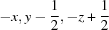
| Symmetry code: (ii) −x, y−1/2, −z+1/2. |
Experimental details
| Crystal data | |
| Chemical formula | C12H10N4 |
| Mr | 210.24 |
| Crystal system, space group | Orthorhombic, Pbca |
| Temperature (K) | 296 |
| a, b, c (Å) | 6.8604 (2), 9.4534 (3), 16.4789 (6) |
| V (Å3) | 1068.72 (6) |
| Z | 4 |
| Radiation type | Mo Kα |
| µ (mm−1) | 0.08 |
| Crystal size (mm) | 0.40 × 0.35 × 0.30 |
| Data collection | |
| Diffractometer | Bruker SMART CCD area-detector diffractometer |
| Absorption correction | Multi-scan (SADABS; Sheldrick, 1996) |
| Tmin, Tmax | 0.967, 0.975 |
| No. of measured, independent and observed [I > 2σ(I)] reflections | 11170, 932, 746 |
| Rint | 0.035 |
| (sin θ/λ)max (Å−1) | 0.594 |
| Refinement | |
| R[F2 > 2σ(F2)], wR(F2), S | 0.032, 0.096, 1.07 |
| No. of reflections | 932 |
| No. of parameters | 77 |
| H-atom treatment | H atoms treated by a mixture of independent and constrained refinement |
| Δρmax, Δρmin (e Å−3) | 0.11, −0.13 |
Computer programs: SMART (Bruker, 2001), SAINT (Bruker, 2001), SHELXS97 (Sheldrick, 2008), SHELXL97 (Sheldrick, 2008), SHELXTL (Sheldrick, 2008) and local programs.
| D—H···A | D—H | H···A | D···A | D—H···A |
| N1—H1B···N2i | 0.981 (17) | 1.863 (18) | 2.8364 (17) | 170.8 (17) |
| Symmetry code: (i) −x, y−1/2, −z+1/2. |
Acknowledgements
The authors thank the National Natural Science Foundation of China (NSFC No. 20801018), Shanghai Education Development Foundation (grant No. 2008 CG31) and the Shanghai Rising-Star Program (10QA1402000) for financial support.
References
 Bruker (2001). SMART and SAINT. Bruker AXS Inc., Madison, Wisconsin, USA. Google Scholar
Etter, M. C., MacDonald, J. C. & Bernstein, J. (1990). Acta Cryst. B46, 256–262. CrossRef CAS Web of Science IUCr Journals Google Scholar
Gao, G.-R. & Duan, W.-H. (2012). Acta Cryst. E68, o1977. CSD CrossRef IUCr Journals Google Scholar
Have, R. (1997). Tetrahedron, 53, 11355–11368. Google Scholar
Huisman, M. (1997). Synth. Commun. 27, 945–952. CrossRef CAS Web of Science Google Scholar
Petersen, S. (1950). Chem. Ber. 83, 551–558. CrossRef CAS Web of Science Google Scholar
Sheldrick, G. M. (1996). SADABS. University of Göttingen, Germany. Google Scholar
Sheldrick, G. M. (2008). Acta Cryst. A64, 112–122. Web of Science CrossRef CAS IUCr Journals Google Scholar
This is an open-access article distributed under the terms of the Creative Commons Attribution (CC-BY) Licence, which permits unrestricted use, distribution, and reproduction in any medium, provided the original authors and source are cited.
| CRYSTALLOGRAPHIC COMMUNICATIONS |


Intense interest in the chemistry of metal-organic frameworks stems from their intriguing structural features and potential applications in catalysis, adsorption, luminescence, etc. The title compound C12H10N4 was designed and synthesized to enable the construction of metal-organic frameworks because of its versatile coordination modes in respect to metal complexation. In the structure of this compound (Fig. 1), the molecule has inversion symmetry with the two imidazole moieties rotated slightly out of the plane of the benzene ring [dihedral angle, 25.02 (8)°]. In the crystal, the molecules are linked through N—H···N hydrogen bonds (Table 1), forming inter-associated cyclic units [graph set R44(28)] which generate a two-dimensional layered structure extending across (011) (Fig. 2).