 | Acta Crystallographica Section E Acta Crystallographica Section E CRYSTALLOGRAPHIC COMMUNICATIONS |


 journal menu


metal-organic compounds
| CRYSTALLOGRAPHIC COMMUNICATIONS |
 access
Hexakis(μ3-1-methylthiourea-κ3S:S:S)hexakis[iodidocopper(I)]

aDepartment of Chemistry, University of Engineering and Technology, Lahore 54890, Pakistan, bDepartment of Chemistry, Government College of Science, Wahdat Road, Lahore, Pakistan, cDepartment of Chemistry, Government College University, Lahore, Pakistan, and dX-ray Crystallography Unit, School of Physics, Universiti Sains Malaysia, 11800 USM, Penang, Malaysia
*Correspondence e-mail: [email protected]
The title compound, [Cu6I6(C2H6N2S)6], was obtained from the reaction of copper(I) iodide with N-methylthiourea (Metu) in equimolar amounts in acetonitile. The complex consists of two six-membered trinuclear Cu3S3I3 cores that combine through triply bridging Metu, forming a hexanuclear core which has -3 symmetry. The CuII atom is coordinated by three S atoms of Metu and one iodide ion in a distorted tetrahedral geometry. The is stabilized by N—H⋯I hydrogen bonds and cuprophilic interactions [Cu⋯Cu = 3.0264 (9) Å].
Related literature
For crystal structures of copper(I) complexes of thiourea-type ligands, see: Ahmad et al. (2010![[Ahmad, S., Altaf, M., Stoeckli-Evans, H., Ruffer, T., Lang, H., Mufakkar, M. & Abdul Waheed, A. (2010). J. Chem. Crystallogr. 40, 639-645.]](../../../../../../logos/arrows/e_arr.gif "Ahmad, S., Altaf, M., Stoeckli-Evans, H., Ruffer, T., Lang, H., Mufakkar, M. & Abdul Waheed, A. (2010). J. Chem. Crystallogr. 40, 639-645.") ); Bowmaker et al. (2009); Li et al. (2005); Lobana et al. (2003, 2005); Khan et al. (2007); Mufakkar et al. (2007, 2009, 2011); Stocker et al. (1997); Zoufala et al. (2007). For van der Waals radii and cuprophilic interactions, see: Siemeling et al. (1997); Singh et al. (1997).
); Bowmaker et al. (2009); Li et al. (2005); Lobana et al. (2003, 2005); Khan et al. (2007); Mufakkar et al. (2007, 2009, 2011); Stocker et al. (1997); Zoufala et al. (2007). For van der Waals radii and cuprophilic interactions, see: Siemeling et al. (1997); Singh et al. (1997).
![[Scheme 1]](rz5016scheme1.gif)
Experimental
Crystal data
|

Refinement
|
| |||||||||||||||||||||||||||
 ; (ii)
 Data collection: APEX2 (Bruker, 2008); cell refinement: SAINT (Bruker, 2008); data reduction: SAINT; program(s) used to solve structure: SHELXTL (Sheldrick, 2008); program(s) used to refine structure: SHELXTL; molecular graphics: SHELXTL; software used to prepare material for publication: SHELXTL and PLATON (Spek, 2009).
Supporting information
contains datablocks I, global. DOI: 10.1107/S1600536812043437/rz5016sup1.cif
Structure factors: contains datablock I. DOI: 10.1107/S1600536812043437/rz5016Isup2.hkl
The title compund was prepared by mixing solutions of copper(I) iodide (1.0 mmol) in 10 ml acetonitrile and N-methylthiourea (1.0 mmol) in acetonitrile (15 ml). The mixture was stirred for half an hour and then filtered. The resulting colourless solution when allowed to stand for 24 h yielded white crystals suitable for X-ray structure analysis.
All H atoms were placed in calculated positions with C—H = 0.96 Å, N—H = 0.80-0.83 Å, and with Uiso(H) = 1.2 Ueq(N) or 1.5 Ueq(C)
Data collection: APEX2 (Bruker, 2008); cell SAINT (Bruker, 2008); data reduction: SAINT (Bruker, 2008); program(s) used to solve structure: SHELXTL (Sheldrick, 2008); program(s) used to refine structure: SHELXTL (Sheldrick, 2008); molecular graphics: SHELXTL (Sheldrick, 2008); software used to prepare material for publication: SHELXTL (Sheldrick, 2008) and PLATON (Spek, 2009).
![[Figure 1]](./rz5016fig1thm.gif) | Fig. 1. Molecular structure of the title compound with displacement ellipsoids drawn at 50% probability level. Symmetry codes: (a) 1-y, 2+x-y, z; (b) -1-x+y, 1-x, z; (c) -x, 2-y, -z; (d) -1+y, -x+y, -z; (e) 1+x-y, 1+x, -z. |
| [Cu6I6(C2H6N2S)6] | Dx = 2.684 Mg m−3 |
| Mr = 1683.65 | Mo Kα radiation, λ = 0.71073 Å |
| Trigonal, R3 | Cell parameters from 4617 reflections |
| Hall symbol: -R 3 | θ = 2.2–26.6° |
| a = 21.7517 (1) Å | µ = 7.79 mm−1 |
| c = 7.6269 (1) Å | T = 296 K |
| V = 3125.11 (5) Å3 | Block, colourless |
| Z = 3 | 0.28 × 0.15 × 0.14 mm |
| F(000) = 2340 |
| Bruker SMART APEXII CCD area-detector diffractometer | 1995 independent reflections |
| Radiation source: fine-focus sealed tube | 1649 reflections with I > 2σ(I) |
| Graphite monochromator | Rint = 0.035 |
| ϕ and ω scans | θmax = 29.8°, θmin = 1.9° |
| Absorption correction: multi-scan (SADABS; Bruker, 2008) | h = −30→30 |
| Tmin = 0.179, Tmax = 0.338 | k = −30→30 |
| 14898 measured reflections | l = −10→10 |
| Refinement on F2 | Primary atom site location: structure-invariant direct methods |
| Least-squares matrix: full | Secondary atom site location: difference Fourier map |
| R[F2 > 2σ(F2)] = 0.027 | Hydrogen site location: inferred from neighbouring sites |
| wR(F2) = 0.061 | H-atom parameters constrained |
| S = 1.06 | w = 1/[σ2(Fo2) + (0.0202P)2 + 17.0381P] where P = (Fo2 + 2Fc2)/3 |
| 1995 reflections | (Δ/σ)max < 0.001 |
| 65 parameters | Δρmax = 1.32 e Å−3 |
| 0 restraints | Δρmin = −1.64 e Å−3 |
| [Cu6I6(C2H6N2S)6] | Z = 3 |
| Mr = 1683.65 | Mo Kα radiation |
| Trigonal, R3 | µ = 7.79 mm−1 |
| a = 21.7517 (1) Å | T = 296 K |
| c = 7.6269 (1) Å | 0.28 × 0.15 × 0.14 mm |
| V = 3125.11 (5) Å3 |
| Bruker SMART APEXII CCD area-detector diffractometer | 1995 independent reflections |
| Absorption correction: multi-scan (SADABS; Bruker, 2008) | 1649 reflections with I > 2σ(I) |
| Tmin = 0.179, Tmax = 0.338 | Rint = 0.035 |
| 14898 measured reflections |
| R[F2 > 2σ(F2)] = 0.027 | 0 restraints |
| wR(F2) = 0.061 | H-atom parameters constrained |
| S = 1.06 | w = 1/[σ2(Fo2) + (0.0202P)2 + 17.0381P] where P = (Fo2 + 2Fc2)/3 |
| 1995 reflections | Δρmax = 1.32 e Å−3 |
| 65 parameters | Δρmin = −1.64 e Å−3 |
Geometry. All e.s.d.'s (except the e.s.d. in the dihedral angle between two l.s. planes) are estimated using the full covariance matrix. The cell e.s.d.'s are taken into account individually in the estimation of e.s.d.'s in distances, angles and torsion angles; correlations between e.s.d.'s in cell parameters are only used when they are defined by crystal symmetry. An approximate (isotropic) treatment of cell e.s.d.'s is used for estimating e.s.d.'s involving l.s. planes. |
Refinement. Refinement of F2 against ALL reflections. The weighted R-factor wR and goodness of fit S are based on F2, conventional R-factors R are based on F, with F set to zero for negative F2. The threshold expression of F2 > σ(F2) is used only for calculating R-factors(gt) etc. and is not relevant to the choice of reflections for refinement. R-factors based on F2 are statistically about twice as large as those based on F, and R- factors based on ALL data will be even larger. |
| x | y | z | Uiso*/Ueq | ||
| I1 | 0.082885 (13) | 0.829523 (13) | 0.17796 (4) | 0.04164 (9) | |
| Cu1 | 0.04125 (3) | 0.91805 (3) | 0.12398 (9) | 0.05416 (16) | |
| N1 | −0.10312 (17) | 0.76485 (17) | 0.3103 (5) | 0.0478 (8) | |
| H1N1 | −0.1264 | 0.7232 | 0.3455 | 0.057* | |
| H2N1 | −0.0616 | 0.7805 | 0.2909 | 0.057* | |
| N2 | −0.19615 (15) | 0.78569 (16) | 0.2972 (4) | 0.0394 (7) | |
| H1N2 | −0.2067 | 0.8151 | 0.2721 | 0.047* | |
| C1 | −0.12810 (18) | 0.80754 (17) | 0.2777 (5) | 0.0330 (7) | |
| C2 | −0.2500 (2) | 0.7132 (2) | 0.3356 (6) | 0.0489 (10) | |
| H2A | −0.2945 | 0.7111 | 0.3573 | 0.073* | |
| H2B | −0.2363 | 0.6970 | 0.4375 | 0.073* | |
| H2C | −0.2549 | 0.6834 | 0.2375 | 0.073* | |
| S1 | −0.07031 (4) | 0.89448 (4) | 0.21477 (14) | 0.0388 (2) |
| U11 | U22 | U33 | U12 | U13 | U23 | |
| I1 | 0.04018 (14) | 0.03935 (13) | 0.05508 (16) | 0.02713 (11) | 0.00274 (11) | 0.00505 (11) |
| Cu1 | 0.0380 (3) | 0.0348 (2) | 0.0945 (4) | 0.0218 (2) | −0.0005 (3) | 0.0007 (3) |
| N1 | 0.0340 (16) | 0.0398 (17) | 0.071 (2) | 0.0197 (14) | 0.0127 (16) | 0.0209 (17) |
| N2 | 0.0316 (14) | 0.0353 (15) | 0.0534 (19) | 0.0182 (13) | 0.0053 (13) | 0.0115 (14) |
| C1 | 0.0318 (16) | 0.0306 (16) | 0.0369 (17) | 0.0157 (13) | 0.0033 (14) | 0.0031 (13) |
| C2 | 0.0305 (17) | 0.042 (2) | 0.063 (3) | 0.0101 (16) | 0.0039 (18) | 0.0181 (19) |
| S1 | 0.0266 (4) | 0.0264 (4) | 0.0635 (6) | 0.0133 (3) | 0.0024 (4) | 0.0039 (4) |
| I1—Cu1 | 2.5379 (5) | N2—C1 | 1.317 (4) |
| Cu1—S1i | 2.3164 (10) | N2—C2 | 1.449 (5) |
| Cu1—S1 | 2.3210 (10) | N2—H1N2 | 0.8028 |
| Cu1—S1ii | 2.6057 (13) | C1—S1 | 1.735 (3) |
| Cu1—Cu1iii | 3.0264 (9) | C2—H2A | 0.9600 |
| Cu1—Cu1ii | 3.0264 (9) | C2—H2B | 0.9600 |
| N1—C1 | 1.313 (4) | C2—H2C | 0.9600 |
| N1—H1N1 | 0.8316 | S1—Cu1iv | 2.3164 (10) |
| N1—H2N1 | 0.8039 | S1—Cu1iii | 2.6057 (13) |
| S1i—Cu1—S1 | 98.22 (5) | C1—N2—C2 | 124.5 (3) |
| S1i—Cu1—I1 | 122.56 (3) | C1—N2—H1N2 | 113.8 |
| S1—Cu1—I1 | 120.95 (3) | C2—N2—H1N2 | 121.2 |
| S1i—Cu1—S1ii | 102.80 (4) | N1—C1—N2 | 120.7 (3) |
| S1—Cu1—S1ii | 102.67 (4) | N1—C1—S1 | 119.5 (3) |
| I1—Cu1—S1ii | 106.80 (3) | N2—C1—S1 | 119.7 (3) |
| S1i—Cu1—Cu1iii | 118.09 (3) | N2—C2—H2A | 109.5 |
| S1—Cu1—Cu1iii | 56.49 (3) | N2—C2—H2B | 109.5 |
| I1—Cu1—Cu1iii | 118.39 (2) | H2A—C2—H2B | 109.5 |
| S1ii—Cu1—Cu1iii | 47.86 (3) | N2—C2—H2C | 109.5 |
| S1i—Cu1—Cu1ii | 56.52 (3) | H2A—C2—H2C | 109.5 |
| S1—Cu1—Cu1ii | 118.03 (3) | H2B—C2—H2C | 109.5 |
| I1—Cu1—Cu1ii | 119.84 (2) | C1—S1—Cu1iv | 115.65 (12) |
| S1ii—Cu1—Cu1ii | 47.96 (3) | C1—S1—Cu1 | 115.53 (12) |
| Cu1iii—Cu1—Cu1ii | 85.08 (3) | Cu1iv—S1—Cu1 | 123.88 (5) |
| C1—N1—H1N1 | 126.2 | C1—S1—Cu1iii | 98.60 (12) |
| C1—N1—H2N1 | 116.1 | Cu1iv—S1—Cu1iii | 75.63 (3) |
| H1N1—N1—H2N1 | 117.6 | Cu1—S1—Cu1iii | 75.55 (3) |
| C2—N2—C1—N1 | −7.1 (6) | Cu1iii—Cu1—S1—C1 | 92.76 (14) |
| C2—N2—C1—S1 | 174.9 (3) | Cu1ii—Cu1—S1—C1 | 154.78 (14) |
| N1—C1—S1—Cu1iv | 171.7 (3) | S1i—Cu1—S1—Cu1iv | 57.15 (8) |
| N2—C1—S1—Cu1iv | −10.3 (4) | I1—Cu1—S1—Cu1iv | −166.73 (4) |
| N1—C1—S1—Cu1 | 15.6 (4) | S1ii—Cu1—S1—Cu1iv | −48.03 (7) |
| N2—C1—S1—Cu1 | −166.4 (3) | Cu1iii—Cu1—S1—Cu1iv | −61.20 (5) |
| N1—C1—S1—Cu1iii | 93.6 (3) | Cu1ii—Cu1—S1—Cu1iv | 0.83 (8) |
| N2—C1—S1—Cu1iii | −88.4 (3) | S1i—Cu1—S1—Cu1iii | 118.35 (4) |
| S1i—Cu1—S1—C1 | −148.90 (13) | I1—Cu1—S1—Cu1iii | −105.53 (3) |
| I1—Cu1—S1—C1 | −12.78 (15) | S1ii—Cu1—S1—Cu1iii | 13.17 (4) |
| S1ii—Cu1—S1—C1 | 105.92 (14) | Cu1ii—Cu1—S1—Cu1iii | 62.03 (4) |
| Symmetry codes: (i) −y+1, x−y+2, z; (ii) x−y+1, x+1, −z; (iii) y−1, −x+y, −z; (iv) −x+y−1, −x+1, z. |
| D—H···A | D—H | H···A | D···A | D—H···A |
| N1—H1N1···I1v | 0.83 | 2.95 | 3.744 (3) | 161 |
| N1—H2N1···I1 | 0.80 | 2.90 | 3.698 (4) | 173 |
| N2—H1N2···I1iv | 0.80 | 2.95 | 3.756 (3) | 177 |
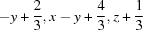
| Symmetry codes: (iv) −x+y−1, −x+1, z; (v) −y+2/3, x−y+4/3, z+1/3. |
Experimental details
| Crystal data | |
| Chemical formula | [Cu6I6(C2H6N2S)6] |
| Mr | 1683.65 |
| Crystal system, space group | Trigonal, R3 |
| Temperature (K) | 296 |
| a, c (Å) | 21.7517 (1), 7.6269 (1) |
| V (Å3) | 3125.11 (5) |
| Z | 3 |
| Radiation type | Mo Kα |
| µ (mm−1) | 7.79 |
| Crystal size (mm) | 0.28 × 0.15 × 0.14 |
| Data collection | |
| Diffractometer | Bruker SMART APEXII CCD area-detector diffractometer |
| Absorption correction | Multi-scan (SADABS; Bruker, 2008) |
| Tmin, Tmax | 0.179, 0.338 |
| No. of measured, independent and observed [I > 2σ(I)] reflections | 14898, 1995, 1649 |
| Rint | 0.035 |
| (sin θ/λ)max (Å−1) | 0.700 |
| Refinement | |
| R[F2 > 2σ(F2)], wR(F2), S | 0.027, 0.061, 1.06 |
| No. of reflections | 1995 |
| No. of parameters | 65 |
| H-atom treatment | H-atom parameters constrained |
| w = 1/[σ2(Fo2) + (0.0202P)2 + 17.0381P] where P = (Fo2 + 2Fc2)/3 | |
| Δρmax, Δρmin (e Å−3) | 1.32, −1.64 |
Computer programs: APEX2 (Bruker, 2008), SAINT (Bruker, 2008), SHELXTL (Sheldrick, 2008) and PLATON (Spek, 2009).
| D—H···A | D—H | H···A | D···A | D—H···A |
| N1—H1N1···I1i | 0.8300 | 2.9500 | 3.744 (3) | 161.00 |
| N1—H2N1···I1 | 0.8000 | 2.9000 | 3.698 (4) | 173.00 |
| N2—H1N2···I1ii | 0.8000 | 2.9500 | 3.756 (3) | 177.00 |
| Symmetry codes: (i) −y+2/3, x−y+4/3, z+1/3; (ii) −x+y−1, −x+1, z. |
Acknowledgements
The authors gratefully acknowledge Universiti Sains Malaysia and Government College University, Lahore, for providing X-ray facilities.
References
 Ahmad, S., Altaf, M., Stoeckli-Evans, H., Ruffer, T., Lang, H., Mufakkar, M. & Abdul Waheed, A. (2010). J. Chem. Crystallogr. 40, 639–645. Web of Science CSD CrossRef CAS Google Scholar
Bowmaker, G. A., Hanna, J. V., Pakawatchai, C., Skelton, B. W., Thanyasirikul, Y. & White, A. H. (2009). Inorg. Chem. 48, 350–368. Web of Science CSD CrossRef PubMed CAS Google Scholar
Bruker (2008). APEX2, SAINT and SADABS. Bruker Axs Inc., Madison, Wisconsin, USA. Google Scholar
Khan, I. U., Mufakkar, M., Ahmad, S., Fun, H.-K. & Chantrapromma, S. (2007). Acta Cryst. E63, m2550–m2551. Web of Science CSD CrossRef IUCr Journals Google Scholar
Li, D., Shi, W. J. & Hou, L. (2005). Inorg. Chem. 44, 3907–3913. Web of Science CSD CrossRef PubMed CAS Google Scholar
Lobana, T. S., Sharma, R., Bermejo, E. & Castineiras, A. (2003). Inorg. Chem. 42, 7728–7730. Web of Science CSD CrossRef PubMed CAS Google Scholar
Lobana, T. S., Sharma, R., Sharma, R., Mehra, S., Castineiras, A. & Turner, R. (2005). Inorg. Chem. 44, 1914–1921. Web of Science CSD CrossRef PubMed CAS Google Scholar
Mufakkar, M., Ahmad, S., Khan, I. U., Fun, H.-K. & Chantrapromma, S. (2007). Acta Cryst. E63, m2384. Web of Science CSD CrossRef IUCr Journals Google Scholar
Mufakkar, M., Isab, A. A., Ruffer, T., Lang, H., Ahmad, S., Arshad, N. & Waheed, A. (2011). Transition Met. Chem. 36, 505–512. Web of Science CSD CrossRef CAS Google Scholar
Mufakkar, M., Tahir, M. N., Ahmad, S., Shaheen, M. A. & Waheed, A. (2009). Acta Cryst. E65, m892–m893. Web of Science CSD CrossRef IUCr Journals Google Scholar
Sheldrick, G. M. (2008). Acta Cryst. A64, 112–122. Web of Science CrossRef CAS IUCr Journals Google Scholar
Siemeling, U., Vorfeld, U., Neumann, B. & Stammler, H.-G. (1997). Chem. Commun. pp. 1723-1724. CSD CrossRef Web of Science Google Scholar
Singh, K., Long, J. R. & Stavropoulos, P. (1997). J. Am. Chem. Soc. 119, 2942–2943. CSD CrossRef CAS Web of Science Google Scholar
Spek, A. L. (2009). Acta Cryst. D65, 148–155. Web of Science CrossRef CAS IUCr Journals Google Scholar
Stocker, F. B., Troester, M. A. & Britton, D. (1997). Inorg. Chem. 35, 3145–3153. CSD CrossRef Web of Science Google Scholar
Zoufala, P., Rüffer, T., Lang, H., Ahmad, S. & Mufakkar, M. (2007). X-ray Struct. Anal. Online 23, x219–x220. CAS Google Scholar
This is an open-access article distributed under the terms of the Creative Commons Attribution (CC-BY) Licence, which permits unrestricted use, distribution, and reproduction in any medium, provided the original authors and source are cited.
| CRYSTALLOGRAPHIC COMMUNICATIONS |


Copper(I) complexes with thiones possess a variety of structures ranging from mononuclear three- or four- coordinate species with trigonal planar and tetrahedral Cu(I) respectively to hexameric species with pseudo-four-coordinated geometry (Ahmad et al. 2010; Bowmaker et al., 2009; Li et al., 2005; Lobana et al., 2003, 2005; Khan et al. 2007; Mufakkar et al., 2007, 2009, 2011; Stocker et al., 1997; Zoufala et al., 2007). In some cases mononuclear units further aggregate to form polymeric structures, for example, [Cu6(PyT)6I6]n (where Pyt = pyridine-2-thione) (Li et al., 2005; Lobana et al., 2003, 2005). The present report describes the structure of a hexameric copper(I) complex, iodido(N-methylthiourea)copper(I), that is characterized by significant copper-copper interactions.
The structure of the title complex is shown in Figure 1. The complex is hexanuclear consisting of six [Metu-Cu—I] units, associated through sulfur atoms of N-methylthiourea. Three copper(I) iodides and three Metu ligands are combined through bridging sulfur atoms to form a six-membered trinuclear core, Cu3S3I3. Two six-membered trinuclear cores combine via µ3-sulfur atoms of Metu to form the centrosymmetric hexanuclear core, Cu6S6I6. Each copper within the complex is coordinated to three sulfur atoms of N-methylthiourea and with one iodide as a terminal ligand adopting a distorted tetrahedral geometry. The angles around Cu vary over the range 98.22 (5)–122.56 (3) °. The Cu—S bond distances are unequal; two are short (2.3164 (10) and 2.3210 (10) Å) and one is long (2.6057 (13) Å). However, they are within the range (2.30–2.60 Å) of the Cu—S bond distances found in other complexes. All of the Cu—I distances are equal (2.5379 (5) Å) and are in agreement with the values reported in the literature. The hexanuclear structure is supported by significant intermolecular N—H···I hydrogen bonding (Table 1) and Cu···Cu interactions. The Cu···Cu distance of 3.0264 (9) Å is close to similar distances observed in other complexes. However, this value is slightly larger than the sum of the van der Waals radii of two copper atoms (2.80 Å) (Siemeling et al. 1997; Singh et al., 1997). Similar hexanuclear core structures have been reported for [Cu6(Imt)6I6]n and [Cu6(Pyt)6I6]n (Imt = imidazolidine-2-thione and Pyt = pyridine-2-thione; Lobana et al., 2003, 2005).