 | Acta Crystallographica Section E Acta Crystallographica Section E CRYSTALLOGRAPHIC COMMUNICATIONS |


 journal menu


organic compounds
| CRYSTALLOGRAPHIC COMMUNICATIONS |
 access
Piperidine-1-carboxamidinium ethyl carbonate

aFakultät Chemie/Organische Chemie, Hochschule Aalen, Beethovenstrasse 1, D-73430 Aalen, Germany
*Correspondence e-mail: [email protected]
In the title salt, C6H14N3+·C3H5O3−, the C—N bond lengths in the central CN3 unit of the carboxamidinium cation are 1.3262 (18), 1.3359 (18) and 1.3498 (18) Å, indicating partial double-bond character. The central C atom is bonded to the three N atoms in a nearly ideal trigonal–planar geometry and the positive charge is delocalized in the CN3 plane. The piperidine ring is in a chair conformation. The C—O bond lengths in the ethyl carbonate anion are characteristic for a delocalized double bond and a typical single bond. In the crystal, N—H⋯O hydrogen bonds between cations and anions generate a two-dimensional network in the direction of the ab plane, whereas adjacent ion pairs form chains running along the b axis.
Related literature
For the synthesis and crystal structures of guanidinium hydrogencarbonates, see: Tiritiris et al. (2011![[Tiritiris, I., Mezger, J., Stoyanov, E. V. & Kantlehner, W. (2011). Z. Naturforsch. Teil B, 66, 407-418.]](../../../../../../logos/arrows/e_arr.gif "Tiritiris, I., Mezger, J., Stoyanov, E. V. & Kantlehner, W. (2011). Z. Naturforsch. Teil B, 66, 407-418.") ). For the crystal structure of piperidine-1-carboximidamide, see: Tiritiris (2012), and for the crystal structure of sodium methyl carbonate, see: Kunert et al. (1998).
). For the crystal structure of piperidine-1-carboximidamide, see: Tiritiris (2012), and for the crystal structure of sodium methyl carbonate, see: Kunert et al. (1998).
![[Scheme 1]](kp2439scheme1.gif)
Experimental
Crystal data
|
Data collection
|
Refinement
|
|
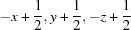 ; (ii)
 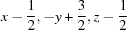 ; (iii)
 Data collection: COLLECT (Hooft, 2004); cell refinement: SCALEPACK (Otwinowski & Minor, 1997); data reduction: SCALEPACK; program(s) used to solve structure: SHELXS97 (Sheldrick, 2008); program(s) used to refine structure: SHELXL97 (Sheldrick, 2008); molecular graphics: DIAMOND (Brandenburg & Putz, 2005); software used to prepare material for publication: SHELXL97.
Supporting information
contains datablocks I, global. DOI: 10.1107/S1600536812045497/kp2439sup1.cif
Structure factors: contains datablock I. DOI: 10.1107/S1600536812045497/kp2439Isup2.hkl
The title compound was prepared by bubbling excess CO2 gas into an ethanolic solution of 2.04 g (16 mmol) piperidine-1-carboximidamide (Tiritiris, 2012). The resulting colourless precipitate was recrystallized from a small amount of ethanol and single crystals suitable for X-ray analysis were obtained. Yield: 3.25 g (93.3%). 1H NMR (500 MHz, D2O/DSS): δ = 1.17–1.20 [t, 3 H, –CH3], 1.61–1.70 [m, 6 H, –CH2], 3.40–3.43 [m, 4 H, –CH2], 3.64–3.68 [q, 2 H, –CH2]. Because of the H/D exchange, the hydrogen atoms of the –NH2 groups were not observed. 13C NMR (125 MHz, D2O/DSS): δ = 16.8 (–CH3), 23.1 (–CH2), 24.7 (–CH2), 46.7 (–CH2), 57.4 (–CH2), 155.5 (N3C+), 160.3 (C═O).
The N-bound H atoms were located in a difference Fourier map and were refined freely [N—H = 0.84 (2)–0.88 (2) Å]. The hydrogen atoms of the methyl group were allowed to rotate with a fixed angle around the C–C bond to best fit the experimental electron density, with U(H) set to 1.5 Ueq(C) and d(C—H) = 0.98 Å. The H atoms of the methylene groups were placed in calculated positions with d(C—H) = 0.99 Å. They were included in the in the riding model approximation, with U(H) set to 1.2 Ueq(C).
Data collection: COLLECT (Hooft, 2004); cell SCALEPACK (Otwinowski & Minor, 1997); data reduction: SCALEPACK (Otwinowski & Minor, 1997); program(s) used to solve structure: SHELXS97 (Sheldrick, 2008); program(s) used to refine structure: SHELXL97 (Sheldrick, 2008); molecular graphics: DIAMOND (Brandenburg & Putz, 2005); software used to prepare material for publication: SHELXL97 (Sheldrick, 2008).
![[Figure 1]](./kp2439fig1thm.gif) | Fig. 1. The structure of the title compound with displacement ellipsoids at the 50% probability level. |
![[Figure 2]](./kp2439fig2thm.gif) | Fig. 2. N–H···O hydrogen bonds generating a two-dimensional network, ab-view. The hydrogen bonds are indicated by dashed lines. |
![[Figure 3]](./kp2439fig3thm.gif) | Fig. 3. N–H···O hydrogen bond arrangement forming chains running along the b axis. The hydrogen bonds are indicated by dashed lines. |
| C6H14N3+·C3H5O3− | F(000) = 472 |
| Mr = 217.27 | Dx = 1.306 Mg m−3 |
| Monoclinic, P21/n | Melting point: 397 K |
| Hall symbol: -P 2yn | Mo Kα radiation, λ = 0.71073 Å |
| a = 11.8320 (6) Å | Cell parameters from 2732 reflections |
| b = 7.2407 (4) Å | θ = 0.4–27.9° |
| c = 13.3755 (9) Å | µ = 0.10 mm−1 |
| β = 105.292 (3)° | T = 100 K |
| V = 1105.33 (11) Å3 | Plate, colourless |
| Z = 4 | 0.25 × 0.20 × 0.05 mm |
| Bruker–Nonius KappaCCD diffractometer | 1982 reflections with I > 2σ(I) |
| Radiation source: sealed tube | Rint = 0.047 |
| Graphite monochromator | θmax = 27.9°, θmin = 2.1° |
| ϕ scans, and ω scans | h = −15→15 |
| 4452 measured reflections | k = −9→8 |
| 2638 independent reflections | l = −17→17 |
| Refinement on F2 | Primary atom site location: structure-invariant direct methods |
| Least-squares matrix: full | Secondary atom site location: difference Fourier map |
| R[F2 > 2σ(F2)] = 0.042 | Hydrogen site location: difference Fourier map |
| wR(F2) = 0.106 | H atoms treated by a mixture of independent and constrained refinement |
| S = 1.02 | w = 1/[σ2(Fo2) + (0.0412P)2 + 0.424P] where P = (Fo2 + 2Fc2)/3 |
| 2638 reflections | (Δ/σ)max < 0.001 |
| 153 parameters | Δρmax = 0.28 e Å−3 |
| 0 restraints | Δρmin = −0.23 e Å−3 |
| C6H14N3+·C3H5O3− | V = 1105.33 (11) Å3 |
| Mr = 217.27 | Z = 4 |
| Monoclinic, P21/n | Mo Kα radiation |
| a = 11.8320 (6) Å | µ = 0.10 mm−1 |
| b = 7.2407 (4) Å | T = 100 K |
| c = 13.3755 (9) Å | 0.25 × 0.20 × 0.05 mm |
| β = 105.292 (3)° |
| Bruker–Nonius KappaCCD diffractometer | 1982 reflections with I > 2σ(I) |
| 4452 measured reflections | Rint = 0.047 |
| 2638 independent reflections |
| R[F2 > 2σ(F2)] = 0.042 | 0 restraints |
| wR(F2) = 0.106 | H atoms treated by a mixture of independent and constrained refinement |
| S = 1.02 | Δρmax = 0.28 e Å−3 |
| 2638 reflections | Δρmin = −0.23 e Å−3 |
| 153 parameters |
Geometry. All e.s.d.'s (except the e.s.d. in the dihedral angle between two l.s. planes) are estimated using the full covariance matrix. The cell e.s.d.'s are taken into account individually in the estimation of e.s.d.'s in distances, angles and torsion angles; correlations between e.s.d.'s in cell parameters are only used when they are defined by crystal symmetry. An approximate (isotropic) treatment of cell e.s.d.'s is used for estimating e.s.d.'s involving l.s. planes. |
Refinement. Refinement of F2 against ALL reflections. The weighted R-factor wR and goodness of fit S are based on F2, conventional R-factors R are based on F, with F set to zero for negative F2. The threshold expression of F2 > σ(F2) is used only for calculating R-factors(gt) etc. and is not relevant to the choice of reflections for refinement. R-factors based on F2 are statistically about twice as large as those based on F, and R- factors based on ALL data will be even larger. |
| x | y | z | Uiso*/Ueq | ||
| N1 | −0.01610 (11) | 0.84504 (19) | 0.10282 (10) | 0.0182 (3) | |
| H11 | 0.0373 (17) | 0.810 (3) | 0.0712 (16) | 0.030 (5)* | |
| H12 | −0.0527 (16) | 0.949 (3) | 0.0829 (15) | 0.029 (5)* | |
| N2 | −0.11973 (10) | 0.83590 (18) | 0.22402 (10) | 0.0162 (3) | |
| H21 | −0.1508 (14) | 0.936 (3) | 0.1994 (14) | 0.019 (4)* | |
| H22 | −0.1552 (15) | 0.779 (3) | 0.2649 (15) | 0.023 (5)* | |
| N3 | 0.01511 (10) | 0.60093 (16) | 0.22039 (9) | 0.0140 (2) | |
| C1 | −0.04041 (11) | 0.75874 (19) | 0.18211 (11) | 0.0138 (3) | |
| C2 | −0.02711 (12) | 0.4939 (2) | 0.29709 (11) | 0.0163 (3) | |
| H2A | −0.0969 | 0.4214 | 0.2610 | 0.020* | |
| H2B | −0.0508 | 0.5798 | 0.3455 | 0.020* | |
| C3 | 0.06700 (13) | 0.3636 (2) | 0.35824 (11) | 0.0192 (3) | |
| H3A | 0.1322 | 0.4369 | 0.4019 | 0.023* | |
| H3B | 0.0338 | 0.2866 | 0.4046 | 0.023* | |
| C4 | 0.11384 (13) | 0.2397 (2) | 0.28736 (12) | 0.0191 (3) | |
| H4A | 0.0498 | 0.1632 | 0.2446 | 0.023* | |
| H4B | 0.1748 | 0.1564 | 0.3288 | 0.023* | |
| C5 | 0.16564 (13) | 0.3613 (2) | 0.21824 (12) | 0.0219 (3) | |
| H5A | 0.2320 | 0.4326 | 0.2617 | 0.026* | |
| H5B | 0.1963 | 0.2825 | 0.1709 | 0.026* | |
| C6 | 0.07529 (12) | 0.4939 (2) | 0.15493 (11) | 0.0188 (3) | |
| H6A | 0.1144 | 0.5805 | 0.1175 | 0.023* | |
| H6B | 0.0163 | 0.4232 | 0.1027 | 0.023* | |
| O1 | 0.25289 (8) | 0.31135 (14) | 0.63820 (8) | 0.0173 (2) | |
| O2 | 0.36182 (9) | 0.34098 (15) | 0.52507 (8) | 0.0210 (2) | |
| O3 | 0.26553 (8) | 0.08408 (14) | 0.52492 (8) | 0.0175 (2) | |
| C7 | 0.29380 (11) | 0.2563 (2) | 0.56646 (11) | 0.0144 (3) | |
| C8 | 0.18221 (12) | −0.0237 (2) | 0.56032 (11) | 0.0169 (3) | |
| H8A | 0.1079 | 0.0451 | 0.5511 | 0.020* | |
| H8B | 0.2132 | −0.0548 | 0.6346 | 0.020* | |
| C9 | 0.16276 (14) | −0.1971 (2) | 0.49492 (12) | 0.0232 (3) | |
| H9A | 0.1235 | −0.1652 | 0.4229 | 0.035* | |
| H9B | 0.1137 | −0.2832 | 0.5215 | 0.035* | |
| H9C | 0.2384 | −0.2551 | 0.4980 | 0.035* |
| U11 | U22 | U33 | U12 | U13 | U23 | |
| N1 | 0.0210 (6) | 0.0191 (6) | 0.0183 (6) | 0.0056 (5) | 0.0120 (5) | 0.0059 (5) |
| N2 | 0.0193 (6) | 0.0147 (6) | 0.0175 (6) | 0.0039 (5) | 0.0100 (5) | 0.0048 (5) |
| N3 | 0.0151 (5) | 0.0161 (6) | 0.0124 (5) | 0.0021 (4) | 0.0064 (4) | 0.0022 (5) |
| C1 | 0.0155 (6) | 0.0145 (6) | 0.0115 (6) | −0.0020 (5) | 0.0037 (5) | −0.0012 (5) |
| C2 | 0.0177 (6) | 0.0194 (7) | 0.0141 (7) | 0.0018 (6) | 0.0086 (5) | 0.0035 (6) |
| C3 | 0.0228 (7) | 0.0207 (7) | 0.0154 (7) | 0.0043 (6) | 0.0072 (6) | 0.0048 (6) |
| C4 | 0.0243 (7) | 0.0145 (7) | 0.0207 (7) | 0.0026 (6) | 0.0098 (6) | 0.0027 (6) |
| C5 | 0.0232 (7) | 0.0229 (8) | 0.0240 (8) | 0.0081 (6) | 0.0137 (6) | 0.0062 (6) |
| C6 | 0.0229 (7) | 0.0206 (7) | 0.0168 (7) | 0.0060 (6) | 0.0122 (6) | 0.0028 (6) |
| O1 | 0.0201 (5) | 0.0178 (5) | 0.0171 (5) | −0.0018 (4) | 0.0104 (4) | −0.0027 (4) |
| O2 | 0.0244 (5) | 0.0221 (6) | 0.0209 (5) | −0.0078 (4) | 0.0139 (4) | −0.0052 (4) |
| O3 | 0.0188 (5) | 0.0184 (5) | 0.0181 (5) | −0.0050 (4) | 0.0099 (4) | −0.0041 (4) |
| C7 | 0.0123 (6) | 0.0181 (7) | 0.0131 (7) | 0.0006 (5) | 0.0037 (5) | −0.0003 (5) |
| C8 | 0.0169 (6) | 0.0186 (7) | 0.0174 (7) | −0.0021 (5) | 0.0081 (6) | −0.0004 (6) |
| C9 | 0.0250 (7) | 0.0238 (8) | 0.0241 (8) | −0.0083 (6) | 0.0121 (6) | −0.0052 (7) |
| N1—C1 | 1.3262 (18) | C4—H4B | 0.9900 |
| N1—H11 | 0.88 (2) | C5—C6 | 1.518 (2) |
| N1—H12 | 0.88 (2) | C5—H5A | 0.9900 |
| N2—C1 | 1.3359 (18) | C5—H5B | 0.9900 |
| N2—H21 | 0.84 (2) | C6—H6A | 0.9900 |
| N2—H22 | 0.87 (2) | C6—H6B | 0.9900 |
| N3—C1 | 1.3498 (18) | O1—C7 | 1.2485 (16) |
| N3—C2 | 1.4742 (17) | O2—C7 | 1.2509 (17) |
| N3—C6 | 1.4842 (17) | O3—C7 | 1.3706 (18) |
| C2—C3 | 1.5227 (19) | O3—C8 | 1.4323 (16) |
| C2—H2A | 0.9900 | C8—C9 | 1.512 (2) |
| C2—H2B | 0.9900 | C8—H8A | 0.9900 |
| C3—C4 | 1.512 (2) | C8—H8B | 0.9900 |
| C3—H3A | 0.9900 | C9—H9A | 0.9800 |
| C3—H3B | 0.9900 | C9—H9B | 0.9800 |
| C4—C5 | 1.518 (2) | C9—H9C | 0.9800 |
| C4—H4A | 0.9900 | ||
| C1—N1—H11 | 125.4 (13) | H4A—C4—H4B | 108.4 |
| C1—N1—H12 | 117.1 (12) | C6—C5—C4 | 111.62 (12) |
| H11—N1—H12 | 117.4 (18) | C6—C5—H5A | 109.3 |
| C1—N2—H21 | 118.6 (11) | C4—C5—H5A | 109.3 |
| C1—N2—H22 | 125.0 (12) | C6—C5—H5B | 109.3 |
| H21—N2—H22 | 114.7 (16) | C4—C5—H5B | 109.3 |
| C1—N3—C2 | 119.25 (11) | H5A—C5—H5B | 108.0 |
| C1—N3—C6 | 118.65 (11) | N3—C6—C5 | 112.21 (11) |
| C2—N3—C6 | 116.07 (11) | N3—C6—H6A | 109.2 |
| N1—C1—N2 | 117.59 (13) | C5—C6—H6A | 109.2 |
| N1—C1—N3 | 121.04 (12) | N3—C6—H6B | 109.2 |
| N2—C1—N3 | 121.36 (12) | C5—C6—H6B | 109.2 |
| N3—C2—C3 | 111.43 (10) | H6A—C6—H6B | 107.9 |
| N3—C2—H2A | 109.3 | C7—O3—C8 | 118.52 (10) |
| C3—C2—H2A | 109.3 | O1—C7—O2 | 127.52 (13) |
| N3—C2—H2B | 109.3 | O1—C7—O3 | 119.95 (12) |
| C3—C2—H2B | 109.3 | O2—C7—O3 | 112.53 (12) |
| H2A—C2—H2B | 108.0 | O3—C8—C9 | 105.90 (11) |
| C4—C3—C2 | 111.57 (12) | O3—C8—H8A | 110.6 |
| C4—C3—H3A | 109.3 | C9—C8—H8A | 110.6 |
| C2—C3—H3A | 109.3 | O3—C8—H8B | 110.6 |
| C4—C3—H3B | 109.3 | C9—C8—H8B | 110.6 |
| C2—C3—H3B | 109.3 | H8A—C8—H8B | 108.7 |
| H3A—C3—H3B | 108.0 | C8—C9—H9A | 109.5 |
| C3—C4—C5 | 108.14 (12) | C8—C9—H9B | 109.5 |
| C3—C4—H4A | 110.1 | H9A—C9—H9B | 109.5 |
| C5—C4—H4A | 110.1 | C8—C9—H9C | 109.5 |
| C3—C4—H4B | 110.1 | H9A—C9—H9C | 109.5 |
| C5—C4—H4B | 110.1 | H9B—C9—H9C | 109.5 |
| C2—N3—C1—N1 | −170.39 (13) | C3—C4—C5—C6 | −58.57 (17) |
| C6—N3—C1—N1 | −18.76 (19) | C1—N3—C6—C5 | 160.64 (12) |
| C2—N3—C1—N2 | 11.15 (19) | C2—N3—C6—C5 | −46.85 (16) |
| C6—N3—C1—N2 | 162.78 (13) | C4—C5—C6—N3 | 52.04 (17) |
| C1—N3—C2—C3 | −160.06 (12) | C8—O3—C7—O1 | 4.51 (19) |
| C6—N3—C2—C3 | 47.59 (16) | C8—O3—C7—O2 | −175.98 (12) |
| N3—C2—C3—C4 | −54.20 (16) | C7—O3—C8—C9 | 175.66 (12) |
| C2—C3—C4—C5 | 59.74 (16) |
| D—H···A | D—H | H···A | D···A | D—H···A |
| N1—H11···O2i | 0.88 (2) | 1.99 (2) | 2.812 (1) | 155 (1) |
| N1—H12···O2ii | 0.88 (2) | 1.88 (2) | 2.747 (1) | 173 (1) |
| N2—H21···O1ii | 0.84 (2) | 2.19 (2) | 3.033 (1) | 175 (1) |
| N2—H22···O1iii | 0.87 (2) | 2.06 (2) | 2.923 (1) | 170 (1) |
| Symmetry codes: (i) −x+1/2, y+1/2, −z+1/2; (ii) x−1/2, −y+3/2, z−1/2; (iii) −x, −y+1, −z+1. |
Experimental details
| Crystal data | |
| Chemical formula | C6H14N3+·C3H5O3− |
| Mr | 217.27 |
| Crystal system, space group | Monoclinic, P21/n |
| Temperature (K) | 100 |
| a, b, c (Å) | 11.8320 (6), 7.2407 (4), 13.3755 (9) |
| β (°) | 105.292 (3) |
| V (Å3) | 1105.33 (11) |
| Z | 4 |
| Radiation type | Mo Kα |
| µ (mm−1) | 0.10 |
| Crystal size (mm) | 0.25 × 0.20 × 0.05 |
| Data collection | |
| Diffractometer | Bruker–Nonius KappaCCD diffractometer |
| Absorption correction | – |
| No. of measured, independent and observed [I > 2σ(I)] reflections | 4452, 2638, 1982 |
| Rint | 0.047 |
| (sin θ/λ)max (Å−1) | 0.658 |
| Refinement | |
| R[F2 > 2σ(F2)], wR(F2), S | 0.042, 0.106, 1.02 |
| No. of reflections | 2638 |
| No. of parameters | 153 |
| H-atom treatment | H atoms treated by a mixture of independent and constrained refinement |
| Δρmax, Δρmin (e Å−3) | 0.28, −0.23 |
Computer programs: COLLECT (Hooft, 2004), SCALEPACK (Otwinowski & Minor, 1997), SHELXS97 (Sheldrick, 2008), SHELXL97 (Sheldrick, 2008), DIAMOND (Brandenburg & Putz, 2005).
| D—H···A | D—H | H···A | D···A | D—H···A |
| N1—H11···O2i | 0.88 (2) | 1.99 (2) | 2.812 (1) | 155 (1) |
| N1—H12···O2ii | 0.88 (2) | 1.88 (2) | 2.747 (1) | 173 (1) |
| N2—H21···O1ii | 0.84 (2) | 2.19 (2) | 3.033 (1) | 175 (1) |
| N2—H22···O1iii | 0.87 (2) | 2.06 (2) | 2.923 (1) | 170 (1) |
| Symmetry codes: (i) −x+1/2, y+1/2, −z+1/2; (ii) x−1/2, −y+3/2, z−1/2; (iii) −x, −y+1, −z+1. |
Acknowledgements
The author thanks Dr F. Lissner (Institut für Anorganische Chemie, Universität Stuttgart) for measuring the crystal data.
References
 Brandenburg, K. & Putz, H. (2005). DIAMOND. Crystal Impact GbR, D-53002 Bonn, Germany. Google Scholar
Hooft, R. W. W. (2004). COLLECT. Bruker–Nonius BV, Delft, The Netherlands. Google Scholar
Kunert, M., Wiegeleben, P., Görls, H. & Dinjus, E. (1998). Inorg. Chem. Commun. 1, 131–133. Web of Science CSD CrossRef CAS Google Scholar
Otwinowski, Z. & Minor, W. (1997). Methods in Enzymology, Vol. 276, Macromolecular Crystallography, Part A, edited by C. W. Carter Jr & R. M. Sweet, pp. 307–326. New York: Academic Press. Google Scholar
Sheldrick, G. M. (2008). Acta Cryst. A64, 112–122. Web of Science CrossRef CAS IUCr Journals Google Scholar
Tiritiris, I. (2012). Acta Cryst. E68, o3253. CSD CrossRef IUCr Journals Google Scholar
Tiritiris, I., Mezger, J., Stoyanov, E. V. & Kantlehner, W. (2011). Z. Naturforsch. Teil B, 66, 407–418. CrossRef CAS Google Scholar
This is an open-access article distributed under the terms of the Creative Commons Attribution (CC-BY) Licence, which permits unrestricted use, distribution, and reproduction in any medium, provided the original authors and source are cited.
| CRYSTALLOGRAPHIC COMMUNICATIONS |


By reacting guanidines with CO2 in undried aprotic solvents, the corresponding guanidinium hydrogen carbonate salts are formed exclusively (Tiritiris et al., 2011). To investigate the reaction of carboxamidines with CO2, we used both aprotic and protic solvents. Due to the water content in the common aprotic solvents, the hydrogen carbonate salts were formed too. Most of them are sparingly soluble and could therefore not be obtained in crystalline form. By using ethanol as a solvent for the reaction, the crystalline title compound emerged. According to the structure analysis, the C1–N1 bond in the title compound is 1.3262 (18) Å, C1–N2 = 1.3359 (18) Å and C1–N3 = 1.3498 (18) Å, showing partial double-bond character (Fig. 1). The N–C1–N angles are: 117.59 (13)° (N1–C1–N2), 121.04 (12)° (N1–C1–N3) and 121.36 (12)° (N2–C1–N3), which indicate a nearly ideal trigonal-planar surrounding of the carbon centre by the nitrogen atoms. The positive charge is completely delocalized on the CN3 plane. The structural parameters of the piperidine ring in the here presented title compound agree very well with the data obtained from the X-ray analysis of the starting compound piperidine-1-carboximidamide (Tiritiris, 2012). The piperidine ring adopt a chair conformation. In the ethyl carbonate ion the C7–O1 and C7–O2 bond lengths indicate an evenly distributed double bond character (C7–O1, 1.2485 (16) Å; C7–O2, 1.2509 (17) Å) and a typical single bond (C7–O3, 1.3706 (18) Å). The data fit with the C–O bond lengths of the anion in sodium methyl carbonate (Kunert et al., 1998). In the crystal structure, strong N—H···O hydrogen bonds between hydrogen atoms of carboxamidinium ions and oxygen atoms of neighboring ethyl carbonate ions are observed, generating an infinite two-dimensional network [d(H···O) = 1.88 (2)–2.19 (2) Å] (Tab. 1) with base vectors [1 0 - 1] and [0 1 0] (Fig. 2). Furthermore, the hydrogen bonds are arranged in a way, that adjacent ion pairs are forming chains running along the b axis (Fig. 3).