 | Acta Crystallographica Section E Acta Crystallographica Section E CRYSTALLOGRAPHIC COMMUNICATIONS |


 journal menu


inorganic compounds
| CRYSTALLOGRAPHIC COMMUNICATIONS |
 access
The pyrochlore-type molybdate Pr2Mo1.73Sc0.27O7

aUnité Sciences Chimiques de Rennes, UMR CNRS No. 6226, Université de Rennes I – INSA Rennes, Campus de Beaulieu, 35042 Rennes CEDEX, France
*Correspondence e-mail: [email protected]
Dipraseodymium molybdenum scandium heptaoxide, Pr2Mo1.73Sc0.27O7, crystallizes in the cubic pyrochlore-type structure. In the crystal, (Mo,Sc)O6 octahedra are linked together by common corners, forming a three-dimensional [(Mo,Sc)2O6] framework. The Pr atom and another O atom atom are located in the voids of this framework. The Mo and the Sc atom are distributed statistically over the same 16d crystallographic position, with site-occupancy factors of 0.867 (3) and 0.133 (3), respectively. The Pr3+ ions are surrounded by six O atoms from the MoO6 octahedra and by two other O atoms, forming a ditrigonal scalenohedron. All atoms lie on special positions. The Pr and the statistically distributed (Mo,Sc) sites are in the 16c and 16d positions with .-3m symmetry, and two O atoms are in 48f and 8a positions with 2.mm and -43m respectively.
Related literature
For pyrochlore-type molybdates, see, for example: Hubert (1974![[Hubert, Ph. H. (1974). Bull. Soc. Chim. Fr. 11, 2385-2386.]](../../../../../../logos/arrows/e_arr.gif "Hubert, Ph. H. (1974). Bull. Soc. Chim. Fr. 11, 2385-2386.") ); Subramanian et al. (1983); Gall & Gougeon (2008). For the physical properties of some rare-earth molybdate pyrochlores, see: Hill et al. (1989); Ali et al. (1989); Miyoshi et al. (2001, 2003). An attempt to synthesize ScPr9Mo16O35, a compound with the LiNd9Mo16O35 type structure (Gougeon et al., 2011), was unsuccessful, resulting in a multiphase product with Pr2Mo1.73Sc0.27O7 and Pr16Mo21O56 (Gougeon & Gall, 2011) as predominant phases.
); Subramanian et al. (1983); Gall & Gougeon (2008). For the physical properties of some rare-earth molybdate pyrochlores, see: Hill et al. (1989); Ali et al. (1989); Miyoshi et al. (2001, 2003). An attempt to synthesize ScPr9Mo16O35, a compound with the LiNd9Mo16O35 type structure (Gougeon et al., 2011), was unsuccessful, resulting in a multiphase product with Pr2Mo1.73Sc0.27O7 and Pr16Mo21O56 (Gougeon & Gall, 2011) as predominant phases.
Experimental
Crystal data
|

Refinement
|
| ||||||||||
 ; (ii)
  .
. Data collection: COLLECT (Nonius, 1998); cell refinement: COLLECT; data reduction: EVALCCD (Duisenberg et al., 2003); program(s) used to solve structure: SIR97 (Altomare et al., 1999); program(s) used to refine structure: SHELXL97 (Sheldrick, 2008); molecular graphics: DIAMOND (Brandenburg, 2001); software used to prepare material for publication: SHELXL97.
Supporting information
contains datablocks global, I. DOI: 10.1107/S1600536812045138/ru2045sup1.cif
Structure factors: contains datablock I. DOI: 10.1107/S1600536812045138/ru2045Isup2.hkl
Single crystals of Pr2Mo1.73Sc0.27O7 were prepared from a mixture of Pr6O11 (Rhone Poulenc, 99.99%), Sc2O3 (Strem Chemicals, 99.99%), MoO3 (Cerac, 99.95%) and Mo (Plansee, 99.9999%) with the nominal composition ScPr9Mo16O35. Before use, Mo powder was reduced under H2 flowing gas at 1273 K during ten hours in order to eliminate any trace of oxygen. The initial mixture (ca 5 g) was cold pressed and loaded into a molybdenum crucible, which was sealed under a low argon pressure using an arc welding system. The charge was heated at the rate of 300 K/h up to 2223 K, temperature which was held for 5 min., then cooled at 100 K/h down to 1373 K and finally furnace cooled. The final product was multiphasic with Pr2Mo1.73Sc0.27O7 and Pr16Mo21O56 (Gougeon & Gall, 2011), as predominant phases. The crystals thus obtained were of irregular shape.
The structure was solved by direct method using SIR97. The second setting, with the origin at 3 m of the Fd3m was chosen. The first refinements taking into account a full occupancy of the Pr1 and Mo1 sites resulted in a factor of about 0.033. Refinements of the site-occupancy factors of the Pr1 and Mo1 atoms show that the first site was fully occupied while the second one was slightly deficiency. As qualitative microanalyses using a Jeol JSM-35 CF scanning electron microscope equipped with a Tracor energy- dispersive-type X-ray spectrometer indicated the presence of scandium in the crystals, we could expect that the deficiency observed on the Mo1 site results from the presence of scandium. Refinements taking into account an occupation of the deficient Mo1 site simultaneously by Mo and Sc atoms with no constraint on the site-occupancy factors of the Mo1 and Sc1 atoms led to an occupation of 1.03 (9) of the 16 d position. Consequently, the sum of the site occupancy factors was constrained to the unity, and the ADPs of the Mo1 and Sc1 atoms were constrained to be equal. of the occupancy factor of the O2 atom in 8a position which frequently exhibits partial or total deficiency, indicates a quasi-full occupation of this position (0.97 (2) %).
Data collection: COLLECT (Nonius, 1998); cell COLLECT (Nonius, 1998); data reduction: EVALCCD (Duisenberg et al., 2003); program(s) used to solve structure: SIR97 (Altomare et al., 1999); program(s) used to refine structure: SHELXL97 (Sheldrick, 2008); molecular graphics: DIAMOND (Brandenburg, 2001); software used to prepare material for publication: SHELXL97 (Sheldrick, 2008).
![[Figure 1]](./ru2045fig1thm.gif) | Fig. 1. : View of Pr2Mo1.73Sc0.27O7 along the [110] direction. Displacement ellipsoids are drawn at the 97% probability level. |
| Pr2Mo1.73Sc0.27O7 | Mo Kα radiation, λ = 0.71070 Å |
| Mr = 571.69 | Cell parameters from 5283 reflections |
| Cubic, Fd3m | θ = 5.5–50° |
| a = 10.5271 (3) Å | µ = 20.33 mm−1 |
| V = 1166.61 (6) Å3 | T = 293 K |
| Z = 8 | Irregular block, black |
| F(000) = 2018 | 0.1 × 0.06 × 0.05 mm |
| Dx = 6.510 Mg m−3 |
| Nonius KappaCCD diffractometer | 326 independent reflections |
| Radiation source: fine-focus sealed tube | 269 reflections with I > 2σ(I) |
| Horizontally mounted graphite crystal monochromator | Rint = 0.044 |
| Detector resolution: 9 pixels mm-1 | θmax = 50.0°, θmin = 5.5° |
| ϕ scans (κ = 0) + additional ω scans | h = −19→22 |
| Absorption correction: analytical (de Meulenaar & Tompa, 1965) | k = −12→22 |
| Tmin = 0.302, Tmax = 0.461 | l = −22→22 |
| 9208 measured reflections |
| Refinement on F2 | Primary atom site location: structure-invariant direct methods |
| Least-squares matrix: full | Secondary atom site location: difference Fourier map |
| R[F2 > 2σ(F2)] = 0.018 | w = 1/[σ2(Fo2) + (0.0144P)2 + 3.2607P] where P = (Fo2 + 2Fc2)/3 |
| wR(F2) = 0.047 | (Δ/σ)max < 0.001 |
| S = 1.33 | Δρmax = 0.79 e Å−3 |
| 326 reflections | Δρmin = −0.81 e Å−3 |
| 13 parameters | Extinction correction: SHELXL97 (Sheldrick, 2008), Fc*=kFc[1+0.001xFc2λ3/sin(2θ)]-1/4 |
| 0 restraints | Extinction coefficient: 0.00067 (7) |
| Pr2Mo1.73Sc0.27O7 | Z = 8 |
| Mr = 571.69 | Mo Kα radiation |
| Cubic, Fd3m | µ = 20.33 mm−1 |
| a = 10.5271 (3) Å | T = 293 K |
| V = 1166.61 (6) Å3 | 0.1 × 0.06 × 0.05 mm |
| Nonius KappaCCD diffractometer | 326 independent reflections |
| Absorption correction: analytical (de Meulenaar & Tompa, 1965) | 269 reflections with I > 2σ(I) |
| Tmin = 0.302, Tmax = 0.461 | Rint = 0.044 |
| 9208 measured reflections |
| R[F2 > 2σ(F2)] = 0.018 | 13 parameters |
| wR(F2) = 0.047 | 0 restraints |
| S = 1.33 | Δρmax = 0.79 e Å−3 |
| 326 reflections | Δρmin = −0.81 e Å−3 |
Geometry. All e.s.d.'s (except the e.s.d. in the dihedral angle between two l.s. planes) are estimated using the full covariance matrix. The cell e.s.d.'s are taken into account individually in the estimation of e.s.d.'s in distances, angles and torsion angles; correlations between e.s.d.'s in cell parameters are only used when they are defined by crystal symmetry. An approximate (isotropic) treatment of cell e.s.d.'s is used for estimating e.s.d.'s involving l.s. planes. |
Refinement. Refinement of F2 against ALL reflections. The weighted R-factor wR and goodness of fit S are based on F2, conventional R-factors R are based on F, with F set to zero for negative F2. The threshold expression of F2 > σ(F2) is used only for calculating R-factors(gt) etc. and is not relevant to the choice of reflections for refinement. R-factors based on F2 are statistically about twice as large as those based on F, and R- factors based on ALL data will be even larger. |
| x | y | z | Uiso*/Ueq | Occ. (<1) | |
| Pr1 | 0.0000 | 0.0000 | 0.0000 | 0.00874 (8) | |
| Mo1 | 0.5000 | 0.5000 | 0.5000 | 0.00591 (13) | 0.867 (6) |
| Sc1 | 0.5000 | 0.5000 | 0.5000 | 0.00591 (13) | 0.133 (6) |
| O1 | 0.41969 (18) | 0.1250 | 0.1250 | 0.0132 (3) | |
| O2 | 0.1250 | 0.1250 | 0.1250 | 0.0072 (6) | 0.972 (16) |
| U11 | U22 | U33 | U12 | U13 | U23 | |
| Pr1 | 0.00874 (8) | 0.00874 (8) | 0.00874 (8) | −0.00193 (2) | −0.00193 (2) | −0.00193 (2) |
| Mo1 | 0.00591 (13) | 0.00591 (13) | 0.00591 (13) | −0.00007 (4) | −0.00007 (4) | −0.00007 (4) |
| Sc1 | 0.00591 (13) | 0.00591 (13) | 0.00591 (13) | −0.00007 (4) | −0.00007 (4) | −0.00007 (4) |
| O1 | 0.0175 (7) | 0.0110 (4) | 0.0110 (4) | 0.000 | 0.000 | −0.0014 (5) |
| O2 | 0.0072 (6) | 0.0072 (6) | 0.0072 (6) | 0.000 | 0.000 | 0.000 |
| Pr1—O2i | 2.2792 | Mo1—O1xiii | 2.0440 (8) |
| Pr1—O2 | 2.2792 | Mo1—O1xiv | 2.0440 (8) |
| Pr1—O1ii | 2.5795 (13) | Mo1—O1xv | 2.0440 (8) |
| Pr1—O1iii | 2.5795 (13) | Mo1—O1xvi | 2.0440 (8) |
| Pr1—O1iv | 2.5795 (13) | O1—Sc1xvii | 2.0440 (8) |
| Pr1—O1v | 2.5795 (13) | O1—Mo1xvii | 2.0440 (8) |
| Pr1—O1vi | 2.5795 (13) | O1—Sc1xviii | 2.0440 (8) |
| Pr1—O1vii | 2.5795 (13) | O1—Mo1xviii | 2.0440 (8) |
| Pr1—Pr1v | 3.7219 (1) | O1—Pr1v | 2.5795 (13) |
| Pr1—Pr1viii | 3.7219 (1) | O1—Pr1viii | 2.5795 (13) |
| Pr1—Pr1ix | 3.7219 (1) | O2—Pr1viii | 2.2792 |
| Pr1—Pr1x | 3.7219 (1) | O2—Pr1v | 2.2792 |
| Mo1—O1xi | 2.0440 (8) | O2—Pr1x | 2.2792 |
| Mo1—O1xii | 2.0440 (8) | ||
| O2i—Pr1—O2 | 180.0 | O1vi—Pr1—Pr1ix | 43.83 (3) |
| O2i—Pr1—O1ii | 79.09 (3) | O1vii—Pr1—Pr1ix | 136.17 (3) |
| O2—Pr1—O1ii | 100.91 (3) | Pr1v—Pr1—Pr1ix | 180.0 |
| O2i—Pr1—O1iii | 100.91 (3) | Pr1viii—Pr1—Pr1ix | 120.0 |
| O2—Pr1—O1iii | 79.09 (3) | O2i—Pr1—Pr1x | 144.7 |
| O1ii—Pr1—O1iii | 180.00 (6) | O2—Pr1—Pr1x | 35.3 |
| O2i—Pr1—O1iv | 79.09 (3) | O1ii—Pr1—Pr1x | 82.59 (3) |
| O2—Pr1—O1iv | 100.91 (3) | O1iii—Pr1—Pr1x | 97.41 (3) |
| O1ii—Pr1—O1iv | 116.506 (19) | O1iv—Pr1—Pr1x | 136.17 (3) |
| O1iii—Pr1—O1iv | 63.494 (19) | O1v—Pr1—Pr1x | 43.83 (3) |
| O2i—Pr1—O1v | 100.91 (3) | O1vi—Pr1—Pr1x | 82.59 (3) |
| O2—Pr1—O1v | 79.09 (3) | O1vii—Pr1—Pr1x | 97.41 (3) |
| O1ii—Pr1—O1v | 63.494 (19) | Pr1v—Pr1—Pr1x | 60.0 |
| O1iii—Pr1—O1v | 116.506 (19) | Pr1viii—Pr1—Pr1x | 60.0 |
| O1iv—Pr1—O1v | 180.00 (6) | Pr1ix—Pr1—Pr1x | 120.0 |
| O2i—Pr1—O1vi | 79.09 (3) | O1xi—Mo1—O1xii | 83.22 (6) |
| O2—Pr1—O1vi | 100.91 (3) | O1xi—Mo1—O1xiii | 96.78 (6) |
| O1ii—Pr1—O1vi | 116.506 (19) | O1xii—Mo1—O1xiii | 180.0 |
| O1iii—Pr1—O1vi | 63.494 (19) | O1xi—Mo1—O1xiv | 83.22 (6) |
| O1iv—Pr1—O1vi | 116.506 (19) | O1xii—Mo1—O1xiv | 96.78 (6) |
| O1v—Pr1—O1vi | 63.494 (19) | O1xiii—Mo1—O1xiv | 83.22 (6) |
| O2i—Pr1—O1vii | 100.91 (3) | O1xi—Mo1—O1xv | 96.78 (6) |
| O2—Pr1—O1vii | 79.09 (3) | O1xii—Mo1—O1xv | 83.22 (6) |
| O1ii—Pr1—O1vii | 63.494 (19) | O1xiii—Mo1—O1xv | 96.78 (6) |
| O1iii—Pr1—O1vii | 116.506 (19) | O1xiv—Mo1—O1xv | 180.0 |
| O1iv—Pr1—O1vii | 63.494 (19) | O1xi—Mo1—O1xvi | 180.0 |
| O1v—Pr1—O1vii | 116.506 (19) | O1xii—Mo1—O1xvi | 96.78 (6) |
| O1vi—Pr1—O1vii | 180.00 (6) | O1xiii—Mo1—O1xvi | 83.22 (6) |
| O2i—Pr1—Pr1v | 144.7 | O1xiv—Mo1—O1xvi | 96.78 (6) |
| O2—Pr1—Pr1v | 35.3 | O1xv—Mo1—O1xvi | 83.22 (6) |
| O1ii—Pr1—Pr1v | 82.59 (3) | Sc1xvii—O1—Mo1xvii | 0.0 |
| O1iii—Pr1—Pr1v | 97.41 (3) | Sc1xvii—O1—Sc1xviii | 131.13 (9) |
| O1iv—Pr1—Pr1v | 82.59 (3) | Mo1xvii—O1—Sc1xviii | 131.13 (9) |
| O1v—Pr1—Pr1v | 97.41 (3) | Sc1xvii—O1—Mo1xviii | 131.13 (9) |
| O1vi—Pr1—Pr1v | 136.17 (3) | Mo1xvii—O1—Mo1xviii | 131.13 (9) |
| O1vii—Pr1—Pr1v | 43.83 (3) | Sc1xviii—O1—Mo1xviii | 0.0 |
| O2i—Pr1—Pr1viii | 144.7 | Sc1xvii—O1—Pr1v | 106.64 (2) |
| O2—Pr1—Pr1viii | 35.3 | Mo1xvii—O1—Pr1v | 106.64 (2) |
| O1ii—Pr1—Pr1viii | 136.17 (3) | Sc1xviii—O1—Pr1v | 106.64 (2) |
| O1iii—Pr1—Pr1viii | 43.83 (3) | Mo1xviii—O1—Pr1v | 106.64 (2) |
| O1iv—Pr1—Pr1viii | 82.59 (3) | Sc1xvii—O1—Pr1viii | 106.64 (2) |
| O1v—Pr1—Pr1viii | 97.41 (3) | Mo1xvii—O1—Pr1viii | 106.64 (2) |
| O1vi—Pr1—Pr1viii | 82.59 (3) | Sc1xviii—O1—Pr1viii | 106.64 (2) |
| O1vii—Pr1—Pr1viii | 97.41 (3) | Mo1xviii—O1—Pr1viii | 106.64 (2) |
| Pr1v—Pr1—Pr1viii | 60.0 | Pr1v—O1—Pr1viii | 92.34 (6) |
| O2i—Pr1—Pr1ix | 35.3 | Pr1—O2—Pr1viii | 109.5 |
| O2—Pr1—Pr1ix | 144.7 | Pr1—O2—Pr1v | 109.5 |
| O1ii—Pr1—Pr1ix | 97.41 (3) | Pr1viii—O2—Pr1v | 109.5 |
| O1iii—Pr1—Pr1ix | 82.59 (3) | Pr1—O2—Pr1x | 109.5 |
| O1iv—Pr1—Pr1ix | 97.41 (3) | Pr1viii—O2—Pr1x | 109.5 |
| O1v—Pr1—Pr1ix | 82.59 (3) | Pr1v—O2—Pr1x | 109.5 |
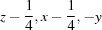
| Symmetry codes: (i) −x, −y, −z; (ii) z−1/4, x−1/4, −y; (iii) −z+1/4, −x+1/4, y; (iv) x−1/4, y−1/4, −z; (v) −x+1/4, −y+1/4, z; (vi) −y, z−1/4, x−1/4; (vii) y, −z+1/4, −x+1/4; (viii) y+1/4, −x, z+1/4; (ix) −x−1/4, −y−1/4, z; (x) x, −y+1/4, −z+1/4; (xi) −y+1/2, −z+1/2, −x+1; (xii) x, y+1/2, z+1/2; (xiii) −x+1, −y+1/2, −z+1/2; (xiv) z+1/2, x, y+1/2; (xv) −z+1/2, −x+1, −y+1/2; (xvi) y+1/2, z+1/2, x; (xvii) x, −y+3/4, −z+3/4; (xviii) x, y−1/2, z−1/2. |
Experimental details
| Crystal data | |
| Chemical formula | Pr2Mo1.73Sc0.27O7 |
| Mr | 571.69 |
| Crystal system, space group | Cubic, Fd3m |
| Temperature (K) | 293 |
| a (Å) | 10.5271 (3) |
| V (Å3) | 1166.61 (6) |
| Z | 8 |
| Radiation type | Mo Kα |
| µ (mm−1) | 20.33 |
| Crystal size (mm) | 0.1 × 0.06 × 0.05 |
| Data collection | |
| Diffractometer | Nonius KappaCCD diffractometer |
| Absorption correction | Analytical (de Meulenaar & Tompa, 1965) |
| Tmin, Tmax | 0.302, 0.461 |
| No. of measured, independent and observed [I > 2σ(I)] reflections | 9208, 326, 269 |
| Rint | 0.044 |
| (sin θ/λ)max (Å−1) | 1.078 |
| Refinement | |
| R[F2 > 2σ(F2)], wR(F2), S | 0.018, 0.047, 1.33 |
| No. of reflections | 326 |
| No. of parameters | 13 |
| Δρmax, Δρmin (e Å−3) | 0.79, −0.81 |
Computer programs: COLLECT (Nonius, 1998), EVALCCD (Duisenberg et al., 2003), SIR97 (Altomare et al., 1999), SHELXL97 (Sheldrick, 2008), DIAMOND (Brandenburg, 2001).
| Pr1—O2 | 2.2792 | Mo1—O1ii | 2.0440 (8) |
| Pr1—O1i | 2.5795 (13) |
| Symmetry codes: (i) z−1/4, x−1/4, −y; (ii) x, y+1/2, z+1/2. |
Acknowledgements
Intensity data were collected at the Centre de diffractométrie de l'Université de Rennes I (www.cdifx.univ-rennes1.fr).
References
 Ali, N., Hill, M., Labroo, S. & Greedan, J. (1989). J. Solid State Chem. 83, 178–187. CrossRef CAS Web of Science Google Scholar
Altomare, A., Burla, M. C., Camalli, M., Cascarano, G. L., Giacovazzo, C., Guagliardi, A., Moliterni, A. G. G., Polidori, G. & Spagna, R. (1999). J. Appl. Cryst. 32, 115–119. Web of Science CrossRef CAS IUCr Journals Google Scholar
Brandenburg, K. (2001). DIAMOND. Crystal Impact GbR, Bonn, Germany. Google Scholar
Duisenberg, A. J. M., Kroon-Batenburg, L. M. J. & Schreurs, A. M. M. (2003). J. Appl. Cryst. 36, 220–229. Web of Science CrossRef CAS IUCr Journals Google Scholar
Gall, P. & Gougeon, P. (2008). Acta Cryst. E64, i42. Web of Science CrossRef IUCr Journals Google Scholar
Gougeon, P. & Gall, P. (2011). Acta Cryst. E67, i34–i35. Web of Science CrossRef IUCr Journals Google Scholar
Gougeon, P., Gall, P., Cuny, J., Gautier, R., Le Polles, L., Delevoye, L. & Trebosc, J. (2011). Chem. Eur. J. 17, 13806–130813. Web of Science CrossRef CAS PubMed Google Scholar
Hill, P., Labroo, S., Zhang, X. & Ali, N. (1989). J. Less Common Met. 149, 327–330. CrossRef Web of Science Google Scholar
Hubert, Ph. H. (1974). Bull. Soc. Chim. Fr. 11, 2385–2386. Google Scholar
Meulenaer, J. de & Tompa, H. (1965). Acta Cryst. A19, 1014–1018. Google Scholar
Miyoshi, K., Honda, K., Hiraoka, T., Fujiwara, K., Takeuchi, J. & Hamasaki, T. (2003). Physica B, 329, 1059–1060. Web of Science CrossRef Google Scholar
Miyoshi, K., Honda, K., Yamashita, T., Fujiwara, K. & Takeuchi, J. (2001). J. Magn. Magn. Mater. 226, 898–899. Web of Science CrossRef Google Scholar
Nonius (1998). COLLECT. Nonius BV, Delft, The Netherlands Google Scholar
Sheldrick, G. M. (2008). Acta Cryst. A64, 112–122. Web of Science CrossRef CAS IUCr Journals Google Scholar
Subramanian, M. A., Aravamudan, G. & Subba Rao, G. V. (1983). Prog. Solid State Chem. 15, 55–143. CrossRef CAS Web of Science Google Scholar
This is an open-access article distributed under the terms of the Creative Commons Attribution (CC-BY) Licence, which permits unrestricted use, distribution, and reproduction in any medium, provided the original authors and source are cited.
| CRYSTALLOGRAPHIC COMMUNICATIONS |


An attempt to synthesize ScPr9Mo16O35, a compound with the LiNd9Mo16O35 type structure (Gougeon et al., 2011), was unsuccessful, resulting in a multiphase product. However, the formation of the new compound, Pr2Mo1.73Sc0.27O7 was achieved. Recently, we presented the crystal structure of the pseudo-quaternary pyrochlore Pr1.37Ca0.63Mo2O7 (Gall & Gougeon, 2008) in which the Pr and Ca toms occupy statistically the A site. The existence of the latter two phases clearly suggests the unknown Pr2Mo2O7 could be synthesized. However, our attempts to obtain a single- phase powder sample as well as single-crystals of Pr2Mo2O7 were unsuccessful up to now.