 | Acta Crystallographica Section E Acta Crystallographica Section E CRYSTALLOGRAPHIC COMMUNICATIONS |


 journal menu


metal-organic compounds
| CRYSTALLOGRAPHIC COMMUNICATIONS |
 access
Di-μ-hydroxido-bis[dimethyl(thiocyanato-κN)tin(IV)]

aLaboratoire de Chimie Minerale et Analytique (LACHIMIA), Departement de Chimie, Faculte des Sciences et Techniques, Universite Cheikh Anta Diop, Dakar, Senegal, and bDepartment of Chemistry, University of Bath, Bath BA2 7AY, England
*Correspondence e-mail: [email protected]
The SnIV atom in the centrosymmetric title complex, [Sn2(CH3)4(NCS)2(OH)2], adopts a distorted trigonal–bipyramidal coordination environment defined by two methyl C atoms and one bridging hydroxide group in the equatorial plane while the other bridging hydroxide group and the N atom of the thiocyanate anion are in the apical >positions. The dinuclear species are linked through O—H⋯S and C—H⋯ S hydrogen-bonding interactions into a three-dimensional network.
Related literature
For background to organotin(IV) chemistry, see: Davies (2004![[Davies, A. G. (2004). Organotin Chemistry, 2nd ed. Weinheim: Wiley-VCH.]](../../../../../../logos/arrows/e_arr.gif "Davies, A. G. (2004). Organotin Chemistry, 2nd ed. Weinheim: Wiley-VCH.") ); Gielen et al. (1991); Gielen (1996); Kamruddin et al. (1996); Khoo & Ng (2001); Tsangaris & Williams (1992). For structures containing the four-membered distannoxane [Sn(μ-OH)]2 unit, see: Chandrasekhar et al. (2007); Ng (1998). For related structures, see: Cox & Wardell (1996); Okio et al. (2003).
); Gielen et al. (1991); Gielen (1996); Kamruddin et al. (1996); Khoo & Ng (2001); Tsangaris & Williams (1992). For structures containing the four-membered distannoxane [Sn(μ-OH)]2 unit, see: Chandrasekhar et al. (2007); Ng (1998). For related structures, see: Cox & Wardell (1996); Okio et al. (2003).
![[Scheme 1]](wm2689scheme1.gif)
Experimental
Crystal data
|
Refinement
|
| ||||||||||||||||||||||
 ; (ii)
  .
. Data collection: COLLECT (Nonius, 1999); cell refinement: DENZO and SCALEPACK (Otwinowski & Minor, 1997); data reduction: DENZO and SCALEPACK; program(s) used to solve structure: SIR97 (Altomare et al., 1999); program(s) used to refine structure: SHELXL97 (Sheldrick, 2008); molecular graphics: ORTEP-3 (Farrugia, 1997); software used to prepare material for publication: WinGX (Farrugia, 1999).
Supporting information
contains datablocks I, global. DOI: 10.1107/S1600536812043462/wm2689sup1.cif
Structure factors: contains datablock I. DOI: 10.1107/S1600536812043462/wm2689Isup2.hkl
All chemicals were purchased from Aldrich (Germany) and used without any further purification. The salt (NH4)SCN was obtained by mixing KSCN with NH4Cl in ethanol 96%. The title compound (I) was synthesized by reacting Sn(CH3)2Cl2 with (NH4)SCN in ethanol (96wt%) in a 1:1 ratio. After stirring for two hours a clear solution was obtained that was slowly evaporated, yielding colourless crystals with a melting point of 502 K.
Hydrogen atoms bonded to the O atom have been located in difference Fourier maps and have been freely refined. The other hydrogen atoms have been placed onto calculated position and refined using a riding model, with C—H distances of 0.98 Å and Uiso(H)= 1.5Ueq(C).
Data collection: COLLECT (Nonius, 1999); cell DENZO and SCALEPACK (Otwinowski & Minor, 1997); data reduction: DENZO and SCALEPACK (Otwinowski & Minor, 1997); program(s) used to solve structure: SIR97 (Altomare et al., 1999); program(s) used to refine structure: SHELXL97 (Sheldrick, 2008); molecular graphics: ORTEP-3 (Farrugia, 1997); software used to prepare material for publication: WinGX (Farrugia, 1999).
![[Figure 1]](./wm2689fig1thm.gif) | Fig. 1. The dinuclear complex of compound (I). Displacement ellipsoids are drawn at the 50% probability level. [Symmetry code: (') -x,-y + 1, -z + 1.] |
![[Figure 2]](./wm2689fig2thm.gif) | Fig. 2. View of the hydrogen bonding system (dashed lines) between the sulfur atom of the SCN- anion and the H atom of the bridging OH group, as well as C—H···S interactions. O atoms are red, S atoms olive, N atoms blue, Sn atoms green, H atoms yellow and C atoms grey. |
| [Sn2(CH3)4(NCS)2(OH)2] | F(000) = 848 |
| Mr = 447.69 | Dx = 2.116 Mg m−3 |
| Orthorhombic, Pcab | Mo Kα radiation, λ = 0.71073 Å |
| Hall symbol: -P 2bc 2ac | Cell parameters from 30989 reflections |
| a = 8.3440 (2) Å | θ = 2.9–27.5° |
| b = 12.5214 (3) Å | µ = 3.85 mm−1 |
| c = 13.3871 (2) Å | T = 150 K |
| V = 1398.67 (5) Å3 | Block, colourless |
| Z = 4 | 0.15 × 0.15 × 0.10 mm |
| Nonius KappaCCD diffractometer | 1603 independent reflections |
| Radiation source: fine-focus sealed tube | 1333 reflections with I > 2σ(I) |
| Graphite monochromator | Rint = 0.055 |
| 584 1.0 degree images with ϕ and ω scans | θmax = 27.5°, θmin = 4.1° |
| Absorption correction: multi-scan (SORTAV; Blessing, 1995) | h = −10→10 |
| Tmin = 0.596, Tmax = 0.699 | k = −16→16 |
| 20098 measured reflections | l = −17→17 |
| Refinement on F2 | Secondary atom site location: difference Fourier map |
| Least-squares matrix: full | Hydrogen site location: inferred from neighbouring sites |
| R[F2 > 2σ(F2)] = 0.026 | H atoms treated by a mixture of independent and constrained refinement |
| wR(F2) = 0.056 | w = 1/[σ2(Fo2) + (0.0224P)2 + 1.8745P] where P = (Fo2 + 2Fc2)/3 |
| S = 1.11 | (Δ/σ)max < 0.001 |
| 1603 reflections | Δρmax = 1.06 e Å−3 |
| 71 parameters | Δρmin = −0.64 e Å−3 |
| 1 restraint | Extinction correction: SHELXL97 (Sheldrick, 2008), Fc*=kFc[1+0.001xFc2λ3/sin(2θ)]-1/4 |
| Primary atom site location: structure-invariant direct methods | Extinction coefficient: 0.0026 (2) |
| [Sn2(CH3)4(NCS)2(OH)2] | V = 1398.67 (5) Å3 |
| Mr = 447.69 | Z = 4 |
| Orthorhombic, Pcab | Mo Kα radiation |
| a = 8.3440 (2) Å | µ = 3.85 mm−1 |
| b = 12.5214 (3) Å | T = 150 K |
| c = 13.3871 (2) Å | 0.15 × 0.15 × 0.10 mm |
| Nonius KappaCCD diffractometer | 1603 independent reflections |
| Absorption correction: multi-scan (SORTAV; Blessing, 1995) | 1333 reflections with I > 2σ(I) |
| Tmin = 0.596, Tmax = 0.699 | Rint = 0.055 |
| 20098 measured reflections |
| R[F2 > 2σ(F2)] = 0.026 | 1 restraint |
| wR(F2) = 0.056 | H atoms treated by a mixture of independent and constrained refinement |
| S = 1.11 | Δρmax = 1.06 e Å−3 |
| 1603 reflections | Δρmin = −0.64 e Å−3 |
| 71 parameters |
Geometry. All e.s.d.'s (except the e.s.d. in the dihedral angle between two l.s. planes) are estimated using the full covariance matrix. The cell e.s.d.'s are taken into account individually in the estimation of e.s.d.'s in distances, angles and torsion angles; correlations between e.s.d.'s in cell parameters are only used when they are defined by crystal symmetry. An approximate (isotropic) treatment of cell e.s.d.'s is used for estimating e.s.d.'s involving l.s. planes. |
Refinement. Refinement of F2 against ALL reflections. The weighted R-factor wR and goodness of fit S are based on F2, conventional R-factors R are based on F, with F set to zero for negative F2. The threshold expression of F2 > σ(F2) is used only for calculating R-factors(gt) etc. and is not relevant to the choice of reflections for refinement. R-factors based on F2 are statistically about twice as large as those based on F, and R- factors based on ALL data will be even larger. |
| x | y | z | Uiso*/Ueq | ||
| Sn | 0.20586 (3) | 0.512859 (18) | 0.486833 (17) | 0.02446 (10) | |
| S | 0.55735 (12) | 0.27972 (7) | 0.69604 (7) | 0.0356 (2) | |
| O | 0.0319 (3) | 0.4300 (2) | 0.5594 (2) | 0.0365 (6) | |
| N | 0.3739 (3) | 0.4101 (2) | 0.5723 (2) | 0.0301 (6) | |
| C1 | 0.2597 (4) | 0.4461 (3) | 0.3467 (3) | 0.0337 (8) | |
| H1A | 0.1938 | 0.3823 | 0.3361 | 0.051* | |
| H1B | 0.3733 | 0.4264 | 0.3445 | 0.051* | |
| H1C | 0.2371 | 0.4985 | 0.2942 | 0.051* | |
| C2 | 0.2640 (4) | 0.6541 (3) | 0.5634 (3) | 0.0326 (8) | |
| H2A | 0.2317 | 0.7159 | 0.5233 | 0.049* | |
| H2B | 0.3799 | 0.6566 | 0.5751 | 0.049* | |
| H2C | 0.2076 | 0.6556 | 0.6276 | 0.049* | |
| C3 | 0.4481 (4) | 0.3549 (3) | 0.6243 (2) | 0.0247 (7) | |
| H10 | 0.054 (4) | 0.377 (2) | 0.596 (2) | 0.033 (10)* |
| U11 | U22 | U33 | U12 | U13 | U23 | |
| Sn | 0.01938 (14) | 0.02506 (15) | 0.02894 (15) | 0.00034 (9) | −0.00069 (9) | 0.00358 (8) |
| S | 0.0431 (5) | 0.0317 (5) | 0.0319 (5) | 0.0115 (4) | −0.0139 (4) | −0.0056 (3) |
| O | 0.0234 (13) | 0.0358 (15) | 0.0501 (16) | 0.0009 (11) | −0.0028 (12) | 0.0229 (12) |
| N | 0.0249 (15) | 0.0311 (16) | 0.0342 (16) | 0.0036 (13) | −0.0038 (13) | 0.0023 (12) |
| C1 | 0.032 (2) | 0.034 (2) | 0.036 (2) | −0.0050 (16) | −0.0056 (15) | −0.0037 (15) |
| C2 | 0.034 (2) | 0.033 (2) | 0.0311 (19) | 0.0002 (15) | 0.0040 (15) | −0.0044 (15) |
| C3 | 0.0200 (17) | 0.0275 (18) | 0.0266 (16) | −0.0032 (14) | 0.0030 (14) | −0.0071 (13) |
| Sn—O | 2.032 (2) | N—C3 | 1.160 (4) |
| Sn—C2 | 2.101 (4) | C1—H1A | 0.9800 |
| Sn—C1 | 2.102 (4) | C1—H1B | 0.9800 |
| Sn—Oi | 2.198 (2) | C1—H1C | 0.9800 |
| Sn—N | 2.220 (3) | C2—H2A | 0.9800 |
| S—C3 | 1.625 (4) | C2—H2B | 0.9800 |
| O—Sni | 2.198 (2) | C2—H2C | 0.9800 |
| O—H10 | 0.842 (18) | ||
| O—Sn—C2 | 111.20 (13) | Sn—C1—H1A | 109.5 |
| O—Sn—C1 | 112.11 (13) | Sn—C1—H1B | 109.5 |
| C2—Sn—C1 | 136.11 (15) | H1A—C1—H1B | 109.5 |
| O—Sn—Oi | 69.90 (10) | Sn—C1—H1C | 109.5 |
| C2—Sn—Oi | 94.13 (12) | H1A—C1—H1C | 109.5 |
| C1—Sn—Oi | 94.06 (13) | H1B—C1—H1C | 109.5 |
| O—Sn—N | 84.76 (10) | Sn—C2—H2A | 109.5 |
| C2—Sn—N | 95.18 (12) | Sn—C2—H2B | 109.5 |
| C1—Sn—N | 95.43 (13) | H2A—C2—H2B | 109.5 |
| Oi—Sn—N | 154.66 (10) | Sn—C2—H2C | 109.5 |
| Sn—O—Sni | 110.10 (10) | H2A—C2—H2C | 109.5 |
| Sn—O—H10 | 122 (3) | H2B—C2—H2C | 109.5 |
| Sni—O—H10 | 128 (3) | N—C3—S | 178.1 (3) |
| C3—N—Sn | 172.5 (3) |
| Symmetry code: (i) −x, −y+1, −z+1. |
| D—H···A | D—H | H···A | D···A | D—H···A |
| O—H10···Sii | 0.84 (2) | 2.38 (2) | 3.207 (3) | 168 (4) |
| C2—H2C···Siii | 0.98 | 2.79 | 3.746 (4) | 164 |
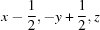
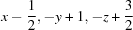
| Symmetry codes: (ii) x−1/2, −y+1/2, z; (iii) x−1/2, −y+1, −z+3/2. |
Experimental details
| Crystal data | |
| Chemical formula | [Sn2(CH3)4(NCS)2(OH)2] |
| Mr | 447.69 |
| Crystal system, space group | Orthorhombic, Pcab |
| Temperature (K) | 150 |
| a, b, c (Å) | 8.3440 (2), 12.5214 (3), 13.3871 (2) |
| V (Å3) | 1398.67 (5) |
| Z | 4 |
| Radiation type | Mo Kα |
| µ (mm−1) | 3.85 |
| Crystal size (mm) | 0.15 × 0.15 × 0.10 |
| Data collection | |
| Diffractometer | Nonius KappaCCD diffractometer |
| Absorption correction | Multi-scan (SORTAV; Blessing, 1995) |
| Tmin, Tmax | 0.596, 0.699 |
| No. of measured, independent and observed [I > 2σ(I)] reflections | 20098, 1603, 1333 |
| Rint | 0.055 |
| (sin θ/λ)max (Å−1) | 0.649 |
| Refinement | |
| R[F2 > 2σ(F2)], wR(F2), S | 0.026, 0.056, 1.11 |
| No. of reflections | 1603 |
| No. of parameters | 71 |
| No. of restraints | 1 |
| H-atom treatment | H atoms treated by a mixture of independent and constrained refinement |
| Δρmax, Δρmin (e Å−3) | 1.06, −0.64 |
Computer programs: COLLECT (Nonius, 1999), DENZO and SCALEPACK (Otwinowski & Minor, 1997), SIR97 (Altomare et al., 1999), SHELXL97 (Sheldrick, 2008), ORTEP-3 (Farrugia, 1997), WinGX (Farrugia, 1999).
| D—H···A | D—H | H···A | D···A | D—H···A |
| O—H10···Si | 0.842 (18) | 2.38 (2) | 3.207 (3) | 168 (4) |
| C2—H2C···Sii | 0.98 | 2.79 | 3.746 (4) | 164.2 |
| Symmetry codes: (i) x−1/2, −y+1/2, z; (ii) x−1/2, −y+1, −z+3/2. |
References
 Altomare, A., Burla, M. C., Camalli, M., Cascarano, G. L., Giacovazzo, C., Guagliardi, A., Moliterni, A. G. G., Polidori, G. & Spagna, R. (1999). J. Appl. Cryst. 32, 115–119. Web of Science CrossRef CAS IUCr Journals Google Scholar
Blessing, R. H. (1995). Acta Cryst. A51, 33–38. CrossRef CAS Web of Science IUCr Journals Google Scholar
Chandrasekhar, V., Singh, P. & Gopal, K. (2007). Appl. Organomet. Chem. 21, 483–503. Web of Science CrossRef CAS Google Scholar
Cox, P. J. & Wardell, J. L. (1996). Acta Cryst. C52, 317–319. CSD CrossRef CAS Web of Science IUCr Journals Google Scholar
Davies, A. G. (2004). Organotin Chemistry, 2nd ed. Weinheim: Wiley-VCH. Google Scholar
Farrugia, L. J. (1997). J. Appl. Cryst. 30, 565. CrossRef IUCr Journals Google Scholar
Farrugia, L. J. (1999). J. Appl. Cryst. 32, 837–838. CrossRef CAS IUCr Journals Google Scholar
Gielen, M. (1996). Coord. Chem. Rev. 151, 41–51. CrossRef CAS Google Scholar
Gielen, M., Boualam, M., Biesemans, M., Mahieu, B. & Willem, R. (1991). Main Group Met. Chem. 14, 271–281. CAS Google Scholar
Kamruddin, S. K., Chattopadhyaya, T. K., Roy, A. & Tiekink, E. R. T. (1996). Appl. Organomet. Chem. 10, 513–521. CrossRef CAS Google Scholar
Khoo, L. E. & Ng, S. W. (2001). Main. Group. Met. Chem. 24, 445–446. CAS Google Scholar
Ng, S. W. (1998). Acta Cryst. C54, 752–755. Web of Science CSD CrossRef CAS IUCr Journals Google Scholar
Nonius (1999). COLLECT. Nonius BV, Delft, The Netherlands. Google Scholar
Okio, K. Y., Diop, L., Barry, A. H., Jouini, T. & Ortega, S. H. (2003). Appl. Organomet. Chem. 17, 317–318. Web of Science CSD CrossRef CAS Google Scholar
Otwinowski, Z. & Minor, W. (1997). Methods in Enzymology, Vol. 276, Macromolecular Crystallography, Part A, edited by C.W. Carter Jr & R. M. Sweet, pp. 307–326. New York: Academic Press. Google Scholar
Sheldrick, G. M. (2008). Acta Cryst. A64, 112–122. Web of Science CrossRef CAS IUCr Journals Google Scholar
Tsangaris, J. M. & Williams, D. R. (1992). Appl. Organomet. Chem. 6, 3–18. CrossRef CAS Web of Science Google Scholar
This is an open-access article distributed under the terms of the Creative Commons Attribution (CC-BY) Licence, which permits unrestricted use, distribution, and reproduction in any medium, provided the original authors and source are cited.
| CRYSTALLOGRAPHIC COMMUNICATIONS |


Organotin complexes may interact with biological systems in many different ways as bactericides, fungicides, acaricides and industrial biocides (Davies, 2004; Gielen et al., 1991; Gielen, 1996; Kamruddin et al., 1996; Khoo & Ng, 2001; Tsangaris & Williams, 1992). Many tin compounds containing the Sn(CH3)2 residue tiogether with a four-membered distannoxane [Sn(µ-OH)]2 ring have been reported (Chandrasekhar et al., 2007; Ng, 1998). In the context of new Sn(CH3)2-residue containing compounds we have initiated the structural study of the interactions between (NH4)SCN and Sn(CH3)2Cl2, which has yielded the title complex, [Sn(CH3)2(OH)(SCN)]2, (I).
The asymmetric unit of compound (I) is situated close to an inversion centre, which generates a dimer containing a central Sn2O2 ring; the tin(IV) atom is five-coordinated by two methyl groups, two bridging oxygen atoms and one nitrogen atom of the thiocyanate anion, forming a distorted trigonal bipyramid (Fig. 1). The sum of the angles at the tin atom, involving the carbon atoms and one O atom is 359.47 °; the nitrogen and the other oxygen atom Oi [(i) -x,-y + 1, -z + 1] are at the apical positions. The angles involving N and the atoms of the equatorial plane [N1—Sn1—C2 = 95.18 (12)°, N—Sn—C1 = 95.43 (13)°, N—Sn—O1 = 84.76 (10)°] show a significant deviation from the perfect trigonal-bipyramidal configuration. The bond lengths Sn—C [2.101 (4), 2.102 (4) Å] and Sn—N [2.220 (3) Å] are quite similar while the two Sn—O bond lengths [Sn—O1 = 2.032 (2), Sn—Oi = 2.198 (2) Å] are different but are in the range of typical Sn—O(bridging) distances (Ng, 1998; Chandrasekhar et al., 2007). The Sn—N and Sn—C bond length are likewise in the range of reported values (Cox & Wardell, 1996; Ng, 1998; Okio et al., 2003; Chandrasekhar et al., 2007). The SCN- anion is almost linear [N—C3—S = 178.1 (3)°], as in the structure of [(CH3)4N][Sn(C6H5)3(SCN)2] (Okio et al., 2003). The Sn—N—C angle deviates more from linearity [C3—N—Sn = 172.5 (3)°].
The dinuclear species are linked through O—H···S hydrogen bonds into layers parallel to (001) (Fig. 2); C—H···S hydrogen bonding interactions (Table 1) lead to the formation of a three-dimensional network.