 | Acta Crystallographica Section E Acta Crystallographica Section E CRYSTALLOGRAPHIC COMMUNICATIONS |


 journal menu


metal-organic compounds
| CRYSTALLOGRAPHIC COMMUNICATIONS |
 access
[μ-N1,N2-Bis(pyridin-2-yl)hydrazine-1,2-dicarbothioamidato]bis[chloridocopper(II)]

aCollege of Chemistry and Material Science, South-Central University for Nationalities, Wuhan, Hubei 430074, People's Republic of China
*Correspondence e-mail: [email protected]
The binuclear title compound, [Cu2(C12H10N6S2)Cl2], possesses twofold rotational symmetry. The CuII atom occupies a four-coordinate pseudo-tetrahedral environment bound to one S atom, one imine N atom and one pyridine N atom from the N1,N2-bis(pyridin-2-yl)hydrazine-1,2-dicarbothioamidate ligand, and one Cl− anion. The metal atoms are connected via the bis-tridentate ligand into a binuclear structure. The molecule is bow-shaped with the pyridine rings inclined to one another by 51.56 (14)°. In the crystal, N—H⋯Cl hydrogen bonds lead to the formation of ribbons propagating along [001]. These ribbons are connected via C—H⋯Cl, C—H⋯S and π–π interactions [centroid–centroid distance = 3.6146 (19) Å], leading to the formation of a three-dimensional structure.
Related literature
For the biological activity of thiosemicarbazides and their metal complexes, see: West et al. (1993![[West, D. X., Liberta, A. E., Padhye, S. B., Chikate, R. C., Sonawane, P. B., Kumbhar, A. S. & Yerande, R. G. (1993). Coord. Chem. Rev. 123, 49-71.]](../../../../../../logos/arrows/e_arr.gif "West, D. X., Liberta, A. E., Padhye, S. B., Chikate, R. C., Sonawane, P. B., Kumbhar, A. S. & Yerande, R. G. (1993). Coord. Chem. Rev. 123, 49-71.") ). For related structures, see: Wang et al. (2011); Yamin & Yusof (2003); Akinchan et al. (2002). For the synthesis of the ligand, see: Szecsenyi et al. (2006).
). For related structures, see: Wang et al. (2011); Yamin & Yusof (2003); Akinchan et al. (2002). For the synthesis of the ligand, see: Szecsenyi et al. (2006).
![[Scheme 1]](su2393scheme1.gif)
Experimental
Crystal data
|
Refinement
|
| ||||||||||||
 .
.
| |||||||||||||||||||||||||||
 ; (iii)
  ; (iv)
  .
. Data collection: SMART (Bruker, 2003); cell refinement: SAINT-Plus (Bruker, 2003); data reduction: SAINT-Plus; program(s) used to solve structure: SHELXS97 (Sheldrick, 2008); program(s) used to refine structure: SHELXL97 (Sheldrick, 2008); molecular graphics: SHELXTL (Sheldrick, 2008); software used to prepare material for publication: SHELXTL.
Supporting information
contains datablocks global, I. DOI: https://doi.org/10.1107/S1600536812048659/su2393sup1.cif
Structure factors: contains datablock I. DOI: https://doi.org/10.1107/S1600536812048659/su2393Isup2.hkl
The ligand (L), N,N'-di(pyridin-2-yl)hydrazine-1,2-bis(carbothioamide,) was prepared by the literature method (Szecsenyi et al., 2006). L (0.05 mmol) was solved in DMF (5 ml) in a test tube, then an 8 ml solvent mixture of CH3OH and DMF (v/v = 1:1) was added as a buffer layer. A solution of CuCl2(0.10 mmol) in CH3OH (3 ml) was then carefully layered on top. The system was sealed and kept for a week, after which black block-like single crystals, suitable for X-ray analysis, were obtained. Anal. Calcd for C12H10Cl2Cu2N6S2: C 28.80, H 2.01, N16.80. Found: C 29.23; H, 2.40; N, 16.44.
The NH and C-bound H atoms were included in calculated positions and treated as riding atoms: N–H = 0.86 Å and C–H = 0.93 Å , with Uiso(H) = 1.2Ueq(N,C).
Thiosemicarbazide and their metal complexes have attracked considerable interest due to their biological activities, such as antiviral, antibacterial, antimalarial, antifungal, and antitumoral activities (West et al., 1993). Thiosemicarbazide are versatile ligands that can coordinate as neutral ligands or in the deprotonated form. They can also be used as flexible spacers with potential multiple binding sites to construct coordination polymers with multiple dimensions and various topologies. In the present paper, the synthesis and of the title thiosemicarbazide binuclear copper(II) compound is reported.
The title compound possesses twofold rotational symmetry (Fig.1). Each CuII center occupies a four-coordinated pseudotetrahedral environment bound to one sulfur atom, one imine nitrogen atom, and one pyridine nitrogen atom from one N,N'-di(pyridin-2-yl)hydrazine-1,2-bis(carbothioamide) ligand, and one chlorine anion. The metal centres are connected via the hexadentate ligand into a binuclear structure. The molecule is bow-shaped. The thiosemicarbazide moiety (S2/N2(N3/N6) is twisted by 20.14 (13)° from the pyridine ring to which it is attached. The two thiosemicarbazide moieties, (S2/N2/N3/N6) and (S2A/N2A/N3A/N6A), are inclined to one another by 23.36 (13) °, while the pyrdine rings make a dihedral angle of 51.56 (14)°.
The Cu—S distance is 2.2295 (9) Å, and the Cu—N distances vary between 1.961 (3)–1.986 (2) Å. The C—S bond distances of 1.711 (3) Å are within the normal range for a C—S single bond, indicating that the thiosemicarbazide moieties adopt the thiol tautomeric form, acting as a doubly charged negative ligand. The C6—N distances of 1.311 (3)–1.366 (3) Å and the N3—N3A distance of 1.399 (3) Å are intermediate between formal single and double bonds, pointing to extensive electron delocalization over the entire ligand skeleton. This agrees well with the same distances observed in related compounds (Wang et al., 2011; Yamin & Yusof, 2003; Akinchan et al., 2002).
In the crystal, there are N-H···Cl hydrogen bonds, leading to the formation of ribbons propagating along [001], and C-H···Cl and C-H···S interactions (Table 1). The latter link the ribbons and together with π–π interactions lead to the formation of a three-dimensional structure [Cg1···Cg1i 3.6146 (19) Å; perpendicular separation 3.5312 (11) Å; slippage 0.772 Å; Cg1 is the centroid of pyrdine ring N1/C1-C5; symmetry code: (i) -x, -y+2, -z].
For the biological activity of thiosemicarbazides and their metal complexes, see: West et al. (1993). For related structures, see: Wang et al. (2011); Yamin & Yusof (2003); Akinchan et al. (2002). For the synthesis of the ligand, see: Szecsenyi et al. (2006).
Data collection: SMART (Bruker, 2003); cell SAINT-Plus (Bruker, 2003); data reduction: SAINT-Plus (Bruker, 2003); program(s) used to solve structure: SHELXS97 (Sheldrick, 2008); program(s) used to refine structure: SHELXL97 (Sheldrick, 2008); molecular graphics: SHELXTL (Sheldrick, 2008); software used to prepare material for publication: SHELXTL (Sheldrick, 2008).
![[Figure 1]](./su2393fig1thm.gif) | Fig. 1. The molecular structure of title compound, with the atom numbering. The displacement ellipsoids are drawn at the 50% probability level [symmetry code: (a) - x, y, - z + 1/2]. |
| [Cu2(C12H10N6S2)Cl2] | F(000) = 992 |
| Mr = 500.36 | Dx = 2.073 Mg m−3 |
| Monoclinic, C2/c | Mo Kα radiation, λ = 0.71073 Å |
| Hall symbol: -C 2yc | Cell parameters from 253 reflections |
| a = 15.825 (3) Å | θ = 2.9–29.5° |
| b = 7.6190 (13) Å | µ = 3.26 mm−1 |
| c = 15.082 (4) Å | T = 293 K |
| β = 118.179 (2)° | Block, black |
| V = 1602.9 (6) Å3 | 0.32 × 0.28 × 0.27 mm |
| Z = 4 |
| Bruker SMART APEX CCD diffractometer | 1561 independent reflections |
| Radiation source: fine-focus sealed tube | 1445 reflections with I > 2σ(I) |
| Graphite monochromator | Rint = 0.018 |
| φ and ω scans | θmax = 26.0°, θmin = 2.9° |
| Absorption correction: multi-scan (SADABS; Bruker, 2003) | h = −19→18 |
| Tmin = 0.422, Tmax = 0.474 | k = −9→7 |
| 4270 measured reflections | l = −18→17 |
| Refinement on F2 | Secondary atom site location: difference Fourier map |
| Least-squares matrix: full | Hydrogen site location: inferred from neighbouring sites |
| R[F2 > 2σ(F2)] = 0.024 | H-atom parameters constrained |
| wR(F2) = 0.068 | w = 1/[σ2(Fo2) + (0.0374P)2 + 2.3083P] where P = (Fo2 + 2Fc2)/3 |
| S = 1.07 | (Δ/σ)max < 0.001 |
| 1561 reflections | Δρmax = 0.73 e Å−3 |
| 110 parameters | Δρmin = −0.34 e Å−3 |
| 0 restraints | Extinction correction: SHELXL97 (Sheldrick, 2008), Fc*=kFc[1+0.001xFc2λ3/sin(2θ)]-1/4 |
| Primary atom site location: structure-invariant direct methods | Extinction coefficient: 0.0018 (3) |
| [Cu2(C12H10N6S2)Cl2] | V = 1602.9 (6) Å3 |
| Mr = 500.36 | Z = 4 |
| Monoclinic, C2/c | Mo Kα radiation |
| a = 15.825 (3) Å | µ = 3.26 mm−1 |
| b = 7.6190 (13) Å | T = 293 K |
| c = 15.082 (4) Å | 0.32 × 0.28 × 0.27 mm |
| β = 118.179 (2)° |
| Bruker SMART APEX CCD diffractometer | 1561 independent reflections |
| Absorption correction: multi-scan (SADABS; Bruker, 2003) | 1445 reflections with I > 2σ(I) |
| Tmin = 0.422, Tmax = 0.474 | Rint = 0.018 |
| 4270 measured reflections |
| R[F2 > 2σ(F2)] = 0.024 | 0 restraints |
| wR(F2) = 0.068 | H-atom parameters constrained |
| S = 1.07 | Δρmax = 0.73 e Å−3 |
| 1561 reflections | Δρmin = −0.34 e Å−3 |
| 110 parameters |
Geometry. Bond distances, angles etc. have been calculated using the rounded fractional coordinates. All su's are estimated from the variances of the (full) variance-covariance matrix. The cell esds are taken into account in the estimation of distances, angles and torsion angles |
Refinement. Refinement of F2 against ALL reflections. The weighted R-factor wR and goodness of fit S are based on F2, conventional R-factors R are based on F, with F set to zero for negative F2. The threshold expression of F2 > σ(F2) is used only for calculating R-factors(gt) etc. and is not relevant to the choice of reflections for refinement. R-factors based on F2 are statistically about twice as large as those based on F, and R- factors based on ALL data will be even larger. |
| x | y | z | Uiso*/Ueq | ||
| Cu1 | 0.12780 (2) | 0.63445 (4) | 0.20890 (2) | 0.0266 (1) | |
| Cl1 | 0.25399 (4) | 0.50248 (9) | 0.20491 (5) | 0.0355 (2) | |
| S2 | 0.18501 (4) | 0.59737 (10) | 0.37400 (5) | 0.0336 (2) | |
| N1 | 0.07304 (14) | 0.7259 (3) | 0.06931 (14) | 0.0267 (6) | |
| N2 | 0.08612 (15) | 0.6577 (3) | 0.46876 (15) | 0.0297 (6) | |
| N3 | −0.00303 (14) | 0.6631 (3) | 0.29480 (15) | 0.0258 (6) | |
| C1 | −0.02056 (17) | 0.7259 (3) | 0.00390 (18) | 0.0265 (7) | |
| C2 | −0.05668 (19) | 0.7912 (4) | −0.09283 (19) | 0.0356 (8) | |
| C3 | 0.0058 (2) | 0.8611 (4) | −0.1223 (2) | 0.0452 (10) | |
| C4 | 0.1031 (2) | 0.8622 (4) | −0.0559 (2) | 0.0434 (10) | |
| C5 | 0.13323 (19) | 0.7951 (4) | 0.03822 (19) | 0.0340 (8) | |
| C6 | 0.07986 (17) | 0.6433 (3) | 0.37555 (18) | 0.0248 (7) | |
| H2 | −0.12210 | 0.78770 | −0.13690 | 0.0430* | |
| H2A | 0.13840 | 0.61870 | 0.51760 | 0.0360* | |
| H3 | −0.01690 | 0.90740 | −0.18660 | 0.0540* | |
| H4 | 0.14670 | 0.90750 | −0.07490 | 0.0520* | |
| H5 | 0.19850 | 0.79710 | 0.08320 | 0.0410* |
| U11 | U22 | U33 | U12 | U13 | U23 | |
| Cu1 | 0.0178 (2) | 0.0406 (2) | 0.0238 (2) | 0.0017 (1) | 0.0118 (1) | 0.0002 (1) |
| Cl1 | 0.0250 (3) | 0.0472 (4) | 0.0381 (3) | 0.0039 (3) | 0.0181 (3) | −0.0055 (3) |
| S2 | 0.0188 (3) | 0.0567 (4) | 0.0270 (3) | 0.0091 (3) | 0.0123 (3) | 0.0067 (3) |
| N1 | 0.0221 (10) | 0.0354 (12) | 0.0249 (10) | −0.0031 (8) | 0.0131 (8) | −0.0023 (9) |
| N2 | 0.0190 (10) | 0.0477 (13) | 0.0217 (10) | 0.0072 (9) | 0.0090 (9) | 0.0026 (9) |
| N3 | 0.0191 (10) | 0.0392 (12) | 0.0213 (9) | −0.0001 (8) | 0.0113 (8) | 0.0005 (8) |
| C1 | 0.0251 (12) | 0.0323 (13) | 0.0260 (11) | −0.0019 (10) | 0.0152 (10) | −0.0031 (10) |
| C2 | 0.0294 (13) | 0.0508 (17) | 0.0245 (12) | −0.0022 (12) | 0.0109 (11) | 0.0020 (11) |
| C3 | 0.0462 (18) | 0.064 (2) | 0.0302 (14) | −0.0015 (14) | 0.0221 (14) | 0.0078 (13) |
| C4 | 0.0428 (17) | 0.0564 (19) | 0.0422 (16) | −0.0074 (13) | 0.0294 (15) | 0.0031 (13) |
| C5 | 0.0268 (13) | 0.0445 (15) | 0.0354 (13) | −0.0062 (11) | 0.0186 (12) | −0.0029 (12) |
| C6 | 0.0204 (12) | 0.0304 (13) | 0.0252 (11) | 0.0001 (9) | 0.0121 (10) | 0.0007 (9) |
| Cu1—Cl1 | 2.2619 (10) | N3—N3i | 1.399 (3) |
| Cu1—S2 | 2.2295 (9) | N2—H2A | 0.8600 |
| Cu1—N1 | 1.986 (2) | C1—C2 | 1.384 (4) |
| Cu1—N3i | 1.961 (3) | C2—C3 | 1.369 (5) |
| S2—C6 | 1.711 (3) | C3—C4 | 1.385 (4) |
| N1—C1 | 1.337 (4) | C4—C5 | 1.366 (4) |
| N1—C5 | 1.352 (4) | C2—H2 | 0.9300 |
| N2—C6 | 1.366 (3) | C3—H3 | 0.9300 |
| N2—C1i | 1.386 (4) | C4—H4 | 0.9300 |
| N3—C6 | 1.311 (3) | C5—H5 | 0.9300 |
| Cl1—Cu1—S2 | 94.32 (3) | N1—C1—C2 | 122.7 (3) |
| Cl1—Cu1—N1 | 94.39 (7) | N1—C1—N2i | 120.3 (2) |
| Cl1—Cu1—N3i | 159.80 (7) | C1—C2—C3 | 118.7 (3) |
| S2—Cu1—N1 | 166.41 (7) | C2—C3—C4 | 119.6 (3) |
| S2—Cu1—N3i | 85.31 (6) | C3—C4—C5 | 118.2 (3) |
| N1—Cu1—N3i | 90.08 (9) | N1—C5—C4 | 123.3 (3) |
| Cu1—S2—C6 | 96.01 (9) | N2—C6—N3 | 120.1 (3) |
| Cu1—N1—C1 | 123.98 (19) | S2—C6—N2 | 115.6 (2) |
| Cu1—N1—C5 | 118.58 (18) | S2—C6—N3 | 124.3 (2) |
| C1—N1—C5 | 117.4 (2) | C1—C2—H2 | 121.00 |
| C1i—N2—C6 | 129.5 (2) | C3—C2—H2 | 121.00 |
| Cu1i—N3—C6 | 124.48 (19) | C2—C3—H3 | 120.00 |
| N3i—N3—C6 | 113.7 (2) | C4—C3—H3 | 120.00 |
| Cu1i—N3—N3i | 119.99 (16) | C3—C4—H4 | 121.00 |
| C6—N2—H2A | 115.00 | C5—C4—H4 | 121.00 |
| C1i—N2—H2A | 115.00 | N1—C5—H5 | 118.00 |
| N2i—C1—C2 | 117.0 (3) | C4—C5—H5 | 118.00 |
| Cl1—Cu1—S2—C6 | −165.43 (8) | C5—N1—C1—N2i | −179.7 (2) |
| N3i—Cu1—S2—C6 | −5.68 (11) | Cu1—N1—C5—C4 | −179.7 (2) |
| Cl1—Cu1—N1—C1 | 138.8 (2) | C1i—N2—C6—S2 | 166.0 (2) |
| Cl1—Cu1—N1—C5 | −42.3 (2) | C6i—N2i—C1—N1 | 26.4 (4) |
| N3i—Cu1—N1—C1 | −21.5 (2) | C6i—N2i—C1—C2 | −154.0 (3) |
| N3i—Cu1—N1—C5 | 157.5 (2) | C1i—N2—C6—N3 | −14.5 (4) |
| Cl1—Cu1—N3i—N3 | 94.0 (2) | N3i—N3—C6—N2 | 173.7 (2) |
| Cl1—Cu1—N3i—C6i | −69.8 (3) | Cu1i—N3—C6—S2 | 157.76 (14) |
| S2—Cu1—N3i—N3 | 4.18 (18) | Cu1i—N3—C6—N2 | −21.7 (3) |
| S2—Cu1—N3i—C6i | −159.6 (2) | C6—N3—N3i—Cu1 | 0.2 (3) |
| N1—Cu1—N3i—N3 | −163.03 (19) | C6—N3—N3i—C6i | 165.6 (2) |
| N1—Cu1—N3i—C6i | 33.2 (2) | Cu1i—N3—N3i—Cu1 | −165.23 (11) |
| Cu1—S2—C6—N2 | −171.77 (17) | N3i—N3—C6—S2 | −6.9 (3) |
| Cu1—S2—C6—N3 | 8.8 (2) | N1—C1—C2—C3 | −1.0 (4) |
| C1—N1—C5—C4 | −0.7 (4) | N2i—C1—C2—C3 | 179.4 (3) |
| Cu1—N1—C1—C2 | 179.7 (2) | C1—C2—C3—C4 | 1.1 (4) |
| C5—N1—C1—C2 | 0.8 (4) | C2—C3—C4—C5 | −1.0 (5) |
| Cu1—N1—C1—N2i | −0.7 (3) | C3—C4—C5—N1 | 0.8 (5) |
| Symmetry code: (i) −x, y, −z+1/2. |
| D—H···A | D—H | H···A | D···A | D—H···A |
| N2—H2A···Cl1ii | 0.86 | 2.70 | 3.507 (2) | 156 |
| C2—H2···Cl1iii | 0.93 | 2.77 | 3.482 (3) | 134 |
| C5—H5···S2iv | 0.93 | 2.82 | 3.425 (3) | 124 |
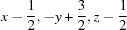
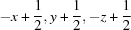
| Symmetry codes: (ii) x, −y+1, z+1/2; (iii) x−1/2, −y+3/2, z−1/2; (iv) −x+1/2, y+1/2, −z+1/2. |
Experimental details
| Crystal data | |
| Chemical formula | [Cu2(C12H10N6S2)Cl2] |
| Mr | 500.36 |
| Crystal system, space group | Monoclinic, C2/c |
| Temperature (K) | 293 |
| a, b, c (Å) | 15.825 (3), 7.6190 (13), 15.082 (4) |
| β (°) | 118.179 (2) |
| V (Å3) | 1602.9 (6) |
| Z | 4 |
| Radiation type | Mo Kα |
| µ (mm−1) | 3.26 |
| Crystal size (mm) | 0.32 × 0.28 × 0.27 |
| Data collection | |
| Diffractometer | Bruker SMART APEX CCD |
| Absorption correction | Multi-scan (SADABS; Bruker, 2003) |
| Tmin, Tmax | 0.422, 0.474 |
| No. of measured, independent and observed [I > 2σ(I)] reflections | 4270, 1561, 1445 |
| Rint | 0.018 |
| (sin θ/λ)max (Å−1) | 0.617 |
| Refinement | |
| R[F2 > 2σ(F2)], wR(F2), S | 0.024, 0.068, 1.07 |
| No. of reflections | 1561 |
| No. of parameters | 110 |
| H-atom treatment | H-atom parameters constrained |
| Δρmax, Δρmin (e Å−3) | 0.73, −0.34 |
Computer programs: SMART (Bruker, 2003), SAINT-Plus (Bruker, 2003), SHELXS97 (Sheldrick, 2008), SHELXL97 (Sheldrick, 2008), SHELXTL (Sheldrick, 2008).
| Cu1—Cl1 | 2.2619 (10) | Cu1—N1 | 1.986 (2) |
| Cu1—S2 | 2.2295 (9) | Cu1—N3i | 1.961 (3) |
| Symmetry code: (i) −x, y, −z+1/2. |
| D—H···A | D—H | H···A | D···A | D—H···A |
| N2—H2A···Cl1ii | 0.86 | 2.70 | 3.507 (2) | 156 |
| C2—H2···Cl1iii | 0.93 | 2.77 | 3.482 (3) | 134 |
| C5—H5···S2iv | 0.93 | 2.82 | 3.425 (3) | 124 |
| Symmetry codes: (ii) x, −y+1, z+1/2; (iii) x−1/2, −y+3/2, z−1/2; (iv) −x+1/2, y+1/2, −z+1/2. |
Acknowledgements
This work was sponsored by the National Natural Science Foundation of China (No. 20977115).
References
 Akinchan, N. T., Drozdzewski, P. M. & Battagli, L. P. (2002). J. Chem. Crystallogr. 32, 91–97. Web of Science CSD CrossRef CAS Google Scholar
Bruker (2003). SADABS, SMART and SAINT-Plus. Bruker AXS Inc., Madison, Wisconsin, USA. Google Scholar
Sheldrick, G. M. (2008). Acta Cryst. A64, 112–122. Web of Science CrossRef CAS IUCr Journals Google Scholar
Szecsenyi, K. M., Leovac, V. M. & Evans, I. R. (2006). J. Coord. Chem. 59, 523–530. CAS Google Scholar
Wang, H. Y., Zhao, P. S., Song, J. & Li, R. Q. (2011). J. Chem. Crystallogr. 41, 379–385. Web of Science CSD CrossRef CAS Google Scholar
West, D. X., Liberta, A. E., Padhye, S. B., Chikate, R. C., Sonawane, P. B., Kumbhar, A. S. & Yerande, R. G. (1993). Coord. Chem. Rev. 123, 49–71. CrossRef CAS Web of Science Google Scholar
Yamin, B. M. & Yusof, M. S. M. (2003). Acta Cryst. E59, o358–o359. Web of Science CSD CrossRef IUCr Journals Google Scholar
This is an open-access article distributed under the terms of the Creative Commons Attribution (CC-BY) Licence, which permits unrestricted use, distribution, and reproduction in any medium, provided the original authors and source are cited.
| CRYSTALLOGRAPHIC COMMUNICATIONS |


Thiosemicarbazide and their metal complexes have attracked considerable interest due to their biological activities, such as antiviral, antibacterial, antimalarial, antifungal, and antitumoral activities (West et al., 1993). Thiosemicarbazide are versatile ligands that can coordinate as neutral ligands or in the deprotonated form. They can also be used as flexible spacers with potential multiple binding sites to construct coordination polymers with multiple dimensions and various topologies. In the present paper, the synthesis and crystal structure of the title thiosemicarbazide binuclear copper(II) compound is reported.
The title compound possesses twofold rotational symmetry (Fig.1). Each CuII center occupies a four-coordinated pseudotetrahedral environment bound to one sulfur atom, one imine nitrogen atom, and one pyridine nitrogen atom from one N,N'-di(pyridin-2-yl)hydrazine-1,2-bis(carbothioamide) ligand, and one chlorine anion. The metal centres are connected via the hexadentate ligand into a binuclear structure. The molecule is bow-shaped. The thiosemicarbazide moiety (S2/N2(N3/N6) is twisted by 20.14 (13)° from the pyridine ring to which it is attached. The two thiosemicarbazide moieties, (S2/N2/N3/N6) and (S2A/N2A/N3A/N6A), are inclined to one another by 23.36 (13) °, while the pyrdine rings make a dihedral angle of 51.56 (14)°.
The Cu—S distance is 2.2295 (9) Å, and the Cu—N distances vary between 1.961 (3)–1.986 (2) Å. The C—S bond distances of 1.711 (3) Å are within the normal range for a C—S single bond, indicating that the thiosemicarbazide moieties adopt the thiol tautomeric form, acting as a doubly charged negative ligand. The C6—N distances of 1.311 (3)–1.366 (3) Å and the N3—N3A distance of 1.399 (3) Å are intermediate between formal single and double bonds, pointing to extensive electron delocalization over the entire ligand skeleton. This agrees well with the same distances observed in related compounds (Wang et al., 2011; Yamin & Yusof, 2003; Akinchan et al., 2002).
In the crystal, there are N-H···Cl hydrogen bonds, leading to the formation of ribbons propagating along [001], and C-H···Cl and C-H···S interactions (Table 1). The latter link the ribbons and together with π–π interactions lead to the formation of a three-dimensional structure [Cg1···Cg1i 3.6146 (19) Å; perpendicular separation 3.5312 (11) Å; slippage 0.772 Å; Cg1 is the centroid of pyrdine ring N1/C1-C5; symmetry code: (i) -x, -y+2, -z].