 | Acta Crystallographica Section E Acta Crystallographica Section E CRYSTALLOGRAPHIC COMMUNICATIONS |


 journal menu


metal-organic compounds
| CRYSTALLOGRAPHIC COMMUNICATIONS |
 access
Bis(4,4′-sulfanediyldipyridinium) tetrachloridonickelate(II) dichloride

aInstitut für Anorganische Chemie, Christian-Albrechts-Universität Kiel, Max-Eyth-Strasse 2, 24118 Kiel, Germany
*Correspondence e-mail: [email protected]
In the title compound, (C10H10N2S)2[NiCl4]Cl2, the Ni2+ cation is tetrahedrally coordinated by four chloride anions. Two 4,4′-sulfanediyldipyridinium cations and two non-coordinating chloride anions are connected via N—H⋯Cl hydrogen-bonding interactions into 20-membered rings, in the middle of which are situated the [NiCl4]2− complex anions. These rings are stacked in the b-axis direction. The Ni2+ cation is located on a twofold rotation axis, whereas the chloride anions and the 4,4′-sulfanediyldipyridinium cations occupy general positions.
Related literature
For background information on this project, see: Boeckmann & Näther (2010![[Boeckmann, J. & Näther, C. (2010). Dalton Trans. 39, 11019-11026.]](../../../../../../logos/arrows/e_arr.gif "Boeckmann, J. & Näther, C. (2010). Dalton Trans. 39, 11019-11026.") , 2011); Wöhlert et al. (2011). For the crystal structure of 4,4′-thiodipyridine, see: Vaganova et al. (2004).
, 2011); Wöhlert et al. (2011). For the crystal structure of 4,4′-thiodipyridine, see: Vaganova et al. (2004).
![[Scheme 1]](wm2703scheme1.gif)
Experimental
Crystal data
|
Refinement
|
| ||||||||
| ||||||||||||||||||||||
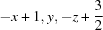 .
. Data collection: X-AREA (Stoe & Cie, 2008); cell refinement: X-AREA; data reduction: X-AREA; program(s) used to solve structure: SHELXS97 (Sheldrick, 2008); program(s) used to refine structure: SHELXL97 (Sheldrick, 2008); molecular graphics: XP in SHELXTL (Sheldrick, 2008) and DIAMOND (Brandenburg, 2011); software used to prepare material for publication: publCIF (Westrip, 2010).
Supporting information
contains datablocks I, global. DOI: https://doi.org/10.1107/S1600536812050623/wm2703sup1.cif
Structure factors: contains datablock I. DOI: https://doi.org/10.1107/S1600536812050623/wm2703Isup2.hkl
Barium thiocyanate trihydrate and 4-chloropyridine hydrochloride were purchased from Alfa Aesar, Ni(SO4)2.6H2O was obtained from Merck. Ni(NCS)2 was prepared by stirring Ba(NCS)2.3H2O (17.5 g, 56.9 mmol) and NiSO4.6H2O (15.0 g, 57 mmol) in water (500 mL). The white residue of BaSO4 was filtered off and the solution evaporated using a rotary evaporator. The of the product was investigated by X-ray powder diffraction. The title compound was prepared by the reaction of 26.2 mg Ni(NCS)2 (0.15 mmol) and 97.5 mg 4-chloropyridine hydrochloride (0.60 mmol) in 1.5 mL ethanol at 354 K in a closed 10 mL glas culture tube. After one day blue needles of the title compound were obtained. The formation of 4,4'-thiodipyridine starting from 4-chloropyridine in an SCN--containing environment and the presence of free Cl- and complex [NiCl4]2- anions seem to be a result of cleavage reactions of both the 4-chloropyridine and SCN- anions. However, the exact mechanism is unclear.
The aromatic H atoms (C- and N-bound) were located in a difference map but were positioned with idealized geometries and were refined isotropically with Uiso(H) = 1.2.Ueq(C,N) using a riding model approximation with C—H = 0.95 Å and N—H = 0.88 Å.
The title compound was prepared within a project on the synthesis and properties of transition metal thiocyanato coordination polymers (Boeckmann & Näther, 2010, 2011; Wöhlert et al., 2011). During our attempts to prepare a one-dimensional coordination polymer based on 4-chloropyridine as a co-ligand, crystals of the title compound, (C10H10N2S+)2[NiCl4]Cl2 (I), have been obtained accidentally and were characterized by single crystal X-ray diffraction.
In the of (I) the Ni2+ cation is coordinated by four chloride anions within a slightly distorted tetrahedral coordination environment. The complex [NiCl4]2- anions are surrounded by two 4,4'-sulfanediyldipyridinium cations and two chloride counter-anions (Fig. 1 and Table 1). Intermolecular N—H···Cl hydrogen bonding is found between the 4,4'-sulfanediyldipyridinium cations and the non-coordinating chloride anions, which leads to the formation of 20-membered rings (Fig. 2 and Table 2). These rings are stacked in the direction of the b axis.
The dihedral angle between the pyridine rings in the cations amounts to 52.57 (7) °. The corresponding bond lengths and angles are comparable to those in the neutral 4,4'-thiodipyridine molecule. Slight differences are found with respect to the dihedral angle between the pyridine rings which amounts to 65.4° in the neutral molecule (Vaganova et al., 2004).
For background information on this project, see: Boeckmann & Näther (2010, 2011); Wöhlert et al. (2011). For the of 4,4'-thiodipyridine, see: Vaganova et al. (2004).
Data collection: X-AREA (Stoe & Cie, 2008); cell X-AREA (Stoe & Cie, 2008); data reduction: X-AREA (Stoe & Cie, 2008); program(s) used to solve structure: SHELXS97 (Sheldrick, 2008); program(s) used to refine structure: SHELXL97 (Sheldrick, 2008); molecular graphics: XP in SHELXTL (Sheldrick, 2008) and DIAMOND (Brandenburg, 2011); software used to prepare material for publication: publCIF (Westrip, 2010).
![[Figure 1]](./wm2703fig1thm.gif) | Fig. 1. Crystal structure of the title compound with labelling and displacement ellipsoids drawn at the 50% probability level. [Symmetry code: i = -x+1, y, -z+3/2.] |
![[Figure 2]](./wm2703fig2thm.gif) | Fig. 2. Crystal structure of the title compound in a view along the b-axis. N—H···Cl hydrogen bonding is shown as dashed lines. |
| (C10H10N2S)2[NiCl4]Cl2 | F(000) = 1320 |
| Mr = 651.93 | Dx = 1.588 Mg m−3 |
| Monoclinic, C2/c | Mo Kα radiation, λ = 0.71073 Å |
| Hall symbol: -C 2yc | Cell parameters from 10707 reflections |
| a = 19.0497 (9) Å | θ = 2.3–27.9° |
| b = 8.0534 (5) Å | µ = 1.47 mm−1 |
| c = 17.7883 (11) Å | T = 200 K |
| β = 92.368 (6)° | Needle, blue |
| V = 2726.7 (3) Å3 | 0.32 × 0.13 × 0.07 mm |
| Z = 4 |
| Stoe IPDS-1 diffractometer | 3162 independent reflections |
| Radiation source: fine-focus sealed tube | 2308 reflections with I > 2σ(I) |
| Graphite monochromator | Rint = 0.062 |
| Phi scans | θmax = 27.9°, θmin = 2.3° |
| Absorption correction: numerical (X-SHAPE and X-RED32; Stoe & Cie, 2008) | h = −23→22 |
| Tmin = 0.789, Tmax = 0.899 | k = −10→10 |
| 10707 measured reflections | l = −23→23 |
| Refinement on F2 | Secondary atom site location: difference Fourier map |
| Least-squares matrix: full | Hydrogen site location: inferred from neighbouring sites |
| R[F2 > 2σ(F2)] = 0.037 | H-atom parameters constrained |
| wR(F2) = 0.084 | w = 1/[σ2(Fo2) + (0.0463P)2] where P = (Fo2 + 2Fc2)/3 |
| S = 0.99 | (Δ/σ)max = 0.001 |
| 3162 reflections | Δρmax = 0.47 e Å−3 |
| 151 parameters | Δρmin = −0.43 e Å−3 |
| 0 restraints | Extinction correction: SHELXL, Fc*=kFc[1+0.001xFc2λ3/sin(2θ)]-1/4 |
| Primary atom site location: structure-invariant direct methods | Extinction coefficient: 0.0013 (3) |
| (C10H10N2S)2[NiCl4]Cl2 | V = 2726.7 (3) Å3 |
| Mr = 651.93 | Z = 4 |
| Monoclinic, C2/c | Mo Kα radiation |
| a = 19.0497 (9) Å | µ = 1.47 mm−1 |
| b = 8.0534 (5) Å | T = 200 K |
| c = 17.7883 (11) Å | 0.32 × 0.13 × 0.07 mm |
| β = 92.368 (6)° |
| Stoe IPDS-1 diffractometer | 3162 independent reflections |
| Absorption correction: numerical (X-SHAPE and X-RED32; Stoe & Cie, 2008) | 2308 reflections with I > 2σ(I) |
| Tmin = 0.789, Tmax = 0.899 | Rint = 0.062 |
| 10707 measured reflections |
| R[F2 > 2σ(F2)] = 0.037 | 0 restraints |
| wR(F2) = 0.084 | H-atom parameters constrained |
| S = 0.99 | Δρmax = 0.47 e Å−3 |
| 3162 reflections | Δρmin = −0.43 e Å−3 |
| 151 parameters |
Geometry. All esds (except the esd in the dihedral angle between two l.s. planes) are estimated using the full covariance matrix. The cell esds are taken into account individually in the estimation of esds in distances, angles and torsion angles; correlations between esds in cell parameters are only used when they are defined by crystal symmetry. An approximate (isotropic) treatment of cell esds is used for estimating esds involving l.s. planes. |
Refinement. Refinement of F2 against ALL reflections. The weighted R-factor wR and goodness of fit S are based on F2, conventional R-factors R are based on F, with F set to zero for negative F2. The threshold expression of F2 > 2sigma(F2) is used only for calculating R-factors(gt) etc. and is not relevant to the choice of reflections for R-factors based on F2 are statistically about twice as large as those based on F, and R- factors based on ALL data will be even larger. |
| x | y | z | Uiso*/Ueq | ||
| Ni1 | 0.5000 | 0.66427 (5) | 0.7500 | 0.02527 (13) | |
| Cl1 | 0.59273 (4) | 0.81985 (9) | 0.71816 (4) | 0.0465 (2) | |
| Cl2 | 0.55194 (4) | 0.49082 (8) | 0.83619 (3) | 0.03563 (17) | |
| Cl3 | 0.75812 (4) | 0.08791 (10) | 0.90585 (4) | 0.04236 (19) | |
| N1 | 0.73877 (13) | 0.1738 (3) | 0.73764 (14) | 0.0425 (6) | |
| H1N1 | 0.7637 | 0.1582 | 0.7798 | 0.051* | |
| C1 | 0.76591 (16) | 0.1281 (4) | 0.67229 (18) | 0.0424 (7) | |
| H1 | 0.8121 | 0.0839 | 0.6718 | 0.051* | |
| C2 | 0.72674 (14) | 0.1451 (3) | 0.60598 (16) | 0.0366 (6) | |
| H2 | 0.7444 | 0.1073 | 0.5598 | 0.044* | |
| C3 | 0.66077 (14) | 0.2189 (3) | 0.60792 (14) | 0.0305 (5) | |
| C4 | 0.63496 (14) | 0.2699 (3) | 0.67604 (14) | 0.0319 (5) | |
| H4 | 0.5905 | 0.3227 | 0.6779 | 0.038* | |
| C5 | 0.67510 (14) | 0.2424 (3) | 0.74071 (15) | 0.0351 (6) | |
| H5 | 0.6575 | 0.2724 | 0.7880 | 0.042* | |
| S1 | 0.61640 (4) | 0.26112 (10) | 0.52047 (4) | 0.03808 (18) | |
| N2 | 0.38935 (13) | 0.1530 (3) | 0.55137 (14) | 0.0394 (5) | |
| H1N2 | 0.3443 | 0.1351 | 0.5570 | 0.047* | |
| C6 | 0.40903 (15) | 0.2520 (4) | 0.49540 (15) | 0.0383 (6) | |
| H6 | 0.3746 | 0.2986 | 0.4615 | 0.046* | |
| C7 | 0.47845 (14) | 0.2859 (3) | 0.48701 (14) | 0.0313 (5) | |
| H7 | 0.4926 | 0.3573 | 0.4479 | 0.038* | |
| C8 | 0.52829 (13) | 0.2148 (3) | 0.53643 (13) | 0.0262 (5) | |
| C9 | 0.50641 (14) | 0.1074 (3) | 0.59261 (14) | 0.0284 (5) | |
| H9 | 0.5398 | 0.0541 | 0.6257 | 0.034* | |
| C10 | 0.43635 (15) | 0.0807 (3) | 0.59898 (15) | 0.0357 (6) | |
| H10 | 0.4206 | 0.0100 | 0.6376 | 0.043* |
| U11 | U22 | U33 | U12 | U13 | U23 | |
| Ni1 | 0.0281 (3) | 0.0202 (2) | 0.0271 (2) | 0.000 | −0.00296 (16) | 0.000 |
| Cl1 | 0.0355 (4) | 0.0461 (4) | 0.0574 (4) | −0.0070 (3) | −0.0039 (3) | 0.0256 (3) |
| Cl2 | 0.0370 (4) | 0.0359 (3) | 0.0341 (3) | 0.0052 (3) | 0.0038 (2) | 0.0137 (3) |
| Cl3 | 0.0275 (4) | 0.0549 (4) | 0.0440 (4) | 0.0065 (3) | −0.0057 (3) | −0.0111 (3) |
| N1 | 0.0347 (15) | 0.0451 (13) | 0.0462 (14) | 0.0034 (11) | −0.0153 (10) | −0.0021 (11) |
| C1 | 0.0290 (17) | 0.0392 (16) | 0.0586 (19) | 0.0058 (11) | −0.0034 (12) | 0.0004 (13) |
| C2 | 0.0266 (15) | 0.0371 (15) | 0.0462 (15) | 0.0021 (11) | 0.0050 (10) | −0.0019 (12) |
| C3 | 0.0248 (14) | 0.0302 (12) | 0.0365 (13) | −0.0030 (9) | −0.0002 (9) | 0.0021 (10) |
| C4 | 0.0256 (14) | 0.0339 (13) | 0.0359 (13) | 0.0016 (10) | −0.0006 (9) | −0.0040 (10) |
| C5 | 0.0351 (16) | 0.0326 (13) | 0.0372 (14) | 0.0001 (11) | −0.0035 (10) | −0.0023 (11) |
| S1 | 0.0278 (4) | 0.0548 (4) | 0.0316 (3) | −0.0045 (3) | 0.0014 (2) | 0.0041 (3) |
| N2 | 0.0240 (13) | 0.0422 (13) | 0.0520 (14) | −0.0035 (10) | −0.0005 (9) | −0.0154 (11) |
| C6 | 0.0339 (16) | 0.0375 (14) | 0.0421 (15) | 0.0076 (12) | −0.0139 (11) | −0.0110 (12) |
| C7 | 0.0360 (16) | 0.0305 (13) | 0.0269 (12) | 0.0033 (10) | −0.0051 (9) | −0.0018 (9) |
| C8 | 0.0265 (13) | 0.0239 (11) | 0.0280 (11) | 0.0017 (9) | −0.0005 (9) | −0.0082 (9) |
| C9 | 0.0282 (14) | 0.0236 (11) | 0.0330 (12) | 0.0000 (9) | −0.0039 (9) | −0.0021 (9) |
| C10 | 0.0384 (17) | 0.0292 (13) | 0.0397 (14) | −0.0060 (11) | 0.0038 (11) | −0.0047 (11) |
| Ni1—Cl1 | 2.2569 (7) | C4—H4 | 0.9500 |
| Ni1—Cl1i | 2.2569 (7) | C5—H5 | 0.9500 |
| Ni1—Cl2i | 2.2706 (7) | S1—C8 | 1.754 (3) |
| Ni1—Cl2 | 2.2706 (6) | N2—C10 | 1.340 (4) |
| N1—C5 | 1.336 (4) | N2—C6 | 1.341 (4) |
| N1—C1 | 1.343 (4) | N2—H1N2 | 0.8800 |
| N1—H1N1 | 0.8800 | C6—C7 | 1.365 (4) |
| C1—C2 | 1.376 (4) | C6—H6 | 0.9500 |
| C1—H1 | 0.9500 | C7—C8 | 1.391 (3) |
| C2—C3 | 1.392 (4) | C7—H7 | 0.9500 |
| C2—H2 | 0.9500 | C8—C9 | 1.398 (3) |
| C3—C4 | 1.389 (4) | C9—C10 | 1.361 (4) |
| C3—S1 | 1.772 (3) | C9—H9 | 0.9500 |
| C4—C5 | 1.373 (4) | C10—H10 | 0.9500 |
| Cl1—Ni1—Cl1i | 112.56 (5) | N1—C5—H5 | 119.7 |
| Cl1—Ni1—Cl2i | 119.73 (3) | C4—C5—H5 | 119.7 |
| Cl1i—Ni1—Cl2i | 100.79 (2) | C8—S1—C3 | 104.00 (12) |
| Cl1—Ni1—Cl2 | 100.79 (2) | C10—N2—C6 | 121.9 (3) |
| Cl1i—Ni1—Cl2 | 119.73 (3) | C10—N2—H1N2 | 119.1 |
| Cl2i—Ni1—Cl2 | 104.07 (4) | C6—N2—H1N2 | 119.1 |
| C5—N1—C1 | 122.1 (2) | N2—C6—C7 | 120.1 (2) |
| C5—N1—H1N1 | 119.0 | N2—C6—H6 | 119.9 |
| C1—N1—H1N1 | 119.0 | C7—C6—H6 | 119.9 |
| N1—C1—C2 | 120.0 (3) | C6—C7—C8 | 119.2 (3) |
| N1—C1—H1 | 120.0 | C6—C7—H7 | 120.4 |
| C2—C1—H1 | 120.0 | C8—C7—H7 | 120.4 |
| C1—C2—C3 | 118.7 (3) | C7—C8—C9 | 119.4 (2) |
| C1—C2—H2 | 120.7 | C7—C8—S1 | 116.3 (2) |
| C3—C2—H2 | 120.7 | C9—C8—S1 | 124.26 (19) |
| C4—C3—C2 | 120.0 (2) | C10—C9—C8 | 118.6 (2) |
| C4—C3—S1 | 122.4 (2) | C10—C9—H9 | 120.7 |
| C2—C3—S1 | 117.3 (2) | C8—C9—H9 | 120.7 |
| C5—C4—C3 | 118.6 (3) | N2—C10—C9 | 120.7 (3) |
| C5—C4—H4 | 120.7 | N2—C10—H10 | 119.7 |
| C3—C4—H4 | 120.7 | C9—C10—H10 | 119.7 |
| N1—C5—C4 | 120.5 (3) |
| Symmetry code: (i) −x+1, y, −z+3/2. |
| D—H···A | D—H | H···A | D···A | D—H···A |
| N2—H1N2···Cl3i | 0.88 | 2.12 | 2.987 (3) | 168 |
| N1—H1N1···Cl3 | 0.88 | 2.32 | 3.078 (3) | 144 |
| Symmetry code: (i) −x+1, y, −z+3/2. |
Experimental details
| Crystal data | |
| Chemical formula | (C10H10N2S)2[NiCl4]Cl2 |
| Mr | 651.93 |
| Crystal system, space group | Monoclinic, C2/c |
| Temperature (K) | 200 |
| a, b, c (Å) | 19.0497 (9), 8.0534 (5), 17.7883 (11) |
| β (°) | 92.368 (6) |
| V (Å3) | 2726.7 (3) |
| Z | 4 |
| Radiation type | Mo Kα |
| µ (mm−1) | 1.47 |
| Crystal size (mm) | 0.32 × 0.13 × 0.07 |
| Data collection | |
| Diffractometer | Stoe IPDS1 |
| Absorption correction | Numerical (X-SHAPE and X-RED32; Stoe & Cie, 2008) |
| Tmin, Tmax | 0.789, 0.899 |
| No. of measured, independent and observed [I > 2σ(I)] reflections | 10707, 3162, 2308 |
| Rint | 0.062 |
| (sin θ/λ)max (Å−1) | 0.659 |
| Refinement | |
| R[F2 > 2σ(F2)], wR(F2), S | 0.037, 0.084, 0.99 |
| No. of reflections | 3162 |
| No. of parameters | 151 |
| H-atom treatment | H-atom parameters constrained |
| Δρmax, Δρmin (e Å−3) | 0.47, −0.43 |
Computer programs: X-AREA (Stoe & Cie, 2008), SHELXS97 (Sheldrick, 2008), SHELXL97 (Sheldrick, 2008), XP in SHELXTL (Sheldrick, 2008) and DIAMOND (Brandenburg, 2011), publCIF (Westrip, 2010).
| D—H···A | D—H | H···A | D···A | D—H···A |
| N2—H1N2···Cl3i | 0.88 | 2.12 | 2.987 (3) | 168.3 |
| N1—H1N1···Cl3 | 0.88 | 2.32 | 3.078 (3) | 144.4 |
| Symmetry code: (i) −x+1, y, −z+3/2. |
Acknowledgements
We gratefully acknowledge financial support by the DFG (project No. NA 720/3–1) and the State of Schleswig–Holstein. We thank Professor Dr Wolfgang Bensch for access to his experimental facilities.
References
 Boeckmann, J. & Näther, C. (2010). Dalton Trans. 39, 11019–11026. Web of Science CSD CrossRef CAS PubMed Google Scholar
Boeckmann, J. & Näther, C. (2011). Chem. Commun. 47, 7104–7106. Web of Science CSD CrossRef CAS Google Scholar
Brandenburg, K. (2011). DIAMOND. Crystal Impact GbR, Bonn, Germany. Google Scholar
Sheldrick, G. M. (2008). Acta Cryst. A64, 112–122. Web of Science CrossRef CAS IUCr Journals Google Scholar
Stoe & Cie (2008). X-AREA, X-RED32 and X-SHAPE. Stoe & Cie, Darmstadt, Germany. Google Scholar
Vaganova, E., Wachtel, E., Rozenberg, H., Khodorkovsky, V., Leitus, V., Shimon, L., Reich, S. & Yitzchaik, S. (2004). Chem. Mater. 16, 3976–3979. Web of Science CSD CrossRef CAS Google Scholar
Westrip, S. P. (2010). J. Appl. Cryst. 43, 920–925. Web of Science CrossRef CAS IUCr Journals Google Scholar
Wöhlert, S., Boeckmann, J., Wriedt, M. & Näther, C. (2011). Angew. Chem. Int. Ed. 50, 6920–6923. Google Scholar
This is an open-access article distributed under the terms of the Creative Commons Attribution (CC-BY) Licence, which permits unrestricted use, distribution, and reproduction in any medium, provided the original authors and source are cited.
| CRYSTALLOGRAPHIC COMMUNICATIONS |


The title compound was prepared within a project on the synthesis and properties of transition metal thiocyanato coordination polymers (Boeckmann & Näther, 2010, 2011; Wöhlert et al., 2011). During our attempts to prepare a one-dimensional coordination polymer based on 4-chloropyridine as a co-ligand, crystals of the title compound, (C10H10N2S+)2[NiCl4]Cl2 (I), have been obtained accidentally and were characterized by single crystal X-ray diffraction.
In the crystal structure of (I) the Ni2+ cation is coordinated by four chloride anions within a slightly distorted tetrahedral coordination environment. The complex [NiCl4]2- anions are surrounded by two 4,4'-sulfanediyldipyridinium cations and two chloride counter-anions (Fig. 1 and Table 1). Intermolecular N—H···Cl hydrogen bonding is found between the 4,4'-sulfanediyldipyridinium cations and the non-coordinating chloride anions, which leads to the formation of 20-membered rings (Fig. 2 and Table 2). These rings are stacked in the direction of the b axis.
The dihedral angle between the pyridine rings in the cations amounts to 52.57 (7) °. The corresponding bond lengths and angles are comparable to those in the neutral 4,4'-thiodipyridine molecule. Slight differences are found with respect to the dihedral angle between the pyridine rings which amounts to 65.4° in the neutral molecule (Vaganova et al., 2004).