Experimental
Crystal data
BaMg2Al2(PO4)3(OH)3 Mr = 576.77 Monoclinic, P 21 /m a = 8.9577 (4) Å b = 12.0150 (5) Å c = 4.9079 (2) Å β = 100.505 (2)° V = 519.37 (4) Å3 Z = 2 Mo Kα radiation μ = 4.72 mm−1 T = 293 K 0.09 × 0.09 × 0.08 mm
|
Data collection
Bruker APEXII CCD diffractometer Absorption correction: multi-scan (SADABS; Sheldrick, 2005![[Sheldrick, G. M. (2005). SADABS. University of Göttingen, Germany.]](../../../../../../logos/arrows/e_arr.gif "Sheldrick, G. M. (2005). SADABS. University of Göttingen, Germany.") ) Tmin = 0.676, Tmax = 0.704 ) Tmin = 0.676, Tmax = 0.704 7681 measured reflections 1970 independent reflections 1925 reflections with I > 2σ(I) Rint = 0.020
|
| Mg—O7i | 2.0591 (11) | | Mg—O1ii | 2.0864 (10) | | Mg—O2iii | 2.1227 (10) | | Mg—OH9iv | 2.1729 (11) | | Mg—O5v | 2.2090 (12) | | Al—O3vi | 1.8523 (11) | | Al—O6 | 1.9080 (11) | | Al—O5vii | 1.9287 (10) | | Al—OH9 | 1.9397 (11) | | Al—OH9viii | 1.9440 (11) | | Al—OH8 | 1.9477 (7) | | P1—O2 | 1.5232 (14) | | P1—O1 | 1.5278 (15) | | P1—O3 | 1.5321 (10) | | P1—O3ix | 1.5321 (10) | | P2—O4 | 1.5083 (11) | | P2—O7 | 1.5272 (11) | | P2—O6 | 1.5443 (11) | | P2—O5 | 1.5680 (10) | Symmetry codes: (i) 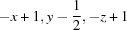 ; (ii) x, y-1, z-1; (iii) x, y-1, z; (iv) ; (ii) x, y-1, z-1; (iii) x, y-1, z; (iv)  ; (v) ; (v)  ; (vi) -x, -y+1, -z+1; (vii) x, y, z-1; (viii) -x, -y+1, -z; (ix) ; (vi) -x, -y+1, -z+1; (vii) x, y, z-1; (viii) -x, -y+1, -z; (ix)  . .
| |
| D—H⋯A | D—H | H⋯A | D⋯A | D—H⋯A | | OH8—H1⋯O6vii | 0.79 (4) | 2.66 (3) | 3.3180 (16) | 142 (1) | | OH9—H2⋯O3 | 0.78 (3) | 1.89 (3) | 2.6512 (13) | 166 (3) | Symmetry code: (vii) x, y, z-1.
| |
Data collection: APEX2 (Bruker, 2004); cell refinement: SAINT (Bruker, 2004); data reduction: SAINT; program(s) used to solve structure: SHELXS97 (Sheldrick, 2008); program(s) used to refine structure: SHELXL97 (Sheldrick, 2008); molecular graphics: XtalDraw (Downs & Hall-Wallace, 2003); software used to prepare material for publication: publCIF (Westrip, 2010).
Supporting information
The penikisite crystal used in this study is from the type locality, 16 miles north of the Hess River, Mayo Mining District, Yukon Territory, Canada and is in the collection of the RRUFF project (http://rruff.info/R060160), donated by Mark Mauthner. Its chemistry was determined with a CAMECA SX50 electron microprobe (8 analysis points), yielding the empirical chemical formula, calculated on the basis of 13.5 O atoms, Ba1.00(Mg1.97Mn0.03)Σ=2Al2.00(P1.00O4)3(OH)3 (OH was estimated by charge balance and difference).
The H atoms were located from difference Fourier syntheses and their positions refined freely with a fixed isotropic displacement (Uiso = 0.03). The highest residual peak in the difference Fourier maps was located at (0.4023, 0.2932, 0.2033), 0.71 Å from Ba, and the deepest hole at (0.5192, 1/4, 0.3234), 0.63 Å from Ba.
Data collection: APEX2 (Bruker, 2004); cell refinement: SAINT (Bruker, 2004); data reduction: SAINT (Bruker, 2004); program(s) used to solve structure: SHELXS97 (Sheldrick, 2008); program(s) used to refine structure: SHELXL97 (Sheldrick, 2008); molecular graphics: XtalDraw (Downs & Hall-Wallace, 2003); software used to prepare material for publication: publCIF (Westrip, 2010).
Barium dimagnesium dialuminium triphosphate trihydroxide
top Crystal data top | Al4H6Mg3.94Mn0.06O30P6·2(Ba) | F(000) = 549 |
| Mr = 576.77 | nearly cube |
| Monoclinic, P121/m1 | Dx = 3.688 Mg m−3 |
| Hall symbol: -P 2yb | Mo Kα radiation, λ = 0.71073 Å |
| a = 8.9577 (4) Å | Cell parameters from 6030 reflections |
| b = 12.0150 (5) Å | θ = 2.9–32.6° |
| c = 4.9079 (2) Å | µ = 4.72 mm−1 |
| β = 100.505 (2)° | T = 293 K |
| V = 519.37 (4) Å3 | Cube, green |
| Z = 2 | 0.09 × 0.09 × 0.08 mm |
Data collection top Bruker APEXII CCD
diffractometer | 1970 independent reflections |
| Radiation source: fine-focus sealed tube | 1925 reflections with I > 2σ(I) |
| Graphite monochromator | Rint = 0.020 |
| ϕ and ω scan | θmax = 32.6°, θmin = 2.9° |
Absorption correction: multi-scan
(SADABS; Sheldrick 2005) | h = −13→12 |
| Tmin = 0.676, Tmax = 0.704 | k = −15→18 |
| 7681 measured reflections | l = −7→7 |
Refinement top | Refinement on F2 | Secondary atom site location: difference Fourier map |
| Least-squares matrix: full | Hydrogen site location: difference Fourier map |
| R[F2 > 2σ(F2)] = 0.015 | All H-atom parameters refined |
| wR(F2) = 0.039 | w = 1/[σ2(Fo2) + (0.020P)2 + 0.2753P]
where P = (Fo2 + 2Fc2)/3 |
| S = 1.14 | (Δ/σ)max = 0.001 |
| 1970 reflections | Δρmax = 0.72 e Å−3 |
| 119 parameters | Δρmin = −0.80 e Å−3 |
| 1 restraint | Extinction correction: SHELXL, Fc*=kFc[1+0.001xFc2λ3/sin(2θ)]-1/4 |
| Primary atom site location: structure-invariant direct methods | Extinction coefficient: 0.0021 (5) |
Crystal data top | Al4H6Mg3.94Mn0.06O30P6·2(Ba) | V = 519.37 (4) Å3 |
| Mr = 576.77 | Z = 2 |
| Monoclinic, P121/m1 | Mo Kα radiation |
| a = 8.9577 (4) Å | µ = 4.72 mm−1 |
| b = 12.0150 (5) Å | T = 293 K |
| c = 4.9079 (2) Å | 0.09 × 0.09 × 0.08 mm |
| β = 100.505 (2)° | |
Data collection top Bruker APEXII CCD
diffractometer | 1970 independent reflections |
Absorption correction: multi-scan
(SADABS; Sheldrick 2005) | 1925 reflections with I > 2σ(I) |
| Tmin = 0.676, Tmax = 0.704 | Rint = 0.020 |
| 7681 measured reflections | |
Refinement top | R[F2 > 2σ(F2)] = 0.015 | 1 restraint |
| wR(F2) = 0.039 | All H-atom parameters refined |
| S = 1.14 | Δρmax = 0.72 e Å−3 |
| 1970 reflections | Δρmin = −0.80 e Å−3 |
| 119 parameters | |
Special details top Geometry. All e.s.d.'s (except the e.s.d. in the dihedral angle between two l.s. planes) are estimated using the full covariance matrix. The cell e.s.d.'s are taken into account individually in the estimation of e.s.d.'s in distances, angles and torsion angles; correlations between e.s.d.'s in cell parameters are only used when they are defined by crystal symmetry. An approximate (isotropic) treatment of cell e.s.d.'s is used for estimating e.s.d.'s involving l.s. planes. |
Refinement. Refinement of F2 against ALL reflections. The weighted R-factor wR and goodness of fit S are based on F2, conventional R-factors R are based on F, with F set to zero for negative F2. The threshold expression of F2 > σ(F2) is used only for calculating R-factors(gt) etc. and is not relevant to the choice of reflections for refinement. R-factors based on F2 are statistically about twice as large as those based on F, and R- factors based on ALL data will be even larger. |
Fractional atomic coordinates and isotropic or equivalent isotropic displacement parameters (Å2) top| | x | y | z | Uiso*/Ueq | Occ. (<1) |
| Ba | 0.547869 (12) | 0.7500 | 0.74171 (2) | 0.00734 (5) | |
| Mg | 0.29439 (5) | −0.11139 (4) | 0.20677 (10) | 0.00705 (9) | 0.9850 (1) |
| Mn | 0.29439 (5) | −0.11139 (4) | 0.20677 (10) | 0.00705 (9) | 0.0150 (1) |
| Al | 0.09176 (4) | 0.40084 (3) | 0.12947 (8) | 0.00401 (8) | |
| P1 | 0.15736 (6) | 0.7500 | 0.68481 (10) | 0.00467 (9) | |
| P2 | 0.33413 (4) | 0.44282 (3) | 0.70566 (7) | 0.00495 (7) | |
| O1 | 0.27909 (16) | 0.7500 | 0.9471 (3) | 0.0072 (2) | |
| O2 | 0.23251 (16) | 0.7500 | 0.4303 (3) | 0.0068 (2) | |
| O3 | 0.05983 (11) | 0.64525 (9) | 0.6850 (2) | 0.00791 (18) | |
| O4 | 0.36649 (12) | 0.55738 (9) | 0.6050 (2) | 0.00846 (18) | |
| O5 | 0.25965 (11) | 0.45434 (9) | 0.9697 (2) | 0.00811 (18) | |
| O6 | 0.22678 (12) | 0.38012 (9) | 0.4741 (2) | 0.00917 (18) | |
| O7 | 0.47653 (12) | 0.37189 (9) | 0.7901 (2) | 0.00821 (18) | |
| OH8 | 0.12478 (17) | 0.2500 | 0.0077 (3) | 0.0083 (3) | |
| OH9 | 0.06100 (12) | 0.55814 (9) | 0.1891 (2) | 0.00679 (17) | |
| H1 | 0.137 (4) | 0.2500 | −0.147 (8) | 0.030* | |
| H2 | 0.046 (3) | 0.585 (2) | 0.325 (5) | 0.030* | |
Atomic displacement parameters (Å2) top| | U11 | U22 | U33 | U12 | U13 | U23 |
| Ba | 0.00667 (6) | 0.00826 (7) | 0.00724 (6) | 0.000 | 0.00171 (4) | 0.000 |
| Mg | 0.0069 (2) | 0.0070 (2) | 0.00715 (19) | 0.00042 (16) | 0.00119 (16) | −0.00064 (16) |
| Mn | 0.0069 (2) | 0.0070 (2) | 0.00715 (19) | 0.00042 (16) | 0.00119 (16) | −0.00064 (16) |
| Al | 0.00373 (17) | 0.00395 (17) | 0.00440 (16) | −0.00027 (13) | 0.00091 (13) | 0.00002 (13) |
| P1 | 0.00489 (19) | 0.0050 (2) | 0.00428 (18) | 0.000 | 0.00138 (15) | 0.000 |
| P2 | 0.00499 (14) | 0.00536 (15) | 0.00459 (14) | 0.00024 (11) | 0.00113 (11) | 0.00027 (10) |
| O1 | 0.0072 (6) | 0.0085 (6) | 0.0055 (6) | 0.000 | 0.0001 (5) | 0.000 |
| O2 | 0.0088 (6) | 0.0061 (6) | 0.0062 (6) | 0.000 | 0.0036 (5) | 0.000 |
| O3 | 0.0082 (4) | 0.0069 (4) | 0.0095 (4) | −0.0029 (3) | 0.0040 (3) | −0.0015 (3) |
| O4 | 0.0101 (4) | 0.0070 (4) | 0.0083 (4) | −0.0001 (3) | 0.0018 (3) | 0.0023 (3) |
| O5 | 0.0084 (4) | 0.0102 (5) | 0.0067 (4) | −0.0008 (4) | 0.0037 (3) | −0.0006 (3) |
| O6 | 0.0093 (4) | 0.0100 (5) | 0.0073 (4) | −0.0002 (4) | −0.0008 (3) | −0.0015 (3) |
| O7 | 0.0058 (4) | 0.0087 (5) | 0.0102 (4) | 0.0021 (3) | 0.0018 (3) | 0.0020 (3) |
| OH8 | 0.0110 (6) | 0.0071 (6) | 0.0071 (6) | 0.000 | 0.0027 (5) | 0.000 |
| OH9 | 0.0078 (4) | 0.0076 (4) | 0.0049 (4) | −0.0001 (3) | 0.0012 (3) | −0.0016 (3) |
Geometric parameters (Å, º) top | Ba—O7i | 2.7669 (10) | Mg—O5x | 2.2090 (12) |
| Ba—O7ii | 2.7669 (10) | Al—O3xi | 1.8523 (11) |
| Ba—O1 | 2.7744 (14) | Al—O6 | 1.9080 (11) |
| Ba—O4 | 2.8370 (11) | Al—O5xii | 1.9287 (10) |
| Ba—O4iii | 2.8370 (11) | Al—OH9 | 1.9397 (11) |
| Ba—O6iv | 2.9019 (11) | Al—OH9xiii | 1.9440 (11) |
| Ba—O6v | 2.9019 (10) | Al—OH8 | 1.9477 (7) |
| Ba—O2 | 2.9566 (15) | P1—O2 | 1.5232 (14) |
| Ba—OH8v | 2.9658 (15) | P1—O1 | 1.5278 (15) |
| Ba—O7v | 2.9661 (10) | P1—O3 | 1.5321 (10) |
| Ba—O7iv | 2.9661 (10) | P1—O3iii | 1.5321 (10) |
| Mg—O4vi | 2.0490 (11) | P2—O4 | 1.5083 (11) |
| Mg—O7vii | 2.0591 (11) | P2—O7 | 1.5272 (11) |
| Mg—O1viii | 2.0864 (10) | P2—O6 | 1.5443 (11) |
| Mg—O2ix | 2.1227 (10) | P2—O5 | 1.5680 (10) |
| Mg—OH9vi | 2.1729 (11) | | |
| | | |
| O4vi—Mg—O7vii | 83.31 (4) | O3xi—Al—OH9xiii | 89.97 (5) |
| O4vi—Mg—O1viii | 144.07 (5) | O6—Al—OH9xiii | 170.24 (5) |
| O7vii—Mg—O1viii | 83.17 (5) | O5xii—Al—OH9xiii | 94.31 (5) |
| O4vi—Mg—O2ix | 79.75 (5) | OH9—Al—OH9xiii | 77.04 (5) |
| O7vii—Mg—O2ix | 105.87 (5) | O3xi—Al—OH8 | 92.21 (5) |
| O1viii—Mg—O2ix | 72.26 (5) | O6—Al—OH8 | 92.49 (6) |
| O4vi—Mg—OH9vi | 94.50 (4) | O5xii—Al—OH8 | 90.69 (5) |
| O7vii—Mg—OH9vi | 168.32 (5) | OH9—Al—OH8 | 170.59 (5) |
| O1viii—Mg—OH9vi | 104.78 (5) | OH9xiii—Al—OH8 | 96.50 (6) |
| O2ix—Mg—OH9vi | 84.93 (5) | O2—P1—O1 | 109.67 (8) |
| O4vi—Mg—O5x | 102.80 (5) | O2—P1—O3 | 109.74 (5) |
| O7vii—Mg—O5x | 97.57 (4) | O1—P1—O3 | 108.60 (5) |
| O1viii—Mg—O5x | 111.89 (4) | O2—P1—O3iii | 109.74 (5) |
| O2ix—Mg—O5x | 156.55 (5) | O1—P1—O3iii | 108.60 (5) |
| OH9vi—Mg—O5x | 71.65 (4) | O3—P1—O3iii | 110.46 (8) |
| O3xi—Al—O6 | 85.88 (5) | O4—P2—O7 | 113.41 (6) |
| O3xi—Al—O5xii | 174.52 (5) | O4—P2—O6 | 109.59 (6) |
| O6—Al—O5xii | 89.36 (5) | O7—P2—O6 | 107.74 (6) |
| O3xi—Al—OH9 | 94.60 (5) | O4—P2—O5 | 109.04 (6) |
| O6—Al—OH9 | 94.47 (5) | O7—P2—O5 | 106.57 (6) |
| O5xii—Al—OH9 | 83.07 (5) | O6—P2—O5 | 110.45 (6) |
| Symmetry codes: (i) −x+1, y+1/2, −z+2; (ii) −x+1, −y+1, −z+2; (iii) x, −y+3/2, z; (iv) −x+1, y+1/2, −z+1; (v) −x+1, −y+1, −z+1; (vi) x, −y+1/2, z; (vii) −x+1, y−1/2, −z+1; (viii) x, y−1, z−1; (ix) x, y−1, z; (x) x, −y+1/2, z−1; (xi) −x, −y+1, −z+1; (xii) x, y, z−1; (xiii) −x, −y+1, −z. |
Hydrogen-bond geometry (Å, º) top | D—H···A | D—H | H···A | D···A | D—H···A |
| OH8—H1···O6xii | 0.79 (4) | 2.66 (3) | 3.3180 (16) | 142 (1) |
| OH9—H2···O3 | 0.78 (3) | 1.89 (3) | 2.6512 (13) | 166 (3) |
| Symmetry code: (xii) x, y, z−1. |
Experimental details
| Crystal data |
| Chemical formula | Al4H6Mg3.94Mn0.06O30P6·2(Ba) |
| Mr | 576.77 |
| Crystal system, space group | Monoclinic, P121/m1 |
| Temperature (K) | 293 |
| a, b, c (Å) | 8.9577 (4), 12.0150 (5), 4.9079 (2) |
| β (°) | 100.505 (2) |
| V (Å3) | 519.37 (4) |
| Z | 2 |
| Radiation type | Mo Kα |
| µ (mm−1) | 4.72 |
| Crystal size (mm) | 0.09 × 0.09 × 0.08 |
| |
| Data collection |
| Diffractometer | Bruker APEXII CCD
diffractometer |
| Absorption correction | Multi-scan
(SADABS; Sheldrick 2005) |
| Tmin, Tmax | 0.676, 0.704 |
No. of measured, independent and
observed [I > 2σ(I)] reflections | 7681, 1970, 1925 |
| Rint | 0.020 |
| (sin θ/λ)max (Å−1) | 0.757 |
| |
| Refinement |
| R[F2 > 2σ(F2)], wR(F2), S | 0.015, 0.039, 1.14 |
| No. of reflections | 1970 |
| No. of parameters | 119 |
| No. of restraints | 1 |
| H-atom treatment | All H-atom parameters refined |
| Δρmax, Δρmin (e Å−3) | 0.72, −0.80 |
Selected bond lengths (Å) top| Mg—O7i | 2.0591 (11) | Al—OH8 | 1.9477 (7) |
| Mg—O1ii | 2.0864 (10) | P1—O2 | 1.5232 (14) |
| Mg—O2iii | 2.1227 (10) | P1—O1 | 1.5278 (15) |
| Mg—OH9iv | 2.1729 (11) | P1—O3 | 1.5321 (10) |
| Mg—O5v | 2.2090 (12) | P1—O3ix | 1.5321 (10) |
| Al—O3vi | 1.8523 (11) | P2—O4 | 1.5083 (11) |
| Al—O6 | 1.9080 (11) | P2—O7 | 1.5272 (11) |
| Al—O5vii | 1.9287 (10) | P2—O6 | 1.5443 (11) |
| Al—OH9 | 1.9397 (11) | P2—O5 | 1.5680 (10) |
| Al—OH9viii | 1.9440 (11) | | |
| Symmetry codes: (i) −x+1, y−1/2, −z+1; (ii) x, y−1, z−1; (iii) x, y−1, z; (iv) x, −y+1/2, z; (v) x, −y+1/2, z−1; (vi) −x, −y+1, −z+1; (vii) x, y, z−1; (viii) −x, −y+1, −z; (ix) x, −y+3/2, z. |
Hydrogen-bond geometry (Å, º) top | D—H···A | D—H | H···A | D···A | D—H···A |
| OH8—H1···O6vii | 0.79 (4) | 2.66 (3) | 3.3180 (16) | 141.9 (12) |
| OH9—H2···O3 | 0.78 (3) | 1.89 (3) | 2.6512 (13) | 166 (3) |
| Symmetry code: (vii) x, y, z−1. |
Acknowledgements
The authors gratefully acknowledge support of this study by the Science Foundation Arizona.
References
 Bruker (2004). APEX2 and SAINT. Bruker AXS Inc., Madison, Wisconsin, USA. Google Scholar
Cooper, M. & Hawthorne, F. C. (1994). Can. Mineral. 32, 15–19. CAS Google Scholar
Downs, R. T. & Hall-Wallace, M. (2003). Am. Mineral. 88, 247–250. CAS Google Scholar
Elliott, P. & Willis, A. C. (2011). Mineral. Mag. 75, 317–325. Web of Science CrossRef CAS Google Scholar
Kolitsch, U., Pring, A. & Tiekink, E. R. T. (2000). Mineral. Petrol. 70, 1–14. Web of Science CrossRef CAS Google Scholar
Mandarino, J. A., Sturman, B. D. & Corlett, M. I. (1977). Can. Mineral. 15, 393–395. Google Scholar
Moore, P. B. & Araki, T. (1974). Am. Mineral. 59, 567–572. CAS Google Scholar
Robinson, K., Gibbs, G. V. & Ribbe, P. H. (1971). Science, 172, 567–570. CrossRef PubMed CAS Web of Science Google Scholar
Sheldrick, G. M. (2005). SADABS. University of Göttingen, Germany. Google Scholar
Sheldrick, G. M. (2008). Acta Cryst. A64, 112–122. Web of Science CrossRef CAS IUCr Journals Google Scholar
Westrip, S. P. (2010). J. Appl. Cryst. 43, 920–925. Web of Science CrossRef CAS IUCr Journals Google Scholar
This is an open-access article distributed under the terms of the Creative Commons Attribution (CC-BY) Licence, which permits unrestricted use, distribution, and reproduction in any medium, provided the original authors and source are cited.
 | CRYSTALLOGRAPHIC
COMMUNICATIONS |
ISSN: 2056-9890
Open

access


 journal menu



![[Figure 1]](./hb7009fig1thm.gif)
![[Figure 2]](./hb7009fig2thm.gif)


The bjarebyite group of minerals is characterized by the general chemical formula BaX2Y2(PO4)3(OH)3, where X=Mn2+, Fe2+ or Mg and Y=Al or Fe3+, and includes five members: bjarebyite BaMn2+2Al2(PO4)3(OH)3, johntomaite BaFe2+2Fe3+2(PO4)3(OH)3, kulanite BaFe2+2Al2(PO4)3(OH)3, penikisite BaMg2Al2(PO4)3(OH)3, and perloffite BaMn2+2Fe3+2(PO4)3(OH)3. Except for penikisite, the crystal structures of all other minerals in the group have been determined (Moore and Araki, 1974; Cooper and Hawthorne, 1994; Kolitsch et al., 2000; Elliot & Willis, 2011), which all possess space group P21/m. Penikisite was first described by Mandarino et al. (1977) as triclinic with space group P1 or P1 (albeit strongly pseudomonoclinic), based on the observation of asymmetric optical dispersion. Since then, no detailed crystallographic study on penikisite has been reported. In our efforts to understand the hydrogen bonding environments in minerals, we conducted a structure determination of penikisite from the type locality by means of single-crystal X-ray diffraction.
Penikisite is isotypic with other members of the bjarebyite group, with space group P21/m. Its structure consists of edge-shared [AlO3(OH)3] octahedral dimers connected via corners to form chains along [010]. These chains are decorated with PO4 tetrahedra and linked along [100] via edge-shared MgO5(OH) octahedral dimers and eleven-coordinated Ba atoms to form a complex three-dimensional network (Figs. 1 and 2). The hydrogen bonding provides additional linkage between chains.
Similar to other minerals in the bjarebyite group, the YO5(OH) octahedra in penikisite are noticeably distorted, as measured by the octahedral angle variance (OAV) and quadratic elongation (OQE) (Robinson et al., 1971), which are 188 and 1.057, respectively. In contrast, the OAV and OQE values are 32 and 1.010 for the XO3(OH)3 octahedra in penikisite. From penikisite to the Fe-analogue kulanite (Cooper and Hawthorne, 1994), and to the Mn-analogue bjarebyite (Moore and Araki, 1974), the average X-O distance increases from 2.117 to 2.146, and to 2.162 Å, respectively, in accordance with the increase in the ionic radius in this site.
There are two hydrogen bonds in penikisite, one between OH8 and O6 [3.318 (2) Å] and the other between OH9 and O3 [2.651 (1) Å], agreeing well with the results obtained by Elliott & Willis (2011) from perloffite. However, Cooper and Hawthorne (1994) proposed a disorder model for H1 in kulanite. The H atoms were not located in the structure of bjarebyite (Moore and Araki, 1974) or johntomaite (Kolitsch et al., 2000).