 | Acta Crystallographica Section B Acta Crystallographica Section B STRUCTURAL SCIENCE, CRYSTAL ENGINEERING AND MATERIALS |


 journal menu


research papers
| STRUCTURAL SCIENCE CRYSTAL ENGINEERING MATERIALS |
 access
SARAh – web representational analysis

aDepartment of Chemistry, University College London (UCL), 20 Gordon Street, London, WC1H 0AJ, England
*Correspondence e-mail: [email protected]
This article is part of a focused issue on Magnetic Structures.
The online software server SARAh–webRepresentational Analysis is introduced. It replaces the previous Windows-versions of SARAh–Representational analysis and SARAh–Refine, and related theory. The new suite of web apps carries out a range representational analysis calculations, including those based on the works of Kovalev, Bertaut, Izyumov, Bradley, Cracknell, Birman and Landau, for magnetic structures and electronic properties within frameworks based on the crystallographic space groups and point groups. Irreducible representations are sourced from the works of Kovalev, tabulated and computations are carried out on a server using Mathematica.
1. Introduction
While the use of representation theory was well established for the calculation of physical properties of atomic systems (Eckart, 1930 ) and crystals (Bouckaert et al., 1936), such as the splitting and degeneracies of energy levels in materials with normal groups and black and white groups, it was the work of Kovalev (1963, 1964) and Bertaut (1968, 1971) that pioneered the use of basis vectors calculated by representation theory for the description of magnetic structures. Despite the subsequent successes of representation theory in describing and analysing magnetic structures, a gap existed between software that could perform representational analysis calculations, most notably MODY for DOS (Sikora, 1994), and magnetic neutron diffraction refinement codes which largely followed a crystallographic approach to magnetic structures, such as in GSAS (Larson & Von Dreele, 1986) where the relationships between the magnetic moments had to be defined in symmetry operations as either black or white, to encode the colour permutation of the (Shubnikov) magnetic space groups (MSGs). While FullProf (Rodríguez-Carvajal, 1993) had incorporated various descriptions for commensurate and incommensurate structures, such as using rotation matrices, integration of representational theory directly into its refinements was to come later (Rodriguez-Carvajal, 2005). The typical situation resembled that of the 1970s (Izyumov & Ozerov, 1970) where refinement of a magnetic structure required a time consuming trial and error process of entering the symmetry constraints for each magnetic moment and testing against experimental data.
The original release of SARAh—Representational Analysis and SARAh—Refine (Wills, 2000) performed the calculations of Representational Analysis using irreducible representations calculated with a Visual Basic 6 translation of KAREP (Hovestreydt et al., 1992) and then projected basis vectors following the methods of Bertaut and Izyumov. The results were integrated with the Rietveld analysis program GSAS using SARAh—Refine. Rather than refining magnetic moments directly, SARAh1 introduced a new protocol where the mixing coefficients of the basis vectors were used as refinement variables and applied global minimization algorithms based on Monte Carlo and Simulated Annealing methods1. This change away from conventional least-squares minimization combined with the typical reduction in the number of refined variables that came from representation theory, to allow the creation of maps of χ2 against refinement parameters as a window to explore the refinement's modelling (Wills, 2001). The functionality in SARAh then increased by incorporation of the computer files of loaded representations from Kovalev's tables as a source of irreducible representations (the 2K version); integration with the subsequent inclusion of basis vectors into FullProf (Rodriguez-Carvajal, 2005), and later Topas (Coelho, 2018). Routines were also developed to determine the values of k vectors by Monte Carlo refinement of equal magnitude magnetic moments, without further symmetry constraint, for the various characteristic k vectors of the Brillouin zone, a method named `Brillouin zone indexing' (Wills, 2009). SARAh's development moved in 2018 to a web system and a new software framework based on Mathematica (Wolfram Research, 2024).
Underlying the development and application of SARAh was the goal of linking the results of representation theory with refinements, and commonly used codes such as GSAS and FullProf. The web version of SARAh seeks not only to reproduce the original functionality; it seeks to extend it by collating a range of symmetry tools within a series of coherent workflows. An area that will be covered in a later report is the recent development of the SERENDIPITY protocol (Georgopoulou et al., 2023), which can determine stability conditions for an observed magnetic structure.
2. Software
The calculations in SARAh are carried out on a local server using Mathematica. The web interface takes in user data, performs the relevant calculation and then returns the output for display. This is preferred over the application of a database for flexibility and future development, but user requests do take longer because of the computational overheads. There are no separate programmes as part of SARAh. Instead, web apps are formed that direct and integrate the flow of various routines towards tailored goals and these flows will be a particular feature of the development. SARAh—webRepresentational analysis is freely available at: http://fermat.chem.ucl.ac.uk/spaces/willsgroup/
3. Application of Kovalev's tables
This section introduces the main tables that are available in the English versions of Kovalev's published tables (Kovalev, 1965; Kovalev, 1993) and via SARAh, though it should be noted that Kovalev's initial collection of Irreducible Representations of the Space Groups was published earlier in Russian (Kovalev, 1961). The current calculations are focused on the commonly found situation where there is a single k vector and full-group method has not yet been integrated. The tables do contain more information than presented here and in future developments more data will be presented.
3.1. Irreducible representations of the little group G(k)
For each Bravais lattice, Kovalev's tables list a set of characteristic vectors2, k, within the first Brillouin zone (BZ). Taking G to be a crystallographic space group with symmetry operations g = {h ∣ t}, where g involves a (proper or improper) rotation h and a subsequent translation t, the set of all the rotation operations h form the point group  . Application of to k transforms the vector into a number of vectors in reciprocal space with equal modulus. The set of operations
  with matrices Rh that leave k invariant within a reciprocal lattice translation K:

form a subgroup  of the point group that is termed the point group of k, the little-point group of k or the little co-group of k (Aroyo & Wondratschek, 1995). As this point group is defined up to an equivalence in k, it may contain more operations than the isotropy group of k (Tolédano & Tolédano, 1987), which consists of those operations that leave k unchanged and the two constructions should be differentiated. The set of k vectors, distinct up to the equivalence equation, generated by application of to k forms the star of the propagation vector:

The subgroup of G consisting of elements,  , whose rotation parts leave k unchanged or invariant up to this equivalence, forms the little group of the vector k, denoted as G(k). This subgroup is fundamental to the application of group theory to problems in condensed matter physics, including the description and analysis of magnetic structures. As the irreducible representations of G(k) depend on the numerical value of k, some attempts at tabulations made in the literature are quite voluminous, for example the tables of Miller & Love (1967). In a remarkable tour de force to reduce such tables to a core, Kovalev (1961) instead took advantage of a construction developed by Lyubarskii (1960) and presented the matrix representatives of the so-called weighted or loaded representations,
  of that are used to construct the small irreducible representations τkp(g) of G(k) according to the equation:

Here the index p labels the irreducible representations. In applying equation (3), the loaded irreducible representations have the necessary mapping with the rotations of but for non-symmorphic groups are not the irreducible representations of the point group themselves. Where the space group operations used in Kovalev's tables do not match the cell choice and settings currently used in International Tables Volume A (International Tables for Crystallography, 2005), transformations of the symmetry operations and k vector are performed by SARAh to enable their use. Tables of the irreducible representations of these groups G(k) are presented following a labelling scheme exemplified by `k3t2',where `k3' is Kovalev's index for the k vector type and `t2' is the IR label. When working with magnetism and the simple groups, this label should be extended to `mk3t2', where the prefix m indicates that magnetic structures break time-reversal symmetry. In his tables, Kovalev refers to groups whose elements correspond to geometric rotations or operations as 'simple groups'3 to differentiate them from double groups where they are matrix rotations.
When working with the irreducible representations of the space groups, it should be noted that the tables from other sources, most commonly those based on Miller & Love (1967), such as available through the Bilbao Crystallography Server (Aroyo et al., 2006) and Isotropy (Stokes et al., 2007), may not feature identical irreducible representations as the space-group settings, symmetry operations and canonical k vectors may differ.
3.2. Irreducible corepresentations of the little group G(k, θk)
Antiunitary symmetry was integrated with representation theory by Wigner (1959) to introduce invariance with respect to the time-reversal t → −t, or, as he thought more appropriate, `reversal of the direction of motion'. The application of the time-reversal operation, θ, brings together stationary states Ψ and θΨ that have the same energy in quantum mechanics. Its applicability to classical physical systems or to spinless quantum theory comes via the operation of complex conjugation, i.e. θ = K.
Using D to signify a corepresentation, Wigner's work leads to an algebra that follows from the properties of the unitary (g) and antiunitary (a) operations:

The importance of complex conjugate in the above equations led Wigner to name these extensions `corepresentations'. Within the application of representational theory to magnetic structures, these corepresentations are used with the direct product of the crystal space group G or point group with the group {E, θ}. A similar direct product of the crystal space group with {E, R} is used to form the grey magnetic space groups, though there time-reversal is the linear operation of moment reversal R = 1′. This shared construction shows that the M(k) = {E, θ} ⊗ G is a form of space–time symmetry group (Birman, 1984), though one that is over an antiunitary group. Kovalev termed such antiunitary groups `neutral groups', following the language of colour symmetry (Senechal, 1983) and to distinguish them from MSGs. Unitary operations appear in corepresentations as a unitary subgroup, which has allowed a shortcut whereby some common properties may be determined without calculation of the corepresentations themselves, explaining the utility and importance of the irreducible representations of G(k).
In Kovalev (1993), a process was laid out for the construction of the irreducible corepresentations of G(k, θk) from irreducible representations of the unitary subgroup G(k) according to two variations.
Variation I. When −k is not a member of {k} the corepresentations are of type c and are over the neutral group M(k) = G + θG. Taking the unitary and antiunitary operations as g and a = θg, respectively, the matrix representatives of the corepresentation are constructed from irreducible representation, Δ, and have the form:
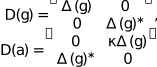
where for simple groups κ = 1 and for double groups κ = −1 (Section 3.3).
Variation II. When −k is a member of {k}, the corepresentation is over the group M(k) = G(k, a0) = G(k) + a0G(k). Here, a0 is an antiunitary generating element that plays two roles in the form of the irreducible corepresentations. It acts in Variation II to extend the group to include the antiunitary operations and is involved in relating the matrix representative of the antiunitary operation to that of a member of the unitary irreducible representation. This is particularly important in magnetic structures where time-reversal links orbits of atomic positions that are equivalent under G but are separated in G(k). Through the given equations, its choice also defines the value of the auxiliary matrix β where relevant. The matrices for the unitary and antiunitary operations are given for three possible situations:
Type a. These contain only one irreducible representation, Δ.

where β satisfies  and
and  .
.
Type b. This involves the same irreducible representation of the unitary subgroup, Δ, twice:

with  and .
and .
Type c. Here two irreducible representations, Δ and  , that are not equivalent combine to form an irreducible corepresentation.

In these, β is an auxiliary matrix which satisfies

Wigner's labelling of the types of corepresentations corresponds to Kovalev's classifications according to type 1 (variation II, type a), type 2 (variation II, type b), and type 3 (variation I and variation II, type c). We believe that historical developments have resulted in a sometimes confusing literature on corepresentations. Interested readers are encouraged to consult (Frei, 1966) and (Birman, 1984).
When applied to the representation analysis of magnetic structures, consequences of the extension from irreducible representations to corepresentations are most commonly seen as being responsible for joining coincidences between eigenvalues. This occurs, for example, when type c (variation II) irreducible representations come together to form a corepresentation that links under time-reversal the orbits of a crystallographic site that are disjoint under G(k) (Radaelli & Chapon, 2007).
Tables of irreducible corepresentations formed from the irreducible representations of G(k) are presented along with details of the a0 and β matrices, where used. To encourage consideration of the consequences of the phase relationships between unitary and antiunitary components, the antiunitary parts are presented with 0 and π phase shifts. θ is used in labelling of the antiunitary operation and the user should adjust this to K when relevant. Corepresentations are presented following a labelling scheme exemplified by `ak3t2', `ak3t2+t4'. Here `ak3' is Kovalev's index for the k-vector type for the antiunitary group. There follows labels for the simple group irreducible representations used in the corepresentation construction and these have the form `t2+t4' for variation II, type c and `t2x2' for variation II type b. This scheme will be extended to complete groups by using capitalized IR labels, and to double groups by inclusion of `†'.
3.3. Irreducible representations of the double-groups of G(k)†
The application of group theory to crystallography typically pertains to classical systems or quantum states with integer angular momentum quantum numbers. For species with half-integer angular momentum quantum numbers, such as electrons, rotation by 4π rather then 2π is required to reverse the direction of momentum (Bethe, 1929). This necessitates an extension from conventional geometry (simple groups) to either double-valued representations of single groups or a doubling of the group with single-valued representations (Opechowski, 1940). Information on the latter, and a process for forming double groups and their irreducible representations are presented in Kovalev (1993). This begins from taking the Euler angles for each proper rotation, h and deriving a set of `matrix rotations' (u matrices). Such a structure creates a fixed correspondence to the h rotations which allows the u matrices, u(h), to be labelled according to the rotational symbol h, and their negative − u(h) as h*. In this way, a simple group H with rotations h1, h2, h3, …, hn forms the double group Hu with the matrix rotations h1,
h1*, h2,
h2*, h3,
h3*, …, hn,
hn*. Irreducible representations of the double groups have the notable property of being either even, π(h) = π(h*), or odd, π(h) = −π(h*).
The multiplication table for the matrix rotations of the crystallographic setting and the irreducible representations formed from G(k) are presented. These irreducible representations fall into two categories – those of the simple group extended to the double group with τ, and those constructed from the loaded irreducible representations  of the double group Hu(k), according to

are labelled with π.
Only τ and π irreducible representations that are even and odd, respectively, have application to physical systems (Kovalev, 1993; Dresselhaus et al., 2008) and are presented following a labelling scheme exemplified by †k3t2 and †k3p1; here † indicates a double group, k3 is Kovalev's index for the k vector type, and t2 and p1 are IR labels for τ- and π-type irreducible representations, respectively.
4. Calculation frameworks
In addition to providing a web-based source of Kovalev's tables, expanded and tailored to the user's problem, SARAh performs calculations based on representation theory. While this technique is most commonly associated with the celebrated paper by Bertaut (1968); Kovalev (1963) extended Dzyaloshinsky's (1958) work to present a clear and detailed methodology based on Landau theory, the application of local symmetry requirements, and the calculation of the thermodynamic potential (Section 4.3.3) in terms of invariant combinations of basis functions associated with the irreducible representations of the space group, G(k) (Section 3.1):

where f2,  and
and  are invariants constructed from coefficients ci of the basis vectors with components α = (x, y, z) that transform according to a compete irreducible representation of the group G (Section 4.2), θ is the transition temperature, and I0 > 0 at the transition temperature. These calculations enabled the determination of phase diagrams of possible magnetic structures when the translation properties of the magnetic structure were the same as, or different to, those of the crystallographic structure. This was an important contribution that effectively combined Landau theory (Landau & Lifshitz, 1980), magnetic symmetry and representation theory.
A notable difference between the methods of Kovalev and Bertaut was the former's focus on transformation of real magnetic moments under the magnetic symmetry while the latter made explicit use of a permutation representation and Fourier components that could involve complex basis vectors.
4.1. The little group method – irreducible representations of G(k)
Currently, projection of the basis vectors for possible magnetic structures in SARAh follows the method of Bertaut and begins from the magnetic representation, Γmag, which describes how the magnetic moments at the atomic positions change under G(k). This representation can be decomposed into irreducible representations of G(k) according to

where for a group of order n(G(k)),

The basis vectors associated with an irreducible representation are calculated using a projection operator

that when applied to a set of trial functions  , commonly

will project out a basis of the irreducible representation. Here, Rh is the rotational matrix of symmetry operation g = {h|τ}, and λ is the element of the representation matrix. In SARAh the final basis vectors come directly from equation (8) and are not adjusted by normalization or an orthogonalization process, such as the Gram–Schmidt algorithm.
There are three features of representational analysis of magnetic structures that are worthy of emphasis. Firstly, projection from an irreducible representation of dimension d can result in up to 3d independent basis functions. When d > 1, use of high-symmetry combinations of these basis vectors can simplify the related analysis of possible magnetic structures (Section 4.2). Secondly, the basis vectors are Fourier components characterized by the propagation vector k and following equation (8) can be complex. Thirdly, the real moments of the magnetic structure can be constructed from a simple sum of the basis vectors associated with the required propagation vectors and representations, with the contribution from each basis vector  weighted by a mixing coefficient, Cν, according to

This simple summation contains some of the key flexibilities in the application of representation theory to magnetic structures. What is included in the summation is also the source of many the arguments and misunderstandings. A common fallacy that should be corrected is the belief that Bertaut's work restricted the basis vectors to a single irreducible representation — this view is incorrect as he carefully signalled more sophisticated scenarios, noting `If the spin components Sα and Sβ belong to different irreducible representations Γα and Γβ, the spin Hamiltonian must have terms of order four at least' (Bertaut, 1968), in line with the arguments from Landau theory that follow in Section 4.3.3.
Where the refinement code is able to use complex basis vectors directly, as is the case in FullProf, there is no need to make the magnetic moment components real during the refinement. Instead, the basis vectors that correspond to −k and the complex-conjugate representation may be added to equation (8) after the refinement to form the final magnetic structure of real moments. This can be done in FullProf.
4.2. Subgroups, stationary vectors, isotropy groups and order parameters
When the irreducible representation has dimension > 1, high-symmetry basis vector spaces and related magnetic structures can be constructed by applying restrictions to the values of the mixing coefficients. These are commonly referred to as isotropy groups or stationary vector groups, and are an example of where commonality between the mathematics of representation theory and magnetic space groups allows their frameworks to be used together.
The application of these isotropy groups grew from the problem of determining the possible subgroups of a parent group. Inspection of an irreducible representation of dimension 1 gives all the symmetry operations that have a character of unity and can thus be combined to form a subgroup. Irreducible representation of dimension > 1 can also be used to find subgroups by looking at operations that leave a vector in irreducible representation space, η invariant:

Here, d(g) is the matrix representative of g. By suitable choice of η, all subgroups associated with an irreducible representation can be determined. The lowest symmetry subgroup is termed the kernel, and the higher symmetry groups are called epikernels (Ascher, 1977; Jarić, 1983). To find the magnetic space groups associated with an irreducible representation, one can identify the operations that reverse η with the antisymmetric operations of the magnetic space group (Stokes & Hatch, 1988). As magnetic space groups involve real atomic moments, the mapping is direct when an irreducible representation is real, but when the irreducible representation is complex and not equivalent to a real irreducible representation, the physically irreducible representation can be applied. These are formed using a block matrix structure of the direct sum d(g) ⊕ d(g)*. A further connection with representation theory is that the vector η is made from the coefficients in equation (10). A form of η that corresponds to a high-symmetry structure within the irreducible representation basis vector space, restricts the coefficients in the basis vector summation and so corresponds to particular moment directions in the magnetic structure.
Ascher (1966) conjectured that for a continuous phase transition between two phases with symmetries H and L < H, the symmetry of L is always a maximal subgroup of H. This provided a link between active representations and the possible group L, and can be thought of as a requirement that there are a minimum in the thermodynamic potential associated with a maximal isotropy group but not the kernel. Subsequently, Mukamel & Jaric (1983) provided the first counter examples to this conjecture involving quartic terms, with more examples found later (Michel, 1984). Despite these failings, maximal subgroups do continue to provide an excellent starting points for considering possible magnetic structures (Aroyo et al., 2006), in particular for quartic Hamiltonians.
In this section, stationary vectors in irreducible representation space were introduced as an abstract tool that can be used to determine subgroups and the respective values of high-symmetry mixing coefficients. They also have physical significance — in the Landau theory of phase transitions, they can define an order parameters of the expansion. Through this step, the mixing coefficients that construct a magnetic structure in equation (10) can be related to polynomial invariants, stability conditions and coupling between irreducible representations. This then allows Laudau theory to restrict possible order parameters and, consequently, the mixing coefficients (Section 4.3.3).
For each irreducible representation of G(k), SARAh presents the various stationary vectors and the associated black and white point groups formed from the rotational parts of the operations in G(k). This provides a simple symmetry description that can be applied alike to commensurate and incommensurate magnetic structures, and is one that will be expanded upon in future updates. The utility of isotropy and stationary groups is embedded into the integration with FullProf (see Section 5) through the ordering of the basis vectors selection tables.
4.3. Magnetic structures that involve several IRs
4.3.1. Primary and secondary order parameters
An important result of isotropy or stationary vector groups is that, while irreducible representations are significant because they correspond to orthogonal symmetry spaces, Landau theory allows coupling between them. This can occur, for example, when the same group appears in several irreducible representations or when there are secondary order parameters involving different irreducible representations to that associated with the primary order parameter. The strength of such coupling depends on the details of the exchange terms and those in the Landau expansion. Within the G(k) framework, common stationary vector groups and group–subgroup relationships can be read from the SARAh output to direct which basis vectors should correspondingly be combined.
4.3.2. Exchange multiplets
Exchange multiplets are not a form of coupling, but their consequences are often incorrectly interpreted as coupling, so they will be discussed here. Conceived by Izyumov et al. (1979), exchange multiplets are a method to recover the magnetic structures possible when spin-orbit coupling is weak, and so when the magnetic Hamiltonian is isotropic.
Their construction is essentially different from the spin groups originally developed by Brinkman & Elliot (1966) and championed by Opechowski (1986), where the symmetry operations that act on position are decoupled from those that act on the moment directions. Instead, for exchange multiplets, the isotropic structure is first considered as that which corresponds to scalar basis vectors, which as of course isotropic under crystallographic symmetry operations. The axial property of the moments is then introduced, which, in the presence of spin-orbit coupling, can cause the degenerate basis vector space of scalars to become split.
Mathematically, exchange multiplets are determined by first calculating the reducible scalar (permutation) representation, Γperm by taking an element g to be acting on atom j at ri in the zeroth unit cell according to:

These matrices will have character

Γperm can be decomposed over the irreducible representations of G(k)

For each non-zero irreducible representation in this decomposition, the direct product is taken with the axial vector representation,  and the result decomposed over irreducible representations of G(k).

In so doing, this sequence creates separate insights while recreating the decomposition of the magnetic representation, whereas in Bertaut's method, the permutation and axial vector properties (with representations Γperm and , respectively) are combined to make the magnetic representation, Γmag which is then decomposed.
The use of exchange multiplets reveals which irreducible representations contained in Γmag would be expected to be coincident when the spin-orbit coupling is weak — the splitting of these multiplets from the state of degeneracy due to spin-orbit coupling is analogous to the splitting of electronic quantum levels in when a magnetic field is applied. As alluded to earlier, there is no coupling energy involved in exchange multiplets and it instead a technique to recover the situation of an isotropic Hamiltonian.
SARAh displays the exchange multiplets together with the stationary vector groups to help inform how and under what circumstances irreducible representations may combine.
4.3.3. Application of Landau theory
This section will focus on results relevant to the current implementation. Interested readers are pointed to excellent monographs such as Landau & Lifshitz (1980), Lyubarskii (1960), Tolédano & Tolédano (1987), Izyumov & Syromyatnikov (1990) and Bradley & Cracknell (1972). Landau's theory of phase transitions is the main source of rules that attempt to direct possible magnetic orderings. These rules are derived as consequences from an expansion of the thermodynamic potential, Φ, in terms of a power series involving one or more order parameters.
When considering magnetic structures, the requirements derived from Landau theory are necessarily dependent on the approximations made in the series expansion, which begins with the lower and upper limits of the power index.
A simple requirement for a phase transition to correspond to a minimum in Φ is that there are no terms of order 1. The minimal physical model from Landau theory then restricts the series to terms of order 2. This approach is applied in many works, though sometimes not explicitly which can lead to some of the confusion. A result from Landau theory from the order 2 expansion is that an invariant cannot be made from coupling non-equivalent irreducible representations, leading to what some refer to as the `rule of a single IR'. Conversely, when a magnetic structure is observed that involves only a single irreducible representation, it may be supposed that the series is well approximated as being of order two.
As the upper limit is increased, this result may be replaced by other sets of requirements or restrictions. In this manner, Landau theory should not be taken as giving an unequivocal rule. Instead it gives restrictions that are relevant for a particular approximation of the series expansion. Whether a transition is required or assumed to be second order (continuous) or first order (discontinuous), is also of fundamental importance in Landau theory and may affect the results. However, care must be taken when assuming an order for a transition, as the Hamiltonian may lead to a magnetic structure that appears to follow the requirements of a second-order phase transition because the terms that require it to be first order have characteristics that are harder to observe.
4.3.4. Calculation of invariant polynomials
Following the methodology of Izyumov & Syromyatnikov (1990), the invariant polynomials are constructed and presented for different values of the stationary vectors of the irreducible representations (Section 4.2), which we take as an order parameter in the expansion of the thermodynamic potential, up to order 6 in the power index, following Section 4.2,

where η has components {η1, η2, …}.
Further, stability conditions are presented based on the thermodynamic potential having a minimum from the first derivatives  ), the second derivatives (
 ) and the requirement that the value of Φ be positive at large values of the order parameter. It is suggested that the restrictions from the first derivatives and to be positive definite be considered separately, as the magnetic structure involved may be metastable with respect to one or more of the coefficients.
The calculation of coupled order parameters using stationary vectors, via a reducible representation formed by combining irreducible representations, allow the determination of which irreducible representations and isotropy groups can combine at a magnetic phase transition, within the relevant approximation of the series expansion (Stokes & Hatch (1991). These have not yet been implemented in SARAh, and instead the results of calculations based on Kronecker powers are provided.
4.3.5. Decomposition of the Kronecker symmetrized power
Following Tolédano & Tolédano (1987), if a representation Γ is carried by the space ε, the symmetrized Kronecker power [εn] carries the symmetrized nth power of Γ, Γn. SARAh uses this simple result to calculate possible couplings between the irreducible representations that are associated with the primary and secondary order parameters, in the manner of a broad selection rule. Currently, these calculations assume the mixed invariant is formed from a primary-order parameter of up to a power of 8 and a linear term, i.e. the lowest order term, from the secondary order parameter. Possible couplings may thus be determined by decomposing the symmetrized Kronecker power of an irreducible representation in G(k) over other irreducible representations of G(k). The relevant couplings are then tabulated. Details of the various polynomial invariants can then be calculated with reference to the results from Section 4.3.4.
Once the irreducible representations of the primary and secondary irreducible representation are identified, the decomposition of the symmetrized Kronecker powers can be used to identify the minimal model of a suitable invariant.
5. Integration with refinement software
The web version of SARAh is integrated with FullProf, marking an initial development of a refinement workflow that allows experimental data to be refined from powder and single-crystal neutron scattering diffractometers. This is achieved by running SARAh calculations, which launch a subsequent editor webpage for FullProf .pcr files. This webpage contains summary results from the representational analysis calculations, including information on stationary vector groups and exchange multiplets. The basis vectors for each irreducible representation are tabulated, allowing the user to select those to be inserted into FullProf for refinement. Separate tables are presented for stationary vector groups that are laid out with maximal symmetry groups first to facilitate use of these results.
Once basis vectors are selected, the user can chose between creating a template phase, to be manually edited and incorporated into the FullProf pcr file, automatically inserting a tailored phase into the pcr file, or editing of a pcr file that has an existing magnetic phase. The latter allows a magnetic phase to be updated quickly by simply selecting the required basis vectors and launching the edit.
The generated pcr information defines the magnetic structure in terms of complex (or real) basis vectors, with initial positions for each orbit, and the k vector used in the symmetry calculations. Unit-cell parameters, the profile function and instrumental parameters are taken from a crystallographic phase that matches the space group and atom positions used in the symmetry calculations.
6. Other symmetries — magnetic space groups, colour groups, spin space groups
Representation theory provides a general framework that underpins the analysis of physical properties and characteristics, such as magnetic structures. A key aspect of its flexibility is that a core set of irreducible representations can be expanded or reduced by introducing relevant symmetry operators through induction. This is exemplified by the extension of irreducible representations to corepresentations and restriction to a subgroup, such as the relationship between the unitary group of operations and the antiunitary group. With this in mind, the paramagnetic magnetic space groups (MSGs) are an extension of the crystallographic space group G made by direct product with {E, R} to form the grey group G′, and its subgroups. While MSGs are typically viewed as being formed of the operators themselves, the MSGs can also be viewed in terms of representation theory as corresponding to the identify representation of G′ over the space of real moments (Bertaut, 1968). This MSG representation may be irreducible or reducible over the irreducible representations of G(k). It may also be reducible over the representations associated with more than 1 k vector. Therefore, if the MSG is taken as the group to characterize the symmetry of a magnetic structure, there is a natural connection with representation theory.
Shubnikov's work (Shubnikov, 1951; Shubnikov & Belov, 1964) triggered much subsequent activity in developing of groups and constructs that could be applied as solutions to the problem of describing magnetic structures. The development to polychromatic groups (Belov & Tarkhova, 1956), and then to spin-space groups (Brinkman & Elliot, 1966), took place with remarkable speed (Zamorzaev & Palistrant, 1980).
In colour groups the two-value construct of the black and white colours of MSGs is generalized to being a permutation operation over a number of colour values, p. In the P-symmetry groups each symmetry operation corresponds to a fixed colour permutation: MSGs are P-symmetry groups (Koptsik, 1988). Another type of colour groups are the W-symmetry groups (Koptsik, 1975). These have the characteristic that the colour permutation is not fixed to a symmetry operation; rather, the colour permutation depends on the atomic position to which the operation is being applied.
The links between representation theory and these symmetry group are simply exemplified starting from the Fedorov group where real one dimensional irreducible representations have a one-to-one mapping to MSGs (two colour P groups) formalized by the Indenbom–Niggli theorem (Niggli, 1959; Indenbom, 1959). The stationary vectors of multidimensional irreducible representations can be used to identify symmetric subgroups that correspond to MSGs, and more broadly, polychromatic-colour groups of both P and W types. Additionally, exchange multiplets can be used to recover the symmetry of the magnetic Hamiltonian that was the driving cause for the development of spin groups (Izyumov et al., 1979).
It is noteworthy that the complementarity of these frameworks is not restricted to a simple mapping between groups and irreducible representations, but also can be deeper, for example when representation theory can be applied in the derivation of the various groups.
Acknowledgements
ASW thanks the members of the IUCr Commission on Magnetic Structures for many inspiring conversations and University College London for funding.
References
 Aroyo, M. I., Kirov, A., Capillas, C., Perez-Mato, J. M. & Wondratschek, H. (2006). Acta Cryst. A62, 115–128.
Web of Science
CrossRef
CAS
IUCr Journals
Google Scholar
Aroyo, M. I., Kirov, A., Capillas, C., Perez-Mato, J. M. & Wondratschek, H. (2006). Acta Cryst. A62, 115–128.
Web of Science
CrossRef
CAS
IUCr Journals
Google Scholar
Aroyo, M. I. & Wondratschek, H. (1995). Z. Kristallogr. 210, 243–254.
CrossRef
CAS
Web of Science
Google Scholar
Ascher, E. (1966). Phys. Lett. 20, 352–354.
CrossRef
CAS
Web of Science
Google Scholar
Ascher, E. (1977). J. Phys. C. Solid State Phys. 10, 1365–1377.
CrossRef
CAS
Google Scholar
Belov, N. V. & Tarkhova, T. N. (1956). Kristallogr. 1, 4–13. [(1956) Sov. Phys. Crystallogr. 1, 5–11.].
Google Scholar
Bertaut, E. F. (1968). Acta Cryst. A24, 217–231.
CrossRef
IUCr Journals
Web of Science
Google Scholar
Bertaut, E. F. (1971). J. Phys. Colloq. C, 1, 462–470.
Google Scholar
Bethe, H. (1929). Annalen Phys. 395, 133–208.
CrossRef
Google Scholar
Birman, J. L. (1984). Theory of Crystal Space Groups and Lattice Dynamics Infra-Red and Raman Optical Processes of Insulating Crystals. Berlin: Springer Verlag.
Google Scholar
Bouckaert, L. P., Smoluchowski, R. & Wigner, E. (1936). Phys. Rev. 50, 58–67.
CrossRef
Google Scholar
Bradley, C. J. & Cracknell, A. P. (1972). The Mathematical Theory of Symmetry in Solids. London: Oxford University Press.
Google Scholar
Brinkman, W. F. & Elliot, R. J. (1966). Proc. R. Soc. Lond. A, 294, 343–358.
CAS
Google Scholar
Coelho, A. A. (2018). J. Appl. Cryst. 51, 210–218.
Web of Science
CrossRef
CAS
IUCr Journals
Google Scholar
Dresselhaus, M. S., Dresselhaus, G. & Jorio, J. (2008). Group Theory. Application to the Physics of Condensed Matter. Berlin: Springer Verlag.
Google Scholar
Dzyaloshinsky, I. (1958). J. Phys. Chem. Solids, 4, 241–255.
CrossRef
CAS
Web of Science
Google Scholar
Eckart, C. (1930). Rev. Mod. Phys. 2, 305–380.
CrossRef
CAS
Google Scholar
Frei, V. (1966). Czech. J. Phys. 16, 207–227.
CrossRef
CAS
Google Scholar
Georgopoulou, M. F. B., Fåk, B., Boldrin, D., Stewart, J. R., Ritter, C., Suard, E., Ollivier, J. & Wills, A. S. (2023). Phys. Rev. B, 107, 024416.
CrossRef
Google Scholar
Hovestreydt, E., Aroyo, M., Sattler, S. & Wondratschek, H. (1992). J. Appl. Cryst. 25, 544–544.
CrossRef
CAS
IUCr Journals
Google Scholar
Indenbom, V. L. (1959). Krystallografiya, 4, 619–621.
Google Scholar
International Tables for Crystallography (2005). Vol. A, Space-group symmetry, edited by M. I. Aroyo. Dordrecht/Boston/London: Kluwer Academic Publishers.
Google Scholar
Izyumov, Yu. A., Naish, V. E. & Petrov, S. B. (1979). J. Magn. Magn. Mater. 13, 275–282.
CrossRef
CAS
Google Scholar
Izyumov, Yu. A. & Ozerov, R. P. (1970). Magnetic Neutron Diffraction. New York: Plenum Press.
Google Scholar
Izyumov, Yu. A. & Syromyatnikov, V. N. (1990). Phase Transitions and Crystal Symmetry. Dordrecht: Kluwer Academic Publishers.
Google Scholar
Jarić, M. V. (1983). J. Math. Phys. 24, 2865–2882.
Google Scholar
Koptsik, V. A. (1975). Cryst. Res. Technol. 10, 231–245.
CrossRef
Google Scholar
Koptsik, V. A. (1988). Comput. Math. Appl. 16, 407–424.
CrossRef
Google Scholar
Kovalev, O. V. (1961). Irreducible Representations of the Space Groups. Kiev: Academy of Sciences USSR Press.
Google Scholar
Kovalev, O. V. (1963). Fiz. Tverd. Tela, 5, 3156–3164. [(1964). Sov. Phys. Solid-State, 5, 2309–2314.].
Google Scholar
Kovalev, O. V. (1964). Kristallografiya, 9, 783–7900. [(1965). Sov. Phys. Crystallogr. 9, 665–671.].
Google Scholar
Kovalev, O. V. (1965). Irreducible Representations of the Space Groups. New York: Gordon and Breach.
Google Scholar
Kovalev, O. V. (1993). Representations of the Crystallographic Space Groups: Irreducible Representations, Induced Representations, and Corepresentations. New York: Gordon and Breach Science.
Google Scholar
Landau, L. D. & E. M. Lifshitz (1980). Statistical Physics, 3rd ed., Part I. New York: Pergamon Press.
Google Scholar
Larson, A. C. & Von Dreele, R. B. (1986). General Structure Analysis System (GSAS). Report LAUR, pp. 86–748. Los Alamos National Laboratory, New Mexico, USA.
Google Scholar
Lyubarskii, G. Ya. (1960). The Application of Group Theory in Physics. Oxford: Pergamon.
Google Scholar
Michel, L. (1984). The Symmetry and Renormalization Group Fixed Points of Quartic Hamiltonians. In Symmetries in Particle Physics, pp. 63–92. New York: Springer.
Google Scholar
Miller, S. C. & Love, W. F. (1967). Tables of Irreducible Representations of Space Groups and Co-representations of Magnetic Space Groups. Boulder: Pruett.
Google Scholar
Mukamel, D. & Jaric, M. V. (1983). Breakdown of maximality conjecture in continuous phase transitions (WIS-PH-83/16). Rehovoth: Weizmann Institute of Science.
Google Scholar
Niggli, A. (1959). Z. Kristallogr. 111, 288–300.
CrossRef
CAS
Google Scholar
Opechowski, W. (1940). Physica, VII, 552–562.
CrossRef
Google Scholar
Opechowski, W. (1986). Crystallographic and Metacrystallographic Groups. Amsterdam: North Holland.
Google Scholar
Radaelli, P. G. & Chapon, L. C. (2007). Phys. Rev. B, 76, 054428.
CrossRef
Google Scholar
Rodríguez-Carvajal, J. (1993). Physica B, 192, 55–69.
Google Scholar
Rodriguez-Carvajal, J. (2005). FullProf News. Available at: www.ill.eu/sites/fullprof/php/Fullprof_News_2005.htm (Accessed: 7 May 2024).
Google Scholar
Senechal, M. (1983). Acta Cryst. A39, 505–511.
CrossRef
CAS
Web of Science
IUCr Journals
Google Scholar
Shubnikov, A. V. (1951). Symmetry and Antisymmetry of Finite Figures. Moscow: Izd-vo Akad. Nauk SSSR. (In Russian.)
Google Scholar
Shubnikov, A. V. & Belov, N. V. (1964). Colored Symmetry. Oxford: Pergamon.
Google Scholar
Sikora, W. (1994). Proceedings of the 3rd International School on Theoretical Physics – Symmetry and Structural Properties of Condensed Matter. London: World Scientific.
Google Scholar
Stokes, H. T., Campbell, B. J. & Hatch, D. M. (2007). Acta Cryst. A63, 365–373.
Web of Science
CrossRef
CAS
IUCr Journals
Google Scholar
Stokes, H. T. & Hatch, D. M. (1988). Isotropy subgroups of the 230 crystallographic space groups. London: World Scientific Publishing.
Google Scholar
Stokes, H. T. & Hatch, D. M. (1991). Phase Transit. 34, 53–67.
CrossRef
CAS
Google Scholar
Tolédano, J. C. & Tolédano, P. (1987). The Landau Theory of Phase Transitions. Teaneck: World Scientific Publishing.
Google Scholar
Wigner, E. P. (1959). Group Theory and its Application to Quantum Mechanics of Atomic Spectra. London: Academic Press.
Google Scholar
Wills, A. S. (2000). Physica B, 276–278, 680–681.
Web of Science
CrossRef
CAS
Google Scholar
Wills, A. S. (2001). Phys. Rev. B, 63, 064430.
Web of Science
CrossRef
Google Scholar
Wills, A. S. (2009). Z. Kristallogr. Suppl. pp. 39–44.
CrossRef
Google Scholar
Wolfram Research (2024). Mathematica. Wolfram Research, Inc., Champaign, IL, USA.
Google Scholar
Zamorzaev, A. M. & Palistrant, A. F. (1980). Z. Kristallogr. 151, 231–248.
CrossRef
CAS
Web of Science
Google Scholar
This is an open-access article distributed under the terms of the Creative Commons Attribution (CC-BY) Licence, which permits unrestricted use, distribution, and reproduction in any medium, provided the original authors and source are cited.
| STRUCTURAL SCIENCE CRYSTAL ENGINEERING MATERIALS |


