 | Acta Crystallographica Section B Acta Crystallographica Section B STRUCTURAL SCIENCE, CRYSTAL ENGINEERING AND MATERIALS |


 journal menu


research papers
| STRUCTURAL SCIENCE CRYSTAL ENGINEERING MATERIALS |
 access
EuPdSn2: magnetic structures in view of resonant X-ray Bragg diffraction

aISIS Facility, STFC, Didcot, Oxon OX11 0QX, UK, bDiamond Light Source, Harwell Science and Innovation Campus, Didcot, Oxon OX11 0DE, UK, and cDepartment of Physics, Oxford University, Oxford, OX1 3PU, UK
*Correspondence e-mail: [email protected]
The magnetic properties of materials hosting Eu2+ (J = 7/2, 4f7) ions have attracted much attention in the science of strongly correlated electrons. In part because crystal electric field effects are impoverished for an S-state ion, as with Gd3+ intermetallics, and Eu2+ substitution in biological and optically active materials is resourceful. The magnetic structure of EuPdSn2 is not wholly resolved. Ferromagnetic and antiferromagnetic structures coexist in powder neutron diffraction patterns, and compete in the ground state. Moreover, the specific heat as a function of temperature is enigmatic and indicative of J = 5/2. We present symmetry-informed analytic magnetic structure factors for single crystal resonant X-ray Bragg diffraction using Eu atomic resonances that reveal significant potential for the technique. Europium ions use Wyckoff positions that are not centres of inversion symmetry in magnetic space groups inferred from neutron diffraction. In consequence, axial and polar Eu multipoles are compulsory components of both magnetic neutron and resonant X-ray Bragg diffraction patterns. The proposed antiferromagnetic phase of EuPdSn2 supports anapoles (magnetic polar dipoles) already observed in magnetic neutron diffraction patterns presented by Gd-doped SmAl2, and several resonant X-ray diffraction patterns.
1. Introduction
Interpretations of major studies of the magnetic structure of EuPdSn2 by neutron diffraction on powder samples indicate the presence of both ferromagnetic (FM) and antiferromagnetic (AF) structures (Martinelli et al., 2023 ; Sereni et al., 2025). The structures coexist below a temperature ≈ 12 K, and compete in the ground state. The efficacy of neutron diffraction for this compound is curtailed by the high-absorption cross-section of natural Eu. Looking ahead, we present symmetry-informed analytic amplitudes for X-ray diffraction by EuPdSn2 with the primary energy tuned to an Eu atomic resonance (Ruck et al., 2011; Anderson et al., 2017). Bragg diffraction patterns for FM and AF structures are significantly different.
In the theory of resonant X-ray Bragg diffraction used here (Lovesey et al., 2005; Lovesey & Balcar, 2013), electronic properties of Eu ions are encapsulated in spherical atomic multipoles of rank K. They are properties of the magnetic ground state. Valence states accessed by photo-ejected electrons interact with neighbouring ions when X-rays excite a core resonance. The aspherical rotational symmetry of Eu electronic multipoles matches the symmetry of its Wyckoff position (Neumann principle; Cracknell, 1975). Absence conditions in Bragg diffraction can be violated by relatively weak spots arising from non-spherical atomic charge (Templeton & Templeton, 1985). Tuning the energy of X-rays to an atomic resonance has two obvious benefits. First, there is a welcome enhancement of Bragg spot intensities and, second, spots are element specific. There are four scattering amplitudes labelled by photon polarization, two with unrotated and two with rotated states of polarization (Lovesey et al., 2005; Scagnoli & Lovesey, 2009; Paolasini, 2014). Strong Thomson scattering, by spherically symmetric atomic charge densities, is absent in rotated channels of polarization for axial electric dipole–electric dipole (E1–E1) and electric quadrupole–electric quadrupole (E2–E2) absorption events. It is, however, allowed in unrotated channels of polarization using E1–E1 and E2–E2 events. Thomson scattering is absent in a parity-odd absorption using a polar electric dipole–electric quadrupole (E1–E2) event, for example. The range of values of the multipole rank K is fixed by the triangle rule, with K = 0–2, K = 1–3 and K = 0–4 for E1–E1, E1–E2 and E2–E2 events, respectively.
2. Unit-cell structure factor
Both axial and polar Eu multipoles are included in our FM and AF diffraction patterns. In so doing, we comply with an edict whereby anything not forbidden by symmetry is compulsory. It is known in other circles as the `totalitarian principle' of symmetry attributed to Murray Gell-Mann (Milton, 2006). Non-magnetic monopoles (K = 0) present Thomson scattering at space-group allowed reflections. A magnetic monopole possesses the discrete symmetries of a Dirac monopole (Milton, 2006). The two types of magnetic dipoles (K = 1) are atomic moments, featured in Figs. 1 and 2, and an anapole (Dirac dipole) depicted in Fig. 3 (Scagnoli et al., 2011; Lovesey et al., 2019). Dirac quadrupoles (K = 2) occur in theories of spintronic and multiferroic materials, e.g. GdCrO3 (Manuel et al., 2025; Hayami, 2025).
![[Figure 1]](px5068fig1thm.gif) | Figure 1 Ferromagnetic (FM) phase Cm′cm′ (BNS No. 63.464) of EuPdSn2 determined by powder neutron diffraction. The FM phase develops between 13.4 K and ≈ 10 K (Martinelli et al., 2023 ). |
![[Figure 2]](px5068fig2thm.gif) | Figure 2 Antiferromagnetic (AF) phase Cc2/c (BNS No. 15.90) of EuPdSn2 is observed below 12.3 K and the transition completes below ≈ 4 K (Martinelli et al., 2023 ). |
![[Figure 3]](px5068fig3thm.gif) | Figure 3 Depiction of an anapole, also known as a toroidal dipole (Scagnoli et al., 2011 ). |
A universal spherical of rank K

determines the chemical (nuclear) and magnetic Bragg diffraction patterns for a reflection vector κ defined by integer (h, k, l) (Scagnoli & Lovesey 2009). The implied sum is over Eu ions in sites d. The generic electronic multipole 〈OKQ〉 possesses (2K + 1) projections in the interval −K ≤ Q ≤ K, and its complex conjugate is defined by (−1)Q〈OK−Q〉 = 〈OKQ〉*. Angular brackets denote a time-average, or expectation value, of the enclosed spherical tensor operator. Our phase convention for real and imaginary parts labelled by single and double primes is 〈OKQ〉 = [〈OKQ〉′ + i〈OKQ〉′′]. Cartesian dipole moments in a unit cell (ξ, η, ζ) are 〈O1ξ〉 = −√2 〈O1+1〉′, 〈O1η〉 = −√2 〈O1+1〉′′, and 〈O1ζ〉 = 〈O10〉.
Multipoles engaged by E1–E1 and E2–E2 absorption events are parity-even (parity signature σπ = +1) to match the axial spatial symmetry. They are time-even with a time signature σθ = +1 (time-odd σθ = −1) for even (odd) rank K, i.e. σθ (−1)K = +1. Parity-odd (σπ = −1) multipoles match the spatial symmetry of the polar E1–E2 absorption event. Discrete symmetries σθσπ = +1 define Dirac multipoles (Milton, 2006). Lovesey & Balcar (2013) give a formal derivation of the cited time signatures. Multipoles have been estimated from simulations of the electronic structure and analytic wavefunctions. Ovchinnikova et al. (2025) report studies of several compounds using the FDMNES simulation code (Bunău et al., 2022), including the iron K-edge of iron orthoborate Fe3BO6 and the uranium M4 edge of U2N3. An analytic form of the Cu atomic wavefunction in CuO yields a satisfactory interpretation of observed Dirac multipoles (Scagnoli et al., 2011; Lovesey & Balcar, 2013).
The structure factor ΨKQ is informed of all elements of symmetry in the magnetic In more detail, equation (1) possesses information about the relevant Wyckoff positions available in the Bilbao table MWYCKPOS for the magnetic symmetry of interest [Bilbao Crystallographic server, http://www.cryst.ehu.es, Belov–Neronova–Smirnova (BNS) setting of magnetic space groups]. Site symmetry that might constrain projections Q is given in the same table. Wyckoff positions in a are related by operations listed in the table MGENPOS (Bilbao). Taken together, the two tables provide all information required to evaluate equation (1) and, thereafter, Bragg diffraction patterns.
The photon wavelength λ = (2πħc/E) with energy E, Planck's constant ħ, and the velocity of light c. For the Laue condition we use λ = (12.40/E) (Å) with E (keV), to a good approximation. Atomic Eu absorption events of immediate interest in resonant X-ray Bragg diffraction by EuPdSn2 include the K edge ≈ 48.49 keV, L2 ≈ 7.62 keV, L3 ≈ 6.98 keV (2p → 5d), and M4,5 ≈ 1.13 keV (3d → 4f) (Thole et al., 1985; Ruck et al., 2011). Unit-cell dimensions for EuPdSn2 are a ≈ 4.4480 (1) Å, b ≈ 11.5420 (1) Å, c ≈ 7.4266 (1) Å (Martinelli et al., 2023). Laue conditions for reflections (h, 0, l) and (0, k, l) for the FM and AF magnetic phases, respectively, follow from

where θ is the Factors (λ/2a) ≈ 1.23 and (λ/2c) ≈ 0.74 for M4,5, and there are no FM Bragg spots. For the Eu L2 edge (λ/2a) ≈ 0.18 and reflections with even h, l are allowed in the FM diffraction pattern. The L2 and L3 edges access 5d and 4f orbitals with E1 and E2 transitions, respectively.
In keeping with standard notation, photon polarizations parallel and perpendicular to the plane of scattering are labelled by π and σ, respectively (Lovesey et al., 2005; Scagnoli & Lovesey, 2009; Paolasini, 2014). Diffraction amplitudes labelled (σ′σ) and (π′π) denote scattering with no rotation of the polarization, e.g. σ → σ′. The two remaining amplitudes (π′σ) and (σ′π) entail the rotation of polarization. In the theory of resonant X-ray diffraction adopted here intensity of a Bragg spot = |(π′σ)|2, for example.
3. FM phase
Axial magnetic dipoles allowed in the FM Cm′cm′ (BNS No. 63.464) are depicted in Fig. 1. Europium ions use Wyckoff positions (4c) with y ≈ 0.4339 (Martinelli et al., 2023). The orthorhombic centrosymmetric magnetic crystal class m′mm′ permits ferromagnetism, a nonlinear magnetoelectric effect, and the piezomagnetic effect. The FM phase develops between 13.4 K and ≈ 10 K (Martinelli et al., 2023), and the corresponding structure factor is

with φ = 2πky and even (h + k) from the centring condition. Wyckoff position symmetry m′2m′ does not contain inversion. Rotation symmetry elements demand σπ σθ (−1)Q = +1, and 〈OKQ〉 = (−1)K+Q〈OK−Q〉 = (−1)K〈OKQ〉*. Notably, 〈OK0〉 is permitted for even K.
Parity-even multipoles 〈TKQ〉 possess a time signature σθ = (−1)K, and it leads to even (K + Q). Dipoles K = 1 possess Q = ±1 and are confined to the ab plane. Bulk magnetic signals, such as X-ray (XMCD), are proportional to ΨKQ(FM) with Miller indices h = k = l = 0 (Lovesey et al., 2005; Anderson et al., 2017). Equation (3) evaluated with σπ = +1 and σθ = −1 yields Ψ1+1(FM) = i4〈T1+1〉′′, and bulk ferromagnetism parallel to the b axis. Dirac multipoles 〈GKQ〉 are revealed in the parity-odd E1–E2 absorption event that requires σπσθ = +1, which leads to even Q, and a magnetic monopole 〈G00〉.
The fact that 〈TK0〉 with even rank is permitted in the FM phase means that Thomson scattering 〈T00〉 contributes to unrotated diffraction amplitudes (σ′σ) and (π′π) for E1–E1 and E2–E2 events (Scagnoli & Lovesey, 2009). This is not so for the rotated amplitude (π′σ), however. For a reflection vector κ = (h, 0, l) with even h, l and an E1–E1 event
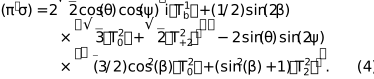
The azimuthal angle ψ measures rotation of the crystal about κ, and the orthorhombic b axis is normal to the plane of scattering for ψ = 0. The angle β in equation (4) is fixed by cos(β) = h/[h2 + (al/c)2]. Note that (π′σ) is proportional to cos(ψ), and the dipole parallel to the crystal b axis is 90° out of phase with contributions from quadrupoles. For (0, 0, 2n) Templeton–Templeton scattering (Templeton & Templeton, 1985) 〈T2+2〉′ survives alongside 〈T1b〉. Dirac multipoles 〈GKQ〉 do not exist in the paramagnetic phase. They are characterized by σπ σθ = +1, and even Q in the FM phase. An anapole (K = 1) as depicted in Fig. 3 does not contribute to reflections (h, 0, l) with even h, odd l using an E1–E2 event. Quadrupole contributions to (σ′σ) and (π′σ) are


Octupoles (K = 3) are omitted here on the grounds of simplicity; they are readily constructed from available universal expressions (Scagnoli & Lovesey 2009). There is no quadrupole contribution to (σ′σ) for a reflection (0, 0, 2n), and (π′σ) reduces to an even function of the azimuthal angle.
4. AF phase
The AF structure Cc2/c (No. 15.90) is depicted in Fig. 2. Europium ions use Wyckoff positions (8i) at (0.5610, 0, 1/8). A basis {(0, −1, 0), (1, 0, 0), (0, 0, 2)} relative to the parent structure defines orthogonal local axes (ξ, η, ζ) for an Eu ion. The monoclinic centrosymmetric structure belongs to the magnetic crystal class 2/m1′ for which any kind of magnetoelectric effect is prohibited. It is a grey group that contains all three inversions 1, 1′, 1′. Ferromagnetism and the piezomagnetic effect are forbidden. The AF magnetic phase is observed below 12.3 K and the transition completes below ≈ 4 K (Martinelli et al., 2023), and the corresponding structure factor is

with γ = {π(2hx + l/4)} and x ≈ 0.5610. Magnetic properties are visible for odd l, which is a forbidden chemical (nuclear) reflection. A null bulk value of ΨKQ(AF) is correct for antiferromagnetic order. Symmetry of the Wyckoff position (8i) does not include inversion, and rotation elements demand 〈OKQ〉 = {σπ σθ(−1)K + Q 〈OK−Q〉}.
For an E1–E1 event 〈TKQ〉 = 〈TKQ〉*, and 〈TK0〉 is permitted for all K. Allowed axial dipoles are 〈T10〉 and 〈T1ξ〉, i.e. dipoles are parallel to the orthorhombic c and b axes. The condition even (K + l) follows from the E1–E1 time signature σθ (−1)K = +1, and forbidden reflections with odd l are purely magnetic. The E1–E1 amplitude (σ′σ) = 0, because it does not include multipoles with odd K (Scagnoli & Lovesey, 2009). The remaining amplitudes are purely imaginary with a common factor [i4√2cos(πl/4)] that is omitted in the results


with cos(β) = {(λk)/[2asin(θ)]}. The azimuthal angle ψ measures rotation of the crystal sample about the reflection vector (0, k, l), and the monoclinic ξ axis is normal to the plane of scattering for ψ = 0.
Unlike an E1–E1 event, the parity-odd E1–E2 amplitude in the unrotated channel of polarization can be different from zero. It reveals the anapole depicted in Fig. 3 parallel to the orthorhombic a axis 〈G1η〉. Reflections (0, k, l) require even k and odd l. At the level of the anapole and quadrupoles the amplitude is
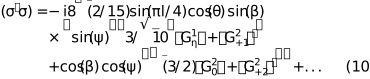
Notably, sin(β) ∝ l and it is different from zero for all considered reflections.
5. Conclusions
In summary, we present exact analytic amplitudes for resonant X-ray Bragg diffraction from EuPdSn2 using an Eu atomic absorption event. A major study of a powder sample of the compound with magnetic neutron diffraction unveiled ferromagnetic (FM) and antiferromagnetic (AF) phases below a temperature of ≈ 12 K depicted in Figs. 1 and 2 (Martinelli et al., 2023). Both phases contribute axial and polar magnetic multipoles to our diffraction patterns. They include rotation of the sample about the reflection vector (an azimuthal angle scan).
Axial dipoles represent atomic magnetic moments in Figs. 1 and 2. Bragg spots in the FM phase satisfy reflection conditions for the parent structure. In consequence, Thomson scattering contributes to diffraction amplitudes in which the orientation of the photon polarization is unchanged, namely, (σ′σ) and (π′π). It is absent in the amplitude for rotated polarization (π′σ) equation (4), which features an axial dipole and Templeton–Templeton scattering (Templeton & Templeton, 1985). Equation (4) is correct for X-ray diffraction enhanced by an electric dipole–electric dipole (E1–E1) absorption event. A corresponding result for the electric quadrupole-electric quadrupole (E2–E2) absorption event is available from the electronic structure factor equation (3) and universal expressions for all diffraction amplitudes (Scagnoli et al., 2009). Dirac quadrupoles and octupoles (polar magnetic multipoles) are revealed in by the parity-odd E1–E2 absorption event. The corresponding amplitudes equations (5) and (6) produce space-group forbidden Bragg spots. Likewise, all Bragg spots in the AF phase. In this phase, E1–E1 amplitudes (π′σ) and (π′π) in equations (8) and (9) contain axial dipoles alone. An anapole contributes to the E1–E2 amplitude (σ′σ) equation (10), whereas for the same reflection condition and an E1–E1 absorption event (σ′σ) = 0.
Acknowledgements
Dr D. D. Khalyavin oversaw use of magnetic space groups. Figs. 1, 2, and Fig. 3 are supplied by Dr A. Martinelli and Dr V. Scagnoli, respectively.
References
 Anderson, N. A., Hupalo, M., Keavney, D., Tringides, M. C. & Vaknin, D. (2017). Phys. Rev. Mater. 1, 054005-09. Web of Science CrossRef Google Scholar
Bunău, A., Ramos, Y. & Joly, Y. (2022). The FDMNES code, https://doi.org/10.1107/S1574870720003304. Google Scholar
Cracknell, A. P. (1975). Magnetism in Crystalline Materials. Oxford: Pergamon Press. Google Scholar
Hayami, S. (2025). Condens. Matter 10, 35–42. Web of Science CrossRef CAS Google Scholar
Lovesey, S. W. & Balcar, E. (2013). J. Phys. Soc. Jpn 82, 021008-19. Google Scholar
Lovesey, S. W., Balcar, E., Knight, K. S. & Fernandezrodriguez, J. (2005). Phys. Rep. 411, 233–289. Web of Science CrossRef CAS Google Scholar
Lovesey, S. W., Chatterji, T., Stunault, A., Khalyavin, D. D. & van der Laan, G. (2019). Phys. Rev. Lett. 122, 047203-5. Web of Science CrossRef CAS PubMed Google Scholar
Manuel, P., Khalyavin, D., Orlandi, F., Chapon, L., Xueyun, W., Jang, T.-H., Choi, E. S. & Cheong, S.-W. (2025). Acta Cryst. B81, 293–301. Web of Science CrossRef IUCr Journals Google Scholar
Martinelli, A., Ryan, D., Sereni, J., Ritter, C., Leineweber, A., Čurlík, I., Freccero, R. & Giovannini, M. (2023). J. Mater. Chem. C 11, 7641–7653. Web of Science CrossRef CAS Google Scholar
Milton, K. A. (2006). Rep. Prog. Phys. 69, 1637–1711. Web of Science CrossRef CAS Google Scholar
Ovchinnikova, E. N., Oreshko, A. P. & Dmitrienko, V. E. (2025). Phys. Usp. 68, 393–400. Web of Science CrossRef CAS Google Scholar
Paolasini, L. (2014). Collection SFN 13, 03002-41. CrossRef Google Scholar
Ruck, B. J., Trodahl, H. J., Richter, J. H., Cezar, J. C., Wilhelm, F., Rogalev, A., Antonov, V. N., Le, B. D. & Meyer, C. (2011). Phys. Rev. B 83, 174404-6. Web of Science CrossRef Google Scholar
Scagnoli, V. & Lovesey, S. W. (2009). Phys. Rev. B 79, 035111. Google Scholar
Scagnoli, V., Staub, U., Bodenthin, Y., de Souza, R. A., García-Fernández, M., Garganourakis, M., Boothroyd, A. T., Prabhakaran, D. & Lovesey, S. W. (2011). Science 332, 696–698. Web of Science CrossRef CAS PubMed Google Scholar
Sereni, J. G., Čurlik, I., Martinelli, A. & Giovannini, M. (2025). Phys. Rev. B 111, 174403-8. Web of Science CrossRef CAS Google Scholar
Templeton, D. H. & Templeton, L. K. (1985). Acta Cryst. A41, 133–142. CrossRef ICSD CAS Web of Science IUCr Journals Google Scholar
Thole, B. T., van der Laan, G., Fuggle, J. C., Sawatzky, G. A., Karnatak, R. C. & Esteva, J.-M. (1985). Phys. Rev. B 32, 5107–5118. CrossRef CAS Web of Science Google Scholar
This is an open-access article distributed under the terms of the Creative Commons Attribution (CC-BY) Licence, which permits unrestricted use, distribution, and reproduction in any medium, provided the original authors and source are cited.
| STRUCTURAL SCIENCE CRYSTAL ENGINEERING MATERIALS |
access


