

 journal menu


issue contents
 | STRUCTURAL BIOLOGY |
ISSN: 2059-7983
Seventh International Symposium on Diffraction Structural Biology 2025
Papers presented at the Seventh International Symposium on Diffraction Structural Biology, 5–7 May 2025, Grenoble, France
Edited by Kristina Djinovic-Carugo , John R. Helliwell and Atsushi Nakagawa
This virtual issue collects together articles from the Seventh International Symposium on Diffraction Structural Biology


Open  access
access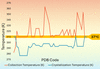
Regulation of pharmaceutical lead compounds does not yet involve the need for patient-relevant macromolecular structures determined at 37°C; nevertheless, we highlight the advantages of these to ensure chemical relevance and the identification of changes which may occur under physiological conditions. The PDB and CSD entries for diffraction data measured at ≥37°C, as well as a cryoEM 37°C freeze-trapped structure, are considered and the description includes structures obtained well above 37°C that are relevant to thermophile and hyperthermophile structural biology.
Open access
access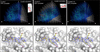
This work demonstrates that multi-position data acquisition mitigates radiation damage in electron diffraction of three-dimensional protein crystals and that merging data from selected crystals in distinct orientations enhances completeness. Application of the two approaches enables high-quality structural models to be obtained from limited or sensitive samples.

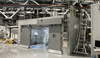
The construction of a new experimental station for macromolecular crystallography at NanoTerasu under the AMED/BINDS project is presented.
PDB reference: hen egg-white lysozyme, 9wks
Open access
access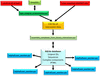
Alphafuser is a structure-prediction pipeline that integrates experimental interaction data with AlphaFold-based modeling to systematically assemble multiprotein complexes in a computationally efficient manner. By implementing an ipTM-based pruning algorithm and validating against known structures and experimental assays, Alphafuser enables the accurate identification of higher-order assemblies from large interactome datasets.

Open access
access
Monte Carlo simulations of neutron protein diffraction experiments provide useful data that models neutrons interacting with instrument components, as well as the crystal diffraction itself. These data can be applied to instrument development, such as the commissioning of the NMX Macromolecular Diffractometer at ESS.
Open access
access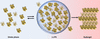
In biological systems, hydrogels often arise through liquid–liquid phase separation, where biomolecular condensates can age into gel-like states. SAXS is a key technique to probe the molecular organization of these samples. This study introduces an in-vacuum Gel-Cell for SAXS-based structural analysis of a biologically derived hydrogel formed by the thermosensory prion-like domain of EARLY FLOWERING 3 and presents a three-component model to interpret the obtained data.
Open access
access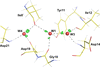
Here, we describe the determination of the highest resolution structure in the PDB at 0.43 Å resolution. Electron-density maps reveal extensive deformation electron density that is completely accounted for by performing transferable aspherical atom refinements using the DiSCaMB library in BUSTER.


