 | Acta Crystallographica Section A Acta Crystallographica Section A FOUNDATIONS AND ADVANCES |


 journal menu


research papers
| FOUNDATIONS ADVANCES |
 access
Pure discrete spectrum and regular model sets on some non-unimodular substitution tilings

aDepartment of Mathematics Education, Catholic Kwandong University, Gangneung 25601, Republic of Korea
*Correspondence e-mail: [email protected]
Substitution tilings with pure discrete spectrum are characterized as regular model sets whose cut-and-project scheme has an internal space that is a product of a Euclidean space and a profinite group. Assumptions made here are that the expansion map of the substitution is diagonalizable and its eigenvalues are all algebraically conjugate with the same multiplicity. A difference from the result of Lee et al. [Acta Cryst. (2020), A76, 600–610] is that unimodularity is no longer assumed in this paper.
Keywords: pure discrete spectrum; regular model sets; non-unimodular substitution; Pisot family substitution; Meyer sets.
1. Introduction
There has been considerable success in studying the structure of tilings with pure discrete spectrum by setting them in the context of model sets (Baake & Moody, 2004![[Baake, M. & Moody, R. V. (2004). J. Reine Angew. Math. 573, 61-94.]](../../../../../../logos/arrows/a_arr.gif "Baake, M. & Moody, R. V. (2004). J. Reine Angew. Math. 573, 61-94.") ; Baake et al., 2007; Strungaru, 2017; Akiyama et al., 2015). However, in general settings, the relation between pure discrete spectrum and model sets is not completely understood and the cut-and-project scheme is usually constructed with an abstract internal space (Baake & Moody, 2004; Strungaru, 2017). Thus it is not easy to understand this relation concretely and get information about the structure from the relation. The notion of inter model sets was introduced by Baake et al. (2007) and Lee & Moody (2006) and we know the equivalence between pure discrete spectrum and inter model sets in substitution tilings (Lee, 2007). But there are still some limitations in getting useful information about the cut-and-project scheme (CPS) because the internal space was constructed abstractly. What is the internal space concretely? There was some progress in this direction by Lee et al. (2018) and Lee, Akiyama & Lee (2020). However, these papers make various assumptions about substitution tilings such as the expansion map is diagonalizable, the eigenvalues of the expansion map should be algebraically conjugate, the multiplicity of the eigenvalues should be the same, and the expansion map is unimodular. From a long perspective, we aim to gradually eliminate assumptions one by one. As a first step, in this paper we eliminate the assumption of unimodularity.
; Baake et al., 2007; Strungaru, 2017; Akiyama et al., 2015). However, in general settings, the relation between pure discrete spectrum and model sets is not completely understood and the cut-and-project scheme is usually constructed with an abstract internal space (Baake & Moody, 2004; Strungaru, 2017). Thus it is not easy to understand this relation concretely and get information about the structure from the relation. The notion of inter model sets was introduced by Baake et al. (2007) and Lee & Moody (2006) and we know the equivalence between pure discrete spectrum and inter model sets in substitution tilings (Lee, 2007). But there are still some limitations in getting useful information about the cut-and-project scheme (CPS) because the internal space was constructed abstractly. What is the internal space concretely? There was some progress in this direction by Lee et al. (2018) and Lee, Akiyama & Lee (2020). However, these papers make various assumptions about substitution tilings such as the expansion map is diagonalizable, the eigenvalues of the expansion map should be algebraically conjugate, the multiplicity of the eigenvalues should be the same, and the expansion map is unimodular. From a long perspective, we aim to gradually eliminate assumptions one by one. As a first step, in this paper we eliminate the assumption of unimodularity.
Our work was inspired by an example of Baake et al. (1998), which offers a guide to what the internal space should be. We will look at this in Example 5.10. The present paper is an extension of the result of Lee, Akiyama & Lee (2020) in the sense that the unimodularity condition is removed, and the setting is quite similar.
There are various research works on non-unimodular substitution cases (Baker et al., 2006; Ei et al., 2006; Siegel, 2002) that study symbolic substitution sequences or their geometric substitution tilings in dimension 1. Our definition of non-unimodularity looks slightly different from that defined in those papers. However, if we restrict the substitution tilings to one dimension  , the two definitions are the same.
We have four basic assumptions about a primitive substitution tiling  on
on  with an expansion map ϕ:
(i) ϕ is diagonalizable.
(ii) All the eigenvalues of ϕ are algebraically conjugate.
(iii) All the eigenvalues of ϕ have the same multiplicity.
(iv)  is rigid [see (14) for the definition].
We call these assumptions DAMR. This paper relies heavily on the rigid structure of substitution tilings, and the rigidity property is only known under those assumptions (i), (ii), (iii) together with finite local complexity (Theorem 2.9). In Section 2, we review some definitions and known results that are going to be used in this paper. The main result of this paper shows the following:
Theorem 1.1
Let be a repetitive primitive substitution tiling on with a diagonalizable expansion map ϕ whose eigenvalues are algebraic conjugates with the same multiplicity and let be rigid. If has pure discrete spectrum, then control point set  of each tile type is a regular model set in the CPS with an internal space which is a product of a Euclidean space and a profinite group, where
  is a control point set of defined in (7) and the CPS is defined in (35).
In Section 3, we give an outline of the proof of this theorem in some simple case of substitution tilings with expansion map ϕ satisfying the DAMR assumptions defined above. In Section 4, we define an appropriate internal space and construct a CPS under the DAMR assumptions. Then we discuss the projected point sets  of neighbourhood bases of a topology in the internal space. In Section 6, under the assumption of pure discrete spectrum of , we look at how the projected point sets and the translation vector set Ξ of the same types of tiles in are related [see (8)]. Using the equivalent property `algebraic coincidence' for pure discrete spectrum, we provide arguments to show that we actually have regular model sets.
2. Definitions and known results
We consider a primitive substitution tiling on with expansion map ϕ satisfying the DAMR assumptions defined above. In this section, we recall some definitions and results that we are going to use in the later sections.
2.1. Tilings
We consider a set of types (or colours)  , which we fix once and for all. A tile in is defined as a pair T = (A,i) where
  (the support of T) is a compact set in , which is the closure of its interior, and
  is the type of T. A tiling of is a set of tiles such that
  and distinct tiles have disjoint interiors.
Given a tiling , a finite set of tiles of is called a -patch. Recall that a tiling is said to be repetitive if the occurrence of every -patch is relatively dense in space. We say that a tiling has finite local complexity (FLC) if for every  there are only finitely many translational classes of -patches whose support lies in some ball of radius R up to translations.
2.2. Delone κ-sets
A κ-set in is a subset  =
= 
 (κ copies) where
  and κ is the number of colours. We also write
  . Recall that a Delone set is a relatively dense and uniformly discrete subset of . We say that
  is a Delone κ-set in if each
  is Delone and
  is Delone. The type (or colour) of a point x in the Delone κ-set
  is i if
  with
with  .
.
A Delone set Λ is called a Meyer set in if  is uniformly discrete, which is equivalent to saying that
  for some finite set F (see Meyer, 1972; Lagarias, 1996; Moody, 1997). If is a Delone κ-set and
  is a Meyer set, we say that is a Meyer κ-set.
2.3. Substitutions
We say that a linear map  is expansive if there is a constant
  with
with

for all  under some metric d on compatible with the standard topology.
Definition 2.1
Let  be a finite set of tiles on such that Ti = (Ai,i); we will call them prototiles. Denote by
  the set of patches made of tiles each of which is a translate of one of the Ti's. We say that
  is a tile-substitution (or simply substitution) with an expansive map ϕ if there exist finite sets
  for
for  , such that

with

Here all sets in the right-hand side must have disjoint interiors; it is possible for some of the  to be empty.
The substitution (1) is extended to all translates of prototiles by  , and to patches and tilings by
  . The substitution ω can be iterated, producing larger and larger patches
  . A tiling satisfying
  is called a fixed point of the tile-substitution or a substitution tiling with expansion map ϕ. It is known (and easy to see) (Solomyak, 1997) that one can always find a periodic point for ω in the tiling dynamical hull, i.e.
  for some
  . In this case we use
  in the place of ω to obtain a fixed point tiling. The substitution
  matrix
  of the tile-substitution is defined by
  . We say that the substitution tiling is primitive if there is an
  for which
  has no zero entries, where is the substitution matrix.
When there exists a monic polynomial P(x) over  with the minimal degree satisfying
  , we call the polynomial the minimal polynomial of ϕ over . We say that ϕ is unimodular if the minimal polynomial of ϕ over has constant term
  ; that is to say, the product of all roots of the minimal polynomial of ϕ is . If the constant term in the minimal polynomial of ϕ is not , then we say that ϕ is non-unimodular.
Note that for  ,
,

where

Definition 2.2
 is called a substitution Delone κ-set if is a Delone κ-set and there exist an expansive map
  and finite sets for such that

where the unions on the right-hand side are disjoint.
Definition 2.3
For a substitution Delone κ-set satisfying (4), define a matrix  whose entries are finite (possibly empty) families of linear affine transformations on given by

Define  for
for  . For a κ-set
  let
let

Thus  by definition. We say that Φ is a κ-set substitution. Let

denote the substitution matrix corresponding to Φ.
Definition 2.4
(Mauduit, 1989.) An algebraic integer θ is a real Pisot number if it is greater than 1 and all its Galois conjugates are less than 1 in modulus, and a complex Pisot number if every Galois conjugate, except the complex conjugate  , has modulus less than 1. A set of algebraic integers
  is a Pisot family if for every
  , every Galois conjugate η of
  , with
  , is contained in Θ.
For r = 1, with  real and
  , this reduces to
  being a real Pisot number, and for r = 2, with non-real and , to being a complex Pisot number.
2.4. Pure discrete spectrum and algebraic coincidence
Let  be the collection of tilings on each of whose patches is a translate of a -patch. In the case that has FLC, there is a well known metric δ on the tilings: for a small
  two tilings
  are ε-close if
  and
and  agree on the ball of radius
  around the origin, after a translation of size less than ε (see Schlottmann, 2000; Radin & Wolff, 1992; Lee et al., 2003). Then

where the closure is taken in the topology induced by the metric δ.
It is known that a dynamical system  with a primitive substitution tiling always has a unique ergodic measure μ in the dynamical system (see Solomyak, 1997; Lee et al., 2003). We consider the associated group of unitary operators
  on
on  :
:

Every  defines a function on by
  . This function is positive definite on , so its Fourier transform is a positive measure
  on called the spectral measure corresponding to g. The dynamical system
  is said to have pure discrete spectrum if is pure point for every . We also say that has pure discrete spectrum if the dynamical system has pure discrete spectrum.
The notion of pure discrete spectrum of the dynamical system is quite closely connected wtih the notion of algebraic coincidence in Definition 2.6. For this we start by introducing control points. There is a standard way to choose distinguished points in the tiles of a primitive substitution tiling so that they form a ϕ-invariant Delone κ-set. They are called control points (Thurston, 1989; Praggastis, 1999), which are defined below.
Definition 2.5
Let be a primitive substitution tiling with an expansion map ϕ. For every -tile T, we choose a tile  in the patch
  ; for all tiles of the same type in , we choose with the same relative position [i.e. if
  for some two tiles
  then
then  ]. This defines a map
  called the tile map. Then we define the control point for a tile
  by
by

The control points satisfy the following: (a)  =
=  , for any tiles
  of the same type; (b)
  , for .
Let

be a set of control points of the tiling in . Let us denote  by
by  .
.
For tiles of any tiling  , the control points have the same relative position as in -tiles. The choice of control points is non-unique, but there are only finitely many possibilities, determined by the choice of the tile map. Let

Since the substitution tiling is primitive, it is possible to assume that the substitution matrix is positive taking  if necessary. So we consider a tile map

with the property that for every , the tile has the same tile type in . That is to say, for every  ,
,  , where
  and
and  . Then for any ,

In order to have  for some
  and
and  , we define the tile map as follows. It is known that there exists a finite generating patch
  for which
  (Lagarias & Wang, 2003). Although it was defined there for primitive substitution point sets, it is easy to see that the same property holds for primitive substitution tilings. We call the finite patch the generating tile set. When we apply the substitution infinitely many times to the generating tile set , we obtain the whole substitution tiling. So there exists
  such that the nth iteration of the substitution to the generating tile set covers the origin. We choose a tile R in a patch
  which contains the origin, where
  for some
  . Then there exists a fixed tile
  such that
  . Replacing the substitution ω by
  , we can define a tile map γ so that

Then by the definition of the control point sets and so . Since for any ,

This implies that

Definition 2.6
(Lee, 2007.) Let be a primitive substitution tiling on with an expansive map ϕ and let  be a corresponding control point set. We say that
  admits an algebraic coincidence if there exists
  and
and  for some such that

Note that if the algebraic coincidence is assumed, then for some  ,
,

Theorem 2.7
[Theorem 3.13 (Lee, 2007), Theorem 2.6 (Lee, Akiyama & Lee, 2020).] Let be a primitive substitution tiling on with an expansive map ϕ and be a control point set of . Suppose that all the eigenvalues of ϕ are algebraic integers. Then has pure discrete spectrum if and only if admits an algebraic coincidence.
2.5. CPS
We use a standard definition for a CPS and model sets (see Baake & Grimm, 2013). For convenience, we give the definition for our setting.
Definition 2.8
A CPS consists of a collection of spaces and mappings as follows:

where is a real Euclidean space, H is a locally compact  and
and  are the canonical projections,
  is a lattice, i.e. a discrete for which the quotient group
  is compact,
  is injective, and
  is dense in H. For a subset
  , we define

Here the set V is called a window of  . A subset of is called a model set if can be of the form
  , where
  has non-empty interior and compact closure in the setting of the CPS in (12). The model set is regular if the boundary of W

is of (Haar) measure 0. We say that is a model κ-set (respectively, regular model κ-set) if each  is a model set (respectively, regular model set) with respect to the same CPS.
2.6. Rigid structure on substitution tilings
The structure of a module generated by the control points is known only for the diagonalizable case for ϕ whose eigenvalues are algebraically conjugate with the same multiplicity given by Lee & Solomyak (2012). We need to use the structure of the module in the subsequent sections. Thus we will have the same assumptions.
Let J be the multiplicity of each eigenvalue of ϕ and assume that the number of distinct eigenvalues of ϕ is m. For  , we define
  such that for each
  ,
,

We recall the following theorem for the module structure of the control point sets. Although the theorem is not explicitly stated by Lee & Solomyak (2012), it can be read off from their Theorem 4.1 and Lemma 6.1.
Theorem 2.9
(Lee & Solomyak, 2012.) Let be a repetitive primitive substitution tiling on with an expansion map ϕ. Assume that has FLC, ϕ is diagonalizable, and all the eigenvalues of ϕ are algebraically conjugate with the same multiplicity J. Then there exists a linear isomorphism  such that

where  , , are given as (13) and
 .
.
Note here that are linearly independent over  . A tiling is said to be rigid if satisfies the result of Theorem 2.9; that is to say, there exists a linear isomorphism such that

where , , are given as (13).
As an example of a substitution tiling with the rigidity property, let us look at the Frank–Robinson substitution tiling (Frank & Robinson, 2006) (Fig. 1).
![[Figure 1]](uv5005fig1thm.gif) | Figure 1 The Frank–Robinson tiling substitution. |
Take the tile-substutition
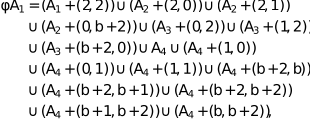



where b is the largest root of  and
and

Then it gives a primitive substitution tiling . Note that b is not a Pisot number. It was shown by Frank & Robinson (2006) that does not have FLC. One can observe that each set of translation vectors satisfies  . Thus

whence the rigidity holds.
3. Outline of the proof of Theorem 1.1
We provide a brief outline of the proof of Theorem 1.1 for the simpler case of repetitive primitive substitution tilings on with an λ ( ):
):
(a) λ is non-unimodular,
(b) λ is a real Pisot number which is not an integer,
(c) has FLC,
(d) has pure discrete spectrum.
Let P(x) be the minimal polynomial of ϕ over for which  . Let
. Let  be all the roots of the equation P(x) = 0, where the absolute values of
  are all less than 1. Using the rigidity of Theorem 2.9, we get up to an isomorphism

Using the algebraic conjugates of λ whose absolute values are less than 1, we consider a Euclidean space  and the map

where

For the case of non-unimodular λ, we construct a profinite group below. We remark that if λ is unimodular, then the profinite group is trivial so that Theorem 1.1 can be covered by the work of Lee, Akiyama & Lee (2020). Let  . From the non-unimodularity of λ,
  . So
. So  . Note that
  is a basis of L as a free -module. Consider the map

This gives an isomorphism of the -module between L and  . Let
. Let
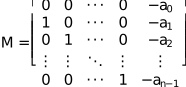
be the companion matrix of P(x). Then

Notice that M acts on and the roots of the minimal polynomial of M over are exactly  . Since ,
  . Here we consider a profinite group
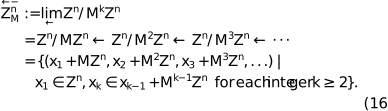
Since embeds in  , we can identify with its image in . Consider the following map:

Now we construct a CPS whose physical space is and internal space is  :
:
![[Scheme 2]](uv5005scheme2.gif)
Under the assumption of pure discrete spectrum of , we know that an algebraic coincidence occurs by Theorem 2.7. So there exist and  for some such that

where Ξ is the set of translational vectors which translate a tile to the same type of tile in as given in (8). Notice that  is a basis element in the locally compact where
  is a ball of radius δ around 0 in . We let
  be the projected point set in coming from a window . It is important to understand the relation between and Ξ. We discuss this in Section 4.2 (see also Lee et al., 2018; Lee, Akiyama & Lee, 2020). From this relation, together with algebraic coincidence, we can view the control point set of as a model set. Using Keesling's argument (Keesling, 1999), we show that the control point set of is actually a regular model set.
4. Construction of a CPS
We aim to prove that the structure of pure discrete spectrum in a substitution tiling can be described by a regular model set which comes from a CPS with the internal space that is a product of a Euclidean space and a profinite group. From Lee & Solomyak (2019), under the assumption of pure discrete spectrum, the control point set of the substitution tiling has the Meyer property and so has FLC. In general settings which are not substitution tilings, it is hard to expect that pure discrete spectrum implies neither the Meyer property nor FLC (Lee, Lenz et al., 2020).
The setting that we consider here is a primitive substitution tiling on with an expansion map ϕ which satisfies the DAMR assumptions. Changing the tile substitution if necessary, we can assume that ϕ is a diagonal matrix without loss of generality.
Under the assumption of DAMR, it is also known from Lee & Solomyak (2012, 2019) that the control point set of the substitution tiling has the Meyer property if and only if the eigenvalues of ϕ form a Pisot family. In our setting, there is no algebraic conjugate η with  for the eigenvalues of ϕ, since ϕ is an expansion map. It is known that if ϕ is an expansion map of a primitive substitution tiling with FLC, every eigenvalue of ϕ is an algebraic integer (Kenyon & Solomyak, 2010; Kwapisz, 2016). Even for non-FLC cases, we know from the rigidity that the control point set lies in a finitely generated free abelian group L which spans and
  . So all the eigenvalues of ϕ are algebraic integers [Lemma 4.1 of Lee & Solomyak (2008)].
In the case of non-unimodular substitution tilings, there are two parts of spaces for the internal space of a CPS. One is a Euclidean part and the other is a profinite group part. We describe them below.
4.1. An internal space for a CPS
4.1.1. Euclidean part for the internal space
In this subsection, we assume that there exists at least one algebraic conjugate whose absolute value is less than 1, which is different from the eigenvalues of ϕ. In the case of unimodular ϕ, we can observe that there always exists such an algebraic conjugate. But in the case of non-unimodular ϕ, it is possible not to have an algebraic conjugate whose absolute value is less than 1. For example, let us consider an expansion map
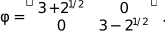
Then the minimal polynomial of ϕ is  , which means that ϕ is non-unimodular. If there exists no other algebraic conjugate of the eigenvalues of ϕ whose absolute value is less than 1, one can skip this subsection and go to the next Section 4.1.2.
Recall that J is the multiplicity of the eigenvalues of ϕ, d is the dimension of the space , m is the number of distinct eigenvalues of ϕ and d = mJ. We can write

where Ak is a real 1×1 matrix for  , a real 2×2 matrix of the form

for  with
with  and m = s+2t. Here O is the m×m zero matrix and . Then the eigenvalues of ψ are

Note that m is the degree of the characteristic polynomial of ψ.
We assume that the minimal polynomial of ψ over has e real roots and f pairs of complex conjugate roots. Since the minimal polynomial of ψ has the characteristic polynomial of ψ as a divisor, we can consider the roots of the minimal polynomial of ψ over in the following order:

Let

We now consider a Euclidean space whose dimension is  , whose number corresponds to the number of the other roots of the minimal polynomial of ψ which are not the eigenvalues of ψ. Let

For , define a  matrix
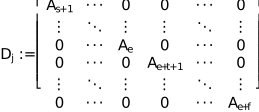
where As+g is a real 1×1 matrix with the value  for
for  , and Ae+t+h is a real 2×2 matrix of the form
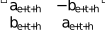
for  [see Lee, Akiyama & Lee (2020) for more details]. The matrix Dj operates on the space
  .
.
Notice that ϕ and ψ have the same minimal polynomial over , since ϕ is the diagonal matrix containing J copies of ψ.
Let us consider now the following embeddings:
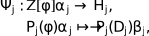
where  ,
,  is as in (13),
  and . Note that

Let  . Note that the minimal polynomial of ϕ is monic, since the eigenvalues of ϕ are all algebraic integers. So and

is a basis of L as a free -module.
Now, we can define the map


Since are linearly independent over , the map  is well defined. Thus
  where
where

is a block diagonal  matrix in which Dj is an matrix, , and
  . Let
. Let  .
.
4.1.2. Profinite group part for the internal space
To make the notation short, denote the basis of L given in (21) by  . Consider a -module isomorphism between L and

where

Consider the (d×nJ) matrix:

Since L spans over , the rank of N is d. Thus  has only the trivial solution, where
  is the transpose of N. From , we can write, for each
  ,
,

Let

Notice that in a special case of J = 1, i.e.  , M is the companion matrix of the minimal polynomial of ϕ over . Then

Note that for any  ,
,

and

Notice also that for any  and for any ,

Lemma 4.1
Any eigenvalue of ϕ with multiplicity J becomes also the eigenvalue of M with the same multiplicity J. Furthermore the minimal polynomial of ϕ over is the same as the minimal polynomial of M over .
Proof
Let λ be an eigenvalue of ϕ with multiplicity J. Since  and ϕ have the same eigenvalues, λ is an eigenvalue of . Let
  be the corresponding eigenvector of . Then

Since is nonzero,  is nonzero and so λ is an eigenvalue of
  . Thus the eigenvalue λ of ϕ becomes also an eigenvalue of M. Since ϕ is a diagonal matrix, there are d( = mJ) independent eigenvectors. The images of these vectors under are the eigenvectors of and linearly independent. Since all the eigenvalues of ϕ are algebraically conjugate with the same multiplicity J, all the eigenvalues of ϕ are also eigenvalues of with the same multiplicity J. Thus we note that the set of the eigenvalues of M consists of all the eigenvalues of ϕ and all the other algebraic conjugates of them which are not the eigenvalues of ϕ, and the multiplicity of all the eigenvalues of M is J.
Since ϕ is a diagonal matrix and all the eigenvalues of ϕ are algebraic integers, there exists a minimal polynomial of ϕ over . Since M is an integer matrix, there exists a minimal polynomial of M over as well. Let P(x) be the minimal polynomial of ϕ over so that where P(x) =  ,
,  , and
, and  . Then using (30), for any ,
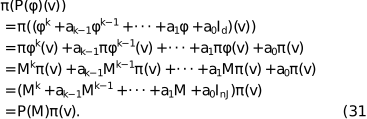
From (31), P(M) is a zero matrix. On the other hand, we can observe that if P(x) is the minimal polynomial of M over , then  is a zero matrix as well. Thus the minimal polynomial of ϕ over is the same as the minimal polynomial of M over .
□
We can observe this property of Lemma 4.1 concretely with Example 5.10.
Let us consider the case that ϕ is non-unimodular, i.e. but  . Let us denote by
  which is a lattice in
  . Then
  but
but  . We define the M-adic space which is an inverse limit space of
  with . Note that
  is an injective homomorphism. Observe that
  is non-trivial and finite. We have an inverse limit of an inverse system of discrete finite groups,
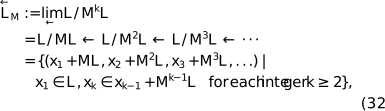
which is a profinite group. Note that  can be supplied with the usual topology of a profinite group. Note that for any element =
  ,
,  ,
,

Thus it becomes a compact group which is invariant under the action of M. In particular, the cosets  ,
,  ,
,  form a basis of open sets in and each of these cosets is both open and closed. An important observation is that any two cosets in are either disjoint or one is contained in the other.
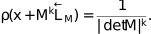
We let ρ denote the Haar measure on , normalized so that  . Thus for a coset ,
We define the translation-invariant metric d on via

Note that contains a canonical copy of via the mapping

We can observe that

Note that  . So we can conclude that the mapping
  embeds in . We identify with its image in . Note that is the closure of with respect to the topology induced by the metric d.
In the unimodularity case of ϕ,  and so
  . Thus is trivial.
4.2. Concrete construction of a CPS
We construct a CPS taking as a physical space and  as an internal space. We will consider this construction dividing ϕ into three cases as given in the following remark. The following construction of a CPS has already appeared in the work of Minervino & Thuswaldner (2014) in the case of d = 1. Here we construct a CPS for the case of
  .
.
Remark 4.2
For an expansion map ϕ, there are three cases.
(i) If ϕ is unimodular, there exists at least one algebraic conjugate λ other than the eigenvalues of ϕ for which  . Then the map ι in (33) is a trivial map and the internal space is constructed mainly by the Euclidean space discussed in Section 4.1.1.
(ii) If ϕ is non-unimodular and there exists no other algebraic conjugate of the eigenvalues of ϕ whose absolute value is less than 1, then  is a trivial group and the internal space is constructed exclusively by the profinite group (32) defined in Section 4.1.2.
(iii) If ϕ is non-unimodular and there exist algebraic conjugates (λ's) other than the eigenvalues of ϕ for which , then the internal space is a product of the Euclidean space in Section 4.1.1 and the profinite group in Section 4.1.2.
Let us define

where π is defined as in (24). Let us construct a CPS:
![[Scheme 3]](uv5005scheme3.gif)
where and are canonical projections,
and

It is easy to see that is injective. We shall show that is dense in and  is a lattice in
  in Lemmas 4.3 and 4.4. We note that
  is injective, since Ψ is injective. Since ϕ commutes with the isomorphism σ in Theorem 2.9, we may identify the control point set
  with its isomorphic image. Thus from Theorem 2.9,

where  and
and  . Note that for any and ,
  by the definition of the tile-map. So we can note that

Proof
For the case (i) of Remark 4.2,  is trivial. So the statement of the lemma follows from Lemma 3.2 of Lee, Akiyama & Lee (2020).
For the case (ii) of Remark 4.2, is trivial. Note that the matrix M in (26) is a d×d integer matrix and L is a lattice in . So is a discrete of  with respect to the product topology. Note that
  ×
×  , where C1 is a compact set in . Since
  is compact, is relatively dense in . Thus the statement of the lemma follows.
For the case (iii) of Remark 4.2, let  =
=  . In Lemma 3.2 of Lee, Akiyama & Lee (2020), we notice that the unimodularity property is used only in observing that is not trivial in that paper. So by the same argument as Lemma 3.2 of Lee, Akiyama & Lee (2020), we obtain that is a lattice in
  . This means that is a discrete such that
  is compact. Notice that is still a discrete in
  . Furthermore,
  is compact. In fact, note that
  , where C1 and C2 are compact sets in and , respectively. Then

Since  is compact, is relatively dense in × . Thus the statement of the lemma follows.
□
 and
and Proof
For the case (i) of Remark 4.2, is trivial. So the statement of the lemma follows from Lemma 3.2 of Lee, Akiyama & Lee (2020).
For the case (ii) of Remark 4.2, is trivial. Note that  and is dense in . Thus is dense in .
Let us consider the case (iii) of Remark 4.2. It is known from Lee, Akiyama & Lee (2020) that  is dense in . For any open neighbourhood
  in
in  , there exists
  such that
  for some
  . Since is dense in and
  =
=  , is dense in . Note that

So  is dense in , where π is defined in (24). So

Hence

Thus is dense in .
□
Now that we have proved that (35) is a CPS, we would like to introduce a special projected set which will appear in the proof of the main result in Section 5. For  and
and  , we define
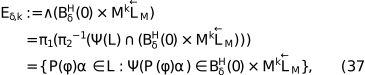
where  is an open ball around
  with a radius δ in and

In the following lemma, we find an adequate window for a set  and note that is a Meyer set.
 . Then for
 and
and 
Proof
Note that
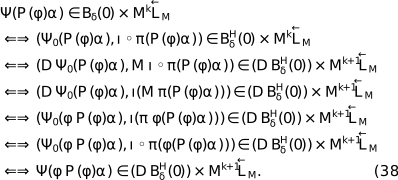
The third equivalence comes from (34) and the fourth equivalence comes from (30). Thus
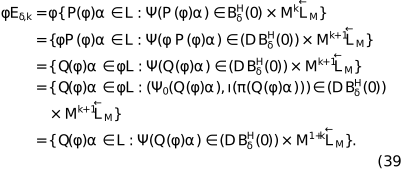
In the unimodularity case of ϕ, is trivial and . So the last equality (39) follows. In the non-unimodularity case of ϕ,  implies
  . Since
  ,
,  . This shows the last equality (39). Hence for any ,

Since (35) is a CPS, is bounded, and is compact,  has a non-empty interior and compact closure, is a model set for each and . It is given by Moody (1997) and Meyer (1972) that a model set is a Meyer set. Thus forms a Meyer set for each and .
□
5. Main result
Recall that we consider a primitive substitution tiling on with a diagonal expansion map ϕ whose eigenvalues are algebraically conjugate with the same multiplicity J and is rigid.
Under the assumption of the rigidity of , the pure discrete spectrum of implies that the set of eigenvalues of ϕ forms a Pisot family [Lemma 5.1 (Lee & Solomyak, 2012)]. Recall that

where is a control point set of .
Lemma 5.1
Assume that ϕ satisfies the Pisot family condition. Then  for some , where
  is given in (37).
Proof
Notice that the setting for fulfils the conditions to use Lemma 4.5 of Lee & Solomyak (2008). So from this lemma, for any  ,
,

Recall that ϕ is an expansive map and satisfies the Pisot family condition. If there exists at least one algebraic conjugate λ other than the eigenvalues of ϕ for which ,  for some . So
  . If there exists no other algebraic conjugate of the eigenvalues of ϕ whose absolute value is less than 1,
  . From the definition of in (37), .
□
Proof
Note from (36) that for any and  ,
,  is contained in Ξ. Recall that
  . From (10) and (36),

So for any  ,
,  is a linear combination of
 over . Applying (11) many times if necessary, we get that for any ,
  for some
  .
.
□
Proposition 5.3
Let be a primitive substitution tiling on with an expansion map ϕ. Under the assumption of the existence of the CPS (35), if has pure discrete spectrum, then for any given , there exists  such that

Proof
Note that is a Meyer set and for some . Since Ξ is relatively dense, for any  , there exists
  such that
  . It is important to note that from the Meyer property of , the point set configurations

are finite up to translations. Let

Then  and F is a finite set. Thus for any ,

From Lemma 5.2, for any , there exists such that  . Since has pure discrete spectrum and so admits algebraic coincidence, by (11) there exists
  such that

Applying the inclusion (43) finitely many times, we obtain that there exists  such that
  . Hence together with (42), there exists such that

□
Proposition 5.4
Let be a primitive substitution tiling on with a diagonalizable expansion map ϕ whose eigenvalues are algebraic conjugates with the same multiplicity and let be rigid. Let Φ be the corresponding κ-set substitution of (see Definition 2.3). Suppose that

for some  , and
, and  . Then each point set

is a model set in the CPS (35) with a window Ui in which is open and precompact.
Proof
For each  and
and  , there exist and for which

From  ,
,

By Theorem 2.7 and Proposition 5.3, there exists such that  . Thus
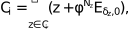
where  and
and  depends on
  . Let
. Let

where  . Then for any

In (47), we assume that we have taken the minimal number so that Ui defined by using  does not satisfy (48).
From Lemma 5.1, for some . Thus  . Since
  is compact,
  is compact. Thus
  is compact.
□
Recall from Lagarias & Wang (2003) and Lee et al. (2003) that there exists a finite generating set  such that

Since  is dense in by Lemma 4.4, we have a unique extension of Φ to a κ-set substitution on in the following way; if
  for which

we define

where  , D and M are given in (23) and (26), and
  . If there is no confusion, we will use the same notation f* for the extended map.
Note that, by the Pisot family condition on ϕ, if there exists at least one algebraic conjugate λ other than the eigenvalues of ϕ for which , there exists some  such that
  for any
  . Furthermore, from (33)

By the same argument as in Section 3 of Lee & Moody (2001), the κ-set substitution Φ induces a multi-component iterated function system on . Thus the κ-set substitution Φ determines a multi-component iterated function system  on and f* is a contraction on . Let
  be a substitution matrix corresponding to . Defining the compact subsets

and using (5) and the continuity of the mappings, we have

This shows that  are the unique attractor of .
Lemma 5.5
Let

where , as obtained in (47) with the minimal number satisfying (48). For any and any , we have

Proof
For any ,  . Recall that

So for any  ,
,  . Thus for any
  ,
,

Notice that  , where
  and . Since we have taken the minimal number in (47) for each Ui,
  . Thus

□
The following proposition shows that the Haar measure of  is zero for each . This is proved using Keesling's argument (Keesling, 1999).
Proposition 5.6
Let be a primitive substitution tiling on with a diagonalizable expansion map ϕ whose eigenvalues are algebraic conjugates with the same multiplicity and let be rigid. Let Φ be the corresponding κ-set substitution of (see Definition 2.3). If

where , and , then each model set , , has a window with boundary measure zero in the internal space of CPS (35).
Proof
Let us define  , where Ui is the maximal open set in satisfying (46). From the assumption of (52), we first note that ϕ fulfils the Pisot family condition from Theorem 2.7 and Lemma 5.1 of Lee & Solomyak (2012). For every measurable set
  and for any
  with
with  ,
,

where μ is a Haar meaure in , ρ is a Haar measure in ,  . Note that
  . In particular,

where
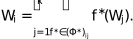
Let us denote  for and
  =
=  . Then for any
  ,
,

From Proposition 5.3, we know that  for any . Thus

Note that the Perron–Frobenius eigenvalue of  is
is  from Lagarias & Wang (2003). Since the minimal polynomials of ϕ and M over are the same from (27) and the multiplicities of eigenvalues of ϕ and M are the same from Lemma 4.1, we have

Since is a non-negative primitive matrix with Perron–Frobenius eigenvalue  , from Lemma 1 of Lee & Moody (2001)

By the positivity of and  ,
,  = .
= .
Recall that for any ,

From (3), for any ,

and

Note that  and Ui is a non-empty open set. As
  ,
,  is dense in Wi. We can find a non-empty open set
  such that
  . So there exists such that
  and
and

Since  ,
,

Thus there exists  such that

Hence
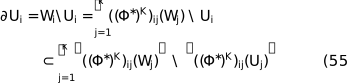

The inclusion (55) follows from Lemma 5.5. Let

Then

Thus from (54), there exists a matrix  for which

where  and
and  . If
. If  , again from Lemma 1 of Lee & Moody (2001),
  . This is a contradiction to (54). Therefore bj = 0 for any
  .
.
□
The regularity property of model sets is shared for all the elements in (see Schlottmann, 1998; Baake et al., 2007; Lee & Moody, 2006). We state it in the following proposition.
Proposition 5.7
[(Schlottmann, 1998), Proposition 7 (Baake et al., 2007), Proposition 4.4 (Lee & Moody, 2006).] Let be a Delone κ-set in for which  where
where  is compact and
  for with respect to to some CPS. Then for any
  , there exists
  so that

From the assumption of pure discrete spectrum and Remark 5.5 of Lee, Akiyama & Lee (2020), we can observe that the condition (52) is fulfilled in the following theorem.
Theorem 5.8
Let be a repetitive primitive substitution tiling on with a diagonalizable expansion map ϕ whose eigenvalues are algebraic conjugates with the same multiplicity and let be rigid. If has pure discrete spectrum, then each control point set , , is a regular model set in CPS (35) with an internal space which is a product of a Euclidean space and a profinite group.
Proof
Through Section 4.1, we can construct the CPS (35) whose internal space is a product of a Euclidean space and a profinite group. Since has pure discrete spectrum and is repetitive, we can find a substitution tiling  in such that

where  , and . From Propositions 5.3, 5.6 and 5.7, the statement of the theorem follows.
Corollary 5.9
Let be a repetitive primitive substitution tiling on with a diagonalizable expansion map ϕ whose eigenvalues are algebraic conjugates with the same multiplicity and be rigid. Then has pure discrete spectrum if and only if each control point set , , is a regular model set in CPS (35) with an internal space which is a product of a Euclidean space and a profinite group.
Proof
It is known that regular model sets have pure discrete spectrum in quite a general setting (Schlottmann, 2000). Together with Theorem 5.8, we obtain the equivalence between pure discrete spectrum and a regular model set in substitution tilings.
□
Now let us look at an example given by Baake et al. (1998).
Example 5.10. We look at the example of non-unimodular substitution tiling which is studied by Baake et al. (1998). This example is proven to be a regular model set in the setting of a CPS constructed by Baake et al. (1998). This has also been considered by Lee, Akiyama & Lee (2020), but it could only be described as a model set, not a regular model set. Here in the setting of CPS (35), we show that this example gives a regular model set. The substitution matrix of the primitive two-letter substitution

has the Perron–Frobenius eigenvalue  which is a Pisot number. A geometric substitution tiling arising from this substitution can be obtained by replacing symbols a and b in this sequence by the intervals of length l(a) = 1 and l(b) = 2 1/2. Then we have the following tile-substitution ω


where Ta = ([0,1],a) and Tb = ([0,2 1/2],b). Since  = 0 is the minimal polynomial of λ over
  and the constant term of the polynomial is 2, the λ is non-unimodular. Then we can construct a repetitive substitution tiling using the substitution ω.
From Theorem 2.9, we know that the control point set  fulfils

Let  and
and  as in Section 4.1.2. Since


we get
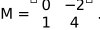
Recall from (32)
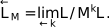
Let

where  ,
,  , and is a M-adic space. Since this substitution tiling is known to have pure discrete spectrum (see Baake et al., 1998), it admits an algebraic coincidence. By Proposition 4.4 of Lee (2007) and rewriting the substitution, if necessary, we know that there exists a substitution tiling such that
  and
and

Then, by the same argument as in Proposition 5.4,
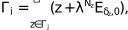
where Nz depends on z and

for some ball  of radius
  around 0 in . Let

Thus

From Proposition 5.7, we can observe that the pure discrete spectrum of gives a model set with an open and precompact window in the internal space  for the control point set . From Proposition 5.6, the measures of the boundaries of the windows are all zero.
Now let us look at another example of a constant-length substitution tiling in . This example shows that it is important to start with a control point set satisfying the containment (10).
Example 5.11. Consider a two-letter substitution defined as follows:

The expansion factor 3 and each prototile can be taken as a unit interval. Starting from  , we can expand b to the left-hand side and a to the right-hand side, applying the substitution infinite times. Then we get the following bi-infinite sequence:

We consider two prototiles Ta and Tb each of which corresponds to the letter a and the letter b. Following the sequence (59), we replace each letter by the corresponding prototile and obtain a substitution tiling which is fixed under the substitution
![[Scheme 1]](uv5005scheme1.gif)
As a representative point of each tile, if one takes the left end of each interval in the tiling, one gets two point sets  and
and  such that
  and
and  . Since
  , we can take
  . Notice in this case that the Euclidean part for the internal space is trivial and the profinite group is
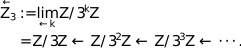
Notice that there does not exist such that

This means that neither nor can be described as a model set projected from a window whose interior is non-empty in  . However the substitution tiling has pure discrete spectrum, since it is a periodic structure. The problem here is that the control point set
  is not taken to satisfy the containment (10).
On the other hand, if we take the tile map  for which

where T = x+Ta and  with
with  and
and  , then the control point set
  is
is  and
and  . So
. So
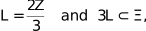
satisfying the containment (10), and the profinite group is

So

Therefore can be described as a model set.
6. Further study
In this paper, the rigid structure property of substitution tilings is used to make a connection from pure discrete spectrum to regular model sets, especially to compute the boundary measure of windows. So far, the rigid structure property is known for substitution tilings whose expansion maps (Q) are diagonalizable and the eigenvalues of Q are algebraically conjugate with the same multiplicity (Lee & Solomyak, 2012). Thus it would be useful to know some rigid structure for more general settings. If the rigidity property is precisely known for general substitution tilings, it is expected that we will be able to find the connection from pure discrete spectrum to regular model sets.
Acknowledgements
The author is sincerely grateful to the referees for their very sharp comments which helped to improve the paper. She would like to thank U. Grimm, M. Baake, F. Gähler and N. Strungaru for their important discussions at MATRIX in Melbourne where this research was initiated. She is also grateful to S. Akiyama for helpful discussions. She is indebted to R. V. Moody for his interest and valuable comments on this work.
Funding information
Funding for this research was provided by: National Research Foundation of Korea (grant No. 2019R1I1A3A01060365).
References
 Akiyama, S., Barge, M., Berthé, V., Lee, J. Y. & Siegel, A. (2015). Mathematics of Aperiodic Order, pp. 33–72, edited by J. Kellendonk, D. Lenz & J. Savinien. Progress in Mathematics, Vol. 309. Basel: Birkhäuser. Google Scholar
Baake, M. & Grimm, U. (2013). Aperiodic Order, Vol. 1. Cambridge University Press. Google Scholar
Baake, M., Lenz, D. & Moody, R. V. (2007). Ergod. Th. Dyn. Sys. 27, 341–382. Web of Science CrossRef Google Scholar
Baake, M. & Moody, R. V. (2004). J. Reine Angew. Math. 573, 61–94. Google Scholar
Baake, M., Moody, R. V. & Schlottmann, M. (1998). J. Phys. A Math. Gen. 31, 5755–5765. Web of Science CrossRef CAS Google Scholar
Baker, V., Barge, M. & Kwapisz, J. (2006). Ann. Inst. Fourier, 56, 2213–2248. Web of Science CrossRef Google Scholar
Ei, H., Ito, S. & Rao, H. (2006). Ann. Inst. Fourier, 56, 2285–2313. Web of Science CrossRef Google Scholar
Frank, N. P. & Robinson, E. A. Jr (2006). Trans. Am. Math. Soc. 360, 1163–1178. Web of Science CrossRef Google Scholar
Keesling, J. (1999). Topol. Appl. 94, 195–205. Web of Science CrossRef Google Scholar
Kenyon, R. & Solomyak, B. (2010). Discrete Comput. Geom. 43, 577–593. Web of Science CrossRef Google Scholar
Kwapisz, J. (2016). Invent. Math. 205, 173–220. Web of Science CrossRef Google Scholar
Lagarias, J. C. (1996). Commun. Math. Phys. 179, 365–376. CrossRef Web of Science Google Scholar
Lagarias, J. C. & Wang, W. (2003). Discrete Comput. Geom. 29, 175–209. Web of Science CrossRef Google Scholar
Lee, D.-I., Akiyama, S. & Lee, J.-Y. (2020). Acta Cryst. A76, 600–610. Web of Science CrossRef IUCr Journals Google Scholar
Lee, J.-Y. (2007). J. Geom. Phys. 57, 2263–2285. Web of Science CrossRef Google Scholar
Lee, J.-Y., Akiyama, S. & Nagai, Y. (2018). Symmetry, 10, 511. Web of Science CrossRef Google Scholar
Lee, J.-Y., Lenz, D., Richard, C., Sing, B. & Strungaru, N. (2020). Lett. Math. Phys. 110, 3435–3472. Web of Science CrossRef Google Scholar
Lee, J.-Y. & Moody, R. V. (2001). Discrete Comput. Geom. 25, 173–201. Web of Science CrossRef Google Scholar
Lee, J.-Y. & Moody, R. V. (2006). Ann. Henri Poincaré, 7, 125–143. Web of Science CrossRef Google Scholar
Lee, J.-Y., Moody, R. V. & Solomyak, B. (2003). Discrete Comput. Geom. 29, 525–560. Web of Science CrossRef Google Scholar
Lee, J.-Y. & Solomyak, B. (2008). Discrete Comput. Geom. 39, 319–338. Web of Science CrossRef Google Scholar
Lee, J.-Y. & Solomyak, B. (2012). Discrete Contin. Dyn. Syst. 32, 935–959. Web of Science CrossRef Google Scholar
Lee, J.-Y. & Solomyak, B. (2019). Discrete Contin. Dyn. Syst. 39, 3149–3177. Web of Science CrossRef Google Scholar
Mauduit, C. (1989). Invent. Math. 95, 133–147. CrossRef Web of Science Google Scholar
Meyer, Y. (1972). Algebraic Numbers and Harmonic Analysis. Amsterdam: North Holland. Google Scholar
Minervino, M. & Thuswaldner, J. (2014). Ann. Inst. Fourier, 64, 1373–1417. Web of Science CrossRef Google Scholar
Moody, R. V. (1997). NATO Adv. Sci. Inst. Ser. C. Math. Phys. Sci. 489, 403–441. Google Scholar
Praggastis, B. (1999). Trans. Am. Math. Soc. 351, 3315–3349. Web of Science CrossRef Google Scholar
Radin, C. & Wolff, M. (1992). Geom. Dedicata, 42, 355–360. CrossRef Web of Science Google Scholar
Schlottmann, M. (1998). Fields Institute Monographs, Vol. 10, pp. 247–264. Providence, RI: AMS. Google Scholar
Schlottmann, M. (2000). CRM Monograph Series, Vol. 13, pp. 143–159. Providence, RI: AMS. Google Scholar
Siegel, A. (2002). Lecture Notes in Mathematics, Vol. 1794, pp. 199–252. Berlin, Heidelberg: Springer. Google Scholar
Solomyak, B. (1997). Ergod. Th. Dyn. Sys. 17, 695–738. CrossRef Web of Science Google Scholar
Strungaru, N. (2017). Aperiodic Order, edited by M. Baake & U. Grimm, pp. 271–342. Encyclopedia of Mathematics and its Applications. Cambridge University Press. Google Scholar
Thurston, W. P. (1989). Groups, Tilings and Finite State Automata. Summer 1989 AMS Colloquium Lectures. Research Report GCG 1. https://timo.jolivet.free.fr/docs/ThurstonLectNotes.pdf. Google Scholar
This is an open-access article distributed under the terms of the Creative Commons Attribution (CC-BY) Licence, which permits unrestricted use, distribution, and reproduction in any medium, provided the original authors and source are cited.
| FOUNDATIONS ADVANCES |
access


