 | Acta Crystallographica Section A Acta Crystallographica Section A FOUNDATIONS AND ADVANCES |


 journal menu


research papers
| FOUNDATIONS ADVANCES |
 access
Algorithms for magnetic search and identification of magnetic from magnetic crystal structure

aDepartment of Materials Science and Engineering, Kyoto University, Sakyo, Kyoto 606-8501, Japan, bResearch and Services Division of Materials Data and Integrated System, National Institute for Materials Science, Tsukuba, Ibaraki 305-0047, Japan, cCenter for Elements Strategy Initiative for Structural Materials, Kyoto University, Sakyo, Kyoto 606-8501, Japan, and dNanostructures Research Laboratory, Japan Fine Ceramics Center, Nagoya 456-8587, Japan
*Correspondence e-mail: [email protected]
A crystal symmetry search is crucial for computational crystallography and materials science. Although algorithms and implementations for the crystal symmetry search have been developed, their extension to magnetic space groups (MSGs) remains limited. In this paper, algorithms for determining magnetic symmetry operations of magnetic crystal structures, identifying magnetic space-group types of given MSGs, searching for transformations to a Belov–Neronova–Smirnova (BNS) setting, and symmetrizing the magnetic crystal structures using the MSGs are presented. The determination of magnetic symmetry operations is numerically stable and is implemented with minimal modifications from the existing crystal symmetry search. Magnetic space-group types and transformations to the BNS setting are identified by a two-step approach combining space-group-type identification and the use of affine normalizers. Point coordinates and magnetic moments of the magnetic crystal structures are symmetrized by projection operators for the MSGs. An implementation is distributed with a permissive free software license in spglib v2.0.2: https://github.com/spglib/spglib.
Keywords: magnetic space group; magnetic space-group type; magnetic structure; crystal structure analysis; affine normalizer.
1. Introduction
A crystal symmetry search and the standardization of crystal structures play crucial roles in computational materials science. For example, symmetry operations are required in irreducible representations of electronic states (Gao et al., 2021![[Gao, J., Wu, Q., Persson, C. & Wang, Z. (2021). Comput. Phys. Commun. 261, 107760.]](../../../../../../logos/arrows/a_arr.gif "Gao, J., Wu, Q., Persson, C. & Wang, Z. (2021). Comput. Phys. Commun. 261, 107760.") ), band paths (Hinuma et al., 2017), phonon calculations (Togo & Tanaka, 2015; Togo et al., 2015), a random structure search (Fredericks et al., 2021) and crystal structure description (Ganose & Jain, 2019). Moreover, the standardization of crystal structures is indispensable for comparing crystal structures in different settings and analyzing magnetic crystal structures in high-throughput first-principles calculations (Horton et al., 2019).
), band paths (Hinuma et al., 2017), phonon calculations (Togo & Tanaka, 2015; Togo et al., 2015), a random structure search (Fredericks et al., 2021) and crystal structure description (Ganose & Jain, 2019). Moreover, the standardization of crystal structures is indispensable for comparing crystal structures in different settings and analyzing magnetic crystal structures in high-throughput first-principles calculations (Horton et al., 2019).
Owing to the development of a computer-friendly description of space groups (Hall, 1981; Shmueli et al., 2010) and algorithms (Opgenorth et al., 1998; Grosse-Kunstleve, 1999; Grosse-Kunstleve & Adams, 2002; Eick & Souvignier, 2006), we can automatically perform the crystal symmetry search nowadays. For example, spglib implements the symmetry-search algorithm and an iterative method to robustly determine crystal symmetries (Togo & Tanaka, 2018), which one of the authors has developed and maintained.
On the other hand, algorithms and implementations for magnetic space groups (MSGs) (Litvin, 2016) are limited. MSGs are essential when we consider time-reversal operations or magnetic crystal structures. To the best of our knowledge, existing implementations only partly provide MSG functionalities. AFLOW-SYM (Hicks et al., 2018) proposed and implemented a robust space-group analysis algorithm; however, it does not seem to support MSGs yet. IDENTIFY MAGNETIC GROUP (Perez-Mato et al., 2015) in the Bilbao Crystallographic Server (Aroyo et al., 2011) and CrysFML2008 (Rodríguez-Carvajal, 1993; González-Platas et al., 2021) can identify MSGs from magnetic symmetry operations; however, the determination of magnetic symmetry operations from magnetic crystal structures is not supported. FINDSYM (Stokes & Hatch, 2005; Stokes et al., 2022) supports the determination of magnetic symmetry operations and the identification of MSGs; however, the source code is not freely available.
Here, we present algorithms for determining magnetic symmetry operations of given magnetic crystal structures, identifying magnetic space-group types of given MSGs, searching for transformations to a Belov–Neronova–Smirnova (BNS) setting, and symmetrizing the magnetic crystal structures on the basis of the determined MSGs. Note that the implementation of these algorithms is virtually unattainable without recent developments in crystallography. Litvin (2014) provided extensive tables for the 1651 MSGs. ISO-MAG (https://iso.byu.edu/iso/magneticspacegroups.php) provides tables of MSGs in both human- and computer-readable formats. Magnetic Hall symbols (González-Platas et al., 2021) and unified (UNI) MSG symbols (Campbell et al., 2022) have been developed to represent MSGs or magnetic space-group types unambiguously, which are based on BNS symbols (Belov et al., 1957; Bradley & Cracknell, 2009). In this paper, we use the magnetic Hall symbols and the MSG data sets tabulated by González-Platas et al. (2021). The implementation is distributed under the BSD 3-clause license in spglib v2.0.2.
This paper is organized as follows. In Section 2, we recall the mathematical structures of MSGs and present definitions and terminology for describing MSGs. In Section 3, we provide an algorithm for determining magnetic symmetry operations of a given magnetic crystal structure on the basis of equivalence relationships between sites in the magnetic crystal structure. In Section 4, we provide an algorithm to identify a magnetic space-group type of the determined MSG and to search for a transformation from the determined MSG to one in the BNS setting. In Section 5, we provide an algorithm to symmetrize point coordinates and magnetic moments of the magnetic crystal structure from the determined MSG.
2. Definitions
Before we discuss algorithms for MSGs and magnetic crystal structures, we describe definitions and terminology for MSGs. In Section 2.1, we define MSGs and derived space groups, which are essential in identifying a magnetic space-group type and searching for a transformation between MSGs. In Section 2.2, we define equivalence relationships between MSGs. In Section 2.3, we mention BNS symbols and their settings, which specify representatives of MSGs, and we use them to standardize given MSGs. Finally, in Section 2.4, we give examples of actions of magnetic symmetry operations for magnetic moments.
2.1. MSG and its construct type
We consider a time-reversal operation  and call an index-two group generated from a time-reversal group
  , where 1 represents an identity operation. Let
  be a of a of three-dimensional Euclidean group E(3) and
  . An element
  of is called a magnetic where we call W a matrix part, w a translation part and
  a time-reversal part of the magnetic In particular,
  is called an antisymmetry operation. A translation of is defined as

where E represents the identity matrix. The is called a MSG when  is generated from three independent translations. We write a magnetic of as

We consider two derived space groups from . A family space group (FSG) of is a obtained by ignoring time-reversal parts in magnetic symmetry operations:

A maximal space subgroup (XSG) of is a obtained by removing antisymmetry operations:

The MSGs are classified into the following four construct types (Bradley & Cracknell, 2009; Campbell et al., 2022):
(Type I)  : the MSG does not have antisymmetry operations.
(Type II)  : the MSG has antisymmetry operations and corresponding ordinary symmetry operations.
(Type III)  and
and  is an index-two translationengleiche of
  . [The notation
  indicates a complement set, =
  .] Thus, translation subgroups of and are identical.
(Type IV) and is an index-two klassengleiche of . Thus, point groups of and are identical.
For a type-III MSG example, Fig. 1(a) shows an antiferromagnetic (AFM) rutile structure whose MSG is  (BNS No. 136.498) in the BNS symbol. The FSG and XSG of
  are P42/mnm (No. 136) and Pnnm (No. 58), respectively.
![[Figure 1]](ib5114fig1thm.gif) | Figure 1 Examples of antiferromagnetic (AFM) crystal structures with (a) type-III and (b) type-IV MSGs. The red arrows represent collinear spins with the same magnitudes. |
For a type-IV MSG example, Fig. 1(b) shows an AFM body-centered cubic (b.c.c.) structure whose MSG is  (BNS No. 221.97) in the BNS symbol. The FSG and XSG of
  are
are  (No. 229) and
  (No. 221), respectively.
2.2. Magnetic space-group type
We consider a transformation  between two coordinate systems specified with basis vectors
  with origin
  and basis vectors
  with origin
  . A transformation with
  is called orientation-preserving. We assume that a magnetic is transformed into
  by as
by as


We refer to the criteria to choose a representative of each space-group type as a setting. The standard ITA setting is one of the conventional descriptions for each space-group type used in the International Tables for Crystallography, Vol. A (Aroyo, 2016): unique axis b setting, cell choice 1 for monoclinic groups, hexagonal axes for rhombohedral groups and origin choice 2 for centrosymmetric groups. Similarly to space groups, each equivalent class of MSGs up to orientation-preserving transformations is called a magnetic space-group type.
2.3. BNS setting
The BNS symbol represents each magnetic space-group type (Belov et al., 1957). We refer to a setting of the BNS symbol as a BNS setting: for types-I, -II and -III MSGs, it uses the same setting as the standard ITA setting of the FSG. For a type-IV MSG, it uses that of the XSG. In Section 4, we consider standardizing a given magnetic crystal structure by applying a transformation to an MSG in the BNS setting.
2.4. Action of magnetic symmetry operations
In general, we can arbitrarily choose how magnetic symmetry operations act on objects as long as they satisfy the definition of actions. For a m, a symmetry operation  acts on m as an axial vector, and the time-reversal operation reverses the sign of m. When we choose the Cartesian coordinates for m, the matrix part of is expressed as
  in Cartesian coordinates with basis vectors . Therefore, the magnetic symmetry operations act on m as

3. Magnetic symmetry operation search
We provide a procedure to search for magnetic symmetry operations from a given magnetic represented by basis vectors, point coordinates, atomic types and magnetic moments within a Formally, our input for the magnetic search is the following four objects: (1) basis vectors of its lattice , (2) an array of point coordinates of sites in its unit cell  , (3) an array of atomic types of sites in its unit cell
  , and (4) an array of magnetic moments of sites in its unit cell
  , where N is the number of sites in the unit cell.
We search for a magnetic  that preserves the magnetic
  . Therefore, the symmetry operation g should map point coordinates
  into
into  up to translations, where
  is a permutation of N sites induced by g. Also,
  should equate a
  with a mapped one
  . Such a magnetic symmetry operation forms an MSG of the magnetic crystal structure as a stabilizer of
  ,
,
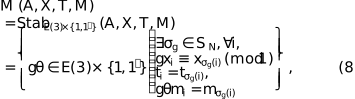
where  is a symmetric group of degree N. [We recall that the condition of
  in equation (8) can be read as there exists a permutation such that point coordinates, atomic types and magnetic moments are preserved for every site i.]
Because the domain of the symmetry operation g in equation (8) is not restricted, we cannot search thoroughly for g at this point. To narrow down the candidates for g, we consider a crystal structure  obtained by ignoring the magnetic moments of . A space group of is written as a of
  that preserves :
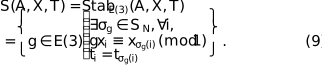
As shown in Fig. 2,  may not be a of in general because the former ignores magnetic moments. Because time-reversal operations do not change point coordinates and atomic types, we can restrict the domain of symmetry operations g to ,
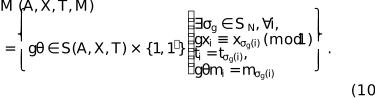
The symmetry operations for can be obtained from existing crystal symmetry search algorithms such as those of Stokes & Hatch (2005), Togo & Tanaka (2018) and Hicks et al. (2018).
![[Figure 2]](ib5114fig2thm.gif) | Figure 2 Group–subgroup relationship of MSGs and related space groups. The nodes represent space groups or MSGs. Each edge indicates that a lower group is a subgroup of an upper group in the diagram. Although it is not exploited in this study, the XSG  is a of the FSG is a of the FSG  because the latter simply ignores time-reversal parts of . because the latter simply ignores time-reversal parts of . |
Based on the formulation of the MSG in equation (10), we can search for magnetic symmetry operations using the following procedure:
(i) We compute by the existing crystal symmetry search algorithms.
(ii) If all magnetic moments are zero, both g1 and  belong to for all
  and we skip the remaining steps (in this case, the MSG is type II). Otherwise, we choose a site
  with a non-zero
  .
.
(iii) For each symmetry operation , we search for the time-reversal part as follows:
(a) We compute a permutation and solve

for . We denote the solution of equation (11) as  if it exists. If the solution does not exist, we skip the g.
(b) We check if the condition  holds for other sites. If the condition holds for all sites,
  belongs to
  .
.
Note that the comparison of point coordinates and magnetic moments should be performed within tolerances in practice (Grosse-Kunstleve et al., 2004). We use an absolute tolerance parameter ε for point coordinates (Togo & Tanaka, 2018) and another absolute tolerance  for magnetic moments. Then, the comparisons in this section are replaced with the following inequalities:


Here,  takes a remainder with modulo one in the range
  .
.
4. Identification of magnetic space-group type and transformation to BNS setting
For the detected MSG  in the previous section, we provide an algorithm to identify its magnetic space-group type and search for a transformation from to a magnetic space-group representative
  in the BNS setting. The algorithms presented in this section are applied to a list of magnetic symmetry operations in the matrix form either obtained through the magnetic search in Section 3 or provided from outside the software package as predetermined operations.
For all the 1651 magnetic space-group types, a magnetic space-group representative in the BNS setting has already been tabulated (González-Platas et al., 2021; Campbell et al., 2022). Thus, we search for with the same magnetic space-group type as and an orientation-preserving transformation while satisfying

In Section 4.1, we identify a construct type of to choose a candidate , which is one of the magnetic space-group representatives in the BNS setting. In Section 4.2, we try to obtain from affine normalizers of  or
or  .
.
4.1. Identification of construct type of MSG
The construct type of can be determined from orders of the magnetic and point groups of FSG and XSG. We write a of  as
as

When  , is type I or II. Then, when
  , is type I. When
  , is type II.
When  , is type III or IV. For a type-III or type-IV MSG, we consider a decomposition of by :

If the coset representative  can be taken as an anti-translation, is a klassengleiche of and is type IV. If not, is a translationengleiche of and is type III.
4.2. Transformation of MSG to BNS setting
For each magnetic space-group representative with the same construct type as , we consider searching for from two consecutive transformations  and
and  with
with

as described below. If such a transformation is found, belongs to the same magnetic space-group type as .
We rewrite equation (14) to an equivalent one in terms of derived space groups because we would like to use an existing transformation search algorithm to obtain a transformation between space groups with the same space-group type proposed by Grosse-Kunstleve (1999). As shown in Appendix A, the condition of equation (14) is equivalent to satisfying the following two conditions:


Note that a transformation satisfying equation (18a) does not necessarily satisfy equation (18b) in general, and vice versa.
The present algorithm, based on the new conditions, is outlined as follows. First, we obtain a temporal transformation  to match FSGs or XSGs of and by the existing transformation search algorithm. Then, we search for a correction transformation
  to match FSGs and XSGs simultaneously.
We divide the transformation search into cases by the construct type of in more detail.
4.2.1. When is type I or II
When is type I or II, with the same construct type as uses the standard ITA setting of . Thus, we need to obtain an orientation-preserving transformation such that  . The temporal transformation can be obtained by the existing transformation search algorithm. We write an MSG transformed by as

By construction,  and are identical as sets,
  .
.
In this case, the XSGs are also identical to one another,  =
=  = = . Thus, we do not need to search for a correction transformation because also satisfies
  =
=  .
.
4.2.2. When is type III
When is type III, with type III uses the standard ITA setting of . Thus, we need to obtain an orientation-preserving transformation such that  =
=  . Then, the FSG of the transformed MSG in equation (19), , is the space-group representative in the standard ITA setting.
A correction transformation should satisfy the following conditions to simultaneously satisfy equations (18a) and (18b),


The condition of equation (20a) indicates that belongs to an affine of (Koch et al., 2016). The situation is shown in Fig. 3(a), where we write the affine normalizer of a space group as

and the three-dimensional affine group as  . If a correction transformation
  satisfies equation (20b), the combined transformation in equation (17) transforms to .
![[Figure 3]](ib5114fig3thm.gif) | Figure 3 Group–subgroup relationship of conjugated MSGs and affine normalizers. |
Finally, we describe how to prepare transformations in the affine  in practice. Because is a of , an operation in does not give another conjugated of . Also, although the affine normalizer may have continuous translations, the continuous translations do not give another conjugated subgroup of . Thus, it is sufficient to consider coset representatives of
  other than continuous translations. We divide the affine computation into cases according to whether the number of representatives other than continuous translations is finite or not.
When is triclinic or monoclinic, the number of representatives other than continuous translations is infinite and we cannot check transformations thoroughly. However, there are no such conjugate space groups with  because
  does not have a pair of proper conjugate subgroups in its affine Therefore, we do not need to compute the affine in this case.
When belongs to other crystal systems, the number of representatives other than continuous translations is finite. To simplify the present algorithm and implementation, instead of using a list of affine normalizers as given by Koch et al. (2016), we enumerate matrix parts and origin shifts of orientation-preserving transformations in the coset representatives other than continuous translations as follows. For matrix parts, we enumerate integer matrices  whose elements are −1, 0 or 1, and their determinants are equal to one. For origin shifts, we enumerate vectors
  by restricting their vector components to one of
  . These will be sufficient because they cover all orientation-preserving coset representatives of
  up to translations (Koch et al., 2016). Since can be tabulated for each space-group representative in the standard ITA setting, we can precompute them before performing the transformation search in practice.
4.2.3. When is type IV
When is type IV, with type IV uses the standard ITA setting of . Thus, we need to obtain an orientation-preserving transformation such that  = . Then, the XSG of the transformed MSG in equation (19), , is the space-group representative in the standard ITA setting.
Similarly to type-III MSGs, we need to search for an orientation-preserving transformation 
 such that

The situation is shown in Fig. 3(b). [The FSG is a of : because is a of , every operation in stabilizes and belongs to . Similarly, is a of .]
When is neither triclinic nor monoclinic, the brute-force tabulation in Section 4.2.2 also works for . For triclinic and monoclinic cases, a factor group  is not finite, and we cannot prove the completeness in the same manner. Thus, we show that the enumerated covers all conjugated type-IV MSGs by explicitly listing and the conjugated MSGs in Appendix B.
4.2.4. Examples of conjugated MSGs
We present examples of conjugated MSGs for type III and type IV. For a type-III MSG example, consider representatives of for  in the BNS setting (BNS No. 17.10) as follows:

There is another MSG  with the same magnetic space-group type as and identical FSG to :

Although and belong to the same space-group type (No. 3), these XSGs are different. The following transformation maps to while satisfying equation (20b):

For a type-IV MSG example, consider coset representatives of for Ccc in the BNS setting (BNS No. 9.40) as follows:
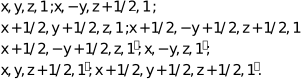
There is another MSG with the same magnetic space-group type as and identical XSG to :
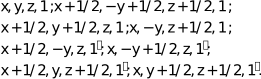
Although and belong to the same space-group type (No. 8), these FSGs are different. The following transformation maps to while satisfying equation (22):

5. Symmetrization of magnetic crystal structure
We symmetrize the magnetic by magnetic symmetry operations of the determined MSG . For convenience, we consider its coset decomposition with a finite index as follows. Let  be a translation group formed by basis vectors
  , which may not be primitive basis vectors. We write a coset decomposition of by as

We write the set of coset representatives as

A centering operation  , where
  , may belong to
  .
.
A procedure to symmetrize the array of point coordinates  by is essentially the same as those used by Grosse-Kunstleve & Adams (2002) and Togo & Tanaka (2018). For the κth magnetic symmetry operation
  , we denote that its inverse maps the
  th point coordinates to the ith point coordinates. Then,
  should be close to up to lattice translations in . With this observation, each of the point coordinates can be symmetrized to
  by a projection operator:

The modulo is required because the original and mapped point coordinates in the unit cell may be displaced by lattice translations.
A procedure to symmetrize the array of magnetic moments  is similar to that to symmetrize the array of point coordinates. Each can be symmetrized to
  by the following projection operator:

6. Conclusion
We have presented the algorithms for determining magnetic symmetry operations for a given magnetic identifying a magnetic space-group type for a given MSG, searching for a transformation to the BNS setting, and symmetrizing the magnetic on the basis of the determined MSG. Matrix and translation parts of magnetic symmetry operations are determined from the by ignoring magnetic moments. A transformation between the determined MSG and a BNS-setting MSG is obtained by considering affine normalizers: that of the FSG for type-III MSGs and that of the XSG for type-IV MSGs. In particular, we provide exhaustive tables of conjugated MSGs with triclinic or monoclinic type-IV MSGs in the BNS setting and corresponding transformations. Projection operators of the determined MSG symmetrize point coordinates and magnetic moments of the magnetic These algorithms are designed comprehensively and implemented in spglib under the BSD 3-clause license. The present algorithms and their implementations are expected to contribute to computational crystallography and materials science, including high-throughput first-principles calculations and predictions.
APPENDIX A
The condition that two MSGs are identical
For two MSGs  and
and  , we write the FSG and XSG of
  as
as  and
and  , respectively. When and have the same construct types, they are identical if and only if their FSGs and XSGs are also identical, that is,
  and
and  . Although it is trivial, we give proof of this fact for completeness.
When and are identical, their FSGs and XSGs are also identical by definition. We check the converse for each construct type. For type-I MSGs, =  =
=  = . For type-II MSGs, =
  =
=  = . For type-III or type-IV MSGs, =
  =
=  = . Thus, if FSGs and XSGs are identical, the two MSGs are also identical.
APPENDIX B
Correction transformations for triclinic or monoclinic type-IV MSGs
We give all anti-translations in conjugated MSGs and corresponding transformations for a type-IV MSG in the BNS setting, where is triclinic or monoclinic. Because an anti-translation  in a type-IV MSG is index-two up to translations, it is sufficient to consider the following seven anti-translations:







When is a triclinic or monoclinic P-centering space group (Nos. 1, 2, 3, 4, 6, 7, 10, 11, 13 and 14), Tables 1, 2 and 4 show transformations for , which are obtained by the brute force described in Section 4.2.2, and anti-translations in the transformed MSGs. Because each table contains the seven anti-translations, we confirm that these transformations are sufficient to search for conjugated type-IV MSGs.
For other cases, is a monoclinic C-centering space group (Nos. 5, 8, 9, 12 and 15). Tables 3, 5 and 6 show transformations for and anti-translations in the transformed MSGs. Note that the anti-translation  should not be contained in the conjugated MSGs because is not type II and is C-centering. Then, each table contains the six anti-translations other than . Thus, we also confirm that these transformations are sufficient.
| |||||||||||||||||||||||














| |||||||||||||||||||||||||


| ||||||||||||||||

| |||||||||||||||||||||||||||
| ||||||||||||||||

| ||||||||||||||||

Acknowledgements
We thank Juan Rodríguez-Carvajal for providing magnetic space-group data sets tabulated by González-Platas et al. (2021).
Funding information
The following funding is acknowledged: Japan Society for the Promotion of Science (grant No. 21J10712 to Kohei Shinohara).
References
 Aroyo, M. I. (2016). Editor. International Tables for Crystallography, Vol. A, 6th ed. Chichester: Wiley. Google Scholar
Aroyo, M. I., Perez-Mato, J. M., Orobengoa, D., Tasci, E., de la Flor, G. & Kirov, A. (2011). Bulg. Chem. Commun. 43, 183–197. CAS Google Scholar
Belov, N. V., Neronova, N. N. & Smirnova, T. S. (1957). Sov. Phys. Crystallogr. 2, 311–322. Google Scholar
Bradley, C. & Cracknell, A. P. (2009). The Mathematical Theory of Symmetry in Solids. Oxford Classic Texts in the Physical Sciences. London: Oxford University Press. Google Scholar
Campbell, B. J., Stokes, H. T., Perez-Mato, J. M. & Rodríguez-Carvajal, J. (2022). Acta Cryst. A78, 99–106. Web of Science CrossRef IUCr Journals Google Scholar
Eick, B. & Souvignier, B. (2006). Int. J. Quantum Chem. 106, 316–343. Web of Science CrossRef CAS Google Scholar
Fredericks, S., Parrish, K., Sayre, D. & Zhu, Q. (2021). Comput. Phys. Commun. 261, 107810. Web of Science CrossRef Google Scholar
Ganose, A. M. & Jain, A. (2019). MRS Commun. 9, 874–881. Web of Science CrossRef CAS Google Scholar
Gao, J., Wu, Q., Persson, C. & Wang, Z. (2021). Comput. Phys. Commun. 261, 107760. Web of Science CrossRef Google Scholar
González-Platas, J., Katcho, N. A. & Rodríguez-Carvajal, J. (2021). J. Appl. Cryst. 54, 338–342. Web of Science CrossRef IUCr Journals Google Scholar
Grosse-Kunstleve, R. W. (1999). Acta Cryst. A55, 383–395. Web of Science CrossRef CAS IUCr Journals Google Scholar
Grosse-Kunstleve, R. W. & Adams, P. D. (2002). Acta Cryst. A58, 60–65. Web of Science CrossRef CAS IUCr Journals Google Scholar
Grosse-Kunstleve, R. W., Sauter, N. K. & Adams, P. D. (2004). Acta Cryst. A60, 1–6. Web of Science CrossRef CAS IUCr Journals Google Scholar
Hall, S. R. (1981). Acta Cryst. A37, 517–525. CrossRef CAS IUCr Journals Web of Science Google Scholar
Hicks, D., Oses, C., Gossett, E., Gomez, G., Taylor, R. H., Toher, C., Mehl, M. J., Levy, O. & Curtarolo, S. (2018). Acta Cryst. A74, 184–203. Web of Science CrossRef IUCr Journals Google Scholar
Hinuma, Y., Pizzi, G., Kumagai, Y., Oba, F. & Tanaka, I. (2017). Comput. Mater. Sci. 128, 140–184. Web of Science CrossRef CAS Google Scholar
Horton, M. K., Montoya, J. H., Liu, M. & Persson, K. A. (2019). npj Comput. Mater. 5, 64. Web of Science CrossRef Google Scholar
Koch, E., Fischer, W. & Müller, U. (2016). International Tables for Crystallography, edited by M. I. Aroyo, Vol. A, ch. 3.5, 6th ed., pp. 826–851. Chichester: Wiley. Google Scholar
Litvin, D. B. (2014). Magnetic Group Tables. IUCr, https://www.iucr.org/publ/978-0-9553602-2-0. Google Scholar
Litvin, D. B. (2016). International Tables for Crystallography, edited by M. I. Aroyo, Vol. A, ch. 3.6, 6th ed., pp. 852–865. Chichester: Wiley. Google Scholar
Opgenorth, J., Plesken, W. & Schulz, T. (1998). Acta Cryst. A54, 517–531. Web of Science CrossRef CAS IUCr Journals Google Scholar
Perez-Mato, J., Gallego, S., Tasci, E., Elcoro, L., de la Flor, G. & Aroyo, M. (2015). Annu. Rev. Mater. Res. 45, 217–248. CAS Google Scholar
Rodríguez-Carvajal, J. (1993). Physica B, 192, 55–69. Google Scholar
Shmueli, U., Hall, S. & Grosse-Kunstleve, R. (2010). International Tables for Crystallography, edited by U. Shmueli, Vol. B, ch. 1.4, 3rd ed., pp. 114–174. Chichester: Wiley. Google Scholar
Stokes, H. T. & Hatch, D. M. (2005). J. Appl. Cryst. 38, 237–238. CrossRef CAS IUCr Journals Google Scholar
Stokes, H. T., Hatch, D. M. & Campbell, B. J. (2022). Findsym. https://stokes.byu.edu/iso/findsym.php. Google Scholar
Togo, A., Chaput, L. & Tanaka, I. (2015). Phys. Rev. B, 91, 094306. Web of Science CrossRef Google Scholar
Togo, A. & Tanaka, I. (2015). Scr. Mater. 108, 1–5. Web of Science CrossRef CAS Google Scholar
Togo, A. & Tanaka, I. (2018). Spglib: a Software Library for Crystal Symmetry Search. https://github.com/spglib/spglib. Google Scholar
This is an open-access article distributed under the terms of the Creative Commons Attribution (CC-BY) Licence, which permits unrestricted use, distribution, and reproduction in any medium, provided the original authors and source are cited.
| FOUNDATIONS ADVANCES |
access


