 | Acta Crystallographica Section A Acta Crystallographica Section A FOUNDATIONS AND ADVANCES |


 journal menu


research papers
| FOUNDATIONS ADVANCES |
Algorithm for spin search

aDepartment of Materials Science and Engineering, Kyoto University, Sakyo, Kyoto 606-8501, Japan, bCenter for Basic Research on Materials, National Institute for Materials Science, Tsukuba, Ibaraki 305-0047, Japan, cResearch Center for Advanced Science and Technology, University of Tokyo, Meguro-ku, Tokyo 153-8904, Japan, dCenter for Elements Strategy Initiative for Structural Materials, Kyoto University, Sakyo, Kyoto 606-8501, Japan, eNanostructures Research Laboratory, Japan Fine Ceramics Center, Nagoya 456-8587, Japan, and fRIKEN, Center for Emergent Matter Science, Saitama 351-0198, Japan
*Correspondence e-mail: [email protected]
A spin provides a suitable way of fully exploiting the symmetry of a spin arrangement with a negligible spin–orbit coupling. There has been a growing interest in applying spin symmetry analysis with the spin in the field of magnetism. However, there is no established algorithm to search for spin symmetry operations of the spin This paper presents an exhaustive algorithm for determining the spin symmetry operations of commensurate spin arrangements. The present algorithm searches for spin symmetry operations from the symmetry operations of a corresponding nonmagnetic and determines their spin-rotation parts by solving a Procrustes problem. An implementation is distributed under a permissive free software license in spinspg Version 0.1.1, available at https://github.com/spglib/spinspg.
Keywords: spin space groups; spin symmetry operations; spin arrangements; Procrustes problems; Hermite normal forms.
1. Introduction
When the spin–orbit coupling (SOC) is negligible, a spin is an appropriate concept for full exploitation of the symmetry of a corresponding spin arrangement (Litvin & Opechowski, 1974 ; Opechowski, 1986; Yang et al., 2021; Liu et al., 2022). The spin arrangement comprises a crystal structure and magnetic moments. A spin symmetry operation of the spin space group is assumed to act on the spatial and spin coordinates simultaneously, generalizing a magnetic symmetry operation of a magnetic space group. The spin space group was first introduced to analyze an extra symmetry of a spin Hamiltonian for neutron scattering experiments (Brinkman & Elliott, 1966; Brinkman et al., 1966) and has recently been applied to the field of magnetism (Šmejkal et al., 2022b); for example, an analysis of a symmetry-adapted tensor of transport properties with negligible SOC (Železný et al., 2017; Zhang et al., 2018), symmetries of a spin Hamiltonian (Zelenskiy et al., 2022), magnon band structure (Corticelli et al., 2022) and classification of antiferromagnetism (Šmejkal et al., 2022a).
When we consider spin space groups of given spin arrangements, we must first exhaustively search for their spin symmetry operations. To the best of our knowledge, there is no rigorous algorithm to search for spin symmetry operations. Therefore, the development of such an algorithm and its implementation would benefit spin symmetry analysis.
There are a few differences between spin space groups and magnetic space groups in terms of symmetry search algorithms. First, a spin space group may contain nontrivial operations acting only on spin coordinates, called a spin-only group, which complicates the group structure of the spin space group. Second, although we only need to consider at most double enlarged cells for magnetic space groups, the unit-cell size may arbitrarily change between a spin arrangement and its nonmagnetic correspondence. Lastly, spin rotations, which simultaneously act on magnetic moments, do not have to belong to a crystallographic point group.
Here, we present a rigorous and robust algorithm for determining the spin symmetry operations of a given commensurate spin arrangement, extending our magnetic symmetry operation search algorithm (Shinohara et al., 2023). The present algorithm fully exploits the group structure of the spin space groups and outputs spin symmetry operations as a coset decomposition of the spin space group, based on the seminal work by Litvin and Opechowski (Litvin, 1973, 1977; Litvin & Opechowski, 1974). We explicitly denote basis vectors of space groups and spin space groups, and employ a lattice algorithm to deal with the case when the unit-cell size varies with and without magnetic moments. We search for the spin-rotation parts from three-dimensional orthogonal groups by solving a well known optimization problem called a Procrustes problem (Gower & Dijksterhuis, 2004). Note that we restrict the present algorithm to commensurate spin arrangements in order to use similar inputs and outputs to an existing space-group search implementation (Togo & Tanaka, 2018). The implementation is distributed under the BSD 3-clause license in spinspg Version 0.1.1 on top of a crystal symmetry search algorithm (Togo & Tanaka, 2018). For magnetic crystal structures tabulated in MAGNDATA (Gallego et al., 2016), the present algorithm and implementation have been used to identify physical properties free from SOC (Watanabe et al., 2023).
This paper is organized as follows. In Section 2 we give definitions of spin space groups and their derived groups. In Section 3 we provide an algorithm for determining a spin-only group, spin translation group and spin of a given spin arrangement. In Section 4 we demonstrate the present spin search applied to the spin arrangement of an NiAs-type CrSe. The notations and terminology in this paper are summarized in Table 1.
| ||||||||||||||||||||||||||||||||||||||||||||||||||||||||||||||||||||||||||||||||||||||||||||||||||||||||||












2. Group structure of a spin space group
We provide the definitions of spin symmetry operations and spin arrangements in Section 2.1. We define the spin space group in Section 2.2 and then introduce its derived groups, the spin-only group (Section 2.3) and spin translation group (Section 2.4). Although these groups were already discussed by Litvin (1973, 1977) and Litvin & Opechowski (1974), we consider it beneficial to summarize these results here because we fully exploit the group structure of the spin space group in searching for spin symmetry operations.
We note that spin-only groups and spin translation groups complicate the group structure of the spin space groups. For example, a spin point group, which ignores the translation parts of the spin symmetry operations of a spin space group, cannot be computed without going through the spin space group due to the existence of a nontrivial spin translation group in general. Although the analysis of spin point groups is not required to determine spin symmetry operations, we discuss the group structure of spin point groups in Appendix B for completeness.
2.1. Spin symmetry operation and spin arrangement
A spin symmetry operation comprises a spatial operation in the three-dimensional Euclidean group E(3) and a spin rotation in the three-dimensional orthogonal group O(3). The spin (g, W) ∈ E(3) × O(3) acts on a pair of position r and magnetic moments m as

The product of two spin symmetry operations (g, W) and (g′, W′) is defined as

Although uncommon in crystallography, we suppose both g and W to be represented with Cartesian coordinates for later convenience. We denote the basis vectors

When g with a matrix part R and a translation part v are represented by A, we explicitly write  , where
  and
and  . A spin arrangement is a set of pairs of a and magnetic moments.
2.2. Spin space group
Let  be a of E(3) × O(3). When the following
  and
and  are space groups, is called a spin space group (Litvin & Opechowski, 1974),


where E stands for the identity matrix. For a spin , we call a family space group and a maximal space subgroup. The maximal space subgroup is a of . In contrast, the family space group is not a of  in general. Although Litvin & Opechowski (1974) did not impose the condition that be crystallographic, we do impose this condition here to guarantee that a given spin arrangement is commensurate. We confine our discussion and algorithms to commensurate spin arrangements.
A spin (g, W) is transformed by a transformation (P, p) on the spatial coordinates and a transformation matrix Q on the spin coordinates as

Two spin space groups  and
and  belong to the same spin space-group type if they are transformed into each other by a pair of an orientation-preserving transformation (P, p) on the spatial coordinates and a transformation matrix Q on the spin coordinates; a transformation (P, p) is called orientation preserving if
  .
.
In the spin space group, we can consider rotating magnetic moments independently with spatial coordinates. On the other hand, we consider rotating magnetic moments only in association with spatial rotations and time-reversal operations in the magnetic space group (Litvin, 2014). Thus, the spin space group can be regarded as a supergroup of the magnetic space group under an appropriate correspondence between spin symmetry operations and magnetic symmetry operations, as discussed in Appendix A.
2.3. Spin-only group
A spin-only group of a spin is a set of spin symmetry operations of with identity spatial operations,

Denoting a trivial group, consisting of a single element, as 1, the direct product of an identity in spatial coordinates and  ,
,  , is a subgroup of .
2.4. Spin translation group
A spin translation group of a spin is a set of spin symmetry operations with identity rotations in spatial coordinates,

Litvin (1973) classified the spin translation groups under the transformation in equation (6).
We denote a translation subgroup and a point group of space group  as
as  and
and  , respectively,


Then, the spin-only group and translation of are a of  . Because
 , their direct product
  is also a of . Thus, we can consider a factor group
  , which is finite for commensurate spin arrangements. Finally, is a of . The factor group
  is isomorphic to
  and thus finite.
3. Spin symmetry operation search
We provide an algorithm to search for spin symmetry operations from a given spin arrangement represented by the following four objects: (i) basis vectors of its lattice A = (a1, a2, a3), (ii) an array of point coordinates of sites in its unit cell X =  , (iii) an array of atomic types of sites in its unit cell T =
  , and (iv) an array of magnetic moments of sites in its unit cell M =
  , where N is the number of sites in the unit cell.
To search for spin symmetry operations robustly, comparisons of point coordinates and magnetic moments should be performed within tolerances in practice. We adopt the same absolute tolerance parameter for point coordinates as Togo & Tanaka (2018). For magnetic moments, we use another tolerance parameter εmag to identify that two magnetic moments Wmi and  are equal to each other if

The present algorithm extends our previous work on detecting magnetic symmetry operations (Shinohara et al., 2023). We first consider a space group of a nonmagnetic crystal structure (A, X, T) in Section 3.1. Next, we search for normal subgroups of the spin space group: the spin-only group in Section 3.2 and the translation  in Section 3.3. With these normal subgroups of , we search for coset representatives of the spin translation group
 in Section 3.4. We search for coset representatives of the spin space group in Section 3.5. Because the notation in this section is abstract to deal unambiguously with several basis vectors, it may be helpful to read it alongside the examples in Section 4.
3.1. Space group of a nonmagnetic crystal structure
A candidate for spatial operations of can be derived from symmetry operations of a (A, X, T) ignoring the magnetic moments. We also employ the space group  given as a of E(3) preserving (A, X, T):

where  is a symmetric group of degree N. Note that maps point coordinates xi to
  . The mapped point coordinates coincide with point coordinates in X up to modulo one, inducing permutation σg.
The existing crystal symmetry search algorithm (Togo & Tanaka, 2018) can find primitive basis vectors  of
of  and decomposition of over
  , where we write a translation subgroup formed by A as

The input basis vector A can be represented as an integer linear combination of . Thus, an integer matrix  exists such that
  . The translation subgroup
  is decomposed as

where  is a centering vector in a spanned by A. The coset decomposition of is written as

Here,  is a translation part of a with a matrix part
  .
.
For the spin arrangement (A, X, T, M), the spin space group can be expressed as a stabilizer of  that preserves (A, X, T, M),

This expression serves as the starting point for the spin symmetry operation search. For notation simplicity, we denote the maximal space subgroup of as  .
.
3.2. Spin-only group search
Because a in the spin-only group of does not change the order of point coordinates, the spin-only group of (A, X, T, M) is expressed as

As shown in Table 2, when a spin space group is a of a spin arrangement, spin-only groups are classified into four types up to transformations (Litvin & Opechowski, 1974; Liu et al., 2022): nonmagnetic, collinear, coplanar and non-coplanar spin arrangements.
| ||||||||||||||||||||

In Section 3.2.1 we provide an algorithm for detecting  using the eigenvalue decomposition of MMT. The spin-only group search should be performed within tolerances for magnetic moments in practice. In fact, selecting appropriate tolerances is challenging. In Section 3.2.2 we propose a robust algorithm, building on the previous section, to alleviate this difficulty.
3.2.1. Spin-only group search by eigenvalue decomposition
We consider a moment tensor of  ,
,

Because MMT is a symmetric semi-definite matrix, we can consider its eigenvalue decomposition,

where σ1 ≥ σ2 ≥ σ3 ≥ 0 and  are orthonormal.
The spin-only group is classified based on the eigenvalues  , as summarized in Table 2. In a nonmagnetic spin arrangement, all magnetic moments are zero. In this case, all eigenvalues are zero, σ1 = σ2 = σ3 = 0. In a collinear spin arrangement, all magnetic moments align parallel or antiparallel to a direction
  . The eigenvector
  with the largest eigenvalue should be parallel or antiparallel to , and the other eigenvalues σ2 and σ3 should be zero. In a coplanar spin arrangement, all magnetic moments align perpendicular to a direction
  . In this case, the eigenvector
  with the smallest eigenvalue should be parallel or antiparallel to and the smallest eigenvalue σ3 should be zero. In other cases, the spin arrangement is non-coplanar. Note that the site order of magnetic moments M does not affect the classification because MMT in equation (18) remains invariant under a permutation of the site order.
3.2.2. Numerically robust spin-only group search
The spin-group search algorithm in the previous section requires a judgment on whether the eigenvalues are zero or positive, which needs an additional tolerance parameter. To reduce the number of tolerance parameters for usability, we modify the spin-group search algorithm solely with the tolerance εmag in equation (11) as follows.
(i) We compute the eigenvalues σi and eigenvectors  in equation (19).
(ii) If all magnetic moments are close to zero within εmag,

the spin arrangement is nonmagnetic.
(iii) If not, we check whether the eigenvector is a parallel or antiparallel direction for all magnetic moments,

When spin symmetry operations in a collinear spin-only group prescribed by a direction act on mi, the acted-on magnetic moments draw a cone, as shown in Fig. 1(a). The left-hand side of the above inequality is the largest displacement between the acted-on magnetic moments, which corresponds to the diameter of the cone with direction . If the inequality holds for all magnetic moments, the spin arrangement is collinear.
![[Figure 1]](ib5119fig1thm.gif) | Figure 1 Magnetic moments acted on by (a) collinear and (b) coplanar spin-only groups. (a) A collinear spin-only group along the axis is generated from rotations along and mirror operations preserving . The red dotted line indicates the largest displacement between magnetic moments acting on the collinear spin-only group. (b) A coplanar spin-only group along the axis is generated from a mirror operation perpendicular to . The red dotted line indicates the largest displacement between magnetic moments acting on the coplanar spin-only group. |
(iv) If not, we check whether the eigenvector is a perpendicular direction for all magnetic moments,

The left-hand side of the above inequality is the largest displacement between magnetic moments acted on by a coplanar spin-only group along , as shown in Fig. 1(b). If the inequality holds for all magnetic moments, the spin arrangement is coplanar.
(v) Otherwise, the spin arrangement is non-coplanar.
3.3. Translation subgroup search
We search for vectors  of the translation
  . The group–subgroup relationships of translation subgroups are shown in Fig. 2. Because
  is between and ,
  , we only need to examine finite coset representatives of
  for candidates of
  . For every coset
  in equation (14), we check whether
  preserves magnetic moments M,

![[Figure 2]](ib5119fig2thm.gif) | Figure 2 The group–subgroup relationship of translation subgroups and space groups derived from a spin space group. The nodes represent translation subgroups and space groups. Each edge indicates that a lower group is a subgroup of an upper group in the diagram. Note that  could be a proper of . could be a proper of . |
An integer matrix  exists such that
  . A lattice algorithm to generate V from centering vectors in equation (23) is presented in Appendix C.
3.4. Spin translation group search
We can find a spin rotation W for a given  by solving a Procrustes problem (Gower & Dijksterhuis, 2004) as follows. We write magnetic moments permuted by g as

where σg is a permutation of N sites induced by g. Rather than directly searching for W ∈ O(3) such that  = , we choose a candidate
  by solving the following Procrustes problem:

Here the displacement between the magnetic moments and those operated on by (g, W) is measured by the Frobenius norm ∥·∥F. The solution to equation (25) can be explicitly written as

where Y and Z are orthogonal matrices of the singular value decomposition of MgMT,

After we obtain ,  is taken as a spin if the condition

holds for every site i. If equation (28) does not hold for some site i, we reject as a spin symmetry operation.
For representatives of  , we search for a corresponding spin rotation
  using the above algorithm if it exists. The decomposition of
  can be written as

where  takes a distinct translation up to and we choose
  .
.
3.5. Spin space-group search
Because the translation of is , the spatial operation parts of should belong to a maximal  of with its translation . Fig. 2 shows the group–subgroup relationship between and . A rotation
  is compatible with if
  is an integer matrix (Hart & Forcade, 2008). Thus, the compatible subgroup is written as
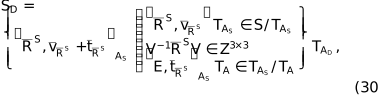
where  is a centering vector in . The additional centering vector is necessary for to form a group (Nebe, 2011; Stokes & Campbell, 2017).
For a coset representative of  , a corresponding spin-rotation part
  can also be determined by solving the Procrustes problem as presented in Section 3.4. Finally, we obtain all spin symmetry operations in a coset decomposition,
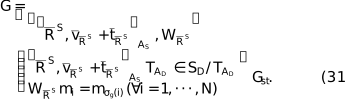
4. Examples of spin symmetry operation search
We consider a spin arrangement of the NiAs-type CrSe (Corliss et al., 1961; Litvin, 1973) [entry No. 2.35 of MAGNDATA (Gallego et al., 2016)] as an example of a spin symmetry operation search, illustrated in Fig. 3. The hexagonal lattice of CrSe has the following basis vectors:
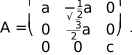
The fractional coordinates and magnetic moments of the atoms are as follows:












Here, the magnetic moments are represented with Cartesian coordinates.
![[Figure 3]](ib5119fig3thm.gif) | Figure 3 A spin arrangement example for NiAs-type CrSe. The gray and orange balls represent Cr and Se atoms, respectively. The red arrows denote magnetic moments of Cr atoms with equal magnitudes. |
4.1. Space group of a nonmagnetic crystal structure
The space-group type of for the ignoring magnetic moments is P63/mmc (No. 194). One of the vectors A for and the transformation matrix U are
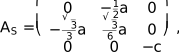
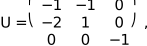
with as defined in Section 3.1. There are three coset representatives for ,
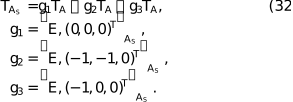
4.2. Spin-only group
The moment tensor of M is given by
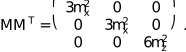
Its eigenvalues 3mx2, 3mx2 and 6mz2 are all positive. Consequently, the spin arrangement is non-coplanar with = 1.
4.3. Translation subgroup of a maximal space subgroup
The translation g1 in equation (32) belongs to . On the other hand, g2 does not belong to because it maps x1 to x3, whereas m1 ≠ m3. Similarly, g3 does not belong to . Therefore, is identical to with as defined in Section 3.3 and we can choose V = E.
4.4. Coset representatives of a spin translation group
There are three candidates for the spatial operation parts of representatives of : g1, g2 and g3. For translation g1 in equation (32), we obtain
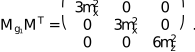
From the singular value decomposition of  , we calculate the spin-rotation part
  for g1 as
  . For translation g2, the singular value decomposition of
  is
is
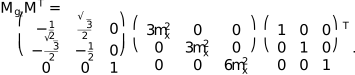
Hence, a candidate for a spin-rotation part with g2 is
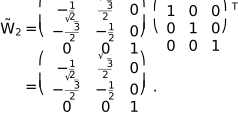
Similarly, a candidate for a spin-rotation part with g3 is
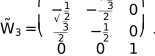
The spin symmetry operations  (i = 1, 2, 3) all preserve magnetic moments. Consequently, the spin translation group is obtained as

4.5. Coset representatives of a spin space group
Because and coincide in this example, is fully compatible with ,  . For the 24 coset representatives of , we search for their spin-rotation parts by solving the Procrustes problems. For example, a sixfold spatial rotoinversion
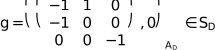
gives a permutation of sites σg = (4, 5, 6, 1, 2, 3, 12, 7, 11, 9, 10, 8) and the singular value decomposition of MgMT,
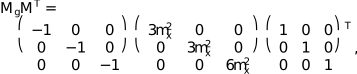
which results in  . Similarly, all of the 24 coset representatives of
  give spin symmetry operations preserving M.
A magnetic space group  of the NiAs-type CrSe is P31m′ (BNS number 157.55), which has
  representatives. Because the spin translation group contains threefold spin-rotation parts, these spin symmetry operations [
 and
and  in Section 4.4] are not captured in . Similarly, the spin symmetry operations with sixfold spatial rotations or rotoinversions are not preserved in .
5. Conclusions
We have presented an algorithm for determining the spin symmetry operations of a given spin arrangement. The spin-only group is robustly determined from the eigenvalue decomposition of the moment tensor of magnetic moments, MMT. We have explicitly considered the three translation subgroups to address the enlargement of the unit cell due to the spin translation group: the translation subgroup spanned by the input basis vectors , one by the primitive basis vector and one by the vectors for the spin . Spin-rotation parts of the coset representatives of the spin translation group and spin space group are found by solving the Procrustes problem to match the original magnetic moments and permuted ones. The present algorithm is implemented in spinspg under a permissive license, available at https://github.com/spglib/spinspg. In future work, it will be beneficial to identify the spin space-group type and a suitable transformation from the spin symmetry operations. Our presented algorithm and implementation will advance spin symmetry analysis in crystallography and condensed matter physics.
Notes added during review. After this work was completed, we became aware of recent preprints on the classification and enumeration of spin space-group types (Xiao et al., 2023; Ren et al., 2023; Jiang et al., 2023). Two of these reports, Xiao et al. (2023) and Jiang et al. (2023), appear to use a workflow similar to ours to determine spin symmetry operations, although they only provide a brief description and their implementations are not available to the public.
Our presented algorithm uses the Procrustes problem to determine a spin-rotation part W. On the other hand, Xiao et al. (2023) directly determine W for a g such that three selected magnetic moments  (i = 1, 2, 3) are transformed into , which may not be robust against numerical noise and the experimental uncertainty of magnetic moments.
Jiang et al. (2023) identify spin symmetry operations on top of spglib (Togo & Tanaka, 2018) similar to ours. However, they do not incorporate translation subgroups and . This omission makes their algorithm complicated and non-exhaustive.
APPENDIX A
Correspondence between spin and magnetic symmetry operation
When we consider a spin ((R, v), W) for a Hamiltonian without spin–orbit coupling (SOC), we derive the condition that ((R, v), W) has a corresponding magnetic symmetry operation for the Hamiltonian with SOC. The SOC introduces an additional term to the Hamiltonian proportional to  , with the angular momentum operator
  and the Pauli matrices
  . A spin symmetry operation ((R, v), W) acts on and
  as
as


where R and W are represented with Cartesian coordinates. Note that  in equation (33) reflects a time-reversal operation. Thus, ((R, v), W) acts on the SOC term as

To preserve the SOC term,  should be identity. Because
  and
and  belong to SO(3), this condition is equivalent to

Therefore, if ((R, v), W) satisfies equation (36), it has a corresponding magnetic symmetry operation  with part (R, v) and time-reversal part . We identify
  with an identity operation and
  with a time-reversal operation. Here, we assume that a magnetic ((R, v), θ) acts on a magnetic moment m as
  .
.
Conversely, a magnetic symmetry operation ((R, v), θ) is mapped to a spin symmetry operation ((R, v), θR). We can confirm this mapping satisfies equation (36) by  = . Because this mapping is injective, the index of a magnetic space group in its translation is a divisor of the index of a corresponding spin in ,
  .
.
APPENDIX B
Spin point group
We define a family spin point group of a spin as

We write a coset decomposition of by its spin translation group as

A spin point group of is

The spin point group  is a of
 and is isomorphic to
  .
.
In general, we cannot choose WR so that {(R, WR)} is a group under the multiplication in O(3) × O(3). We show here one of the counterexamples in which {(R, WR)} is not closed as a group, with a spin arrangement
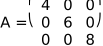
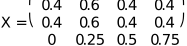
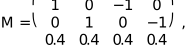
illustrated in Fig. 4. This spin arrangement is non-coplanar with  . The spin space group is obtained as









where we denote a mirror operation along the xy axis as mxy. The spin point group of is

The coset representatives in equation (40) are not closed as a subgroup of O(3) × O(3) because  =
=  does not belong to the representatives. In fact, we cannot choose representatives to form a of O(3) × O(3) in this example because
  ,
,  , and
, and  cannot be written as an internal
  .
.
![[Figure 4]](ib5119fig4thm.gif) | Figure 4 The spin arrangement example described in Appendix B . Its spin point group is not closed under O(3) × O(3) due to the spin translation group. |
APPENDIX C
Generating a transformation matrix from centering vectors
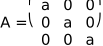
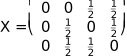
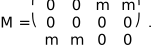
To demonstrate how to generate a transformation matrix V in Section 3.3, we consider the following coplanar face-centered cubic structure with the conventional basis,
One of the primitive basis vectors for a nonmagnetic crystal structure is
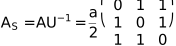
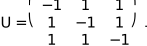
There are four centering vectors in  ,
,





Half of the centering vectors form the translation subgroup of  ,
,

Because is spanned by column vectors of U and centering vectors of g1 and g2, we can rewrite as

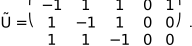
We need to find a transformation matrix such that

and this is known to be achieved by the Hermite normal form of  (Cohen, 1993),
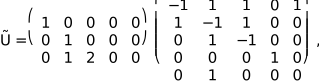
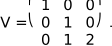
where is decomposed into a product of a lower triangular integer matrix and a unimodular matrix. Because the above 5×5 integer matrix is unimodular, we obtain
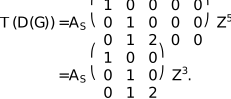
Consequently, we generate the integer matrix
Funding information
The following funding is acknowledged: Japan Society for the Promotion of Science (grant No. 21J10712).
References
 Brinkman, W. & Elliott, R. J. (1966). J. Appl. Phys. 37, 1457–1459. CrossRef CAS Web of Science Google Scholar
Brinkman, W. F., Elliott, R. J. & Peierls, R. E. (1966). Proc. Math. Phys. Eng. Sci. 294, 343–358. CAS Google Scholar
Cohen, H. (1993). A Course in Computational Algebraic Number Theory. Berlin/Heidelberg: Springer. Google Scholar
Corliss, L. M., Elliott, N., Hastings, J. M. & Sass, R. L. (1961). Phys. Rev. 122, 1402–1406. CrossRef CAS Web of Science Google Scholar
Corticelli, A., Moessner, R. & McClarty, P. A. (2022). Phys. Rev. B, 105, 064430. Web of Science CrossRef Google Scholar
Gallego, S. V., Perez-Mato, J. M., Elcoro, L., Tasci, E. S., Hanson, R. M., Momma, K., Aroyo, M. I. & Madariaga, G. (2016). J. Appl. Cryst. 49, 1750–1776. Web of Science CrossRef CAS IUCr Journals Google Scholar
Gower, J. C. & Dijksterhuis, G. B. (2004). Procrustes Problems. Oxford University Press. Google Scholar
Hahn, T., Klapper, H., Müller, U. & Aroyo, M. (2016). International Tables for Crystallography, Vol A, 6th ed., edited by M. I. Aroyo, ch. 3.2, pp. 720–776. Chichester: Wiley. Google Scholar
Hart, G. L. W. & Forcade, R. W. (2008). Phys. Rev. B, 77, 224115. Web of Science CrossRef Google Scholar
Jiang, Y., Song, Z., Zhu, T., Fang, Z., Weng, H., Liu, Z.-X., Yang, J. & Fang, C. (2023). arXiv:2307.10371. Google Scholar
Litvin, D. & Opechowski, W. (1974). Physica, 76, 538–554. CrossRef CAS Web of Science Google Scholar
Litvin, D. B. (1973). Acta Cryst. A29, 651–660. CrossRef CAS IUCr Journals Web of Science Google Scholar
Litvin, D. B. (1977). Acta Cryst. A33, 279–287. CrossRef IUCr Journals Web of Science Google Scholar
Litvin, D. B. (2014). Magnetic Group Tables. https://www.iucr.org/publ/978-0-9553602-2-0. Chester: IUCr. Google Scholar
Liu, P., Li, J., Han, J., Wan, X. & Liu, Q. (2022). Phys. Rev. X, 12, 021016. Google Scholar
Nebe, G. (2011). International Tables for Crystallography, Vol. A1, 2nd ed., edited by H. Wondratschek & U. Müller, ch. 1.4, pp. 27–40. Heidelberg: Springer. Google Scholar
Opechowski, W. (1986). Crystallographic and Metacrystallographic Groups. Amsterdam: North-Holland. Google Scholar
Ren, J., Chen, X., Zhu, Y., Yu, Y., Zhang, A., Li, J., Li, C. & Liu, Q. (2023). arXiv:2307.10369. Google Scholar
Shinohara, K., Togo, A. & Tanaka, I. (2023). Acta Cryst. A79, 390–398. Web of Science CrossRef IUCr Journals Google Scholar
Šmejkal, L., Sinova, J. & Jungwirth, T. (2022a). Phys. Rev. X, 12, 031042. Google Scholar
Šmejkal, L., Sinova, J. & Jungwirth, T. (2022b). Phys. Rev. X, 12, 040501. Google Scholar
Stokes, H. T. & Campbell, B. J. (2017). Acta Cryst. A73, 4–13. Web of Science CrossRef IUCr Journals Google Scholar
Togo, A. & Tanaka, I. (2018). Spglib: a Software Library for Crystal Symmetry Search. https://github.com/spglib/spglib. Google Scholar
Watanabe, H., Shinohara, K., Nomoto, T., Togo, A. & Arita, R. (2023). arXiv:2307.11560. Google Scholar
Xiao, Z., Zhao, J., Li, Y., Shindou, R. & Song, Z.-D. (2023). arXiv:2307.10364. Google Scholar
Yang, J., Liu, Z.-X. & Fang, C. (2021). arXiv:2105.12738. Google Scholar
Zelenskiy, A., Monchesky, T. L., Plumer, M. L. & Southern, B. W. (2022). Phys. Rev. B, 106, 144433. Web of Science CrossRef Google Scholar
Železný, J., Zhang, Y., Felser, C. & Yan, B. (2017). Phys. Rev. Lett. 119, 187204. Web of Science PubMed Google Scholar
Zhang, Y., Železný, J., Sun, Y., van den Brink, J. & Yan, B. (2018). New J. Phys. 20, 073028. Web of Science CrossRef Google Scholar
This article is published by the International Union of Crystallography. Prior permission is not required to reproduce short quotations, tables and figures from this article, provided the original authors and source are cited. For more information, click here.
| FOUNDATIONS ADVANCES |


