 | Acta Crystallographica Section A Acta Crystallographica Section A FOUNDATIONS AND ADVANCES |


 journal menu


- 1. Introduction
- 2. Monoclinic ferroelectric phases: important definitions
- 3. The orientation of PDWs between different pairs of domains
- 4. The change of polarization direction across the domain walls
- 5. Derivation of the transformation matrices and the separation between Bragg peaks
- 6. Conclusion
- Supporting information
- References


- 1. Introduction
- 2. Monoclinic ferroelectric phases: important definitions
- 3. The orientation of PDWs between different pairs of domains
- 4. The change of polarization direction across the domain walls
- 5. Derivation of the transformation matrices and the separation between Bragg peaks
- 6. Conclusion
- Supporting information
- References
research papers
| FOUNDATIONS ADVANCES |
 access
Permissible domain walls in monoclinic MAB ferroelectric phases

aDepartment of Materials Science and Engineering, Tel Aviv University, Wolfson Building for Mechanical Engineering, Tel Aviv, 6997801, Israel
*Correspondence e-mail: [email protected]
This article is part of a collection of articles from the IUCr 2023 Congress in Melbourne, Australia, and commemorates the 75th anniversary of the IUCr.
The concept of monoclinic ferroelectric phases has been extensively used over recent decades for the understanding of crystallographic structures of ferroelectric materials. Monoclinic phases have been actively invoked to describe the phase boundaries such as the so-called morphotropic phase boundary in functional perovskite oxides. These phases are believed to play a major role in the enhancement of such functional properties as dielectricity and electromechanical coupling through rotation of spontaneous polarization and/or modification of the rich domain microstructures. Unfortunately, such microstructures remain poorly understood due to the complexity of the subject. The goal of this work is to formulate the geometrical laws behind the monoclinic domain microstructures. Specifically, the result of previous work [Gorfman et al. (2022). Acta Cryst. A78, 158–171] is implemented to catalog and outline some properties of permissible domain walls that connect `strain' domains with monoclinic (MA/MB type) symmetry, occurring in ferroelectric perovskite oxides. The term `permissible' [Fousek & Janovec (1969). J. Appl. Phys. 40, 135–142] pertains to the domain walls connecting a pair of `strain' domains without a lattice mismatch. It was found that 12 monoclinic domains may form pairs connected along 84 types of permissible domain walls. These contain 48 domain walls with fixed Miller indices (known as W-walls) and 36 domain walls whose Miller indices may change when free lattice parameters change as well (known as S-walls). Simple and intuitive analytical expressions are provided that describe the orientation of these domain walls, the matrices of transformation between crystallographic basis vectors and, most importantly, the separation between Bragg peaks, diffracted from each of the 84 pairs of domains, connected along a permissible domain wall. It is shown that the orientation of a domain wall may be described by the specific combination of the monoclinic distortion parameters r = [2/(γ − α)][(c/a) − 1], f = (π − 2γ)/(π − 2α) and p = [2/(π − α − γ)] [(c/a) − 1]. The results of this work will enhance understanding and facilitate investigation (e.g. using single-crystal X-ray diffraction) of complex monoclinic domain microstructures in both crystals and thin films.
Keywords: ferroelastic domains; monoclinic symmetry; X-ray diffraction.
1. Introduction
Monoclinic ferroelectric phases (MFEPs) have played an important role in understanding the structural mechanisms behind enhancement of properties in functional ferroelectric materials, particularly in mixed-ion perovskite oxides. The concept of `monoclinic ferroelectrics' revolutionized the view on ferroelectricity by suggesting that spontaneous polarization can be rotated, rather than inverted or extended only (Davis et al., 2007 ; Damjanovic, 2010). Evidence of MFEPs was first reported by Noheda et al. (1999, 2000), Guo et al. (2000) and supported by the splitting of Bragg reflections in high-resolution X-ray diffraction patterns. MFEPs were later incorporated into the higher-order Devonshire theory (Vanderbilt & Cohen, 2001) and invoked to explain the enhancement of the giant piezoelectric effect in PbZr1−xTixO3 at the so-called morphotropic phase boundary (MPB) (Fu & Cohen, 2000). The monoclinic space groups of ferroelectrics were used for many structural refinements based on X-ray and neutron scattering experiments (Gorfman & Thomas, 2010; Choe et al., 2018; Zhang et al., 2015; Zhang, Yokota et al., 2014; Aksel et al., 2011), and for the interpretation of the results of polarized light/birefringence experiments (Bokov et al., 2010; Gorfman et al., 2012). However, the true nature of the MFEPs is still debated: it is not clear if the MFEPs are truly long-range ordered or if the apparent long-range monoclinic order is `mimicked' by the so-called adaptive state, consisting of assemblies of locally tetragonal or rhombohedral nanodomains (Jin et al., 2003; Viehland & Salje, 2014; Zhang, Xue et al., 2014). Regardless of the true character of MFEPs, the concept remains useful for the description of various phenomena in single-crystal ferroelectrics (Noheda et al., 2001; Choe et al., 2018; Gorfman et al., 2012), ferro/piezoceramics (Liu et al., 2017; Zhang, Yokota et al., 2014), epitaxial thin films (Wang et al., 2003; von Helden et al., 2018; Braun et al., 2018; Schmidbauer et al., 2017; de Oliveira Guimarães et al., 2022) and shape memory alloys (Bhattacharya, 2003).
Besides the interesting intrinsic properties of MFEPs, rich microstructures of monoclinic domains (MDs) and domain walls (DWs) between them attract a great deal of interest (Nakajima et al., 2022; Mantri & Daniels, 2021). Any domain microstructures may underpin exotic physical properties such as giant electromechanical coupling (Hu et al., 2020), enhanced dielectric permittivity (Trolier-McKinstry et al., 2018), superelasticity (Viehland & Salje, 2014), the shape memory effect (Bhattacharya, 2003) and domain-wall superconductivity (Catalan et al., 2012). These microstructure-driven properties are particularly diverse when individual domains host several order parameters (e.g. electric, magnetic and elastic). Remarkably, such properties are often absent in a single domain. Their appearance and magnitude depend on the mobility of DWs. MFEPs should have rich and volatile domain microstructures. Therefore, the properties of DWs in MFEPs (such as crystallographic orientation and mobility) are relevant for the understanding of physical properties of materials. Although the algorithms for the prediction of DWs between domains of different symmetry are known (Fousek & Janovec, 1969; Sapriel, 1975; Authier, 2003), the underlying complexity of the subjects prevents any comprehensive understanding of domain microstructures of MFEPs.
The aim of this work is to describe the geometry of permissible DWs (PDWs) between domains of MFEPs. The term permissible [coined by Fousek & Janovec (1969), see also Sapriel (1975)] denotes a planar DW connecting two domains without any lattice mismatch. For example, tetragonal domains are permitted to connect along DWs of six different orientations (with the Miller indices belonging to the family {110}), rhombohedral domains are permitted to connect along DWs of 12 different orientations [with the Miller indices belonging to the families {110} and {100}, and exhibiting different physical properties (such as e.g. scattering of light) (Qiu et al., 2020)].
We demonstrate that, most generally, MDs are permitted to connect along 84 types of DW of 45 different orientations and five different orientational families. More specifically, we show that all the 84 DWs contain 48 prominent DWs (W-walls) which have fixed crystallographic orientation and 36 S-walls which change their orientation when free monoclinic lattice parameters change too. In addition, we present the analytical expressions for the matrices of transformation between the lattice basis vectors of matched domains and for the separation between Bragg peaks, diffracted from such domains. The presented equations create the direct path for the calculations of DW-related quantities, such as angles between polarization directions, the direction of DW motion under an electric field and so on.
2. Monoclinic ferroelectric phases: important definitions
This paper implements the list of notations and abbreviations introduced by Gorfman et al. (2022). Appendix A summarizes the most important ones. This section describes the definitions relevant for the description of the monoclinic phases of ferroelectric perovskites.
According to Fu & Cohen (2000), MFEPs can be of MA/MB or alternatively MC types. These types differ from one another by the set of independent pseudocubic lattice parameters and by the direction in which spontaneous polarization may develop. Note that while the spontaneous polarization vector, P (SP), is not mandatory in ferroelastic domains, it exists in practice for the case of ferroic perovskite oxides. Even if the magnitude of such polarization is zero, it is still useful to consider the potential SP direction(s) for domain referencing and numbering.
This paper focuses on the MA/MB case. The case of MC domains will be described in a follow-up paper.
2.1. The definition of MA/MB monoclinic domains
The crystallographic structures of the MA/MB phases of perovskite oxides belong to the space-group types Cm, Cc (Zhang, Yokota et al., 2014). These structures are obtained by the symmetry-lowering phase transitions from those described by the rhombohedral (R) space-group types R3m, R3c. The mirror (m)/glide (c) plane is parallel to two mutually perpendicular face-diagonals and the edge of the pseudocubic unit cell. These space-group types allow for rotation of the polar axis (e.g. the direction of the spontaneous polarization vector) within this mirror plane. Additionally, these space groups permit any distortion of the that maintains the mirror plane. Both the distortion of the pseudocubic (alongside the mirror plane) and the polar axis direction are shown in Fig. 1(a).
![[Figure 1]](lu5030fig1thm.gif) | Figure 1 Schematic illustration of the MA/MB monoclinic domains and numeration of their variants. (a) The unit-cell distortion along with the rotation of the SPD (if such polarization is present). (b) The stereographic projection, showing these directions for the domains of tetragonal (red squares), rhombohedral (green triangles) and monoclinic (blue circles) symmetry. The tetragonal domains (1), (2), (3) correspond to the SPD along [100], [010] and [001], respectively. The rhombohedral domains (1), (2), (3) and (4) correspond to the SPD along [111], [111], [111] and [111] directions, respectively. The SPDs within the 12 monoclinic domains are further explained in Table 1 . |
2.1.1. The numeration of the monoclinic domains and the potential spontaneous polarization
It is convenient to illustrate the monoclinic domains using and the corresponding potential spontaneous polarization direction (SPD). Since MA/MB domains arise from the transition from the rhombohedral R phase, we define the SPD by a small rotation angle ρ from any of the four body-diagonal directions 〈111〉 towards any of the three adjacent unit-cell edges 〈001〉. We mark the corresponding 12 monoclinic domains as Mnm where the first index n lists the SPDs,  in the `parent' rhombohedral domain. In this case,
  ,
,  ,
,  and
and  . The second index m
  marks the pseudocubic axis
  so that
  ,
,  ,
,  to which the polarization rotates. For example, the monoclinic domain M13 has its SPD rotated from
  towards
  , while M21 has its SPD rotated from
  towards
  . The SPDs in all 12 monoclinic domains are shown on the stereographic projections in Fig. 1(b).
In the following, we express the coordinates of the SPD relative to the axes of the Cartesian coordinate system, that are nearly parallel to the pseudocubic basis vectors. For the cases of domains M13 we obtain

Here, we introduced the notation

with  the angle between the body-diagonal and the edge of a cube, so that
  ,
,  . Assuming the SPD rotation angle ρ is small and keeping the first term in the Taylor expansion with respect to ρ, we can rewrite equation (2) as

Note that the cases of  and
and  are referred to as MA and MB phases, correspondingly.
2.1.2. Pseudocubic lattice parameters of the monoclinic MA/MB domains
Fig. 1(a) shows the MA/MB distortion of the pseudocubic The corresponding pseudocubic lattice parameters  are described by four independent variables:
  (Gorfman & Thomas, 2010; Aksel et al., 2011; Choe et al., 2018): e.g. for the domain M13
  ,
,  ,
,  ,
,  . The corresponding matrix of the dot product is

Here, [I] is the unitary matrix and

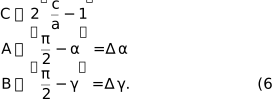
Assuming that the monoclinic distortion is small and keeping the first power of  ,
,  ,
,  , we can write
The resulting monoclinic crystal lattice is invariant with respect to  symmetry operations of the
  . The parent cubic crystal lattice is invariant with respect to
  operations of the m3m. Because the monoclinic distortion may commence from any of these 48 equivalent variants, there are
  variants of the monoclinic domain's variants. These are listed in Table 1, which contains domain identifications, Mnm, the
  metric tensors, the SPD and the lattice parameters a1, a2, a3,
  ,
,  ,
,  .
.
| ||||||||||||||||||||||||||||||||||||||||||||||||||||||||||||||||||||||||
 and
and  are used. The last column contains the reduced matrix
  . The calculations of the
  and corresponding lattice parameters are done using equation (67)


2.2. Domain pairs
Twelve ferroelastic domains (Table 1) can form 66 domain pairs. Some of these pairs can be connected via PDWs and some of them cannot. Before analyzing PDWs between various pairs of monoclinic domains, we will introduce five different pair types. These types are referred to as `R-sibling', `R-planar', `R-semi-planar', `R-semi-crossed' and `R-crossed'. Each type has its own angle between the SPDs and its own expressions for the indices of PDWs. Accordingly, we expect different properties from various domain pair types, with respect to e.g. DW motion under an external electric field. Table 2 presents the information about all five domain pairs, including pair name, abbreviation, formal definition, the angles between SPDs and the reference figure.
| ||||||||||||||||||||||||||||||||||||||||||||


 or
or 
2.2.1. Domain pairs of the type `R-sibling'
We will use the term `R-sibling' for 12 pairs of monoclinic domains Mnk Mnl such that the members of each pair originate from the same parent/rhombohedral domain Rn. Three R-sibling pairs can be formed for each Rn: Mn1 Mn2, Mn2 Mn3 and Mn3 Mn1. All such pairs are illustrated on the stereographic projections (viewed along [001] and [110] directions) in Fig. 2.
![[Figure 2]](lu5030fig2thm.gif) | Figure 2 Schematic illustration of the `R-sibling' type of monoclinic domain pairs. The term `R-sibling' refers to the case when both pair members originate from the same R domain. The figure includes: (a) stereographic projection viewed along the [001] direction, showing the SPDs in the 12 monoclinic domains. (b) Stereographic direction viewed along the direction [110], highlighting the sibling pair types, originating from R1 and R2. |
2.2.2. Domain pairs of the type `R-planar'
We will use the term `R-planar' for six pairs of monoclinic domains MmkMnk, originating from different rhombohedral domains Rm and Rn ( ) but such that
  , where
  marks the pseudocubic axis that is parallel to the RmRn plane so that

All the R-planar domain pairs are illustrated in Fig. 3 on the same type of as in Fig. 2.
![[Figure 3]](lu5030fig3thm.gif) | Figure 3 The same as Fig. 2 but for the case of the `R-planar' type of DW pairs. |
2.2.3. Domain pairs of the type `R-semi-planar'
We use the term `R-semi-planar' for 12 pairs of monoclinic domains MnkMmk originating from different rhombohedral domains Rm and Rn () but such that  . Each RmRn pair produces two monoclinic domain pairs of this type, e.g. M12 M22 and M13 M23 for the case of R1R2. All the R-semi-planar domain pairs are illustrated in Fig. 4.
![[Figure 4]](lu5030fig4thm.gif) | Figure 4 The same as Fig. 2 but for the case of the `R-semi-planar' type of DW pairs. |
2.2.4. Domain walls of the type `R-semi-crossed'
We will use the term `R-semi-crossed' for 12 pairs of monoclinic domains Mmk and Mnl, originating from different rhombohedral domains Rm and Rn () and such that both  and
and  . In addition,
  because the cases of
  are already included in the `R-semi-planar' type of domain pairs. Each RmRn pair produces two pairs of monoclinic domains of this type, e.g. M12 M23 and M13M22 for the case of R1R2. All the R-semi-crossed pairs of domains are illustrated in Fig. 5.
![[Figure 5]](lu5030fig5thm.gif) | Figure 5 The same as Fig. 2 but for the case of the `R-semi-crossed' twin domain pairs. |
2.2.5. Domain pairs of the type `R-crossed'
We will finally use the term `R-crossed' for 24 pairs of monoclinic domains Mmk and Mnl such that  , while either
  or
or  . Each RmRn pair produces four pairs of monoclinic domains of this type, for example M11M23, M11M22, M13M21 and M12M21 for the case of R1R2. All the R-crossed domains are illustrated in Fig. 6. We will see later that these pair types may generally not be connected via PDWs.
![[Figure 6]](lu5030fig6thm.gif) | Figure 6 The same as Fig. 2 but for the case of the `R-crossed' type of domain pair. |
3. The orientation of PDWs between different pairs of domains
According to Fousek & Janovec (1969), the term PDW stands for a planar DW that enables mismatch-free connection of one domain to another. PDWs are parallel to lattice planes with specific Miller indices (hkl) which have the same two-dimensional lattice parameters in both domains connected. For any two arbitrary domains, described by the matrices of dot products [G]n and [G]m, such a plane should satisfy the equations  and
and  (here
(here  ). The key steps (see Gorfman et al., 2022) for finding the orientation of the PDWs between two arbitrary domains (Table 1) are:
(i) Finding the eigenvalues (λ1, λ2 and λ3) of  or, equivalently,
  .
.
(ii) Checking if these domains have PDWs. This is the case if at least one eigenvalue is zero (e.g. λ2 = 0). This condition is fulfilled if and only if  .
.
(iii) Rearranging the eigenvalues so that λ2 = 0, λ3 > 0. Importantly, for all the cases considered in this paper  , which means that
  = 0 and
  .
.
(iv) Forming the orthogonal matrix [V] ( ) whose columns are the corresponding normalized eigenvectors of
  .
.
(v) Finding the PDW indices (the coordinates of the PDW normal with respect to the reciprocal basis vector  ) according to
  or
or  .
.
(vi) When possible,  can be extended to the nearest all-integer values to get the of the corresponding DW hkl.
Besides the ability to calculate the Miller indices of the PDW, this approach provides the basis for the calculation of the orientation relationship between the domain's basis vectors and separation of Bragg peaks, diffracted from a matched pair of domains. This possibility is the main advantage of this approach over those already existing (Fousek & Janovec, 1969). The relevant information for calculating these quantities is given further in Section 5.
3.1. PDWs connecting domain pairs of the type `R-sibling'
We will demonstrate the derivation of the PDWs connecting the representative domain pair M12 M13 and obtain similar results for all the other pairs of this type analogously. Using the last column of Table 1 and equations (6) we obtain

The following notation is introduced here:

and

The eigenvalues of the  can be found trivially as
  ,
,  with
with

The corresponding eigenvalues of the matrix  are
are  with
with

The orthogonal matrix of eigenvectors of (as well as  ) can be expressed as

Accordingly, two PDWs normal to the vectors 
 ) are possible:

The  normal has fixed coordinates that do not depend on the free lattice parameters. According to Fousek & Janovec (1969), such a wall can therefore be referred to as a W-wall. In contrast, the
  depends on the monoclinic distortion parameter r and according to Fousek & Janovec (1969) it can be referred to as an S-wall (`strange' DW). Although the monoclinic distortion parameters C, A, B are small, the value of r (as a ratio of C and A − B) is not. This means that even a small change of monoclinic distortion may cause significant reorientation of the PDW. Table 3 highlights several favorable cases of the monoclinic distortion parameter r which sets the S-wall to have rational `Miller' indices. For example, r = 2 [when
  ] creates a PDW along the (111) plane. Approaching
  (e.g. α = γ) would mean the appearance of a PDW parallel to (011).
| ||||||||||||||||||||||
 of the matrix
  . The condition of mismatch-free connection is only relevant for the case if
  (otherwise the domains may connect along any plane). The last column contains the



3.2. PDWs connecting domain pairs of the type `R-planar'
We will demonstrate the derivation of the PDWs connecting the representative domain pair M11 M21 and obtain similar results for the other pairs of this type analogously. Using the last column of Table 1 and equations (6),

Here, we introduce the following notation:

It is straightforward to see that the eigenvalues of  are
are  . Similarly, the eigenvalues of the matrix
  are
are  with
with

The orthogonal matrix of eigenvectors of both and is

Accordingly, two PDWs normal to the vectors 
 ) exist:

Both are W-walls, i.e. the crystallographic orientation of these walls does not depend on the values of the lattice parameters.
3.3. PDWs connecting domain pairs of the type `R-semi-planar'
We will demonstrate the derivation of the PDWs connecting the representative domain pair M12 M22 and obtain similar results for the other pairs of this type analogously. According to the last column of Table 1 and equations (6),

Here, we introduce the following notation:

and

The eigenvalues and eigenvectors of  can be written as
  ,
,

Accordingly, the corresponding eigenvalues of  are
are  with
with

It is straightforward to see that the orthogonal matrix of eigenvectors of  (as well as ) can be expressed as

Accordingly, two PDWs normal to the vectors 
 ) exist:

As in the case of PDWs connecting domain pairs of the type R-sibling, both W- and S-type DWs are present. Notably, it is shown in equation (22) that the orientation of the DW depends on the ratio of the angles  and
and  rather than the lengths of the pseudocubic cell edges. The corresponding S-wall becomes parallel to the lattice plane with rational for the special case such as
  ,
,  or
or  . Table 4 lists these favorable cases.
| ||||||||||||||||||||||||||


3.4. PDWs connecting domain pairs of the type `R-semi-crossed'
We will demonstrate the derivation of the PDWs connecting the representative domain pair  and obtain similar results for all the other pairs of this type analogously. Using the last column of Table 1 and equations (6),

Here we introduce the following notation:

and

The eigenvectors and eigenvalues of the  can be found as
  , 0,
, 0,  ,
,

Accordingly, the corresponding eigenvalues of  are
are  with
with

It is straightforward to see that the orthogonal matrix of eigenvectors of  (as well as ) can be expressed as

Accordingly, two PDWs normal to the vectors 
 ) exist:

As for the cases of DWs connecting domain pairs of the type `R-sibling' and `R-semi-planar', W-type and S-type DWs are present here. In addition, some favorable cases (Table 5) of the lattice parameters turn the S-type of PDW into the PDW with rational Miller indices.
| ||||||||||||||||||||||






3.5. PDWs connecting domain pairs of the type `R-crossed'
We will show that the corresponding domain pairs of this type do not generally have any PDWs. Indeed, we can attempt to find such for the case of the representative pair of domains M32 M23. According to the last column of Table 1 and equations (6) we get

The determinant of  can be calculated as

Accordingly, this pair of domains may connect along the PDW if one of the following conditions is fulfilled:

or

These conditions are generally not fulfilled and therefore we can consider domain pairs of the type `crossed' not compatible. The special conditions under which domain pairs may connect could be the subject of future work.
4. The change of polarization direction across the domain walls
The SPD changes across any DW. This section demonstrates the calculation of the change of the SPD projection on the DW normal. Such a change is numerically equal to the of at the wall (Jackson, 2007). We will consider that each ferroelastic domain mn may host spontaneous polarization  or
or  (the coordinates of the vectors
  are defined in Table 1). Accordingly, the specific pair of domains m1n1 and m2n2 may meet along a DW that switches SPD according to the configuration
  (+) or
  (−). We will see which of these configurations ensures zero (or minimal) charge at the corresponding DW using equations (14), (19), (26), (33) for the normal to the DW of each type. Table 6 summarizes the results. It shows that uncharged DWs occur in the following cases:
| ||||||||||||||||||||||||||||||||||||||||||||||||||||||||||||||
 to the DW normal. The last column shows the angles between the corresponding SPDs as defined in Table 2
 (°)
(°)


(i) W- and S-type `R-sibling' PDWs change SPD by nearly 180 or 0°, respectively.
(ii) (100)- and (011)-`R-planar' PDWs change SPD by 109 and 71°, respectively.
(iii) W- and S-type `R-semi-planar' PDWs change SPD by 109 and 71°, respectively.
(iv) W- and S-type `R-semi-crossed' PDWs change SPD by 71 and 109°, respectively.
These results have significant implications, particularly in the context of describing the DW motion under external electric fields and assessing the role of the specifically connected domain pair in the extrinsic contribution to the electromechanical coupling (Pramanick et al., 2011; Jones et al., 2006; Tutuncu et al., 2016; Gorfman et al., 2020). Indeed, this contribution hinges on the orientation of the SPD with respect to the electric field: domains with positive/negative projection of the SPD to the applied electric field would expand/contract, respectively. Consequently, comprehending the SPD's orientation and its change across the DW is pivotal.
5. Derivation of the transformation matrices and the separation between Bragg peaks
5.1. General expressions
After calculating the indices of PDWs, connecting the specific pair of domains, it is also possible to calculate the orientation relationship between domains and separation of Bragg peaks diffracted from them. Full details of these calculations are presented by Gorfman et al. (2022) and briefly summarized here. The matrix of transformation  between the basis vectors of the domains m and n is defined as
  ). This matrix can be calculated according to

Here

The sign ± before Z31 is used for the cases when the PDW normal is  , respectively. The coefficients y1 and y2 can be calculated according to

with [Gm,n(W)] being defined as

Similarly, the matrix of transformation  between the reciprocal basis vectors of the domains m and n is defined as
  and can be calculated according to

We can use (42) to calculate the separation between the Bragg peaks H, K, L so that

5.2. Simplifications
Equations (38) and (42) can be used to obtain the elements of and numerically. However, we will show that reasonable approximation leads to more visually appealing analytical expressions. Let us notice that the right-hand side of (40) can be derived from the elements 13 and 23 of the matrix  . Considering that the columns of the matrix [V] are the eigenvectors of with the eigenvectors of
  and
and  , respectively, we can write

Here, the same sign as in equation (39) is implemented instead of ±. Using (44) we can rewrite (40) as

We will now consider the second term in the right side of equation (41)  is proportional to the parameters of monoclinic distortion A, B, C [see equation (6)] and therefore it is much smaller than the first term
  . Accordingly, we can rewrite (41) in the form

Considering (46) we can rewrite (45) as

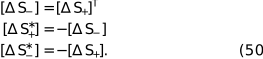
Substituting (47) into (38) and (42) we get

and

Using the notations  for the case of signs + and − in front of , respectively, we can see that (48), (49) lead to
5.3. The case of domain pairs of the type `R-sibling'
We will now apply (48) and (49) for PDWs connecting domain pairs of the type R-sibling. The corresponding transformation matrices  are marked explicitly as
  and
and  . According to (12) we obtain =
  . Substituting (13) into (48) and using (50) we get

Using (43) and (50) we can obtain the separation between the Bragg peaks diffracted from the corresponding pair of domains as

and

As mentioned by Gorfman et al. (2022), the three-dimensional separation between the Bragg peaks diffracted from a pair of connected domains is parallel to the DW normal.
5.4. The case of domain pairs of the type `R-planar'
Similarly, for the case of domain pairs of the type `R-planar', the corresponding transformation matrices  ,
,  are marked explicitly as
  and
and  . According to (17)
  . Substituting (18) into (48) and using (50) we obtain

Equivalently we will obtain the following expression for the separation of Bragg peaks:

and

5.5. The case of domain pairs of the type `R-semi-planar'
The corresponding transformation matrices  are then marked explicitly as
  and
and  . According to (24)
  . Substituting (25) into (48) and using (50):

The separation of Bragg peaks diffracted from the correspondingly connected domain pairs is

and

5.6. The case of domain pairs of the type `R-semi-crossed'
The corresponding transformation matrices are marked explicitly as  and
and  . According to (31)
  . Substituting (32) into (48) and using (50):

The separation of the Bragg peaks diffracted from the domains, meeting along the DW normal to  is
is

and for the case of 

5.7. Summarizing tables
The previous paragraphs demonstrated how to derive key quantities such as the orientation relationship between the lattice basis vectors, and the separation of Bragg peaks for representative domain pairs only. Similar equations can be derived for all the other domain pairs. The tables and figures below list the corresponding quantities for all 84 existing PDWs. The full list includes:
(i) 24 PDWs connecting domain pairs of the type `R-sibling', including 12 W- and 12 S-walls.
(ii) 12 PDWs connecting domain pairs of the type `R-planar'. All of them are W-walls.
(iii) 24 PDWs connecting domain pairs of the type `R-semi-planar', including 12 W-walls and 12 S-walls.
(iv) 24 PDWs connecting domain pairs of the type `R-semi-crossed', including 12 W-walls and 12 S-walls.
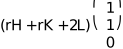
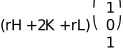
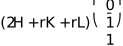
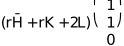
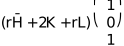
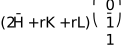
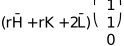
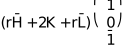
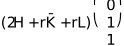
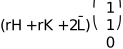
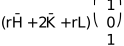
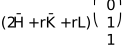
The list of 84 PDWs contains 36 S-walls and 48 W-walls as listed in Tables 7, 8, 9, 10. Each row of these tables contains domain pair number, the Miller indices of the PDW, the matrix of transformation  between the corresponding basis vectors and the separation of Bragg peaks H, K, L diffracted from this pair of domains.
|


























|
 (
( )
) (
(


|
 ] (
] (


|


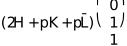


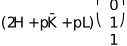


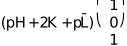


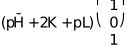


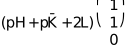


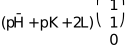


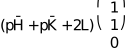


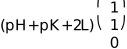


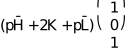


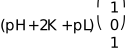


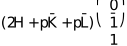


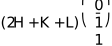


Tables 7, 8, 9, 10 reveal that certain W-walls have the same orientations. For instance, all domain pairs of the type `R-planar' M11M21,M31M41 and all domain pairs of the type `R-semi-planar', M12,M22, M13,M23 have (100)-oriented PDWs. Table 11 presents all the distinct PDW orientations and their relevant details. It reveals that all the PDWs belong to five orientation families {100}, {110}, {2rr}, {10f}, {2pp}, so that PDWs of 45 distinct orientations are present. Furthermore, the table demonstrates the distribution of PDWs based on the pair type and the angle between the polarization directions. It indicates that 84 PDWs are classified into 12 DWs, 30 DWs, 30 DWs, 12 DWs with the angles between SPDs close to 0, 71, 109 and 180°, respectively.
| ||||||||||||||||||||||||||||||||||||||||||||||||||||||||||||||||||||||||||||||||||||||||||


Fig. 7 displays the orientation of all the PDWs for different choices of lattice parameters. The normal vectors to these walls are shown using the poles on the The W-walls are marked by the poles with a solid line edge and the color of the pole reflects the angle between the SPDs being close to 0, 71, 109 and 180° (as specified in the last column of Table 5). Each stereographic projection, from left to right, shows DWs between the domain pairs of the types `R-sibling', `R-planar', `R-semi-planar' and `R-semi-crossed'. The supporting information includes the animated version of this figure showing how the orientation of these DWs changes with the lattice parameters.
![[Figure 7]](lu5030fig7thm.gif) | Figure 7 The orientation of the DW is normal for all the PDWs which connect domain pairs of the R-sibling, R-planar, R-semi-planar and R-semi-crossed types, with 45 different orientations in total. These orientations are distributed among five different orientation families. The normals are shown using the poles on the stereographic projection viewed along the direction [001] with the poles corresponding to the W-walls framed by a solid line. The lattice parameters are chosen arbitrarily. The supporting information includes animated versions of the same figure for different values of the monoclinic lattice parameters. |
6. Conclusion
We have applied the theory of PDWs to create a list of 84 PDWs connecting ferroelastic domains of monoclinic (Cm/Cc) symmetry. Our list includes analytical expressions for the Miller indices of the PDWs, matrices of transformation between the corresponding pseudocubic basis vectors and expressions for the reciprocal-space separation between the corresponding Bragg peak pairs. The 84 PDWs can have 45 different orientations and are grouped into five orientational families.
Our derivation of this list assumed that the two-step transition from the cubic ( phase to the monoclinic (Cm/Cc) phase results in the formation of 12 ferroelastic monoclinic domains. The first step of this transition (from the cubic to the rhombohedral R3m/R3c phase) results in the formation of four ferroelastic domains, while the second step (from the rhombohedral to the monoclinic phase) splits each of them into groups of three monoclinic domains. We identified five different types of domain pairs (referred to here as `R-sibling', `R-planar', `R-semi-planar', `R-semi-crossed' and `R-crossed'), each with its own expression for the PDW orientation. As shown in previous works (Fousek & Janovec, 1969; Sapriel, 1975), we found that the crystallographic orientation/Miller indices of PDWs can be fixed (for the so-called W-walls) or depend on the values of the monoclinic lattice parameters (for the so-called S-walls). We found that the orientation of such walls can be controlled by the three simple parameters
  ,
,  and
and  .
.
We have demonstrated that the rotatable domain walls can be described by the Miller indices {2rr}, {10f}, {2pp}. Even a small change in the monoclinic distortion (such as  ) can cause a significant rotation of the PDW. This process is often referred to as `thermal switching'. Furthermore, we have predicted the angles between polarization directions for the cases when DWs are not charged.
The results of this work can be useful in several different ways. First, the availability of simple analytical expressions (Tables 7–10) for the orientation of DWs can help in describing the domain switching through DW rotation or DW motion. Such a process can be induced by the change of the temperature or external electric field, for example. Second, the expressions for the separation between Bragg peaks (Tables 7–10) can help investigate monoclinic domain patterns, using `single-crystal' X-ray diffraction. Third, the expressions may be useful for the precise calculation of the angles between SPDs of various domains. Such angles can be easily evaluated using the corresponding matrices of transformation between the domain basis vectors in Tables 7–10.
The results have significant importance in the analysis of domains within crystals and epitaxial thin films. Indeed, the observation of monoclinic domains in epitaxial thin films is common (see e.g. Schmidbauer et al., 2017; Gaal et al., 2023) where one or another type of monoclinic distortion is stabilized by the substrate–film lattice mismatch. Modulating this mismatch can influence the monoclinic lattice parameters and, consequently, the orientation of PDWs between them. It is worth highlighting that certain distinctions may arise due to variations in the number of monoclinic domains present. In the case of `free-standing' single crystals, the phase transition sequence from cubic to rhombohedral to monoclinic ideally results in the presence of 12 equivalent domains. However, introducing bias at any of these transitional stages can alter this configuration. For instance, the application of an electric field along the pseudocubic [111] direction during the cubic-to-rhombohedral phase transition may lead to the formation of just one rhombohedral domain instead of the expected four. Subsequently, the rhombohedral-to-monoclinic transition further divides this domain into three monoclinic domains. Consequently, in such scenarios, only `R-sibling' domain pairs, connected by six PDWs, must be considered. The presence of the substrate can bias or suppress the formation of specific domains, such as favoring the presence of domain pairs of the R-sibling type exclusively, and this, in turn, can impact the number of PDWs. A detailed characterization of PDWs in relation to the origin of these domains can prove useful for cataloging the potential PDWs existing between thin film domains or in other cases when formation of domains is biased or engineered.
Finally, this article describes the PDWs between monoclinic domains of MA/MB type. A similar formalism for the monoclinic MC symmetry case will be presented in a follow-up publication.
APPENDIX A
The list of notations and most important crystallographic relationships
This paper uses the notations from Gorfman et al. (2022). For the convenience of the reader, the most important of them are also summarized here.
Basis vectors:  are the basis vectors of a The second index refers to the ferroelastic domain variant m.
  corresponds to the of the higher-symmetry (e.g. cubic) `parent' phase (Fig. 1). The parallelepiped based on the vectors
  forms a unit cell.
Unit-cell settings: many unit-cell settings exist for the same lattice (Gorfman, 2020). Here, we prefer the cell settings ( obtained by the smallest possible distortion/rotation of the parent-phase basis vectors
  .
.
Metric tensor/matrix of dot products:  is the (Giacovazzo, 1992; Hahn, 2005). The corresponding 3 × 3 matrix [G]m is the matrix of dot products for the domain variant m. Their determinants are
  ( VA is the unit-cell volume).
The transformation matrix: the transformation e.g. from the basis vectors to the basis vectors  is defined by the 3 × 3 transformation matrix [S]. The columns of the matrix [S] are the coordinates of with respect to :

Transformation of the metric tensor: the transformation of the basis vectors (63) leads to the following transformation of the corresponding metric tensors:

This relationship can be extended to any cases of transformation between coordinate systems.
The difference transformation matrix is defined as the difference between [S] and the unitary matrix [I]:

Twinning matrix: [T] represents a symmetry operation of the parent-phase lattice (i.e. the one built using the basis vectors ) that is no longer the symmetry operation of a ferroelastic phase lattice. We define [T] as a 3 × 3 matrix, which describes the transformation to the coordinate system from its symmetry equivalent  using the following formal matrix equation:

The number of symmetry-equivalent coordinate systems is equal to the order of the holohedry point symmetry group (e.g. 48 for a cubic lattice). The transition from a paraelastic to a ferroelastic phase is associated with the distortion of the basis vectors  . Such a distortion, however, can commence from any of the symmetry-equivalent . Let us assume that and serve as the starting points for domain variants m and n, correspondingly. The following relationship between [Gn] and [Gm] exists:

Reciprocal basis vectors: the superscript * refers to the reciprocal bases, e.g.  are such that
  . The reciprocal metric tensor is
  . The relationship
  holds.
Transformation between the reciprocal basis vectors: if the direct basis vectors (e.g. and ) are related by the matrix [S] [according to equation (63)], then the corresponding reciprocal-lattice vectors ( and  ) are related by the matrix [S*]. The following relationship between [S] and
  holds:

The difference transformation matrix between the reciprocal basis vectors is defined according to the equation

Supporting information
Animated version of Fig. 7 which shows how the orientation of domain walls changes with the alpha lattice parameter. DOI: https://doi.org/10.1107/S205327332300921X/lu5030sup1.mp4
Animated version of Fig. 7 which shows how the orientation of domain walls changes with the gamma lattice parameter. DOI: https://doi.org/10.1107/S205327332300921X/lu5030sup2.mp4
Animated version of Fig. 7 which shows how the orientation of domain walls changes with the c/a ratio. DOI: https://doi.org/10.1107/S205327332300921X/lu5030sup3.mp4
Funding information
The following funding is acknowledged: Israel Science Foundation (grant Nos. 1561/18, 3455/21, 1365/23 to Semën Gorfman); United States – Israel Binational Science Foundation (award No. 2018161 to Semën Gorfman).
References
 Aksel, E., Forrester, J. S., Jones, J. L., Thomas, P. A., Page, K. & Suchomel, M. R. (2011). Appl. Phys. Lett. 98, 152901. Web of Science CrossRef ICSD Google Scholar
Authier, A. (2003). International Tables for Crystallography, Vol. D, Physical Properties of Crystals. Dordrecht: Kluwer Academic Publishers. Google Scholar
Bhattacharya, K. (2003). Microstructure of Martensite: Why it Forms and How it Gives Rise to the Shape-Memory Effect. Oxford University Press. Google Scholar
Bokov, A. A., Long, X. & Ye, Z.-G. (2010). Phys. Rev. B, 81, 172103. Web of Science CrossRef Google Scholar
Braun, D., Schmidbauer, M., Hanke, M. & Schwarzkopf, J. (2018). Nanotechnology, 29, 015701. Web of Science CrossRef PubMed Google Scholar
Catalan, G., Seidel, J., Ramesh, R. & Scott, J. F. (2012). Rev. Mod. Phys. 84, 119–156. Web of Science CrossRef CAS Google Scholar
Choe, H., Bieker, J., Zhang, N., Glazer, A. M., Thomas, P. A. & Gorfman, S. (2018). IUCrJ, 5, 417–427. Web of Science CrossRef CAS PubMed IUCr Journals Google Scholar
Damjanovic, D. (2010). Appl. Phys. Lett. 97, 062906. Web of Science CrossRef Google Scholar
Davis, M., Budimir, M., Damjanovic, D. & Setter, N. (2007). J. Appl. Phys. 101, 054112. Web of Science CrossRef Google Scholar
Fousek, J. & Janovec, V. (1969). J. Appl. Phys. 40, 135–142. CrossRef CAS Web of Science Google Scholar
Fu, H. & Cohen, R. E. (2000). Nature, 403, 281–283. Web of Science CrossRef PubMed CAS Google Scholar
Gaal, P., Schmidt, D., Khosla, M., Richter, C., Boesecke, P., Novikov, D., Schmidbauer, M. & Schwarzkopf, J. (2023). Appl. Surf. Sci. 613, 155891. Web of Science CrossRef Google Scholar
Giacovazzo, C. (1992). Fundamentals of Crystallography. IUCr/Oxford University Press. Google Scholar
Gorfman, S. (2020). Acta Cryst. A76, 713–718. Web of Science CrossRef IUCr Journals Google Scholar
Gorfman, S., Choe, H., Zhang, G., Zhang, N., Yokota, H., Glazer, A. M., Xie, Y., Dyadkin, V., Chernyshov, D. & Ye, Z.-G. (2020). J. Appl. Cryst. 53, 1039–1050. Web of Science CrossRef CAS IUCr Journals Google Scholar
Gorfman, S., Glazer, A. M., Noguchi, Y., Miyayama, M., Luo, H. & Thomas, P. A. (2012). J. Appl. Cryst. 45, 444–452. Web of Science CrossRef CAS IUCr Journals Google Scholar
Gorfman, S., Spirito, D., Zhang, G., Detlefs, C. & Zhang, N. (2022). Acta Cryst. A78, 158–171. Web of Science CrossRef IUCr Journals Google Scholar
Gorfman, S. & Thomas, P. A. (2010). J. Appl. Cryst. 43, 1409–1414. Web of Science CrossRef CAS IUCr Journals Google Scholar
Guo, R., Cross, L. E., Park, S. E., Noheda, B., Cox, D. E. & Shirane, G. (2000). Phys. Rev. Lett. 84, 5423–5426. Web of Science CrossRef PubMed CAS Google Scholar
Hahn, T. (2005). International Tables for Crystallography, Vol. A, Space Group Symmetry. Heidelberg: Springer. Google Scholar
Helden, L. von, Schmidbauer, M., Liang, S., Hanke, M., Wördenweber, R. & Schwarzkopf, J. (2018). Nanotechnology, 29, 415704. Web of Science PubMed Google Scholar
Hu, C., Meng, X., Zhang, M.-H., Tian, H., Daniels, J. E., Tan, P., Huang, F., Li, L., Wang, K., Li, J.-F., Lu, Q., Cao, W. & Zhou, Z. (2020). Sci. Adv. 6, eaay5979. Web of Science CrossRef PubMed Google Scholar
Jackson, J. D. (2007). Classical Electrodynamics. Hoboken, NJ: John Wiley & Sons. Google Scholar
Jin, Y. M., Wang, Y. U., Khachaturyan, A. G., Li, J. F. & Viehland, D. (2003). J. Appl. Phys. 94, 3629–3640. Web of Science CrossRef CAS Google Scholar
Jones, J. L., Hoffman, M., Daniels, J. E. & Studer, A. J. (2006). Appl. Phys. Lett. 89, 092901. Web of Science CrossRef Google Scholar
Liu, H., Chen, J., Fan, L., Ren, Y., Pan, Z., Lalitha, K. V., Rödel, J. & Xing, X. (2017). Phys. Rev. Lett. 119, 017601. Web of Science CrossRef PubMed Google Scholar
Mantri, S. & Daniels, J. (2021). J. Am. Ceram. Soc. 104, 1619–1632. Web of Science CrossRef CAS Google Scholar
Nakajima, H., Hiroi, S., Tsukasaki, H., Cochard, C., Porcher, F., Janolin, P.-E. & Mori, S. (2022). Phys. Rev. Mater. 6, 074411. Web of Science CrossRef Google Scholar
Noheda, B., Cox, D. E., Shirane, G., Gonzalo, J. A., Cross, L. E. & Park, S.-E. (1999). Appl. Phys. Lett. 74, 2059–2061. Web of Science CrossRef CAS Google Scholar
Noheda, B., Cox, D. E., Shirane, G., Guo, R., Jones, B. & Cross, L. E. (2000). Phys. Rev. B, 63, 014103. Web of Science CrossRef Google Scholar
Noheda, B., Cox, D. E., Shirane, G., Park, S. E., Cross, L. E. & Zhong, Z. (2001). Phys. Rev. Lett. 86, 3891–3894. Web of Science CrossRef PubMed CAS Google Scholar
Oliveira Guimarães, M. de, Richter, C., Hanke, M., Bin Anooz, S., Wang, Y., Schwarzkopf, J. & Schmidbauer, M. (2022). J. Appl. Phys. 132, 154102. Google Scholar
Pramanick, A., Damjanovic, D., Daniels, J. E., Nino, J. C. & Jones, J. L. (2011). J. Am. Ceram. Soc. 94, 293–309. Web of Science CrossRef CAS Google Scholar
Qiu, C., Wang, B., Zhang, N., Zhang, S., Liu, J., Walker, D., Wang, Y., Tian, H., Shrout, T. R., Xu, Z., Chen, L.-Q. & Li, F. (2020). Nature, 577, 350–354. Web of Science CrossRef CAS PubMed Google Scholar
Sapriel, J. (1975). Phys. Rev. B, 12, 5128–5140. CrossRef CAS Web of Science Google Scholar
Schmidbauer, M., Braun, D., Markurt, T., Hanke, M. & Schwarzkopf, J. (2017). Nanotechnology, 28, 24LT02. Web of Science CrossRef PubMed Google Scholar
Trolier-McKinstry, S., Zhang, S., Bell, A. J. & Tan, X. (2018). Annu. Rev. Mater. Res. 48, 191–217. CAS Google Scholar
Tutuncu, G., Chen, J., Fan, L., Fancher, C. M., Forrester, J. S., Zhao, J. & Jones, J. L. (2016). J. Appl. Phys. 120, 044103. Web of Science CrossRef Google Scholar
Vanderbilt, D. & Cohen, M. H. (2001). Phys. Rev. B, 63, 094108. Web of Science CrossRef Google Scholar
Viehland, D. D. & Salje, E. K. H. (2014). Adv. Phys. 63, 267–326. Web of Science CrossRef CAS Google Scholar
Wang, J., Neaton, J. B., Zheng, H., Nagarajan, V., Ogale, S. B., Liu, B., Viehland, D., Vaithyanathan, V., Schlom, D. G., Waghmare, U. V., Spaldin, N. A., Rabe, K. M., Wuttig, M. & Ramesh, R. (2003). Science, 299, 1719–1722. Web of Science CrossRef PubMed CAS Google Scholar
Zhang, N., Paściak, M., Glazer, A. M., Hlinka, J., Gutmann, M., Sparkes, H. A., Welberry, T. R., Majchrowski, A., Roleder, K., Xie, Y. & Ye, Z.-G. (2015). J. Appl. Cryst. 48, 1637–1644. Web of Science CrossRef CAS IUCr Journals Google Scholar
Zhang, N., Yokota, H., Glazer, A. M., Ren, Z., Keen, D. A., Keeble, D. S., Thomas, P. A. & Ye, Z.-G. (2014). Nat. Commun. 5, 1–9. Google Scholar
Zhang, Y., Xue, D., Wu, H., Ding, X., Lookman, T. & Ren, X. (2014). Acta Mater. 71, 176–184. Web of Science CrossRef CAS Google Scholar
This is an open-access article distributed under the terms of the Creative Commons Attribution (CC-BY) Licence, which permits unrestricted use, distribution, and reproduction in any medium, provided the original authors and source are cited.
| FOUNDATIONS ADVANCES |
access


