 | Acta Crystallographica Section B Acta Crystallographica Section B STRUCTURAL SCIENCE, CRYSTAL ENGINEERING AND MATERIALS |


 journal menu


research papers
| STRUCTURAL SCIENCE CRYSTAL ENGINEERING MATERIALS |
 access
A case for resonant X-ray Bragg diffraction by a collinear antiferromagnet Li2Ni3P4O14

aISIS Facility, STFC, Didcot, Oxfordshire OX11 0QX, United Kingdom, bDiamond Light Source, Harwell Science and Innovation Campus, Didcot, Oxfordshire OX11 0DE, United Kingdom, and cDepartment of Physics, Oxford University, Oxford, OX1 3PU, United Kingdom
*Correspondence e-mail: [email protected]
Magnetic axial and polar (Dirac) nickel multipoles contribute to resonant X-ray Bragg amplitudes in a symmetry-informed analysis of monoclinic Li2Ni3P4O14 presented for future diffraction experiments. Magnetic long-range order below a temperature of ≃ 14.5 K can be viewed as a two-dimensional trimerized antiferromagnet with Ni ions in two Wyckoff positions in the centrosymmetric (1) magnetic space group P21/c. It permits the coupling to circular polarization in the primary X-ray beam, unlike the corresponding diffraction by an antiferromagnet characterized by anti-inversion (1′) and a linear magnetoelectric effect, e.g. historically significant chromium sesquioxide (Cr2O3) and Cu2(MoO4)(SeO3) [Lovesey & van der Laan (2024 ). Phys. Rev. B 110, 174442]. The space group is inferred from neutron Bragg diffraction patterns, without an allowance for permitted Dirac dipoles (anapoles) and quadrupoles [Chikara et al. (2025). Phys. Rev. B 112, 014438].
Keywords: antiferromagnet; resonant X-ray scattering; Bragg diffraction; anapoles; chiral signature.
1. Introduction
Electronic correlations in conjunction with in solids create valuable and enigmatic effects (Pourovskii et al., 2025). These include the magnetoelectric effect, collinear antiferromagnetic order, and so-called hidden orders in which a state of matter exists without an easily detectable order parameter. Scattering techniques often have much to offer in gathering incisive information on properties of solids not available with other experimental methods. For example, Néel (1932) proposed antiferromagnetism and Shull & Smart (1949) recognized that magnetic neutron Bragg diffraction could provide the concrete evidence. To this end, diffraction patterns were collected from powdered MnO that presents magnetic order below a temperature of ≃122 K. A difference in patterns from samples at room temperature and at ≃80 K revealed strong magnetic Bragg spots at positions not allowed on the basis of the face-centred cubic unit cell of MnO.
A meaningful analysis of a Bragg diffraction pattern requires appreciation of the symmetry properties of the radiation-matter interaction and those of the illuminated sample (Collins et al., 2007; Collins & Bombardi, 2010; Lovesey & Balcar, 2013; Winkler & Zülicke, 2025). For the sample, an extended Neumann's principle (Neumann, 1885; Cracknell, 1975) imposes space-inversion symmetry and time-inversion symmetry for a resonant ion. Translations absent in the magnetic crystal class appear in the magnetic space group {Bilbao Crystallographic Server (https://www.cryst.ehu.es) Belov–Neronova–Smirnova [BNS] setting of magnetic space groups}. Discrete symmetries of the radiation-matter interaction are spatial-inversion symmetry, time-inversion symmetry and photon polarization. Crystals of berlinite (K-absorption edge of Al), tellurium (L1 edge) and quartz (K edge of Si) form in space groups P3121 (No. 152 right-handed screw) or P3221 (No. 154 left-handed screw), and absolute chirality is verified by Bragg diffraction of circularly polarized X-rays tuned in energy to the specified absorption edges (Tanaka et al., 2010). The most probable absorption event is the parity-even (axial) electric dipole–electric dipole (E1–E2) with atomic transitions 1s → 3p for Al and Si, and 2s → 5p for Te. The parity-odd (polar) electric dipole–electric quadrupole (E1–E2) absorption event plays a minor role. Parity-even E1–E2 and E2–E2 absorption events include nonmagnetic (time-inversion symmetry even) and magnetic (time-inversion symmetry odd) processes. The latter can reveal the long-range magnetic order of familiar axial dipole moments. The corresponding dipoles in a parity-odd E1–E2 absorption event are less familiar anapoles, also known as toroidal moments. Magnetic monopoles, which have not been observed (Milton, 2006), and anapoles possess the same discrete symmetries, namely, parity-odd and time-odd. These symmetries are manifested in a spin anapole (n × S) created with the vector product of position n and spin S of an electron.
A magnetic ground state for Li2Ni3P4O14 depicted in Fig. 1 has been proposed on the basis of and specific heat measurements, neutron powder diffraction and neutron polarization analysis (Chikara et al., 2025). Magnetic long-range order below a temperature of ≃ 14.5 K can be viewed as a two-dimensional trimerized antiferromagnet involving two independent Ni ions. The monoclinic magnetic space group assigned by the authors possesses a propagation vector = (0, 0, 0), commensurate collinear antiferromagnetic order and a ferromagnetic component parallel to the unique crystal axis, b. The permitted coupling of the magnetic order to photon circular polarization in the primary beam is one delineated characteristic of symmetry-informed amplitudes for resonant X-ray Bragg diffraction. Furthermore, Wyckoff positions in Fig. 1 differ with respect to spatial-inversion symmetry. Polar magnetic multipoles are permitted at the non-centrosymmetric position, including anapoles visible in resonant X-ray and neutron Bragg diffraction patterns (Fernández-Rodríguez et al., 2010; Lovesey et al., 2019).
![[Figure 1]](px5071fig1thm.gif) | Figure 1 Axial dipoles in Li2Ni3P4O14 using magnetic symmetry P21/c (No. 14.75, propagation vector k = 0, Bilbao [BNS]). They are in Wyckoff general positions 4e for Ni1 (blue arrows) and 2c for Ni2 (red). Chikara et al. (2025 ) constrained the two sites to have identical dipole moments and the inferred values are used in the figure. |
Resonant X-ray Bragg diffraction by magnetic V2O3 illustrates the puissance of the technique (Paolasini et al., 1999; Paolasini et al., 2001; Lovesey & Knight, 2000). Bragg spots forbidden in the diffraction pattern of the monoclinic structure are due to orbital magnetism and not orbital order as originally proposed. The experiment exploited a relatively weak E2 absorption event at the vanadium K edge. Turning to a second example and a high-Tc material, emergence of the pseudo-gap phase with time-reversal violation in underdoped HgBa2CuO4+δ (Hg1201) diminishes Cu Specifically, the Cu centre of inversion symmetry is lost, and Dirac multipoles herald the onset of the enigmatic phase (Lovesey & Khalyavin, 2015). Analysis of magnetic neutron diffraction patterns for Hg1201 yield the orthorhombic magnetic symmetry of the pseudo-gap phase (Bourges et al., 2021; Croft et al., 2017; Bourges et al., 2018; Fechner et al., 2016).
2. Magnetic structure
The magnetic structure adopted for Li2Ni3P4O14 (P21/c, No. 14.75, Bilbao [BNS]) is depicted in Fig. 1 with nickel ions (Ni2+, 3d8) in Wyckoff general positions 4e and special positions 2c (Chikara et al., 2025). Positions 4e are devoid of any symmetry and 2c are centrosymmetric. Nickel ions in positions 2c are permitted axial (parity even) multipoles alone, while positions 4e are permitted axial and Dirac multipoles. include (0, 2n, 0) and (0, 0, 2n), and the monoclinic cell possesses a unique axis b Bilbao [BNS]. Magnetic multipoles are specified in orthogonal axes labelled (ξ, η, ζ) derived in standard form, namely, ξ ∝ a*, η ∝ b, ζ ∝ c, with reciprocal lattice vectors a*∝ a(1, 0, 0), b* ∝ b(0, 1, 0), c* ∝ c[−cos(βo), 0, sin(βo)] and an obtuse angle βo ≃ 110.31° (Chikara et al., 2025).
Turning to the actual calculation of a scattering amplitude using an atomic wavefunction, the practice of replacing matrix elements by those of convenient operators with strong physical appeal has a long history. In condensed matter physics, it is perhaps best known through use of operator equivalents in electron paramagnetic resonance by Elliott and Stevens (Abragam & Bleaney, 1970). Likewise, electronic multipoles, created with irreducible spherical tensors, to represent time-even (charge like) and time-odd (magnetic) quantities are widespread in modern physics. Specifically, matrix elements of the spin anapole (n × S) mentioned in the Introduction can represent a contribution to the scattering amplitude from Ni ions in Wyckoff positions 4e.
In our adopted description of electronic degrees of freedom, Ni ions are assigned spherical multipoles 〈OKQ〉 of integer rank K with projections Q in the interval −K ≤ Q ≤ K (Lovesey et al., 2005; Lovesey & Balcar, 2013). Angular brackets denote the time-average, or expectation, value of the enclosed spherical tensor operator. Cartesian and spherical components Q = 0, ±1 of a vector n = (ξ, η, ζ) are related by ξ = (n−1 − n+1)/√2, η = i(n−1 + n+1)/√2, ζ = n0. As one example, the spin anapole (K = 1) is proportional to the multipole 〈(n × S)Q〉. A complex conjugate of a multipole is defined as 〈OKQ〉* = (−1)Q 〈OK−Q〉, meaning the diagonal multipole 〈OK0〉 is purely real. The phase convention for real and imaginary parts labelled by single and double primes is 〈OKQ〉 = [〈OKQ〉′ + i〈OKQ〉′′]. Whereupon Cartesian dipoles are 〈O1ξ〉 = −√2 〈O1+1〉′ and 〈O1η〉 = −√2 〈O1+1〉′′.
A structure factor (Lovesey et al., 2005)

delineates the Bragg diffraction pattern for a reflection vector κ defined by integer (h, k, l). The sum is over positions d used by Ni ions in P21/c (No. 14.75, magnetic 2/m). Reflection conditions are derived from ΨKQ by considering its value for even K and Q = 0, and a parity-even signature σπ = +1 (the for nuclear scattering). Bulk magnetic properties are defined by ΨKQ evaluated for K = 1 (dipole), σπ = +1 and h = k = l = 0.
In more detail, equation (1) requires information about the relevant Wyckoff positions found in the BSC table MWYCKPOS for the magnetic symmetry of interest. Wyckoff positions are related by operations listed in the table MGENPOS (Bilbao [BNS]). Taken together, the two tables provide all information required to evaluate equation (1) and, thereafter, all X-ray diffraction amplitudes.
Henceforth, axial (σπ = +1) and polar (σπ = −1) multipoles are denoted by 〈TKQ〉 and 〈GKQ〉, respectively. The time signature σθ of 〈TKQ〉 is σθ = (−1)K, i.e. even K axial multipoles are non-magnetic. Dirac multipoles 〈GKQ〉 are magnetic with σθ = (−1) for all K. We find

Spatial phase factors in equation (2) are α = exp(i2πhx), β = exp(i2πky) and γ = exp(i2πlz). Estimates of the general coordinates (x, y, z) for Ni ions are given by Chikara et al. (2025). Wyckoff positions 2c are centres of inversion symmetry ( , σπ = +1) and nothing more. The result

complies with a reflection condition (k + l) = 2n.
3. X-ray diffraction
Tuning the energy of the X-rays to an atomic resonance has two obvious benefits in diffraction experiments (Paolasini, 2014). In the first place, there is a welcome enhancement of Bragg spot intensities and, secondly, spots are element specific. States of X-ray polarization, Bragg angle θ, and the plane of scattering are shown in Fig. 2. A conventional labelling of linear photon polarization states places σ = (0, 0, 1) and π = [cos(θ), sin(θ), 0] perpendicular and parallel to the plane of scattering, respectively. Secondary states σ′ = σ and π′ = [cos(θ), −sin(θ), 0].
![[Figure 2]](px5071fig2thm.gif) | Figure 2 Primary (σ, π) and secondary (σ′, π′) states of polarization. Corresponding wavevectors q and q′ subtend an angle 2θ. The Laue condition for diffraction is met when q − q′ coincides with a reflection vector (h, k, l) of the monoclinic reciprocal lattice. Crystal vectors that define local axes for Ni ions (ξ, η, ζ) and the depicted Cartesian (x, y, z) coincide in the nominal setting of the crystal. |
The X-ray scattering length in the unrotated channel of polarization σ → σ′ is modelled by (σ′σ)/D(E). In this instance, the resonant denominator is replaced by a sharp oscillator D(E) = {[E − Δ + iΓ/2]/Δ} with the X-ray energy E in the near vicinity of an atomic resonance Δ of total width Γ, namely, E ≃ Δ and Γ << Δ. The cited energy-integrated scattering amplitude (σ′σ), one of four amplitudes, is studied using standard tools and methods from atomic physics and crystallography. In the first place, a vast spectrum of virtual intermediate states makes the X-ray scattering length extremely complicated. It can be truncated by closely following the steps in celebrated studies by Judd and Ofelt of optical absorption intensities of rare-earth ions (Judd, 1962; Ofelt, 1962; Hehlen et al., 2013). An intermediate level of truncation used here reproduces sum rules for axial dichroic signals created by E1–E1 or E2–E2 absorption events (Johnson & Lovesey, 2024). The attendant calculation presented in Lovesey & Balcar (1997) and Section 5.2 in Lovesey et al. (2005) is lengthy and demanding. Experimental results for Dirac multipoles in V2O3 (Fernández-Rodríguez et al., 2010) and CuO (Scagnoli et al., 2011; Lovesey & Balcar, 2013) have been published together with successful interpretations. The study of V2O3 is noted its full use of linear photon polarization analysis to disentangle multipoles in diffraction amplitudes.
Here, we implement universal expressions for scattering amplitudes and abbreviate notation using (σ′σ) ≡ Fσ′σ etc. for E1–E1 amplitudes listed by Scagnoli & Lovesey (2009, Appendix C); likewise, E1–E2 amplitudes by Scagnoli & Lovesey (2009, Appendix D) and E1–M1 amplitudes, where M1 is the magnetic dipole moment (Lovesey & Balcar, 2010a; Lovesey & Balcar, 2010b).
Laue conditions for magnetic reflections (0, 1, 0) and (0, 0, 1) are satisfied at the nickel L3 and L2 absorption edges at E ≃ 0.861 keV and E ≃ 0.878 keV, respectively. The relevant unit-cell parameters for Li2Ni3P4O14 are b ≃ 7.749 Å and c ≃ 9.337 Å (Chikara et al., 2025), e.g. sin(θ) = [λ/{2csin(βo)}] for (0, 0, 1) with a photon wavelength λ ≃ (12.4/E) Å. An E1 (2p → 3d) event is much stronger than E1 (1s → 4p) and E2 (1s → 3d) events at the nickel K edge at E ≃ 8.339 keV (Paolasini, 2014).
4. Reflections (0, 2n + 1, 0)
Reflections (0, 2n + 1, 0) violate the condition for Thomson and nuclear scattering by ions at positions 2c and 4e. The crystal axis c is normal to the plane of scattering depicted in Fig. 2. There is no E1–E1 diffraction in the unrotated σ-channel, i.e. (σ′σ) = 0. This null result follows from two facts [Scagnoli & Lovesey (2009), Appendix C]: a well known absence of contributions to (σ′σ) from magnetic dipoles, and all quadrupoles allowed by Neumann's principle are invisible in reflections (0, 2n + 1, 0). The first fact is not valid for E2–E2 diffraction, and magnetic dipoles 〈T1ζ〉 and 〈T1ξ〉 contribute in (σ′σ) [Scagnoli & Lovesey (2009), Appendix E]. Two remaining (0, 2n + 1, 0) E1–E1 diffraction amplitudes are
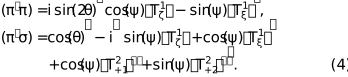
A factor {2 cos(2πky)} with y ≈ 0.1314 (Chikara et al., 2025) is omitted in equation (4) for Wyckoff positions 4e, and it is returned in equation (6). The rotated channel amplitude (π′σ) demonstrates that contributions from axial magnetic dipoles and non-magnetic Templeton–Templeton (T&T) scattering are shifted in phase by 90° (Templeton & Templeton, 1985; Templeton & Templeton, 1986; Ovchinnikova et al., 2025). Scattered intensity picked out by circular polarization in the primary photon beam equals P2ϒ with a chiral signature (Tanaka et al., 2010)

and the Stokes parameter P2 (a purely real pseudoscalar) measures helicity in the primary X-ray beam. Since intensity is a true scalar, ϒ and P2 must possess identical discrete symmetries, specifically, both scalars are time-even and parity-odd. The signature is extracted from observed intensities by subtraction of intensities measured with opposite handed primary X-rays, namely, ±P2. Intensity of a Bragg spot in the rotated channel of polarization is proportional to |(π′σ)|2, and likewise for unrotated channels of polarization. The corresponding E1–E1 chiral signature is
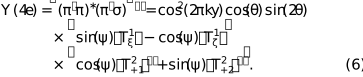
Notably, the chiral signature is a product of dipoles and T&T scattering, and a function of sin(2ψ) and cos(2ψ). The E2–E2 chiral signature is much more complicated because (σ′σ) ≠ 0.
An E1–E2 absorption event reveals Dirac multipoles 〈GK〉 with K = 1, 2, 3 hosted only by Wyckoff positions 4e [Scagnoli & Lovesey (2009), Appendix D:2]. We consider the unrotated amplitude (σ′σ) in light of the absence of diffraction in this channel for an E1–E1 event. The Dirac amplitude is purely imaginary and proportional to {sin(2πky)cos(θ)}. Working to the level of the diagonal octupole
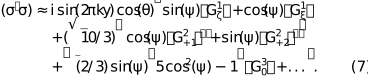
The three omitted octupoles are 〈G3Q〉′ with Q = 1–3. Anapoles (K = 1) in (σ′σ) are parallel to a* and c. The four amplitudes have identical phases, namely, purely imaginary, and the E1–E2 chiral signature is zero.
5. Reflections (0, 0, 2n + 1)
Diffraction amplitudes for forbidden reflections (0, 0, 2n + 1) depend on the monoclinic obtuse angle, and we use d = cos(βo) and e = sin(βo) for an E1–E1 absorption event. It is convenient to employ multipoles

Axial dipoles in A1 and B1 are parallel to a* and c, and T&T scattering create A2 and B2.
The cited amplitudes possess common factors {4cos(2πlz)} with z ≈ 0.9789 (Chikara et al., 2025) or 2 for Wyckoff positions 4e and 2c, respectively. The unique axis b is parallel to the axis y in Fig. 2 at the start of an azimuthal angle scan ψ = 0. E1–E1 amplitudes are
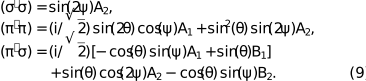
The unrotated amplitude (σ′σ) is purely non-magnetic T&T scattering. Absence of the Bragg angle θ in (σ′σ) is a general condition [Scagnoli & Lovesey (2009), Appendix C]. Multipoles A1 and A2 in the amplitudes (π′σ) and (σ′π) take opposite signs. The chiral signature is caused by an interference between axial dipoles and T&T scattering
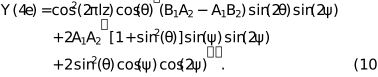
The expression ϒ(4e) is a sum of odd and even functions of the azimuthal angle.
An E1–E2 absorption event reveals the anapole parallel to the unique axis b in the unrotated amplitude (σ′σ),

Octupoles omitted in equation (11) are 〈G3Q〉′′ with Q = 1–3. In line with reflections (0, 2n+ 1, 0), the four amplitudes have identical phases and the E1–E2 chiral signature is zero.
6. Summary and discussion
We have studied Bragg diffraction patterns for the low-temperature phase of Li2Ni3P4O14. On the basis of an extensive set of investigations, Chikara et al. (2025) conclude that it is a monoclinic, collinear antiferromagnet with nickel ions using two Wyckoff positions in the magnetic space group P21/c (No. 14.75) depicted in Fig. 1. Symmetry-informed calculations of resonant X-ray Bragg diffraction patterns reported in the main text include Dirac multipoles (polar and magnetic) permitted at the position that is asymmetric. Anapoles (Dirac dipoles) engaged in diffraction are parallel to the unique axis b, and a* and c, respectively, for two classes of space group forbidden reflections. The magnetic crystal class (2/m) permits the coupling of the magnetic structure to circular polarization (helicity) in the primary beam of X-rays using a parity-even electric-dipole electric-dipole (E1–E1) absorption event. In this study, the coupling is quantified by a chiral signature proportional to the change in X-ray helicity on scattering (Tanaka et al., 2010). The chiral signature is zero for Dirac multipoles exposed by a parity-odd electric-dipole electric-quadrupole (E1–E2) absorption event. Calculated diffraction patterns are enriched by simulating azimuthal angle scans in which the crystal is rotated about the reflection vector.
Chikara et al. (2025) did not allow Dirac multipoles in the analysis of their magnetic Bragg diffraction patterns gathered with neutron scattering (Lovesey et al., 2019). The technique measures the spatial distribution of magnetization (Brown, 1993). Their published measurements extend to a small d-spacing (wavevector κ ≈ 1.36 Å−1) that spans a maximum in the radial integral that accompanies an anapole and a Dirac quadrupole (Lovesey, 2015; Lovesey & van der Laan, 2024).
Acknowledgements
Correspondence with Dr A. K. Bera. Dr D. D. Khalyavin commented on the study in its making and prepared Fig. 1.
References
 Abragam, A. & Bleaney, B. (1970). Electron Paramagnetic Resonance of Transition Ions. Oxford: Clarendon Press. Google Scholar
Bourges, P., Bounoua, D. & Sidis, Y. (2021). C. R. Phys. 22, 7–31. Web of Science CrossRef Google Scholar
Bourges, P., Sidis, Y. & Mangin-Thro, L. (2018). Phys. Rev. B 98, 016501. Web of Science CrossRef Google Scholar
Brown, P. J. (1993). Int. J. Mod. Phys. B 07, 3029–3048. CrossRef CAS Web of Science Google Scholar
Chikara, K. S., Bera, A. K., Kumar, A., Yusuf, S. M., Orlandi, F. & Balz, C. (2025). Phys. Rev. B 112, 014438. Google Scholar
Collins, S. P. & Bombardi, A. (2010). Magnetism and Synchrotron Radiation. Springer Proceedings in Physics, Vol. 133. Heidelberg: Springer. Google Scholar
Collins, S. P., Lovesey, S. W. & Balcar, E. (2007). J. Phys. Condens. Matter 19, 213201-09. Web of Science CrossRef Google Scholar
Cracknell, A. P. (1975). Magnetism in Crystalline Materials. Oxford: Pergamon Press. Google Scholar
Croft, T. P., Blackburn, E., Kulda, J., Liang, R., Bonn, D. A., Hardy, W. N. & Hayden, S. M. (2017). Phys. Rev. B 96, 214504. Google Scholar
Fechner, M., Fierz, M. J. A., Thöle, F., Staub, U. & Spaldin, N. A. (2016). Phys. Rev. B 93, 174419. Web of Science CrossRef Google Scholar
Fernández-Rodríguez, J., Scagnoli, V., Mazzoli, C., Fabrizi, F., Lovesey, S. W., Blanco, J. A., Sivia, D. S., Knight, K. S., de Bergevin, F. & Paolasini, L. (2010). Phys. Rev. B 81, 085107. Google Scholar
Hehlen, M. P., Brik, M. G. & Krämer, K. W. (2013). J. Lumin. 136, 221–239. Web of Science CrossRef CAS Google Scholar
Johnson, R. D. & Lovesey, S. W. (2024). Phys. Rev. B 110, 104405. Web of Science CrossRef Google Scholar
Judd, B. R. (1962). Phys. Rev. 127, 750–761. CrossRef CAS Web of Science Google Scholar
Lovesey, S. W. (2015). Phys. Scr. 90, 108011. Web of Science CrossRef Google Scholar
Lovesey, S. W. & Balcar, E. (1997). J. Phys. Condens. Matter 9, 4237–4260. CrossRef CAS Web of Science Google Scholar
Lovesey, S. W. & Balcar, E. (2010a). J. Phys. Soc. Jpn 79, 074707. Google Scholar
Lovesey, S. W. & Balcar, E. (2010b). J. Phys. Soc. Jpn 79, 104702. Google Scholar
Lovesey, S. W. & Balcar, E. (2013). J. Phys. Soc. Jpn 82, 021008. Google Scholar
Lovesey, S. W., Balcar, E., Knight, K. S. & Fernandez-Rodriguez, J. (2005). Phys. Rep. 411, 233–289. Web of Science CrossRef CAS Google Scholar
Lovesey, S. W., Chatterji, T., Stunault, A., Khalyavin, D. D. & van der Laan, G. (2019). Phys. Rev. Lett. 122, 047203. Web of Science CrossRef PubMed Google Scholar
Lovesey, S. W. & Khalyavin, D. D. (2015). J. Phys. Condens. Matter 27, 495601. Web of Science CrossRef PubMed Google Scholar
Lovesey, S. W. & Knight, K. S. (2000). J. Phys. Condens. Matter 12, L367–L372. Web of Science CrossRef CAS Google Scholar
Lovesey, S. W. & van der Laan, G. (2024). Phys. Rev. B 110, 174442. Web of Science CrossRef Google Scholar
Milton, K. A. (2006). Rep. Prog. Phys. 69, 1637–1711. Web of Science CrossRef CAS Google Scholar
Néel, L. (1932). Ann. Phys. 10, 5–105. Google Scholar
Neumann, F. E. (1885). Vorlesungen über die Theorie Elasticität der festen Körper und des Lichtäthers. Leipzig: Teubner. Google Scholar
Ofelt, G. S. (1962). J. Chem. Phys. 37, 511–520. CrossRef CAS Web of Science Google Scholar
Ovchinnikova, E. N., Oreshko, A. P. & Dmitrienko, V. E. (2025). Phys.-Usp. 68, 393–400 CAS Google Scholar
Paolasini, L. (2014). de la Société Française de la Neutronique (SFN) 13, 03002. Google Scholar
Paolasini, L., Di Matteo, S., Vettier, C., de Bergevin, F., Sollier, A., Neubeck, W., Yakhou, F., Metcalf, P. A. & Honig, J. M. (2001). J. Electron Spectrosc. Relat. Phenom. 120, 1–10. Web of Science CrossRef CAS Google Scholar
Paolasini, L., Vettier, C., de Bergevin, F., Yakhou, F., Mannix, D., Stunault, A., Neubeck, W., Altarelli, M., Fabrizio, M., Metcalf, P. A. & Honig, M. (1999). Phys. Rev. Lett. 82, 4719–4722. Web of Science CrossRef CAS Google Scholar
Pourovskii, L. V., Fiore Mosca, D., Celiberti, L., Khmelevskyi, S., Paramekanti, A. & Franchini, C. (2025). Nat. Rev. Mater. 10, 674–696. Web of Science CrossRef Google Scholar
Scagnoli, V. & Lovesey, S. W. (2009). Phys. Rev. B 79, 035111. Web of Science CrossRef Google Scholar
Scagnoli, V., Staub, U., Bodenthin, Y., de Souza, R. A., García-Fernández, M., Garganourakis, M., Boothroyd, A. T., Prabhakaran, D. & Lovesey, S. W. (2011). Science 332, 696–698. Web of Science CrossRef CAS PubMed Google Scholar
Shull, C. G. & Smart, J. S. (1949). Phys. Rev. 76, 1256–1257. CrossRef Web of Science Google Scholar
Tanaka, Y., Kojima, T., Takata, Y., Chainani, A., Lovesey, S. W., Knight, K. S., Takeuchi, T., Oura, M., Senba, Y., Ohashi, H. & Shin, S. (2010). Phys. Rev. B 81, 144104. Web of Science CrossRef Google Scholar
Templeton, D. H. & Templeton, L. K. (1985). Acta Cryst. A41, 133–142. CrossRef ICSD CAS Web of Science IUCr Journals Google Scholar
Templeton, D. H. & Templeton, L. K. (1986). Acta Cryst. A42, 478–481. CrossRef CAS Web of Science IUCr Journals Google Scholar
Winkler, R. & Zülicke, U. (2025). arXiv: 2405.20940. Google Scholar
This is an open-access article distributed under the terms of the Creative Commons Attribution (CC-BY) Licence, which permits unrestricted use, distribution, and reproduction in any medium, provided the original authors and source are cited.
| STRUCTURAL SCIENCE CRYSTAL ENGINEERING MATERIALS |
access


