

 journal menu


issue contents
December 2025 issue
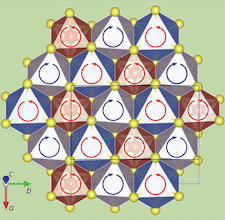
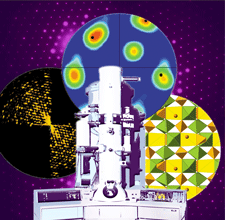
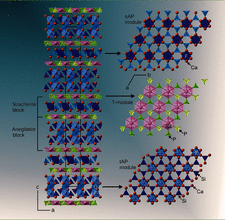
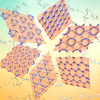
Cover illustration: Transmission electron microscopy and single-crystal X-ray diffraction have been used to study the two-dimensional van der Waals layered compound CuVP2S6. Shown is a crystal structure model of the compound, viewed along the c* axis. See Nur Farhana Hasmuni et al. [(2025), Acta Cryst. B81, 565–571].
editorial


Free 
The virtual special issue on Magnetic Structures is introduced. The articles included here were originally published in recent regular issues of Acta Crystallographica Section B.
scientific commentaries
Free
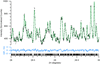
Lake and Von Dreele [Acta Cryst. (2025), B81, 572–581] provide an informative look at the current state of the art in powder diffraction, and subtleties that can be revealed through its careful application.
Current research in crystal growth and related characterization

Download citation


Download citation
Open access
access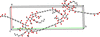
Crystals of flocculosin-A, the major antifungus compound from Anthracocystis flocculosa, are optimised using a cyclic temperature control.
CCDC reference: 2295682
research papers
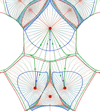
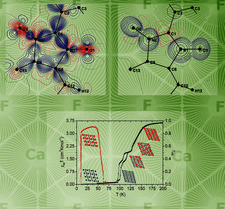
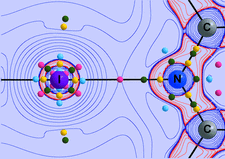
The quantum crystallography approach used here reveals the fine features of the interatomic interactions of different nature in [Co(NH3)5NO2]ClNO3 and [Co(NH3)5ONO]ClNO3 crystals and provides a better insight into the role of the crystalline environment in the intramolecular nitro–nitrito linkage photoisomerization.
Download citation
Download citation
Open access
access
This study highlights how solvent properties, host–guest interaction energies and packing preferences govern the solid-state organization of tert-butylcalix[6]arene, a macrocycle of importance in separation, molecular recognition and supramolecular chemistry.
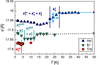
Magnetoelastic effect in R5Pt2In4 (R = Tb–Tm) is determined from neutron powder diffraction data.
Open access
access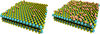
The stable epitaxial growth of silicene on MoS2 requires both van der Waals and covalent interactions – without them, the silicene collapses into a disordered state. These findings offer important insights into designing stable silicene/MoS2 heterostructures for future nanotechnology applications.
Download citation
Download citation
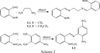
Three new Schiff base ligands are characterized. The presence of intra- and intermolecular interactions in the compounds are established by QTAIM theory and noncovalent interaction plot computational method. Hirshfeld surface analysis reveals that the most abundant intermolecular contacts are H⋯H contacts. The interaction energies of the dimer associates of the compounds through the intermolecular interactions in their solid-state are obtained by energy decomposition analysis via natural orbitals for chemical valence theory.
Download citation
Download citation
Open access
access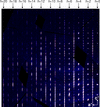
The complex stacking disorder of 2,3-dihydroxy-1,3,4-trimethyl-6-oxo-1,4-cyclohexadiene-1-carboxylic is analyzed by applying the order–disorder theory and its diffuse scattering is interpreted using a growth model.
CCDC reference: 2496234
Download citation
Download citation
Open access
access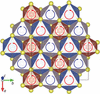
Two-dimensional van der Waals layered compound CuVP2S6 is studied by transmission electron microscopy and single-crystal X-ray diffraction. Rotational microtwin structures, which may be typical and characteristic of two-dimensional van der Waals compounds, are observed.
CCDC reference: 2494459
Download citation
Download citation
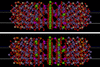
A reconsideration of the crystal structures of mcgovernite and carlfrancisite gives noncentrosymmetric structures with ordered planar defects instead of random site disorder in centrosymmetric ones.
Open access
access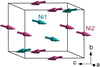
Amplitudes for resonant X-ray diffraction by collinear antiferromagnet Li2Ni3P4O14 that include permitted Dirac multipoles, e.g. anapoles, are investigated. Chiral signatures for the rotation of X-ray helicity are described.
Download citation
Download citation
Open access
access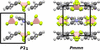
Three symmetry-raising phase transitions of anilinium tetrafluoroborate between room temperature and 490 K have been structurally characterized using powder and single-crystal diffraction, dielectric measurements, NMR and group–subgroup relationships.
Open access
access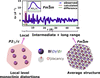
The importance of the cation sublattice in influencing both the average and local structures of δ-Bi2O3-like phases is highlighted. It also reveals the inadequacy of conventional average structural analysis methods in describing comprehensively the structure of real materials.