journal menu


issue contents
March 2026 issue
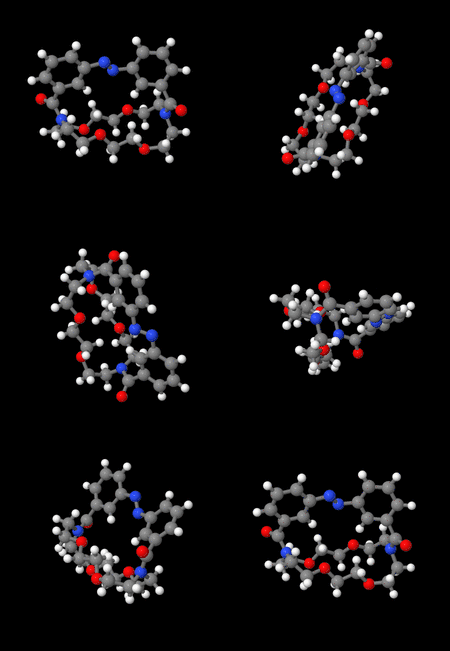
Cover illustration: Crown ether derivatives continue to be of great interest for their tuneable binding affinities to different species. Schwab & Kreidt [Acta Cryst. (2026). E82, 271–277] report the structures of an ‘empty’ azobenzene-bridged crown ether and its complex with sodium cations and 3,5-bis-(trifluoromethyl)phenylborato counter-ions. The crystal structures provide unique insight into the subtle conformational changes that occur on complexation in crown ethers and Hirshfeld surface analyses quantify the intermolecular interactions.
research communications


Download citation


Download citation
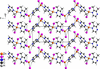
The syntheses and structures of [ZnI2(C6H8N2)]n and [ZnI2(C6H8N2)(H2O)]·0.5C6H8N2·0.5H2O are reported (C6H8N2 = 2,3-dimethylpyrazine). In the first compound, the Zn2+ cations are connected by the 2,3-dimethylpyrazine ligands into helical chains, whereas in the second discrete complexes are observed that are arranged in such a way that cavities are formed, in which additional water and 2,3-dimethylpyrazine molecules are incorporated.
Download citation
Download citation
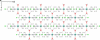
The molecular structure and Hirshfeld surface analysis of the diaqua[5,10,15,20-tetrakis(4-chlorophenyl)porphyrinato-κ4N}magnesium(II) coordination compound with the formula [Mg(C44H24ClN4O2)(H2O)2] is described. The crystal structure of this new MgII metalloporphyrin features C—H⋯π interactions involving the pyrrole rings and non-conventional O—H⋯Cl hydrogen bonds between the axial aqua ligand and a nearby [Mg(TClPP)(H2O)2] molecule.
CCDC reference: 2526366
Download citation
Download citation
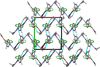
A second orthorhombic polymorph of the title Schiff base crystallizes in space group Pna21, compared to Pbca for the first polymorph. The difference in the structure of the two polymorphs resides in the orientation of the 4-methoxy moiety of the (4-methoxyphenyl)allylidene unit.
CCDC reference: 2527948
Download citation
Download citation
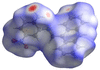
The title compound contains a nitroaniline ring and an anthracene ring system bridged over the methylene amino group. In the crystal, the N—H⋯O hydrogen bonds link the molecules into infinite chains along the b-axis direction. π–π stacking interactions between the nitroaniline rings of adjacent molecules with centroid-to-centroid distance of 3.7682 (2) Å and C—H⋯π(ring) interactions are also observed.
CCDC reference: 2527280
Download citation
Download citation
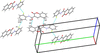
Two 2-oxo-2H-chromene derivatives were synthesized by acid–aniline coupling reactions. These two compounds were subjected to SXRD and Hirshfeld surface analysis to explore their intermolecular interactions.
Download citation
Download citation
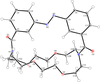
The single-crystal X-ray diffraction structures of an azobenzene-bridged aza-18-crown-6 cryptand and its sodium complex are reported.
Download citation
Download citation
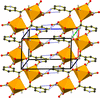
The crystal structure of [Ca2(C6H5NO2)2(H2O)2(NO3)2] reveals an eight-coordinate distorted dodecahedral CaII center with mixed ligands. A Hirshfeld surface analysis elucidated the intermolecular interactions consolidating the crystal.
CCDC reference: 2529092
Download citation
Download citation
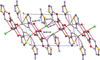
In the complex anion of the title salt, the central MnII atom adopts a distorted octahedral coordination environment, defined by two aqua, two chlorido, and one bidentate malonato ligand. The thiadiazole ligands are protonated and linked to the anion through various hydrogen-bonding interactions.
CCDC reference: 2495418
Download citation
Download citation
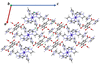
The structure of a hexakis(imidazole)cobalt(II) bis(benzene-1,3,5-tricarboxylate) tetra(imidazole-1-ium) dihydrate compound was determined by single-crystal X-ray diffraction.
CCDC reference: 2531427
Download citation
Download citation

The cocrystal formed between 2,3-diaminopyrazine and tetrafluorophthalic acid, C24H16F8N8O8, crystalizes as a salt in the triclinic space group P1 with one unique protonated 2,3-diaminopyrazinium cation, one half a tetrafluorophthalic acid molecule and one half of a tetrafluorophthalate anion. The salt forms a corrugated two-dimensional supramolecular network with cooperative neutral and charge assisted hydrogen bonding.
CCDC reference: 2531359
Download citation
Download citation
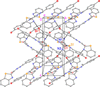
The configuration across the formal N=C double bond of the 2-substituent is E; the atom sequence C—C—C(=O)—N—N=C—(bromophenyl) of the 2-substituent is very approximately planar. A classical hydrogen bond and a halogen bond combine to form a layer structure.
CCDC reference: 2529228
Download citation
Download citation
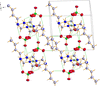
The nickel(II) macrocyclic title complex shows centrosymmetric octahedral coordination with elongated axial Ni—O bonds. Unlike the CuII analogue, it forms a uniform hydrogen-bonded three-dimensional supramolecular network, as revealed by synchrotron crystallography.
CCDC reference: 2531895
Download citation
Download citation
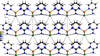
The crystal structures of ZnCl2(C4H5N3)2 (second polymorph) and ZnI2(C4H5N3)2 were determined. Both are built up from discrete tetrahedral complexes that are connected via intermolecular hydrogen bonds.
Download citation
Download citation
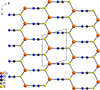
In the title compound, the copper(I) cations are tetrahedrally coordinated and linked into layers by μ-1,3,3(N,S,S) bridging thiocyanate anions.
CCDC reference: 2532015
Download citation
Download citation

A π-conjugated N-donor ligand links μ2-iodido-bridged dinuclear [Bi2I8]2− units to afford a rare one-dimensional anionic iodidobismuth(III) coordination polymer, which was synthesized and structurally characterized by single-crystal X-ray diffraction.
CCDC reference: 2529756
education and outreach

Whitworth University's recent Summer Crystallography Institutes offer important insights into training and engaging the next generation of structural scientists in a workshop setting.