

 journal menu


research papers
 | JOURNAL OF APPLIED CRYSTALLOGRAPHY |
 access
Nematicity and structural strain: a tight connection in Fe-based superconductors

aCNR Institute SPIN, Corso Perrone 24, Genova, I-16152, Italy
*Correspondence e-mail: [email protected]
In the present work, the role of microstrain developing in the temperature range above the in Fe-based superconductors is analysed in depth. Reviewing the results obtained from different compositions, a similar behaviour emerges in all cases. In particular, using an accurate diffraction line broadening analysis it is demonstrated that the tetragonal-to-orthorhombic occurring on cooling is anticipated by a symmetry breaking developing on the local scale in the tetragonal plane. The increase in microstrain with decreasing temperature in the stability field of the tetragonal phase qualitatively mirrors the development of anisotropy measured in some physical properties, a behaviour ascribed to nematicity. These results demonstrate the tight and delicate interplay correlating structural features on the local scale with transport and magnetic properties.
Keywords: superconductor materials; nematicity; line profile analysis.
1. Introduction
Fe-based superconductors constitute one of the most widely studied classes of materials in the past decade, ever since the discovery of temperatures up to 26 K in LaFeAs(O1−xFx) (Kamihara et al., 2008 ). The nematic phase represents one of their most intriguing features. Consistent with experimental observations, the theory of electron nematic order correctly predicts the sequence of structural and magnetic transition in LaFeAsO (Fang et al., 2008). In its first formulation, this theoretical model was based on localized spin at the Fe sites interacting with neighbouring spins by antiferromagnetic interactions (Fang et al., 2008). In this scenario, the tetragonal-to-orthorhombic symmetry reduction in LaFeAsO (envisioned as a transition to an electron nematic phase) is driven by magnetism (Fang et al., 2008). Although the proposed theory correctly describes the sequence of structural and magnetic transitions, it cannot explain why the same structural transition is observed in some cases where magnetism is absent and the ground state is fully superconductive, as in β-FeSe (Margadonna et al., 2008; Pomjakushina et al., 2009; Böhmer et al., 2015), in (Nd1−xSrx)FeAsO (Kasperkiewicz et al., 2009) and in a limited compositional range of the SmFeAs(O1−xFx) system (Margadonna et al., 2009; Martinelli et al., 2012). Subsequently, charge and/or orbital fluctuations were also proposed to play a role in driving the nematic instability (Fernandes et al., 2014); charge density waves (CDWs) were then detected (Martinelli et al., 2017; Lee et al., 2019; Martinelli et al., 2021), adding a new ingredient in the crystallo-physics of these systems.
By definition, in the nematic phase the symmetry of some physical properties is lower than the symmetry of the underlying crystal structure (Johnston, 2010; Kivelson et al., 1998; see also Appendix A). In terms of group theory, the point group L characterizing the symmetry of the tensor physical property is a sub-group of the G characterizing the i.e. L is a of G (L  G), where every element (symmetry operation) of L is an element of G. For example, in-plane resistivity anisotropy was observed in a series of detwinned Ba(Fe1−xCox)2As2 samples well above the temperature, where a C4 rotational symmetry in the high-temperature tetragonal phase coexists with the C2 symmetry of the electronic properties (Chu et al., 2010).
In fact, what is apparently observed in the nematic phase is opposite to what is postulated by Neumann's principle, which states that the macroscopic tensor properties of the crystal must have at least the symmetry of the point group of the crystal structure. That is, the point group G of the crystal is a sub-group of the symmetry group L of any of its physical properties (G  L or L
  G). This implies that, if a crystal is invariant with respect to certain symmetry operations, any of its physical properties must also be invariant with respect to the same symmetry operations. Hence, the in-plane anisotropic behaviour observed in electrical resistivity (a polar tensor property) above the structural transition (in the tetragonal stability field) is clearly opposite to what is predicted by Neumann's principle.
In this paper, criticalities related to the exact detection and definition of structural and microstructural properties are discussed by reviewing numerous studies conducted on different compositions of phases belonging to the class of Fe-based superconductors. It is suggested that the observed relationships between the symmetry properties of the physical tensors and the underlying crystal structure are consistent with Neumann's principle when the microstructural properties of these compounds are considered. In this context, we recall that the structure and properties of periodic matter, in whatever dimension and geometry, are strictly related to crystallography (Nespolo, 2015). For an in-depth treatise on the crystallographic issues examined in the present paper, the reader is also referred to Janovec et al. (2013).
2. Method
Details about sample preparation and data collection are found in the articles cited in the text. The diffraction data were acquired during different experimental sessions using the high-resolution neutron powder diffractometer D2B at the Institute Laue Langevin (ILL, Grenoble, France; NPD data) and the X-ray powder diffractometer on the ID22 beamline (old ID31 beamline) of the European Synchrotron Radiation Facility (ESRF, Grenoble, France; XRPD data). The reader is encouraged to consult these cited articles for more precise experimental details.
3. Results and discussion
3.1. The tetragonal-to-orthorhombic transition in Fe-based superconductors
As a rule, crystal properties are described by a property tensor and the crystal symmetry is defined by a crystallographic The type reductions P4/nmm → Cmme and I4/mmm → Pmmm involved in the structural transitions occurring in LnFeAsO (Ln = lanthanide), β-FeSe and (A,AE)Fe2As2 compounds (A = alkaline element and AE = alkaline earth element) are characterized by the same type dissymmetrization 4/mmm ⇓ mmm (G ⇓ L). For this reason, hereinafter only the former transition P4/nmm → Cmme is discussed; the same arguments apply to the latter.
The symmetry reduction is classified as ferroic, because the type mmm is a strict sub-group of 4/mmm. In principle, the 4/mmm ⇓ mmm type reduction can be induced by the condensation of the symmetry-breaking Γ4+ (B2g) soft mode (Salje, 1991; Martinelli, 2013). Nevertheless, the displacive Γ4+ mode is not active at the occupied sites of LnFeAsO, (A,AE)Fe2As2 and β-FeSe compounds, and hence the structural transition is not driven by structural degrees of freedom; the non-symmetry breaking Γ1+ (A1g) is the only soft mode involved in the reduction [Fig. 1(a)]. In fact, the symmetry breaking does not originate from the critical behaviour of phonons associated with the Γ point of the but the symmetry reduction is induced by an electronically driven instability (charge, spin or orbital degree of freedom); the structural deformation is therefore the response of the to an electronic that develops on cooling. This is the essential nature of the nematic transition, i.e. the dissymetrization does not originate in atomic Electronic (spin, orbital) were proposed to drive the (Fernandes et al., 2014); regrettably, up to now the role of CDWs (possibly originating in Fermi surface nesting; Dong et al., 2008) has been disregarded, although its belated experimental detection (Martinelli et al., 2017; Lee et al., 2019; Martinelli et al., 2021) does demand further study.
![[Figure 1]](po5164fig1thm.gif) | Figure 1 (a) Atomic displacement pattern corresponding to the non-symmetry breaking Γ1+ soft mode in LnFeAsO. (b) Relationship between the high-temperature tetragonal and low-temperature orthorhombic unit cells of β-FeSe (selected as representative; grey arrows show the effect of symmetry breaking on the Fe–Fe inter-atomic distances). |
In the low-temperature orthorhombic phase, the is rotated 45° along the c axis with respect to the high-temperature tetragonal cell, and the edges of the basal cell are a factor of  larger [Fig. 1(b)]. The P4/nmm → Cmme transition is equitranslational (translationengleiche), as it is described by a representation Γn of G. As a consequence, twinned crystals form with symmetry reduction, and the primitive unit cells of the P4/nmm (high-symmetry, HS) and Cmme (low-symmetry, LS) phases have the same size, that is the number of atoms per primitive crystal cell remains the same throughout the For this reason, no additional optical phonon peaks are observed in the Raman spectra below Ts (the temperature). Moreover, theory dictates that the representation Γn involved in the dissymetrization determines the principal tensor parameters associated with the primary if one of these tensors is a vector (first-rank tensor) or a second-rank tensor, the soft mode is infrared or Raman active in the parent phase, respectively (Tolédano et al., 2006). In the present case the Γ1+ representation is associated neither with a vector nor with a second-rank tensor; for this reason, diffraction is the chosen technique to investigate the structural changes in these materials.
Nonetheless, diffraction data must also be analysed with great care. In fact, the observed profile function h(x) (i.e. the diffraction pattern) results from the convolution between the instrumental g(x′) and the intrinsic diffraction f(x−x′) profile functions:

In particular, the P4/nmm → Cmme transition is marked by the selective peak splitting of the {hhl} reflections; in the case of a slight structural distortion combined with an inadequate instrumental resolution, the measured profile function can be greatly affected by the contribution of the instrumental profile function, preventing a resolved peak splitting and consequently preventing the correct determination of the crystal structure (and the resulting phase diagrams; Martinelli et al., 2016).
This is clearly depicted in Fig. 2 where the same sample with nominal composition La(Fe0.90Ru0.10)AsO has been analysed using both a high-resolution synchrotron X-ray powder diffractometer and a high-resolution neutron powder diffractometer [for experimental details see Martinelli et al. (2013)]. The diffraction line 112 has been selected because it has a comparable relative intensity in both diffraction techniques. The peak splitting taking place on cooling is evident in the high-resolution XRPD data, whereas the NPD data display only a faint broadening even well below Ts (∼115 ± 5 K). Hence, in the latter case the is hidden by the instrumental resolution (actually, some peaks show clear splitting in the NPD data at higher Q, marking the structural transition; see Fig. 3 where the tetragonal 420 diffraction line splits into the orthorhombic 260 + 620 reflections on cooling at 110 K).
![[Figure 2]](po5164fig2thm.gif) | Figure 2 Comparison between (left) the synchrotron X-ray and (right) the neutron powder diffraction patterns collected on the same sample with nominal composition La(Fe0.90Ru0.10)AsO in the same Q range and over the same T range. |
![[Figure 3]](po5164fig3thm.gif) | Figure 3 Splitting of the tetragonal 420 diffraction line into the orthorhombic 260 + 620 reflections on cooling in La(Fe0.90Ru0.10)AsO (NPD data). |
Here it is demonstrated that, even when a clear peak splitting cannot be detected, fundamental insights can be gained by an accurate diffraction line broadening analysis (indeed, this technique allowed the first identification of the in SmFeAsO; Martinelli et al., 2009a). In particular, the occurrence of strain broadening in diffraction peaks demonstrates the presence of microstrain, that is, a distribution of interplanar distances around a mean value (Rodríguez-Carvajal et al., 1991; Stephens, 1999). Within this scope, Rietveld refinements were carried out using NPD data collected for La(Fe0.90Ru0.10)AsO; in particular, data exceeding Q ≃ 5.75 Å−1 were excluded (in order to analyse only the diffraction line broadening and exclude from our analysis the split reflections observed at higher Q) and a tetragonal structural model was applied over the whole inspected temperature range. It is apparent that the anisotropic microstrain along {hh0} exhibits an abrupt increase some tens of degrees above Ts and then saturates after the completion of the structural transformation [Fig. 4(a)]. Note that the distortion accompanying the transition occurs exactly along the {hh0} crystallographic direction, i.e. the diagonal direction of the base square [Fig. 1(b)]. The microstrain increase observed on cooling above Ts indicates that the tetragonal phase is becoming progressively unstable, although the thermodynamically stable structure is not yet orthorhombic. The same scenario stands out by superimposing the Williamson–Hall plots obtained at different temperatures [Fig. 4(b)].
![[Figure 4]](po5164fig4thm.gif) | Figure 4 (Left) Evolution with temperature of the anisotropic microstrain representative of the Laue class 4/mmm in La(Fe0.90Ru0.10)AsO (NPD data; lines are guides to the eye). (Right) Superposition of Williamson–Hall plots obtained over the same temperature range. For the sake of clarity, data obtained from (hh0) diffraction line data are plotted with full symbols. |
The development of microstrain has a twofold effect. In fact, both (i) the amplitude of the microstrain and (ii) the volume of the strained regions progressively grow when the high-symmetry P4/nmm phase is cooled down towards Ts. Similar analyses and results on β-FeSe (Martinelli, 2023) and other LnFeAsO systems (Martinelli et al., 2009b; Martinelli et al., 2012; Martinelli et al., 2013; Martinelli et al., 2019; Martinelli, 2019) have been reported; using a different approach, comparable conclusions were also obtained by analysing BaFe2(As1−xPx)2 single crystals (Kasahara et al., 2012).
Another remarkable result is depicted in Fig. 5, where the tensor surface representing the structural microstrain exhibits the peculiar morphology theoretically calculated for the 4/mmm ⇓ mmm type dissymetrization (Leineweber, 2011). In particular, a four-fold tensor surface is theoretically predicted to develop in the ab plane for this symmetry reduction, fully consistent with our data. All these results demonstrate that an accurate microstructural analysis can reveal (or at least suggest) the occurrence of a subtle even when the instrumental resolution prevents a sharp peak splitting (Fig. 2).
![[Figure 5]](po5164fig5thm.gif) | Figure 5 Evolution with temperature of the strain tensor surface characterizing La(Fe0.90Ru0.10)AsO (obtained using the refined tetragonal anisotropic strain parameters). |
3.2. Microstructural features below the transition temperature
Below the transition temperature, the symmetry reduction is accompanied by the development of a domain structure in the ferroic Cmme polymorph (transformation twins) to accommodate the change (Ma et al., 2009; Tanatar et al., 2009). In particular, the Cmme type is a maximal non-isomorphic of P4/nmm and the transition thus produces a twin domain structure. The dimension and shape of the domains depend on many factors, among which the most relevant are the kinetics of the and the occurrence of local stresses and defects. The change in the symmetry at the determines the type of domain structure. All domains are characterized by the same as the low-temperature polymorph, differently oriented in the different domains. Remarkably, these different domains even exhibit different tensor properties. A ferroelastic domain structure can grow when the is characterized by a decrease in the independent strain components; in this case, the mechanical strain is different in the different domain states, but by applying a mechanical stress the different orientation states can be switched.
In the inspected case, the dissymetrization 4/mmm ⇓ mmm ( 4z/mzmxmxy ⇓  ) is a ferroic transition accompanied by a spontaneous strain (the part of the strain due entirely to the structural transition; Salje, 1991), giving rise to ferroelastic domains with different strains. The theoretical analysis of this symmetry reduction (Janovec & Přívratská, 2013) predicts the occurrence of two principal domain states, S1 and S2, related by a symmetry operation suppressed during the transitions (Figs. 6 and 7). These domain states correspond to two ferroelastic domain states, in perfect agreement with the domain structures observed in (A,AE)Fe2As2 compounds (Ma et al., 2009; Tanatar et al., 2009).
![[Figure 6]](po5164fig6thm.gif) | Figure 6 Exploded view of single-domain states S1 and S2 (solid rectangles) formed during the transition 4z/mzmxmxy ⇓  . The tetragonal phase is represented by the dashed square (rotated by 45°; see Fig. 1) and possible variants of the orthorhombic phase by rectangles. Symmetry elements of the point group 4z/mzmxmxy are also drawn. . The tetragonal phase is represented by the dashed square (rotated by 45°; see Fig. 1) and possible variants of the orthorhombic phase by rectangles. Symmetry elements of the point group 4z/mzmxmxy are also drawn. |
![[Figure 7]](po5164fig7thm.gif) | Figure 7 Schematic representations of the atomic arrangement within the [FeSe] layer, (left) in the high-symmetry P4/nmm phase and (right) in the domain structure of the low-symmetry Cmme phase. The 4/mmm → mmm transition gives rise to different ferroelastic domain states (having different orientation states separated by domain walls; in the present case, the mirror plane perpendicular to the tetragonal x axis) with different spontaneous strains. Unit cells representative of the tetragonal and orthorhombic structures are highlighted [see also Fig. 1(b)]. |
As the number of ferroelastic domain states is equal to the number of principal domain states, the 4/mmm → mmm transition is fully ferroelastic, with the principal domain states S1 and S2 characterized by spontaneous strain tensors having different orientation states. Mirror planes of the tetragonal structure which are not present in the orthorhombic structure are permissible domain walls in the twin domain structure (Sapriel, 1975); in the present case permissible domain walls are thus mirror planes mx and my (Figs. 6 and 7).
The strain tensor is a polar symmetric property tensor of second rank; as a general rule, if one second-rank polar symmetric property tensor changes, all other polar symmetric property tensors with rank ≥2 also change (Aizu, 1969; Aizu, 1970). In particular, the strain tensor, the electrical conductivity tensor and the magnetic susceptibility tensor are all second-rank tensors and therefore have the same transformationa1 properties; thus their changes are always correlated. As a consequence, when the strain tensor changes the electrical conductivity must also change symmetrically. The domain pair sketched in Fig. 6 and in the panel on the right-hand side of Fig. 7 consists of domain states with different orientations, each characterized by its own strain tensor. These domain states can appear with the same probability when related by a suppressed by dissymetrization, that is a of P4/nmm but not of Cmme. By applying an external mechanical stress, the different states of the domain structure can be oriented along the same direction (detwinning) and hence display the same tensor properties; in this case, distinct resistivities along x and y can be measured, or are otherwise ideally averaged at about the same value when the two domain states develop with the same probability. The anisotropy measured for the physical property is primarily determined by the symmetry of the [FeSe] layer, rather than by the amplitude of the orthorhombic structural distortion (in the present case, the percentage difference between the cell parameters a and b in the orthorhombic phase of β-FeSe is less than 0.5%).
3.3. Microstructural features above the transition temperature
Hitherto the microstructural properties of the low-symmetry Cmme phase below Ts (T < Ts) have been examined. It is instructive at this point to analyse the temperature dependence of the microstructural properties (Snyder et al., 2000) of the HS P4/nmm phase just above Ts, where the nematic phase is reported to occur. In particular, we have debated the spontaneous strain that measures the amplitude of the deformation of the LS structure with respect to the HS one (the spontaneous strain being null in the HS phase; Salje, 1991). From now on we analyse the features of the microstrain in the P4/nmm phase (T > Ts), describing the response of the crystal structure of the HS phase to a temperature change. This microstrain originates from the local distortion of the tetragonal structure, i.e. the changes in the distances between its various atoms along different crystallographic directions, and occurs on account of static fluctuations and correlations between metric parameters (Rodríguez-Carvajal et al., 1991). Therefore, the atomic arrangement in the locally distorted regions is not the same as that in an undistorted tetragonal structure, due to the different forces acting on the atoms. The 4/mmm symmetry is thus broken on the local scale within some regions of the tetragonal phase, as sketched in Fig. 8, even though the crystal structure remains P4/nmm on average. Nonetheless, the interactions between the electrons and the atoms are modified in the distorted regions, thus affecting the electron–structure coupling and transport properties (Millis, 1998). Fluctuations of the order parameter occur on the local scale on cooling (reaching a critical level as Ts is approached) and progressively affect the strain tensor. In the present case, the strain is not produced by stress, but it is caused by a temperature change, which is a scalar quantity and hence has no orientation. Consequently, the strain must be invariant with respect to the symmetry of the crystal (Nye, 1957). For the 4/mmm the corresponding symmetry-adapted form of the strain tensor is
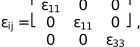
with two independent coefficients. This expression holds when microstrain is negligible in the tetragonal structure.
![[Figure 8]](po5164fig8thm.gif) | Figure 8 Representation of microstrain within the [FeSe] layer, breaking the 4/mmm symmetry on the local scale. In the average tetragonal structure (red cell), locally correlated orthorhombic distortions (orange cell) take place along {hh0} [see also Fig. 1(b)]. |
The temperature evolution of microstrain in the P4/nmm phase is illustrated in Fig. 4 and shows a progressive increase in microstrain along {hh0} starting some tens of degrees above Ts, i.e. in the same temperature range as where nematic properties are typically measured. As mentioned above, the orthorhombic structural distortion accompanying the transition occurs along this same {hh0} direction. Consequently, a microstrained tetragonal structure with locally correlated orthorhombic distortions takes place in this temperature range. On cooling/heating, the crystal deformation is described by the thermal expansion  , a second-rank tensor relating the strain to the change in temperature:

Then, on the local scale and for the orthorhombic distorted regions, the thermal expansion tensor is related to the strain tensor:
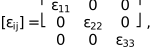
with three independent coefficients conforming to the local symmetry. As all second-rank tensors have the same transformation properties, their changes are thus correlated and always occur simultaneously. Since the strain (a polar symmetric property tensor of second rank) changes with temperature, all other polar symmetric property tensors with rank = 2 (such as electrical conductivity) must transform in the same way. In particular, the development of microstrain along {hh0} in the P4/nmm phase breaks the 4/mmm symmetry on the local scale; therefore, the symmetry group characterizing the electrical conductivity accordingly also changes on the local scale and resistivity fluctuations occur along the same tetragonal {hh0} crystallographic directions where microstrain develops. This is the reason why resistivity displays different values when measured along different in-plane directions above Ts in the tetragonal phase of untwinned crystals (Chu et al., 2010).
Note that the magnitude of ρb/ρa for in-plane resistivity of detwinned Ba(Fe1−xCox)2As2 samples decreases with heating for T > Ts; this is exactly the same dependence on temperature as observed for the microstrain along {hh0} (Fig. 4). This feature clearly shows the close relationship and interplay between the microstrain (and the associated strain tensor on the local scale) and electrical resistivity (and more generally between the strain and other physical property tensors with rank ≥2). Similarly, the linear coupling between the microstrain and the nematic order parameter obtained by magnetic torque measurements (Kasahara et al., 2012) must be ascribed to the fact that the magnetic susceptibility tensor and the magnetic permeability tensor are again second-rank tensors.
A final remark concerns the degree(s) of freedom driving the structural microstrain and dissymetrization. The development of CDWs is consistent with the Fermi surface nesting characterizing these compounds, even though initial investigations ruled out its occurrence on the basis of the erroneous conclusion that a negligible structural distortion takes place on cooling (Dong et al., 2008). The recent experimental detection of incommensurately modulated phases in these materials (Martinelli et al., 2017; Lee et al., 2019; Martinelli et al., 2021) strongly demands further theoretical investigations into the role played by CDWs in the physics of these materials. It is likely that the observed structural distortion results from an electrostrictive coupling between the strain tensor and the electric field associated with the CDWs. As a rule, the development of the incommensurate state is accompanied by a microstrain-like diffraction line broadening (Leineweber & Petricek, 2007), a behaviour fully consistent with our microstructural analysis.
4. Conclusion
A careful analysis of structural and microstructural properties as a function of temperature reveals a significant evolution of the microstrain in the tetragonal polymorph of Fe-based superconductors. In particular, local distortions are shown by the progressive increase on cooling of the microstrain along {hh0} in the tetragonal phase as the tetragonal-to-orthorhombic structural transition is approached. Consequently, a microstrained tetragonal structure with locally correlated orthorhombic distortions occurs in this temperature range. As thermal expansion and the associated strain are second-rank polar symmetric property tensors and must conform to crystal symmetry (even on the local scale), their dependence on temperature is expected to symmetrically affect all other polar symmetric property tensors with rank ≥2, such as electrical conductivity and magnetic susceptibility. As a result, the anisotropy of the physical properties observed above Ts and ascribed to nematicity is actually provided by a diffuse short-range structural distortion breaking the average tetragonal symmetry on the local scale.
Ultimately, this scenario reconciles the apparent violation of Neumann's principle (stating that G L) with the current definition of the nematic phase provided for Fe-based superconductors, i.e. a phase with a tetragonal structure but with physical properties characterized by a lower symmetry (L G).
APPENDIX A
On the original definition of the nematic phase
In the original formulation of the applied to a two-dimensional square lattice, it is stated that `the nematic phase breaks the four-fold rotation symmetry of the lattice, but leaves both translation and reflection symmetries unbroken' (Kivelson et al., 1998). Although seldom confused with the concept of structure, the lattice is constituted by an infinite set of integral linear combinations of linearly independent vectors in the vector space. The points of the point lattice thus have a periodic order, they are all equal and they all have the same surroundings. The symmetry group G of a square lattice consists of eight mapping elements g (identity, one two-fold rotation axis, two four-fold rotation axes and four mirror planes) (Müller, 2013). Group theory dictates that, to each product gi × gj of two elements of a group G, there corresponds a unique element gk of G. This means that it is not possible to eliminate the four-fold rotation elements while keeping unchanged the reflection elements. In fact, the product of two reflection planes that are not mutually perpendicular to each other corresponds to a four-fold rotation axis. For example, by multiplying the reflection plane perpendicular to the x axis with a diagonal reflection plane, the four-fold rotation element is again generated:

Nonetheless, for a crystal the metric of the unit cell associated with the lattice can be accidentally higher than expected (for example, an orthorhombic crystal structure with a unit cell of lattice parameters a = b) within certain temperature and/or pressure ranges. In this case, the lattice is promoted to a higher symmetry, but without increasing the underlying symmetry of the structure (Nespolo, 2015).
Acknowledgements
Open access publishing facilitated by Consiglio Nazionale delle Ricerche, as part of the Wiley–CRUI-CARE agreement.
Conflict of interest
There are no conflicts of interest.
Data availability
Data supporting the reported results can be accessed upon request.
References
 Aizu, K. (1969). J. Phys. Soc. Jpn 27, 387–396. CrossRef CAS Google Scholar
Aizu, K. (1970). J. Phys. Soc. Jpn 28, 706–716. CrossRef CAS Google Scholar
Böhmer, A. E., Arai, T., Hardy, F., Hattori, T., Iye, T., Wolf, T., Löhneysen, H., Ishida, K. & Meingast, C. (2015). Phys. Rev. Lett. 114, 027001. PubMed Google Scholar
Chu, J.-H., Analytis, J. G., De Greve, K., McMahon, P. L., Islam, Z., Yamamoto, Y. & Fisher, I. R. (2010). Science 329, 824–826. CrossRef CAS PubMed Google Scholar
Dong, J., Zhang, H. J., Xu, G., Li, Z., Li, G., Hu, W. Z., Wu, D., Chen, G. F., Dai, X., Luo, J. L., Fang, Z. & Wang, N. L. (2008). Europhys. Lett. 83, 27006. CrossRef Google Scholar
Fang, C., Yao, H., Tsai, W.-F., Hu, J. P. & Kivelson, S. A. (2008). Phys. Rev. B 77, 224509. CrossRef Google Scholar
Fernandes, R. M., Chubukov, A. V. & Schmalian, J. (2014). Nat. Phys. 10, 97–104. CrossRef CAS Google Scholar
Janovec, V., Hahn, Th. & Klapper, H. (2013). Twinning and domain structures, in International tables for crystallography, Vol. D, ch. 3.2, pp. 397–412. International Union of Crystallography. Google Scholar
Janovec, V. & Přívratská, J. (2013). Domain structures, in International tables for crystallography, Vol. D, ch. 3.4, pp. 484–543. International Union of Crystallography. Google Scholar
Johnston, D. C. (2010). Adv. Phys. 59, 803–1061. CrossRef CAS Google Scholar
Kamihara, Y., Watanabe, T., Hirano, M. & Hosono, H. (2008). J. Am. Chem. Soc. 130, 3296–3297. Web of Science CrossRef ICSD PubMed CAS Google Scholar
Kasahara, S., Shi, H. J., Hashimoto, K., Tonegawa, S., Mizukami, Y., Shibauchi, T., Sugimoto, K., Fukuda, T., Terashima, T., Nevidomskyy, A. H. & Matsuda, Y. (2012). Nature 486, 382–385. CrossRef CAS PubMed Google Scholar
Kasperkiewicz, K., Bos, J. G., Fitch, A. N., Prassides, K. & Margadonna, S. (2009). Chem. Commun. pp. 707–709. CrossRef ICSD Google Scholar
Kivelson, S. A., Fradkin, E. & Emery, V. J. (1998). Nature 393, 550–553. CrossRef CAS Google Scholar
Lee, S., de la Peña, G., Sun, S. X.-L., Mitrano, M., Fang, Y., Jang, H., Lee, J.-S., Eckberg, C., Campbell, D., Collini, J., Paglione, J., de Groot, F. M. F. & Abbamonte, P. (2019). Phys. Rev. Lett. 122, 147601. CrossRef PubMed Google Scholar
Leineweber, A. (2011). Z. Kristallogr. 226, 905–923. Web of Science CrossRef CAS Google Scholar
Leineweber, A. & Petricek, V. (2007). J. Appl. Cryst. 40, 1027–1034. Web of Science CrossRef CAS IUCr Journals Google Scholar
Ma, C., Yang, H. X., Tian, H. F., Shi, H. L., Lu, J. B., Wang, Z. W., Zeng, L. J., Chen, G. F., Wang, N. L. & Li, J. Q. (2009). Phys. Rev. B 79, 060506. CrossRef Google Scholar
Margadonna, S., Takabayashi, Y., McDonald, M. T., Brunelli, M., Wu, G., Liu, R. H., Chen, X. H. & Prassides, K. (2009). Phys. Rev. B 79, 014503. CrossRef ICSD Google Scholar
Margadonna, S., Takabayashi, Y., McDonald, M. T., Kasperkiewicz, K., Mizuguchi, Y., Takano, Y., Fitch, A. N., Suard, E. & Prassides, K. (2008). Chem. Commun. pp. 5607. Google Scholar
Martinelli, A. (2013). J. Phys. Condens. Matter 25, 125703. CrossRef PubMed Google Scholar
Martinelli, A. (2019). Supercond. Sci. Technol. 32, 015014. CrossRef Google Scholar
Martinelli, A. (2023). Mater. Res. Bull. 167, 112399. CrossRef Google Scholar
Martinelli, A., Bernardini, F. & Massidda, S. (2016). C. R. Phys. 17, 5–35. CrossRef CAS Google Scholar
Martinelli, A., Carretta, P., Moroni, M. & Sanna, S. (2021). Phys. Rev. B 103, 014518. CrossRef Google Scholar
Martinelli, A., Manfrinetti, P., Provino, A., Genovese, A., Caglieris, F., Lamura, G., Ritter, C. & Putti, M. (2017). Phys. Rev. Lett. 118, 055701. CrossRef PubMed Google Scholar
Martinelli, A., Manfrinetti, P., Provino, A., Ritter, C. & Ferdeghini, C. (2019). J. Phys. Condens. Matter 31, 064001. CrossRef PubMed Google Scholar
Martinelli, A., Palenzona, A., Ferdeghini, C., Putti, M. & Emerich, H. (2009a). J. Alloys Compd. 477, L21–L23. CrossRef ICSD CAS Google Scholar
Martinelli, A., Palenzona, A., Pallecchi, I., Ferdeghini, C., Putti, M., Sanna, S., Curfs, C. & Ritter, C. (2013). J. Phys. Condens. Matter 25, 395701. CrossRef ICSD PubMed Google Scholar
Martinelli, A., Palenzona, A., Putti, M. & Ferdeghini, C. (2012). Phys. Rev. B 85, 224534. CrossRef Google Scholar
Martinelli, A., Palenzona, A., Tropeano, M., Ferdeghini, C., Cimberle, M. R. & Ritter, C. (2009b). Phys. Rev. B 80, 214106. CrossRef ICSD Google Scholar
Millis, A. J. (1998). Nature 392, 147–150. CrossRef CAS Google Scholar
Müller, U. (2013). Symmetry relationships between crystal structures. IUCr/Oxford Science Publications. Google Scholar
Nespolo, M. (2015). J. Appl. Cryst. 48, 1290–1298. Web of Science CrossRef CAS IUCr Journals Google Scholar
Nye, J. F. (1957). Physical properties of crystals. Oxford University Press. Google Scholar
Pomjakushina, E., Conder, K., Pomjakushin, V., Bendele, M. & Khasanov, R. (2009). Phys. Rev. B 80, 024517. CrossRef ICSD Google Scholar
Rodríguez-Carvajal, J., Fernández-Díaz, M. T. & Martínez, J. L. (1991). J. Phys. Condens. Matter 3, 3215–3234. Google Scholar
Salje, E. K. (1991). Phase transitions in ferroelastic and co-elastic crystals, Cambridge topics in mineral physics and chemistry. Cambridge University Press. Google Scholar
Sapriel, J. (1975). Phys. Rev. B 12, 5128–5140. CrossRef CAS Google Scholar
Snyder, R. L., Fiala, J. & Bunge, H. J. (2000). Defect and microstructure analysis by diffraction. International Union of Crystallography/Oxford University Press. Google Scholar
Stephens, P. W. (1999). J. Appl. Cryst. 32, 281–289. Web of Science CrossRef CAS IUCr Journals Google Scholar
Tanatar, M. A., Kreyssig, A., Nandi, S., Ni, N., Bud'ko, S. L., Canfield, P. C., Goldman, A. I. & Prozorov, R. (2009). Phys. Rev. B 79, 180508. CrossRef Google Scholar
Tolédano, J.-C., Janovec, V., Kopský, V., Scott, J. F. & Boček, P. (2013). Structural phase transitions, in International tables for crystallography, Vol. D, ch. 3.1, pp. 358–396. International Union of Crystallography. Google Scholar
This is an open-access article distributed under the terms of the Creative Commons Attribution (CC-BY) Licence, which permits unrestricted use, distribution, and reproduction in any medium, provided the original authors and source are cited.
| JOURNAL OF APPLIED CRYSTALLOGRAPHY |
access


