

 journal menu


teaching and education
 | JOURNAL OF APPLIED CRYSTALLOGRAPHY |
From symmetry operations to dimensional restrictions: a mathematical formalization of unit-cell constraints for the seven crystal systems in crystallography

aUniversity of Science and Technology Beijing, No. 30 Xueyuan Road, Haidian District, Beijing, 100083, People's Republic of China, and bDepartment of Physics, Oxford University, Oxford, United Kingdom
*Correspondence e-mail: [email protected], [email protected], [email protected]
While the dimensional constraints of crystal systems are well documented in crystallography, chemistry and materials science textbooks, their pedagogical presentation predominantly relies on descriptive narratives lacking rigorous mathematical derivation, resulting in incomplete comprehension and persistent misconceptions among both instructors and learners. This study establishes a mathematical framework connecting symmetry operations with metrical restrictions through a systematic analysis of representation matrices. By developing transformation matrix derivations for the basis vectors, a, b and c, we demonstrate how dimensional constraints emerge inherently from rotational symmetry requirements. Our derivations rigorously confirm the conventional unit-cell dimensional constraints while providing critical arguments against the use of inequality constraints in non-cubic systems. Examples across representative non-cubic crystals with cubic metric specializations are provided to fulfill the conventional teaching paradigms. The formalization process offers a pedagogically understandable and accessible methodology to replace current approaches.
Keywords: crystallographic constraints; unit-cell geometry; symmetry operations; crystal system classification.
1. Introduction
The classification of crystals into seven crystal systems frequently serves as a student's first encounter with in core curricula across chemistry, physics and materials science. Despite its pedagogical prevalence, numerous textbooks perpetuate a persistent misconception by equating crystal systems with prescribed unit-cell parameters (axial ratios and interaxial angles) rather than their authentic determinant—symmetry operations1 (Nespolo et al., 2018 ). This is not sufficient when deciding on the crystal system for a particular crystal structure. This fundamental misconception stems from reversed causality: while symmetry operations inherently impose specific relations between cell parameters (e.g. a = b), they leave the exact numerical values free to vary with external conditions. This inherent freedom gives rise to the phenomenon of metric specialization, where parameters may accidentally attain values that suggest a higher metric symmetry (Nespolo, 2015). For instance, critical analysis demonstrates that metrical conformity cannot guarantee crystallographic symmetry, as evidenced by triclinic systems exhibiting the cubic metric specialization (a = b = c, α = β = γ = 90°) without cubic symmetry (Sharma, 1982). Other metric relations beyond those usually listed can define a particular crystal system (see the examples in Appendix A). Brock & Lingafelter (1980) further validate this paradox by revealing non-cubic crystals with experimental metrics mimicking cubic geometry—a phenomenon arising from measurement uncertainties rather than authentic symmetry equivalence. Such paradoxical scenarios underscore that metrical parameters alone do not define crystal systems (Schomaker & Lingafelter, 1985). Rather than memorizing dimensional thresholds, students need to recognize that crystal systems derive from symmetry operations (proper/improper rotations), not geometric coincidences. It thus becomes a necessity for educators to demonstrate the symmetry-based classification in preliminary curricula.
Despite the widespread textbook acknowledgement that symmetry operations fundamentally govern the classification of crystals into crystal systems and their associated unit-cell constraints, the absence of step-by-step mathematical derivations in pedagogical materials has inadvertently fostered the misinterpretation of the inequality sign relating basis vectors and the flawed perception of dimensional parameters as classification determinants instead of symmetry-derived consequences. Advanced treatments utilizing metric tensor analysis can be found in International tables for crystallography, Vol. A (Aroyo, 2016). This approach employs the invariance of the metric tensor G under a transformation P, which can be expressed as  with the superscript T meaning transpose. Although such treatment could lead to the cell constraints on axial lengths and interaxial angles, the mathematical complexity may render it inaccessible to novice learners. While Burns & Glazer (2013) pioneered an intuitive approach, linking symmetry operations to metric constraints through equivalence transformations, and established the correct concept about the causality between symmetry and unit-cell shapes, classroom observations reveal enduring student struggles in applying these principles—particularly in reconciling pre/post-symmetry metric invariance for monoclinic systems and resolving axial equivalence conditions in tetragonal/hexagonal configurations.
Inspired by Burns and Glazer, we develop a transformational matrix methodology centered on unit-cell vector operations to address these challenges. The transformation matrix for the unit-cell vectors is explored because these vectors are directly related to the mathematical construction of crystal lattices, as they reproduce lattice points in specific patterns. It is no longer necessary for the students to match the axial lengths with the assistance of equivalent point coordinates. They can directly use the symmetry criterion developed in the next section to derive those constraints. We hope that this straightforward and visualizable derivation pathway can fill in the missing key pieces and contribute to the advancement of crystallography education.
2. Transformation matrix and symmetry criterion for crystal systems
Before delving into the mathematical formalization, it is crucial to establish a rigorous foundation: a is defined by the distinct sets of point groups (geometric crystal classes) that share the same possible types (Nespolo et al., 2018). This definition places symmetry at the very heart of the classification. The pedagogical challenge, and the aim of this work, is to guide students from merely observing metric outcomes to understanding these underlying symmetry principles.
An object demonstrates symmetry when its structural features remain indistinguishable before and after applying specific symmetry operations, such as rotation by defined angles, inversion through a point or reflection across particular planes. This invariance under transformation constitutes the fundamental criterion for identifying crystallographic symmetry rather than a mere geometric coincidence of measurements. Consider a vector to a point (x, y, z) measured in a coordinate system characterized by basis vectors a, b and c with the corresponding magnitudes a, b and c. The symmetry operation acts to transform the point to (x′, y′, z′) under the same basis. Such a symmetry operation is called an active operation. In conventional correspondence to the basis, the interaxial angles are denoted as α, β and γ. The symmetry criterion will be via comparison of vector magnitudes |xa + yb + zc| = |x′a + y′b + z′c| as proposed by Burns and Glazer. On the other hand, the symmetry criterion can be derived from the basis vector transformation. To maintain the symmetry, the unit cell before and after the symmetry operation needs to keep the same dimensions, which gives the symmetry requirement in equation (1):
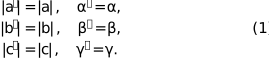
Suppose a matrix A changes the orientation of the basis, and a matrix B changes the orientation of the coordinates. The matrices are related by A = B−1 (Burns & Glazer, 2013). Since matrix B transforms coordinates, it is the matrix for the The B matrices for the minimal generators that determine different crystal systems are provided in Table S1 in the supporting information. Next, we will show how the symmetry requirement of equation (1) sets constraints on unit-cell axial lengths a, b, c and interaxial angles α, β, γ. Those parameters define the conventional cell. For each lattice, the conventional cell is the cell obeying the following conditions: its basis vectors define a right-handed axial setting; its edges are along symmetry directions of the lattice; it is the smallest cell compatible with the above condition. This method is critically dependent on the matrices representing the symmetry operations. These matrices are selected to conform to the symmetry imposed on the unit cell for a specific cell choice. The representative compounds analyzed in subsequent sections were systematically retrieved from the Inorganic Crystal Structure Database (2025 release; Zagorac et al., 2019) The conventional unit-cell dimensional constraints for the seven crystal systems are summarized in Table 1. In the following sections, we will derive these conditions through an elementary mathematical approach based on symmetry operations, demonstrating how they originate directly from crystallographic symmetry.
| ||||||||||||||||||||||
3. Derivations of dimensional constraints for the seven crystal systems
3.1. Triclinic
For the triclinic system, the minimal generator is 1 or  , and it is quite straightforward to write the matrices for the symmetry operations of 1 and , and subsequently the A matrices that transform the unit cells, i.e.

Either 1 or could determine the unit-cell transformation matrices as
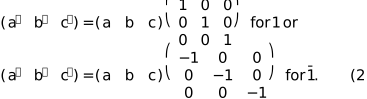
From equation (2), the unit-cell axes before and after applying the symmetry operation have to maintain the same length:

It is obvious that equation (3) itself is in accordance with the symmetry requirement of equation (1). Therefore, no further constraints are required on the unit-cell axes or angles. As a result, the triclinic system is always recognized with the unit-cell axis and angle relationship given by a ≠ b ≠ c, α ≠ β ≠ γ, and an oblique parallelepiped is envisaged for the unit cell. However, there is a wide and long-term misinterpretation of the ≠ sign as meaning `must not be equal', because equation (3) shows that there is no limitation on the interaxial length and angle magnitudes; a better interpretation of the ≠ sign is to think of it meaning `not necessarily equal to'. As an example, the pseudocubic weakly anisotropic pyrite (FeS2) has apparent unit-cell dimensions of a = b = c = 5.417 (1) Å and α = β = γ = 90°, but examination of the shows that it has P1 space-group symmetry with all the Fe and S atoms on the 1a Wyckoff site (Bayliss, 1977). Since most cubic pyrite (Pa ) is diamagnetic, which indicates a low-spin configuration (t2g)6(eg)0 for Fe2+, the weak paramagnetism measured for the anisotropic pyrite agrees with a small distortion from cubic symmetry (Fleet, 1975).
3.2. Monoclinic and orthorhombic
For the monoclinic system, the sole twofold or mirror reflection determines the perpendicularity of one axis to the other two. Suppose c is chosen as the principal direction (be aware that crystallographers usually choose the principal axis to be b). Then either of those two symmetry operations will change the vector r with general point (x, y, z) into a new vector r′ following equation (4), in which the symmetry operation is followed by its directional indices (Glazer et al., 2014):

Since A = B−1, the twofold rotation of the basis vectors gives
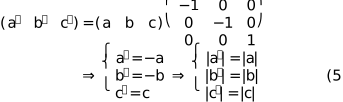
Like equation (3), in the monoclinic system equation (5) puts no specific constraints on interaxial lengths, so again we have a ≠ b ≠ c, in which the inequality implies that a, b and c are mutually unconstrained. For the unit-cell angles, however, the sets constraints on β and β′, which could be derived from equation (6) as
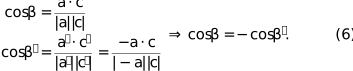
Combined with β = β′ in equation (1), cos β = 0 is the only choice for the fulfillment of equation (6). As a result, β must be 90°. Similarly, α must be 90°. For γ, however,
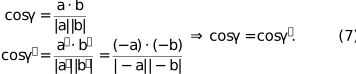
No additional constraint is produced concerning γ = γ′ in equations (1) and (7). For the unit-cell angle constraints, although they are usually written as α = β = 90° and γ ≠ 90°, the last term can be omitted because γ has no constrained value. If the twofold rotation axis is directed along b, a similar derivation gives the constraints α = γ = 90°. K2NbF7 with P21/c has cell parameters of 90°, 90.0 (1)° and 90° for α, β and γ, respectively(Brown & Walker, 1966).
The perpendicularity in the monoclinic system arises from the twofold rotation or the mirror reflection. As Burns and Glazer pointed out, it is the different signs allocated by the symmetry operation matrix that cause the perpendicularity. For example, in equation (5), the transformed c′ has a plus sign in contrast to the minus signs of a′ and b′, and consequently α and β are forced to be 90°. This criterion can be applied in the orthorhombic system, in which two perpendicular twofold rotation axes or mirror reflections make all the axes mutually perpendicular. As a result, α = β = γ = 90°, but the interaxial lengths have no specific constraint, i.e. a ≠ b ≠ c. Orthorhombic crystals do exist with apparent equal unit-cell edges. For example, when measured at 99 K, Ag3SBr0.5I0.5 with Fmm2 is reported to have a = b = c = 9.637 (2) Å (Sakuma et al., 1982).
3.3. Tetragonal
For the tetragonal system, 4 or  is the minimal generator. By convention, c is selected for the fourfold rotation axis. Since 42 = 2, the constraint α = β = 90° holds. The fourfold puts extra constraints on γ and the unit-cell edges. Its effect is expressed by the matrix in equation (8):

Since A = B−1, equation (9) is derived for transformation of basis:
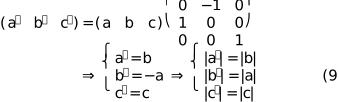
Taking |a| = |a′| and |b| = |b′| of equation (1) into account, it is clear from equation (9) that |a| = |b| and the length of c has no specific symmetry constraint. The constraint of γ can be also derived from equation (9) by
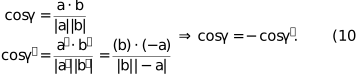
Equation (10) gives γ = 90° in the same manner as equation (6), and therefore the unit-cell angles α, β and γ of the tetragonal system are all required to be 90°. As for the requirement of a = b ≠ c for the unit-cell edge lengths, the inequality sign again only indicates no specific constraint on c. For example, there exists an example of an apparent a = b = c, in PbZr0.35(Fe0.67W0.33)0.65O3 measured at 14 K. This crystallizes in P4mm with all the cell lengths reported to be 8.09195 (5) Å (Frantti et al., 2015).
3.4. Hexagonal
For the hexagonal system, the minimal generator is 6 or  . In the hexagonal coordinate system, the symmetry operation matrix for 6 is displayed in equation (11) as

From equation (11), the unit-cell axis transformation matrix A = B−1 gives

Equation (12) gives the relationship a′ = −b, b′ = a + b and c′ = c. Combined with the symmetry requirement of the unit-cell axes [equation (1)], we have

For the second equation in equation (13), squaring both sides gives
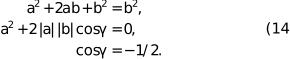
This explains why the γ angle is equal to 120° and a and b have equal lengths. Since a twofold rotation is embedded in successive sixfold rotations, i.e. 63 = 2, it is expected from the monoclinic case that c is simultaneously perpendicular to both a and b, i.e. α = β = 90°. The length of c has no specific symmetry limitations, and therefore, the inequality sign in the commonly used unit-cell edge relation a = b ≠ c again means `not necessarily equal' for the hexagonal system, just as in the tetragonal system. As an example, Mo3.8Zr9.2P has equal cell lengths within the standard error of 8.690 (1), 8.690 (1) and 8.691 (2) Å, with space group P63/mmc (Lomnitskaya & Kuz'ma, 1991).
3.5. Trigonal
The trigonal system is determined by 3 or . Equation (15) shows the symmetry operation matrix for threefold rotation about the c axis,

and the calculated A matrix is displayed in equation (16),

Considering equation (16) together with equation (1), the unit-cell edges have the constraints |a + b| = |a| and |b| = |a|. Following the same steps as for equations (13) and (14), it can be proved that γ = 120°. For the β angle, the relation between cos β and cos β′ is determined as
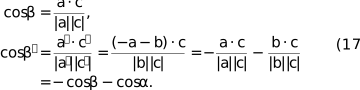
Furthermore,
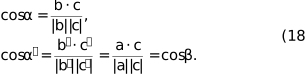
Since β = β′ in equation (1) gives cos β = cos β′, we obtain 2 cos β = −cos α. Similarly, for the α angle, equation (18) sets cos α = cos β. Finally, the only solution is cos α = cos β = 0, and we have α = β = 90°. Since the matrix for the symmetry operation in equation (15) is derived from a hexagonal coordinate system, the unit-cell axis constraints of a = b ≠ c, α = β = 90°, γ = 120° for the trigonal system measured in a hexagonal configuration are exactly the same as those of the hexagonal system. For some trigonal systems, there is a choice between two settings: (1) a hexagonal `R-centered' setting with the threefold rotation axis conventionally along [001] to give a = b, α = β = 90°, γ = 120° and a total of three lattice points or (2) a primitive rhombohedral setting with the threefold rotation axis along [111], which gives the unit-cell constraints a = b = c, α = β = γ but no constraints on the angle. For the hexagonal setting of a rhombohedral lattice, the additional lattice points sit at 2/3, 1/3, 1/3 and 1/3, 2/3, 2/3 (R-obverse setting) or at 1/3, 2/3, 1/3 and 2/3, 1/3, 2/3 (R-reverse setting). All crystals with a rhombohedral have the R-centered lattice symbol for the regardless of whether the primitive `rhombohedral' setting or the centered `hexagonal' setting is used. The only means to determine which setting is being used is by looking at the unit-cell dimensions for the which will be either a = b, α = β = 90°, γ = 120° or a = b = c, α = β = γ. Note that since the hexagonal axis setting comprises three lattice points while the rhombohedral axis setting comprises one, the corresponding volumes also differ by a factor of 3. Regardless of the setting choice, there are always two parameters that must be measured to describe the crystal basis: a and c in the hexagonal axis setting or a and α in the rhombohedral axis setting. The remaining four parameters are constrained by the threefold symmetry (Julian et al., 2024).
The inequality sign in cell length or angle again means no specific constraint. For example, La(H2O)3[N(SO2CF3)2]3(H2O)2.5 with P has equal unit-cell edge lengths of 8.2562 (9) Å, and 90°, 90°, 120° for α, β, γ at 100 K (Vander Hoogerstraete et al., 2015). On the other hand, the rhombohedral CoGe1.5S1.5 with R3 has 90° for the γ angle (Korenstein et al., 1977).
3.6. Cubic
The cubic system requires two threefold rotation axes directed along the body diagonals. The matrix for the of the threefold rotation about the [111] direction is displayed in equation (19),

and the corresponding basis transformation matrix in equation (20),
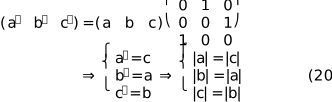
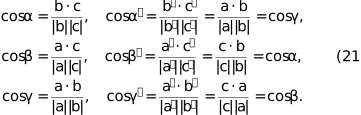
From equation (20), it is clear that all three unit-cell edges have equal lengths, i.e. a = b = c. To confirm α = β = γ, consider the angle relations derived in equation (21):
The proof of inter-axial perpendicularity needs another threefold rotation, for example, the 3− rotation about [ 1] in equation (22):

The transformation between unit-cell edges is given in equation (23):
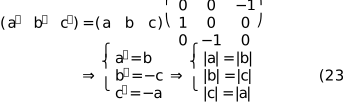
This provides new relations for the three angles:
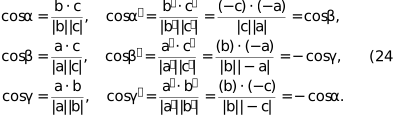
Finally, the cosine values are all zero [equation (25)], indicating that α = β = γ = 90°:

Apart from the 3− rotation about [1], one twofold rotation about a, b or c also requires the interaxial perpendicularity. Take 2010 for example; it gives α = γ = 90°, which further gives β = 90° according to equation (21). This result shows that one threefold rotation together with one twofold rotation about the cell edge directions also gives the cubic system. The reason lies in the fact that 2010 results from the product of  and
and  . Correspondingly, 2010 together with gives
  , as shown in equation (26):
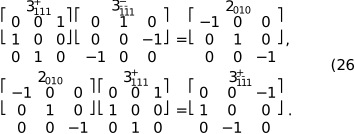
As a result, two body-diagonal threefold rotations are sufficient to determine the cubic constraints, and there is no need to include fourfold rotation for the perpendicular cell axes. In fact, some cubic space groups, such as P23, do not include fourfold rotations.
In brief, the pathway to cubic symmetry can be understood through the successive imposition of symmetries. The application of a first yields the metric restrictions of the rhombohedral Subsequently, the enforcement of a second threefold rotation along a different 〈111〉 direction, or a twofold rotation, imposes the additional condition that all interaxial angles must be 90°, thereby defining the cubic crystal system.
4. Conclusion
This study presents a rigorous mathematical derivation of the unit-cell dimensional constraints governing the seven fundamental crystal systems in crystallography. The proposed methodology requires solely the transformation matrix between basis vectors a, b and c, which can be systematically derived from the matrices of symmetry operations. Through comprehensive analysis of the cell edge transformation relationships, we establish definitive constraints for both cell parameters (cell edge lengths) and interaxial angles. While these constraints align with conventional descriptions in standard crystallographic references, this work provides critical clarification regarding the interpretation of inequality relations in dimensional restrictions with representative examples. This theoretical framework offers valuable insights for novice students in chemistry, physics and materials science, facilitating systematic understanding of symmetry-imposed constraints and the classification framework underlying the seven crystal systems.
APPENDIX A
Table 1 lists the usual criteria for defining crystal systems. However, this list is not the only way in which the crystal systems can be related metrically. For instance, suppose we find the following constraints: a = −2c cos β, α = γ = 90° or a = c, α = γ = 90°. At first sight, this might seem to indicate a monoclinic system. However, this is an example of metric specialization, which in this case corresponds to the orthorhombic system with lattice type oB. Fig. 1 illustrates the construction of the orthorhombic cell in each case. Note also that the at each lattice point is mmm, thus pointing to the orthorhombic crystal system. The arrangement in Fig. 1(b) is a common construction for perovskite crystals, e.g. in the orthorhombic phase of BaTiO3, space group Bmm2.
![[Figure 1]](dv5028fig1thm.gif) | Figure 1 Construction of the orthorhombic cell. |
Supporting information
Supporting information file. DOI: https://doi.org/10.1107/S1600576725010271/dv5028sup1.pdf
Footnotes
1Symmetry operation is the standard International Union of Crystallography notation, while the term symmetry operator is also used frequently. The term symmetry operator strictly refers to the mathematical device that performs a symmetry operation. Thus a symmetry operator acts on a vector to produce a new vector, the whole process being described as a symmetry operation. The term symmetry operator arises from the theory of groups and is used in many applications, such as the Bilbao Crystallographic Server (https://www.cryst.ehu.es/) and the much used software ISODISTORT (https://iso.byu.edu/isodistort.php; Campbell et al., 2006).
Acknowledgements
ZS would like to thank Mois Aroyo for beneficial discussions. We thank the anonymous reviewers for their critical feedback and valuable comments, which have greatly enhanced the rigour and clarity of this work.
Conflict of interest
There are no conflicts of interest.
Data availability
The supporting information file contains matrices for minimal generators determining crystal systems.
Funding information
The following funding is acknowledged: National Natural Science Foundation of China (grant No. 12274023); Exemplary English-Medium Instruction Course for University of Science and Technology Beijing (grant No. KC2023QYW03).
References
 Aroyo, M. I. (2016). International tables for crystallography, Vol. A, Space-group symmetry. International Union of Crystallography. Google Scholar
Bayliss, P. (1977). Am. Mineral. 62, 1168–1172. CAS Google Scholar
Brock, C. P. & Lingafelter, E. C. (1980). J. Chem. Educ. 57, 552. CrossRef Web of Science Google Scholar
Brown, G. M. & Walker, L. A. (1966). Acta Cryst. 20, 220–229. CrossRef ICSD IUCr Journals Web of Science Google Scholar
Burns, G. & Glazer, M. (2013). Space groups for solid state scientists. Academic Press. Google Scholar
Campbell, B. J., Stokes, H. T., Tanner, D. E. & Hatch, D. M. (2006). J. Appl. Cryst. 39, 607–614. Web of Science CrossRef CAS IUCr Journals Google Scholar
Fleet, M. E. (1975). Z. Krist. Cryst. Mater. 142, 332–346. CrossRef Web of Science Google Scholar
Frantti, J., Fujioka, Y., Zhang, J., Zhu, J. & Vogel, S. C. (2015). Phys. Status Solidi B 252, 1280–1290. Web of Science CrossRef ICSD CAS Google Scholar
Glazer, A. M., Aroyo, M. I. & Authier, A. (2014). Acta Cryst. A70, 300–302. Web of Science CrossRef CAS IUCr Journals Google Scholar
Julian, M. M., Slebodnick, C. & Julian, F. T. (2024). Foundations of crystallography with computer applications. CRC Press. Google Scholar
Korenstein, R., Soled, S., Wold, A. & Collin, G. (1977). Inorg. Chem. 16, 2344–2346. CrossRef ICSD CAS Web of Science Google Scholar
Lomnitskaya, Ya. F. & Kuz'ma, Yu. B. (1991). Powder Metall. Met. Ceram. 30, 162–165. CrossRef ICSD Web of Science Google Scholar
Nespolo, M. (2015). J. Appl. Cryst. 48, 1290–1298. Web of Science CrossRef CAS IUCr Journals Google Scholar
Nespolo, M., Aroyo, M. I. & Souvignier, B. (2018). J. Appl. Cryst. 51, 1481–1491. Web of Science CrossRef CAS IUCr Journals Google Scholar
Sakuma, T., Fujishita, H. & Hoshino, S. (1982). J. Phys. Soc. Jpn 51, 2628–2634. CrossRef ICSD CAS Web of Science Google Scholar
Schomaker, V. & Lingafelter, E. C. (1985). J. Chem. Educ. 62, 219. CrossRef Web of Science Google Scholar
Sharma, B. D. (1982). J. Chem. Educ. 59, 742. CrossRef Web of Science Google Scholar
Vander Hoogerstraete, T., Brooks, N. R., Onghena, B., Van Meervelt, L. & Binnemans, K. (2015). CrystEngComm 17, 7142–7149. Web of Science CSD CrossRef ICSD CAS Google Scholar
Zagorac, D., Müller, H., Ruehl, S., Zagorac, J. & Rehme, S. (2019). J. Appl. Cryst. 52, 918–925. Web of Science CrossRef CAS IUCr Journals Google Scholar
This article is published by the International Union of Crystallography. Prior permission is not required to reproduce short quotations, tables and figures from this article, provided the original authors and source are cited. For more information, click here.
| JOURNAL OF APPLIED CRYSTALLOGRAPHY |


