

 journal menu


research papers
 | JOURNAL OF SYNCHROTRON RADIATION |
On the wave zone of synchrotron radiation

aTomsk State University, Lenin Avenue 36, 634050 Tomsk, Russia, and bInstitute of High Current Electronics, SB RAS, Akademichesky Avenue 4, 634055 Tomsk, Russia
*Correspondence e-mail: [email protected]
The extension of the wave zone of synchrotron radiation is studied.
Keywords: wave zone; synchrotron radiation.
1. Introduction
A theoretical study into the problem of the wave zone of synchrotron radiation was carried out by Sokolov et al. (1966![[Sokolov, A. A., Ternov, I. M. & Bagrov, V. G. (1966). The Synchrotron Radiation, edited by A. A. Sokolov and I. M. Ternov, pp. 18-71. Moscow: Nauka. (In Russian.)]](../../../../../../logos/arrows/s_arr.gif "Sokolov, A. A., Ternov, I. M. & Bagrov, V. G. (1966). The Synchrotron Radiation, edited by A. A. Sokolov and I. M. Ternov, pp. 18-71. Moscow: Nauka. (In Russian.)") ; pp. 45–49). This research was published in English two years later (Sokolov & Ternov, 1968; pp. 34–37). Since then, for half a century, these results (concerning the issue of the wave radiation zone) have been considered as rigorously proven. Indeed, the proof given by Sokolov et al. (1966) and Sokolov & Ternov (1968) remains valid; however, the possibility of applying these reasonings to an estimation of the wave zone size has to be refined. This problem is the subject of the present work.
; pp. 45–49). This research was published in English two years later (Sokolov & Ternov, 1968; pp. 34–37). Since then, for half a century, these results (concerning the issue of the wave radiation zone) have been considered as rigorously proven. Indeed, the proof given by Sokolov et al. (1966) and Sokolov & Ternov (1968) remains valid; however, the possibility of applying these reasonings to an estimation of the wave zone size has to be refined. This problem is the subject of the present work.
2. Theory and discussion
The radiation power W of a charged particle in classical electrodynamics is given by the expression

where the surface  is a sphere with its center at the charge location, and the vector
  is the Poynting vector,

The electric  and magnetic
  radiation fields of a point charge, determined with the help of Liénard–Wiechert potentials, can be written in the form

Here,  =
=  ,
,  =
=  , is the charge velocity,
  is the vector connecting the location point of the radiating charge to the observation point of radiation, e is the charge magnitude and c is the speed of light. In the right-hand sides of relations (3), all the quantities are regarded at the time instant τ determined by the condition

In particular, equation (4) implies

When considering synchrotron radiation, the velocity and acceleration of a particle are mutually orthogonal, constant in absolute value, and belong to one and the same fixed plane. Let us select the following coordinate system (see Fig. 1). The origin of the coordinate system is chosen at the location point of the radiating charge. The x-axis is directed along the velocity of the electron, and the y-axis is directed toward the center of the circular trajectory. We choose the z-axis so that the coordinate system is right-handed (when the charge moves in a constant and uniform magnetic field, with the z-axis being parallel to the external magnetic field). The radius of a circular orbit of the radiating particle is denoted by ρ and is oriented along the y-axis of the given coordinate system. The angle formed by the x-axis and the vector is denoted by α  , while the angle between the y-axis and the projection of the vector onto the yz-plane is denoted by χ
  . The surface element is given by
  =
=  ,
,  =
=  .
.
![[Figure 1]](il5018fig1thm.gif) | Figure 1 Coordinate system. |
Taking into account the above notation and equations (1) and (2), one easily obtains a well known expression (Sokolov et al., 1966; Sokolov & Ternov, 1968) for the instantaneous power of synchrotron radiation,

where, in virtue of relations (4) and (5), the right- and left-hand sides of equation (6) are regarded at the radiation instant τ, with the following notation being used,
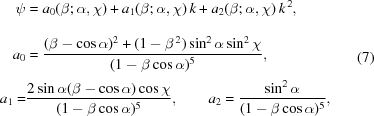

The expression in equation (7) is a second-order polynomial in the parameter k with three coefficients,  (s = 0, 1, 2), depending on the value of β and on the integration angles
  . For
. For  [according to equation (8), this corresponds to the limit
  ], the given expression results in the instantaneous angular distribution
  of synchrotron radiation power.
Formally, the value of k in equation (7) is an expansion parameter, and therefore by Sokolov et al. (1966) and Sokolov & Ternov (1968) we investigated the region  , with the tacit assumption that this is the radiation wave zone. However, the smallness of the parameter k and the definition of the wave zone are related only indirectly: the parameter k may be small, but the wave zone has not yet been formed.
Let us point out two obvious facts: (a) the specific structure of the coefficients may alter the conclusion about the boundaries of the wave radiation zone; however, this structure was not investigated by Sokolov et al. (1966) and Sokolov & Ternov (1968); (b) if we consider radiation in a certain cone (the cone is given by the region of integration with respect to ), then the wave zone is determined not only by the radiation properties but also by the choice of the cone in question. This fact was not considered by Sokolov et al. (1966) and Sokolov & Ternov (1968) either.
Let us examine the total power of synchrotron radiation. Substituting the expressions (7) and (8) into equation (6), we carry out integration over in the entire space. As a result of simple calculations, we find
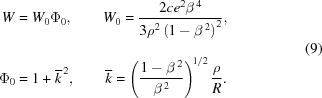
Here, W0 is the total emitted power in the limit (Sokolov et al., 1966; Sokolov & Ternov, 1968), and the coefficient  characterizes the size of the near-field zone.
We assume the space region  to be the radiation wave zone. From equations (8) and (9) it then follows that k and are related by

where γ is the relativistic factor (assuming, for instance, the electron energy to be ∼1 GeV, we obtain for the relativistic factor the approximation  ). Equation (10) implies that
  , and also the fact that is not necessarily the case at . Consequently, the condition , discussed by Sokolov et al. (1966) and Sokolov & Ternov (1968), is a necessary one, but is not sufficient to determine the synchrotron radiation wave zone (
 ).
).
From equation (9), it follows that

where Rv is the distance separating the radiation space into the wave zone ( ) and the near-field zone (
 ). The classical theory (Sokolov et al., 1966; Sokolov & Ternov, 1968) predicts a relation between the orbit radius ρ, the velocity of the radiating particle and the strength H of the controlling external magnetic field,

where m0 is the rest mass of the radiating particle. Substituting the expression (12) into equation (11), we obtain Rv in the form

where  is the cyclotron frequency. For instance, the field H = 1 T = 104 electromagnetic CGS units results in Rv = 0.1704 cm. The expression (13) shows that the parameter Rv is determined only by the rest energy of the radiating particle and by the magnitude of the external magnetic field. The other characteristics (for example, speed) of the radiating particle do not influence the quantity Rv.
Let us consider two examples when the radiation cone does not cover the entire space.
As a first example, we represent the whole space as the sum of two  subspaces: the subspace (-) is given by the region
  (which corresponds to
  , and the center of the orbit lies in this subspace); the subspace (+) is given by the region
  (which corresponds to
  , and the center of the orbit does not lie in this subspace). It is easy to obtain the expressions
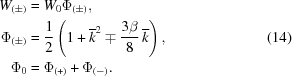
As expected, the particle characteristics (being its speed β) now also enter the expressions (14) for  ; however, the condition determines the wave radiation zone in this case as well.
As a second example, we represent the entire space as the sum of two, (in) and (out), subspaces: the (in)-subspace corresponds to the radiation value  (which determines the range of variation
  ); the (out)-subspace corresponds to the radiation value
  (which determines the range of variation
  ). Thus, the space is divided into the (in)-part, in which the projection of the radiation pulse on the particle velocity is positive, and the (out)-part, in which the projection of the radiation pulse on the particle velocity is negative.
For the (in)-subspace, it is easy to obtain expression
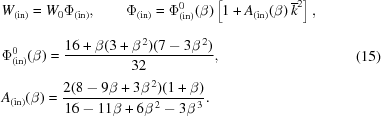
We note the simplest properties of the functions  and
and  in the segment
  . The function increases monotonously,

and the function at the ends of the segment A(in)(0) = A(in)(1) = 1 has a unique maximum at the point
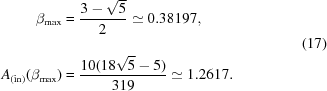
Thus, the variation domain of the function is bounded,

Returning to the expressions (15) and taking into account equations (16)–(18), we obtain

From equation (19) we find that in the non-relativistic case half of the emtted energy falls on the (in)-subspace, whereas in the ultra-relativistic case this subspace accumulates all the emitted energy. The emergence condition for the wave zone still has the form .
For the (out)-subspace, we obtain the expression
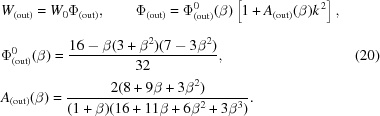
From equations (15) and (20), it follows that  =
=  , which corresponds to the equality of the total radiation energy to the sum of the two energies in the subspaces. This also means 1 =
  , which indicates that the radiation energy in the wave zone is equal to the sum of the two energies in the wave zone of the subspaces. The functions
  and
and  in the segment are bounded and monotonously decreasing functions of β,

In the non-relativistic limit  , as implied by equations (21) and (19), we find W(out) = W(in) =
  [in this case, with allowance made for equation (10), it has been taken into account that k = ].
In the ultra-relativistic limit  for
for  ≃ 5/9, with account taken of equation (20), we find

which differs significantly from the expression (9) involving k. Equation (22) involves k, and in this case the wave zone emerges earlier than in equation (9). However, as noted above, the limit  holds true, and, according to equation (20), this results in
  . Consequently, the radiation value W(out) in the ultra-relativistic limit is extremely small in relation to W(in) and does not offer any tangible contribution to the total radiation.
For a given external magnetic field H in the ultra-relativistic limit, the radiation value W(out) is not only small in relation to W(in) but also tends to zero as the energy of the radiating charge increases. Indeed, taking into account equation (9) for the quantity W0 and using equation (12), we find the expression

which implies that the radiation value W0 [and thereby also the value of W(in)] for some fixed H (with a fixed ) increases infinitely with an increasing charge energy ( ). For W(out) in equation (20), we obtain
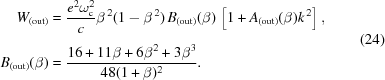
The value of  , decreasing monotonously in the segment , is bounded:
  . From equation (24), it follows that a fixed H results in a radiation value W(out) decreasing to zero as the energy
  increases.
Funding information
This work was supported in part by RFBR grant No. 18-02-00149 and by the Program for Improving TSU's Competitiveness among World Leading Scientific and Educational Centers.
References
 Sokolov, A. A. & Ternov, I. M. (1968). Synchrotron Radiation, p. 202. Berlin: Academie-Verlag. Google Scholar
Sokolov, A. A., Ternov, I. M. & Bagrov, V. G. (1966). The Synchrotron Radiation, edited by A. A. Sokolov and I. M. Ternov, pp. 18–71. Moscow: Nauka. (In Russian.) Google Scholar
© International Union of Crystallography. Prior permission is not required to reproduce short quotations, tables and figures from this article, provided the original authors and source are cited. For more information, click here.
| JOURNAL OF SYNCHROTRON RADIATION |


