 | Acta Crystallographica Section E Acta Crystallographica Section E CRYSTALLOGRAPHIC COMMUNICATIONS |


 journal menu


metal-organic compounds
| CRYSTALLOGRAPHIC COMMUNICATIONS |
 access
Bis(4-chloropyridinium) tetrachloridonickelate(II)

aCollege of Chemistry, Beijing Normal University, Xinjiekouwai Street 19, Beijing 100875, People's Republic of China, and bInstitut für Anorganische Chemie, RWTH Aachen, Prof.-Pirlet-Strasse 1, 52074 Aachen, Germany
*Correspondence e-mail: [email protected]
In the title compound, (C5H5ClN)2[NiCl4], the dianion lies on a twofold rotation axis. Two cations are linked to each anion by classical N—H⋯Cl hydrogen bonds, and short Cl⋯Cl contacts and Cl⋯π stacking interactions [with distances of 3.376 (2) and 3.684 (2) Å, respectively] extend this pattern into a chain. The [NiCl4]2− anion shows significant deviation from ideal tetrahedral geometry.
Related literature
For related literature, see: Espallargas et al. (2006![[Espallargas, G. M., Brammer, L. & Sherwood, P. (2006). Angew. Chem. Int. Ed. 45, 435-440.]](../../../../../../logos/arrows/e_arr.gif "Espallargas, G. M., Brammer, L. & Sherwood, P. (2006). Angew. Chem. Int. Ed. 45, 435-440.") ); Luque et al. (2001); Willett et al. (2003).
); Luque et al. (2001); Willett et al. (2003).
![[Scheme 1]](at2533scheme1.gif)
Experimental
Crystal data
|
Refinement
|
| |||||||||||||||||||||||||||
 .
. Data collection: SMART (Bruker, 2001); cell refinement: SAINT (Bruker, 1999); data reduction: SAINT; program(s) used to solve structure: SHELXTL (Sheldrick, 2008); program(s) used to refine structure: SHELXTL; molecular graphics: PLATON (Spek, 2003); software used to prepare material for publication: SHELXTL.
Supporting information
contains datablocks global, I. DOI: 10.1107/S1600536808001360/at2533sup1.cif
Structure factors: contains datablock I. DOI: 10.1107/S1600536808001360/at2533Isup2.hkl
2.0 mmol NiCl2.6H2O (476 mg) were dissolved in ca 10 ml conc hydrochloric acid. 4.0 mmol 4-chloropyridine (600 mg) in 2 ml H2O were added. The mixture was stirred at room temp for 1 h. After several days of isothermal evaporation, 1.9 mmol, 816 mg of the product were obtained, corresp to yield of 95%.
The product does not melt but decomposes at temperatures above 443 K. At this temperature, pyridine may be sublimed off under vacuum.
Microanalytical data, found: C 27.14, H 2.71, N 6.37%. Calculated for C10H10Cl6N2Ni: C 27.96, H2.35, N 6.52%.
All H atoms were placed in idealized positions and treated as riding atoms with C—H distance of 0.93 Å and and N—H distance of 0.86 Å, and Uiso(H) = 1.2Ueq(C).
Data collection: SMART (Bruker, 2001); cell SAINT (Bruker, 1999); data reduction: SAINT (Bruker, 1999); program(s) used to solve structure: SHELXTL (Sheldrick, 2008); program(s) used to refine structure: SHELXTL (Bruker, 2000); molecular graphics: PLATON (Spek, 2003); software used to prepare material for publication: SHELXTL (Sheldrick, 2008).
![[Figure 1]](./at2533fig1thm.gif) | Fig. 1. Displacement ellipsoid plot (50% probability level) of the cation (left) and anion in the title compound; symmetry code: i = 1 - x, y, 1.5 - z. |
![[Figure 2]](./at2533fig2thm.gif) | Fig. 2. Closest intermolecular interactions between cations and anions; hydrogen bonds and Cl···Cl contacts are drawn as dashed lines. Symmetry codes: ii = 1 - x, -y, 1 - z; iii = x, -y, z - 1/2; iv = x - 1/2, y + 1/2, z; v = 0.5 - x, 0.5 - y, 1 - z. |
![[Figure 3]](./at2533fig3thm.gif) | Fig. 3. Packing diagram of the titie compound. Shortest interactions (shown in Fig. 2) extend along [101]. |
| (C5H5ClN)2[NiCl4] | F(000) = 856 |
| Mr = 429.61 | Dx = 1.729 Mg m−3 |
| Monoclinic, C2/c | Mo Kα radiation, λ = 0.71073 Å |
| Hall symbol: -C 2yc | Cell parameters from 5779 reflections |
| a = 16.513 (2) Å | θ = 2.5–28.3° |
| b = 7.2862 (11) Å | µ = 2.13 mm−1 |
| c = 13.948 (2) Å | T = 298 K |
| β = 100.526 (3)° | Block, light green |
| V = 1650.0 (4) Å3 | 0.36 × 0.28 × 0.26 mm |
| Z = 4 |
| Bruker SMART APEX CCD area-detector diffractometer | 2049 independent reflections |
| Radiation source: fine-focus sealed tube | 1820 reflections with I > 2σ(I) |
| Graphite monochromator | Rint = 0.026 |
| ω scans | θmax = 28.3°, θmin = 2.5° |
| Absorption correction: multi-scan (SADABS; Bruker, 1999) | h = −12→22 |
| Tmin = 0.46, Tmax = 0.57 | k = −9→9 |
| 5779 measured reflections | l = −16→18 |
| Refinement on F2 | Primary atom site location: structure-invariant direct methods |
| Least-squares matrix: full | Secondary atom site location: difference Fourier map |
| R[F2 > 2σ(F2)] = 0.045 | Hydrogen site location: inferred from neighbouring sites |
| wR(F2) = 0.123 | H-atom parameters constrained |
| S = 1.07 | w = 1/[σ2(Fo2) + (0.0592P)2 + 3.4552P] where P = (Fo2 + 2Fc2)/3 |
| 2049 reflections | (Δ/σ)max < 0.001 |
| 87 parameters | Δρmax = 0.80 e Å−3 |
| 0 restraints | Δρmin = −0.98 e Å−3 |
| (C5H5ClN)2[NiCl4] | V = 1650.0 (4) Å3 |
| Mr = 429.61 | Z = 4 |
| Monoclinic, C2/c | Mo Kα radiation |
| a = 16.513 (2) Å | µ = 2.13 mm−1 |
| b = 7.2862 (11) Å | T = 298 K |
| c = 13.948 (2) Å | 0.36 × 0.28 × 0.26 mm |
| β = 100.526 (3)° |
| Bruker SMART APEX CCD area-detector diffractometer | 2049 independent reflections |
| Absorption correction: multi-scan (SADABS; Bruker, 1999) | 1820 reflections with I > 2σ(I) |
| Tmin = 0.46, Tmax = 0.57 | Rint = 0.026 |
| 5779 measured reflections |
| R[F2 > 2σ(F2)] = 0.045 | 0 restraints |
| wR(F2) = 0.123 | H-atom parameters constrained |
| S = 1.07 | Δρmax = 0.80 e Å−3 |
| 2049 reflections | Δρmin = −0.98 e Å−3 |
| 87 parameters |
Geometry. All e.s.d.'s (except the e.s.d. in the dihedral angle between two l.s. planes) are estimated using the full covariance matrix. The cell e.s.d.'s are taken into account individually in the estimation of e.s.d.'s in distances, angles and torsion angles; correlations between e.s.d.'s in cell parameters are only used when they are defined by crystal symmetry. An approximate (isotropic) treatment of cell e.s.d.'s is used for estimating e.s.d.'s involving l.s. planes. |
Refinement. Refinement of F2 against ALL reflections. The weighted R-factor wR and goodness of fit S are based on F2, conventional R-factors R are based on F, with F set to zero for negative F2. The threshold expression of F2 > σ(F2) is used only for calculating R-factors(gt) etc. and is not relevant to the choice of reflections for refinement. R-factors based on F2 are statistically about twice as large as those based on F, and R- factors based on ALL data will be even larger. |
| x | y | z | Uiso*/Ueq | ||
| Ni1 | 0.5000 | 0.04605 (7) | 0.7500 | 0.03657 (17) | |
| Cl1 | 0.23687 (6) | 0.54295 (11) | 0.57163 (7) | 0.0551 (2) | |
| N1 | 0.4043 (2) | 0.3152 (4) | 0.3908 (3) | 0.0575 (8) | |
| H1 | 0.4372 | 0.2717 | 0.3553 | 0.069* | |
| C6 | 0.3310 (2) | 0.3788 (5) | 0.3468 (3) | 0.0561 (8) | |
| H6A | 0.3162 | 0.3745 | 0.2792 | 0.067* | |
| C5 | 0.2776 (2) | 0.4503 (4) | 0.4014 (3) | 0.0488 (7) | |
| H5A | 0.2262 | 0.4942 | 0.3719 | 0.059* | |
| C4 | 0.30238 (19) | 0.4555 (4) | 0.5012 (2) | 0.0425 (6) | |
| C3 | 0.3784 (2) | 0.3868 (5) | 0.5454 (3) | 0.0557 (8) | |
| H3A | 0.3947 | 0.3887 | 0.6129 | 0.067* | |
| C2 | 0.4285 (2) | 0.3161 (5) | 0.4867 (3) | 0.0604 (9) | |
| H2A | 0.4798 | 0.2685 | 0.5141 | 0.072* | |
| Cl2 | 0.42552 (5) | −0.15941 (15) | 0.64578 (9) | 0.0716 (3) | |
| Cl3 | 0.59081 (7) | 0.21312 (15) | 0.68764 (8) | 0.0692 (3) |
| U11 | U22 | U33 | U12 | U13 | U23 | |
| Ni1 | 0.0316 (3) | 0.0336 (3) | 0.0470 (3) | 0.000 | 0.0137 (2) | 0.000 |
| Cl1 | 0.0570 (5) | 0.0507 (5) | 0.0633 (5) | 0.0008 (4) | 0.0259 (4) | −0.0050 (3) |
| N1 | 0.0537 (17) | 0.0489 (15) | 0.077 (2) | 0.0035 (13) | 0.0319 (16) | −0.0008 (14) |
| C6 | 0.063 (2) | 0.0528 (18) | 0.0570 (18) | 0.0012 (17) | 0.0217 (16) | 0.0033 (15) |
| C5 | 0.0463 (17) | 0.0456 (16) | 0.0560 (18) | 0.0044 (13) | 0.0130 (14) | 0.0072 (13) |
| C4 | 0.0402 (15) | 0.0360 (14) | 0.0538 (16) | −0.0028 (11) | 0.0146 (13) | −0.0009 (12) |
| C3 | 0.0510 (19) | 0.0515 (18) | 0.062 (2) | 0.0024 (15) | 0.0026 (16) | 0.0000 (16) |
| C2 | 0.0416 (17) | 0.0540 (19) | 0.085 (3) | 0.0063 (15) | 0.0112 (17) | −0.0002 (18) |
| Cl2 | 0.0384 (4) | 0.0777 (6) | 0.0951 (7) | 0.0017 (4) | 0.0026 (4) | −0.0373 (6) |
| Cl3 | 0.0636 (6) | 0.0751 (6) | 0.0769 (6) | −0.0151 (5) | 0.0337 (5) | 0.0112 (5) |
| Ni1—Cl3 | 2.2280 (9) | C6—C5 | 1.368 (5) |
| Ni1—Cl3i | 2.2280 (9) | C6—H6A | 0.9300 |
| Ni1—Cl2 | 2.2833 (10) | C5—C4 | 1.379 (5) |
| Ni1—Cl2i | 2.2833 (10) | C5—H5A | 0.9300 |
| Cl1—C4 | 1.712 (3) | C4—C3 | 1.387 (5) |
| N1—C2 | 1.324 (5) | C3—C2 | 1.368 (5) |
| N1—C6 | 1.336 (5) | C3—H3A | 0.9300 |
| N1—H1 | 0.8600 | C2—H2A | 0.9300 |
| Cl3—Ni1—Cl3i | 113.76 (6) | C6—C5—C4 | 118.0 (3) |
| Cl3—Ni1—Cl2 | 115.62 (4) | C6—C5—H5A | 121.0 |
| Cl3i—Ni1—Cl2 | 106.51 (4) | C4—C5—H5A | 121.0 |
| Cl3—Ni1—Cl2i | 106.51 (4) | C5—C4—C3 | 121.1 (3) |
| Cl3i—Ni1—Cl2i | 115.62 (4) | C5—C4—Cl1 | 119.2 (3) |
| Cl2—Ni1—Cl2i | 98.06 (6) | C3—C4—Cl1 | 119.6 (3) |
| C2—N1—C6 | 122.9 (3) | C2—C3—C4 | 117.8 (3) |
| C2—N1—H1 | 118.5 | C2—C3—H3A | 121.1 |
| C6—N1—H1 | 118.5 | C4—C3—H3A | 121.1 |
| N1—C6—C5 | 119.9 (3) | N1—C2—C3 | 120.2 (3) |
| N1—C6—H6A | 120.1 | N1—C2—H2A | 119.9 |
| C5—C6—H6A | 120.1 | C3—C2—H2A | 119.9 |
| Symmetry code: (i) −x+1, y, −z+3/2. |
| D—H···A | D—H | H···A | D···A | D—H···A |
| C2—H2A···Cl3 | 0.93 | 2.79 | 3.586 (4) | 145 |
| N1—H1···Cl2ii | 0.86 | 2.41 | 3.158 (3) | 145 |
| C5—H5A···Cl2iii | 0.93 | 2.75 | 3.633 (4) | 159 |
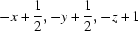
| Symmetry codes: (ii) −x+1, −y, −z+1; (iii) −x+1/2, −y+1/2, −z+1. |
Experimental details
| Crystal data | |
| Chemical formula | (C5H5ClN)2[NiCl4] |
| Mr | 429.61 |
| Crystal system, space group | Monoclinic, C2/c |
| Temperature (K) | 298 |
| a, b, c (Å) | 16.513 (2), 7.2862 (11), 13.948 (2) |
| β (°) | 100.526 (3) |
| V (Å3) | 1650.0 (4) |
| Z | 4 |
| Radiation type | Mo Kα |
| µ (mm−1) | 2.13 |
| Crystal size (mm) | 0.36 × 0.28 × 0.26 |
| Data collection | |
| Diffractometer | Bruker SMART APEX CCD area-detector diffractometer |
| Absorption correction | Multi-scan (SADABS; Bruker, 1999) |
| Tmin, Tmax | 0.46, 0.57 |
| No. of measured, independent and observed [I > 2σ(I)] reflections | 5779, 2049, 1820 |
| Rint | 0.026 |
| (sin θ/λ)max (Å−1) | 0.667 |
| Refinement | |
| R[F2 > 2σ(F2)], wR(F2), S | 0.045, 0.123, 1.07 |
| No. of reflections | 2049 |
| No. of parameters | 87 |
| H-atom treatment | H-atom parameters constrained |
| Δρmax, Δρmin (e Å−3) | 0.80, −0.98 |
Computer programs: SMART (Bruker, 2001), SAINT (Bruker, 1999), SHELXTL (Sheldrick, 2008), SHELXTL (Bruker, 2000), PLATON (Spek, 2003).
| D—H···A | D—H | H···A | D···A | D—H···A |
| C2—H2A···Cl3 | 0.93 | 2.786 | 3.586 (4) | 144.8 |
| N1—H1···Cl2i | 0.86 | 2.413 | 3.158 (3) | 145.2 |
| C5—H5A···Cl2ii | 0.93 | 2.749 | 3.633 (4) | 159.1 |
| Symmetry codes: (i) −x+1, −y, −z+1; (ii) −x+1/2, −y+1/2, −z+1. |
Acknowledgements
Support from the NSFC (grant No. 20571012) and the NSFBJ (grant No. 2042013) is gratefully acknowledged.
References
 Bruker (1999). SAINT and SADABS. Bruker AXS Inc., Madison, Wisconsin, USA. Google Scholar
Bruker (2001). SMART. Version 5.624. Bruker AXS Inc., Madison, Wisconson, USA. Google Scholar
Espallargas, G. M., Brammer, L. & Sherwood, P. (2006). Angew. Chem. Int. Ed. 45, 435–440. Web of Science CSD CrossRef CAS Google Scholar
Luque, A., Sertucha, J., Casillo, O. & Romain, P. (2001). New J. Chem. 25, 1208–1214. Web of Science CSD CrossRef CAS Google Scholar
Sheldrick, G. M. (2008). Acta Cryst. A64, 112–122. Web of Science CrossRef CAS IUCr Journals Google Scholar
Spek, A. L. (2003). J. Appl. Cryst. 36, 7–13. Web of Science CrossRef CAS IUCr Journals Google Scholar
Willett, R. D., Awwadi, F. & Butcher, R. (2003). Cryst. Growth Des. 3, 301–311. Web of Science CSD CrossRef CAS Google Scholar
This is an open-access article distributed under the terms of the Creative Commons Attribution (CC-BY) Licence, which permits unrestricted use, distribution, and reproduction in any medium, provided the original authors and source are cited.
| CRYSTALLOGRAPHIC COMMUNICATIONS |


Short intermolecular X···X (X = F, Cl, Br) interactions in crystals have attracted increasing attention. The title compound is isotypic and probably isomorphous with (4-X'pyH)2[CoX4], wherein X' = Cl, X = Cl or X' = Br, X = Cl (Espallargas et al., 2006). Studies by Willett et al. have been devoted to bromopyridinium tetrahalocuprate salts (Willett et al., 2003), and methyl pyridinium derivatives were reported earlier by Luque and his coworkers (Luque et al., 2001). In the structure communicated here, the anionic building block is a [NiCl4]2- group with site symmetry 2 and metal–halide distances of 2.2280 (9) and 2.2833 (10) Å and Cl—Ni—Cl bond angles ranging from 98.06 (6) to 115.62 (4)°. The 4-chloropyridinium cation is located in general position and planar within error. A displacement ellipsoid plot of the ionic constituents is given in Fig. 1. Fig. 2 shows the classical hydrogen bonds and the short interhalogen contacts (dashed red lines, Cl···Cl = 3.3762 (16) Å). Shortest interatomic distances between neighbouring cations amount to ca 3.5Å and indicate π interactions. A projection of the unit cell is provided in Fig. 3. The above-mentioned contacts and the classical N—H···Cl bonds result in a chain which extends in [101] direction. Adjacent strands are crosslinked by additional weak non-classical H bonds.