 | Acta Crystallographica Section E Acta Crystallographica Section E CRYSTALLOGRAPHIC COMMUNICATIONS |


 journal menu


metal-organic compounds
| CRYSTALLOGRAPHIC COMMUNICATIONS |
 access
Poly[[diaqua-μ2-4,4′-bipyridyl-μ2-o-phthalato-nickel(II)] dihydrate]

aResearch Academy of Science and Technology, Harbin Institute of Technology, Harbin, Heilongjiang 150080, People's Republic of China, bState Key Laboratory of Applied Organic Chemistry, Lanzhou, Gansu 730000, People's Republic of China, and cState Key Laboratory of Polymer Physics and Chemistry, Changchun Institute of Applied Chemistry, Graduate School of the Chinese Academy of Sciences, Chinese Academy of Sciences, Changchun 130022, People's Republic of China
*Correspondence e-mail: [email protected]
In the title layer complex, {[Ni(C8H4O4)(C10H8N2)(H2O)2]·2H2O}n, the Ni atom has a distorted octahedral environment, defined by the phthalate and 4,4′-bipyridyl ligands which link the Ni atoms, forming a square lattice in the bc plane. This extends into a three-dimensional supramolecular network through O—H⋯O hydrogen-bonding interactions. The Ni atom lies on, and both ligands are bisected by, a crystallographic twofold axis.
Related literature
For related literature, see: Burrows et al. (2000![[Burrows, A. D., Harrington, R. W., Mahon, M. F. & Price, C. E. (2000). J. Chem. Soc. Dalton Trans. pp. 3845-3854.]](../../../../../../logos/arrows/e_arr.gif "Burrows, A. D., Harrington, R. W., Mahon, M. F. & Price, C. E. (2000). J. Chem. Soc. Dalton Trans. pp. 3845-3854.") ); Hagrman et al. (1999); Ma et al. (2003); Zheng et al. (1999).
); Hagrman et al. (1999); Ma et al. (2003); Zheng et al. (1999).
![[Scheme 1]](bg2157scheme1.gif)
Experimental
Crystal data
|
Refinement
|
| ||||||||||||
|
 ; (iii)
  ; (iv)
 Data collection: RAPID-AUTO (Rigaku, 1998); cell refinement: RAPID-AUTO; data reduction: RAPID-AUTO; program(s) used to solve structure: SHELXS97 (Sheldrick, 1997); program(s) used to refine structure: SHELXL97 (Sheldrick, 1997); molecular graphics: DIAMOND (Brandenburg, 1999); software used to prepare material for publication: SHELXL97.
Supporting information
contains datablocks I, global. DOI: 10.1107/S1600536807064562/bg2157sup1.cif
Structure factors: contains datablock I. DOI: 10.1107/S1600536807064562/bg2157Isup2.hkl
All reagents were of analytical grade and were used without further purification. A mixture of NiCl2.6H2O(0.25 g, 1.05 mmol), H2Pht (0.2 g, 1.20 mmol), 4,4'-bipy (0.2 g, 1.04 mmol) and distilled water (12 ml) was neutralized to pH =5.5 with sodium hydroxide aqueous solution under stirring for 1 h and sealed in a 20 ml Teflon-lined stainless steel reactor, then heated at 170 °C for 3days. After cooling to room temperature, the green block crystals were isolated, washed with distilled water, and dried at ambient temperature.Yield: 0.17 g (36% based on Ni).
All H atoms attached to C atoms and unambiguously defined by stereochemistry were placed in calculated positions (H–C = 0.93 Å) and allowed to ride, with Uiso(H) = 1.2 Ueq(C). H atoms attached to O atoms were located in late-stage difference maps and refined with restrained distances of O—H = 0.85 (1) Å, H···H = 1.35 (2) Å and free Uĩso~(H).
Data collection: RAPID-AUTO (Rigaku, 1998); cell RAPID-AUTO; data reduction: RAPID-AUTO; program(s) used to solve structure: SHELXS97 (Sheldrick, 1997); program(s) used to refine structure: SHELXL97 (Sheldrick, 1997); molecular graphics: DIAMOND (Brandenburg, 1999); software used to prepare material for publication: SHELXL97.
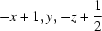
![[Figure 1]](./bg2157fig1thm.gif) | Fig. 1. View of the title compound, with displacement ellipsoids drawn at the 50% probability level [Symmetry codes: (i) x, y - 1, z; (ii) -x, y, -z + 1/2; (iii) -x + 1, y, -z + 1/2]. |
![[Figure 2]](./bg2157fig2thm.gif) | Fig. 2. Polymer layer in the title compound. (The uncoordinated waters have been omitted for clarity). |
![[Figure 3]](./bg2157fig3thm.gif) | Fig. 3. Formation of a three-dimensional framework in the title compound (dashed lines show hydrogen bonds). |
| [Ni(C8H4O4)(C10H8N2)(H2O)2]·2H2O | F(000) = 468 |
| Mr = 451.07 | Dx = 1.604 Mg m−3 |
| Monoclinic, P2/c | Mo Kα radiation, λ = 0.71073 Å |
| Hall symbol: -P 2yc | Cell parameters from 8171 reflections |
| a = 7.6160 (15) Å | θ = 3.2–27.5° |
| b = 11.372 (2) Å | µ = 1.09 mm−1 |
| c = 12.954 (4) Å | T = 298 K |
| β = 123.63 (2)° | Block, green |
| V = 934.2 (4) Å3 | 0.55 × 0.35 × 0.25 mm |
| Z = 2 |
| Rigaku R-AXIS RAPID diffractometer | 2142 independent reflections |
| Radiation source: fine-focus sealed tube | 1968 reflections with I > 2σ(I) |
| Graphite monochromator | Rint = 0.020 |
| Detector resolution: 10 pixels mm-1 | θmax = 27.5°, θmin = 3.2° |
| ω scans | h = −9→8 |
| Absorption correction: empirical (using intensity measurements) (ABSCOR; Higashi, 1995) | k = −14→14 |
| Tmin = 0.58, Tmax = 0.76 | l = −16→16 |
| 8992 measured reflections |
| Refinement on F2 | Primary atom site location: structure-invariant direct methods |
| Least-squares matrix: full | Secondary atom site location: difference Fourier map |
| R[F2 > 2σ(F2)] = 0.030 | Hydrogen site location: inferred from neighbouring sites |
| wR(F2) = 0.091 | H atoms treated by a mixture of independent and constrained refinement |
| S = 1.12 | w = 1/[σ2(Fo2) + (0.0548P)2 + 0.4267P] where P = (Fo2 + 2Fc2)/3 |
| 2142 reflections | (Δ/σ)max = 0.001 |
| 149 parameters | Δρmax = 0.53 e Å−3 |
| 6 restraints | Δρmin = −0.25 e Å−3 |
| [Ni(C8H4O4)(C10H8N2)(H2O)2]·2H2O | V = 934.2 (4) Å3 |
| Mr = 451.07 | Z = 2 |
| Monoclinic, P2/c | Mo Kα radiation |
| a = 7.6160 (15) Å | µ = 1.09 mm−1 |
| b = 11.372 (2) Å | T = 298 K |
| c = 12.954 (4) Å | 0.55 × 0.35 × 0.25 mm |
| β = 123.63 (2)° |
| Rigaku R-AXIS RAPID diffractometer | 2142 independent reflections |
| Absorption correction: empirical (using intensity measurements) (ABSCOR; Higashi, 1995) | 1968 reflections with I > 2σ(I) |
| Tmin = 0.58, Tmax = 0.76 | Rint = 0.020 |
| 8992 measured reflections |
| R[F2 > 2σ(F2)] = 0.030 | 6 restraints |
| wR(F2) = 0.091 | H atoms treated by a mixture of independent and constrained refinement |
| S = 1.12 | Δρmax = 0.53 e Å−3 |
| 2142 reflections | Δρmin = −0.25 e Å−3 |
| 149 parameters |
Geometry. All e.s.d.'s (except the e.s.d. in the dihedral angle between two l.s. planes) are estimated using the full covariance matrix. The cell e.s.d.'s are taken into account individually in the estimation of e.s.d.'s in distances, angles and torsion angles; correlations between e.s.d.'s in cell parameters are only used when they are defined by crystal symmetry. An approximate (isotropic) treatment of cell e.s.d.'s is used for estimating e.s.d.'s involving l.s. planes. |
Refinement. Refinement of F2 against ALL reflections. The weighted R-factor wR and goodness of fit S are based on F2, conventional R-factors R are based on F, with F set to zero for negative F2. The threshold expression of F2 > σ(F2) is used only for calculating R-factors(gt) etc. and is not relevant to the choice of reflections for refinement. R-factors based on F2 are statistically about twice as large as those based on F, and R- factors based on ALL data will be even larger. |
| x | y | z | Uiso*/Ueq | ||
| Ni1 | 0.0000 | 0.72030 (2) | 0.2500 | 0.01769 (12) | |
| O1 | 0.3358 (2) | 0.70882 (11) | 0.37051 (13) | 0.0245 (3) | |
| O2 | 0.6416 (2) | 0.65853 (13) | 0.39977 (15) | 0.0373 (4) | |
| N1 | 0.0000 | −0.09196 (17) | 0.2500 | 0.0177 (4) | |
| N2 | 0.0000 | 0.53103 (17) | 0.2500 | 0.0207 (4) | |
| C1 | −0.0330 (3) | −0.03021 (15) | 0.15229 (16) | 0.0223 (4) | |
| H1 | −0.0574 | −0.0713 | 0.0834 | 0.027* | |
| C2 | −0.0327 (3) | 0.09169 (15) | 0.14895 (16) | 0.0228 (4) | |
| H2 | −0.0542 | 0.1307 | 0.0797 | 0.027* | |
| C3 | 0.0000 | 0.1551 (2) | 0.2500 | 0.0191 (5) | |
| C4 | 0.0000 | 0.28534 (19) | 0.2500 | 0.0197 (5) | |
| C5 | 0.1289 (3) | 0.34832 (15) | 0.22487 (18) | 0.0244 (4) | |
| H5 | 0.2156 | 0.3093 | 0.2064 | 0.029* | |
| C6 | 0.1261 (3) | 0.47013 (15) | 0.22773 (19) | 0.0244 (4) | |
| H6 | 0.2161 | 0.5115 | 0.2135 | 0.029* | |
| C7 | 0.4933 (2) | 0.84072 (14) | 0.30166 (14) | 0.0160 (3) | |
| C8 | 0.4914 (3) | 0.94753 (17) | 0.35359 (18) | 0.0259 (4) | |
| H8 | 0.4854 | 0.9479 | 0.4234 | 0.031* | |
| C9 | 0.4982 (3) | 1.05329 (17) | 0.3028 (2) | 0.0340 (5) | |
| H9 | 0.5003 | 1.1240 | 0.3396 | 0.041* | |
| C10 | 0.4895 (3) | 0.72697 (14) | 0.36067 (16) | 0.0190 (3) | |
| O1W | 0.0029 (2) | 0.71811 (10) | 0.08697 (12) | 0.0216 (3) | |
| O2W | 0.3483 (3) | 0.58768 (15) | 0.56342 (15) | 0.0392 (4) | |
| H2WA | 0.385 (5) | 0.608 (2) | 0.516 (2) | 0.059* | |
| H1WA | −0.091 (3) | 0.673 (2) | 0.034 (2) | 0.048 (8)* | |
| H1WB | 0.113 (2) | 0.705 (2) | 0.090 (2) | 0.032 (6)* | |
| H2WB | 0.362 (5) | 0.5147 (9) | 0.571 (3) | 0.060 (10)* |
| U11 | U22 | U33 | U12 | U13 | U23 | |
| Ni1 | 0.01990 (18) | 0.01195 (17) | 0.02568 (19) | 0.000 | 0.01542 (14) | 0.000 |
| O1 | 0.0194 (6) | 0.0303 (7) | 0.0295 (7) | 0.0009 (5) | 0.0170 (5) | 0.0078 (5) |
| O2 | 0.0295 (7) | 0.0349 (8) | 0.0598 (10) | 0.0140 (6) | 0.0324 (7) | 0.0256 (7) |
| N1 | 0.0185 (9) | 0.0120 (9) | 0.0227 (9) | 0.000 | 0.0114 (8) | 0.000 |
| N2 | 0.0248 (10) | 0.0118 (9) | 0.0321 (11) | 0.000 | 0.0198 (9) | 0.000 |
| C1 | 0.0291 (9) | 0.0149 (8) | 0.0235 (8) | 0.0001 (7) | 0.0150 (7) | −0.0013 (6) |
| C2 | 0.0321 (9) | 0.0146 (8) | 0.0236 (8) | 0.0013 (7) | 0.0166 (7) | 0.0030 (6) |
| C3 | 0.0201 (11) | 0.0096 (10) | 0.0275 (12) | 0.000 | 0.0131 (10) | 0.000 |
| C4 | 0.0252 (12) | 0.0099 (10) | 0.0244 (11) | 0.000 | 0.0141 (10) | 0.000 |
| C5 | 0.0296 (9) | 0.0142 (7) | 0.0389 (10) | 0.0027 (7) | 0.0249 (8) | 0.0006 (7) |
| C6 | 0.0283 (9) | 0.0146 (8) | 0.0404 (10) | 0.0007 (7) | 0.0253 (8) | 0.0018 (7) |
| C7 | 0.0138 (7) | 0.0157 (7) | 0.0199 (7) | −0.0003 (6) | 0.0102 (6) | −0.0001 (6) |
| C8 | 0.0241 (9) | 0.0256 (9) | 0.0307 (9) | −0.0027 (7) | 0.0170 (8) | −0.0102 (7) |
| C9 | 0.0275 (10) | 0.0166 (8) | 0.0555 (13) | −0.0019 (7) | 0.0214 (10) | −0.0107 (8) |
| C10 | 0.0189 (8) | 0.0211 (8) | 0.0199 (8) | −0.0004 (6) | 0.0126 (7) | 0.0024 (6) |
| O1W | 0.0231 (6) | 0.0197 (6) | 0.0284 (7) | −0.0027 (5) | 0.0182 (6) | −0.0048 (5) |
| O2W | 0.0393 (8) | 0.0440 (9) | 0.0432 (9) | 0.0144 (7) | 0.0283 (7) | 0.0197 (7) |
| Ni1—O1W | 2.1244 (14) | C3—C4 | 1.481 (3) |
| Ni1—O1Wi | 2.1244 (14) | C4—C5 | 1.392 (2) |
| Ni1—N1ii | 2.135 (2) | C4—C5i | 1.392 (2) |
| Ni1—O1 | 2.1383 (15) | C5—C6 | 1.386 (2) |
| Ni1—O1i | 2.1383 (15) | C5—H5 | 0.9300 |
| Ni1—N2 | 2.152 (2) | C6—H6 | 0.9300 |
| O1—C10 | 1.263 (2) | C7—C8 | 1.393 (2) |
| O2—C10 | 1.247 (2) | C7—C7iv | 1.397 (3) |
| N1—C1 | 1.344 (2) | C7—C10 | 1.511 (2) |
| N1—C1i | 1.344 (2) | C8—C9 | 1.385 (3) |
| N1—Ni1iii | 2.135 (2) | C8—H8 | 0.9300 |
| N2—C6 | 1.339 (2) | C9—C9iv | 1.384 (5) |
| N2—C6i | 1.339 (2) | C9—H9 | 0.9300 |
| C1—C2 | 1.387 (2) | O1W—H1WA | 0.84 (3) |
| C1—H1 | 0.9300 | O1W—H1WB | 0.83 (3) |
| C2—C3 | 1.391 (2) | O2W—H2WA | 0.84 (3) |
| C2—H2 | 0.9300 | O2W—H2WB | 0.84 (2) |
| C3—C2i | 1.391 (2) | ||
| O1W—Ni1—O1Wi | 178.66 (6) | C2—C3—C2i | 117.6 (2) |
| O1W—Ni1—N1ii | 90.67 (3) | C2—C3—C4 | 121.22 (11) |
| O1Wi—Ni1—N1ii | 90.67 (3) | C2i—C3—C4 | 121.22 (11) |
| O1W—Ni1—O1 | 93.34 (6) | C5—C4—C5i | 118.0 (2) |
| O1Wi—Ni1—O1 | 86.58 (6) | C5—C4—C3 | 120.98 (10) |
| N1ii—Ni1—O1 | 93.50 (4) | C5i—C4—C3 | 120.98 (11) |
| O1W—Ni1—O1i | 86.58 (6) | C6—C5—C4 | 119.00 (17) |
| O1Wi—Ni1—O1i | 93.34 (6) | C6—C5—H5 | 120.5 |
| N1ii—Ni1—O1i | 93.50 (4) | C4—C5—H5 | 120.5 |
| O1—Ni1—O1i | 173.00 (7) | N2—C6—C5 | 123.11 (17) |
| O1W—Ni1—N2 | 89.33 (3) | N2—C6—H6 | 118.4 |
| O1Wi—Ni1—N2 | 89.33 (3) | C5—C6—H6 | 118.4 |
| N1ii—Ni1—N2 | 180.0 | C8—C7—C7iv | 119.25 (11) |
| O1—Ni1—N2 | 86.50 (4) | C8—C7—C10 | 119.60 (16) |
| O1i—Ni1—N2 | 86.50 (4) | C7iv—C7—C10 | 121.10 (9) |
| C10—O1—Ni1 | 135.82 (12) | C9—C8—C7 | 120.97 (19) |
| C1—N1—C1i | 117.0 (2) | C9—C8—H8 | 119.5 |
| C1—N1—Ni1iii | 121.51 (10) | C7—C8—H8 | 119.5 |
| C1i—N1—Ni1iii | 121.51 (10) | C9iv—C9—C8 | 119.73 (12) |
| C6—N2—C6i | 117.7 (2) | C9iv—C9—H9 | 120.1 |
| C6—N2—Ni1 | 121.15 (10) | C8—C9—H9 | 120.1 |
| C6i—N2—Ni1 | 121.15 (10) | O2—C10—O1 | 124.17 (16) |
| N1—C1—C2 | 123.31 (16) | O2—C10—C7 | 117.79 (15) |
| N1—C1—H1 | 118.3 | O1—C10—C7 | 118.01 (15) |
| C2—C1—H1 | 118.3 | Ni1—O1W—H1WA | 109.8 (19) |
| C1—C2—C3 | 119.41 (16) | Ni1—O1W—H1WB | 121.7 (17) |
| C1—C2—H2 | 120.3 | H1WA—O1W—H1WB | 108.2 (19) |
| C3—C2—H2 | 120.3 | H2WA—O2W—H2WB | 106 (2) |
| O1W—Ni1—O1—C10 | 18.21 (17) | C2i—C3—C4—C5 | 126.71 (13) |
| O1Wi—Ni1—O1—C10 | −163.14 (17) | C2—C3—C4—C5i | 126.71 (13) |
| N1ii—Ni1—O1—C10 | −72.67 (17) | C2i—C3—C4—C5i | −53.29 (13) |
| N2—Ni1—O1—C10 | 107.33 (17) | C5i—C4—C5—C6 | 0.97 (13) |
| O1W—Ni1—N2—C6 | 43.77 (11) | C3—C4—C5—C6 | −179.03 (13) |
| O1Wi—Ni1—N2—C6 | −136.23 (11) | C6i—N2—C6—C5 | 1.05 (14) |
| O1—Ni1—N2—C6 | −49.62 (11) | Ni1—N2—C6—C5 | −178.95 (14) |
| O1i—Ni1—N2—C6 | 130.38 (11) | C4—C5—C6—N2 | −2.1 (3) |
| O1W—Ni1—N2—C6i | −136.23 (11) | C7iv—C7—C8—C9 | 1.3 (3) |
| O1Wi—Ni1—N2—C6i | 43.77 (11) | C10—C7—C8—C9 | 178.96 (17) |
| O1—Ni1—N2—C6i | 130.38 (11) | C7—C8—C9—C9iv | 1.6 (4) |
| O1i—Ni1—N2—C6i | −49.62 (11) | Ni1—O1—C10—O2 | −133.71 (17) |
| Ni1iii—N1—C1—C2 | −179.49 (13) | Ni1—O1—C10—C7 | 48.5 (2) |
| N1—C1—C2—C3 | −1.0 (3) | C8—C7—C10—O2 | −119.1 (2) |
| C1—C2—C3—C2i | 0.47 (12) | C7iv—C7—C10—O2 | 58.5 (3) |
| C1—C2—C3—C4 | −179.53 (12) | C8—C7—C10—O1 | 58.9 (2) |
| C2—C3—C4—C5 | −53.29 (13) | C7iv—C7—C10—O1 | −123.5 (2) |
| Symmetry codes: (i) −x, y, −z+1/2; (ii) x, y+1, z; (iii) x, y−1, z; (iv) −x+1, y, −z+1/2. |
| D—H···A | D—H | H···A | D···A | D—H···A |
| O2W—H2WA···O1 | 0.84 (3) | 2.06 (2) | 2.809 (2) | 149 (3) |
| O1W—H1WA···O2Wi | 0.84 (3) | 1.91 (1) | 2.716 (2) | 163 (2) |
| O1W—H1WB···O2iv | 0.83 (3) | 1.87 (1) | 2.703 (2) | 174 (2) |
| O2W—H2WB···O2v | 0.84 (2) | 2.01 (1) | 2.834 (2) | 169 (3) |
| Symmetry codes: (i) −x, y, −z+1/2; (iv) −x+1, y, −z+1/2; (v) −x+1, −y+1, −z+1. |
Experimental details
| Crystal data | |
| Chemical formula | [Ni(C8H4O4)(C10H8N2)(H2O)2]·2H2O |
| Mr | 451.07 |
| Crystal system, space group | Monoclinic, P2/c |
| Temperature (K) | 298 |
| a, b, c (Å) | 7.6160 (15), 11.372 (2), 12.954 (4) |
| β (°) | 123.63 (2) |
| V (Å3) | 934.2 (4) |
| Z | 2 |
| Radiation type | Mo Kα |
| µ (mm−1) | 1.09 |
| Crystal size (mm) | 0.55 × 0.35 × 0.25 |
| Data collection | |
| Diffractometer | Rigaku R-AXIS RAPID diffractometer |
| Absorption correction | Empirical (using intensity measurements) (ABSCOR; Higashi, 1995) |
| Tmin, Tmax | 0.58, 0.76 |
| No. of measured, independent and observed [I > 2σ(I)] reflections | 8992, 2142, 1968 |
| Rint | 0.020 |
| (sin θ/λ)max (Å−1) | 0.649 |
| Refinement | |
| R[F2 > 2σ(F2)], wR(F2), S | 0.030, 0.091, 1.12 |
| No. of reflections | 2142 |
| No. of parameters | 149 |
| No. of restraints | 6 |
| H-atom treatment | H atoms treated by a mixture of independent and constrained refinement |
| Δρmax, Δρmin (e Å−3) | 0.53, −0.25 |
Computer programs: RAPID-AUTO (Rigaku, 1998), RAPID-AUTO, SHELXS97 (Sheldrick, 1997), SHELXL97 (Sheldrick, 1997), DIAMOND (Brandenburg, 1999), SHELXL97.
| Ni1—O1W | 2.1244 (14) | Ni1—O1 | 2.1383 (15) |
| Ni1—N1i | 2.135 (2) | Ni1—N2 | 2.152 (2) |
| Symmetry code: (i) x, y+1, z. |
| D—H···A | D—H | H···A | D···A | D—H···A |
| O2W—H2WA···O1 | 0.84 (3) | 2.056 (16) | 2.809 (2) | 149 (3) |
| O1W—H1WA···O2Wii | 0.84 (3) | 1.906 (11) | 2.716 (2) | 163 (2) |
| O1W—H1WB···O2iii | 0.83 (3) | 1.874 (10) | 2.703 (2) | 174 (2) |
| O2W—H2WB···O2iv | 0.84 (2) | 2.009 (11) | 2.834 (2) | 169 (3) |
| Symmetry codes: (ii) −x, y, −z+1/2; (iii) −x+1, y, −z+1/2; (iv) −x+1, −y+1, −z+1. |
Acknowledgements
This work was supported by the New Century Talent Program of the Chinese Ministry of Education.
References
 Brandenburg, K. (1999). DIAMOND. Release 2.1c. Crystal Impact GbR, Bonn, Germany. Google Scholar
Burrows, A. D., Harrington, R. W., Mahon, M. F. & Price, C. E. (2000). J. Chem. Soc. Dalton Trans. pp. 3845–3854. Web of Science CSD CrossRef Google Scholar
Hagrman, P. J., Hagrman, D. & Zubieta, J. (1999). Angew. Chem. Int. Ed. 38, 2638–2684. CrossRef Google Scholar
Higashi, T. (1995). ABSCOR. Rigaku Corporation, Tokyo, Japan. Google Scholar
Ma, C., Chen, C., Liu, Q., Liao, D., Li, L. & Sun, L. (2003). New J. Chem. 27, 890–894. Web of Science CSD CrossRef CAS Google Scholar
Rigaku (1998). RAPID-AUTO. Version 1.06. Rigaku Corporation, Tokyo, Japan. Google Scholar
Sheldrick, G. M. (1997). SHELXS97 and SHELXL97. University of Göttingen, Germany. Google Scholar
Zheng, L. M., Fang, X., Lii, K. H., Song, H.-H., Xin, X.-Q., Fun, H.-K., Chinnakali, K. & Razak, I. A. (1999). J. Chem. Soc. Dalton Trans. pp. 2311–2316. Web of Science CSD CrossRef Google Scholar
This is an open-access article distributed under the terms of the Creative Commons Attribution (CC-BY) Licence, which permits unrestricted use, distribution, and reproduction in any medium, provided the original authors and source are cited.
| CRYSTALLOGRAPHIC COMMUNICATIONS |


The construction of novel metal coordination polymers, based on the interaction between metal ions and organic ligands has attracted widespread interest among chemists owing to their potential applications and intriguing variety of architectures and topologies. (Hagrman et al., 1999). In the design of coordination polymers with different dimensions, Pht, 4,4'-bipy, and some other ligands have proved promising (Ma et al., 2003, Burrows et al., 2000). Among these, the bridging coordination modes of Pht have revealed as favouring the formation of polymeric structures. We report here the synthesis and structure of the title compound containing two-dimensional polymeric layers of [Ni(Pht)(4,4'-bipy)(H2O)2]n in which the metal atoms are connected by bridging Pht and 4,4'-bipy ligands.
The Pht and 4,4'-bipy ligands have C2 intrinsic symmetry with a two fold axis that passes through the midpoints of the C7–C7iii and C9–C9iii bonds in Pht and through the N1 and N2 atoms in 4,4'-bipy, thus determining their geometry (Fig. 1). The two pyridyl rings in the 4,4'-bipy group are not coplanar, the dihedral angle subtended being 54.0°. The cation also lies on the two fold axis and is coordinated by two N atoms from the 4,4'-bipy molecules, two O atoms from the Pht residue, and two O atoms of the H2O molecules forming a distorted octahedral environment. The Ni atoms form a square lattice in the bc plane, one side being directed along the a axis due to the 1, 6-bridging function of the Pht residue [the Ni–Ni distance is 7.616 (2) Å], and the other side being stretched along the b axis owing to the endo-bidentate function of the 4.4'-bipy molecule [the Ni–Ni distance is 11.372 (2) Å] (Fig. 2). The formation of lattices of this type is encountered rather often when the bridging bidentate 4,4'-bipy ligand is combined with another bridging ligand, such as [Co(C2O4)(4,4'-bipy)]n (Zheng et al., 1999). The layers are united into a three-dimensional framework along c axis by H-bonds involving coordinated (O1W), uncoordinated (O2W) water molecules and a carboxyl oxygen atom (Fig. 3 and Table 2). The distance between neighboring layers is 5.39 (1) Å.