 | Acta Crystallographica Section E Acta Crystallographica Section E CRYSTALLOGRAPHIC COMMUNICATIONS |


 journal menu


organic compounds
| CRYSTALLOGRAPHIC COMMUNICATIONS |
 access
Urea–N,N-dimethylacetamide (1/1)

aSolid-State Research Group, Strathclyde Institute of Pharmacy and Biomedical Sciences, University of Strathclyde, 27 Taylor Street, Glasgow G4 0NR, Scotland, and bISIS Facility, STFC Rutherford Appleton Laboratory, Chilton, Didcot, Oxon OX11 0QX, England
*Correspondence e-mail: [email protected]
Urea forms a 1:1 solvate with N,N-dimethylacetamide (DMA) [systematic name: diaminomethanal–N,N-dimethylacetamide (1/1), C4H9NO·CH4N2O] with both molecules positioned on a twofold axis, giving rise to rotational disorder of the DMA molecule. The molecules display a layered structure in which urea molecules form hydrogen-bonded ribbons bounded by molecules of solvent.
Related literature
For details on experimental methods used to obtain this crystalline compound, see: Florence et al. (2003![[Florence, A. J., Baumgartner, B., Weston, C., Shankland, N., Kennedy, A. R., Shankland, K. & David, W. I. F. (2003). J. Pharm. Sci. 92, 1930-1938.]](../../../../../../logos/arrows/e_arr.gif "Florence, A. J., Baumgartner, B., Weston, C., Shankland, N., Kennedy, A. R., Shankland, K. & David, W. I. F. (2003). J. Pharm. Sci. 92, 1930-1938.") ). For crystal structures of urea, see: Fernandes et al. (2007); Vaughan & Donohue (1952), and references therein; Swaminathan et al. (1984); Pryor & Sanger (1970); Guth et al. (1980); Weber et al. (2002). For related literature, see: Etter (1990).
). For crystal structures of urea, see: Fernandes et al. (2007); Vaughan & Donohue (1952), and references therein; Swaminathan et al. (1984); Pryor & Sanger (1970); Guth et al. (1980); Weber et al. (2002). For related literature, see: Etter (1990).
![[Scheme 1]](ga2020scheme1.gif)
Experimental
Crystal data
|
Refinement
|
| ||||||||||||||||||||||
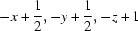 ; (ii)
 Data collection: COLLECT (Hooft, 1998); cell refinement: DENZO (Otwinowski & Minor, 1997) and COLLECT; data reduction: DENZO and COLLECT; program(s) used to solve structure: SIR92 (Altomare et al., 1994); program(s) used to refine structure: CRYSTALS (Betteridge et al., 2003); molecular graphics: ORTEP-3 (Farrugia, 1997) and Mercury (Macrae et al., 2006); software used to prepare material for publication: enCIFer (Allen et al., 2004) and publCIF (Westrip, 2008).
Supporting information
contains datablocks global, I. DOI: 10.1107/S1600536807067232/ga2020sup1.cif
Structure factors: contains datablock I. DOI: 10.1107/S1600536807067232/ga2020Isup2.hkl
The compound was sourced from Sigma-Aldrich and used as supplied. A single-crystal sample of the 1/1 solvate was recrystallized from a saturated N,N-dimethylacetamide solution by isothermal solvent evaporation at room temperature (298 K).
The DMA moiety was found to be disordered over a 2-fold rotation axis, with atoms C7 and O9 sitting on this axis. The site occupancies of N4 and C8 were consequently fixed to 1/2, whilst that of C6 was fixed to 1.0 as this atom acts as a methyl carbon both attached to N4 and to C8 in the disordered model. All non-H-atoms were modelled with anisotropic displacement parameters. H-atoms attached to N3 were located in a difference Fourier map and their positions were freely refined. H-atoms attached to C6 and C7 were positioned geometrically, taking into account disorder and occupancy of the parents atoms, and their positions were fixed during Uiso(H) were assigned in the range 1.2–1.5 times Ueq of the parent atom.
Note that both the (1 1 0) and the (-2 0 2) reflections were excluded from the final as they were significant outliers on the Fo versus Fc plot.
Data collection: COLLECT (Hooft, 1998); cell DENZO (Otwinowski & Minor, 1997) and COLLECT (Hooft, 1998); data reduction: DENZO (Otwinowski & Minor, 1997) and COLLECT (Hooft, 1998); program(s) used to solve structure: SIR92 (Altomare et al., 1994); program(s) used to refine structure: CRYSTALS (Betteridge et al., 2003); molecular graphics: ORTEP-3 (Farrugia, 1997) and Mercury (Macrae et al., 2006); software used to prepare material for publication: enCIFer (Allen et al., 2004) and publCIF (Westrip, 2007).
![[Figure 1]](./ga2020fig1thm.gif) | Fig. 1. The molecular structure of the title compound showing 50% probablility displacement ellipsoids. Hydrogen atoms have been omitted for clarity. A twofold axis runs through C1, O2 of urea and O9, C7 of DMA, giving rise to the rotational disorder of the DMA molecule. Symmetry codes: (i) -x, y, 1/2 - z. (ii) -x, y, 3/2 - z. |
![[Figure 2]](./ga2020fig2thm.gif) | Fig. 2. Selected molecular packing, viewed down the a axis, of the title compound illustrating the hydrogen bonded network. Urea molecules (green) form an R22(8) motif (Etter, 1990) involving contact 1 (entry 1, Table 1) that propagates to form an infinite ribbon. DMA molecules (shown in blues with rotational disorder) are hydrogen bonded via N—H···O contacts 2 (entry 2, Table 1) at the edges of the ribbon. Hydrogen bonds are shown as dashed lines and hydrogen atoms have been omitted for clarity. Symmetry codes: (a) -x, 1 - y, 1 - z; (b) 1/2 - x, 1/2 - y, 1 - z. |
| C4H9NO·CH4N2O | F(000) = 320 |
| Mr = 147.18 | Dx = 1.192 Mg m−3 |
| Monoclinic, C2/c | Melting point: 406 K |
| Hall symbol: -C 2yc | Mo Kα radiation, λ = 0.71073 Å |
| a = 7.2770 (3) Å | Cell parameters from 2218 reflections |
| b = 17.5394 (9) Å | θ = 3–27° |
| c = 7.3789 (4) Å | µ = 0.09 mm−1 |
| β = 119.450 (3)° | T = 120 K |
| V = 820.11 (7) Å3 | Lath, colourless |
| Z = 4 | 0.40 × 0.12 × 0.04 mm |
| Bruker–Nonius KappaCCD diffractometer | 941 independent reflections |
| Radiation source: Bruker-Nonius FR591 rotating anode | 552 reflections with I > 2.0σ(I) |
| Graphite monochromator | Rint = 0.048 |
| Detector resolution: 9.091 pixels mm-1 | θmax = 27.6°, θmin = 3.4° |
| ϕ & ω scans | h = −9→9 |
| Absorption correction: multi-scan (SADABS; Bruker, 2007) | k = −22→22 |
| Tmin = 0.867, Tmax = 1 | l = −9→9 |
| 5338 measured reflections |
| Refinement on F2 | Primary atom site location: structure-invariant direct methods |
| Least-squares matrix: full | Hydrogen site location: geom + difmap |
| R[F2 > 2σ(F2)] = 0.050 | H atoms treated by a mixture of independent and constrained refinement |
| wR(F2) = 0.150 | Method = Modified Sheldrick w = 1/[σ2(F2) + ( 0.07P)2] , where P = (max(Fo2,0) + 2Fc2)/3 |
| S = 0.89 | (Δ/σ)max = 0.000129 |
| 939 reflections | Δρmax = 0.31 e Å−3 |
| 63 parameters | Δρmin = −0.39 e Å−3 |
| 0 restraints |
| C4H9NO·CH4N2O | V = 820.11 (7) Å3 |
| Mr = 147.18 | Z = 4 |
| Monoclinic, C2/c | Mo Kα radiation |
| a = 7.2770 (3) Å | µ = 0.09 mm−1 |
| b = 17.5394 (9) Å | T = 120 K |
| c = 7.3789 (4) Å | 0.40 × 0.12 × 0.04 mm |
| β = 119.450 (3)° |
| Bruker–Nonius KappaCCD diffractometer | 941 independent reflections |
| Absorption correction: multi-scan (SADABS; Bruker, 2007) | 552 reflections with I > 2.0σ(I) |
| Tmin = 0.867, Tmax = 1 | Rint = 0.048 |
| 5338 measured reflections |
| R[F2 > 2σ(F2)] = 0.050 | 0 restraints |
| wR(F2) = 0.150 | H atoms treated by a mixture of independent and constrained refinement |
| S = 0.89 | Δρmax = 0.31 e Å−3 |
| 939 reflections | Δρmin = −0.39 e Å−3 |
| 63 parameters |
| x | y | z | Uiso*/Ueq | Occ. (<1) | |
| C1 | 0.0000 | 0.30587 (14) | 0.2500 | 0.0293 | |
| O2 | 0.0000 | 0.23473 (9) | 0.2500 | 0.0380 | |
| N3 | 0.1649 (2) | 0.34642 (10) | 0.3935 (3) | 0.0360 | |
| N4 | 0.0668 (4) | 0.37977 (18) | 0.7962 (5) | 0.0347 | 0.5000 |
| C6 | 0.2835 (3) | 0.40670 (13) | 0.9670 (4) | 0.0525 | |
| C7 | 0.0000 | 0.29897 (16) | 0.7500 | 0.0508 | |
| C8 | −0.0735 (5) | 0.4351 (2) | 0.6946 (6) | 0.0347 | 0.5000 |
| O9 | 0.0000 | 0.50307 (11) | 0.7500 | 0.0628 | |
| H31 | 0.264 (3) | 0.3224 (11) | 0.499 (4) | 0.0365* | |
| H32 | 0.158 (3) | 0.3959 (13) | 0.393 (3) | 0.0360* | |
| H71 | −0.1409 | 0.2969 | 0.6380 | 0.0608* | 0.5000 |
| H72 | 0.0074 | 0.2760 | 0.8696 | 0.0608* | 0.5000 |
| H73 | 0.0908 | 0.2732 | 0.7124 | 0.0608* | 0.5000 |
| H61 | 0.2880 | 0.4608 | 0.9665 | 0.0542* | 0.5000 |
| H62 | 0.3056 | 0.3894 | 1.0980 | 0.0542* | 0.5000 |
| H63 | 0.3889 | 0.3866 | 0.9409 | 0.0542* | 0.5000 |
| H64 | 0.2827 | 0.3526 | 0.9657 | 0.0542* | 0.5000 |
| H65 | 0.3108 | 0.4244 | 1.0994 | 0.0542* | 0.5000 |
| H66 | 0.3885 | 0.4250 | 0.9377 | 0.0542* | 0.5000 |
| U11 | U22 | U33 | U12 | U13 | U23 | |
| C1 | 0.0239 (11) | 0.0284 (14) | 0.0251 (13) | 0.0000 | 0.0038 (10) | 0.0000 |
| O2 | 0.0315 (9) | 0.0245 (10) | 0.0342 (11) | 0.0000 | −0.0022 (8) | 0.0000 |
| N3 | 0.0289 (8) | 0.0261 (9) | 0.0325 (10) | −0.0009 (6) | −0.0006 (7) | 0.0011 (7) |
| N4 | 0.0290 (18) | 0.0271 (17) | 0.038 (2) | 0.0003 (11) | 0.0085 (16) | −0.0020 (14) |
| C6 | 0.0327 (10) | 0.0554 (14) | 0.0474 (14) | −0.0003 (9) | 0.0026 (10) | 0.0046 (11) |
| C7 | 0.0663 (19) | 0.0236 (14) | 0.059 (2) | 0.0000 | 0.0286 (17) | 0.0000 |
| C8 | 0.0332 (19) | 0.030 (2) | 0.031 (2) | −0.0004 (14) | 0.0084 (16) | 0.0008 (16) |
| O9 | 0.0855 (16) | 0.0210 (11) | 0.0587 (16) | 0.0000 | 0.0176 (13) | 0.0000 |
| O9—C8 | 1.288 (4) | C6—H63 | 0.9500 |
| O9—C8i | 1.288 (4) | C6—H64 | 0.9500 |
| O2—C1 | 1.248 (3) | C6—H65 | 0.9500 |
| N4—C6 | 1.531 (4) | C6—H61 | 0.9500 |
| N4—C8 | 1.339 (5) | C6—H66 | 0.9500 |
| N4—C7 | 1.483 (4) | C7—H72i | 0.9500 |
| N3—C1 | 1.348 (2) | C7—H73i | 0.9500 |
| N3—H32 | 0.87 (2) | C7—H71i | 0.9500 |
| N3—H31 | 0.87 (2) | C7—H71 | 0.9500 |
| C6—C8i | 1.488 (5) | C7—H72 | 0.9500 |
| C6—H62 | 0.9500 | C7—H73 | 0.9500 |
| C6—N4—C7 | 124.9 (2) | C8i—C6—H61 | 72.00 |
| C6—N4—C8 | 115.5 (3) | H62—C6—H63 | 110.00 |
| C7—N4—C8 | 119.4 (3) | H62—C6—H64 | 72.00 |
| C1—N3—H32 | 119.8 (14) | C8i—C6—H66 | 109.00 |
| H31—N3—H32 | 120.7 (19) | N4—C7—H71i | 75.00 |
| C1—N3—H31 | 118.4 (14) | N4—C7—H72i | 119.00 |
| N4—C8—C6i | 114.0 (3) | N4—C7—H73 | 109.00 |
| O9—C8—N4 | 114.2 (3) | H71—C7—H72 | 110.00 |
| O9—C8—C6i | 131.8 (3) | H71—C7—H73 | 110.00 |
| N4—C6—H61 | 109.00 | N4—C7—H73i | 126.00 |
| N4—C6—H62 | 109.00 | H71—C7—H71i | 176.00 |
| N4—C6—H63 | 109.00 | H71—C7—H72i | 68.00 |
| N4—C6—H64 | 72.00 | H71—C7—H73i | 68.00 |
| H61—C6—H63 | 110.00 | H72—C7—H73 | 110.00 |
| H61—C6—H64 | 178.00 | N4i—C7—H72 | 119.00 |
| H61—C6—H65 | 72.00 | H71i—C7—H72 | 68.00 |
| H61—C6—H66 | 68.00 | N4i—C7—H71 | 75.00 |
| N4—C6—H65 | 124.00 | N4i—C7—H73 | 126.00 |
| N4—C6—H66 | 122.00 | H71i—C7—H73 | 68.00 |
| H61—C6—H62 | 110.00 | N4i—C7—H71i | 109.00 |
| H62—C6—H66 | 126.00 | N4i—C7—H72i | 109.00 |
| C8i—C6—H62 | 121.00 | N4i—C7—H73i | 109.00 |
| H63—C6—H64 | 68.00 | H71i—C7—H72i | 110.00 |
| H63—C6—H65 | 123.00 | H71i—C7—H73i | 110.00 |
| C8i—C6—H63 | 125.00 | N4—C7—H71 | 109.00 |
| H64—C6—H65 | 110.00 | N4—C7—H72 | 109.00 |
| H64—C6—H66 | 110.00 | O2—C1—N3 | 121.84 (12) |
| C8i—C6—H64 | 109.00 | O2—C1—N3ii | 121.84 (12) |
| H65—C6—H66 | 110.00 | N3—C1—N3ii | 116.3 (2) |
| C8i—C6—H65 | 109.00 |
| Symmetry codes: (i) −x, y, −z+3/2; (ii) −x, y, −z+1/2. |
| D—H···A | D—H | H···A | D···A | D—H···A |
| N3—H31···O2iii | 0.87 (2) | 2.06 (2) | 2.930 (2) | 180 (3) |
| N3—H32···O9iv | 0.87 (2) | 2.09 (2) | 2.878 (3) | 149.7 (19) |
| Symmetry codes: (iii) −x+1/2, −y+1/2, −z+1; (iv) −x, −y+1, −z+1. |
Experimental details
| Crystal data | |
| Chemical formula | C4H9NO·CH4N2O |
| Mr | 147.18 |
| Crystal system, space group | Monoclinic, C2/c |
| Temperature (K) | 120 |
| a, b, c (Å) | 7.2770 (3), 17.5394 (9), 7.3789 (4) |
| β (°) | 119.450 (3) |
| V (Å3) | 820.11 (7) |
| Z | 4 |
| Radiation type | Mo Kα |
| µ (mm−1) | 0.09 |
| Crystal size (mm) | 0.40 × 0.12 × 0.04 |
| Data collection | |
| Diffractometer | Bruker–Nonius KappaCCD diffractometer |
| Absorption correction | Multi-scan (SADABS; Bruker, 2007) |
| Tmin, Tmax | 0.867, 1 |
| No. of measured, independent and observed [I > 2.0σ(I)] reflections | 5338, 941, 552 |
| Rint | 0.048 |
| (sin θ/λ)max (Å−1) | 0.652 |
| Refinement | |
| R[F2 > 2σ(F2)], wR(F2), S | 0.050, 0.150, 0.89 |
| No. of reflections | 939 |
| No. of parameters | 63 |
| H-atom treatment | H atoms treated by a mixture of independent and constrained refinement |
| Δρmax, Δρmin (e Å−3) | 0.31, −0.39 |
Computer programs: , DENZO (Otwinowski & Minor, 1997) and COLLECT (Hooft, 1998), SIR92 (Altomare et al., 1994), CRYSTALS (Betteridge et al., 2003), ORTEP-3 (Farrugia, 1997) and Mercury (Macrae et al., 2006), enCIFer (Allen et al., 2004) and publCIF (Westrip, 2007).
| D—H···A | D—H | H···A | D···A | D—H···A |
| N3—H31···O2i | 0.87 (2) | 2.06 (2) | 2.930 (2) | 180 (3) |
| N3—H32···O9ii | 0.87 (2) | 2.09 (2) | 2.878 (3) | 149.7 (19) |
| Symmetry codes: (i) −x+1/2, −y+1/2, −z+1; (ii) −x, −y+1, −z+1. |
Acknowledgements
The authors thank the Basic Technology programme of the UK Research Councils for funding this work under the project Control and Prediction of the Organic Solid State (http://www.cposs.org.uk ). We also thank the EPSRC National X-ray Crystallography Service at the University of Southampton for the data collection.
References
 Allen, F. H., Johnson, O., Shields, G. P., Smith, B. R. & Towler, M. (2004). J. Appl. Cryst. 37, 335–338. Web of Science CrossRef CAS IUCr Journals Google Scholar
Altomare, A., Cascarano, G., Giacovazzo, G., Guagliardi, A., Burla, M. C., Polidori, G. & Camalli, M. (1994). J. Appl. Cryst. 27, 435. CrossRef Web of Science IUCr Journals Google Scholar
Betteridge, P. W., Carruthers, J. R., Cooper, R. I., Prout, K. & Watkin, D. J. (2003). J. Appl. Cryst. 36, 1487. Web of Science CrossRef IUCr Journals Google Scholar
Bruker (2007). SADABS. Version 2007/2. Bruker AXS Inc., Madison, Wisconsin, USA. Google Scholar
Etter, M. C. (1990). Acc. Chem. Res. 23, 120–126. CrossRef CAS Web of Science Google Scholar
Farrugia, L. J. (1997). J. Appl. Cryst. 30, 565. CrossRef IUCr Journals Google Scholar
Fernandes, P., Florence, A. J., Fabbiani, F., David, W. I. F. & Shankland, K. (2007). Acta Cryst. E63, o4861. Web of Science CSD CrossRef IUCr Journals Google Scholar
Florence, A. J., Baumgartner, B., Weston, C., Shankland, N., Kennedy, A. R., Shankland, K. & David, W. I. F. (2003). J. Pharm. Sci. 92, 1930–1938. Web of Science CSD CrossRef PubMed CAS Google Scholar
Guth, H., Heger, G., Klein, S., Treutmann, W. & Scheringer, C. (1980). Z. Kristallogr. 153, 237–254. CrossRef CAS Google Scholar
Hooft, R. W. W. (1998). COLLECT. Nonius BV, Delft, The Netherlands. Google Scholar
Macrae, C. F., Edgington, P. R., McCabe, P., Pidcock, E., Shields, G. P., Taylor, R., Towler, M. & van de Streek, J. (2006). J. Appl. Cryst. 39, 453–457. Web of Science CrossRef CAS IUCr Journals Google Scholar
Otwinowski, Z. & Minor, W. (1997). Methods in Enzymology, Vol. 276, Macromolecular Crystallography, Part A, edited by C. W. Carter Jr & R. M. Sweet, pp. 307–326. New York: Academic Press. Google Scholar
Pryor, A. W. & Sanger, P. L. (1970). Acta Cryst. A26, 543–558. CrossRef CAS IUCr Journals Web of Science Google Scholar
Swaminathan, S., Craven, B. M. & McMullan, R. K. (1984). Acta Cryst. B40, 300–306. CSD CrossRef CAS Web of Science IUCr Journals Google Scholar
Vaughan, P. & Donohue, J. (1952). Acta Cryst. 5, 530–535. CrossRef CAS IUCr Journals Google Scholar
Weber, H. P., Marshall, W. G. & Dmitriev, V. (2002). Acta Cryst. A58 (Suppl.), C174. Google Scholar
Westrip, S. P. (2008). publCIF. In preparation. Google Scholar
This is an open-access article distributed under the terms of the Creative Commons Attribution (CC-BY) Licence, which permits unrestricted use, distribution, and reproduction in any medium, provided the original authors and source are cited.
| CRYSTALLOGRAPHIC COMMUNICATIONS |


The crystal structure of urea has been widely studied (see for example, Vaughan and Donohue (1952) and references therein; Swaminathan et al. (1984), Pryor and Sanger (1970), Guth et al. (1980) and Weber et al. (2002)). This previously unreported crystalline solvate of urea was discovered during an investigation into the influence of different crystallization solvents on urea crystal morphology (see also Fernandes et al., 2007). The sample was obtained by slow evaporation from a saturated N,N-dimethylacetamide (DMA) solution at 298 K and identified by using multi-sample foil transmission X-ray powder diffraction analysis (Florence et al., 2003). Subsequent recrystallization produced a single-crystal suitable for X-ray diffraction at 120 K (Fig. 1).
Both molecules lie over a two fold rotation axis resulting in the DMA being disordered (see refinement section for details). Each urea molecule interacts with adjacent urea molecules via contact 1 (Fig. 2, entry 1, Table 1), forming a hydrogen bonded ribbon that runs in the direction [-1 0 1]. Molecules of DMA lie on the edge of the ribbons, connected through a second hydrogen bond (contact 2), (entry 2, Table 1).The DMA-bordered ribbons of urea pack side-by-side to form a two-dimensional sheet.