Related literature
Previous reports give details of the structural characterization of several organic ammonium tetrasulfidotungstates containing organic cations derived from a variety of amines (Srinivasan, Naik et al., 2007![[Srinivasan, B. R., Naik, A. R., Näther, C. & Bensch, W. (2007). Z. Anorg. Allg. Chem. 633, 582-588.]](../../../../../../logos/arrows/e_arr.gif "Srinivasan, B. R., Naik, A. R., Näther, C. & Bensch, W. (2007). Z. Anorg. Allg. Chem. 633, 582-588.") and related literature cited therein; Srinivasan, Girkar & Raghavaiah 2007 and related literature cited therein). The title compound is isotypic with (NH4)2[WS4], (Srinivasan et al., 2004), Rb2[WS4] (Yao & Ibers, 2004), Cs2[WS4] (Srinivasan, Näther & Bensch 2007) and (CNH6)2[MoS4] (Srinivasan, Näther et al., 2006). For related literature, see: Bondi (1964); Jeffrey (1997).
and related literature cited therein; Srinivasan, Girkar & Raghavaiah 2007 and related literature cited therein). The title compound is isotypic with (NH4)2[WS4], (Srinivasan et al., 2004), Rb2[WS4] (Yao & Ibers, 2004), Cs2[WS4] (Srinivasan, Näther & Bensch 2007) and (CNH6)2[MoS4] (Srinivasan, Näther et al., 2006). For related literature, see: Bondi (1964); Jeffrey (1997).
Experimental
Crystal data
(CH6N)2[WS4] Mr = 376.23 Orthorhombic, P n m a a = 9.5591 (10) Å b = 7.0006 (7) Å c = 15.734 (2) Å V = 1052.9 (2) Å3 Z = 4 Mo Kα radiation μ = 11.70 mm−1 T = 170 (2) K 0.12 × 0.06 × 0.04 mm
|
Data collection
Stoe IPDS1 diffractometer Absorption correction: numerical (X-SHAPE; Stoe & Cie, 1998) Tmin = 0.441, Tmax = 0.631 9418 measured reflections 1355 independent reflections 1060 reflections with I > 2σ(I) Rint = 0.065
|
| W1—S1 | 2.1862 (13) | | W1—S2 | 2.199 (2) | | W1—S3 | 2.2010 (18) | | | S1i—W1—S1 | 108.46 (7) | | S1—W1—S2 | 108.62 (5) | | S1—W1—S3 | 110.45 (5) | | S2—W1—S3 | 110.18 (8) | Symmetry code: (i)  . .
| |
| D—H⋯A | D—H | H⋯A | D⋯A | D—H⋯A | | N1—H1N1⋯S1ii | 0.91 | 2.55 | 3.328 (6) | 144 | | N1—H1N1⋯S3ii | 0.91 | 2.90 | 3.5623 (12) | 131 | | N1—H2N1⋯S2 | 0.91 | 2.40 | 3.227 (7) | 152 | | N1—H2N1⋯S3 | 0.91 | 2.83 | 3.390 (7) | 121 | | N2—H1N2⋯S1 | 0.91 | 2.77 | 3.468 (6) | 135 | | N2—H1N2⋯S1iii | 0.91 | 2.95 | 3.502 (6) | 121 | | N2—H1N2⋯S2iii | 0.91 | 2.96 | 3.5491 (12) | 124 | | N2—H2N2⋯S3iv | 0.91 | 2.64 | 3.464 (7) | 151 | | C1—H1A⋯S1v | 0.98 | 2.97 | 3.736 (8) | 135 | | C1—H1B⋯S2vi | 0.96 | 2.89 | 3.589 (10) | 131 | Symmetry codes: (ii) -x, -y, -z+1; (iii) -x+1, -y, -z+1; (iv) x+1, y, z; (v) 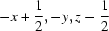 ; (vi) ; (vi) 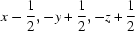 . .
| |
Data collection: IPDS Program Package (Stoe & Cie, 1998); cell refinement: IPDS Program Package; data reduction: IPDS Program Package; program(s) used to solve structure: SHELXS97 (Sheldrick, 1997); program(s) used to refine structure: SHELXL97 (Sheldrick, 1997); molecular graphics: DIAMOND (Brandenburg, 1999); software used to prepare material for publication: CIFTAB in SHELXTL (Bruker, 1998).
Supporting information
(NH4)2[WS4] (1 g) was dissolved in 40% methylamine (5 ml) and water (2 ml) and filtered. The clear yellow filtrate was left undisturbed for crystallization. After a day crystalline blocks of the title compound separated. The product was filtered, washed with ice-cold water (1 ml), followed by 2-propanol (5 ml) and diethyl ether (10 ml) and dried. Yield: 1.1 g.
All H atoms were located in difference map but were positioned with idealized geometry ((CH3 and NH3 allowed to rotate but not to tip) with 0.98 and 0.96 Å (methyl) and N—H = 0.91 Å) and were refined using a riding model, with Uiso(H) fixed at 1.5Ueq(CH3 and NH3). The largest peak in the residual electron density map of 1.48 e Å-3 is located at a distance of 0.09 Å from W1 and the deepest hole of -2.34 e Å-3 is located at a distance of 0.83 Å from W1.
Data collection: IPDS (Stoe & Cie, 1998); cell refinement: IPDS (Stoe & Cie, 1998); data reduction: IPDS (Stoe & Cie, 1998); program(s) used to solve structure: SHELXS97 (Sheldrick, 1997); program(s) used to refine structure: SHELXL97 (Sheldrick, 1997); molecular graphics: DIAMOND (Brandenburg, 1999); software used to prepare material for publication: CIFTAB in SHELXTL (Bruker, 1998).
Bis(methylammonium) tetrasulfidotungstate(VI)
top Crystal data top | (CH6N)2[WS4] | F(000) = 704 |
| Mr = 376.23 | Dx = 2.373 Mg m−3 |
| Orthorhombic, Pnma | Mo Kα radiation, λ = 0.71073 Å |
| Hall symbol: -P 2ac 2n | Cell parameters from 8000 reflections |
| a = 9.5591 (10) Å | θ = 1.9–28.2° |
| b = 7.0006 (7) Å | µ = 11.70 mm−1 |
| c = 15.734 (2) Å | T = 170 K |
| V = 1052.9 (2) Å3 | Block, yellow |
| Z = 4 | 0.12 × 0.06 × 0.04 mm |
Data collection top Stoe IPDS1
diffractometer | 1355 independent reflections |
| Radiation source: fine-focus sealed tube | 1060 reflections with I > 2σ(I) |
| Graphite monochromator | Rint = 0.065 |
| ϕ scans | θmax = 27.9°, θmin = 2.5° |
Absorption correction: numerical
(X-SHAPE; Stoe & Cie, 1998) | h = −12→12 |
| Tmin = 0.441, Tmax = 0.631 | k = −9→9 |
| 9418 measured reflections | l = −20→20 |
Refinement top | Refinement on F2 | Secondary atom site location: difference Fourier map |
| Least-squares matrix: full | Hydrogen site location: inferred from neighbouring sites |
| R[F2 > 2σ(F2)] = 0.032 | H-atom parameters constrained |
| wR(F2) = 0.081 | w = 1/[σ2(Fo2) + (0.045P)2 + 1.2501P]
where P = (Fo2 + 2Fc2)/3 |
| S = 1.10 | (Δ/σ)max < 0.001 |
| 1355 reflections | Δρmax = 1.48 e Å−3 |
| 53 parameters | Δρmin = −2.34 e Å−3 |
| 0 restraints | Extinction correction: SHELXL97 (Sheldrick, 1997), Fc*=kFc[1+0.001xFc2λ3/sin(2θ)]-1/4 |
| Primary atom site location: structure-invariant direct methods | Extinction coefficient: 0.0022 (3) |
Crystal data top | (CH6N)2[WS4] | V = 1052.9 (2) Å3 |
| Mr = 376.23 | Z = 4 |
| Orthorhombic, Pnma | Mo Kα radiation |
| a = 9.5591 (10) Å | µ = 11.70 mm−1 |
| b = 7.0006 (7) Å | T = 170 K |
| c = 15.734 (2) Å | 0.12 × 0.06 × 0.04 mm |
Data collection top Stoe IPDS1
diffractometer | 1355 independent reflections |
Absorption correction: numerical
(X-SHAPE; Stoe & Cie, 1998) | 1060 reflections with I > 2σ(I) |
| Tmin = 0.441, Tmax = 0.631 | Rint = 0.065 |
| 9418 measured reflections | |
Refinement top | R[F2 > 2σ(F2)] = 0.032 | 0 restraints |
| wR(F2) = 0.081 | H-atom parameters constrained |
| S = 1.10 | Δρmax = 1.48 e Å−3 |
| 1355 reflections | Δρmin = −2.34 e Å−3 |
| 53 parameters | |
Special details top Geometry. All e.s.d.'s (except the e.s.d. in the dihedral angle between two l.s. planes) are estimated using the full covariance matrix. The cell e.s.d.'s are taken into account individually in the estimation of e.s.d.'s in distances, angles and torsion angles; correlations between e.s.d.'s in cell parameters are only used when they are defined by crystal symmetry. An approximate (isotropic) treatment of cell e.s.d.'s is used for estimating e.s.d.'s involving l.s. planes. |
Refinement. Refinement of F2 against ALL reflections. The weighted R-factor wR and goodness of fit S are based on F2, conventional R-factors R are based on F, with F set to zero for negative F2. The threshold expression of F2 > σ(F2) is used only for calculating R-factors(gt) etc. and is not relevant to the choice of reflections for refinement. R-factors based on F2 are statistically about twice as large as those based on F, and R- factors based on ALL data will be even larger. |
Fractional atomic coordinates and isotropic or equivalent isotropic displacement parameters (Å2) top| | x | y | z | Uiso*/Ueq | |
| W1 | 0.24968 (3) | 0.2500 | 0.552442 (15) | 0.01100 (14) | |
| S3 | 0.02612 (18) | 0.2500 | 0.58592 (13) | 0.0191 (4) | |
| S2 | 0.2751 (2) | 0.2500 | 0.41353 (13) | 0.0209 (4) | |
| S1 | 0.35291 (14) | −0.00338 (18) | 0.60404 (9) | 0.0204 (3) | |
| N1 | −0.0570 (7) | 0.2500 | 0.3764 (4) | 0.0178 (13) | |
| H1N1 | −0.1078 | 0.1449 | 0.3909 | 0.027* | |
| H2N1 | 0.0246 | 0.2500 | 0.4063 | 0.027* | |
| C1 | −0.0349 (12) | 0.2500 | 0.2832 (6) | 0.041 (2) | |
| H1A | 0.0168 | 0.1361 | 0.2652 | 0.061* | |
| H1B | −0.1279 | 0.2500 | 0.2601 | 0.061* | |
| N2 | 0.6638 (7) | 0.2500 | 0.5893 (4) | 0.0233 (14) | |
| H1N2 | 0.6161 | 0.1449 | 0.5715 | 0.035* | |
| H2N2 | 0.7517 | 0.2500 | 0.5672 | 0.035* | |
| C2 | 0.6709 (10) | 0.2500 | 0.6828 (5) | 0.0282 (18) | |
| H2A | 0.7249 | 0.3626 | 0.7000 | 0.042* | |
| H2B | 0.5836 | 0.2500 | 0.7155 | 0.042* | |
Atomic displacement parameters (Å2) top| | U11 | U22 | U33 | U12 | U13 | U23 |
| W1 | 0.00838 (19) | 0.01006 (18) | 0.01455 (19) | 0.000 | −0.00081 (11) | 0.000 |
| S3 | 0.0086 (8) | 0.0257 (9) | 0.0230 (9) | 0.000 | 0.0029 (8) | 0.000 |
| S2 | 0.0157 (9) | 0.0286 (9) | 0.0183 (9) | 0.000 | 0.0028 (8) | 0.000 |
| S1 | 0.0166 (6) | 0.0131 (5) | 0.0316 (6) | 0.0016 (5) | −0.0057 (6) | 0.0043 (5) |
| N1 | 0.016 (3) | 0.016 (3) | 0.021 (3) | 0.000 | −0.006 (3) | 0.000 |
| C1 | 0.048 (6) | 0.058 (6) | 0.016 (4) | 0.000 | 0.003 (4) | 0.000 |
| N2 | 0.017 (3) | 0.025 (3) | 0.028 (4) | 0.000 | 0.005 (3) | 0.000 |
| C2 | 0.027 (5) | 0.037 (4) | 0.021 (4) | 0.000 | 0.002 (4) | 0.000 |
Geometric parameters (Å, º) top | W1—S1i | 2.1862 (13) | C1—H1A | 0.98 |
| W1—S1 | 2.1862 (13) | C1—H1B | 0.96 |
| W1—S2 | 2.199 (2) | N2—C2 | 1.473 (11) |
| W1—S3 | 2.2010 (18) | N2—H1N2 | 0.91 |
| N1—C1 | 1.482 (10) | N2—H2N2 | 0.91 |
| N1—H1N1 | 0.91 | C2—H2A | 0.98 |
| N1—H2N1 | 0.91 | C2—H2B | 0.98 |
| | | |
| S1i—W1—S1 | 108.46 (7) | N1—C1—H1A | 111.0 |
| S1i—W1—S2 | 108.62 (5) | N1—C1—H1B | 104.1 |
| S1—W1—S2 | 108.62 (5) | H1A—C1—H1B | 110.9 |
| S1i—W1—S3 | 110.45 (5) | C2—N2—H1N2 | 109.4 |
| S1—W1—S3 | 110.45 (5) | C2—N2—H2N2 | 109.8 |
| S2—W1—S3 | 110.18 (8) | H1N2—N2—H2N2 | 110.2 |
| C1—N1—H1N1 | 108.8 | N2—C2—H2A | 107.4 |
| C1—N1—H2N1 | 112.8 | N2—C2—H2B | 119.0 |
| H1N1—N1—H2N1 | 109.2 | H2A—C2—H2B | 107.7 |
| Symmetry code: (i) x, −y+1/2, z. |
Hydrogen-bond geometry (Å, º) top | D—H···A | D—H | H···A | D···A | D—H···A |
| N1—H1N1···S1ii | 0.91 | 2.55 | 3.328 (6) | 144 |
| N1—H1N1···S3ii | 0.91 | 2.90 | 3.5623 (12) | 131 |
| N1—H2N1···S2 | 0.91 | 2.40 | 3.227 (7) | 152 |
| N1—H2N1···S3 | 0.91 | 2.83 | 3.390 (7) | 121 |
| N2—H1N2···S1 | 0.91 | 2.77 | 3.468 (6) | 135 |
| N2—H1N2···S1iii | 0.91 | 2.95 | 3.502 (6) | 121 |
| N2—H1N2···S2iii | 0.91 | 2.96 | 3.5491 (12) | 124 |
| N2—H2N2···S3iv | 0.91 | 2.64 | 3.464 (7) | 151 |
| C1—H1A···S1v | 0.98 | 2.97 | 3.736 (8) | 135 |
| C1—H1B···S2vi | 0.96 | 2.89 | 3.589 (10) | 131 |
| Symmetry codes: (ii) −x, −y, −z+1; (iii) −x+1, −y, −z+1; (iv) x+1, y, z; (v) −x+1/2, −y, z−1/2; (vi) x−1/2, −y+1/2, −z+1/2. |
Experimental details
| Crystal data |
| Chemical formula | (CH6N)2[WS4] |
| Mr | 376.23 |
| Crystal system, space group | Orthorhombic, Pnma |
| Temperature (K) | 170 |
| a, b, c (Å) | 9.5591 (10), 7.0006 (7), 15.734 (2) |
| V (Å3) | 1052.9 (2) |
| Z | 4 |
| Radiation type | Mo Kα |
| µ (mm−1) | 11.70 |
| Crystal size (mm) | 0.12 × 0.06 × 0.04 |
| |
| Data collection |
| Diffractometer | Stoe IPDS1
diffractometer |
| Absorption correction | Numerical
(X-SHAPE; Stoe & Cie, 1998) |
| Tmin, Tmax | 0.441, 0.631 |
No. of measured, independent and
observed [I > 2σ(I)] reflections | 9418, 1355, 1060 |
| Rint | 0.065 |
| (sin θ/λ)max (Å−1) | 0.657 |
| |
| Refinement |
| R[F2 > 2σ(F2)], wR(F2), S | 0.032, 0.081, 1.10 |
| No. of reflections | 1355 |
| No. of parameters | 53 |
| H-atom treatment | H-atom parameters constrained |
| Δρmax, Δρmin (e Å−3) | 1.48, −2.34 |
Selected geometric parameters (Å, º) top| W1—S1 | 2.1862 (13) | W1—S3 | 2.2010 (18) |
| W1—S2 | 2.199 (2) | | |
| | | |
| S1i—W1—S1 | 108.46 (7) | S1—W1—S3 | 110.45 (5) |
| S1—W1—S2 | 108.62 (5) | S2—W1—S3 | 110.18 (8) |
| Symmetry code: (i) x, −y+1/2, z. |
Hydrogen-bond geometry (Å, º) top | D—H···A | D—H | H···A | D···A | D—H···A |
| N1—H1N1···S1ii | 0.91 | 2.55 | 3.328 (6) | 144 |
| N1—H1N1···S3ii | 0.91 | 2.90 | 3.5623 (12) | 131 |
| N1—H2N1···S2 | 0.91 | 2.40 | 3.227 (7) | 152 |
| N1—H2N1···S3 | 0.91 | 2.83 | 3.390 (7) | 121 |
| N2—H1N2···S1 | 0.91 | 2.77 | 3.468 (6) | 135 |
| N2—H1N2···S1iii | 0.91 | 2.95 | 3.502 (6) | 121 |
| N2—H1N2···S2iii | 0.91 | 2.96 | 3.5491 (12) | 124 |
| N2—H2N2···S3iv | 0.91 | 2.64 | 3.464 (7) | 151 |
| C1—H1A···S1v | 0.98 | 2.97 | 3.736 (8) | 135 |
| C1—H1B···S2vi | 0.96 | 2.89 | 3.589 (10) | 131 |
| Symmetry codes: (ii) −x, −y, −z+1; (iii) −x+1, −y, −z+1; (iv) x+1, y, z; (v) −x+1/2, −y, z−1/2; (vi) x−1/2, −y+1/2, −z+1/2. |
Acknowledgements
BRS thanks Mr R. G. Mhalsikar and Mr A. R. Naik for the preparation of the crystals of the title compound, and the Department of Science and Technology (DST), New Delhi, India, for financial support.
References
 Bondi, A. (1964). J. Phys. Chem. 68, 441–451. CrossRef CAS Web of Science Google Scholar
Brandenburg, K. (1999). DIAMOND. Release 2.1c. Crystal Impact GbR, Bonn, Germany. Google Scholar
Bruker (1998). SHELXTL. Version 5.10. Bruker AXS Inc., Madison, Wisconsin, USA. Google Scholar
Jeffrey, G. A. (1997). An Introduction to Hydrogen Bonding. Oxford University Press. Google Scholar
Sheldrick, G. M. (1997). SHELXS97 and SHELXL97. University of Göttingen, Germany. Google Scholar
Srinivasan, B. R., Girkar, S. V. & Raghavaiah, P. (2007). Acta Cryst. E63, m3100–m3101. Web of Science CSD CrossRef IUCr Journals Google Scholar
Srinivasan, B. R., Naik, A. R., Näther, C. & Bensch, W. (2007). Z. Anorg. Allg. Chem. 633, 582–588. Web of Science CSD CrossRef CAS Google Scholar
Srinivasan, B. R., Näther, C. & Bensch, W. (2007). Acta Cryst. E63, i167. Web of Science CrossRef IUCr Journals Google Scholar
Srinivasan, B. R., Näther, C., Naik, A. R. & Bensch, W. (2006). Acta Cryst. E62, m1635–m1637. Web of Science CSD CrossRef IUCr Journals Google Scholar
Srinivasan, B. R., Poisot, M., Näther, C. & Bensch, W. (2004). Acta Cryst. E60, i136–i138. Web of Science CrossRef IUCr Journals Google Scholar
Stoe & Cie (1998). X-SHAPE (Version 1.03) and IPDS Program Package (Version 2.89). Stoe & Cie, Darmstadt, Germany. Google Scholar
Yao, J. & Ibers, J. A. (2004). Acta Cryst. E60, i10–i11. Web of Science CrossRef IUCr Journals Google Scholar
This is an open-access article distributed under the terms of the Creative Commons Attribution (CC-BY) Licence, which permits unrestricted use, distribution, and reproduction in any medium, provided the original authors and source are cited.
 | CRYSTALLOGRAPHIC
COMMUNICATIONS |
ISSN: 2056-9890
Open

access


 journal menu



![[Scheme 1]](si2066scheme1.gif)
![[Figure 1]](./si2066fig1thm.gif)
![[Figure 2]](./si2066fig2thm.gif)
![[Figure 3]](./si2066fig3thm.gif)


In continuation of our recent reports on the synthesis and structural characterization of organic ammonium tetrasulfidotungstates (Srinivasan, Naik et al., 2007 and related literature cited therein; Srinivasan, Girkar & Raghavaiah 2007) we describe herein the structure of a new organic [WS4]2- compound containing methylammonium as counter cation.
The title compound is isostructural with (NH4)2[WS4], (Srinivasan et al., 2004), Cs2[WS4] (Srinivasan, Näther & Bensch 2007), Rb2[WS4] (Yao & Ibers 2004), and (CH6N)2[MoS4] (Srinivasan,, Näther et al., 2006). The structure consists of a discrete tetrahedral [WS4]2- ion and two crystallographically independent methylammonium cations (Fig. 1) all of which are located on crystallographic mirror planes so that each half of these ions make up the asymmetric unit. The bond lengths and bond angles of the organic cations are in good agreement with the reported values for the isotypic Mo compound. The WS4 tetrahedron is slightly distorted with S—W—S angles between 108.46 (7) and 110.45 (5) ° (Table 1). The W—S bond lengths range from 2.1862 (13) to 2.2010 (18) Å with an average value of 2.1931 Å. The observed difference Δ between the longest and the shortest W—S bonds of 0.0148 Å in the title compound is slightly shorter than the Δ value of 0.0199 Å in the analogous Mo compound (CNH6)2[MoS4] (Srinivasan, Näther et al., 2006).
A scrutiny of the structure reveals that each [WS4]2- is hydrogen bonded to ten symmetry related organic cations via several weak N—H···S and C—H···S interactions (Fig.2). These weak interactions can explain the observed distinct W—S bond distances. In general, unshared H-bonds have a considerably stronger effect than bifurcated ones, while the effect of trifurcated H-bonds is quite weak (Jeffrey, 1997). The atoms H1N1 and H2N1 are involved in bifurcated H-bonding while H1N2 makes a trifurcated H-bond, and H2N2 forms an unshared H-bond. Although short S···H contacts are observed at 2.40 and 2.55 Å for S2 and S1 respectively, these are relatively weaker in view of the bifurcated nature of H-bonding and hence do not cause much lengthening of these W—S bonds. The weakness of the trifurcated H-bond can also be evidenced from the observed longer S···H distances accompanied by smaller N—H···S angles. S3 is involved in a singly unshared H-bond at a distance of 2.64 Å. The effect of this contact is stronger than all the other contacts and can explain the elongation of the W—S3 bond, the longest observed W—S distance for the title compound. In all ten short S···H contacts ranging from 2.40 to 2.97 Å, all of which are shorter than the sum of their van der Waals radii (Bondi, 1964) are observed (Table 2). As a result of H-bonding, the organic cations are organized such that the ammonium groups always point towards the S atoms of tetrasulfidotungstate as can be seen in the sequence in the crystallographic bc plane viz. WS4··· H3NMe··· MeNH3··· WS4··· and so on (Fig. 3).