 | Acta Crystallographica Section E Acta Crystallographica Section E CRYSTALLOGRAPHIC COMMUNICATIONS |


 journal menu


metal-organic compounds
| CRYSTALLOGRAPHIC COMMUNICATIONS |
 access
Bis(acetato-κO)[N,N,N′,N′-tetramethylethane-1,2-diamine-κ2N,N′]copper(II)

aLaboratorium für Organische Chemie, Eidgenössische Technische Hochschule (ETH) Zürich, Wolfgang-Pauli-Strasse 10, 8093 Zürich, Switzerland
*Correspondence e-mail: [email protected]
In the title compound, [Cu(C2H3O2)2(C6H16N2)], the CuII atom is coordinated by two N atoms from the chelating N,N,N′,N′-tetramethylethane-1,2-diamine ligand and two O atoms from two acetate anions in a distorted square-planar geometry. In addition, there are longer contacts between Cu and the second O atom of each acetate ligand, which could be considered to complete a distorted octahedral geometry. The molecules in the crystal structure are connected via intermolecular C—H⋯O hydrogen-bonding contacts.
Related literature
For general background, see: Slootweg & Chen (2006![[Slootweg, J. C. & Chen, P. (2006). Organometallics, 25, 5863-5869.]](../../../../../../logos/arrows/e_arr.gif "Slootweg, J. C. & Chen, P. (2006). Organometallics, 25, 5863-5869.") ); Gerdes & Chen (2004); Gerdes (2004). For related structures, see: Dalai et al. (2002); Margraf et al. (2005); Devereux et al. (2007); Brown et al. (2002).
); Gerdes & Chen (2004); Gerdes (2004). For related structures, see: Dalai et al. (2002); Margraf et al. (2005); Devereux et al. (2007); Brown et al. (2002).
![[Scheme 1]](si2074scheme1.gif)
Experimental
Crystal data
|
Data collection
|
Refinement
|
| |||||||||||||||||||||||||||||||
|
 ; (ii)
  ; (iii)
  ; (iv)
  .
. Data collection: COLLECT (Nonius, 2000); cell refinement: SCALEPACK (Otwinowski & Minor, 1997); data reduction: DENZO (Otwinowski & Minor, 1997) and SCALEPACK; program(s) used to solve structure: SIR97 (Altomare et al., 1999); program(s) used to refine structure: SHELXL97 (Sheldrick, 2008); molecular graphics: PLATON (Spek, 2003); software used to prepare material for publication: SHELXL97.
Supporting information
contains datablocks I, global. DOI: 10.1107/S1600536808002584/si2074sup1.cif
Structure factors: contains datablock I. DOI: 10.1107/S1600536808002584/si2074Isup2.hkl
General Procedures. ESI-MS measurements were performed on a Finnigan MAT TSQ Quantum triple-quad equipped with electrospray sources. Elemental analyses were performed by the Microanalytical Laboratory of the Laboratorium für Organische Chemie, ETH Zürich.
The title compound was obtained as follows. To a suspension of copper(II)acetate (1.78 g, 9.78 mmol) in MeOH (40 ml) an equimolar amount of TMEDA (1.48 ml, 9.78 mmol) was added and the reaction mixture was stirred for 18 h at room temperature yielding a deep blue solution. After filtration, the solvent was removed in vacuo yielding analytically pure [(TMEDA)Cu(OAc)2] (2.64 g, 91%) as a blue powder. Crystallization from THF at room temperature yielded blue plates suitable for X-ray crystallography. M.p. 178 °C (decomp.). MS (ESI, positive ions, DCM) m/z (%): 238 (100) [M - O2CCH3]+. Elem. anal.: Found C, 40.18; H, 7.15; N, 9.41. Calcd. for C10H22N2O4Cu: C, 40.33; H, 7.44; N, 9.41.
The structure was refined by full-matrix least-squares analysis using an isotropic extinction correction. All non H-atoms were refined anisotropically, H-atoms isotropically, whereby H-positions are based on stereochemical considerations. For CH3 groups, C—H distances are 0.97 Å and Uiso(H) = 1.5U(eq) on the respective C-atom, while for CH2 groups, the corresponding values are 0.98 Å and 1.2U(eq), respectively.
Data collection: COLLECT (Nonius, 2000); cell SCALEPACK (Otwinowski & Minor, 1997); data reduction: DENZO and SCALEPACK (Otwinowski & Minor, 1997); program(s) used to solve structure: SIR97 (Altomare et al., 1999); program(s) used to refine structure: SHELXL97 (Sheldrick, 2008); molecular graphics: PLATON (Spek, 2003); software used to prepare material for publication: SHELXL97 (Sheldrick, 2008).
![[Figure 1]](./si2074fig1thm.gif) | Fig. 1. Displacement ellipsoid of [(TMEDA)Cu(OAc)2] with ellipsoids drawn at the 50% probability level. Weak interactions in the metal coordination sphere are shown as dotted lines. Hydrogen atoms are omitted for clarity. |
| [Cu(C2H3O2)2(C6H16N2)] | F(000) = 628 |
| Mr = 297.84 | Dx = 1.428 Mg m−3 |
| Monoclinic, P21/n | Melting point: 178 K |
| Hall symbol: -P 2yn | Mo Kα radiation, λ = 0.7107 Å |
| a = 8.0201 (5) Å | Cell parameters from 10930 reflections |
| b = 15.9153 (10) Å | θ = 3.2–26.0° |
| c = 10.8536 (7) Å | µ = 1.58 mm−1 |
| β = 90.910 (3)° | T = 220 K |
| V = 1385.20 (15) Å3 | Cut fragment, blue |
| Z = 4 | 0.21 × 0.19 × 0.15 mm |
| Nonius KappaCCD area-detector diffractometer | 2321 reflections with I > 2σ(I) |
| Radiation source: fine-focus sealed tube | Rint = 0.040 |
| Graphite monochromator | θmax = 26.0°, θmin = 3.2° |
| ϕ and ω scans with κ offsets | h = −9→9 |
| 4704 measured reflections | k = −16→19 |
| 2711 independent reflections | l = −13→13 |
| Refinement on F2 | Secondary atom site location: difference Fourier map |
| Least-squares matrix: full | Hydrogen site location: inferred from neighbouring sites |
| R[F2 > 2σ(F2)] = 0.040 | H-atom parameters constrained |
| wR(F2) = 0.106 | w = 1/[σ2(Fo2) + (0.0446P)2 + 0.7399P] where P = (Fo2 + 2Fc2)/3 |
| S = 1.06 | (Δ/σ)max = 0.006 |
| 2711 reflections | Δρmax = 0.53 e Å−3 |
| 183 parameters | Δρmin = −0.45 e Å−3 |
| 0 restraints | Extinction correction: SHELXL97 (Sheldrick, 2008), Fc*=kFc[1+0.001xFc2λ3/sin(2θ)]-1/4 |
| Primary atom site location: structure-invariant direct methods | Extinction coefficient: 0.0108 (18) |
| [Cu(C2H3O2)2(C6H16N2)] | V = 1385.20 (15) Å3 |
| Mr = 297.84 | Z = 4 |
| Monoclinic, P21/n | Mo Kα radiation |
| a = 8.0201 (5) Å | µ = 1.58 mm−1 |
| b = 15.9153 (10) Å | T = 220 K |
| c = 10.8536 (7) Å | 0.21 × 0.19 × 0.15 mm |
| β = 90.910 (3)° |
| Nonius KappaCCD area-detector diffractometer | 2321 reflections with I > 2σ(I) |
| 4704 measured reflections | Rint = 0.040 |
| 2711 independent reflections |
| R[F2 > 2σ(F2)] = 0.040 | 0 restraints |
| wR(F2) = 0.106 | H-atom parameters constrained |
| S = 1.06 | Δρmax = 0.53 e Å−3 |
| 2711 reflections | Δρmin = −0.45 e Å−3 |
| 183 parameters |
Geometry. All e.s.d.'s (except the e.s.d. in the dihedral angle between two l.s. planes) are estimated using the full covariance matrix. The cell e.s.d.'s are taken into account individually in the estimation of e.s.d.'s in distances, angles and torsion angles; correlations between e.s.d.'s in cell parameters are only used when they are defined by crystal symmetry. An approximate (isotropic) treatment of cell e.s.d.'s is used for estimating e.s.d.'s involving l.s. planes. |
Refinement. Refinement of F2 against ALL reflections. The weighted R-factor wR and goodness of fit S are based on F2, conventional R-factors R are based on F, with F set to zero for negative F2. The threshold expression of F2 > σ(F2) is used only for calculating R-factors(gt) etc. and is not relevant to the choice of reflections for refinement. R-factors based on F2 are statistically about twice as large as those based on F, and R- factors based on ALL data will be even larger. |
| x | y | z | Uiso*/Ueq | ||
| Cu1 | 0.53786 (4) | 0.26068 (2) | 0.13564 (3) | 0.03199 (13) | |
| N2 | 0.3491 (3) | 0.18731 (15) | 0.1983 (2) | 0.0345 (5) | |
| C3 | 0.1951 (4) | 0.23935 (18) | 0.1898 (3) | 0.0382 (7) | |
| H3A | 0.1903 | 0.2777 | 0.2603 | 0.058 (11)* | |
| H3B | 0.0964 | 0.2031 | 0.1909 | 0.051 (9)* | |
| C4 | 0.1978 (4) | 0.28884 (19) | 0.0717 (3) | 0.0389 (7) | |
| H4A | 0.1912 | 0.2506 | 0.0010 | 0.038 (9)* | |
| H4B | 0.1016 | 0.3268 | 0.0675 | 0.055 (11)* | |
| N5 | 0.3551 (3) | 0.33834 (15) | 0.0673 (2) | 0.0374 (5) | |
| C6 | 0.3407 (4) | 0.4158 (2) | 0.1401 (4) | 0.0529 (9) | |
| H6A | 0.2490 | 0.4494 | 0.1078 | 0.079 (12)* | |
| H6B | 0.4436 | 0.4476 | 0.1351 | 0.044 (9)* | |
| H6C | 0.3201 | 0.4016 | 0.2254 | 0.066 (12)* | |
| C7 | 0.3938 (4) | 0.3596 (3) | −0.0616 (3) | 0.0562 (9) | |
| H7A | 0.3075 | 0.3960 | −0.0952 | 0.079 (14)* | |
| H7B | 0.3988 | 0.3085 | −0.1101 | 0.073 (12)* | |
| H7C | 0.5005 | 0.3881 | −0.0642 | 0.059 (11)* | |
| C8 | 0.3279 (4) | 0.10915 (18) | 0.1261 (3) | 0.0414 (7) | |
| H8A | 0.2369 | 0.0766 | 0.1595 | 0.062 (10)* | |
| H8B | 0.4299 | 0.0765 | 0.1308 | 0.048 (9)* | |
| H8C | 0.3029 | 0.1231 | 0.0408 | 0.070 (13)* | |
| C9 | 0.3865 (4) | 0.1654 (2) | 0.3283 (3) | 0.0448 (7) | |
| H9A | 0.3981 | 0.2164 | 0.3765 | 0.053 (10)* | |
| H9B | 0.4896 | 0.1336 | 0.3330 | 0.058 (10)* | |
| H9C | 0.2963 | 0.1317 | 0.3605 | 0.081 (13)* | |
| O10 | 0.7070 (2) | 0.17122 (13) | 0.15991 (18) | 0.0385 (5) | |
| C11 | 0.7292 (3) | 0.14698 (17) | 0.0489 (3) | 0.0349 (6) | |
| O12 | 0.6444 (3) | 0.17379 (14) | −0.03924 (19) | 0.0465 (5) | |
| C13 | 0.8650 (4) | 0.0828 (2) | 0.0276 (3) | 0.0492 (8) | |
| H13A | 0.8172 | 0.0335 | −0.0118 | 0.083 (13)* | |
| H13B | 0.9156 | 0.0669 | 0.1060 | 0.104 (18)* | |
| H13C | 0.9493 | 0.1068 | −0.0250 | 0.096 (15)* | |
| O14 | 0.7116 (2) | 0.34802 (13) | 0.11797 (18) | 0.0405 (5) | |
| C15 | 0.7388 (4) | 0.36997 (18) | 0.2298 (3) | 0.0369 (6) | |
| O16 | 0.6567 (3) | 0.34218 (14) | 0.31695 (19) | 0.0449 (5) | |
| C17 | 0.8749 (4) | 0.4340 (2) | 0.2530 (4) | 0.0503 (8) | |
| H17A | 0.8266 | 0.4850 | 0.2858 | 0.078 (12)* | |
| H17B | 0.9300 | 0.4466 | 0.1762 | 0.084 (16)* | |
| H17C | 0.9557 | 0.4115 | 0.3117 | 0.091 (13)* |
| U11 | U22 | U33 | U12 | U13 | U23 | |
| Cu1 | 0.0299 (2) | 0.0361 (2) | 0.0299 (2) | 0.00122 (13) | −0.00067 (14) | −0.00086 (13) |
| N2 | 0.0332 (12) | 0.0405 (12) | 0.0295 (12) | 0.0007 (10) | −0.0031 (9) | −0.0032 (10) |
| C3 | 0.0315 (14) | 0.0484 (16) | 0.0346 (15) | 0.0014 (12) | 0.0018 (12) | −0.0055 (12) |
| C4 | 0.0351 (15) | 0.0467 (16) | 0.0348 (15) | 0.0062 (13) | −0.0063 (12) | −0.0057 (13) |
| N5 | 0.0379 (13) | 0.0390 (12) | 0.0352 (13) | 0.0029 (10) | −0.0005 (10) | 0.0015 (10) |
| C6 | 0.0446 (18) | 0.0394 (16) | 0.074 (3) | 0.0082 (14) | −0.0051 (17) | −0.0102 (16) |
| C7 | 0.054 (2) | 0.071 (2) | 0.0435 (19) | 0.0032 (18) | −0.0009 (16) | 0.0163 (18) |
| C8 | 0.0379 (15) | 0.0382 (15) | 0.0481 (19) | −0.0035 (12) | −0.0016 (13) | −0.0061 (13) |
| C9 | 0.0479 (18) | 0.0558 (18) | 0.0306 (15) | 0.0010 (15) | −0.0045 (13) | 0.0079 (14) |
| O10 | 0.0361 (11) | 0.0447 (11) | 0.0347 (11) | 0.0060 (9) | −0.0011 (8) | −0.0023 (9) |
| C11 | 0.0273 (13) | 0.0368 (14) | 0.0405 (16) | −0.0042 (11) | 0.0034 (11) | 0.0005 (12) |
| O12 | 0.0471 (12) | 0.0582 (13) | 0.0341 (11) | 0.0019 (10) | −0.0039 (9) | 0.0026 (10) |
| C13 | 0.0395 (17) | 0.0447 (17) | 0.064 (2) | 0.0024 (13) | 0.0077 (16) | −0.0079 (16) |
| O14 | 0.0384 (11) | 0.0465 (11) | 0.0366 (11) | −0.0045 (9) | 0.0025 (9) | −0.0017 (9) |
| C15 | 0.0315 (14) | 0.0392 (15) | 0.0399 (16) | 0.0031 (11) | −0.0014 (12) | −0.0018 (12) |
| O16 | 0.0441 (12) | 0.0536 (12) | 0.0371 (11) | −0.0046 (10) | 0.0056 (9) | −0.0008 (10) |
| C17 | 0.0405 (17) | 0.0480 (17) | 0.062 (2) | −0.0092 (14) | 0.0007 (16) | −0.0118 (16) |
| Cu1—O14 | 1.9797 (19) | C4—H4A | 0.98 |
| Cu1—O10 | 1.9813 (19) | C4—H4B | 0.98 |
| Cu1—O12 | 2.509 (2) | C6—H6A | 0.97 |
| Cu1—O16 | 2.531 (2) | C6—H6B | 0.97 |
| Cu1—N2 | 2.037 (2) | C6—H6C | 0.97 |
| Cu1—N5 | 2.047 (2) | C7—H7A | 0.97 |
| N2—C8 | 1.478 (4) | C7—H7B | 0.97 |
| N2—C9 | 1.480 (4) | C7—H7C | 0.97 |
| N2—C3 | 1.489 (4) | C8—H8A | 0.97 |
| C3—C4 | 1.505 (4) | C8—H8B | 0.97 |
| C4—N5 | 1.489 (4) | C8—H8C | 0.97 |
| N5—C6 | 1.470 (4) | C9—H9A | 0.97 |
| N5—C7 | 1.477 (4) | C9—H9B | 0.97 |
| O10—C11 | 1.280 (4) | C9—H9C | 0.97 |
| C11—O12 | 1.241 (3) | C13—H13A | 0.97 |
| C11—C13 | 1.514 (4) | C13—H13B | 0.97 |
| O14—C15 | 1.278 (4) | C13—H13C | 0.97 |
| C15—O16 | 1.243 (4) | C17—H17A | 0.97 |
| C15—C17 | 1.512 (4) | C17—H17B | 0.97 |
| C3—H3A | 0.98 | C17—H17C | 0.97 |
| C3—H3B | 0.98 | ||
| O14—Cu1—O10 | 92.08 (9) | H4A—C4—H4B | 108 |
| O14—Cu1—N2 | 164.30 (9) | N5—C6—H6A | 109 |
| O10—Cu1—N2 | 93.12 (9) | N5—C6—H6B | 109 |
| O14—Cu1—N5 | 92.40 (9) | N5—C6—H6C | 109 |
| O10—Cu1—N5 | 165.18 (9) | H6A—C6—H6B | 109 |
| N2—Cu1—N5 | 86.30 (9) | H6A—C6—H6C | 109 |
| C8—N2—C9 | 109.1 (2) | H6B—C6—H6C | 109 |
| C8—N2—C3 | 110.3 (2) | N5—C7—H7A | 109 |
| C9—N2—C3 | 110.2 (2) | N5—C7—H7B | 109 |
| C8—N2—Cu1 | 112.67 (18) | N5—C7—H7C | 109 |
| C9—N2—Cu1 | 108.25 (18) | H7A—C7—H7B | 109 |
| C3—N2—Cu1 | 106.29 (17) | H7A—C7—H7C | 110 |
| N2—C3—C4 | 108.7 (2) | H7B—C7—H7C | 109 |
| N5—C4—C3 | 109.1 (2) | N2—C8—H8A | 109 |
| C6—N5—C7 | 109.7 (3) | N2—C8—H8B | 109 |
| C6—N5—C4 | 110.7 (2) | N2—C8—H8C | 109 |
| C7—N5—C4 | 110.0 (2) | H8A—C8—H8B | 109 |
| C6—N5—Cu1 | 111.94 (19) | H8A—C8—H8C | 109 |
| C7—N5—Cu1 | 108.74 (19) | H8B—C8—H8C | 110 |
| C4—N5—Cu1 | 105.74 (17) | N2—C9—H9A | 109 |
| C11—O10—Cu1 | 101.36 (17) | N2—C9—H9B | 109 |
| O12—C11—O10 | 122.6 (3) | N2—C9—H9C | 109 |
| O12—C11—C13 | 120.1 (3) | H9A—C9—H9B | 110 |
| O10—C11—C13 | 117.3 (3) | H9A—C9—H9C | 110 |
| C15—O14—Cu1 | 102.12 (18) | H9B—C9—H9C | 109 |
| O16—C15—O14 | 122.7 (3) | C11—C13—H13A | 109 |
| O16—C15—C17 | 120.2 (3) | C11—C13—H13B | 110 |
| O14—C15—C17 | 117.0 (3) | C11—C13—H13C | 110 |
| N2—C3—H3A | 110 | H13A—C13—H13B | 109 |
| N2—C3—H3B | 110 | H13A—C13—H13C | 109 |
| C4—C3—H3A | 110 | H13B—C13—H13C | 109 |
| C4—C3—H3B | 110 | C15—C17—H17A | 110 |
| H3A—C3—H3B | 108 | C15—C17—H17B | 109 |
| N5—C4—H4A | 110 | C15—C17—H17C | 109 |
| N5—C4—H4B | 110 | H17A—C17—H17B | 109 |
| C3—C4—H4A | 110 | H17A—C17—H17C | 110 |
| C3—C4—H4B | 110 | H17B—C17—H17C | 109 |
| O14—Cu1—N2—C8 | −167.6 (3) | N2—Cu1—N5—C6 | 106.3 (2) |
| O10—Cu1—N2—C8 | −58.42 (19) | O14—Cu1—N5—C7 | 63.3 (2) |
| N5—Cu1—N2—C8 | 106.75 (19) | O10—Cu1—N5—C7 | −44.1 (5) |
| O14—Cu1—N2—C9 | −46.9 (4) | N2—Cu1—N5—C7 | −132.3 (2) |
| O10—Cu1—N2—C9 | 62.3 (2) | O14—Cu1—N5—C4 | −178.58 (17) |
| N5—Cu1—N2—C9 | −132.6 (2) | O10—Cu1—N5—C4 | 74.0 (4) |
| O14—Cu1—N2—C3 | 71.5 (4) | N2—Cu1—N5—C4 | −14.25 (17) |
| O10—Cu1—N2—C3 | −179.34 (17) | O14—Cu1—O10—C11 | −90.25 (17) |
| N5—Cu1—N2—C3 | −14.18 (18) | N2—Cu1—O10—C11 | 104.56 (18) |
| C8—N2—C3—C4 | −82.3 (3) | N5—Cu1—O10—C11 | 17.2 (4) |
| C9—N2—C3—C4 | 157.2 (2) | Cu1—O10—C11—O12 | −5.8 (3) |
| Cu1—N2—C3—C4 | 40.1 (3) | Cu1—O10—C11—C13 | 174.5 (2) |
| N2—C3—C4—N5 | −55.2 (3) | O10—Cu1—O14—C15 | −87.43 (18) |
| C3—C4—N5—C6 | −81.1 (3) | N2—Cu1—O14—C15 | 21.9 (4) |
| C3—C4—N5—C7 | 157.5 (3) | N5—Cu1—O14—C15 | 106.71 (19) |
| C3—C4—N5—Cu1 | 40.3 (3) | Cu1—O14—C15—O16 | −4.8 (3) |
| O14—Cu1—N5—C6 | −58.0 (2) | Cu1—O14—C15—C17 | 176.6 (2) |
| O10—Cu1—N5—C6 | −165.4 (3) |
| D—H···A | D—H | H···A | D···A | D—H···A |
| C3—H3A···O12i | 0.98 | 2.34 | 3.281 (4) | 160 |
| C4—H4A···O16ii | 0.98 | 2.50 | 3.475 (4) | 176 |
| C13—H13C···O16iii | 0.97 | 2.54 | 3.507 (4) | 173 |
| C17—H17C···O12iv | 0.97 | 2.58 | 3.542 (4) | 170 |
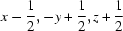
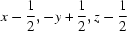
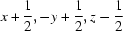
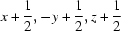
| Symmetry codes: (i) x−1/2, −y+1/2, z+1/2; (ii) x−1/2, −y+1/2, z−1/2; (iii) x+1/2, −y+1/2, z−1/2; (iv) x+1/2, −y+1/2, z+1/2. |
Experimental details
| Crystal data | |
| Chemical formula | [Cu(C2H3O2)2(C6H16N2)] |
| Mr | 297.84 |
| Crystal system, space group | Monoclinic, P21/n |
| Temperature (K) | 220 |
| a, b, c (Å) | 8.0201 (5), 15.9153 (10), 10.8536 (7) |
| β (°) | 90.910 (3) |
| V (Å3) | 1385.20 (15) |
| Z | 4 |
| Radiation type | Mo Kα |
| µ (mm−1) | 1.58 |
| Crystal size (mm) | 0.21 × 0.19 × 0.15 |
| Data collection | |
| Diffractometer | Nonius KappaCCD area-detector diffractometer |
| Absorption correction | – |
| No. of measured, independent and observed [I > 2σ(I)] reflections | 4704, 2711, 2321 |
| Rint | 0.040 |
| (sin θ/λ)max (Å−1) | 0.617 |
| Refinement | |
| R[F2 > 2σ(F2)], wR(F2), S | 0.040, 0.106, 1.06 |
| No. of reflections | 2711 |
| No. of parameters | 183 |
| H-atom treatment | H-atom parameters constrained |
| Δρmax, Δρmin (e Å−3) | 0.53, −0.45 |
Computer programs: COLLECT (Nonius, 2000), DENZO and SCALEPACK (Otwinowski & Minor, 1997), SIR97 (Altomare et al., 1999), SHELXL97 (Sheldrick, 2008), PLATON (Spek, 2003).
| Cu1—O14 | 1.9797 (19) | Cu1—N5 | 2.047 (2) |
| Cu1—O10 | 1.9813 (19) | O10—C11 | 1.280 (4) |
| Cu1—O12 | 2.509 (2) | C11—O12 | 1.241 (3) |
| Cu1—O16 | 2.531 (2) | O14—C15 | 1.278 (4) |
| Cu1—N2 | 2.037 (2) | C15—O16 | 1.243 (4) |
| O14—Cu1—O10 | 92.08 (9) | O14—Cu1—N5 | 92.40 (9) |
| O14—Cu1—N2 | 164.30 (9) | O10—Cu1—N5 | 165.18 (9) |
| O10—Cu1—N2 | 93.12 (9) | N2—Cu1—N5 | 86.30 (9) |
| O14—Cu1—N2—C3 | 71.5 (4) | N5—Cu1—N2—C3 | −14.18 (18) |
| O10—Cu1—N2—C3 | −179.34 (17) |
| D—H···A | D—H | H···A | D···A | D—H···A |
| C3—H3A···O12i | 0.98 | 2.34 | 3.281 (4) | 160 |
| C4—H4A···O16ii | 0.98 | 2.50 | 3.475 (4) | 176 |
| C13—H13C···O16iii | 0.97 | 2.54 | 3.507 (4) | 173 |
| C17—H17C···O12iv | 0.97 | 2.58 | 3.542 (4) | 170 |
| Symmetry codes: (i) x−1/2, −y+1/2, z+1/2; (ii) x−1/2, −y+1/2, z−1/2; (iii) x+1/2, −y+1/2, z−1/2; (iv) x+1/2, −y+1/2, z+1/2. |
Footnotes
‡Present address: Department of Chemistry and Pharmaceutical Sciences, Vrije Universiteit Amsterdam, De Boelelaan 1083, 1081 HV Amsterdam, The Netherlands.
Acknowledgements
A TALENT stipend (JCS) of the Netherlands Organization for Scientific Research (NWO) is gratefully acknowledged. We thank Mr P. Seiler for the single-crystal structure determination.
References
 Altomare, A., Burla, M. C., Camalli, M., Cascarano, G. L., Giacovazzo, C., Guagliardi, A., Moliterni, A. G. G., Polidori, G. & Spagna, R. (1999). J. Appl. Cryst. 32, 115–119. Web of Science CrossRef CAS IUCr Journals Google Scholar
Brown, D. A., Errington, W., Fitzpatrick, N. J., Glass, W. K., Kemp, T. J., Nimir, H. & Ryan, Á. T. (2002). Chem. Commun. pp. 1210–1211. CrossRef Google Scholar
Dalai, S., Sarathi Mukherjee, P., Rogez, G., Mallah, T., Drew, M. G. B. & Ray Chaudhuri, N. (2002). Eur. J. Inorg. Chem. pp. 3292–3297. CrossRef Google Scholar
Devereux, M., O'Shea, D., O'Connor, M., Grehan, H., Connor, G., McCann, M., Rosair, G., Lyng, F., Kellett, A., Walsh, M., Egan, D. & Thati, B. (2007). Polyhedron, 26, 4073–4084. Web of Science CSD CrossRef CAS Google Scholar
Gerdes, G. (2004). PhD thesis, ETH Zürich, Switzerland. Google Scholar
Gerdes, G. & Chen, P. (2004). Organometallics, 23, 3031–3036. Web of Science CrossRef CAS Google Scholar
Margraf, G., Bats, J. W., Wagner, M. & Lerner, H.-W. (2005). Inorg. Chim. Acta, 358, 1193–1203. Web of Science CSD CrossRef CAS Google Scholar
Nonius (2000). COLLECT. Nonius BV, Delft, The Netherlands. Google Scholar
Otwinowski, Z. & Minor, W. (1997). Methods in Enzymology, Vol. 276, Macromolecular Crystallography, Part A, edited by C. W. Carter Jr & R. M. Sweet, pp. 307–326. New York: Academic Press. Google Scholar
Sheldrick, G. M. (2008). Acta Cryst. A64, 112–122. Web of Science CrossRef CAS IUCr Journals Google Scholar
Slootweg, J. C. & Chen, P. (2006). Organometallics, 25, 5863–5869. Web of Science CSD CrossRef CAS Google Scholar
Spek, A. L. (2003). J. Appl. Cryst. 36, 7–13. Web of Science CrossRef CAS IUCr Journals Google Scholar
This is an open-access article distributed under the terms of the Creative Commons Attribution (CC-BY) Licence, which permits unrestricted use, distribution, and reproduction in any medium, provided the original authors and source are cited.
| CRYSTALLOGRAPHIC COMMUNICATIONS |


The aspiration of our work is to gain insight into the underlying mechanisms of the catalytic transformations of hydrocarbons by C—H bond activation (Slootweg & Chen, 2006; Gerdes & Chen, 2004) and subsequent oxidative coupling using heterobimetallic catalysis (Gerdes, 2004). Well defined platinum or palladium catalysts are suited for the C—H activation, whearas a copper-catalyzed coupling cycle is ideal for the C—X bond forming step. The intersection of the two cycles, that is transmetallation of the hydrocarbon group from platinum/palladium to copper, is poorly understood while being decisive for the outcome of the reaction. To connect two different catalyticallly active metal fragments, bridging acetate ligands are ideally suited (Gerdes, 2004) and therefore deserve our current attention. The title complex, [(TMEDA)Cu(OAc)2] (TMEDA = tetramethylethane-1,2-diamine), is a promising building block for the generation of the mixed [(TMEDA)Cu(κ1-acetate)(µ-acetate)MLn] complexes.
In the mononuclear title complex, the copper(II) atom is in a distorted, square-planar coordination geometry (Fig. 1, Table 1) and bonded to the bidentate tetramethylethane-1,2-diamine ligand [Cu—N 2.037 (2), 2.047 (2) Å] and to the two acetate anions (Dalai et al., 2002; Margraf et al., 2005). The acetato groups in [(TMEDA)Cu(OAc)2] are mono-coordinating [Cu—O 1.979 (2), 1.9810 (19) Å] (Devereux et al., 2007), but the second oxygen atom of each ligand shows an additional weak interaction with the copper atom [Cu—O 2.509 (2), 2.531 (2) Å], and could be considered to complete a distorted octahedral geometry (Dalai et al., 2002). A similar situation is observed for the zinc analogue, [(TMEDA)Zn(OAc)2], which displays more pronounced κ2-coordination of the acetates [Zn—O 2.052 (2), 2.353 (4) Å] (Brown et al., 2002).
The molecules in the crystal are connected via hydrogen bonding. There are four short intermolecular C—H···O contacts with O···H distances between 2.34 and 2.58 Å and C—H···O angles between 160 and 176° (Table 2).