 | Acta Crystallographica Section E Acta Crystallographica Section E CRYSTALLOGRAPHIC COMMUNICATIONS |


 journal menu


organic compounds
| CRYSTALLOGRAPHIC COMMUNICATIONS |
 access
Benzylethyldimethylammonium bromide

aFaculty of Chemistry, Jagiellonian University, Ingardena 3, 30-060 Kraków, Poland
*Correspondence e-mail: [email protected]
The of the title compound, C11H18N+·Br−, has been determined as part of an ongoing study of the influence of the alkyl chain length on amphiphilic activity of quaternary ammonium salts. The title salt forms a three-dimensional network of ionic contacts through weak C—H⋯Br hydrogen bonds, with donor–acceptor distances in the range 3.757 (2)–3.959 (2) Å, in which methyl groups serve as donors.
Related literature
For related literature, see: Ogawa & Kuroda (1997![[Ogawa, M. & Kuroda, K. (1997). Bull. Chem. Soc. Jpn, 70, 2593-2618.]](../../../../../../logos/arrows/e_arr.gif "Ogawa, M. & Kuroda, K. (1997). Bull. Chem. Soc. Jpn, 70, 2593-2618.") ); Hodorowicz et al. (2003, 2005); Kwolek et al. (2003); Allen et al. (1987).
); Hodorowicz et al. (2003, 2005); Kwolek et al. (2003); Allen et al. (1987).
![[Scheme 1]](cf2179scheme1.gif)
Experimental
Crystal data
|
|
 ; (ii)
  .
. Data collection: COLLECT (Nonius, 2000); cell refinement: SCALEPACK (Otwinowski & Minor, 1997); data reduction: DENZO (Otwinowski & Minor, 1997) and SCALEPACK; program(s) used to solve structure: SIR92 (Altomare et al., 1994); program(s) used to refine structure: SHELXL97 (Sheldrick, 2008); molecular graphics: ORTEP-3 for Windows (Farrugia, 1997) and DIAMOND (Brandenburg, 2006); software used to prepare material for publication: SHELXL97.
Supporting information
contains datablocks I, global. DOI: 10.1107/S1600536808002481/cf2179sup1.cif
Structure factors: contains datablock I. DOI: 10.1107/S1600536808002481/cf2179Isup2.hkl
The title compound was prepared by dissolving a 1:1 mixture of bromoethane and N,N-dimethylbenzylamine in acetone at 273 K. The solution was slowly heated to room temperature to give colourless single crystals of the title compound. Recrystallization from acetone afforded crystals suitable for X-ray measurements.
All hydrogen atom positions were observed in a difference Fourier map. Nevertheless, in the procedure the hydrogen atoms were positioned geometrically and refined using a riding model, with C—H = C—H = 0.97 Å for CH2 groups, 0.96 Å for CH3 groups, and 0.93 Å for aromatic CH, and with Uiso(H) = 1.5Ueq(C) for methyl groups and Uiso(H) = 1.2Ueq(C) for all other H atoms.
Data collection: COLLECT (Nonius, 2000); cell SCALEPACK (Otwinowski & Minor, 1997); data reduction: DENZO (Otwinowski & Minor, 1997) and SCALEPACK; program(s) used to solve structure: SIR92 (Altomare et al., 1994); program(s) used to refine structure: SHELXL97 (Sheldrick, 2008); molecular graphics: ORTEP-3 for Windows (Farrugia, 1997) and DIAMOND (Brandenburg, 2006); software used to prepare material for publication: SHELXL97 (Sheldrick, 2008).
![[Figure 1]](./cf2179fig1thm.gif) | Fig. 1. ORTEP-3 (Farrugia, 1997) drawing of the with atom labels. Displacement ellipsoids of non-H atoms are drawn at the 30% probabilty level. |
![[Figure 2]](./cf2179fig2thm.gif) | Fig. 2. Chain of benzyldimethylethylammonium cations along [100] projected onto (010). The chain is formed due to C—H···π interactions (ORTEP-3; Farrugia, 1997). |
![[Figure 3]](./cf2179fig3thm.gif) | Fig. 3. Layers parallel to (010) and built of the ammonium cations, arranged in a zig—zag 'head-to-tail' system, are joined together through Br counterions. View along [100] (ORTEP-3; Farrugia, 1997). |
![[Figure 4]](./cf2179fig4thm.gif) | Fig. 4. The sequence of the cationic and anionic layers along [010] in projecton onto (100) (DIAMOND; Brandenburg, 2006). |
| C11H18N+·Br− | F(000) = 504 |
| Mr = 244.17 | Dx = 1.364 Mg m−3 |
| Orthorhombic, P212121 | Mo Kα radiation, λ = 0.71073 Å |
| Hall symbol: P 2ac 2ab | Cell parameters from 2258 reflections |
| a = 6.7765 (1) Å | θ = 1.0–31.5° |
| b = 12.5827 (2) Å | µ = 3.42 mm−1 |
| c = 13.9433 (2) Å | T = 293 K |
| V = 1188.90 (3) Å3 | Prism, colourless |
| Z = 4 | 0.20 × 0.19 × 0.17 mm |
| Nonius KappaCCD diffractometer | 3874 independent reflections |
| Radiation source: fine-focus sealed tube | 3483 reflections with I > 2σ(I) |
| Horizontally mounted graphite crystal monochromator | Rint = 0.041 |
| Detector resolution: 9 pixels mm-1 | θmax = 31.5°, θmin = 2.9° |
| ϕ and ω scans | h = 0→9 |
| Absorption correction: multi-scan (DENZO and SCALEPACK Otwinowski & Minor, 1997) | k = 0→18 |
| Tmin = 0.548, Tmax = 0.594 | l = −20→20 |
| 18366 measured reflections |
| Refinement on F2 | Hydrogen site location: inferred from neighbouring sites |
| Least-squares matrix: full | H-atom parameters constrained |
| R[F2 > 2σ(F2)] = 0.027 | w = 1/[σ2(Fo2) + (0.0247P)2 + 0.2756P] where P = (Fo2 + 2Fc2)/3 |
| wR(F2) = 0.065 | (Δ/σ)max = 0.001 |
| S = 1.07 | Δρmax = 0.26 e Å−3 |
| 3874 reflections | Δρmin = −0.49 e Å−3 |
| 119 parameters | Extinction correction: SHELXL97 (Sheldrick, 2008), Fc*=kFc[1+0.001xFc2λ3/sin(2θ)]-1/4 |
| 0 restraints | Extinction coefficient: 0.045 (2) |
| Primary atom site location: structure-invariant direct methods | Absolute structure: Flack (1983), 1627 Friedel pairs |
| Secondary atom site location: difference Fourier map | Absolute structure parameter: 0.002 (9) |
| C11H18N+·Br− | V = 1188.90 (3) Å3 |
| Mr = 244.17 | Z = 4 |
| Orthorhombic, P212121 | Mo Kα radiation |
| a = 6.7765 (1) Å | µ = 3.42 mm−1 |
| b = 12.5827 (2) Å | T = 293 K |
| c = 13.9433 (2) Å | 0.20 × 0.19 × 0.17 mm |
| Nonius KappaCCD diffractometer | 3874 independent reflections |
| Absorption correction: multi-scan (DENZO and SCALEPACK Otwinowski & Minor, 1997) | 3483 reflections with I > 2σ(I) |
| Tmin = 0.548, Tmax = 0.594 | Rint = 0.041 |
| 18366 measured reflections |
| R[F2 > 2σ(F2)] = 0.027 | H-atom parameters constrained |
| wR(F2) = 0.065 | Δρmax = 0.26 e Å−3 |
| S = 1.07 | Δρmin = −0.49 e Å−3 |
| 3874 reflections | Absolute structure: Flack (1983), 1627 Friedel pairs |
| 119 parameters | Absolute structure parameter: 0.002 (9) |
| 0 restraints |
Geometry. All e.s.d.'s (except the e.s.d. in the dihedral angle between two l.s. planes) are estimated using the full covariance matrix. The cell e.s.d.'s are taken into account individually in the estimation of e.s.d.'s in distances, angles and torsion angles; correlations between e.s.d.'s in cell parameters are only used when they are defined by crystal symmetry. An approximate (isotropic) treatment of cell e.s.d.'s is used for estimating e.s.d.'s involving l.s. planes. |
Refinement. Refinement of F2 against ALL reflections. The weighted R-factor wR and goodness of fit S are based on F2, conventional R-factors R are based on F, with F set to zero for negative F2. The threshold expression of F2 > σ(F2) is used only for calculating R-factors(gt) etc. and is not relevant to the choice of reflections for refinement. R-factors based on F2 are statistically about twice as large as those based on F, and R- factors based on ALL data will be even larger. |
| x | y | z | Uiso*/Ueq | ||
| Br1 | 0.29436 (3) | 1.294368 (16) | 0.812541 (14) | 0.05290 (8) | |
| N1 | 0.7787 (2) | 1.06178 (12) | 0.85616 (10) | 0.0397 (3) | |
| C1 | 0.8014 (4) | 1.15508 (19) | 0.92125 (17) | 0.0613 (5) | |
| H1A | 0.7328 | 1.2150 | 0.8947 | 0.074* | |
| H1B | 0.9389 | 1.1720 | 0.9279 | 0.074* | |
| H1C | 0.7471 | 1.1383 | 0.9830 | 0.074* | |
| C2 | 0.8857 (3) | 0.9680 (2) | 0.89734 (18) | 0.0578 (5) | |
| H2A | 0.8706 | 0.9081 | 0.8554 | 0.069* | |
| H2B | 0.8317 | 0.9512 | 0.9591 | 0.069* | |
| H2C | 1.0232 | 0.9848 | 0.9039 | 0.069* | |
| C31 | 0.7883 (5) | 1.1763 (3) | 0.70577 (19) | 0.0808 (8) | |
| H31A | 0.8569 | 1.1845 | 0.6460 | 0.097* | |
| H31B | 0.8025 | 1.2399 | 0.7432 | 0.097* | |
| H31C | 0.6509 | 1.1635 | 0.6936 | 0.097* | |
| C3 | 0.8734 (3) | 1.08411 (19) | 0.75980 (15) | 0.0526 (5) | |
| H3A | 1.0130 | 1.0972 | 0.7698 | 0.063* | |
| H3B | 0.8617 | 1.0210 | 0.7203 | 0.063* | |
| C4 | 0.5616 (2) | 1.03466 (14) | 0.84108 (12) | 0.0373 (3) | |
| H4A | 0.4933 | 1.0982 | 0.8197 | 0.045* | |
| H4B | 0.5518 | 0.9824 | 0.7902 | 0.045* | |
| C41 | 0.4578 (2) | 0.99204 (13) | 0.92838 (12) | 0.0368 (3) | |
| C42 | 0.3755 (3) | 1.05941 (16) | 0.99624 (14) | 0.0483 (4) | |
| H42 | 0.3879 | 1.1326 | 0.9892 | 0.058* | |
| C43 | 0.2748 (4) | 1.0181 (2) | 1.07459 (15) | 0.0617 (5) | |
| H43 | 0.2222 | 1.0636 | 1.1205 | 0.074* | |
| C44 | 0.2528 (3) | 0.9094 (2) | 1.08438 (16) | 0.0645 (6) | |
| H44 | 0.1860 | 0.8817 | 1.1370 | 0.077* | |
| C45 | 0.3293 (4) | 0.84284 (19) | 1.01657 (18) | 0.0619 (6) | |
| H45 | 0.3126 | 0.7698 | 1.0229 | 0.074* | |
| C46 | 0.4319 (3) | 0.88285 (15) | 0.93829 (16) | 0.0477 (4) | |
| H46 | 0.4832 | 0.8367 | 0.8925 | 0.057* |
| U11 | U22 | U33 | U12 | U13 | U23 | |
| Br1 | 0.06094 (12) | 0.04546 (10) | 0.05230 (11) | 0.00357 (9) | 0.00416 (9) | 0.00747 (8) |
| N1 | 0.0369 (6) | 0.0416 (7) | 0.0405 (6) | −0.0039 (6) | −0.0001 (6) | −0.0024 (5) |
| C1 | 0.0611 (12) | 0.0599 (12) | 0.0629 (12) | −0.0199 (11) | 0.0056 (12) | −0.0207 (10) |
| C2 | 0.0422 (9) | 0.0646 (13) | 0.0667 (13) | 0.0038 (9) | −0.0115 (9) | 0.0112 (10) |
| C31 | 0.0638 (13) | 0.106 (2) | 0.0727 (15) | 0.0084 (16) | 0.0168 (13) | 0.0409 (14) |
| C3 | 0.0452 (9) | 0.0642 (12) | 0.0482 (10) | −0.0012 (9) | 0.0100 (8) | 0.0015 (9) |
| C4 | 0.0357 (7) | 0.0384 (8) | 0.0378 (7) | −0.0008 (6) | −0.0014 (6) | 0.0000 (6) |
| C41 | 0.0356 (7) | 0.0363 (8) | 0.0386 (7) | −0.0027 (6) | −0.0026 (6) | 0.0018 (6) |
| C42 | 0.0509 (9) | 0.0470 (10) | 0.0470 (9) | −0.0018 (8) | 0.0061 (8) | −0.0034 (8) |
| C43 | 0.0592 (11) | 0.0815 (15) | 0.0444 (9) | −0.0056 (12) | 0.0091 (10) | −0.0051 (10) |
| C44 | 0.0544 (13) | 0.0901 (17) | 0.0489 (10) | −0.0140 (11) | −0.0012 (8) | 0.0251 (11) |
| C45 | 0.0603 (13) | 0.0531 (11) | 0.0722 (14) | −0.0119 (10) | −0.0057 (11) | 0.0228 (10) |
| C46 | 0.0484 (9) | 0.0363 (8) | 0.0584 (10) | −0.0033 (7) | −0.0020 (9) | 0.0034 (8) |
| Br1—N1 | 4.4393 (16) | C3—H3B | 0.970 |
| N1—C1 | 1.492 (2) | C4—C41 | 1.505 (2) |
| N1—C2 | 1.499 (3) | C4—H4A | 0.970 |
| N1—C3 | 1.515 (2) | C4—H4B | 0.970 |
| N1—C4 | 1.525 (2) | C41—C42 | 1.387 (3) |
| C1—H1A | 0.960 | C41—C46 | 1.392 (2) |
| C1—H1B | 0.960 | C42—C43 | 1.389 (3) |
| C1—H1C | 0.960 | C42—H42 | 0.930 |
| C2—H2A | 0.960 | C43—C44 | 1.382 (4) |
| C2—H2B | 0.960 | C43—H43 | 0.930 |
| C2—H2C | 0.960 | C44—C45 | 1.365 (4) |
| C31—C3 | 1.498 (3) | C44—H44 | 0.930 |
| C31—H31A | 0.960 | C45—C46 | 1.388 (3) |
| C31—H31B | 0.960 | C45—H45 | 0.930 |
| C31—H31C | 0.960 | C46—H46 | 0.930 |
| C3—H3A | 0.970 | ||
| C1—N1—C2 | 109.66 (17) | C31—C3—H3A | 108.5 |
| C1—N1—C3 | 110.47 (16) | N1—C3—H3A | 108.5 |
| C2—N1—C3 | 106.30 (16) | C31—C3—H3B | 108.5 |
| C1—N1—C4 | 111.07 (16) | N1—C3—H3B | 108.5 |
| C2—N1—C4 | 110.08 (15) | H3A—C3—H3B | 107.5 |
| C3—N1—C4 | 109.15 (14) | C41—C4—N1 | 114.79 (13) |
| C1—N1—Br1 | 68.95 (13) | C41—C4—H4A | 108.6 |
| C2—N1—Br1 | 158.26 (12) | N1—C4—H4A | 108.6 |
| C3—N1—Br1 | 93.99 (11) | C41—C4—H4B | 108.6 |
| C4—N1—Br1 | 54.22 (8) | N1—C4—H4B | 108.6 |
| N1—C1—H1A | 109.5 | H4A—C4—H4B | 107.5 |
| N1—C1—H1B | 109.5 | C42—C41—C46 | 119.00 (18) |
| H1A—C1—H1B | 109.5 | C42—C41—C4 | 121.45 (15) |
| N1—C1—H1C | 109.5 | C46—C41—C4 | 119.40 (16) |
| H1A—C1—H1C | 109.5 | C41—C42—C43 | 120.3 (2) |
| H1B—C1—H1C | 109.5 | C41—C42—H42 | 119.8 |
| N1—C2—H2A | 109.5 | C43—C42—H42 | 119.8 |
| N1—C2—H2B | 109.5 | C44—C43—C42 | 120.1 (2) |
| H2A—C2—H2B | 109.5 | C44—C43—H43 | 120.0 |
| N1—C2—H2C | 109.5 | C42—C43—H43 | 120.0 |
| H2A—C2—H2C | 109.5 | C45—C44—C43 | 119.8 (2) |
| H2B—C2—H2C | 109.5 | C45—C44—H44 | 120.1 |
| C3—C31—H31A | 109.5 | C43—C44—H44 | 120.1 |
| C3—C31—H31B | 109.5 | C44—C45—C46 | 120.8 (2) |
| H31A—C31—H31B | 109.5 | C44—C45—H45 | 119.6 |
| C3—C31—H31C | 109.5 | C46—C45—H45 | 119.6 |
| H31A—C31—H31C | 109.5 | C45—C46—C41 | 119.9 (2) |
| H31B—C31—H31C | 109.5 | C45—C46—H46 | 120.0 |
| C31—C3—N1 | 115.22 (18) | C41—C46—H46 | 120.0 |
| C1—N1—C3—C31 | −60.9 (3) | N1—C4—C41—C46 | −98.94 (19) |
| C2—N1—C3—C31 | −179.8 (2) | C46—C41—C42—C43 | 2.2 (3) |
| C4—N1—C3—C31 | 61.5 (2) | C4—C41—C42—C43 | 177.88 (19) |
| Br1—N1—C3—C31 | 8.1 (2) | C41—C42—C43—C44 | −1.2 (3) |
| C1—N1—C4—C41 | −68.2 (2) | C42—C43—C44—C45 | −0.4 (4) |
| C2—N1—C4—C41 | 53.4 (2) | C43—C44—C45—C46 | 0.9 (4) |
| C3—N1—C4—C41 | 169.73 (15) | C44—C45—C46—C41 | 0.1 (3) |
| Br1—N1—C4—C41 | −109.45 (15) | C42—C41—C46—C45 | −1.6 (3) |
| N1—C4—C41—C42 | 85.4 (2) | C4—C41—C46—C45 | −177.40 (18) |
| D—H···A | D—H | H···A | D···A | D—H···A |
| C1—H1A···Br1 | 0.96 | 3.34 | 4.144 (3) | 143 |
| C4—H4A···Br1 | 0.97 | 2.81 | 3.757 (2) | 164 |
| C42—H42···Br1 | 0.93 | 3.26 | 3.950 (2) | 132 |
| C31—H31C···Br1 | 0.96 | 3.36 | 3.953 (3) | 122 |
| C2—H2A···Br1i | 0.96 | 2.96 | 3.850 (3) | 154 |
| C4—H4B···Br1i | 0.97 | 2.96 | 3.832 (2) | 151 |
| C3—H3B···Br1i | 0.97 | 3.08 | 3.950 (2) | 151 |
| C3—H3A···Br1ii | 0.97 | 3.19 | 3.959 (2) | 138 |
| C1—H1C···Br1iii | 0.96 | 2.99 | 3.766 (2) | 139 |
| C2—H2C···Cg1ii | 0.96 | 2.69 | 3.526 | 145 |
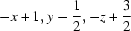
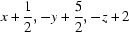
| Symmetry codes: (i) −x+1, y−1/2, −z+3/2; (ii) x+1, y, z; (iii) x+1/2, −y+5/2, −z+2. |
Experimental details
| Crystal data | |
| Chemical formula | C11H18N+·Br− |
| Mr | 244.17 |
| Crystal system, space group | Orthorhombic, P212121 |
| Temperature (K) | 293 |
| a, b, c (Å) | 6.7765 (1), 12.5827 (2), 13.9433 (2) |
| V (Å3) | 1188.90 (3) |
| Z | 4 |
| Radiation type | Mo Kα |
| µ (mm−1) | 3.42 |
| Crystal size (mm) | 0.20 × 0.19 × 0.17 |
| Data collection | |
| Diffractometer | Nonius KappaCCD diffractometer |
| Absorption correction | Multi-scan (DENZO and SCALEPACK Otwinowski & Minor, 1997) |
| Tmin, Tmax | 0.548, 0.594 |
| No. of measured, independent and observed [I > 2σ(I)] reflections | 18366, 3874, 3483 |
| Rint | 0.041 |
| (sin θ/λ)max (Å−1) | 0.735 |
| Refinement | |
| R[F2 > 2σ(F2)], wR(F2), S | 0.027, 0.065, 1.07 |
| No. of reflections | 3874 |
| No. of parameters | 119 |
| H-atom treatment | H-atom parameters constrained |
| Δρmax, Δρmin (e Å−3) | 0.26, −0.49 |
| Absolute structure | Flack (1983), 1627 Friedel pairs |
| Absolute structure parameter | 0.002 (9) |
Computer programs: COLLECT (Nonius, 2000), SCALEPACK (Otwinowski & Minor, 1997), DENZO (Otwinowski & Minor, 1997) and SCALEPACK, SIR92 (Altomare et al., 1994), SHELXL97 (Sheldrick, 2008), ORTEP-3 for Windows (Farrugia, 1997) and DIAMOND (Brandenburg, 2006).
| D—H···A | D—H | H···A | D···A | D—H···A |
| C4—H4A···Br1 | 0.97 | 2.81 | 3.757 (2) | 164 |
| C2—H2A···Br1i | 0.96 | 2.96 | 3.850 (3) | 154 |
| C4—H4B···Br1i | 0.97 | 2.96 | 3.832 (2) | 151 |
| C3—H3B···Br1i | 0.97 | 3.08 | 3.950 (2) | 151 |
| C3—H3A···Br1ii | 0.97 | 3.19 | 3.959 (2) | 138 |
| C1—H1C···Br1iii | 0.96 | 2.99 | 3.766 (2) | 139 |
| C2—H2C···Cg1ii | 0.96 | 2.69 | 3.526 | 145 |
| Symmetry codes: (i) −x+1, y−1/2, −z+3/2; (ii) x+1, y, z; (iii) x+1/2, −y+5/2, −z+2. |
Acknowledgements
The authors thank the Joint X-ray Laboratory, Faculty of Chemistry, and SLAFiBS, Jagiellonian University, for making the Nonius KappaCCD diffractometer available.
References
 Allen, F. H., Kennard, O., Watson, D. G., Brammer, L., Orpen, A. G. & Taylor, R. (1987). J. Chem. Soc. Perkin Trans. 2, pp. S1–19. CrossRef Web of Science Google Scholar
Altomare, A., Cascarano, G., Giacovazzo, C., Guagliardi, A., Burla, M. C., Polidori, G. & Camalli, M. (1994). J. Appl. Cryst. 27, 435–436. CrossRef Web of Science IUCr Journals Google Scholar
Brandenburg, K. (2006). DIAMOND. Version 3.1d. Crystal Impact GbR, Bonn, Germany. Google Scholar
Farrugia, L. J. (1997). J. Appl. Cryst. 30, 565. CrossRef IUCr Journals Google Scholar
Flack, H. D. (1983). Acta Cryst. A39, 876–881. CrossRef CAS Web of Science IUCr Journals Google Scholar
Hodorowicz, M. A., Czapkiewicz, J. & Stadnicka, K. (2003). Acta Cryst. C59, o547–o549. Web of Science CSD CrossRef CAS IUCr Journals Google Scholar
Hodorowicz, M., Stadnicka, K. & Czapkiewicz, J. (2005). J. Colloid Interface Sci. 290, 76–82. Web of Science CSD CrossRef PubMed CAS Google Scholar
Kwolek, T., Hodorowicz, M., Stadnicka, K. & Czapkiewicz, J. (2003). J. Colloid Interface Sci. 264, 14–19. Web of Science CrossRef PubMed CAS Google Scholar
Nonius (2000). COLLECT. Nonius BV, Delft, The Netherlands. Google Scholar
Ogawa, M. & Kuroda, K. (1997). Bull. Chem. Soc. Jpn, 70, 2593–2618. Web of Science CrossRef CAS Google Scholar
Otwinowski, Z. & Minor, W. (1997). Methods in Enzymology, Vol. 276, Macromolecular Crystallography, Part A, edited by C. W. Carter Jr & R. M. Sweet, pp. 307–326. New York: Academic Press. Google Scholar
Sheldrick, G. M. (2008). Acta Cryst. A64, 112–122. Web of Science CrossRef CAS IUCr Journals Google Scholar
This is an open-access article distributed under the terms of the Creative Commons Attribution (CC-BY) Licence, which permits unrestricted use, distribution, and reproduction in any medium, provided the original authors and source are cited.
| CRYSTALLOGRAPHIC COMMUNICATIONS |


Quaternary alkylammonium salts are widely used to modify natural clay minerals into hydrophobic organo-clays which exhibit high capability to remove hydrophobic contaminants from aqueous solutions (Ogawa & Kuroda, 1997). From the systematic study of the relation between the crystal structures of chosen homologous benzyldimethylalkylammonium bromides and their cations' ability for sorption on clay minerals (Kwolek et al., 2003; Hodorowicz et al., 2003, 2005), it became obvious that the hydrophobic interactions are responsible for an alkyl-chain bilayer formation when the long-chain (n = 8–12) ammonium cations are adsorbed on montmorillonite (Hodorowicz et al., 2005), whereas a different way of cation packing seems to dominate in the case of short-chain ammonium cations (Kwolek et al., 2003). The crystal structure analysis of benzyldimethylethylammonium bromide was performed to find out the influence of molecular geometry, and the length of the alkyl chain in particular, on the packing properties of the ammonium cations. The structure of the title compound is shown in Fig. 1. The asymmetric unit is composed of a quaternary ammonium cation and a bromide counterion (N+···Br- = 4.439 (2) Å). The bond lengths and angles indicate the typical tetrahedral arragement of the substituents at the N atom. The molecular dimensions are comparable with the values reported in the literature (Allen et al., 1987). Methyl and methylene groups of the quaternary ammonium cation as well as C—H of the benzene ring are involved in weak intermolecular interactions of the C—H···Br- type (Table 1). There are also relatively strong interactions of the C—H···π type observed between the C2 methyl group and the π system of the benzene ring, which result in cation chains along [100] (Fig. 2). The chains are joined into layers parallel to (010) due to C—H···Br- interactions (Fig. 3). The interactions are also responsible for packing of the layers along [010], as shown in Fig. 4. Each layer consists of cations inclined to the anionic layer and arranged in a zig—zag 'head-to-tail' system. The thickness of the layer is b/2. The observed architecture of the short-chain ammonium cation layers, best seen in Figs. 3 and 4, could be considered as a model for the organic cation layers intercalated into the montmorillonite structure (Kwolek et al., 2003).