 | Acta Crystallographica Section E Acta Crystallographica Section E CRYSTALLOGRAPHIC COMMUNICATIONS |


 journal menu


metal-organic compounds
| CRYSTALLOGRAPHIC COMMUNICATIONS |
 access
Dichloridobis[3-methyl-4-phenyl-5-(2-pyridyl)-4H-1,2,4-triazole-κ2N1,N5]copper(II) 3.33-hydrate

aOrdered Matter Science Research Center, Southeast University, Nanjing 210096, People's Republic of China
*Correspondence e-mail: [email protected]
In the title compound, [CuCl2(C14H12N4)2]·3.33H2O, the Cu(II) atom is coordinated by two chelating 3-methyl-4-phenyl-5-(2-pyridyl)-1,2,4-triazole ligands and two chloride anions in a distorted octahedral geometry with a CuN2N′2Cl2 chromophore. The Cu atom is located on an inversion center. Two uncoordinated water molecules lie on threefold rotation axes with disordered H atoms. Two hydrogen bonds are formed between the water molecules, and another between water and a chlorido ligand.
Related literature
For related literature, see: Bencini et al. (1987![[Bencini, A., Gatteschi, D., Zanchini, C., Haasnoot, J. G., Prins, R. & Reedijk, J. (1987). J. Am. Chem. Soc. 109, 2926-2931.]](../../../../../../logos/arrows/e_arr.gif "Bencini, A., Gatteschi, D., Zanchini, C., Haasnoot, J. G., Prins, R. & Reedijk, J. (1987). J. Am. Chem. Soc. 109, 2926-2931.") ); Koningsbruggen et al. (1995); Moliner et al. (1998, 2001); Klingele & Brooker (2003); Klingele et al. (2005); Garcia et al. (1997); Lavrenova & Larionov (1998); Kahn & Martinez (1998); Koningsbruggen (2004); Matouzenko et al. (2004); Wang et al. (2005); Zhou et al. (2006a,b).
); Koningsbruggen et al. (1995); Moliner et al. (1998, 2001); Klingele & Brooker (2003); Klingele et al. (2005); Garcia et al. (1997); Lavrenova & Larionov (1998); Kahn & Martinez (1998); Koningsbruggen (2004); Matouzenko et al. (2004); Wang et al. (2005); Zhou et al. (2006a,b).
![[Scheme 1]](cf2182scheme1.gif)
Experimental
Crystal data
|

Refinement
|
| |||||||||||||||||||||||||
| |||||||||||||||||||||||||||
 .
. Data collection: SMART (Bruker, 2000); cell refinement: SAINT (Bruker, 2000); data reduction: SAINT; program(s) used to solve structure: SHELXTL (Sheldrick, 2008); program(s) used to refine structure: SHELXTL; molecular graphics: SHELXTL; software used to prepare material for publication: SHELXTL.
Supporting information
contains datablocks I, New_Global_Publ_Block. DOI: 10.1107/S1600536808007630/cf2182sup1.cif
Structure factors: contains datablock I. DOI: 10.1107/S1600536808007630/cf2182Isup2.hkl
To a warm solution of 0.944 g 3-methyl-4-phenyl-5-(2-pyridyl)-1,2,4-triazole (4.0 mmol) in 20 ml e thanol, 0.270 g copper(II) chloride (2.0 mmol) was added. The filtrate was left to stand at room temperature for several days, and blue single crystals suitable for X-ray diffraction were collected.
All H atoms were located in a difference Fourier map and allowed to ride on their parent atoms at distances of 0.93 Å (aromatic), 0.96 Å (methyl) and 0.85 (water), and with Uiso(H) = 1.2Ueq(C) or 1.5Ueq(O). O2 and O3 lie on threefold rotation axes, and accordingly, their H atoms are disordered with a partial occupancy of 1/3 and U values in the range 0.64–0.85 Å2.
Data collection: SMART (Bruker, 2000); cell SAINT (Bruker, 2000); data reduction: SAINT (Bruker, 2000); program(s) used to solve structure: SHELXTL (Sheldrick, 2008); program(s) used to refine structure: SHELXTL (Sheldrick, 2008); molecular graphics: SHELXTL (Sheldrick, 2008); software used to prepare material for publication: SHELXTL (Sheldrick, 2008).
![[Figure 1]](./cf2182fig1thm.gif) | Fig. 1. The molecular structure of the title compound with the atomic labelling. Displacement ellipsoids are shown at the 30% probability level. [Symmetry code i: -x + 1, -y + 2, -z + 2.] |
| [CuCl2(C14H12N4)2]·3.33H2O | F(000) = 3099 |
| Mr = 667.04 | Dx = 1.407 Mg m−3 |
| Rhombohedral, R3 | Mo Kα radiation, λ = 0.71073 Å |
| Hall symbol: -R 3 | Cell parameters from 3501 reflections |
| a = 21.5496 (13) Å | θ = 2.5–23.9° |
| c = 17.619 (2) Å | µ = 0.91 mm−1 |
| α = 90° | T = 293 K |
| γ = 120° | Polyhedron, blue |
| V = 7086.0 (10) Å3 | 0.28 × 0.26 × 0.22 mm |
| Z = 9 |
| Bruker SMART APEX CCD diffractometer | 3091 independent reflections |
| Radiation source: sealed tube | 2155 reflections with I > 2σ(I) |
| Graphite monochromator | Rint = 0.055 |
| ϕ and ω scans | θmax = 26.0°, θmin = 1.9° |
| Absorption correction: multi-scan (SADABS; Bruker, 2000) | h = −26→26 |
| Tmin = 0.78, Tmax = 0.82 | k = −21→26 |
| 12784 measured reflections | l = −21→19 |
| Refinement on F2 | Primary atom site location: structure-invariant direct methods |
| Least-squares matrix: full | Secondary atom site location: difference Fourier map |
| R[F2 > 2σ(F2)] = 0.057 | Hydrogen site location: inferred from neighbouring sites |
| wR(F2) = 0.114 | H-atom parameters constrained |
| S = 1.06 | w = 1/[σ2(Fo2) + (0.05P)2] where P = (Fo2 + 2Fc2)/3 |
| 3091 reflections | (Δ/σ)max < 0.001 |
| 194 parameters | Δρmax = 0.31 e Å−3 |
| 0 restraints | Δρmin = −0.82 e Å−3 |
| [CuCl2(C14H12N4)2]·3.33H2O | V = 7086.0 (10) Å3 |
| Mr = 667.04 | Z = 9 |
| Rhombohedral, R3 | Mo Kα radiation |
| a = 21.5496 (13) Å | µ = 0.91 mm−1 |
| c = 17.619 (2) Å | T = 293 K |
| α = 90° | 0.28 × 0.26 × 0.22 mm |
| γ = 120° |
| Bruker SMART APEX CCD diffractometer | 3091 independent reflections |
| Absorption correction: multi-scan (SADABS; Bruker, 2000) | 2155 reflections with I > 2σ(I) |
| Tmin = 0.78, Tmax = 0.82 | Rint = 0.055 |
| 12784 measured reflections |
| R[F2 > 2σ(F2)] = 0.057 | 0 restraints |
| wR(F2) = 0.114 | H-atom parameters constrained |
| S = 1.06 | Δρmax = 0.31 e Å−3 |
| 3091 reflections | Δρmin = −0.82 e Å−3 |
| 194 parameters |
Geometry. All e.s.d.'s (except the e.s.d. in the dihedral angle between two l.s. planes) are estimated using the full covariance matrix. The cell e.s.d.'s are taken into account individually in the estimation of e.s.d.'s in distances, angles and torsion angles; correlations between e.s.d.'s in cell parameters are only used when they are defined by crystal symmetry. An approximate (isotropic) treatment of cell e.s.d.'s is used for estimating e.s.d.'s involving l.s. planes. |
Refinement. Refinement of F2 against ALL reflections. The weighted R-factor wR and goodness of fit S are based on F2, conventional R-factors R are based on F, with F set to zero for negative F2. The threshold expression of F2 > σ(F2) is used only for calculating R-factors(gt) etc. and is not relevant to the choice of reflections for refinement. R-factors based on F2 are statistically about twice as large as those based on F, and R- factors based on ALL data will be even larger. |
| x | y | z | Uiso*/Ueq | Occ. (<1) | |
| Cu1 | 0.5000 | 1.0000 | 1.0000 | 0.04781 (19) | |
| C1 | 0.56211 (17) | 0.87212 (17) | 0.88733 (16) | 0.0408 (7) | |
| C2 | 0.54547 (13) | 0.96307 (14) | 0.86885 (15) | 0.0280 (6) | |
| C3 | 0.53495 (14) | 1.02034 (15) | 0.84128 (15) | 0.0292 (6) | |
| C4 | 0.54676 (16) | 1.04762 (16) | 0.76855 (16) | 0.0366 (7) | |
| H4 | 0.5626 | 1.0287 | 0.7307 | 0.044* | |
| C5 | 0.53496 (19) | 1.10252 (19) | 0.75306 (16) | 0.0459 (8) | |
| H5 | 0.5416 | 1.1206 | 0.7040 | 0.055* | |
| C6 | 0.51311 (18) | 1.13172 (19) | 0.80953 (16) | 0.0444 (8) | |
| H6 | 0.5053 | 1.1696 | 0.7995 | 0.053* | |
| C7 | 0.50315 (17) | 1.10251 (16) | 0.88239 (17) | 0.0412 (7) | |
| H7 | 0.4894 | 1.1222 | 0.9214 | 0.049* | |
| C8 | 0.57362 (19) | 0.81162 (17) | 0.87105 (17) | 0.0445 (8) | |
| H8A | 0.6136 | 0.8167 | 0.9001 | 0.067* | |
| H8B | 0.5834 | 0.8112 | 0.8179 | 0.067* | |
| H8C | 0.5314 | 0.7675 | 0.8845 | 0.067* | |
| C9 | 0.56300 (18) | 0.90787 (16) | 0.74991 (16) | 0.0380 (7) | |
| C10 | 0.4997 (2) | 0.86341 (18) | 0.71288 (19) | 0.0504 (8) | |
| H10 | 0.4565 | 0.8395 | 0.7389 | 0.061* | |
| C11 | 0.5032 (2) | 0.8556 (2) | 0.6345 (2) | 0.0574 (9) | |
| H11 | 0.4617 | 0.8262 | 0.6072 | 0.069* | |
| C12 | 0.56770 (19) | 0.89132 (18) | 0.59789 (17) | 0.0458 (8) | |
| H12 | 0.5696 | 0.8859 | 0.5457 | 0.055* | |
| C13 | 0.6281 (2) | 0.9340 (2) | 0.6358 (2) | 0.0563 (9) | |
| H13 | 0.6711 | 0.9579 | 0.6093 | 0.068* | |
| C14 | 0.62835 (19) | 0.94346 (18) | 0.71455 (19) | 0.0509 (8) | |
| H14 | 0.6704 | 0.9722 | 0.7413 | 0.061* | |
| N4 | 0.54193 (13) | 0.94977 (13) | 0.94163 (13) | 0.0361 (6) | |
| N5 | 0.55287 (15) | 0.89213 (14) | 0.95473 (14) | 0.0411 (6) | |
| N6 | 0.55975 (13) | 0.91589 (13) | 0.83203 (13) | 0.0333 (5) | |
| N7 | 0.51276 (12) | 1.04744 (13) | 0.89762 (13) | 0.0356 (6) | |
| Cl1 | 0.37209 (5) | 0.88666 (5) | 0.95079 (5) | 0.0581 (3) | |
| O1 | 0.38596 (12) | 0.77383 (11) | 0.85941 (11) | 0.0424 (5) | |
| H1D | 0.3825 | 0.8054 | 0.8850 | 0.051* | |
| H1A | 0.3444 | 0.7409 | 0.8465 | 0.051* | |
| O2 | 0.3333 | 0.6667 | 0.7377 (2) | 0.0567 (11) | |
| H2A | 0.2895 | 0.6359 | 0.7304 | 0.068* | 0.334 |
| H2B | 0.3504 | 0.6925 | 0.6983 | 0.068* | 0.334 |
| O3 | 0.6667 | 0.3333 | 0.70495 (19) | 0.0428 (9) | |
| H3A | 0.6650 | 0.3103 | 0.6651 | 0.051* | 0.3333 |
| H3C | 0.6474 | 0.3042 | 0.7416 | 0.051* | 0.3333 |
| U11 | U22 | U33 | U12 | U13 | U23 | |
| Cu1 | 0.0484 (3) | 0.0501 (4) | 0.0456 (4) | 0.0251 (3) | 0.0044 (3) | 0.0055 (3) |
| C1 | 0.0531 (19) | 0.0518 (18) | 0.0298 (17) | 0.0356 (16) | 0.0098 (14) | 0.0032 (14) |
| C2 | 0.0275 (14) | 0.0340 (15) | 0.0229 (13) | 0.0158 (12) | 0.0030 (11) | −0.0039 (11) |
| C3 | 0.0295 (14) | 0.0369 (15) | 0.0227 (13) | 0.0178 (12) | 0.0003 (11) | −0.0025 (11) |
| C4 | 0.0469 (17) | 0.0542 (18) | 0.0184 (13) | 0.0326 (15) | −0.0003 (12) | −0.0004 (13) |
| C5 | 0.062 (2) | 0.068 (2) | 0.0205 (14) | 0.0417 (19) | 0.0051 (14) | 0.0132 (15) |
| C6 | 0.064 (2) | 0.062 (2) | 0.0292 (15) | 0.0477 (18) | 0.0059 (15) | 0.0107 (15) |
| C7 | 0.060 (2) | 0.0531 (19) | 0.0302 (15) | 0.0429 (16) | 0.0118 (14) | 0.0119 (14) |
| C8 | 0.065 (2) | 0.052 (2) | 0.0315 (17) | 0.0406 (18) | 0.0071 (15) | 0.0038 (14) |
| C9 | 0.064 (2) | 0.0440 (17) | 0.0176 (14) | 0.0356 (16) | 0.0047 (14) | −0.0010 (12) |
| C10 | 0.064 (2) | 0.053 (2) | 0.0408 (18) | 0.0341 (18) | 0.0118 (17) | 0.0035 (16) |
| C11 | 0.062 (2) | 0.070 (2) | 0.0377 (19) | 0.031 (2) | −0.0055 (18) | −0.0072 (18) |
| C12 | 0.070 (2) | 0.057 (2) | 0.0244 (16) | 0.0420 (19) | 0.0051 (16) | −0.0025 (14) |
| C13 | 0.063 (2) | 0.068 (2) | 0.042 (2) | 0.036 (2) | −0.0001 (18) | 0.0004 (18) |
| C14 | 0.050 (2) | 0.055 (2) | 0.0416 (19) | 0.0214 (17) | −0.0045 (16) | −0.0022 (16) |
| N4 | 0.0456 (14) | 0.0424 (14) | 0.0237 (13) | 0.0245 (12) | 0.0007 (10) | 0.0104 (10) |
| N5 | 0.0589 (17) | 0.0484 (15) | 0.0291 (13) | 0.0367 (14) | 0.0058 (12) | 0.0062 (11) |
| N6 | 0.0484 (15) | 0.0400 (13) | 0.0197 (11) | 0.0282 (12) | 0.0069 (10) | −0.0004 (10) |
| N7 | 0.0401 (13) | 0.0454 (14) | 0.0329 (13) | 0.0303 (12) | −0.0029 (11) | −0.0059 (11) |
| Cl1 | 0.0439 (5) | 0.0671 (6) | 0.0520 (5) | 0.0191 (4) | 0.0020 (4) | 0.0033 (4) |
| O1 | 0.0534 (13) | 0.0488 (13) | 0.0327 (11) | 0.0313 (11) | 0.0046 (10) | 0.0029 (10) |
| O2 | 0.0633 (16) | 0.0633 (16) | 0.043 (3) | 0.0317 (8) | 0.000 | 0.000 |
| O3 | 0.0519 (14) | 0.0519 (14) | 0.0245 (18) | 0.0259 (7) | 0.000 | 0.000 |
| Cu1—N4i | 2.006 (2) | C8—H8A | 0.960 |
| Cu1—N4 | 2.006 (2) | C8—H8B | 0.960 |
| Cu1—N7 | 2.023 (2) | C8—H8C | 0.960 |
| Cu1—N7i | 2.023 (2) | C9—C14 | 1.371 (5) |
| Cu1—Cl1 | 2.7537 (9) | C9—C10 | 1.377 (5) |
| Cu1—Cl1i | 2.7537 (9) | C9—N6 | 1.463 (3) |
| C1—N5 | 1.312 (4) | C10—C11 | 1.398 (5) |
| C1—N6 | 1.375 (4) | C10—H10 | 0.930 |
| C1—C8 | 1.472 (4) | C11—C12 | 1.368 (5) |
| C2—N4 | 1.308 (3) | C11—H11 | 0.930 |
| C2—N6 | 1.365 (3) | C12—C13 | 1.338 (5) |
| C2—C3 | 1.446 (4) | C12—H12 | 0.930 |
| C3—N7 | 1.354 (3) | C13—C14 | 1.402 (5) |
| C3—C4 | 1.380 (4) | C13—H13 | 0.930 |
| C4—C5 | 1.356 (4) | C14—H14 | 0.930 |
| C4—H4 | 0.930 | N4—N5 | 1.395 (3) |
| C5—C6 | 1.380 (4) | O1—H1D | 0.850 |
| C5—H5 | 0.930 | O1—H1A | 0.850 |
| C6—C7 | 1.398 (4) | O2—H2A | 0.850 |
| C6—H6 | 0.930 | O2—H2B | 0.8499 |
| C7—N7 | 1.330 (4) | O3—H3A | 0.850 |
| C7—H7 | 0.930 | O3—H3C | 0.850 |
| N4i—Cu1—N4 | 180.000 (1) | C1—C8—H8B | 109.5 |
| N4i—Cu1—N7 | 99.70 (9) | H8A—C8—H8B | 109.5 |
| N4—Cu1—N7 | 80.30 (9) | C1—C8—H8C | 109.5 |
| N4i—Cu1—N7i | 80.30 (9) | H8A—C8—H8C | 109.5 |
| N4—Cu1—N7i | 99.70 (9) | H8B—C8—H8C | 109.5 |
| N7—Cu1—N7i | 180.000 (1) | C14—C9—C10 | 123.8 (3) |
| N4i—Cu1—Cl1 | 96.83 (8) | C14—C9—N6 | 118.7 (3) |
| N4—Cu1—Cl1 | 83.17 (8) | C10—C9—N6 | 117.5 (3) |
| N7—Cu1—Cl1 | 89.45 (7) | C9—C10—C11 | 117.3 (3) |
| N4i—Cu1—Cl1i | 83.17 (8) | C9—C10—H10 | 121.4 |
| N4—Cu1—Cl1i | 96.83 (8) | C11—C10—H10 | 121.4 |
| N7—Cu1—Cl1i | 90.55 (7) | C12—C11—C10 | 119.9 (3) |
| N7i—Cu1—Cl1i | 89.45 (7) | C12—C11—H11 | 120.1 |
| Cl1—Cu1—Cl1i | 180.00 (4) | C10—C11—H11 | 120.1 |
| N5—C1—N6 | 110.6 (3) | C13—C12—C11 | 121.2 (3) |
| N5—C1—C8 | 126.0 (3) | C13—C12—H12 | 119.4 |
| N6—C1—C8 | 123.4 (3) | C11—C12—H12 | 119.4 |
| N4—C2—N6 | 108.2 (2) | C12—C13—C14 | 121.7 (3) |
| N4—C2—C3 | 120.0 (2) | C12—C13—H13 | 119.2 |
| N6—C2—C3 | 131.8 (2) | C14—C13—H13 | 119.2 |
| N7—C3—C4 | 121.8 (3) | C9—C14—C13 | 116.1 (3) |
| N7—C3—C2 | 111.2 (2) | C9—C14—H14 | 121.9 |
| C4—C3—C2 | 127.0 (2) | C13—C14—H14 | 121.9 |
| C5—C4—C3 | 118.9 (3) | C2—N4—N5 | 109.9 (2) |
| C5—C4—H4 | 120.5 | C2—N4—Cu1 | 112.15 (18) |
| C3—C4—H4 | 120.5 | N5—N4—Cu1 | 135.90 (18) |
| C4—C5—C6 | 120.6 (3) | C1—N5—N4 | 105.3 (2) |
| C4—C5—H5 | 119.7 | C2—N6—C1 | 105.9 (2) |
| C6—C5—H5 | 119.7 | C2—N6—C9 | 126.9 (2) |
| C5—C6—C7 | 117.9 (3) | C1—N6—C9 | 126.8 (2) |
| C5—C6—H6 | 121.1 | C7—N7—C3 | 118.9 (3) |
| C7—C6—H6 | 121.1 | C7—N7—Cu1 | 126.0 (2) |
| N7—C7—C6 | 122.0 (3) | C3—N7—Cu1 | 115.07 (19) |
| N7—C7—H7 | 119.0 | H1D—O1—H1A | 109.5 |
| C6—C7—H7 | 119.0 | H2A—O2—H2B | 109.5 |
| C1—C8—H8A | 109.5 | H3A—O3—H3C | 109.5 |
| Symmetry code: (i) −x+1, −y+2, −z+2. |
| D—H···A | D—H | H···A | D···A | D—H···A |
| O1—H1D···Cl1 | 0.85 | 2.20 | 3.053 (2) | 179 |
| O1—H1A···O2 | 0.85 | 2.43 | 2.932 (3) | 119 |
| O2—H2B···O2ii | 0.85 | 1.88 | 2.505 (8) | 130 |
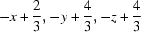
| Symmetry code: (ii) −x+2/3, −y+4/3, −z+4/3. |
Experimental details
| Crystal data | |
| Chemical formula | [CuCl2(C14H12N4)2]·3.33H2O |
| Mr | 667.04 |
| Crystal system, space group | Rhombohedral, R3 |
| Temperature (K) | 293 |
| a, c (Å) | 21.5496 (13), 17.619 (2) |
| V (Å3) | 7086.0 (10) |
| Z | 9 |
| Radiation type | Mo Kα |
| µ (mm−1) | 0.91 |
| Crystal size (mm) | 0.28 × 0.26 × 0.22 |
| Data collection | |
| Diffractometer | Bruker SMART APEX CCD diffractometer |
| Absorption correction | Multi-scan (SADABS; Bruker, 2000) |
| Tmin, Tmax | 0.78, 0.82 |
| No. of measured, independent and observed [I > 2σ(I)] reflections | 12784, 3091, 2155 |
| Rint | 0.055 |
| (sin θ/λ)max (Å−1) | 0.617 |
| Refinement | |
| R[F2 > 2σ(F2)], wR(F2), S | 0.057, 0.114, 1.06 |
| No. of reflections | 3091 |
| No. of parameters | 194 |
| H-atom treatment | H-atom parameters constrained |
| Δρmax, Δρmin (e Å−3) | 0.31, −0.82 |
Computer programs: SMART (Bruker, 2000), SAINT (Bruker, 2000), SHELXTL (Sheldrick, 2008).
| Cu1—N4 | 2.006 (2) | Cu1—Cl1 | 2.7537 (9) |
| Cu1—N7 | 2.023 (2) | ||
| N4i—Cu1—N7 | 99.70 (9) | N4—Cu1—Cl1 | 83.17 (8) |
| N4—Cu1—N7 | 80.30 (9) | N7—Cu1—Cl1 | 89.45 (7) |
| N4i—Cu1—Cl1 | 96.83 (8) | N7—Cu1—Cl1i | 90.55 (7) |
| Symmetry code: (i) −x+1, −y+2, −z+2. |
| D—H···A | D—H | H···A | D···A | D—H···A |
| O1—H1D···Cl1 | 0.85 | 2.20 | 3.053 (2) | 179.3 |
| O1—H1A···O2 | 0.85 | 2.43 | 2.932 (3) | 118.5 |
| O2—H2B···O2ii | 0.85 | 1.88 | 2.505 (8) | 129.6 |
| Symmetry code: (ii) −x+2/3, −y+4/3, −z+4/3. |
Acknowledgements
We are grateful to Jingye Pharmochemical Pilot Plant for financial assistance though project 8507041056.
References
 Bencini, A., Gatteschi, D., Zanchini, C., Haasnoot, J. G., Prins, R. & Reedijk, J. (1987). J. Am. Chem. Soc. 109, 2926–2931. CrossRef CAS Web of Science Google Scholar
Bruker (2000). SMART, SAINT and SADABS. Bruker AXS Inc., Madison, Wisconsin, USA. Google Scholar
Garcia, Y., Koningsbruggen, P. J., Codjovi, E., Lapouyade, R., Kahn, O. & Rabardel, L. (1997). J. Mater. Chem. 7, 857–858. CrossRef CAS Web of Science Google Scholar
Kahn, O. & Martinez, C. J. (1998). Science, 279, 44–48. Web of Science CrossRef CAS Google Scholar
Klingele, M. H., Boyd, P. D. W., Moubaraki, B., Murray, K. S. & Brooker, S. (2005). Eur. J. Inorg. Chem. pp. 910–918. Web of Science CSD CrossRef Google Scholar
Klingele, M. H. & Brooker, S. (2003). Coord. Chem. Rev. 241, 119–132. Web of Science CrossRef CAS Google Scholar
Koningsbruggen, P. J. (2004). Top. Curr. Chem. 233, 123–149. CrossRef Google Scholar
Koningsbruggen, P. J., Gatteshi, D., Graaff, R. A. G., Hassnoot, J. G., Reedijk, J. & Zanchini, C. (1995). Inorg. Chem. 34, 5175–5182. CrossRef Web of Science Google Scholar
Lavrenova, L. G. & Larionov, S. V. (1998). Russ. J. Coord. Chem. 24, 379–395. CAS Google Scholar
Matouzenko, G. S., Bousseksou, A., Borshch, S. A., Perrin, M., Zein, S., Salmon, L., Molnar, G. & Lecocq, S. (2004). Inorg. Chem. 43, 227–236. Web of Science CSD CrossRef PubMed CAS Google Scholar
Moliner, N., Gaspar, A. B., Munoz, M. C., Niel, V., Cano, J. & Real, J. A. (2001). Inorg. Chem. 40, 3986–3991. Web of Science CSD CrossRef PubMed CAS Google Scholar
Moliner, N., Munoz, M. C., Koningsbruggen, P. J. & Real, J. A. (1998). Inorg. Chim. Acta, 274, 1–6. Web of Science CSD CrossRef CAS Google Scholar
Sheldrick, G. M. (2008). Acta Cryst. A64, 112–122. Web of Science CrossRef CAS IUCr Journals Google Scholar
Wang, Z.-X., Lan, Y., Yuan, L.-T. & Liu, C.-Y. (2005). Acta Cryst. E61, o2033–o2034. Web of Science CSD CrossRef IUCr Journals Google Scholar
Zhou, A.-Y., Wang, Z.-X., Lan, Y., Yuan, L.-T. & Liu, C.-Y. (2006b). Acta Cryst. E62, m591–m592. Web of Science CSD CrossRef IUCr Journals Google Scholar
Zhou, B. G., Wang, Z. X., Qiao, X. Y. & Liu, C. Y. (2006a). Acta Cryst. E62, m3176–m3177. Web of Science CSD CrossRef IUCr Journals Google Scholar
This is an open-access article distributed under the terms of the Creative Commons Attribution (CC-BY) Licence, which permits unrestricted use, distribution, and reproduction in any medium, provided the original authors and source are cited.
| CRYSTALLOGRAPHIC COMMUNICATIONS |


The coordination chemistry of 1,2,4-triazole derivatives has attracted great attention in recent years (Bencini et al., 1987; Koningsbruggen et al., 1995; Moliner et al., 1998, 2001; Klingele & Brooker, 2003; Klingele et al., 2005). Some spin-crossover complexes of 1,2,4-triazoles with iron(II) salts have been reported, which could be used as molecular-based memory devices, displays and optical switches (Garcia et al., 1997; Lavrenova & Larionov, 1998; Kahn & Martinez, 1998; Koningsbruggen, 2004; Matouzenko et al., 2004). We have synthesized some new 3,4-disubstituted-5-(2-pyridyl)-1,2,4-triazoles and their transition-metal complexes (Wang et al., 2005; Zhou et al., 2006a,b). We report here the crystal structure analysis of the title compound, (I).
The structure of (I) is shown in Fig.1. In the crystal structure, the Cu(II) atom is coordinated by two chelating 3-methyl-4-phenyl-5-(2-pyridyl)-1,2,4-triazole ligands and two chloride anions in a distorted octahedral geometry with a CuN2N'2Cl2 chromophore. Two hydrogen bonds are formed between the water molecules, and another involves the chloro ligand.