 | Acta Crystallographica Section E Acta Crystallographica Section E CRYSTALLOGRAPHIC COMMUNICATIONS |


 journal menu


metal-organic compounds
| CRYSTALLOGRAPHIC COMMUNICATIONS |
 access
(Thiocyanato-κN)bis(thiosemicarbazide-κS)copper(I)

aLiaoCheng Vocational and Technical College, Liaocheng, Shandong 252000, People's Republic of China, bShandong Vocational Animal Science and Veterinary College, Weifang, Shandong 261000, People's Republic of China, and cSchool of Chemistry and Chemical Engineering, Liaocheng University, Shandong 252059, People's Republic of China
*Correspondence e-mail: [email protected]
In the title complex, [Cu(CH5N3S)2(NCS)], the non-H part of the molecule is strictly planar, lying on the mirror plane at y = 0.25. The Cu atom lies at the centre of a triangle formed by the coordination of three monodentate groups, viz. two thiosemicarbazide ligands and one NCS− anion. Weak intermolecular N—H⋯S interactions generate a two-dimensional network.
Related literature
For related thiosemicarbazide metal complexes, see: Capacchi et al. (1968![[Capacchi, L. C., Gasparri, G. F., Ferrari, M. & Nardelli, M. (1968). Chem. Commun. pp. 910-911.]](../../../../../../logos/arrows/e_arr.gif "Capacchi, L. C., Gasparri, G. F., Ferrari, M. & Nardelli, M. (1968). Chem. Commun. pp. 910-911.") ). For related literature, see: Chattopadhyay et al. (1991).
). For related literature, see: Chattopadhyay et al. (1991).
![[Scheme 1]](bg2183scheme1.gif)
Experimental
Crystal data
|
Refinement
|
|
 ; (ii)
  ; (iii)
  ; (iv)
  ; (v)
; (v)  ; (vi)
  ; (vii)
  .
. Data collection: SMART (Bruker, 1997); cell refinement: SAINT (Bruker, 1997); data reduction: SAINT; program(s) used to solve structure: SHELXS97 (Sheldrick, 2008); program(s) used to refine structure: SHELXL97 (Sheldrick, 2008); molecular graphics: SHELXTL (Sheldrick, 2008); software used to prepare material for publication: SHELXTL.
Supporting information
contains datablocks I, global. DOI: 10.1107/S1600536808013068/bg2183sup1.cif
Structure factors: contains datablock I. DOI: 10.1107/S1600536808013068/bg2183Isup2.hkl
Copper chloride dihydrate (0.3 mmol 51.2 mg) was dissolved in absolute methanol (10 ml), and was added dropwise to a solution of an equate ligand thiosemicarbazide in MeOH (10 ml). The solution was stirred for 10 minutes, then NaSCN was added. The solution became bottle-green. The mother liquid was placed at room temperature, and single crystals were obtained on standing. Elemental analysis for C3H10Cu N7S3 calculated: C 36.03, H 10.08, N %; found: C 36.12, H 10.26, N 98.05%.
All H atoms were placed geometrically and treated as riding on their parent atoms with N—H 0.86 Å (thiosemicarbazide) [Uiso(H) = 1.2Ueq(N)].
The copper atom presents an abnormally elongated displacement ellipsoid perpendicular to the mirror plane, suggeesting some kind of disorder around its (average) symmetric position.
Data collection: SMART (Bruker, 1997); cell SAINT (Bruker, 1997); data reduction: SAINT (Bruker, 1997); program(s) used to solve structure: SHELXS97 (Sheldrick, 2008); program(s) used to refine structure: SHELXL97 (Sheldrick, 2008); molecular graphics: SHELXTL (Sheldrick, 2008); software used to prepare material for publication: SHELXTL (Sheldrick, 2008).
![[Figure 1]](./bg2183fig1thm.gif) | Fig. 1. The crystal structure of the title compound showing the atomic numbering and 30% probability displacement ellipsoids. N-bound H atoms have been omitted for clarity. |
| [Cu(CH5N3S)2(NCS)] | F(000) = 616 |
| Mr = 303.90 | Dx = 1.815 Mg m−3 |
| Orthorhombic, Pnma | Mo Kα radiation, λ = 0.71073 Å |
| Hall symbol: -P 2ac 2n | Cell parameters from 3130 reflections |
| a = 11.488 (2) Å | θ = 2.3–28.2° |
| b = 6.6085 (12) Å | µ = 2.50 mm−1 |
| c = 14.650 (3) Å | T = 298 K |
| V = 1112.2 (4) Å3 | Block, black |
| Z = 4 | 0.38 × 0.27 × 0.24 mm |
| Bruker SMART CCD area-detector diffractometer | 1077 independent reflections |
| Radiation source: fine-focus sealed tube | 947 reflections with I > 2σ(I) |
| Graphite monochromator | Rint = 0.021 |
| ϕ and ω scans | θmax = 25.0°, θmin = 2.3° |
| Absorption correction: multi-scan (SADABS; Sheldrick, 1996) | h = −13→13 |
| Tmin = 0.44, Tmax = 0.55 | k = −7→7 |
| 5593 measured reflections | l = −17→10 |
| Refinement on F2 | Secondary atom site location: difference Fourier map |
| Least-squares matrix: full | Hydrogen site location: inferred from neighbouring sites |
| R[F2 > 2σ(F2)] = 0.029 | H-atom parameters constrained |
| wR(F2) = 0.080 | w = 1/[σ2(Fo2) + (0.0469P)2 + 0.712P] where P = (Fo2 + 2Fc2)/3 |
| S = 1.05 | (Δ/σ)max < 0.001 |
| 1077 reflections | Δρmax = 0.67 e Å−3 |
| 86 parameters | Δρmin = −0.54 e Å−3 |
| 0 restraints | Extinction correction: SHELXL97 (Sheldrick, 2008), Fc*=kFc[1+0.001xFc2λ3/sin(2θ)]-1/4 |
| Primary atom site location: structure-invariant direct methods | Extinction coefficient: 0.0072 (9) |
| [Cu(CH5N3S)2(NCS)] | V = 1112.2 (4) Å3 |
| Mr = 303.90 | Z = 4 |
| Orthorhombic, Pnma | Mo Kα radiation |
| a = 11.488 (2) Å | µ = 2.50 mm−1 |
| b = 6.6085 (12) Å | T = 298 K |
| c = 14.650 (3) Å | 0.38 × 0.27 × 0.24 mm |
| Bruker SMART CCD area-detector diffractometer | 1077 independent reflections |
| Absorption correction: multi-scan (SADABS; Sheldrick, 1996) | 947 reflections with I > 2σ(I) |
| Tmin = 0.44, Tmax = 0.55 | Rint = 0.021 |
| 5593 measured reflections |
| R[F2 > 2σ(F2)] = 0.029 | 0 restraints |
| wR(F2) = 0.080 | H-atom parameters constrained |
| S = 1.05 | Δρmax = 0.67 e Å−3 |
| 1077 reflections | Δρmin = −0.54 e Å−3 |
| 86 parameters |
Geometry. All e.s.d.'s (except the e.s.d. in the dihedral angle between two l.s. planes) are estimated using the full covariance matrix. The cell e.s.d.'s are taken into account individually in the estimation of e.s.d.'s in distances, angles and torsion angles; correlations between e.s.d.'s in cell parameters are only used when they are defined by crystal symmetry. An approximate (isotropic) treatment of cell e.s.d.'s is used for estimating e.s.d.'s involving l.s. planes. |
Refinement. Refinement of F2 against ALL reflections. The weighted R-factor wR and goodness of fit S are based on F2, conventional R-factors R are based on F, with F set to zero for negative F2. The threshold expression of F2 > σ(F2) is used only for calculating R-factors(gt) etc. and is not relevant to the choice of reflections for refinement. R-factors based on F2 are statistically about twice as large as those based on F, and R- factors based on ALL data will be even larger. |
| x | y | z | Uiso*/Ueq | Occ. (<1) | |
| Cu1 | 0.28439 (4) | 0.2500 | 0.53244 (3) | 0.0689 (3) | |
| N1 | 0.1200 (2) | 0.2500 | 0.25507 (19) | 0.0338 (6) | |
| H1A | 0.1489 | 0.2500 | 0.2009 | 0.041* | |
| H1B | 0.0458 | 0.2500 | 0.2625 | 0.041* | |
| N2 | 0.3047 (2) | 0.2500 | 0.31376 (19) | 0.0361 (7) | |
| H2 | 0.3483 | 0.2500 | 0.3615 | 0.043* | |
| N3 | 0.3600 (2) | 0.2500 | 0.22780 (18) | 0.0348 (6) | |
| H3A | 0.3244 | 0.1616 | 0.1914 | 0.052* | 0.50 |
| H3B | 0.3555 | 0.3732 | 0.2035 | 0.052* | 0.50 |
| N4 | 0.4655 (2) | 0.2500 | 0.7081 (2) | 0.0457 (8) | |
| H4A | 0.5262 | 0.2500 | 0.7423 | 0.055* | |
| H4B | 0.4729 | 0.2500 | 0.6496 | 0.055* | |
| N5 | 0.3516 (2) | 0.2500 | 0.83438 (18) | 0.0349 (7) | |
| H5 | 0.2839 | 0.2500 | 0.8594 | 0.042* | |
| N6 | 0.4526 (2) | 0.2500 | 0.88959 (19) | 0.0414 (7) | |
| H6A | 0.4426 | 0.1645 | 0.9359 | 0.062* | 0.50 |
| H6B | 0.4647 | 0.3741 | 0.9112 | 0.062* | 0.50 |
| N7 | 0.4475 (3) | 0.2500 | 0.4928 (2) | 0.0415 (7) | |
| S1 | 0.13368 (7) | 0.2500 | 0.43541 (6) | 0.0335 (2) | |
| S2 | 0.23512 (7) | 0.2500 | 0.68064 (5) | 0.0318 (2) | |
| S3 | 0.68866 (8) | 0.2500 | 0.47665 (7) | 0.0528 (3) | |
| C1 | 0.1893 (3) | 0.2500 | 0.3264 (2) | 0.0283 (7) | |
| C2 | 0.3611 (3) | 0.2500 | 0.7450 (2) | 0.0286 (7) | |
| C3 | 0.5450 (3) | 0.2500 | 0.4851 (2) | 0.0278 (7) |
| U11 | U22 | U33 | U12 | U13 | U23 | |
| Cu1 | 0.0292 (3) | 0.1520 (7) | 0.0256 (3) | 0.000 | −0.00124 (17) | 0.000 |
| N1 | 0.0205 (13) | 0.0557 (17) | 0.0252 (13) | 0.000 | −0.0003 (10) | 0.000 |
| N2 | 0.0214 (13) | 0.0632 (18) | 0.0237 (14) | 0.000 | −0.0002 (11) | 0.000 |
| N3 | 0.0254 (13) | 0.0517 (17) | 0.0274 (15) | 0.000 | 0.0048 (11) | 0.000 |
| N4 | 0.0261 (15) | 0.088 (2) | 0.0236 (14) | 0.000 | −0.0024 (11) | 0.000 |
| N5 | 0.0260 (13) | 0.0529 (17) | 0.0259 (15) | 0.000 | −0.0030 (11) | 0.000 |
| N6 | 0.0339 (15) | 0.0617 (19) | 0.0285 (15) | 0.000 | −0.0088 (12) | 0.000 |
| N7 | 0.0338 (18) | 0.0549 (19) | 0.0357 (16) | 0.000 | 0.0011 (13) | 0.000 |
| S1 | 0.0242 (4) | 0.0521 (5) | 0.0242 (4) | 0.000 | 0.0021 (3) | 0.000 |
| S2 | 0.0232 (4) | 0.0477 (5) | 0.0243 (4) | 0.000 | −0.0017 (3) | 0.000 |
| S3 | 0.0279 (5) | 0.0971 (8) | 0.0333 (5) | 0.000 | −0.0009 (4) | 0.000 |
| C1 | 0.0242 (15) | 0.0345 (16) | 0.0263 (16) | 0.000 | −0.0003 (12) | 0.000 |
| C2 | 0.0256 (15) | 0.0335 (16) | 0.0265 (16) | 0.000 | −0.0038 (12) | 0.000 |
| C3 | 0.0286 (18) | 0.0395 (18) | 0.0152 (14) | 0.000 | 0.0017 (12) | 0.000 |
| Cu1—N7 | 1.962 (3) | N4—H4A | 0.8600 |
| Cu1—S1 | 2.2401 (10) | N4—H4B | 0.8600 |
| Cu1—S2 | 2.2437 (10) | N5—C2 | 1.314 (4) |
| N1—C1 | 1.313 (4) | N5—N6 | 1.414 (4) |
| N1—H1A | 0.8600 | N5—H5 | 0.8600 |
| N1—H1B | 0.8600 | N6—H6A | 0.8900 |
| N2—C1 | 1.339 (4) | N6—H6B | 0.8900 |
| N2—N3 | 1.410 (4) | N7—C3 | 1.126 (4) |
| N2—H2 | 0.8600 | S1—C1 | 1.721 (3) |
| N3—H3A | 0.8900 | S2—C2 | 1.727 (3) |
| N3—H3B | 0.8900 | S3—C3 | 1.655 (3) |
| N4—C2 | 1.315 (4) | ||
| N7—Cu1—S1 | 123.38 (10) | C2—N5—H5 | 119.9 |
| N7—Cu1—S2 | 121.85 (10) | N6—N5—H5 | 119.9 |
| S1—Cu1—S2 | 114.77 (4) | N5—N6—H6A | 109.3 |
| C1—N1—H1A | 120.0 | N5—N6—H6B | 109.4 |
| C1—N1—H1B | 120.0 | H6A—N6—H6B | 109.5 |
| H1A—N1—H1B | 120.0 | C3—N7—Cu1 | 168.5 (3) |
| C1—N2—N3 | 124.7 (3) | C1—S1—Cu1 | 107.58 (11) |
| C1—N2—H2 | 117.7 | C2—S2—Cu1 | 108.46 (11) |
| N3—N2—H2 | 117.7 | N1—C1—N2 | 119.4 (3) |
| N2—N3—H3A | 109.2 | N1—C1—S1 | 120.9 (2) |
| N2—N3—H3B | 109.4 | N2—C1—S1 | 119.7 (2) |
| H3A—N3—H3B | 109.5 | N5—C2—N4 | 119.0 (3) |
| C2—N4—H4A | 120.0 | N5—C2—S2 | 118.3 (2) |
| C2—N4—H4B | 120.0 | N4—C2—S2 | 122.7 (3) |
| H4A—N4—H4B | 120.0 | N7—C3—S3 | 178.6 (3) |
| C2—N5—N6 | 120.1 (3) |
| D—H···A | D—H | H···A | D···A | D—H···A |
| N1—H1A···S3i | 0.86 | 2.64 | 3.485 (3) | 167 |
| N1—H1B···N3i | 0.86 | 2.14 | 2.998 (4) | 177 |
| N2—H2···N7 | 0.86 | 2.24 | 3.093 (4) | 175 |
| N3—H3A···S2ii | 0.89 | 2.81 | 3.5481 (11) | 141 |
| N3—H3B···S2iii | 0.89 | 2.72 | 3.5481 (11) | 155 |
| N4—H4A···S2iv | 0.86 | 2.65 | 3.501 (3) | 170 |
| N4—H4B···N7 | 0.86 | 2.32 | 3.161 (4) | 167 |
| N5—H5···S3v | 0.86 | 2.64 | 3.342 (3) | 140 |
| N6—H6A···S1vi | 0.89 | 2.88 | 3.5144 (12) | 130 |
| N6—H6B···S1vii | 0.89 | 2.75 | 3.5144 (11) | 144 |
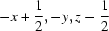
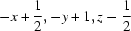
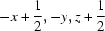
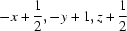
| Symmetry codes: (i) x−1/2, y, −z+1/2; (ii) −x+1/2, −y, z−1/2; (iii) −x+1/2, −y+1, z−1/2; (iv) x+1/2, y, −z+3/2; (v) x−1/2, y, −z+3/2; (vi) −x+1/2, −y, z+1/2; (vii) −x+1/2, −y+1, z+1/2. |
Experimental details
| Crystal data | |
| Chemical formula | [Cu(CH5N3S)2(NCS)] |
| Mr | 303.90 |
| Crystal system, space group | Orthorhombic, Pnma |
| Temperature (K) | 298 |
| a, b, c (Å) | 11.488 (2), 6.6085 (12), 14.650 (3) |
| V (Å3) | 1112.2 (4) |
| Z | 4 |
| Radiation type | Mo Kα |
| µ (mm−1) | 2.50 |
| Crystal size (mm) | 0.38 × 0.27 × 0.24 |
| Data collection | |
| Diffractometer | Bruker SMART CCD area-detector diffractometer |
| Absorption correction | Multi-scan (SADABS; Sheldrick, 1996) |
| Tmin, Tmax | 0.44, 0.55 |
| No. of measured, independent and observed [I > 2σ(I)] reflections | 5593, 1077, 947 |
| Rint | 0.021 |
| (sin θ/λ)max (Å−1) | 0.595 |
| Refinement | |
| R[F2 > 2σ(F2)], wR(F2), S | 0.029, 0.080, 1.05 |
| No. of reflections | 1077 |
| No. of parameters | 86 |
| H-atom treatment | H-atom parameters constrained |
| Δρmax, Δρmin (e Å−3) | 0.67, −0.54 |
Computer programs: SMART (Bruker, 1997), SAINT (Bruker, 1997), SHELXS97 (Sheldrick, 2008), SHELXL97 (Sheldrick, 2008), SHELXTL (Sheldrick, 2008).
| D—H···A | D—H | H···A | D···A | D—H···A |
| N1—H1A···S3i | 0.86 | 2.64 | 3.485 (3) | 167.3 |
| N1—H1B···N3i | 0.86 | 2.14 | 2.998 (4) | 176.5 |
| N2—H2···N7 | 0.86 | 2.24 | 3.093 (4) | 175.0 |
| N3—H3A···S2ii | 0.89 | 2.81 | 3.5481 (11) | 141.3 |
| N3—H3B···S2iii | 0.89 | 2.72 | 3.5481 (11) | 155.3 |
| N4—H4A···S2iv | 0.86 | 2.65 | 3.501 (3) | 169.5 |
| N4—H4B···N7 | 0.86 | 2.32 | 3.161 (4) | 167.0 |
| N5—H5···S3v | 0.86 | 2.64 | 3.342 (3) | 139.7 |
| N6—H6A···S1vi | 0.89 | 2.88 | 3.5144 (12) | 129.9 |
| N6—H6B···S1vii | 0.89 | 2.75 | 3.5144 (11) | 144.4 |
| Symmetry codes: (i) x−1/2, y, −z+1/2; (ii) −x+1/2, −y, z−1/2; (iii) −x+1/2, −y+1, z−1/2; (iv) x+1/2, y, −z+3/2; (v) x−1/2, y, −z+3/2; (vi) −x+1/2, −y, z+1/2; (vii) −x+1/2, −y+1, z+1/2. |
Acknowledgements
We acknowledge the Natural Science Foundation of Liaocheng University (X051002) for support.
References
 Bruker (1997). SMART and SAINT. Bruker AXS Inc., Madison, Wisconsin, USA. Google Scholar
Capacchi, L. C., Gasparri, G. F., Ferrari, M. & Nardelli, M. (1968). Chem. Commun. pp. 910–911. Google Scholar
Chattopadhyay, D., Majumdar, S. K., Lowe, P., Schwalbe, C. H., Chattopadhyay, S. K. & Ghosh, S. (1991). Dalton Trans. pp. 2121–2124. CrossRef Google Scholar
Sheldrick, G. M. (1996). SADABS. University of Göttingen, Germany. Google Scholar
Sheldrick, G. M. (2008). Acta Cryst. A64, 112–122. Web of Science CrossRef CAS IUCr Journals Google Scholar
This is an open-access article distributed under the terms of the Creative Commons Attribution (CC-BY) Licence, which permits unrestricted use, distribution, and reproduction in any medium, provided the original authors and source are cited.
| CRYSTALLOGRAPHIC COMMUNICATIONS |


Thiosemicarbazide can behave as a chelating agent(Chattopadhyay et al.,1991) or as a monodentate ligand(Capacchi et al., 1968). Among the different N,S donors studies,thiosemicarbazides and thiosemicarbazines are of special interest as both of these free ligands and their copper complexes exhibit a variety of biological activities including antitumour activity(Chattopadhyay et al.,1991). In this paper, Cu(CH5N3S)2(NCS) was synthesized by the reaction of CuCl2.6H2O, thiosemicarbazide and NaSCN at room temperature and the structure of the resulting complex is presented herein. The non-H part of the molecule is strictly planar, lying on the mirror plane at y=0.25. The Cu atom lies at the centre of a planar triangle formed by coordination of three monodentate groups, two thiosemicarbazide ligands and one NCS anion (Fig. 1). The Cu—S bond length (2.2415 (13) Å) is comparable to those in [Cu(SC(NH2)NHNH2)Cl2] (2.266 (1) Å,Chattopadhyay et al., 1991), while the Cu—N bond is shorter than the corresponding value therein (2.002 (4)Å).
In the crystal structure, weak intermolecular C—H···S interactions determine a two-dimensional network.