 | Acta Crystallographica Section E Acta Crystallographica Section E CRYSTALLOGRAPHIC COMMUNICATIONS |


 journal menu


organic compounds
| CRYSTALLOGRAPHIC COMMUNICATIONS |
 access
N-(3,4-Difluorophenyl)-3,4-dimethoxybenzenesulfonamide

aDepartment of Chemistry, Chungnam National University, Daejeon 305-764, Republic of Korea, bDepartment of Food Science and Technology, Chungnam National University, Daejeon 305-764, Republic of Korea, and cDepartment of Materials Chemistry, Korea University, 208 Seochang, Chochidwon, Chungnam 339-700, Republic of Korea
*Correspondence e-mail: [email protected]
In the title sulfonamide derivative, C14H13F2NO4S, the dihedral angle between the benzene rings is 66.05 (9)°. The crystal structure is stabilized by weak intermolecular N—H⋯O hydrogen bonds involving the amine and methoxy groups, which link the molecules into a one-dimensional chain. No significant interchain contacts are observed.
Related literature
For general background on skin-whitening agents, see: Dawley & Flurkey (1993![[Dawley, R. M. & Flurkey, W. H. (1993). J. Food Sci. 58, 609-610.]](../../../../../../logos/arrows/e_arr.gif "Dawley, R. M. & Flurkey, W. H. (1993). J. Food Sci. 58, 609-610.") ); Nerya et al. (2003); Juana et al. (1994); Briganti et al. (2003). For the synthesis, see: Hussain et al. (2003).
); Nerya et al. (2003); Juana et al. (1994); Briganti et al. (2003). For the synthesis, see: Hussain et al. (2003).
![[Scheme 1]](bh2170scheme1.gif)
Experimental
Crystal data
|
Refinement
|
| ||||||||||||||||||||||
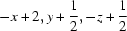 .
. Data collection: SMART (Bruker, 2002); cell refinement: SAINT (Bruker, 2002); data reduction: SAINT; program(s) used to solve structure: SHELXS97 (Sheldrick, 2008); program(s) used to refine structure: SHELXL97 (Sheldrick, 2008); molecular graphics: ORTEP-3 for Windows (Farrugia, 1997); software used to prepare material for publication: WinGX (Farrugia, 1999).
Supporting information
contains datablocks global, I. DOI: 10.1107/S1600536808012610/bh2170sup1.cif
Structure factors: contains datablock I. DOI: 10.1107/S1600536808012610/bh2170Isup2.hkl
3,4-difluoroaniline and 3,4-dimethoxy benzenesulfonyl chloride were purchased from Sigma Chemical Co. Solvents used for organic synthesis were redistilled before used. All other chemicals and solvents were of analytical grade and used without further purification. The title compound was prepared by the reaction of 3,4-difluoroaniline (1 mmol) with aromatic sulfonyl chloride (1.2 mmol) in triethylamine as a solvent, under stirring. Evaporation of solvent, treatment with water, extraction with methylene chloride and of the dried solution (MgSO4) on silica gel column (2 / 1 = hexane / ethyl acetate) gave the title compound in 56% yield. Colourless single crystals were obtained by slow evaporation from an ethyl acetate solution, at room temperature.
The amine H atom H7 was located in a difference map and refined freely. The other H atoms were positioned geometrically and refined using a riding model, with C—H = 0.93 Å for aromatic H atoms and 0.96 Å for methyl H atoms, and with Uiso(H) = 1.2Ueq(C) for aromatic and 1.5Ueq(C) for methyl H atoms.
Data collection: SMART (Bruker, 2002); cell SAINT (Bruker, 2002); data reduction: SAINT (Bruker, 2002); program(s) used to solve structure: SHELXS97 (Sheldrick, 2008); program(s) used to refine structure: SHELXL97 (Sheldrick, 2008); molecular graphics: ORTEP-3 for Windows (Farrugia, 1997); software used to prepare material for publication: WinGX (Farrugia, 1999).
![[Figure 1]](./bh2170fig1thm.gif) | Fig. 1. The molecular structure of the title compound, showing the atom-numbering scheme and 30% probability ellipsoids. |
| C14H13F2NO4S | F(000) = 680 |
| Mr = 329.31 | Dx = 1.516 Mg m−3 |
| Monoclinic, P21/c | Mo Kα radiation, λ = 0.71073 Å |
| Hall symbol: -P 2ybc | Cell parameters from 1598 reflections |
| a = 12.2886 (10) Å | θ = 2.8–23.5° |
| b = 8.5662 (7) Å | µ = 0.26 mm−1 |
| c = 14.5546 (12) Å | T = 295 K |
| β = 109.655 (2)° | Block, colourless |
| V = 1442.8 (2) Å3 | 0.25 × 0.18 × 0.15 mm |
| Z = 4 |
| Bruker SMART CCD area-detector diffractometer | 1700 reflections with I > 2σ(I) |
| ϕ and ω scans | Rint = 0.042 |
| Absorption correction: multi-scan (SADABS; Bruker, 2002) | θmax = 27.5°, θmin = 1.8° |
| Tmin = 0.928, Tmax = 0.957 | h = −15→14 |
| 9690 measured reflections | k = −11→9 |
| 3308 independent reflections | l = −18→18 |
| Refinement on F2 | H atoms treated by a mixture of independent and constrained refinement |
| Least-squares matrix: full | w = 1/[σ2(Fo2) + (0.0426P)2 + 0.5561P] where P = (Fo2 + 2Fc2)/3 |
| R[F2 > 2σ(F2)] = 0.044 | (Δ/σ)max = 0.001 |
| wR(F2) = 0.126 | Δρmax = 0.19 e Å−3 |
| S = 0.99 | Δρmin = −0.21 e Å−3 |
| 3308 reflections | Extinction correction: SHELXL97 (Sheldrick, 2008), Fc*=kFc[1+0.001xFc2λ3/sin(2θ)]-1/4 |
| 204 parameters | Extinction coefficient: 0.0349 (19) |
| 0 restraints |
| C14H13F2NO4S | V = 1442.8 (2) Å3 |
| Mr = 329.31 | Z = 4 |
| Monoclinic, P21/c | Mo Kα radiation |
| a = 12.2886 (10) Å | µ = 0.26 mm−1 |
| b = 8.5662 (7) Å | T = 295 K |
| c = 14.5546 (12) Å | 0.25 × 0.18 × 0.15 mm |
| β = 109.655 (2)° |
| Bruker SMART CCD area-detector diffractometer | 3308 independent reflections |
| Absorption correction: multi-scan (SADABS; Bruker, 2002) | 1700 reflections with I > 2σ(I) |
| Tmin = 0.928, Tmax = 0.957 | Rint = 0.042 |
| 9690 measured reflections |
| R[F2 > 2σ(F2)] = 0.044 | 0 restraints |
| wR(F2) = 0.126 | H atoms treated by a mixture of independent and constrained refinement |
| S = 0.99 | Δρmax = 0.19 e Å−3 |
| 3308 reflections | Δρmin = −0.21 e Å−3 |
| 204 parameters |
| x | y | z | Uiso*/Ueq | ||
| F1 | 0.37106 (16) | 0.1400 (3) | −0.04021 (13) | 0.0975 (7) | |
| F2 | 0.3788 (2) | 0.0318 (3) | 0.13264 (17) | 0.1271 (9) | |
| C1 | 0.6212 (2) | 0.3457 (3) | 0.11332 (19) | 0.0492 (7) | |
| C2 | 0.5338 (2) | 0.2966 (3) | 0.0306 (2) | 0.0584 (8) | |
| H2 | 0.5288 | 0.3352 | −0.0304 | 0.07* | |
| C3 | 0.4554 (2) | 0.1914 (4) | 0.0395 (2) | 0.0609 (8) | |
| C4 | 0.4593 (3) | 0.1366 (4) | 0.1281 (2) | 0.0753 (10) | |
| C5 | 0.5430 (3) | 0.1849 (5) | 0.2102 (2) | 0.0885 (12) | |
| H5 | 0.5454 | 0.1475 | 0.2708 | 0.106* | |
| C6 | 0.6248 (2) | 0.2906 (4) | 0.2030 (2) | 0.0692 (9) | |
| H6 | 0.6826 | 0.3245 | 0.2591 | 0.083* | |
| N7 | 0.7042 (2) | 0.4591 (3) | 0.1068 (2) | 0.0595 (7) | |
| H7 | 0.738 (2) | 0.489 (4) | 0.158 (2) | 0.062 (10)* | |
| S8 | 0.78080 (6) | 0.43912 (9) | 0.03547 (5) | 0.0595 (3) | |
| O9 | 0.84833 (17) | 0.5777 (2) | 0.04834 (17) | 0.0802 (7) | |
| O10 | 0.70295 (15) | 0.3991 (3) | −0.05866 (13) | 0.0709 (6) | |
| C11 | 0.8750 (2) | 0.2809 (3) | 0.07756 (18) | 0.0490 (7) | |
| C12 | 0.9910 (2) | 0.3073 (3) | 0.13211 (17) | 0.0478 (6) | |
| H12 | 1.0184 | 0.4087 | 0.1468 | 0.057* | |
| C13 | 1.0644 (2) | 0.1829 (3) | 0.16380 (17) | 0.0472 (6) | |
| C14 | 1.0231 (2) | 0.0296 (3) | 0.14189 (18) | 0.0480 (6) | |
| C15 | 0.9086 (2) | 0.0050 (3) | 0.0875 (2) | 0.0559 (7) | |
| H15 | 0.8809 | −0.0962 | 0.0724 | 0.067* | |
| C16 | 0.8350 (2) | 0.1300 (3) | 0.0554 (2) | 0.0566 (7) | |
| H16 | 0.7579 | 0.1128 | 0.0187 | 0.068* | |
| O17 | 1.17904 (15) | 0.1936 (2) | 0.21844 (13) | 0.0614 (5) | |
| C18 | 1.2333 (2) | 0.3419 (4) | 0.2277 (2) | 0.0669 (9) | |
| H18A | 1.3129 | 0.3326 | 0.2681 | 0.1* | |
| H18B | 1.1949 | 0.4141 | 0.2569 | 0.1* | |
| H18C | 1.2288 | 0.3792 | 0.1643 | 0.1* | |
| O19 | 1.10296 (15) | −0.0832 (2) | 0.17753 (14) | 0.0599 (5) | |
| C20 | 1.0682 (3) | −0.2409 (3) | 0.1507 (2) | 0.0668 (8) | |
| H20A | 1.132 | −0.3098 | 0.1805 | 0.1* | |
| H20B | 1.0441 | −0.2514 | 0.0811 | 0.1* | |
| H20C | 1.005 | −0.2674 | 0.1727 | 0.1* |
| U11 | U22 | U33 | U12 | U13 | U23 | |
| F1 | 0.0780 (12) | 0.1205 (18) | 0.0749 (12) | −0.0470 (12) | 0.0005 (10) | −0.0069 (11) |
| F2 | 0.1139 (17) | 0.160 (2) | 0.1037 (16) | −0.0684 (17) | 0.0321 (14) | 0.0185 (15) |
| C1 | 0.0374 (13) | 0.0490 (16) | 0.0540 (17) | 0.0026 (12) | 0.0060 (12) | −0.0074 (13) |
| C2 | 0.0499 (16) | 0.0634 (19) | 0.0522 (17) | −0.0065 (14) | 0.0044 (13) | 0.0047 (14) |
| C3 | 0.0480 (16) | 0.069 (2) | 0.0555 (18) | −0.0104 (15) | 0.0037 (14) | −0.0058 (15) |
| C4 | 0.0615 (19) | 0.088 (3) | 0.075 (2) | −0.0210 (18) | 0.0223 (17) | 0.0036 (19) |
| C5 | 0.074 (2) | 0.134 (4) | 0.057 (2) | −0.015 (2) | 0.0207 (18) | 0.008 (2) |
| C6 | 0.0520 (17) | 0.096 (3) | 0.0530 (19) | −0.0028 (17) | 0.0093 (14) | −0.0121 (17) |
| N7 | 0.0462 (13) | 0.0581 (16) | 0.0618 (17) | −0.0029 (12) | 0.0019 (12) | −0.0102 (13) |
| S8 | 0.0460 (4) | 0.0573 (5) | 0.0647 (5) | −0.0070 (4) | 0.0048 (3) | 0.0101 (4) |
| O9 | 0.0582 (12) | 0.0579 (14) | 0.1098 (18) | −0.0137 (10) | 0.0090 (12) | 0.0198 (12) |
| O10 | 0.0543 (11) | 0.0896 (17) | 0.0556 (12) | −0.0054 (10) | 0.0009 (9) | 0.0153 (11) |
| C11 | 0.0422 (14) | 0.0530 (17) | 0.0480 (15) | −0.0059 (13) | 0.0102 (12) | 0.0031 (13) |
| C12 | 0.0480 (14) | 0.0453 (16) | 0.0459 (15) | −0.0115 (12) | 0.0102 (12) | −0.0005 (12) |
| C13 | 0.0420 (14) | 0.0526 (17) | 0.0427 (14) | −0.0059 (13) | 0.0084 (11) | 0.0005 (12) |
| C14 | 0.0469 (14) | 0.0473 (17) | 0.0482 (15) | −0.0036 (13) | 0.0138 (12) | 0.0015 (12) |
| C15 | 0.0509 (16) | 0.0509 (17) | 0.0643 (18) | −0.0130 (14) | 0.0171 (14) | −0.0060 (14) |
| C16 | 0.0418 (14) | 0.062 (2) | 0.0598 (18) | −0.0137 (14) | 0.0092 (13) | −0.0027 (15) |
| O17 | 0.0470 (10) | 0.0523 (12) | 0.0707 (13) | −0.0082 (9) | 0.0010 (9) | 0.0051 (10) |
| C18 | 0.0486 (16) | 0.061 (2) | 0.078 (2) | −0.0199 (14) | 0.0042 (14) | 0.0031 (16) |
| O19 | 0.0563 (11) | 0.0441 (12) | 0.0732 (13) | −0.0037 (9) | 0.0138 (10) | −0.0016 (9) |
| C20 | 0.0727 (19) | 0.0473 (18) | 0.081 (2) | −0.0054 (16) | 0.0270 (17) | −0.0061 (16) |
| F1—C3 | 1.343 (3) | C11—C12 | 1.398 (3) |
| F2—C4 | 1.354 (3) | C12—C13 | 1.372 (4) |
| C1—C6 | 1.375 (4) | C12—H12 | 0.93 |
| C1—C2 | 1.382 (3) | C13—O17 | 1.369 (3) |
| C1—N7 | 1.434 (4) | C13—C14 | 1.405 (4) |
| C2—C3 | 1.357 (4) | C14—O19 | 1.350 (3) |
| C2—H2 | 0.93 | C14—C15 | 1.379 (3) |
| C3—C4 | 1.359 (4) | C15—C16 | 1.378 (4) |
| C4—C5 | 1.352 (4) | C15—H15 | 0.93 |
| C5—C6 | 1.383 (4) | C16—H16 | 0.93 |
| C5—H5 | 0.93 | O17—C18 | 1.420 (3) |
| C6—H6 | 0.93 | C18—H18A | 0.96 |
| N7—S8 | 1.628 (3) | C18—H18B | 0.96 |
| N7—H7 | 0.76 (3) | C18—H18C | 0.96 |
| S8—O10 | 1.424 (2) | O19—C20 | 1.431 (3) |
| S8—O9 | 1.424 (2) | C20—H20A | 0.96 |
| S8—C11 | 1.754 (3) | C20—H20B | 0.96 |
| C11—C16 | 1.381 (4) | C20—H20C | 0.96 |
| C6—C1—C2 | 119.3 (3) | C13—C12—C11 | 119.6 (2) |
| C6—C1—N7 | 119.9 (2) | C13—C12—H12 | 120.2 |
| C2—C1—N7 | 120.7 (3) | C11—C12—H12 | 120.2 |
| C3—C2—C1 | 119.2 (3) | O17—C13—C12 | 125.1 (2) |
| C3—C2—H2 | 120.4 | O17—C13—C14 | 114.6 (2) |
| C1—C2—H2 | 120.4 | C12—C13—C14 | 120.3 (2) |
| F1—C3—C2 | 120.1 (3) | O19—C14—C15 | 125.5 (2) |
| F1—C3—C4 | 118.5 (3) | O19—C14—C13 | 114.9 (2) |
| C2—C3—C4 | 121.4 (3) | C15—C14—C13 | 119.6 (3) |
| C5—C4—F2 | 120.7 (3) | C16—C15—C14 | 120.1 (3) |
| C5—C4—C3 | 120.4 (3) | C16—C15—H15 | 119.9 |
| F2—C4—C3 | 118.9 (3) | C14—C15—H15 | 119.9 |
| C4—C5—C6 | 119.3 (3) | C15—C16—C11 | 120.5 (2) |
| C4—C5—H5 | 120.3 | C15—C16—H16 | 119.8 |
| C6—C5—H5 | 120.3 | C11—C16—H16 | 119.8 |
| C1—C6—C5 | 120.3 (3) | C13—O17—C18 | 118.3 (2) |
| C1—C6—H6 | 119.8 | O17—C18—H18A | 109.5 |
| C5—C6—H6 | 119.8 | O17—C18—H18B | 109.5 |
| C1—N7—S8 | 123.2 (2) | H18A—C18—H18B | 109.5 |
| C1—N7—H7 | 109 (2) | O17—C18—H18C | 109.5 |
| S8—N7—H7 | 115 (2) | H18A—C18—H18C | 109.5 |
| O10—S8—O9 | 120.03 (13) | H18B—C18—H18C | 109.5 |
| O10—S8—N7 | 107.04 (13) | C14—O19—C20 | 117.3 (2) |
| O9—S8—N7 | 105.36 (14) | O19—C20—H20A | 109.5 |
| O10—S8—C11 | 107.51 (13) | O19—C20—H20B | 109.5 |
| O9—S8—C11 | 108.15 (12) | H20A—C20—H20B | 109.5 |
| N7—S8—C11 | 108.29 (13) | O19—C20—H20C | 109.5 |
| C16—C11—C12 | 119.9 (2) | H20A—C20—H20C | 109.5 |
| C16—C11—S8 | 120.0 (2) | H20B—C20—H20C | 109.5 |
| C12—C11—S8 | 120.0 (2) |
| D—H···A | D—H | H···A | D···A | D—H···A |
| N7—H7···O17i | 0.76 (3) | 2.48 (3) | 3.180 (3) | 155 (3) |
| N7—H7···O19i | 0.76 (3) | 2.61 (3) | 3.256 (3) | 144 (3) |
| Symmetry code: (i) −x+2, y+1/2, −z+1/2. |
Experimental details
| Crystal data | |
| Chemical formula | C14H13F2NO4S |
| Mr | 329.31 |
| Crystal system, space group | Monoclinic, P21/c |
| Temperature (K) | 295 |
| a, b, c (Å) | 12.2886 (10), 8.5662 (7), 14.5546 (12) |
| β (°) | 109.655 (2) |
| V (Å3) | 1442.8 (2) |
| Z | 4 |
| Radiation type | Mo Kα |
| µ (mm−1) | 0.26 |
| Crystal size (mm) | 0.25 × 0.18 × 0.15 |
| Data collection | |
| Diffractometer | Bruker SMART CCD area-detector diffractometer |
| Absorption correction | Multi-scan (SADABS; Bruker, 2002) |
| Tmin, Tmax | 0.928, 0.957 |
| No. of measured, independent and observed [I > 2σ(I)] reflections | 9690, 3308, 1700 |
| Rint | 0.042 |
| (sin θ/λ)max (Å−1) | 0.650 |
| Refinement | |
| R[F2 > 2σ(F2)], wR(F2), S | 0.044, 0.126, 0.99 |
| No. of reflections | 3308 |
| No. of parameters | 204 |
| H-atom treatment | H atoms treated by a mixture of independent and constrained refinement |
| Δρmax, Δρmin (e Å−3) | 0.19, −0.21 |
Computer programs: SMART (Bruker, 2002), SAINT (Bruker, 2002), SHELXS97 (Sheldrick, 2008), SHELXL97 (Sheldrick, 2008), ORTEP-3 for Windows (Farrugia, 1997), WinGX (Farrugia, 1999).
| D—H···A | D—H | H···A | D···A | D—H···A |
| N7—H7···O17i | 0.76 (3) | 2.48 (3) | 3.180 (3) | 155 (3) |
| N7—H7···O19i | 0.76 (3) | 2.61 (3) | 3.256 (3) | 144 (3) |
| Symmetry code: (i) −x+2, y+1/2, −z+1/2. |
Acknowledgements
This work was partially supported by Chungnam National University,, the Fund of New Universities for Regional Innovation (05-Na-A-01) from the Ministry of Education and Human Resources Department, Republic of Korea, and the DBIO Co. Ltd.
References
 Briganti, S., Camera, E. & Picardo, M. (2003). Pigment Cell Res. 16, 101–110. Web of Science CrossRef PubMed Google Scholar
Bruker (2002). SADABS, SAINT and SMART. Bruker AXS Inc., Madison, Wisconsin, USA. Google Scholar
Dawley, R. M. & Flurkey, W. H. (1993). J. Food Sci. 58, 609–610. CrossRef CAS Web of Science Google Scholar
Farrugia, L. J. (1997). J. Appl. Cryst. 30, 565. CrossRef IUCr Journals Google Scholar
Farrugia, L. J. (1999). J. Appl. Cryst. 32, 837–838. CrossRef CAS IUCr Journals Google Scholar
Hussain, H. H., Babic, G., Durst, T., Wright, J. S., Flueraru, M., Chichirau, A. & Chepelev, L. L. (2003). J. Org. Chem. 68, 7023–7032. Web of Science CrossRef PubMed CAS Google Scholar
Juana, C., Soledad, C. & Francisco, G. (1994). J. Pharm. Pharmacol. 46, 983–985. Google Scholar
Nerya, O., Vaya, J., Musa, R., Izrael, S., Ben-Arie, R. & Tamir, S. (2003). J. Agric. Food Chem. 51, 1201–1207. Web of Science CrossRef PubMed CAS Google Scholar
Sheldrick, G. M. (2008). Acta Cryst. A64, 112–122. Web of Science CrossRef CAS IUCr Journals Google Scholar
This is an open-access article distributed under the terms of the Creative Commons Attribution (CC-BY) Licence, which permits unrestricted use, distribution, and reproduction in any medium, provided the original authors and source are cited.
| CRYSTALLOGRAPHIC COMMUNICATIONS |


Most skin whitening agents currently on the market (Dawley & Flurkey, 1993; Nerya et al., 2003) contain hydroquinone, ascorbic acid, kojic acid (Juana et al., 1994), arbutin, azealic acid, and glycyrrhetinic acid. They include aromatic, methoxy, hydroxyl and carbonyl functional groups in their structures. They are acting as a direct inhibitors of tyrosinase, the enzyme in the skin pigment cells (melanocytes) producing melanin.
Tyrosinase is the key enzyme converting the amino acid L-tyrosine to melanin, and its inhibitors are target molecules to develop anti-pigmentation agents for skin treatment after sunburn (Briganti et al. 2003). The melanin formation by the tyrosinase activity after sunlight exposure causes some dermatological disorders associated with freckles and melasma. Therefore, potent inhibitory agents on melanin formation and tyrosinase should be cosmetically useful for treatment of dermatological disorders.
However, most skin whitening agents have some problems, due to toxicity, low stability of formulation and poor skin permeation. In our work on the development of new whitening agents to complement the inadequacy of current whitening agents and maximize the inhibitory effects of melanin creation, we synthesized the title compound (Fig. 1), via a general chemical reaction (Hussain et al., 2003) of 3,4-difluoroaniline with aromatic sulfonyl chloride, and studied its X-ray crystal structure.
The 3,4-dimethoxybenzenesulfonyl and 3,4-difluoroaniline moieties are essentially planar, with a mean deviation of 0.004 Å and 0.010 Å, respectively, from the corresponding least-squares planes. The dihedral angle between benzene rings is 66.05 (9)°. The intermolecular N7—H7···O17i and O19i [symmetry code: (i) -x + 2, y + 1/2, -z + 1/2] hydrogen bonds (involving the H atom of the amine and O atoms of methoxy groups) allow to form an extensive one-dimensional network along the b axis, which stabilizes the crystal structure.