Experimental
Crystal data
(C5H8N2)[HgBr4]·H2O Mr = 634.34 Monoclinic, P 21 /n a = 8.1896 (7) Å b = 14.0245 (12) Å c = 11.5711 (10) Å β = 94.730 (2)° V = 1324.5 (2) Å3 Z = 4 Mo Kα radiation μ = 23.66 mm−1 T = 296 (2) K 0.20 × 0.10 × 0.03 mm
|
Data collection
Bruker–Siemens SMART APEX diffractometer Absorption correction: multi-scan (SADABS; Bruker, 2001![[Bruker (2001). SADABS, SAINT and SMART. Bruker AXS Inc., Madison, Wisconsin, USA.]](../../../../../../logos/arrows/e_arr.gif "Bruker (2001). SADABS, SAINT and SMART. Bruker AXS Inc., Madison, Wisconsin, USA.") ) Tmin = 0.034, Tmax = 0.492 ) Tmin = 0.034, Tmax = 0.492 16873 measured reflections 3780 independent reflections 2628 reflections with I > 2σ(I) Rint = 0.056
|
| Hg1—Br4 | 2.5818 (7) | | Hg1—Br1 | 2.5875 (6) | | Hg1—Br3 | 2.6216 (7) | | Hg1—Br2 | 2.6309 (7) | | | Br4—Hg1—Br1 | 120.99 (2) | | Br4—Hg1—Br3 | 104.23 (2) | | Br1—Hg1—Br3 | 109.78 (2) | | Br4—Hg1—Br2 | 103.42 (2) | | Br1—Hg1—Br2 | 107.40 (2) | | Br3—Hg1—Br2 | 110.73 (2) | | |
| D—H⋯A | D—H | H⋯A | D⋯A | D—H⋯A | | O1—H1⋯Br2i | 0.89 (6) | 2.98 (6) | 3.564 (5) | 125 (5) | | O1—H2⋯Br3 | 0.89 (6) | 2.65 (3) | 3.513 (5) | 162 (7) | | N1—H1A⋯O1ii | 0.89 | 1.80 | 2.686 (7) | 174 | | N1—H1B⋯Br4i | 0.89 | 2.79 | 3.442 (5) | 132 | | N1—H1B⋯Br2iii | 0.89 | 2.84 | 3.535 (5) | 136 | | N1—H1C⋯Br3i | 0.89 | 2.63 | 3.436 (5) | 152 | | N4—H4⋯Br1iv | 0.86 | 2.73 | 3.419 (5) | 138 | Symmetry codes: (i) 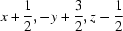 ; (ii) ; (ii) 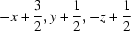 ; (iii) x, y, z-1; (iv) ; (iii) x, y, z-1; (iv) 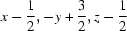 . .
| |
Data collection: SMART (Bruker, 2001); cell refinement: SAINT-Plus (Bruker, 2001); data reduction: SAINT-Plus; program(s) used to solve structure: XS in SHELXTL (Sheldrick, 2008); program(s) used to refine structure: XL in SHELXTL; molecular graphics: XP in SHELXTL; software used to prepare material for publication: XCIF in SHELXTL.
Supporting information
A warm solution of HgCl2 (1.0 mmol) dissolved in ethanol (10 ml) and HBr (60%, 3 ml), was added dropwise to a stirred hot solution of 2-aminopyridine (1 mmol) dissolved in ethanol (10 ml). After refluxing for 2 h, the mixture was filtered off, and then allowed to stand undisturbed at room temperature. The salt crystallized over 3 days as pink crystals. Crystals were filtered off and one crystal suitable for diffraction measurements was used to collect data.
H atoms attached to water O atoms were located in a difference map and refined with restraints (O—H distance of 0.89 Å). Other H atoms were positioned geometrically, with N—H = 0.86 Å (for py NH), N—H = 0.89 Å (for ammonium NH) and C—H = 0.93 Å for aromatic H, and constrained to ride on their parent atoms, with Uiso(H) = 1.2Ueq(C,N).
Data collection: SMART (Bruker, 2001); cell refinement: SAINT-Plus (Bruker, 2001); data reduction: SAINT-Plus (Bruker, 2001); program(s) used to solve structure: XS in SHELXTL (Sheldrick, 2008); program(s) used to refine structure: XL in SHELXTL (Sheldrick, 2008); molecular graphics: XP in SHELXTL (Sheldrick, 2008); software used to prepare material for publication: XCIF in SHELXTL (Sheldrick, 2008).
3-Ammoniopyridinium tetrabromidomercurate(II) monohydrate
top Crystal data top | (C5H8N2)[HgBr4]·H2O | F(000) = 1128 |
| Mr = 634.34 | Dx = 3.181 Mg m−3 |
| Monoclinic, P21/n | Mo Kα radiation, λ = 0.71073 Å |
| Hall symbol: -P 2yn | Cell parameters from 5049 reflections |
| a = 8.1896 (7) Å | θ = 2.3–27.6° |
| b = 14.0245 (12) Å | µ = 23.66 mm−1 |
| c = 11.5711 (10) Å | T = 296 K |
| β = 94.730 (2)° | Chunk, pink |
| V = 1324.5 (2) Å3 | 0.20 × 0.10 × 0.03 mm |
| Z = 4 | |
Data collection top Bruker–Siemens SMART APEX
diffractometer | 3780 independent reflections |
| Radiation source: fine-focus sealed tube | 2628 reflections with I > 2σ(I) |
| Graphite monochromator | Rint = 0.056 |
| Detector resolution: 8.3 pixels mm-1 | θmax = 30.1°, θmin = 2.3° |
| ω scans | h = −11→11 |
Absorption correction: multi-scan
(SADABS; Bruker, 2001) | k = −19→19 |
| Tmin = 0.034, Tmax = 0.492 | l = −16→16 |
| 16873 measured reflections | |
Refinement top | Refinement on F2 | Secondary atom site location: difference Fourier map |
| Least-squares matrix: full | Hydrogen site location: inferred from neighbouring sites |
| R[F2 > 2σ(F2)] = 0.035 | H atoms treated by a mixture of independent and constrained refinement |
| wR(F2) = 0.074 | w = 1/[σ2(Fo2) + (0.018P)2 + 0.74P]
where P = (Fo2 + 2Fc2)/3 |
| S = 1.03 | (Δ/σ)max = 0.001 |
| 3780 reflections | Δρmax = 0.85 e Å−3 |
| 126 parameters | Δρmin = −1.32 e Å−3 |
| 3 restraints | Extinction correction: SHELXTL (Sheldrick, 2008), Fc*=kFc[1+0.001xFc2λ3/sin(2θ)]-1/4 |
| Primary atom site location: structure-invariant direct methods | Extinction coefficient: 0.00271 (13) |
Crystal data top | (C5H8N2)[HgBr4]·H2O | V = 1324.5 (2) Å3 |
| Mr = 634.34 | Z = 4 |
| Monoclinic, P21/n | Mo Kα radiation |
| a = 8.1896 (7) Å | µ = 23.66 mm−1 |
| b = 14.0245 (12) Å | T = 296 K |
| c = 11.5711 (10) Å | 0.20 × 0.10 × 0.03 mm |
| β = 94.730 (2)° | |
Data collection top Bruker–Siemens SMART APEX
diffractometer | 3780 independent reflections |
Absorption correction: multi-scan
(SADABS; Bruker, 2001) | 2628 reflections with I > 2σ(I) |
| Tmin = 0.034, Tmax = 0.492 | Rint = 0.056 |
| 16873 measured reflections | |
Refinement top | R[F2 > 2σ(F2)] = 0.035 | 3 restraints |
| wR(F2) = 0.074 | H atoms treated by a mixture of independent and constrained refinement |
| S = 1.03 | Δρmax = 0.85 e Å−3 |
| 3780 reflections | Δρmin = −1.32 e Å−3 |
| 126 parameters | |
Fractional atomic coordinates and isotropic or equivalent isotropic displacement parameters (Å2) top| | x | y | z | Uiso*/Ueq | |
| O1 | 0.8331 (6) | 0.5315 (4) | 0.4741 (5) | 0.0770 (15) | |
| H1 | 0.883 (9) | 0.575 (4) | 0.433 (5) | 0.116* | |
| H2 | 0.802 (10) | 0.560 (4) | 0.538 (4) | 0.116* | |
| Hg1 | 0.68459 (3) | 0.763019 (18) | 0.84039 (2) | 0.05085 (10) | |
| Br1 | 0.95522 (7) | 0.85483 (4) | 0.89061 (5) | 0.04424 (15) | |
| Br2 | 0.53644 (7) | 0.74688 (4) | 1.03273 (5) | 0.04900 (16) | |
| Br3 | 0.74834 (8) | 0.59454 (4) | 0.75688 (5) | 0.05157 (17) | |
| Br4 | 0.45943 (8) | 0.83129 (5) | 0.69416 (6) | 0.0622 (2) | |
| N1 | 0.8418 (6) | 0.9030 (4) | 0.1560 (4) | 0.0506 (13) | |
| H1A | 0.7884 | 0.9447 | 0.1089 | 0.076* | |
| H1B | 0.8181 | 0.8440 | 0.1317 | 0.076* | |
| H1C | 0.9492 | 0.9128 | 0.1560 | 0.076* | |
| C2 | 0.7926 (6) | 0.9151 (4) | 0.2726 (4) | 0.0337 (11) | |
| C3 | 0.6981 (6) | 0.8466 (4) | 0.3172 (5) | 0.0413 (13) | |
| H3 | 0.6637 | 0.7934 | 0.2737 | 0.050* | |
| N4 | 0.6563 (6) | 0.8582 (4) | 0.4258 (4) | 0.0501 (12) | |
| H4 | 0.5957 | 0.8158 | 0.4547 | 0.060* | |
| C5 | 0.7057 (7) | 0.9339 (4) | 0.4914 (5) | 0.0462 (14) | |
| H5 | 0.6764 | 0.9390 | 0.5672 | 0.055* | |
| C6 | 0.7989 (7) | 1.0030 (4) | 0.4463 (5) | 0.0424 (13) | |
| H6 | 0.8318 | 1.0562 | 0.4903 | 0.051* | |
| C7 | 0.8433 (7) | 0.9933 (4) | 0.3356 (5) | 0.0419 (13) | |
| H7 | 0.9074 | 1.0395 | 0.3036 | 0.050* | |
Atomic displacement parameters (Å2) top| | U11 | U22 | U33 | U12 | U13 | U23 |
| O1 | 0.061 (3) | 0.073 (4) | 0.096 (4) | −0.012 (3) | 0.003 (3) | −0.027 (3) |
| Hg1 | 0.04444 (15) | 0.05348 (17) | 0.05300 (16) | −0.00161 (11) | −0.00571 (10) | −0.00193 (11) |
| Br1 | 0.0406 (3) | 0.0417 (3) | 0.0508 (3) | −0.0052 (2) | 0.0063 (2) | −0.0018 (2) |
| Br2 | 0.0451 (3) | 0.0563 (4) | 0.0451 (3) | −0.0050 (3) | 0.0014 (3) | −0.0036 (3) |
| Br3 | 0.0573 (4) | 0.0473 (4) | 0.0506 (3) | −0.0023 (3) | 0.0077 (3) | −0.0071 (3) |
| Br4 | 0.0454 (3) | 0.0673 (5) | 0.0713 (4) | −0.0031 (3) | −0.0099 (3) | 0.0294 (3) |
| N1 | 0.053 (3) | 0.061 (3) | 0.037 (3) | 0.010 (2) | 0.003 (2) | 0.000 (2) |
| C2 | 0.034 (3) | 0.039 (3) | 0.027 (2) | 0.008 (2) | −0.001 (2) | 0.002 (2) |
| C3 | 0.030 (3) | 0.040 (3) | 0.053 (3) | −0.004 (2) | −0.003 (2) | −0.012 (3) |
| N4 | 0.041 (3) | 0.048 (3) | 0.062 (3) | −0.009 (2) | 0.007 (2) | 0.003 (2) |
| C5 | 0.045 (3) | 0.057 (4) | 0.036 (3) | 0.001 (3) | 0.003 (2) | −0.004 (3) |
| C6 | 0.045 (3) | 0.038 (3) | 0.044 (3) | −0.003 (2) | −0.001 (3) | −0.009 (2) |
| C7 | 0.045 (3) | 0.034 (3) | 0.047 (3) | 0.000 (2) | 0.006 (3) | 0.006 (2) |
Geometric parameters (Å, º) top | O1—H1 | 0.89 (6) | C2—C3 | 1.362 (7) |
| O1—H2 | 0.89 (6) | C3—N4 | 1.339 (7) |
| Hg1—Br4 | 2.5818 (7) | C3—H3 | 0.9300 |
| Hg1—Br1 | 2.5875 (6) | N4—C5 | 1.349 (7) |
| Hg1—Br3 | 2.6216 (7) | N4—H4 | 0.8600 |
| Hg1—Br2 | 2.6309 (7) | C5—C6 | 1.364 (8) |
| N1—C2 | 1.450 (6) | C5—H5 | 0.9300 |
| N1—H1A | 0.8900 | C6—C7 | 1.367 (7) |
| N1—H1B | 0.8900 | C6—H6 | 0.9300 |
| N1—H1C | 0.8900 | C7—H7 | 0.9300 |
| C2—C7 | 1.363 (7) | | |
| | | |
| H1—O1—H2 | 108 (5) | N4—C3—C2 | 117.8 (5) |
| Br4—Hg1—Br1 | 120.99 (2) | N4—C3—H3 | 121.1 |
| Br4—Hg1—Br3 | 104.23 (2) | C2—C3—H3 | 121.1 |
| Br1—Hg1—Br3 | 109.78 (2) | C3—N4—C5 | 122.4 (5) |
| Br4—Hg1—Br2 | 103.42 (2) | C3—N4—H4 | 118.8 |
| Br1—Hg1—Br2 | 107.40 (2) | C5—N4—H4 | 118.8 |
| Br3—Hg1—Br2 | 110.73 (2) | N4—C5—C6 | 119.7 (5) |
| C2—N1—H1A | 109.5 | N4—C5—H5 | 120.2 |
| C2—N1—H1B | 109.5 | C6—C5—H5 | 120.2 |
| H1A—N1—H1B | 109.5 | C5—C6—C7 | 119.3 (5) |
| C2—N1—H1C | 109.5 | C5—C6—H6 | 120.4 |
| H1A—N1—H1C | 109.5 | C7—C6—H6 | 120.4 |
| H1B—N1—H1C | 109.5 | C2—C7—C6 | 119.2 (5) |
| C7—C2—C3 | 121.6 (5) | C2—C7—H7 | 120.4 |
| C7—C2—N1 | 119.7 (5) | C6—C7—H7 | 120.4 |
| C3—C2—N1 | 118.7 (5) | | |
| | | |
| C7—C2—C3—N4 | −0.2 (8) | N4—C5—C6—C7 | −1.3 (9) |
| N1—C2—C3—N4 | 178.8 (5) | C3—C2—C7—C6 | 0.3 (8) |
| C2—C3—N4—C5 | −0.7 (8) | N1—C2—C7—C6 | −178.7 (5) |
| C3—N4—C5—C6 | 1.4 (9) | C5—C6—C7—C2 | 0.4 (8) |
Hydrogen-bond geometry (Å, º) top | D—H···A | D—H | H···A | D···A | D—H···A |
| O1—H1···Br2i | 0.89 (6) | 2.98 (6) | 3.564 (5) | 125 (5) |
| O1—H2···Br3 | 0.89 (6) | 2.65 (3) | 3.513 (5) | 162 (7) |
| N1—H1A···O1ii | 0.89 | 1.80 | 2.686 (7) | 174 |
| N1—H1B···Br4i | 0.89 | 2.79 | 3.442 (5) | 132 |
| N1—H1B···Br2iii | 0.89 | 2.84 | 3.535 (5) | 136 |
| N1—H1C···Br3i | 0.89 | 2.63 | 3.436 (5) | 152 |
| N4—H4···Br1iv | 0.86 | 2.73 | 3.419 (5) | 138 |
| Symmetry codes: (i) x+1/2, −y+3/2, z−1/2; (ii) −x+3/2, y+1/2, −z+1/2; (iii) x, y, z−1; (iv) x−1/2, −y+3/2, z−1/2. |
Experimental details
| Crystal data |
| Chemical formula | (C5H8N2)[HgBr4]·H2O |
| Mr | 634.34 |
| Crystal system, space group | Monoclinic, P21/n |
| Temperature (K) | 296 |
| a, b, c (Å) | 8.1896 (7), 14.0245 (12), 11.5711 (10) |
| β (°) | 94.730 (2) |
| V (Å3) | 1324.5 (2) |
| Z | 4 |
| Radiation type | Mo Kα |
| µ (mm−1) | 23.66 |
| Crystal size (mm) | 0.20 × 0.10 × 0.03 |
| |
| Data collection |
| Diffractometer | Bruker–Siemens SMART APEX
diffractometer |
| Absorption correction | Multi-scan
(SADABS; Bruker, 2001) |
| Tmin, Tmax | 0.034, 0.492 |
No. of measured, independent and
observed [I > 2σ(I)] reflections | 16873, 3780, 2628 |
| Rint | 0.056 |
| (sin θ/λ)max (Å−1) | 0.705 |
| |
| Refinement |
| R[F2 > 2σ(F2)], wR(F2), S | 0.035, 0.074, 1.03 |
| No. of reflections | 3780 |
| No. of parameters | 126 |
| No. of restraints | 3 |
| H-atom treatment | H atoms treated by a mixture of independent and constrained refinement |
| Δρmax, Δρmin (e Å−3) | 0.85, −1.32 |
Selected geometric parameters (Å, º) top| Hg1—Br4 | 2.5818 (7) | Hg1—Br3 | 2.6216 (7) |
| Hg1—Br1 | 2.5875 (6) | Hg1—Br2 | 2.6309 (7) |
| | | |
| Br4—Hg1—Br1 | 120.99 (2) | Br4—Hg1—Br2 | 103.42 (2) |
| Br4—Hg1—Br3 | 104.23 (2) | Br1—Hg1—Br2 | 107.40 (2) |
| Br1—Hg1—Br3 | 109.78 (2) | Br3—Hg1—Br2 | 110.73 (2) |
Hydrogen-bond geometry (Å, º) top | D—H···A | D—H | H···A | D···A | D—H···A |
| O1—H1···Br2i | 0.89 (6) | 2.98 (6) | 3.564 (5) | 125 (5) |
| O1—H2···Br3 | 0.89 (6) | 2.65 (3) | 3.513 (5) | 162 (7) |
| N1—H1A···O1ii | 0.89 | 1.80 | 2.686 (7) | 173.9 |
| N1—H1B···Br4i | 0.89 | 2.79 | 3.442 (5) | 131.5 |
| N1—H1B···Br2iii | 0.89 | 2.84 | 3.535 (5) | 136.3 |
| N1—H1C···Br3i | 0.89 | 2.63 | 3.436 (5) | 151.5 |
| N4—H4···Br1iv | 0.86 | 2.73 | 3.419 (5) | 138.1 |
| Symmetry codes: (i) x+1/2, −y+3/2, z−1/2; (ii) −x+3/2, y+1/2, −z+1/2; (iii) x, y, z−1; (iv) x−1/2, −y+3/2, z−1/2. |
Acknowledgements
Al al-Bayt University and Al-Balqa'a Applied University are thanked for support.
References
 Al-Far, R. & Ali, B. F. (2007a). Acta Cryst. C63, m137–m139. Web of Science CSD CrossRef IUCr Journals Google Scholar
Al-Far, R. & Ali, B. F. (2007b). J. Chem. Crystallogr. 37, 331–341. Web of Science CSD CrossRef Google Scholar
Al-Far, R., Ali, B. F. & Al-Sou'od, K. (2006). J. Chem. Crystallogr. 36, 523–529. Web of Science CSD CrossRef CAS Google Scholar
Ali, B. F. & Al-Far, R. (2007a). Acta Cryst. C63, m451–m453. Web of Science CSD CrossRef IUCr Journals Google Scholar
Ali, B. F. & Al-Far, R. (2007b). Acta Cryst. E63, m892–m894. Web of Science CSD CrossRef IUCr Journals Google Scholar
Ali, B. F. & Al-Far, R. (2008). J. Chem. Crystallogr. (2008). Accepted. Google Scholar
Ali, B. F., Al-Far, R. H. & Haddad, S. F. (2008). Acta Cryst. E64, m485–m486. Web of Science CSD CrossRef IUCr Journals Google Scholar
Bruker (2001). SADABS, SAINT and SMART. Bruker AXS Inc., Madison, Wisconsin, USA. Google Scholar
Desiraju, G. R. (1997). Chem. Commun. pp. 1475–1482. CrossRef Web of Science Google Scholar
Orpen, A. G., Brammer, L., Allen, F. H., Kennard, O., Watson, D. G. & Taylor, R. (1989). J. Chem. Soc. Dalton Trans. pp. S1–S83. CrossRef Web of Science Google Scholar
Sheldrick, G. M. (2008). Acta Cryst. A64, 112–122. Web of Science CrossRef CAS IUCr Journals Google Scholar
This is an open-access article distributed under the terms of the Creative Commons Attribution (CC-BY) Licence, which permits unrestricted use, distribution, and reproduction in any medium, provided the original authors and source are cited.
 | CRYSTALLOGRAPHIC
COMMUNICATIONS |
ISSN: 2056-9890
Open

access


 journal menu



![[Scheme 1]](cs2074scheme1.gif)
![[Figure 1]](./cs2074fig1thm.gif)
![[Figure 2]](./cs2074fig2thm.gif)
![[Figure 3]](./cs2074fig3thm.gif)
![[Figure 4]](./cs2074fig4thm.gif)


Noncovalent interactions play an important role in organizing structural units in both natural and artificial systems (Desiraju, 1997). In connection with ongoing studies (Al-Far et al., 2006; Al-Far & Ali 2007a,b; Ali & Al-Far 2007a,b; Ali & Al-Far 2008; Ali et al., 2008) of the structural aspects of bromometal anions' salts, we herein report the crystal structure of the title compound.
In the title compound, Fig. 1, the asymmetric unit contains one cation and one anion along with one water molecules. The anion exhibits a distorted tetrahedral arrangement about Hg atom (Table 1). The Hg—Br1 and Hg—Br4 [2.5875 (6) and 2.5818 (7) Å, respectively] bonds are almost invariant and significantly shorter than Hg—Br2 and Hg—Br3 [2.6309 (7) and 2.6216 (7) Å, respectively]. These lengths fall within the range of Hg—Br distances reported previously for compounds containing [HgBr4]2- anions (Al-Far et al., 2006; Ali & Al-Far 2008). It is noteworthy that the longer Hg—Br2, Br3 bonds are involved in more interactions than the shorter ones (Table 2). In the cation, the bond lengths and angles are in accordance with normal values (Orpen et al., 1989). The cation is, of course, planar, in which N1 and N2 atoms are also coplanar.
The packing can be regarded as sheets of cations in the ac plane that are separated by stacks of anions.
Each two cations are connected via two water centers in a cation···2H2O···cation supramolecular motif, (Fig. 2), through N—H···O and O—H···O hydrogen bonding. These motifs are further connected to the next one via π···π stacking leading to infinite layers of ···pyNH3···OH2···H2O···H3Npy··· pyNH3···OH2···H2O···H3Npy··· connected molecules (Fig. 3). These layers are then connected by π···π stacking to the next layer causing the sheet arrangement (Fig. 3). The sheets are separated by the anion stacks (Fig. 4), where no significant Br···Br interactions (shortest Br···Br is 3.9527 (9) Å) were observed. The anion stacks are interacting extensively with cation sheets by different significant hydrogen bonds of the type pyN—H···Br and C—H···Br (Table 2), along with extra O—H···Br—Hg interactions (Table 2), cause to the formation of a three-dimensional supramolecular architecture. π···π Stacking may be effective in the stabilization of the crystal structure apart from hydrogen bonding, dipole-dipole and van der Waals interactions.