Experimental
Crystal data
C8H12O4 Mr = 172.18 Monoclinic, C 2/c a = 5.585 (1) Å b = 13.840 (3) Å c = 10.035 (2) Å β = 96.114 (3)° V = 771.3 (3) Å3 Z = 4 Mo Kα radiation μ = 0.12 mm−1 T = 100 (2) K 0.38 × 0.06 × 0.04 mm
|
Data collection
Bruker SMART APEX diffractometer Absorption correction: none 2320 measured reflections 883 independent reflections 715 reflections with I > 2σ(I) Rint = 0.035
|
| D—H⋯A | D—H | H⋯A | D⋯A | D—H⋯A | | O1—H1o⋯O2i | 0.85 (1) | 1.81 (1) | 2.662 (2) | 178 (2) | Symmetry code: (i) 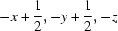 . .
| |
Data collection: APEX2 (Bruker, 2007![[Bruker (2007). APEX2 and SAINT. Bruker AXS Inc., Madison, Wisconsin, USA.]](../../../../../../logos/arrows/e_arr.gif "Bruker (2007). APEX2 and SAINT. Bruker AXS Inc., Madison, Wisconsin, USA.") ); cell refinement: SAINT (Bruker, 2007); data reduction: SAINT; program(s) used to solve structure: SHELXS97 (Sheldrick, 2008); program(s) used to refine structure: SHELXL97 (Sheldrick, 2008); molecular graphics: X-SEED (Barbour, 2001); software used to prepare material for publication: publCIF (Westrip, 2008).
); cell refinement: SAINT (Bruker, 2007); data reduction: SAINT; program(s) used to solve structure: SHELXS97 (Sheldrick, 2008); program(s) used to refine structure: SHELXL97 (Sheldrick, 2008); molecular graphics: X-SEED (Barbour, 2001); software used to prepare material for publication: publCIF (Westrip, 2008).
Supporting information
The commercially available acid was recrystallized from ethanol.
Carbon-bound H-atoms were placed in calculated positions (C—H 0.99 to 1.00 Å) and were included in the refinement in the riding model approximation, with U(H) set to 1.2 U(C). The acid H-atom was located in a difference Fourier map, and was isotropically refined with a distance restraint of O–H 0.85 (1) Å.
Data collection: APEX2 (Bruker, 2007); cell refinement: SAINT (Bruker, 2007); data reduction: SAINT (Bruker, 2007); program(s) used to solve structure: SHELXS97 (Sheldrick, 2008); program(s) used to refine structure: SHELXL97 (Sheldrick, 2008); molecular graphics: X-SEED (Barbour, 2001); software used to prepare material for publication: publCIF (Westrip, 2008).
trans-cyclohexane-1,2-dicarboxylic acid
top Crystal data top | C8H12O4 | F(000) = 368 |
| Mr = 172.18 | Dx = 1.483 Mg m−3 |
| Monoclinic, C2/c | Mo Kα radiation, λ = 0.71073 Å |
| Hall symbol: -C 2yc | Cell parameters from 739 reflections |
| a = 5.585 (1) Å | θ = 3.6–28.2° |
| b = 13.840 (3) Å | µ = 0.12 mm−1 |
| c = 10.035 (2) Å | T = 100 K |
| β = 96.114 (3)° | Strip, colourless |
| V = 771.3 (3) Å3 | 0.38 × 0.06 × 0.04 mm |
| Z = 4 | |
Data collection top Bruker SMART APEX
diffractometer | 715 reflections with I > 2σ(I) |
| Radiation source: fine-focus sealed tube | Rint = 0.035 |
| Graphite monochromator | θmax = 27.5°, θmin = 2.9° |
| ω scans | h = −7→7 |
| 2320 measured reflections | k = −17→17 |
| 883 independent reflections | l = −13→8 |
Refinement top | Refinement on F2 | Primary atom site location: structure-invariant direct methods |
| Least-squares matrix: full | Secondary atom site location: difference Fourier map |
| R[F2 > 2σ(F2)] = 0.042 | Hydrogen site location: inferred from neighbouring sites |
| wR(F2) = 0.115 | H atoms treated by a mixture of independent and constrained refinement |
| S = 1.07 | w = 1/[σ2(Fo2) + (0.0635P)2 + 0.2009P]
where P = (Fo2 + 2Fc2)/3 |
| 883 reflections | (Δ/σ)max = 0.001 |
| 59 parameters | Δρmax = 0.31 e Å−3 |
| 1 restraint | Δρmin = −0.28 e Å−3 |
Crystal data top | C8H12O4 | V = 771.3 (3) Å3 |
| Mr = 172.18 | Z = 4 |
| Monoclinic, C2/c | Mo Kα radiation |
| a = 5.585 (1) Å | µ = 0.12 mm−1 |
| b = 13.840 (3) Å | T = 100 K |
| c = 10.035 (2) Å | 0.38 × 0.06 × 0.04 mm |
| β = 96.114 (3)° | |
Data collection top Bruker SMART APEX
diffractometer | 715 reflections with I > 2σ(I) |
| 2320 measured reflections | Rint = 0.035 |
| 883 independent reflections | |
Refinement top | R[F2 > 2σ(F2)] = 0.042 | 1 restraint |
| wR(F2) = 0.115 | H atoms treated by a mixture of independent and constrained refinement |
| S = 1.07 | Δρmax = 0.31 e Å−3 |
| 883 reflections | Δρmin = −0.28 e Å−3 |
| 59 parameters | |
Fractional atomic coordinates and isotropic or equivalent isotropic displacement parameters (Å2) top| | x | y | z | Uiso*/Ueq | |
| O1 | 0.0840 (2) | 0.1596 (1) | 0.0902 (1) | 0.0173 (3) | |
| O2 | 0.4725 (2) | 0.1968 (1) | 0.0869 (1) | 0.0166 (3) | |
| C1 | 0.3157 (3) | 0.1471 (1) | 0.1279 (2) | 0.0122 (3) | |
| C2 | 0.3668 (2) | 0.0626 (1) | 0.2220 (2) | 0.0122 (4) | |
| C3 | 0.2893 (3) | −0.0314 (1) | 0.1475 (2) | 0.0139 (4) | |
| C4 | 0.3647 (3) | −0.1208 (1) | 0.2303 (2) | 0.0159 (4) | |
| H1o | 0.068 (4) | 0.206 (1) | 0.035 (2) | 0.036 (6)* | |
| H2 | 0.2676 | 0.0704 | 0.2986 | 0.015* | |
| H3a | 0.1121 | −0.0315 | 0.1261 | 0.017* | |
| H3b | 0.3626 | −0.0339 | 0.0620 | 0.017* | |
| H4a | 0.2799 | −0.1218 | 0.3120 | 0.019* | |
| H4b | 0.3184 | −0.1796 | 0.1776 | 0.019* | |
Atomic displacement parameters (Å2) top| | U11 | U22 | U33 | U12 | U13 | U23 |
| O1 | 0.0124 (6) | 0.0179 (6) | 0.0205 (7) | 0.0008 (4) | −0.0027 (5) | 0.0074 (5) |
| O2 | 0.0149 (6) | 0.0153 (6) | 0.0186 (6) | −0.0017 (4) | −0.0028 (4) | 0.0048 (4) |
| C1 | 0.0140 (7) | 0.0112 (7) | 0.0107 (8) | 0.0012 (5) | −0.0025 (6) | −0.0034 (6) |
| C2 | 0.0115 (7) | 0.0118 (7) | 0.0126 (8) | 0.0003 (5) | −0.0025 (6) | −0.0004 (6) |
| C3 | 0.0138 (7) | 0.0141 (7) | 0.0134 (8) | −0.0013 (5) | −0.0012 (6) | −0.0014 (6) |
| C4 | 0.0170 (8) | 0.0109 (7) | 0.0190 (9) | −0.0011 (5) | −0.0012 (6) | 0.0003 (6) |
Geometric parameters (Å, º) top | O1—C1 | 1.321 (2) | O1—H1o | 0.85 (1) |
| O2—C1 | 1.220 (2) | C2—H2 | 1.0000 |
| C1—C2 | 1.511 (2) | C3—H3a | 0.9900 |
| C2—C2i | 1.533 (3) | C3—H3b | 0.9900 |
| C2—C3 | 1.5397 (19) | C4—H4a | 0.9900 |
| C3—C4 | 1.523 (2) | C4—H4b | 0.9900 |
| C4—C4i | 1.521 (3) | | |
| | | |
| O2—C1—O1 | 123.1 (1) | C3—C2—H2 | 108.3 |
| O2—C1—C2 | 123.6 (1) | C4—C3—H3a | 109.2 |
| O1—C1—C2 | 113.3 (1) | C2—C3—H3a | 109.2 |
| C1—C2—C2i | 109.9 (1) | C4—C3—H3b | 109.2 |
| C1—C2—C3 | 109.0 (1) | C2—C3—H3b | 109.2 |
| C2i—C2—C3 | 112.9 (1) | H3a—C3—H3b | 107.9 |
| C4—C3—C2 | 112.0 (1) | C4i—C4—H4a | 109.5 |
| C4i—C4—C3 | 110.5 (1) | C3—C4—H4a | 109.5 |
| C1—O1—H1o | 109 (1) | C4i—C4—H4b | 109.5 |
| C1—C2—H2 | 108.3 | C3—C4—H4b | 109.5 |
| C2i—C2—H2 | 108.3 | H4a—C4—H4b | 108.1 |
| | | |
| O2—C1—C2—C2i | 11.2 (2) | C1—C2—C3—C4 | 172.7 (1) |
| O1—C1—C2—C2i | −171.2 (1) | C2i—C2—C3—C4 | 50.2 (2) |
| O2—C1—C2—C3 | −113.0 (2) | C2—C3—C4—C4i | −56.6 (2) |
| O1—C1—C2—C3 | 64.6 (2) | | |
| Symmetry code: (i) −x+1, y, −z+1/2. |
Hydrogen-bond geometry (Å, º) top | D—H···A | D—H | H···A | D···A | D—H···A |
| O1—H1o···O2ii | 0.85 (1) | 1.81 (1) | 2.662 (2) | 178 (2) |
| Symmetry code: (ii) −x+1/2, −y+1/2, −z. |
Experimental details
| Crystal data |
| Chemical formula | C8H12O4 |
| Mr | 172.18 |
| Crystal system, space group | Monoclinic, C2/c |
| Temperature (K) | 100 |
| a, b, c (Å) | 5.585 (1), 13.840 (3), 10.035 (2) |
| β (°) | 96.114 (3) |
| V (Å3) | 771.3 (3) |
| Z | 4 |
| Radiation type | Mo Kα |
| µ (mm−1) | 0.12 |
| Crystal size (mm) | 0.38 × 0.06 × 0.04 |
| |
| Data collection |
| Diffractometer | Bruker SMART APEX
diffractometer |
| Absorption correction | – |
No. of measured, independent and
observed [I > 2σ(I)] reflections | 2320, 883, 715 |
| Rint | 0.035 |
| (sin θ/λ)max (Å−1) | 0.650 |
| |
| Refinement |
| R[F2 > 2σ(F2)], wR(F2), S | 0.042, 0.115, 1.07 |
| No. of reflections | 883 |
| No. of parameters | 59 |
| No. of restraints | 1 |
| H-atom treatment | H atoms treated by a mixture of independent and constrained refinement |
| Δρmax, Δρmin (e Å−3) | 0.31, −0.28 |
Hydrogen-bond geometry (Å, º) top | D—H···A | D—H | H···A | D···A | D—H···A |
| O1—H1o···O2i | 0.85 (1) | 1.81 (1) | 2.662 (2) | 178 (2) |
| Symmetry code: (i) −x+1/2, −y+1/2, −z. |
Acknowledgements
We thank the University of Malaya for the purchase of the diffractometer.
References
 Barbour, L. J. (2001). J. Supramol. Chem. 1, 189–191. CrossRef CAS Google Scholar
Benedetti, E., Corradini, P., Perrone, C. & Post, B. (1969). J. Am. Chem. Soc. 91, 4072–4074. CSD CrossRef CAS Web of Science Google Scholar
Bruker (2007). APEX2 and SAINT. Bruker AXS Inc., Madison, Wisconsin, USA. Google Scholar
Koningsveld, H. van (1984). Acta Cryst. C40, 1857–1863. CSD CrossRef Web of Science IUCr Journals Google Scholar
Luger, P., Plieth, K. & Ruban, G. (1972). Acta Cryst. B28, 706–710. CSD CrossRef CAS IUCr Journals Web of Science Google Scholar
Sheldrick, G. M. (2008). Acta Cryst. A64, 112–122. Web of Science CrossRef CAS IUCr Journals Google Scholar
Westrip, S. P. (2008). publCIF. In preparation. Google Scholar
This is an open-access article distributed under the terms of the Creative Commons Attribution (CC-BY) Licence, which permits unrestricted use, distribution, and reproduction in any medium, provided the original authors and source are cited.
 | CRYSTALLOGRAPHIC
COMMUNICATIONS |
ISSN: 2056-9890
Open

access


 journal menu



![[Scheme 1]](cv2404scheme1.gif)
![[Figure 1]](./cv2404fig1thm.gif)
![[Figure 2]](./cv2404fig2thm.gif)


Crystallographic studies of the metal derivatives of trans-1,2-cyclohexanedicarboxylic acid occasionally refer to the room-temperature crystal structure of the dicarboxylic acid, which was reported in 1969. The report (Benedetti et al., 1969) contains typographical errors that have since been corrected in the Cambridge Structural Database (Version 5.29, Nov. 2007). The reported monoclinic cell dimensions can be transformed to 5.65 (1), b 13.34 (3), c 10.22 (3) Å; β 97.2 (2)°.
Whereas the low-temperature unit cell has a slightly larger volume compared with the room-temperature cell, the low-temperature cell has a much longer b-axis [13.840 (3) Å]. The bond distances and angles of room-temperature structure are normal; those of the present study are not significantly different despite the longer axis. Possibly, the expansion of this axis is a genuine observation. Moreover, the present study is able to establish the hydrogen bonding scheme of the compound (Scheme I, Fig. 1). Adjacent molecules are linked by a linear O–H···O hydrogen bond [2.662 (2) Å] into a chain (Fig. 2).
The crystal structures of 1,3- and 1,4-cyclohexanedicarboxylic acids have already been reported (van Koningsveld, 1984; Luger et al., 1972).