Experimental
Crystal data
[Na2Zn(SO4)2(H2O)4] Mr = 375.53 Monoclinic, P 21 /c a = 5.5075 (2) Å b = 8.2127 (3) Å c = 11.0559 (4) Å β = 99.958 (10)° V = 492.54 (3) Å3 Z = 2 Mo Kα radiation μ = 3.07 mm−1 T = 170 (2) K 0.30 × 0.20 × 0.10 mm
|
Data collection
Bruker SMART CCD diffractometer Absorption correction: multi-scan (SADABS; Sheldrick, 1996![[Sheldrick, G. M. (1996). SADABS. University of Göttingen, Germany.]](../../../../../../logos/arrows/e_arr.gif "Sheldrick, G. M. (1996). SADABS. University of Göttingen, Germany.") ) Tmin = 0.452, Tmax = 0.728 ) Tmin = 0.452, Tmax = 0.728 3533 measured reflections 1080 independent reflections 1062 reflections with I > 2σ(I) Rint = 0.012
|
| Zn1—O1W | 2.0636 (11) | | Zn1—O3 | 2.0952 (11) | | Zn1—O2W | 2.1285 (11) | | Na1—O2i | 2.3603 (12) | | Na1—O4ii | 2.3786 (12) | | Na1—O1 | 2.4016 (12) | | Na1—O1W | 2.4017 (12) | | Na1—O2iii | 2.4224 (13) | | Na1—O2Wiv | 2.5694 (13) | Symmetry codes: (i)  ; (ii) ; (ii) 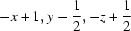 ; (iii) ; (iii) 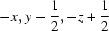 ; (iv) ; (iv) 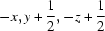 . .
| |
| D—H⋯A | D—H | H⋯A | D⋯A | D—H⋯A | | O1W—H1WA⋯O1iii | 0.800 (17) | 1.916 (17) | 2.6977 (17) | 165 (3) | | O1W—H1WB⋯O4v | 0.832 (16) | 1.901 (16) | 2.7288 (17) | 173 (2) | | O2W—H2WA⋯O1ii | 0.826 (16) | 2.051 (18) | 2.8468 (16) | 162 (2) | | O2W—H2WB⋯O4vi | 0.805 (16) | 2.15 (2) | 2.8779 (16) | 151 (3) | Symmetry codes: (ii) ; (iii) ; (v) x-1, y, z; (vi) -x+1, -y, -z.
| |
Data collection: SMART (Bruker, 2001); cell refinement: SAINT (Bruker, 2001); data reduction: SAINT; program(s) used to solve structure: SHELXS97 (Sheldrick, 2008); program(s) used to refine structure: SHELXL97 (Sheldrick, 2008); molecular graphics: SHELXTL (Sheldrick, 2008); software used to prepare material for publication: SHELXTL and PLATON (Spek, 2003).
Supporting information
The compound was obtained an an unintended product in a synthesis of Zn(II) complexes. Recently prepared anysaldehyde bisulfitic derivative (60 mg) were dissolved in 5 ml of water and mixed with an aqueous solution of Zn acetate (112 mg/5 ml). The aqueous mixture was left in a methanol atmosphere, until colourless cubic crystals were obtained.
Hydrogen atoms pertaining to water molecules were found in the difference- Fourier synthesis and refined with restrained O—H:0.82 (2) Å, H···H:1.35 (2) Å, but free isotropic displacement parameters.
Data collection: SMART (Bruker, 2001); cell refinement: SAINT (Bruker, 2001); data reduction: SAINT (Bruker, 2001); program(s) used to solve structure: SHELXS97 (Sheldrick, 2008); program(s) used to refine structure: SHELXL97 (Sheldrick, 2008); molecular graphics: SHELXTL (Sheldrick, 2008); software used to prepare material for publication: SHELXTL (Sheldrick, 2008) and PLATON (Spek, 2003).
poly[tetra-µ-aqua-di-µ–sulfato-zinc(II)disodium(I)]
top Crystal data top | [Na2Zn(SO4)2(H2O)4] | F(000) = 376 |
| Mr = 375.53 | Dx = 2.539 Mg m−3 |
| Monoclinic, P21/c | Mo Kα radiation, λ = 0.71073 Å |
| Hall symbol: -P 2ybc | Cell parameters from 3942 reflections |
| a = 5.5075 (2) Å | θ = 3.8–26.7° |
| b = 8.2127 (3) Å | µ = 3.07 mm−1 |
| c = 11.0559 (4) Å | T = 170 K |
| β = 99.958 (1)° | Prism, colourless |
| V = 492.54 (3) Å3 | 0.30 × 0.20 × 0.10 mm |
| Z = 2 | |
Data collection top Bruker SMART CCD
diffractometer | 1080 independent reflections |
| Radiation source: fine-focus sealed tube | 1062 reflections with I > 2σ(I) |
| Graphite monochromator | Rint = 0.012 |
| ϕ and ω scans | θmax = 27.9°, θmin = 3.1° |
Absorption correction: multi-scan
(SADABS; Sheldrick, 1996) | h = −6→7 |
| Tmin = 0.452, Tmax = 0.728 | k = −10→10 |
| 3533 measured reflections | l = −13→14 |
Refinement top | Refinement on F2 | Secondary atom site location: difference Fourier map |
| Least-squares matrix: full | Hydrogen site location: inferred from neighbouring sites |
| R[F2 > 2σ(F2)] = 0.017 | H atoms treated by a mixture of independent and constrained refinement |
| wR(F2) = 0.054 | w = 1/[σ2(Fo2) + (0.0408P)2 + 0.265P]
where P = (Fo2 + 2Fc2)/3 |
| S = 1.00 | (Δ/σ)max < 0.001 |
| 1080 reflections | Δρmax = 0.29 e Å−3 |
| 96 parameters | Δρmin = −0.53 e Å−3 |
| 6 restraints | Extinction correction: SHELXL97 (Sheldrick, 2008), Fc*=kFc[1+0.001xFc2λ3/sin(2θ)]-1/4 |
| Primary atom site location: structure-invariant direct methods | Extinction coefficient: 0.080 (4) |
Crystal data top | [Na2Zn(SO4)2(H2O)4] | V = 492.54 (3) Å3 |
| Mr = 375.53 | Z = 2 |
| Monoclinic, P21/c | Mo Kα radiation |
| a = 5.5075 (2) Å | µ = 3.07 mm−1 |
| b = 8.2127 (3) Å | T = 170 K |
| c = 11.0559 (4) Å | 0.30 × 0.20 × 0.10 mm |
| β = 99.958 (1)° | |
Data collection top Bruker SMART CCD
diffractometer | 1080 independent reflections |
Absorption correction: multi-scan
(SADABS; Sheldrick, 1996) | 1062 reflections with I > 2σ(I) |
| Tmin = 0.452, Tmax = 0.728 | Rint = 0.012 |
| 3533 measured reflections | |
Refinement top | R[F2 > 2σ(F2)] = 0.017 | 6 restraints |
| wR(F2) = 0.054 | H atoms treated by a mixture of independent and constrained refinement |
| S = 1.00 | Δρmax = 0.29 e Å−3 |
| 1080 reflections | Δρmin = −0.53 e Å−3 |
| 96 parameters | |
Special details top Geometry. All e.s.d.'s (except the e.s.d. in the dihedral angle between two l.s. planes) are estimated using the full covariance matrix. The cell e.s.d.'s are taken into account individually in the estimation of e.s.d.'s in distances, angles and torsion angles; correlations between e.s.d.'s in cell parameters are only used when they are defined by crystal symmetry. An approximate (isotropic) treatment of cell e.s.d.'s is used for estimating e.s.d.'s involving l.s. planes. |
Fractional atomic coordinates and isotropic or equivalent isotropic displacement parameters (Å2) top| | x | y | z | Uiso*/Ueq | |
| Zn1 | 0.0000 | 0.0000 | 0.0000 | 0.00887 (13) | |
| Na1 | 0.12607 (11) | 0.07173 (8) | 0.36217 (5) | 0.01231 (17) | |
| S1 | 0.37405 (6) | 0.28842 (4) | 0.13609 (3) | 0.00821 (14) | |
| O1 | 0.3516 (2) | 0.27120 (14) | 0.26765 (10) | 0.0127 (2) | |
| O2 | 0.2085 (2) | 0.41630 (14) | 0.07871 (10) | 0.0136 (3) | |
| O3 | 0.3186 (2) | 0.13129 (14) | 0.07174 (10) | 0.0134 (2) | |
| O4 | 0.63500 (19) | 0.32955 (13) | 0.13056 (10) | 0.0127 (2) | |
| O1W | −0.1247 (2) | 0.03807 (16) | 0.16331 (10) | 0.0110 (2) | |
| O2W | 0.1753 (2) | −0.21442 (13) | 0.08065 (10) | 0.0115 (2) | |
| H1WA | −0.215 (5) | −0.032 (3) | 0.179 (2) | 0.028 (7)* | |
| H1WB | −0.207 (4) | 0.123 (2) | 0.156 (2) | 0.023 (6)* | |
| H2WA | 0.299 (4) | −0.203 (3) | 0.1341 (18) | 0.021 (6)* | |
| H2WB | 0.213 (5) | −0.278 (3) | 0.032 (2) | 0.034 (7)* | |
Atomic displacement parameters (Å2) top| | U11 | U22 | U33 | U12 | U13 | U23 |
| Zn1 | 0.01021 (18) | 0.00753 (17) | 0.00909 (17) | −0.00024 (7) | 0.00231 (11) | −0.00054 (7) |
| Na1 | 0.0133 (3) | 0.0116 (3) | 0.0118 (3) | −0.0002 (2) | 0.0015 (2) | 0.0005 (2) |
| S1 | 0.0083 (2) | 0.0075 (2) | 0.0089 (2) | 0.00016 (12) | 0.00150 (13) | −0.00049 (12) |
| O1 | 0.0156 (6) | 0.0130 (5) | 0.0101 (5) | 0.0014 (4) | 0.0034 (4) | 0.0013 (4) |
| O2 | 0.0149 (5) | 0.0139 (6) | 0.0119 (5) | 0.0051 (4) | 0.0017 (4) | 0.0017 (4) |
| O3 | 0.0111 (5) | 0.0109 (5) | 0.0179 (5) | −0.0016 (4) | 0.0022 (4) | −0.0054 (4) |
| O4 | 0.0103 (5) | 0.0110 (5) | 0.0176 (5) | −0.0021 (4) | 0.0042 (4) | −0.0016 (4) |
| O1W | 0.0114 (5) | 0.0098 (5) | 0.0122 (5) | 0.0000 (4) | 0.0035 (4) | 0.0002 (4) |
| O2W | 0.0120 (5) | 0.0100 (5) | 0.0118 (5) | 0.0007 (4) | −0.0002 (4) | −0.0017 (4) |
Geometric parameters (Å, º) top | Zn1—O1Wi | 2.0636 (11) | Na1—O2Wv | 2.5694 (13) |
| Zn1—O1W | 2.0636 (11) | Na1—Na1vi | 3.7507 (12) |
| Zn1—O3 | 2.0952 (11) | S1—O2 | 1.4619 (11) |
| Zn1—O3i | 2.0952 (11) | S1—O3 | 1.4797 (11) |
| Zn1—O2W | 2.1285 (11) | S1—O1 | 1.4876 (11) |
| Zn1—O2Wi | 2.1285 (11) | S1—O4 | 1.4878 (11) |
| Na1—O2ii | 2.3603 (12) | O1W—H1WA | 0.800 (17) |
| Na1—O4iii | 2.3786 (12) | O1W—H1WB | 0.832 (16) |
| Na1—O1 | 2.4016 (12) | O2W—H2WA | 0.826 (16) |
| Na1—O1W | 2.4017 (12) | O2W—H2WB | 0.805 (16) |
| Na1—O2iv | 2.4224 (13) | | |
| | | |
| O1Wi—Zn1—O1W | 180.00 (9) | O1—Na1—O2Wv | 92.61 (4) |
| O1Wi—Zn1—O3 | 91.46 (4) | O1W—Na1—O2Wv | 90.58 (4) |
| O1W—Zn1—O3 | 88.54 (4) | O2iv—Na1—O2Wv | 74.93 (4) |
| O1Wi—Zn1—O3i | 88.54 (4) | O2—S1—O3 | 110.89 (7) |
| O1W—Zn1—O3i | 91.46 (4) | O2—S1—O1 | 109.97 (6) |
| O3—Zn1—O3i | 180.00 (8) | O3—S1—O1 | 110.00 (7) |
| O1Wi—Zn1—O2W | 92.62 (5) | O2—S1—O4 | 110.71 (7) |
| O1W—Zn1—O2W | 87.38 (5) | O3—S1—O4 | 107.38 (6) |
| O3—Zn1—O2W | 88.72 (4) | O1—S1—O4 | 107.81 (7) |
| O3i—Zn1—O2W | 91.28 (4) | S1—O1—Na1 | 128.83 (7) |
| O1Wi—Zn1—O2Wi | 87.38 (5) | S1—O2—Na1vii | 117.79 (6) |
| O1W—Zn1—O2Wi | 92.62 (5) | S1—O2—Na1v | 135.07 (7) |
| O3—Zn1—O2Wi | 91.28 (4) | Na1vii—O2—Na1v | 103.29 (4) |
| O3i—Zn1—O2Wi | 88.72 (4) | S1—O3—Zn1 | 136.09 (7) |
| O2W—Zn1—O2Wi | 180.00 (7) | S1—O4—Na1viii | 136.15 (7) |
| O2ii—Na1—O4iii | 89.56 (4) | Zn1—O1W—Na1 | 126.34 (5) |
| O2ii—Na1—O1 | 112.94 (4) | Zn1—O1W—H1WA | 113 (2) |
| O4iii—Na1—O1 | 105.09 (4) | Na1—O1W—H1WA | 99.6 (19) |
| O2ii—Na1—O1W | 155.87 (5) | Zn1—O1W—H1WB | 107.7 (17) |
| O4iii—Na1—O1W | 99.32 (5) | Na1—O1W—H1WB | 102.0 (17) |
| O1—Na1—O1W | 86.50 (4) | H1WA—O1W—H1WB | 106 (2) |
| O2ii—Na1—O2iv | 76.71 (4) | Zn1—O2W—Na1iv | 113.77 (5) |
| O4iii—Na1—O2iv | 89.57 (4) | Zn1—O2W—H2WA | 117.7 (16) |
| O1—Na1—O2iv | 162.11 (5) | Na1iv—O2W—H2WA | 112.8 (17) |
| O1W—Na1—O2iv | 80.94 (4) | Zn1—O2W—H2WB | 114.1 (18) |
| O2ii—Na1—O2Wv | 75.00 (4) | Na1iv—O2W—H2WB | 89 (2) |
| O4iii—Na1—O2Wv | 160.12 (5) | H2WA—O2W—H2WB | 106 (2) |
| Symmetry codes: (i) −x, −y, −z; (ii) x, −y+1/2, z+1/2; (iii) −x+1, y−1/2, −z+1/2; (iv) −x, y−1/2, −z+1/2; (v) −x, y+1/2, −z+1/2; (vi) −x, −y, −z+1; (vii) x, −y+1/2, z−1/2; (viii) −x+1, y+1/2, −z+1/2. |
Hydrogen-bond geometry (Å, º) top | D—H···A | D—H | H···A | D···A | D—H···A |
| O1W—H1WA···O1iv | 0.80 (2) | 1.92 (2) | 2.6977 (17) | 165 (3) |
| O1W—H1WB···O4ix | 0.83 (2) | 1.90 (2) | 2.7288 (17) | 173 (2) |
| O2W—H2WA···O1iii | 0.83 (2) | 2.05 (2) | 2.8468 (16) | 162 (2) |
| O2W—H2WB···O4x | 0.81 (2) | 2.15 (2) | 2.8779 (16) | 151 (3) |
| Symmetry codes: (iii) −x+1, y−1/2, −z+1/2; (iv) −x, y−1/2, −z+1/2; (ix) x−1, y, z; (x) −x+1, −y, −z. |
Experimental details
| Crystal data |
| Chemical formula | [Na2Zn(SO4)2(H2O)4] |
| Mr | 375.53 |
| Crystal system, space group | Monoclinic, P21/c |
| Temperature (K) | 170 |
| a, b, c (Å) | 5.5075 (2), 8.2127 (3), 11.0559 (4) |
| β (°) | 99.958 (1) |
| V (Å3) | 492.54 (3) |
| Z | 2 |
| Radiation type | Mo Kα |
| µ (mm−1) | 3.07 |
| Crystal size (mm) | 0.30 × 0.20 × 0.10 |
| |
| Data collection |
| Diffractometer | Bruker SMART CCD
diffractometer |
| Absorption correction | Multi-scan
(SADABS; Sheldrick, 1996) |
| Tmin, Tmax | 0.452, 0.728 |
No. of measured, independent and
observed [I > 2σ(I)] reflections | 3533, 1080, 1062 |
| Rint | 0.012 |
| (sin θ/λ)max (Å−1) | 0.658 |
| |
| Refinement |
| R[F2 > 2σ(F2)], wR(F2), S | 0.017, 0.054, 1.00 |
| No. of reflections | 1080 |
| No. of parameters | 96 |
| No. of restraints | 6 |
| H-atom treatment | H atoms treated by a mixture of independent and constrained refinement |
| Δρmax, Δρmin (e Å−3) | 0.29, −0.53 |
Selected bond lengths (Å) top| Zn1—O1W | 2.0636 (11) | Na1—O1 | 2.4016 (12) |
| Zn1—O3 | 2.0952 (11) | Na1—O1W | 2.4017 (12) |
| Zn1—O2W | 2.1285 (11) | Na1—O2iii | 2.4224 (13) |
| Na1—O2i | 2.3603 (12) | Na1—O2Wiv | 2.5694 (13) |
| Na1—O4ii | 2.3786 (12) | | |
| Symmetry codes: (i) x, −y+1/2, z+1/2; (ii) −x+1, y−1/2, −z+1/2; (iii) −x, y−1/2, −z+1/2; (iv) −x, y+1/2, −z+1/2. |
Hydrogen-bond geometry (Å, º) top | D—H···A | D—H | H···A | D···A | D—H···A |
| O1W—H1WA···O1iii | 0.800 (17) | 1.916 (17) | 2.6977 (17) | 165 (3) |
| O1W—H1WB···O4v | 0.832 (16) | 1.901 (16) | 2.7288 (17) | 173 (2) |
| O2W—H2WA···O1ii | 0.826 (16) | 2.051 (18) | 2.8468 (16) | 162 (2) |
| O2W—H2WB···O4vi | 0.805 (16) | 2.15 (2) | 2.8779 (16) | 151 (3) |
| Symmetry codes: (ii) −x+1, y−1/2, −z+1/2; (iii) −x, y−1/2, −z+1/2; (v) x−1, y, z; (vi) −x+1, −y, −z. |
Acknowledgements
The authors acknowledge the Spanish Research Council (CSIC) for providing a free-of-charge licence to the Cambridge Structural Database (Allen, 2002).
References
 Allen, F. H. (2002). Acta Cryst. B58, 380–388. Web of Science CrossRef CAS IUCr Journals Google Scholar
Bruker (2001). SMART and SAINT for Windows NT. Bruker AXS Inc., Madison, Wisconsin, USA. Google Scholar
Bukin, V. I. & Nozik, Yu. Z. (1974). Zh. Strukt. Khim. 15, 712–716. CAS Google Scholar
Bukin, V. I. & Nozik, Yu. Z. (1975). Kristallografiya, 20, 293–296. CAS Google Scholar
Díaz de Vivar, M. E. de, Baggio, S., Garland, M. T. & Baggio, R. (2006). Acta Cryst. E62, i196–i198. Web of Science CrossRef IUCr Journals Google Scholar
Giglio, M. (1958). Naturwissenschaften, 45, 82–83. CrossRef CAS Google Scholar
Rumanova, I. M. (1958). Dokl. Akad. Nauk SSSR, 118, 84–87. CAS Google Scholar
Sheldrick, G. M. (1996). SADABS. University of Göttingen, Germany. Google Scholar
Sheldrick, G. M. (2008). Acta Cryst. A64, 112–122. Web of Science CrossRef CAS IUCr Journals Google Scholar
Spek, A. L. (2003). J. Appl. Cryst. 36, 7–13. Web of Science CrossRef CAS IUCr Journals Google Scholar
This is an open-access article distributed under the terms of the Creative Commons Attribution (CC-BY) Licence, which permits unrestricted use, distribution, and reproduction in any medium, provided the original authors and source are cited.
 | CRYSTALLOGRAPHIC
COMMUNICATIONS |
ISSN: 2056-9890
Open

access


 journal menu



![[Scheme 1]](fi2061scheme1.gif)
![[Figure 1]](./fi2061fig1thm.gif)
![[Figure 2]](./fi2061fig2thm.gif)
![[Figure 3]](./fi2061fig3thm.gif)


The original mineral astrakanite [Na2M(SO4)2(H2O)4], M = Mg, structurally characterized almost 50 years ago (Rumanova, 1958), gave its name to a whole isostructural family, of which some members have been known for a long while (M = Zn, Giglio, 1958; Bukin & Nozik, 1974; M = Co, Bukin & Nozik, 1975), while the Ni analogue has been only recently reported, (Díaz de Vivar et al., 2006). We present herein an improved, low temperature data refinement of the zinc member of the group, Na2Zn(SO4)2(H2O)4 (I), unwittingly obtained as a byproduct while looking for something else (See experimental section).
Fig. 1 shows the asymmetric unit of (I) as well as part of its close environment, and Table 1 presents some selected bond distances. The structure consists of ZnO(aqua)4O(sulf)2 and NaO(aqua)2O(sulf)4 octahedra in a 1:2 ratio, linked through two bridging water molecules (O1W, O2W) and the fully coordinated sulfato groups.
Zn cations lay on centers of symmetry and their coordination polyhedra defined by O3, O1w, O2w and their respective centrosymmetric counterparts are quite regular, possibly due to the large number of geometrically unconstrained aqua molecules (Parameters range: Zn—O,2.0636 (11)–2.1285 (11) Å; (O—Zn—O)cis, 87.38 (5)–92.62 (5)°; (O—Zn—O)trans, 180.°, fixed by symmetry). Na cations, instead, occupy general positions and, contrasting the former, their O(sulf)-rich coordination octahedra appear as quite irregular (Parameters range: Na—O,2.3603 (12)–2.5694 (13) Å; (O—Na—O)cis, 74.93 (4)–112.94 (4)°; (O—Na—O)trans, 155.87 (5)–162.11 (5)°).
The geometry of the sulfate anion is rather regular, with S—O distances in the range 1.4619 (11) to 1.4878 (11) Å and angles from 107.38 (5) to 110.89 (7)°. The group exhibits a complex µ5-κ4-O:O':O'':O''' coordination, binding in a monocoordinated fashion to Zn through O3 and to Na through O1 and O4, while bridging two Na cations through O2. The result of this intricate interconnectivity is the formation of broad two-dimensional structures parallel to (100) containing both types of polyhedra (Fig.1) and internally linked by the two bridging aqua and O atoms O1, O2 and O3 from the sulfate anion.
These "planes", in turn, are interconnected along a single "strong" interaction, the O4—Na1 bonds between sulfate O4 atoms from a given layer and Na1 cations from their neighbours (Fig. 2).
Also H-bonding interactions (Table 2) contribute to the intraplane (via O1W, entries 1 and 2) and interplane (via O2W, entries 3 and 4) cohesion.
It is worth noting that O1 and O4 act as the only (double) acceptors for H-bonding. In analyzing the S—O bond lengths, it appears that S1—O1 and S1—O4 present precisely the longest distances suggesting a slight weakening effect on the S—O covalent link due to the oxygen involvement in H interactions.
Even though the isostructural character of (I) with the rest of the strakanite family is obvious by inspection, the low precision with which the Mn and Co members have been reported leaves comparison with the Ni moiety as the only relevant one. In this respect, both structures are almost undistinguishable, as proved by the least squares fit of the extended group shown in Fig. 3, where the maximum departure amounts for less than 0.05Å for atom O2W.