 | Acta Crystallographica Section E Acta Crystallographica Section E CRYSTALLOGRAPHIC COMMUNICATIONS |


 journal menu


organic compounds
| CRYSTALLOGRAPHIC COMMUNICATIONS |
 access
N-(2,6-Dimethylanilino)-5,6-dihydro-4H-1,3-thiazin-3-ium chloride monohydrate

aUniversity of Latvia, Kr. Valdemara 48, Riga, LV 1013, Latvia
*Correspondence e-mail: [email protected]
In the title compound, alternatively called xylazine hydrochloride monohydrate, C12H17N2S+·Cl−·H2O, the six-membered thiazine ring is in a half-chair conformation. In the crystal structure, six component centrosymmetric clusters are formed via intermolecular O—H⋯Cl, N—H⋯O and N—H⋯Cl hydrogen bonds involving xylazine cations, chloride anions and water molecules.
![[Scheme 1]](lh2620scheme1.gif)
Experimental
Crystal data
|
Refinement
|
|
 ; (ii)
  .
. Data collection: CrysAlis CCD (Oxford Diffraction, 2007![[Oxford Diffraction (2007). CrysAlis CCD and CrysAlis RED. Oxford Diffraction Ltd, Abingdon, Oxfordshire, England.]](../../../../../../logos/arrows/e_arr.gif "Oxford Diffraction (2007). CrysAlis CCD and CrysAlis RED. Oxford Diffraction Ltd, Abingdon, Oxfordshire, England.") ); cell refinement: CrysAlis RED (Oxford Diffraction, 2007); data reduction: CrysAlis RED; program(s) used to solve structure: SIR92 (Altomare et al., 1994); program(s) used to refine structure: CRYSTALS (Betteridge et al., 2003); molecular graphics: ORTEP-3 for Windows (Farrugia, 1997); software used to prepare material for publication: CRYSTALS.
); cell refinement: CrysAlis RED (Oxford Diffraction, 2007); data reduction: CrysAlis RED; program(s) used to solve structure: SIR92 (Altomare et al., 1994); program(s) used to refine structure: CRYSTALS (Betteridge et al., 2003); molecular graphics: ORTEP-3 for Windows (Farrugia, 1997); software used to prepare material for publication: CRYSTALS.
Supporting information
contains datablocks global, I. DOI: 10.1107/S160053680801372X/lh2620sup1.cif
Structure factors: contains datablock I. DOI: 10.1107/S160053680801372X/lh2620Isup2.hkl
The title compound was supplied by Grindeks Company. For determination suitable crystals were grown by slow evaporation of an ethanol (96%) solution at room temperature.
The hydrogen atoms were located by difference Fourier method. During hydrogen atoms were costrained to the riding mode. Uiso(H)=xUeq(C,N,O), where the average values of x are 1.15 for H atoms bonded to the thiazine ring, 1.48 for methyl H atoms, 1.16 for benzene ring H atoms, 1.17 fot the H atoms bonded to the nitrogen atoms and 1.44 for the H atoms of the water molecule.
Data collection: CrysAlis CCD (Oxford Diffraction, 2007); cell CrysAlis RED (Oxford Diffraction, 2007); data reduction: CrysAlis RED (Oxford Diffraction, 2007); program(s) used to solve structure: SIR92 (Altomare et al., 1994); program(s) used to refine structure: CRYSTALS (Betteridge et al., 2003); molecular graphics: ORTEP-3 for Windows (Farrugia, 1997); software used to prepare material for publication: CRYSTALS (Betteridge et al., 2003).
![[Figure 1]](./lh2620fig1thm.gif) | Fig. 1. The molecular structure of the title compound with thermal ellipsoids drawn at the 50% probability level. |
![[Figure 2]](./lh2620fig2thm.gif) | Fig. 2. Intermolecular hydrogen bond formation (dashed lines) in the title compound. |
| C12H17N2S+·Cl−·H2O | F(000) = 584 |
| Mr = 274.81 | Dx = 1.300 Mg m−3 |
| Monoclinic, P21/c | Cu Kα radiation, λ = 1.5418 Å |
| Hall symbol: -P 2ybc | Cell parameters from 19046 reflections |
| a = 13.4546 (2) Å | θ = 3.5–74.6° |
| b = 8.6547 (1) Å | µ = 3.69 mm−1 |
| c = 12.7732 (2) Å | T = 100 K |
| β = 109.210 (2)° | Prism, white |
| V = 1404.56 (4) Å3 | 0.44 × 0.25 × 0.14 mm |
| Z = 4 |
| Oxford Diffraction Xcalibur diffractometer | 2747 independent reflections |
| Radiation source: Enhance (Cu) X-ray Source | 2509 reflections with I > 2.0σ(I) |
| Graphite monochromator | Rint = 0.029 |
| ϕ and ω scans | θmax = 74.6°, θmin = 3.5° |
| Absorption correction: numerical (de Meulenaer & Tompa, 1965) | h = −16→16 |
| Tmin = 0.30, Tmax = 0.61 | k = −10→10 |
| 19046 measured reflections | l = −15→15 |
| Refinement on F2 | 0 restraints |
| Least-squares matrix: full | H-atom parameters constrained |
| R[F2 > 2σ(F2)] = 0.033 | W = [weight][1-(δF/6σF)2]2 |
| wR(F2) = 0.088 | (Δ/σ)max = 0.000294 |
| S = 1.02 | Δρmax = 0.43 e Å−3 |
| 2509 reflections | Δρmin = −0.33 e Å−3 |
| 154 parameters |
| C12H17N2S+·Cl−·H2O | V = 1404.56 (4) Å3 |
| Mr = 274.81 | Z = 4 |
| Monoclinic, P21/c | Cu Kα radiation |
| a = 13.4546 (2) Å | µ = 3.69 mm−1 |
| b = 8.6547 (1) Å | T = 100 K |
| c = 12.7732 (2) Å | 0.44 × 0.25 × 0.14 mm |
| β = 109.210 (2)° |
| Oxford Diffraction Xcalibur diffractometer | 2747 independent reflections |
| Absorption correction: numerical (de Meulenaer & Tompa, 1965) | 2509 reflections with I > 2.0σ(I) |
| Tmin = 0.30, Tmax = 0.61 | Rint = 0.029 |
| 19046 measured reflections |
| R[F2 > 2σ(F2)] = 0.033 | 0 restraints |
| wR(F2) = 0.088 | H-atom parameters constrained |
| S = 1.02 | Δρmax = 0.43 e Å−3 |
| 2509 reflections | Δρmin = −0.33 e Å−3 |
| 154 parameters |
| x | y | z | Uiso*/Ueq | ||
| S1 | 0.72343 (3) | 0.06408 (5) | 0.19253 (3) | 0.0234 | |
| C2 | 0.79732 (14) | −0.11421 (19) | 0.19970 (14) | 0.0244 | |
| C3 | 0.90751 (14) | −0.0827 (2) | 0.19854 (14) | 0.0252 | |
| C4 | 0.90283 (13) | −0.0099 (2) | 0.08935 (14) | 0.0244 | |
| N5 | 0.84522 (11) | 0.13793 (17) | 0.06888 (12) | 0.0225 | |
| C6 | 0.76970 (12) | 0.17936 (19) | 0.10687 (13) | 0.0199 | |
| N7 | 0.72435 (11) | 0.31807 (16) | 0.08222 (11) | 0.0217 | |
| C8 | 0.65460 (13) | 0.37922 (18) | 0.13689 (14) | 0.0210 | |
| C9 | 0.69975 (13) | 0.4718 (2) | 0.23077 (14) | 0.0224 | |
| C10 | 0.63438 (14) | 0.5346 (2) | 0.28445 (15) | 0.0278 | |
| C11 | 0.52719 (15) | 0.5046 (2) | 0.24466 (17) | 0.0319 | |
| C12 | 0.48404 (14) | 0.4128 (2) | 0.15214 (17) | 0.0300 | |
| C13 | 0.54694 (13) | 0.3482 (2) | 0.09525 (15) | 0.0255 | |
| C14 | 0.49879 (15) | 0.2481 (2) | −0.00495 (16) | 0.0319 | |
| C15 | 0.81647 (13) | 0.4980 (2) | 0.27462 (14) | 0.0249 | |
| Cl16 | 0.18401 (3) | 0.10294 (5) | 0.51765 (3) | 0.0238 | |
| O17 | 0.94136 (9) | 0.31268 (14) | −0.05720 (10) | 0.0272 | |
| H21 | 0.8012 | −0.1644 | 0.2678 | 0.0280* | |
| H31 | 0.9450 | −0.1803 | 0.2067 | 0.0276* | |
| H32 | 0.9432 | −0.0145 | 0.2573 | 0.0277* | |
| H41 | 0.9748 | 0.0101 | 0.0908 | 0.0289* | |
| H42 | 0.8694 | −0.0804 | 0.0300 | 0.0289* | |
| H141 | 0.4312 | 0.2885 | −0.0488 | 0.0475* | |
| H142 | 0.5426 | 0.2414 | −0.0510 | 0.0467* | |
| H143 | 0.4889 | 0.1450 | 0.0189 | 0.0475* | |
| H151 | 0.8332 | 0.5724 | 0.3339 | 0.0357* | |
| H152 | 0.8415 | 0.5357 | 0.2174 | 0.0356* | |
| H153 | 0.8515 | 0.4017 | 0.3030 | 0.0359* | |
| H171 | 0.9124 | 0.3966 | −0.0570 | 0.0391* | |
| H172 | 1.0056 | 0.3286 | −0.0335 | 0.0395* | |
| H22 | 0.7604 | −0.1794 | 0.1379 | 0.0278* | |
| H5 | 0.8667 | 0.2066 | 0.0318 | 0.0267* | |
| H7 | 0.7466 | 0.3812 | 0.0417 | 0.0250* | |
| H10 | 0.6635 | 0.5960 | 0.3474 | 0.0320* | |
| H11 | 0.4838 | 0.5483 | 0.2825 | 0.0362* | |
| H12 | 0.4111 | 0.3933 | 0.1255 | 0.0341* |
| U11 | U22 | U33 | U12 | U13 | U23 | |
| S1 | 0.0236 (2) | 0.0216 (2) | 0.0306 (2) | 0.00450 (15) | 0.01642 (17) | 0.00271 (14) |
| C2 | 0.0292 (9) | 0.0208 (8) | 0.0269 (8) | 0.0023 (6) | 0.0143 (7) | 0.0055 (6) |
| C3 | 0.0257 (8) | 0.0265 (8) | 0.0251 (8) | −0.0001 (7) | 0.0109 (7) | 0.0059 (7) |
| C4 | 0.0227 (8) | 0.0262 (9) | 0.0274 (8) | −0.0012 (7) | 0.0127 (7) | 0.0037 (6) |
| N5 | 0.0227 (7) | 0.0222 (7) | 0.0268 (7) | 0.0015 (5) | 0.0137 (5) | 0.0004 (5) |
| C6 | 0.0186 (7) | 0.0218 (8) | 0.0203 (7) | −0.0012 (6) | 0.0076 (6) | −0.0019 (6) |
| N7 | 0.0237 (7) | 0.0206 (7) | 0.0245 (7) | 0.0018 (5) | 0.0130 (6) | 0.0002 (5) |
| C8 | 0.0203 (7) | 0.0193 (8) | 0.0258 (8) | 0.0046 (6) | 0.0107 (6) | 0.0032 (6) |
| C9 | 0.0225 (8) | 0.0204 (8) | 0.0258 (8) | 0.0035 (6) | 0.0103 (7) | 0.0035 (6) |
| C10 | 0.0297 (9) | 0.0274 (8) | 0.0296 (9) | −0.0003 (7) | 0.0140 (7) | 0.0043 (7) |
| C11 | 0.0274 (9) | 0.0319 (10) | 0.0432 (10) | 0.0024 (8) | 0.0209 (8) | 0.0065 (7) |
| C12 | 0.0181 (8) | 0.0290 (9) | 0.0442 (11) | 0.0072 (8) | 0.0121 (7) | 0.0020 (7) |
| C13 | 0.0221 (8) | 0.0218 (8) | 0.0319 (9) | 0.0052 (7) | 0.0078 (7) | 0.0008 (6) |
| C14 | 0.0264 (8) | 0.0263 (9) | 0.0382 (10) | 0.0001 (8) | 0.0042 (7) | −0.0029 (7) |
| C15 | 0.0224 (8) | 0.0254 (9) | 0.0259 (8) | 0.0012 (7) | 0.0065 (7) | 0.0007 (6) |
| Cl16 | 0.0232 (2) | 0.0239 (2) | 0.0266 (2) | 0.00033 (14) | 0.01150 (16) | 0.00127 (14) |
| O17 | 0.0244 (6) | 0.0248 (6) | 0.0351 (7) | −0.0025 (5) | 0.0135 (5) | −0.0028 (5) |
| S1—C2 | 1.8215 (17) | C9—C10 | 1.391 (2) |
| S1—C6 | 1.7403 (16) | C9—C15 | 1.501 (2) |
| C2—C3 | 1.512 (2) | C10—C11 | 1.387 (3) |
| C2—H21 | 0.959 | C10—H10 | 0.936 |
| C2—H22 | 0.964 | C11—C12 | 1.383 (3) |
| C3—C4 | 1.513 (2) | C11—H11 | 0.950 |
| C3—H31 | 0.971 | C12—C13 | 1.401 (3) |
| C3—H32 | 0.952 | C12—H12 | 0.942 |
| C4—N5 | 1.474 (2) | C13—C14 | 1.504 (3) |
| C4—H41 | 0.977 | C14—H141 | 0.964 |
| C4—H42 | 0.961 | C14—H142 | 0.961 |
| N5—C6 | 1.312 (2) | C14—H143 | 0.966 |
| N5—H5 | 0.866 | C15—H151 | 0.963 |
| C6—N7 | 1.336 (2) | C15—H152 | 0.957 |
| N7—C8 | 1.442 (2) | C15—H153 | 0.967 |
| N7—H7 | 0.870 | O17—H171 | 0.825 |
| C8—C9 | 1.404 (2) | O17—H172 | 0.829 |
| C8—C13 | 1.395 (2) | ||
| C2—S1—C6 | 102.42 (8) | C9—C8—C13 | 122.61 (15) |
| S1—C2—C3 | 111.57 (12) | C8—C9—C10 | 118.55 (16) |
| S1—C2—H21 | 107.2 | C8—C9—C15 | 120.71 (15) |
| C3—C2—H21 | 109.3 | C10—C9—C15 | 120.71 (16) |
| S1—C2—H22 | 109.2 | C9—C10—C11 | 119.76 (17) |
| C3—C2—H22 | 109.9 | C9—C10—H10 | 119.4 |
| H21—C2—H22 | 109.7 | C11—C10—H10 | 120.8 |
| C2—C3—C4 | 109.91 (14) | C10—C11—C12 | 120.93 (16) |
| C2—C3—H31 | 108.6 | C10—C11—H11 | 118.6 |
| C4—C3—H31 | 108.9 | C12—C11—H11 | 120.5 |
| C2—C3—H32 | 110.3 | C11—C12—C13 | 121.14 (16) |
| C4—C3—H32 | 109.0 | C11—C12—H12 | 120.4 |
| H31—C3—H32 | 110.2 | C13—C12—H12 | 118.5 |
| C3—C4—N5 | 112.65 (13) | C12—C13—C8 | 117.01 (16) |
| C3—C4—H41 | 108.4 | C12—C13—C14 | 120.45 (16) |
| N5—C4—H41 | 108.0 | C8—C13—C14 | 122.53 (16) |
| C3—C4—H42 | 109.2 | C13—C14—H141 | 110.2 |
| N5—C4—H42 | 109.1 | C13—C14—H142 | 112.1 |
| H41—C4—H42 | 109.3 | H141—C14—H142 | 108.5 |
| C4—N5—C6 | 126.70 (14) | C13—C14—H143 | 109.2 |
| C4—N5—H5 | 116.2 | H141—C14—H143 | 108.5 |
| C6—N5—H5 | 116.9 | H142—C14—H143 | 108.3 |
| S1—C6—N5 | 123.83 (13) | C9—C15—H151 | 109.9 |
| S1—C6—N7 | 115.66 (12) | C9—C15—H152 | 110.8 |
| N5—C6—N7 | 120.50 (15) | H151—C15—H152 | 108.8 |
| C6—N7—C8 | 122.35 (13) | C9—C15—H153 | 109.3 |
| C6—N7—H7 | 118.9 | H151—C15—H153 | 108.8 |
| C8—N7—H7 | 117.6 | H152—C15—H153 | 109.3 |
| N7—C8—C9 | 117.10 (14) | H171—O17—H172 | 106.9 |
| N7—C8—C13 | 120.28 (15) |
| D—H···A | D—H | H···A | D···A | D—H···A |
| N5—H5···O17 | 0.87 | 1.97 | 2.815 (2) | 163 |
| O17—H171···Cl16i | 0.82 | 2.36 | 3.158 (1) | 164 |
| N7—H7···Cl16i | 0.87 | 2.37 | 3.204 (1) | 162 |
| O17—H172···Cl16ii | 0.83 | 2.35 | 3.171 (1) | 173 |
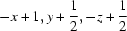
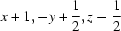
| Symmetry codes: (i) −x+1, y+1/2, −z+1/2; (ii) x+1, −y+1/2, z−1/2. |
Experimental details
| Crystal data | |
| Chemical formula | C12H17N2S+·Cl−·H2O |
| Mr | 274.81 |
| Crystal system, space group | Monoclinic, P21/c |
| Temperature (K) | 100 |
| a, b, c (Å) | 13.4546 (2), 8.6547 (1), 12.7732 (2) |
| β (°) | 109.210 (2) |
| V (Å3) | 1404.56 (4) |
| Z | 4 |
| Radiation type | Cu Kα |
| µ (mm−1) | 3.69 |
| Crystal size (mm) | 0.44 × 0.25 × 0.14 |
| Data collection | |
| Diffractometer | Oxford Diffraction Xcalibur diffractometer |
| Absorption correction | Numerical (de Meulenaer & Tompa, 1965) |
| Tmin, Tmax | 0.30, 0.61 |
| No. of measured, independent and observed [I > 2.0σ(I)] reflections | 19046, 2747, 2509 |
| Rint | 0.029 |
| (sin θ/λ)max (Å−1) | 0.625 |
| Refinement | |
| R[F2 > 2σ(F2)], wR(F2), S | 0.033, 0.088, 1.02 |
| No. of reflections | 2509 |
| No. of parameters | 154 |
| H-atom treatment | H-atom parameters constrained |
| Δρmax, Δρmin (e Å−3) | 0.43, −0.33 |
Computer programs: CrysAlis CCD (Oxford Diffraction, 2007), CrysAlis RED (Oxford Diffraction, 2007), SIR92 (Altomare et al., 1994), CRYSTALS (Betteridge et al., 2003), ORTEP-3 for Windows (Farrugia, 1997).
| D—H···A | D—H | H···A | D···A | D—H···A |
| N5—H5···O17 | 0.87 | 1.97 | 2.815 (2) | 163 |
| O17—H171···Cl16i | 0.82 | 2.36 | 3.158 (1) | 164 |
| N7—H7···Cl16i | 0.87 | 2.37 | 3.204 (1) | 162 |
| O17—H172···Cl16ii | 0.83 | 2.35 | 3.171 (1) | 173 |
| Symmetry codes: (i) −x+1, y+1/2, −z+1/2; (ii) x+1, −y+1/2, z−1/2. |
Acknowledgements
We thank Oxford Diffraction Ltd for the low-temperature data collection and reduction. Cooperation of the University of Cincinnati Crystallography Centre and the Latvia Institute of Organic Synthesis is acknowledged. Financial aid was provided by Latvia Science Council grant 05.1737.
References
 Altomare, A., Cascarano, G., Giacovazzo, C., Guagliardi, A., Burla, M. C., Polidori, G. & Camalli, M. (1994). J. Appl. Cryst. 27, 435. CrossRef Web of Science IUCr Journals Google Scholar
Betteridge, P. W., Carruthers, J. R., Cooper, R. I., Prout, K. & Watkin, D. J. (2003). J. Appl. Cryst. 36, 1487. Web of Science CrossRef IUCr Journals Google Scholar
Carpy, A., Gadret, M. & Leger, J. M. (1979). Acta Cryst. B35, 994–996. CSD CrossRef CAS IUCr Journals Web of Science Google Scholar
Farrugia, L. J. (1997). J. Appl. Cryst. 30, 565. CrossRef IUCr Journals Google Scholar
Kalman, A., Argay, G., Ribar, B. & Toldy, L. (1977). Tetrahedron Lett. 18, 4241–4244. CSD CrossRef Google Scholar
Meulenaer, J. de & Tompa, H. (1965). Acta Cryst. A19, 1014–1018. Google Scholar
Oxford Diffraction (2007). CrysAlis CCD and CrysAlis RED. Oxford Diffraction Ltd, Abingdon, Oxfordshire, England. Google Scholar
This is an open-access article distributed under the terms of the Creative Commons Attribution (CC-BY) Licence, which permits unrestricted use, distribution, and reproduction in any medium, provided the original authors and source are cited.
| CRYSTALLOGRAPHIC COMMUNICATIONS |


Xylazine hydrochloride monohydrate is a pharmaceutical used in veterinary medicine as an anesthetic. The substance is an alpha2-agonist with sedative, analgesic, and muscle relaxing properties.
The crystal structure of the title compound has been determined at 100 K. The structure is depicted in Fig. 1. The phenyl ring forms a dihedral angle of 83.24 (14)° with the plane defined by S1, C6 and N5 of the thiazine ring. The six-member thiazine ring assumes the half-chair conformation.
Hydrogen atoms are bonded to both nitrogen atoms forming a cation. Both hydrogen atoms participate in hydrogen bonding. The two xylazine moieties are held together through an extended H-bond network involving the nitrogen, oxygen, and chlorine anions. In the crystal structure, centrosymmetric clusters are formed by N—H···O—H···Cl···H—N hydrogen bond sequence between the two xylazine moieties.
There are H-bonds which do not join the xylazine moities between oxygen and chlorine (Fig. 2). These may impart additional rigidity in the cluster. As a result of Cl···H—O hydrogen bonding a parallelogram is formed by the Cl—O—Cl—O atoms.
The hydrogen bond lengths are given in the Table 1.