 | Acta Crystallographica Section E Acta Crystallographica Section E CRYSTALLOGRAPHIC COMMUNICATIONS |


 journal menu


inorganic compounds
| CRYSTALLOGRAPHIC COMMUNICATIONS |
 access
Hexaaquadibromidoeuropium(III) bromide, [EuBr2(H2O)6]Br

aMax-Planck-Institut für Festkörperforschung, Heisenbergstrasse 1, D-70569 Stuttgart, Germany
*Correspondence e-mail: [email protected]
The title compound crystallizes with the GdCl3·6H2O structure type, exhibiting discrete [EuBr2(H2O)6]+ cations as the main building blocks, linked with isolated bromide anions via H⋯Br hydrogen bonds to form a complex framework. The Eu atom and one Br atom each lie on a twofold rotation axis.
Related literature
For related literature, see: Bärnighausen et al. (1965![[Bärnighausen, H., Brauer, G. & Schultz, N. (1965). Z. Anorg. Allg. Chem. 338, 250-265.]](../../../../../../logos/arrows/e_arr.gif "Bärnighausen, H., Brauer, G. & Schultz, N. (1965). Z. Anorg. Allg. Chem. 338, 250-265.") ); Bell & Smith (1990); Burns & Peterson (1971); Demyanets et al. (1974); Duhlev et al. (1988); Graeber et al. (1966); Habenschuss & Spedding (1980); Junk et al. (1999); Kolitsch (2006); Marezio et al. (1961); Reuter et al. (1994); Tegenfeldt et al. (1979); Wickleder & Meyer (1995).
); Bell & Smith (1990); Burns & Peterson (1971); Demyanets et al. (1974); Duhlev et al. (1988); Graeber et al. (1966); Habenschuss & Spedding (1980); Junk et al. (1999); Kolitsch (2006); Marezio et al. (1961); Reuter et al. (1994); Tegenfeldt et al. (1979); Wickleder & Meyer (1995).
Experimental
Crystal data
|
Refinement
|
| |||||||||||||
 .
.
|
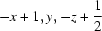
 ; (iv)
 Data collection: X-AREA (Stoe & Cie, 2006); cell refinement: X-AREA; data reduction: X-AREA; program(s) used to solve structure: SHELXS97 (Sheldrick, 2008); program(s) used to refine structure: SHELXL97 (Sheldrick, 2008); molecular graphics: DRAWXTL (Finger et al., 2007); software used to prepare material for publication: PLATON (Spek, 2003).
Supporting information
contains datablocks global, I. DOI: 10.1107/S1600536808014359/mg2051sup1.cif
Structure factors: contains datablock I. DOI: 10.1107/S1600536808014359/mg2051Isup2.hkl
Colourless single crystals of [EuBr2(H2O)6]Br were obtained by recrystallizing the commercially available product ("EuBr3.X H2O", Alfa Aesar, 99.99%) under argon from degassed aqueous HBr solution by slow cooling of a solution saturated at ca 60 °C to room temperature.
The positions of all hydrogen atoms were identified from the difference Fourier map, close to their ideal positions. Their was performed applying a DFIX command (Sheldrick, 2008), restricting the O—H bond lengths to 0.82 ± 0.02 Å.
Data collection: X-AREA (Stoe & Cie, 2006); cell X-AREA (Stoe & Cie, 2006); data reduction: X-AREA (Stoe & Cie, 2006); program(s) used to solve structure: SHELXS97 (Sheldrick, 2008); program(s) used to refine structure: SHELXL97 (Sheldrick, 2008); molecular graphics: DRAWXTL (Finger et al., 2007); software used to prepare material for publication: PLATON (Spek, 2003).
![[Figure 1]](./mg2051fig1thm.gif) | Fig. 1. View of the cationic [Eu(H2O)6Br2]+ unit in [Eu(H2O)6Br2]Br, with displacement ellipsoids drawn at the 90% propability level. H atoms are shown as black spheres of arbitrary radii. [Symmetry code: (i) -x, y, 1/2 - z.] |
![[Figure 2]](./mg2051fig2thm.gif) | Fig. 2. View of the H—Br contacts in [Eu(H2O)6Br(2)2]Br(1), left: four hydrogen bonds link Br1 to water molecules, right: six hydrogen bonds link Br2 to water molecules. All displacement ellipsoids are drawn at the 90% propability level. [Symmetry codes: (i) -x, y, 1/2 - z; (ii) -x, -y, -z; (iii) x, -y, 1/2 + z.] |
![[Figure 3]](./mg2051fig3thm.gif) | Fig. 3. View along (010) on the crystal structure of [Eu(H2O)6Br2]Br. Small black spheres represent H atoms, large black spheres represent Eu atoms, grey spheres represent Br atoms, light grey spheres represent O atoms. Grey polyhedra represent the coordination of H atoms around Br atoms. |
| [EuBr2(H2O)6]Br | F(000) = 456 |
| Mr = 499.79 | Dx = 3.006 Mg m−3 |
| Monoclinic, P2/c | Mo Kα radiation, λ = 0.71073 Å |
| Hall symbol: -P 2yc | Cell parameters from 10367 reflections |
| a = 8.1672 (7) Å | θ = 3.0–32.1° |
| b = 6.7538 (4) Å | µ = 16.52 mm−1 |
| c = 12.5451 (10) Å | T = 293 K |
| β = 127.077 (5)° | Irregular polyhedron, clear colourless |
| V = 552.08 (8) Å3 | 0.25 × 0.24 × 0.18 mm |
| Z = 2 |
| Stoe IPDSII diffractometer | 1613 independent reflections |
| Radiation source: fine-focus sealed tube | 1397 reflections with I > 2s(I) |
| Graphite monochromator | Rint = 0.067 |
| ω scans (in two runs with ϕ1 = 0° and ϕ2 = 90°) | θmax = 30.0°, θmin = 3.0° |
| Absorption correction: numerical [X-RED (Stoe & Cie, 2001) and X-SHAPE (Stoe & Cie, 1999)] | h = −11→11 |
| Tmin = 0.065, Tmax = 0.155 | k = −9→9 |
| 10921 measured reflections | l = −17→17 |
| Refinement on F2 | Secondary atom site location: difference Fourier map |
| Least-squares matrix: full | Hydrogen site location: difference Fourier map |
| R[F2 > 2σ(F2)] = 0.028 | All H-atom parameters refined |
| wR(F2) = 0.049 | w = 1/[σ2(Fo2) + (0.0169P)2] where P = (Fo2 + 2Fc2)/3 |
| S = 1.11 | (Δ/σ)max < 0.001 |
| 1613 reflections | Δρmax = 1.14 e Å−3 |
| 72 parameters | Δρmin = −1.10 e Å−3 |
| 0 restraints | Extinction correction: SHELXL97 (Sheldrick, 2008), Fc*=kFc[1+0.001xFc2λ3/sin(2θ)]-1/4 |
| Primary atom site location: structure-invariant direct methods | Extinction coefficient: 0.0409 (10) |
| [EuBr2(H2O)6]Br | V = 552.08 (8) Å3 |
| Mr = 499.79 | Z = 2 |
| Monoclinic, P2/c | Mo Kα radiation |
| a = 8.1672 (7) Å | µ = 16.52 mm−1 |
| b = 6.7538 (4) Å | T = 293 K |
| c = 12.5451 (10) Å | 0.25 × 0.24 × 0.18 mm |
| β = 127.077 (5)° |
| Stoe IPDSII diffractometer | 1613 independent reflections |
| Absorption correction: numerical [X-RED (Stoe & Cie, 2001) and X-SHAPE (Stoe & Cie, 1999)] | 1397 reflections with I > 2s(I) |
| Tmin = 0.065, Tmax = 0.155 | Rint = 0.067 |
| 10921 measured reflections |
| R[F2 > 2σ(F2)] = 0.028 | 0 restraints |
| wR(F2) = 0.049 | All H-atom parameters refined |
| S = 1.11 | Δρmax = 1.14 e Å−3 |
| 1613 reflections | Δρmin = −1.10 e Å−3 |
| 72 parameters |
Experimental. The title compoud is a commercially available chemical (Alfa Aesar) and was recrystallized under argon from degassed aqueous HBr solution. A suitable single-crystal was sealed with mother liquor in a thin-walled glass capillary. |
Geometry. All e.s.d.'s (except the e.s.d. in the dihedral angle between two l.s. planes) are estimated using the full covariance matrix. The cell e.s.d.'s are taken into account individually in the estimation of e.s.d.'s in distances, angles and torsion angles; correlations between e.s.d.'s in cell parameters are only used when they are defined by crystal symmetry. An approximate (isotropic) treatment of cell e.s.d.'s is used for estimating e.s.d.'s involving l.s. planes. |
Refinement. Refinement of F2 against ALL reflections. The weighted R-factor wR and goodness of fit S are based on F2, conventional R-factors R are based on F, with F set to zero for negative F2. The threshold expression of F2 > σ(F2) is used only for calculating R-factors(gt) etc. and is not relevant to the choice of reflections for refinement. R-factors based on F2 are statistically about twice as large as those based on F, and R- factors based on ALL data will be even larger. |
| x | y | z | Uiso*/Ueq | ||
| Eu1 | 0.50000 | 0.16454 (4) | 0.25000 | 0.0170 (1) | |
| Br1 | 0.70613 (6) | −0.15845 (7) | 0.44669 (4) | 0.0295 (1) | |
| Br2 | 0.00000 | 0.63151 (9) | 0.25000 | 0.0318 (2) | |
| O1 | 0.1772 (5) | 0.3097 (5) | 0.0676 (3) | 0.0320 (7) | |
| O2 | 0.2413 (5) | 0.0620 (5) | 0.2757 (4) | 0.0313 (7) | |
| O3 | 0.4434 (5) | 0.4262 (5) | 0.3524 (4) | 0.0335 (7) | |
| H11 | 0.148 (11) | 0.336 (10) | −0.006 (4) | 0.06 (2)* | |
| H12 | 0.072 (9) | 0.258 (14) | 0.050 (10) | 0.10 (3)* | |
| H21 | 0.253 (12) | 0.098 (11) | 0.342 (5) | 0.07 (2)* | |
| H22 | 0.183 (11) | −0.046 (6) | 0.253 (9) | 0.09 (3)* | |
| H31 | 0.518 (10) | 0.526 (7) | 0.376 (8) | 0.08 (2)* | |
| H32 | 0.321 (5) | 0.456 (12) | 0.315 (8) | 0.09 (3)* |
| U11 | U22 | U33 | U12 | U13 | U23 | |
| Eu1 | 0.0168 (1) | 0.0180 (1) | 0.0172 (1) | 0.000 | 0.0109 (1) | 0.000 |
| Br1 | 0.0295 (2) | 0.0293 (2) | 0.0266 (3) | 0.0027 (2) | 0.0152 (2) | 0.0066 (2) |
| Br2 | 0.0294 (3) | 0.0360 (3) | 0.0327 (4) | 0.000 | 0.0202 (3) | 0.000 |
| O1 | 0.0233 (13) | 0.0385 (17) | 0.0256 (18) | 0.0036 (12) | 0.0102 (13) | 0.0084 (14) |
| O2 | 0.0316 (15) | 0.0367 (17) | 0.0355 (19) | −0.0076 (13) | 0.0254 (15) | −0.0055 (14) |
| O3 | 0.0308 (15) | 0.0302 (15) | 0.042 (2) | −0.0035 (13) | 0.0229 (16) | −0.0106 (14) |
| Eu1—Br1 | 2.9449 (5) | Eu1—O3i | 2.388 (3) |
| Eu1—Br1i | 2.9449 (5) | O1—H11 | 0.82 (2) |
| Eu1—O1 | 2.424 (3) | O1—H12 | 0.83 (2) |
| Eu1—O1i | 2.424 (3) | O2—H21 | 0.82 (2) |
| Eu1—O2 | 2.422 (3) | O2—H22 | 0.82 (2) |
| Eu1—O2i | 2.422 (3) | O3—H31 | 0.83 (2) |
| Eu1—O3 | 2.388 (3) | O3—H32 | 0.83 (2) |
| Br1—Eu1—O1 | 146.89 (8) | O1—Eu1—O2 | 72.6 (1) |
| Br1i—Eu1—O1i | 146.89 (8) | O1i—Eu1—O2i | 72.6 (1) |
| Br1—Eu1—O1i | 76.21 (9) | O1—Eu1—O2i | 122.0 (1) |
| Br1i—Eu1—O1 | 76.21 (9) | O1i—Eu1—O2 | 122.0 (1) |
| Br1—Eu1—O2 | 77.33 (8) | O1—Eu1—O3 | 75.8 (1) |
| Br1i—Eu1—O2i | 77.33 (8) | O1i—Eu1—O3i | 75.8 (1) |
| Br1—Eu1—O2i | 78.22 (8) | O1—Eu1—O3i | 69.3 (1) |
| Br1i—Eu1—O2 | 78.22 (8) | O1i—Eu1—O3 | 69.3 (1) |
| Br1—Eu1—O3 | 107.21 (9) | O2—Eu1—O3 | 70.9 (1) |
| Br1i—Eu1—O3i | 107.21 (9) | O2i—Eu1—O3i | 70.9 (1) |
| Br1—Eu1—O3i | 143.18 (8) | O2—Eu1—O3i | 138.6 (1) |
| Br1i—Eu1—O3 | 143.18 (8) | O2i—Eu1—O3 | 138.6 (1) |
| Br1—Eu1—Br1i | 84.41 (2) | H11—O1—H12 | 104 (8) |
| O1—Eu1—O1i | 132.3 (2) | H21—O2—H22 | 107 (8) |
| O2—Eu1—O2i | 146.8 (2) | H31—O3—H32 | 112 (8) |
| O3—Eu1—O3i | 84.5 (2) |
| Symmetry code: (i) −x+1, y, −z+1/2. |
| D—H···A | D—H | H···A | D···A | D—H···A |
| O1—H11···Br2ii | 0.83 (2) | 2.53 (8) | 3.343 (4) | 168 (6) |
| O1—H12···Br1iii | 0.83 (2) | 2.52 (13) | 3.333 (4) | 165 (6) |
| O2—H21···Br1iv | 0.82 (2) | 2.49 (10) | 3.307 (4) | 172 (6) |
| O2—H22···Br2v | 0.83 (2) | 2.63 (11) | 3.417 (4) | 161 (6) |
| O3—H31···Br1vi | 0.83 (2) | 2.46 (8) | 3.288 (4) | 173 (6) |
| O3—H32···Br2 | 0.83 (2) | 2.52 (11) | 3.328 (5) | 163 (6) |
| Symmetry codes: (ii) −x, −y+1, −z; (iii) x−1, −y, z−1/2; (iv) −x+1, −y, −z+1; (v) x, y−1, z; (vi) x, y+1, z. |
Experimental details
| Crystal data | |
| Chemical formula | [EuBr2(H2O)6]Br |
| Mr | 499.79 |
| Crystal system, space group | Monoclinic, P2/c |
| Temperature (K) | 293 |
| a, b, c (Å) | 8.1672 (7), 6.7538 (4), 12.5451 (10) |
| β (°) | 127.077 (5) |
| V (Å3) | 552.08 (8) |
| Z | 2 |
| Radiation type | Mo Kα |
| µ (mm−1) | 16.52 |
| Crystal size (mm) | 0.25 × 0.24 × 0.18 |
| Data collection | |
| Diffractometer | Stoe IPDSII diffractometer |
| Absorption correction | Numerical [X-RED (Stoe & Cie, 2001) and X-SHAPE (Stoe & Cie, 1999)] |
| Tmin, Tmax | 0.065, 0.155 |
| No. of measured, independent and observed [I > 2s(I)] reflections | 10921, 1613, 1397 |
| Rint | 0.067 |
| (sin θ/λ)max (Å−1) | 0.703 |
| Refinement | |
| R[F2 > 2σ(F2)], wR(F2), S | 0.028, 0.049, 1.11 |
| No. of reflections | 1613 |
| No. of parameters | 72 |
| H-atom treatment | All H-atom parameters refined |
| Δρmax, Δρmin (e Å−3) | 1.14, −1.10 |
Computer programs: X-AREA (Stoe & Cie, 2006), SHELXS97 (Sheldrick, 2008), SHELXL97 (Sheldrick, 2008), DRAWXTL (Finger et al., 2007), PLATON (Spek, 2003).
| Eu1—Br1 | 2.9449 (5) | Eu1—O3i | 2.388 (3) |
| Eu1—Br1i | 2.9449 (5) | O1—H11 | 0.82 (2) |
| Eu1—O1 | 2.424 (3) | O1—H12 | 0.83 (2) |
| Eu1—O1i | 2.424 (3) | O2—H21 | 0.82 (2) |
| Eu1—O2 | 2.422 (3) | O2—H22 | 0.82 (2) |
| Eu1—O2i | 2.422 (3) | O3—H31 | 0.83 (2) |
| Eu1—O3 | 2.388 (3) | O3—H32 | 0.83 (2) |
| Br1—Eu1—O1 | 146.89 (8) | O1—Eu1—O2 | 72.6 (1) |
| Br1i—Eu1—O1i | 146.89 (8) | O1i—Eu1—O2i | 72.6 (1) |
| Br1—Eu1—O1i | 76.21 (9) | O1—Eu1—O2i | 122.0 (1) |
| Br1i—Eu1—O1 | 76.21 (9) | O1i—Eu1—O2 | 122.0 (1) |
| Br1—Eu1—O2 | 77.33 (8) | O1—Eu1—O3 | 75.8 (1) |
| Br1i—Eu1—O2i | 77.33 (8) | O1i—Eu1—O3i | 75.8 (1) |
| Br1—Eu1—O2i | 78.22 (8) | O1—Eu1—O3i | 69.3 (1) |
| Br1i—Eu1—O2 | 78.22 (8) | O1i—Eu1—O3 | 69.3 (1) |
| Br1—Eu1—O3 | 107.21 (9) | O2—Eu1—O3 | 70.9 (1) |
| Br1i—Eu1—O3i | 107.21 (9) | O2i—Eu1—O3i | 70.9 (1) |
| Br1—Eu1—O3i | 143.18 (8) | O2—Eu1—O3i | 138.6 (1) |
| Br1i—Eu1—O3 | 143.18 (8) | O2i—Eu1—O3 | 138.6 (1) |
| Br1—Eu1—Br1i | 84.41 (2) | H11—O1—H12 | 104 (8) |
| O1—Eu1—O1i | 132.3 (2) | H21—O2—H22 | 107 (8) |
| O2—Eu1—O2i | 146.8 (2) | H31—O3—H32 | 112 (8) |
| O3—Eu1—O3i | 84.5 (2) |
| Symmetry code: (i) −x+1, y, −z+1/2. |
| D—H···A | D—H | H···A | D···A | D—H···A |
| O1—H11···Br2ii | 0.83 (2) | 2.53 (8) | 3.343 (4) | 168 (6) |
| O1—H12···Br1iii | 0.83 (2) | 2.52 (13) | 3.333 (4) | 165 (6) |
| O2—H21···Br1iv | 0.82 (2) | 2.49 (10) | 3.307 (4) | 172 (6) |
| O2—H22···Br2v | 0.83 (2) | 2.63 (11) | 3.417 (4) | 161 (6) |
| O3—H31···Br1vi | 0.83 (2) | 2.46 (8) | 3.288 (4) | 173 (6) |
| O3—H32···Br2 | 0.83 (2) | 2.52 (11) | 3.328 (5) | 163 (6) |
| Symmetry codes: (ii) −x, −y+1, −z; (iii) x−1, −y, z−1/2; (iv) −x+1, −y, −z+1; (v) x, y−1, z; (vi) x, y+1, z. |
References
 Bärnighausen, H., Brauer, G. & Schultz, N. (1965). Z. Anorg. Allg. Chem. 338, 250–265. Google Scholar
Bell, A. M. T. & Smith, A. J. (1990). Acta Cryst. C46, 960–962. CrossRef CAS Web of Science IUCr Journals Google Scholar
Burns, J. H. & Peterson, J. R. (1971). Inorg. Chem. 10, 147–151. CrossRef CAS Web of Science Google Scholar
Demyanets, L. N., Bukin, V. I., Emelyanova, E. N. & Ivanov, V. I. (1974). Sov. Phys. Cystallogr. 18, 806–808. Google Scholar
Duhlev, R., Brown, I. D. & Faggiani, R. (1988). Acta Cryst. C44, 1693–1696. CrossRef CAS Web of Science IUCr Journals Google Scholar
Finger, L. W., Kroeker, M. & Toby, B. H. (2007). J. Appl. Cryst. 40, 188–192. Web of Science CrossRef CAS IUCr Journals Google Scholar
Graeber, E. J., Conrad, G. H. & Duliere, S. F. (1966). Acta Cryst. 21, 1012–1013. CrossRef CAS IUCr Journals Web of Science Google Scholar
Habenschuss, A. & Spedding, F. H. (1980). Cryst. Struct. Commun. 9, 71–75. CAS Google Scholar
Junk, P. C., Semenova, L. I., Skelton, B. W. & White, A. H. (1999). Austr. J. Chem. 52, 531–538. CAS Google Scholar
Kolitsch, U. (2006). Acta Cryst. E62, i122–i123. Web of Science CrossRef IUCr Journals Google Scholar
Marezio, M., Plettinger, H. A. & Zachariasen, W. H. (1961). Acta Cryst. 14, 234–236. CrossRef CAS IUCr Journals Web of Science Google Scholar
Reuter, G., Fink, H. & Seifert, H. J. (1994). Z. Anorg. Allg. Chem. 620, 665–671. CrossRef CAS Web of Science Google Scholar
Sheldrick, G. M. (2008). Acta Cryst. A64, 112–122. Web of Science CrossRef CAS IUCr Journals Google Scholar
Spek, A. L. (2003). J. Appl. Cryst. 36, 7–13. Web of Science CrossRef CAS IUCr Journals Google Scholar
Stoe & Cie (1999). X-SHAPE. Stoe & Cie GmbH, Darmstadt, Germany. Google Scholar
Stoe & Cie (2001). X-RED. Stoe & Cie GmbH, Darmstadt, Germany. Google Scholar
Stoe & Cie (2006). X-AREA. Stoe & Cie GmbH, Darmstadt, Germany. Google Scholar
Tegenfeldt, J., Tellgren, R., Pedersen, B. & Olovsson, I. (1979). Acta Cryst. B35, 1679–1682. CrossRef CAS IUCr Journals Web of Science Google Scholar
Wickleder, M. S. & Meyer, G. (1995). Z. Anorg. Allg. Chem. 621, 457–463. CrossRef CAS Web of Science Google Scholar
This is an open-access article distributed under the terms of the Creative Commons Attribution (CC-BY) Licence, which permits unrestricted use, distribution, and reproduction in any medium, provided the original authors and source are cited.
| CRYSTALLOGRAPHIC COMMUNICATIONS |


[EuBr2(H2O)6]Br crystallizes in the monoclinic space group P2/c (No. 13) and is isotypic with the GdCl3.6H2O structure type (Marezio et al., 1961), like many chloride hexahydrates MCl3.6H2O with M = Y (Bell & Smith, 1990), Ce (Reuter et al., 1994), Nd (Habenschuss & Spedding, 1980), Sm - Tm (Graeber et al., 1966), Am, Bk (Burns & Peterson, 1971), and two bromide hexahydrates MBr3.6H2O (M = Pr, Dy, Junk et al., 1999).
The Eu atoms in [EuBr2(H2O)6]Br are coordinated by six water molecules and two bromine atoms forming a distorted square antiprism (Fig. 1). Hydrogen bonds H—Br connect the [EuBr2(H2O)6]+ cations with the Br- counter-anions to a network. The bromine atom Br1 belonging to the cationic complex is surrounded by four, the isolated bromine atom Br2 by six hydrogen bonds (Fig. 2). A view of the unit cell of [EuBr2(H2O)6]Br is given in Fig. 3.
The H—Br distances (2.46–2.63 Å) are in good agreement with those in other bromide hydrates (e.g. 2.38–2.54 Å in [Sc(H2O)5(OH)]Br2, Kolitsch, 2006; 2.32–2.80 Å in [Ca(H2O)6]2[CdBr6], Duhlev et al., 1988; 2.40–2.83 A in NaBr.2H2O, Tegenfeldt et al., 1979). The EuIII—O distances in [EuBr2(H2O)6]Br range from 2.39 to 2.42 Å and thus are very similar to those in EuCl3.3H2O (2.39–2.40 Å, Reuter et al., 1994), EuCl3.6H2O (2.39–2.43 Å, Graeber et al., 1966), or EuCl(OH)2 (2.35–2.44 Å, Demyanets et al., 1974). The same holds for the EuIII—Br distances in [EuBr2(H2O)6]Br (2.94 Å) which lie between those in Na3EuBr6 (2.83 Å, Wickleder & Meyer, 1995) and those in EuOBr (3.19 Å, Bärnighausen et al., 1965).